#termmax "Batch auction for efficiency, fairness, and permissionlessness" is a phrase from TermMax's own materials on their secondary market that I don't think gets explained enough.
🔍 Here's what it actually means compared to a normal DEX.
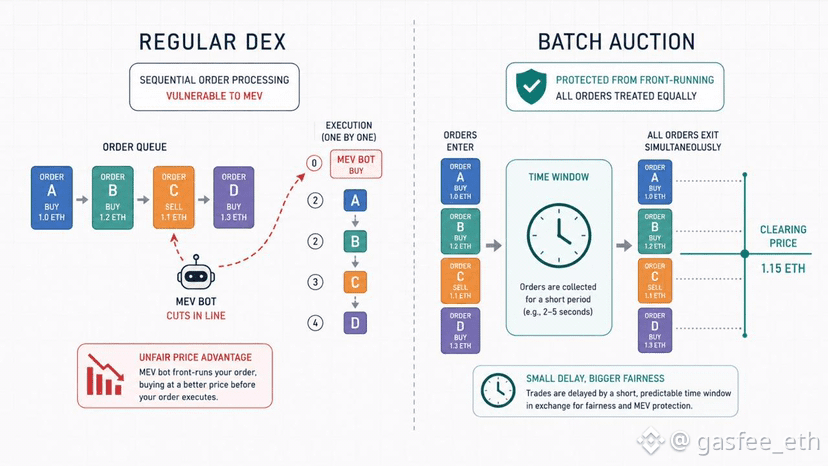
A typical DEX order book or AMM processes trades continuously, one at a time, in the order they arrive — meaning whoever's transaction lands first (often decided by who pays more gas) gets the better price, and MEV bots specifically exist to exploit that ordering. ⚡🤖 A batch auction instead collects orders over a window, then clears them all at a single uniform price at the end of that window. 📦
The practical difference: in a batch auction, being first in line within the batch doesn't get you a better price than being last — everyone in the same batch settles at the same clearing price. That structurally removes the front-running incentive that makes continuous order books such fertile ground for MEV extraction. 🛡️
Trade-off worth naming: batch auctions add latency — you're waiting for the batch window to close instead of getting instant execution — so this is optimizing for fairness over speed, a real trade-off, not a free upgrade. ⏱️
Would you accept a short delay for guaranteed uniform pricing, or do you value instant execution enough to accept the front-running risk that comes with it?
🤔 Has anyone noticed the batch window length in practice — does it feel fast enough for a fixed-rate market specifically?
@TermMax #TermMax
🔍 Here's what it actually means compared to a normal DEX.
A typical DEX order book or AMM processes trades continuously, one at a time, in the order they arrive — meaning whoever's transaction lands first (often decided by who pays more gas) gets the better price, and MEV bots specifically exist to exploit that ordering. ⚡🤖 A batch auction instead collects orders over a window, then clears them all at a single uniform price at the end of that window. 📦
The practical difference: in a batch auction, being first in line within the batch doesn't get you a better price than being last — everyone in the same batch settles at the same clearing price. That structurally removes the front-running incentive that makes continuous order books such fertile ground for MEV extraction. 🛡️
Trade-off worth naming: batch auctions add latency — you're waiting for the batch window to close instead of getting instant execution — so this is optimizing for fairness over speed, a real trade-off, not a free upgrade. ⏱️
Would you accept a short delay for guaranteed uniform pricing, or do you value instant execution enough to accept the front-running risk that comes with it?
🤔 Has anyone noticed the batch window length in practice — does it feel fast enough for a fixed-rate market specifically?
@TermMax #TermMax