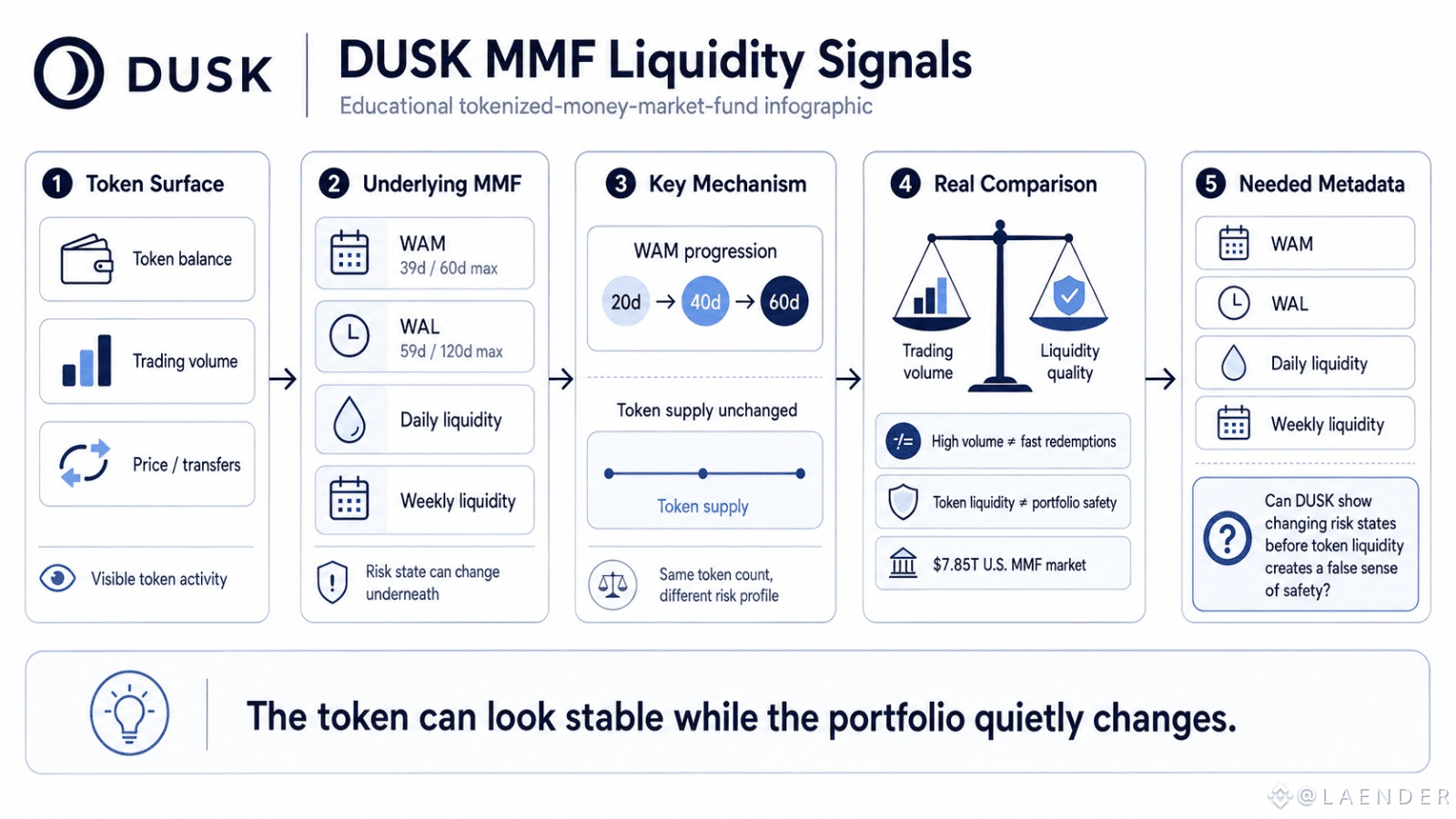
In my review of MMF liquidity metrics with token trading activity, I noticed something easy to miss: the token balance can stay flat while the portfolio underneath quietly becomes riskier.
A prime MMF might sit around a 39-day WAM against a 60-day limit, with WAL near 59 days against a 120-day ceiling. If WAM moves from 20 to 40 to 60 days, DUSK token supply does not need to change at all. The risk state does.
That is why I think liquidity quality vs trading volume is the better comparison here.
For DUSK a heavily traded MMF token could still represent a portfolio moving closer to its duration or liquidity constraints. High secondary volume says users can trade the token. It says much less about how quickly the underlying fund can meet redemptions.
This matters in a market holding roughly $7.85T in U.S. MMF assets. Cash-like tokenization has a different pressure profile from ordinary bond tokenization.
What I would want from DUSK is compact on-chain risk metadata: WAM, WAL, daily liquidity and weekly liquidity, without exposing every portfolio position.
The uncomfortable question is whether DUSK can make those changing risk states visible before token liquidity gives users a false sense of safety.
@Dusk #dusk $DUSK