#dusk $DUSK @Dusk
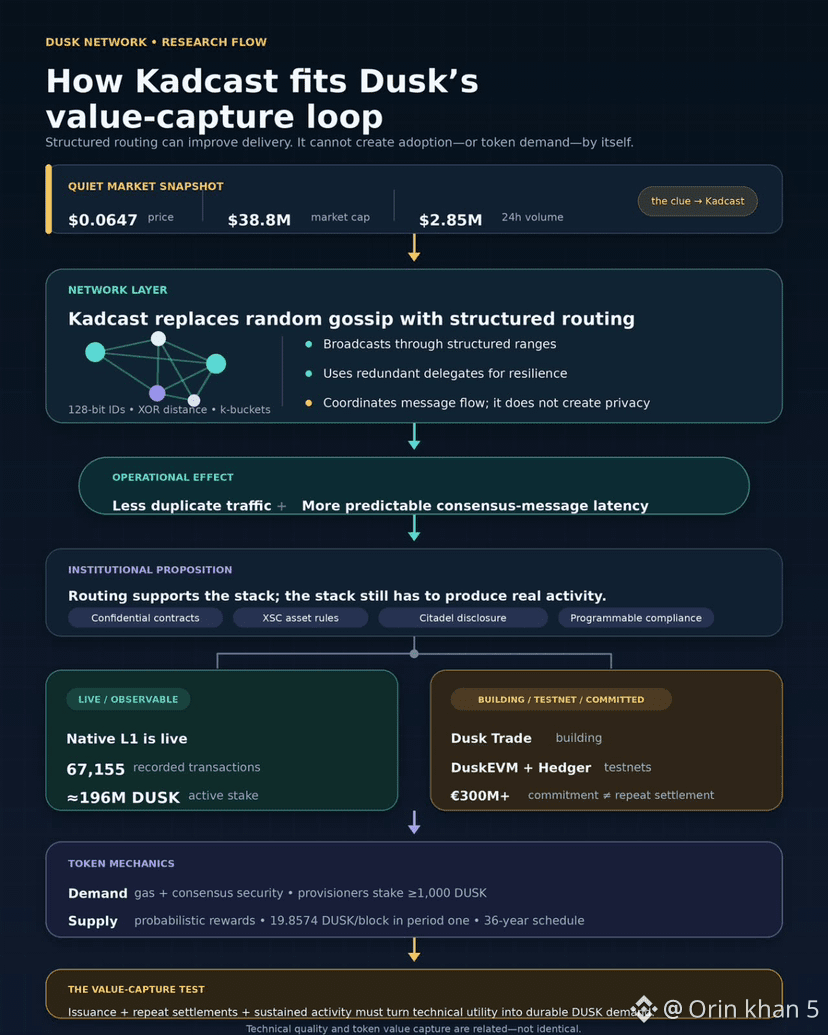
Late last night I found DUSK near $0.0647, with a $38.8 million market cap and $2.85 million in 24-hour volume. The market looked quiet; Kadcast was the detail that pulled me back into the documentation.
Unlike random gossip, Kadcast assigns 128-bit identifiers, organizes nodes into XOR-distance k-buckets, and broadcasts through structured ranges with redundant delegates. It does not create privacy; it aims to reduce duplicate traffic and make consensus-message latency more predictable.
That supports Dusk’s larger proposition: regulated activity through confidential smart contracts, XSC asset rules, Citadel selective disclosure, and programmable compliance. Yet the live L1 has recorded 67,155 transactions and roughly 196 million DUSK in active stake. Dusk Trade is building; DuskEVM and Hedger remain testnets. The advertised €300M-plus issuance is a commitment, not visible repeat settlement.
DUSK pays gas and secures consensus. Provisioners stake at least 1,000, stay online, and earn probabilistic emissions plus fees. Legacy allocations are listed fully vested, but the 36-year reward schedule still emits 19.8574 DUSK per block in its first four-year period, leaving ongoing supply pressure.
I come back to the value-capture tension. Issuers may use Dusk’s routing, privacy, and compliance stack while holding little DUSK beyond operating needs; holders absorb emissions, execution risk, and adoption time. Technical quality and token value capture are related, not identical. Can verifiable issuance, repeat settlement volume, and sustained activity close the gap between roadmap and usage?