continuing from the previous discussion on $DUSK Trade.
Part 2
6. Settlement
The final step is settlement.
This is where the transaction becomes more than a trading intention.
The relevant asset and payment movements need to be completed according to the rules governing the transaction.
By integrating trading and settlement workflows, the application layer can help turn an on-chain transaction into something closer to a complete financial-market process.
The Importance of Eligibility and Disclosure
One of the most interesting aspects of Dusk Trade is that it is designed around the requirements of regulated markets.
In traditional finance, not every financial product is available to every investor.
There can be restrictions based on jurisdiction, investor status, asset type, or other regulatory requirements.
Information can also matter just as much as the transaction itself.
Investors may need access to disclosures and other relevant information before participating.
This means a tokenized financial market needs to answer questions such as:
Who can buy this asset?
What information should the investor receive?
Who is authorized to access certain information?
Under what conditions can the asset be transferred?
Dusk Trade's application-layer approach is intended to make these considerations part of the workflow rather than treating them as something separate from blockchain activity.
Dusk Trade and the Dusk Ecosystem
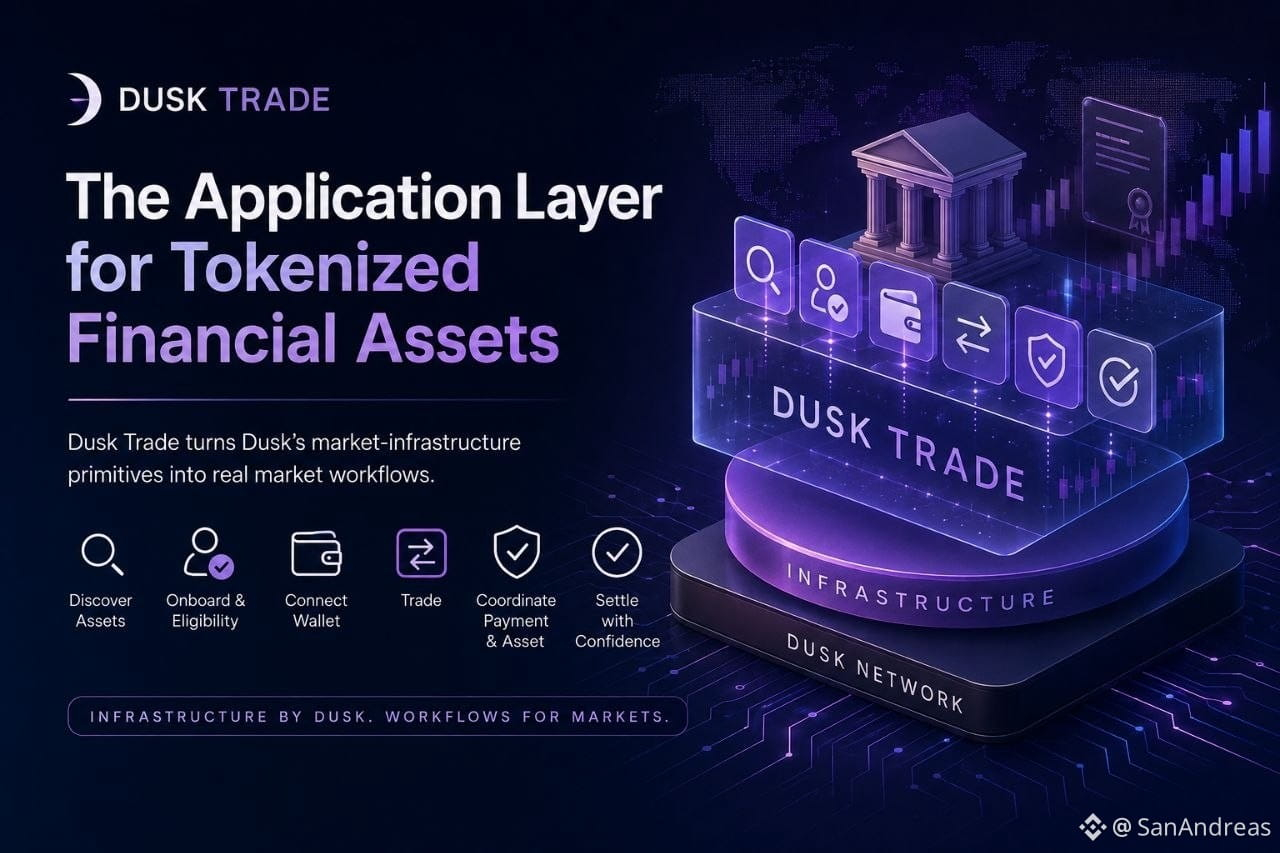
It is useful to distinguish between the base protocol and the application layer.
The Dusk network provides the underlying infrastructure and market-oriented primitives.
Dusk Trade operates above that infrastructure.
A simple way to visualize the relationship is:
Dusk Network → Market Infrastructure → Dusk Trade → Users & Market Participants
The base layer provides the foundation.
The application layer turns that foundation into experiences that issuers, investors, venues, and other authorized participants can actually use.
@Dusk #dusk
Part 2
6. Settlement
The final step is settlement.
This is where the transaction becomes more than a trading intention.
The relevant asset and payment movements need to be completed according to the rules governing the transaction.
By integrating trading and settlement workflows, the application layer can help turn an on-chain transaction into something closer to a complete financial-market process.
The Importance of Eligibility and Disclosure
One of the most interesting aspects of Dusk Trade is that it is designed around the requirements of regulated markets.
In traditional finance, not every financial product is available to every investor.
There can be restrictions based on jurisdiction, investor status, asset type, or other regulatory requirements.
Information can also matter just as much as the transaction itself.
Investors may need access to disclosures and other relevant information before participating.
This means a tokenized financial market needs to answer questions such as:
Who can buy this asset?
What information should the investor receive?
Who is authorized to access certain information?
Under what conditions can the asset be transferred?
Dusk Trade's application-layer approach is intended to make these considerations part of the workflow rather than treating them as something separate from blockchain activity.
Dusk Trade and the Dusk Ecosystem
It is useful to distinguish between the base protocol and the application layer.
The Dusk network provides the underlying infrastructure and market-oriented primitives.
Dusk Trade operates above that infrastructure.
A simple way to visualize the relationship is:
Dusk Network → Market Infrastructure → Dusk Trade → Users & Market Participants
The base layer provides the foundation.
The application layer turns that foundation into experiences that issuers, investors, venues, and other authorized participants can actually use.
@Dusk #dusk