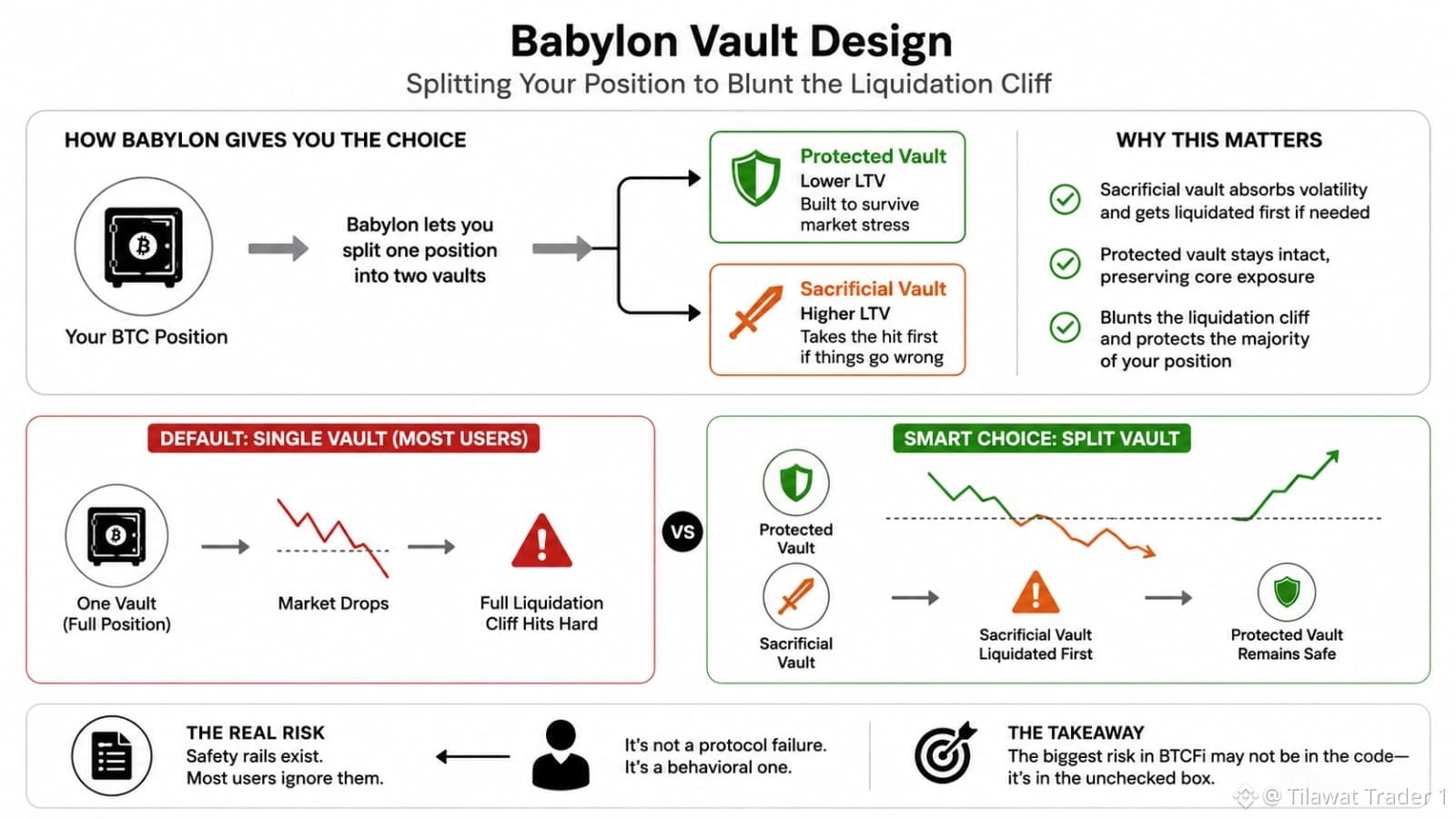
I keep coming back to a detail in Babylon's vault design that most people skip past: the protocol explicitly gives you the option to split a position into a sacrificial vault and a protected one, specifically to blunt the cliff effect in liquidations. Almost nobody uses it.
That's the part worth sitting with. A BTCFi protocol is only as trustworthy as the choices its users actually make inside it, not the choices its documentation assumes they'll make. Babylon isn't hiding the safer path. It's offering it and watching most capital walk past it toward the simpler, riskier default. That tells you something about how BTC holders price convenience against protection when the asset in motion is the one they've held the longest and trust the most.
The honest weakness is that this isn't a protocol failure, it's a behavioral one, and no smart contract fixes a habit of taking shortcuts with size on the line.
I don't think the market has fully priced how much of BTCFi's real risk sits in these unused safety rails rather than in the code itself.
"The riskiest line in any protocol is the one users decide not to read twice."
@BabylonLabs_io #baby $BABY $GIGGLE $KOMA