


The Middle East is in the middle of a once-in-a-generation economic transformation. Saudi Arabia’s Vision 2030, the UAE’s aggressive Web3 regulatory framework, Bahrain’s digital finance push — these aren’t experiments. They are declarations that this region intends to own a significant piece of the next global digital economy.
But there’s a foundational question every ambitious digital economy must answer first: How do you establish trust at scale, across borders, without surrendering sovereignty to a foreign intermediary?
@SignOfficial and $SIGN exist precisely to answer that question.
🔷 What Is Sign Protocol?
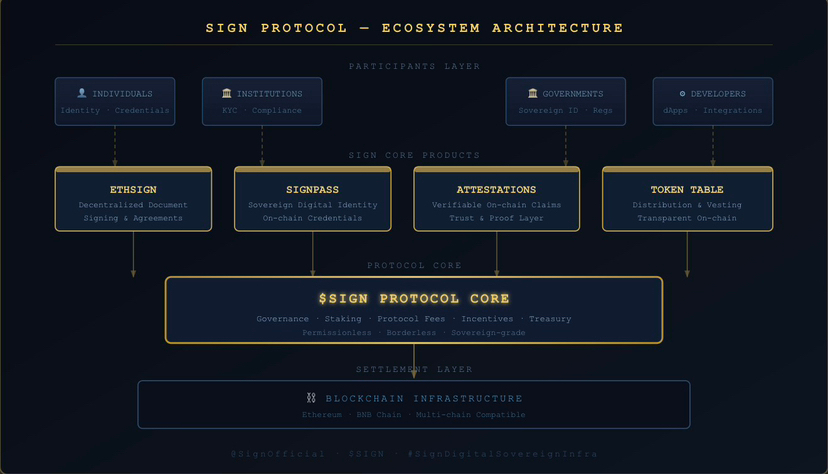
Sign is a decentralized attestation and digital identity protocol — the trust and verification layer for the on-chain economy. Where traditional systems rely on centralised databases, paper documents, and third-party authorities, Sign enables:
EthSign — blockchain-backed document signing with immutable proof of agreement
SignPass — sovereign digital identity, portable across Web3 ecosystems
On-chain Attestations — verifiable, tamper-proof claims about identity, credentials, and compliance
TokenTable — transparent, on-chain token distribution and vesting infrastructure
Together, these products form something the market has never had before: a complete sovereign digital infrastructure stack — from identity verification to contract execution to token distribution — all on-chain, all permissionless, all borderless.
(See Diagram 1: Sign Ecosystem Architecture)
🔷 Why the Middle East Is the Perfect Market for $SIGN
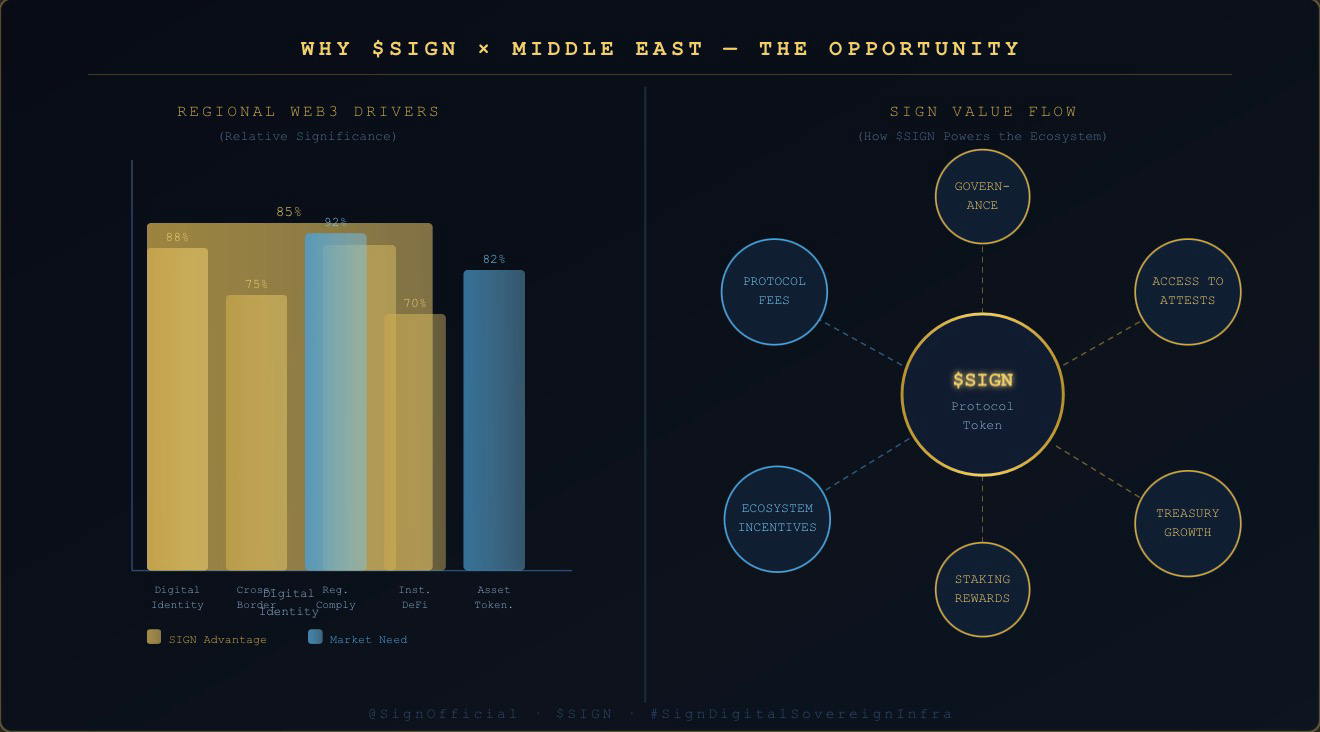
The alignment between Sign’s capabilities and the Middle East’s needs is not coincidental — it is structural. Five major forces converge here:
1. Regulatory Clarity Is Creating Demand for Verifiable Compliance
The UAE, Saudi Arabia, and Bahrain are building some of the world’s most sophisticated digital asset regulatory frameworks. As these frameworks mature, the ability to prove identity, KYC status, and transaction compliance on-chain becomes a legal requirement, not a feature. Sign’s attestation layer is the infrastructure that makes on-chain compliance possible.
2. Cross-Border Commerce Needs Neutral Trust Rails
The GCC sits at the intersection of three continents. Cross-border digital commerce between the Middle East, Africa, Asia, and Europe requires trust infrastructure that no single government controls. Sign’s permissionless, decentralized design is purpose-built for exactly this role.
3. Sovereign Digital Identity Is a National Priority
Every major Gulf nation is investing in national digital identity programs. Sign’s architecture enables these initiatives to interoperate with global Web3 ecosystems — bridging traditional government ID systems with DeFi, tokenized assets, and decentralized applications.
4. Institutional DeFi Demands Verified Participants
As institutional capital moves on-chain, KYC and AML compliance become non-negotiable. Sign provides the privacy-preserving attestation layer that allows institutions to participate in DeFi with verified credentials — without exposing sensitive data to public ledgers.
5. Tokenization of Real-World Assets Is Accelerating
The Middle East holds trillions of dollars in real-world assets — real estate, commodities, sovereign wealth. As these assets move on-chain, the need for verified ownership, signed agreements, and transparent distribution (via TokenTable) will be enormous.
(See Diagram 2: $SIGN Value Flow & Middle East Opportunity)
🔷 The $SIGN Token — Structural Value, Not Speculation
$SIGN is the native utility and governance token of the Sign ecosystem. Its value is tied directly to protocol usage:
Every document signed via EthSign generates protocol fees paid in $SIGN
Every identity attestation issued via SignPass drives token demand
Every TokenTable distribution uses the SIGN infrastructure
Governance rights over protocol upgrades and treasury are held by SIGN stakers
This is not a token waiting for a use case. The use cases are live, the infrastructure is deployed, and adoption in the Middle East represents one of the largest untapped growth vectors in the entire Web3 economy.
🔷 The Bottom Line
Sign is not building a product. It is building the digital sovereign infrastructure of the next era of global commerce — and the Middle East, with its ambition, its capital, and its regulatory momentum, is the region best positioned to benefit.
The nations that build on sovereign digital infrastructure now will lead the digital economy for decades.
@SignOfficial is building the rails. $SIGN is the fuel.