

#silver
silver
7.3M views
17,842 Discussing
Hot
Latest

·
--
🚨SILVER UNDER PRESSURE: CAN $54 HOLD OR IS $50 NEXT?
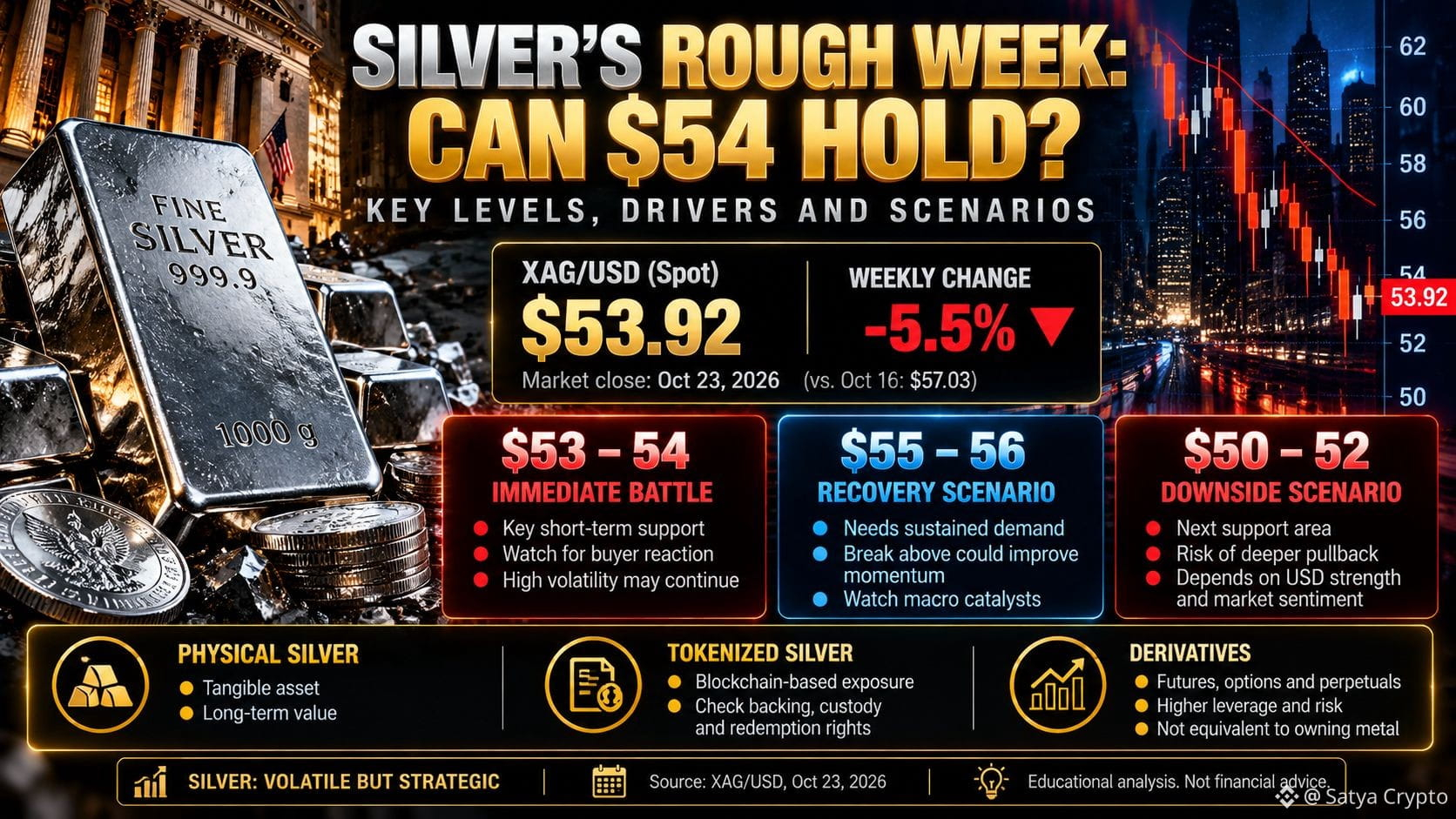
Silver (XAG/USD) ended October 23 near $53.92 per troy ounce, down approximately 5.5% for the week.
After trading above $58, the metal experienced a sharp selloff. Now traders are watching whether buyers can defend the $53–54 area.
THREE PRICE ZONES TO WATCH
$53–54: IMMEDIATE SUPPORT TEST
Friday's price action tested this region. Stabilization could signal easing selling pressure, but one rebound does not confirm a bottom.
$55–56: RECOVERY ZONE
A sustained move above this area would strengthen the case for a short-term recovery.
$50–52: DOWNSIDE SCENARIO
If $53 breaks decisively, traders may focus on lower psychological and technical levels.
WHY SILVER IS DIFFERENT
Silver combines precious-metal investment demand with industrial uses.
Its price reacts to:
• US dollar and Treasury yields.
• Federal Reserve expectations.
• Industrial demand.
• Investor positioning and liquidity.
THE RWA CONNECTION
PHYSICAL SILVER: Ownership of bullion, with storage and delivery considerations.
TOKENIZED SILVER: Blockchain-based claims whose backing, custody and redemption rights must be verified.
SILVER DERIVATIVES: Futures and perpetuals involving contract specifications, margin and potential liquidation risks.
These are NOT interchangeable instruments.
MY TAKE
The important question is not whether silver looks cheap after a weekly decline.
It is whether buyers can establish sustainable demand while macroeconomic conditions remain uncertain.
Watch price structure, market liquidity and the upcoming Fed decision.
Will silver defend $54, or will the market test lower levels first?
Source: XAG/USD historical prices.
Market snapshot: Oct 23, 2026.
Educational analysis. Not financial advice.
#Silver #XAGUSD #PreciousMetals #RWA #Macro
🚨SILVER UNDER PRESSURE: CAN $54 HOLD OR IS $50 NEXT?
Silver (XAG/USD) ended October 23 near $53.92 per troy ounce, down approximately 5.5% for the week.
After trading above $58, the metal experienced a sharp selloff. Now traders are watching whether buyers can defend the $53–54 area.
THREE PRICE ZONES TO WATCH
$53–54: IMMEDIATE SUPPORT TEST
Friday's price action tested this region. Stabilization could signal easing selling pressure, but one rebound does not confirm a bottom.
$55–56: RECOVERY ZONE
A sustained move above this area would strengthen the case for a short-term recovery.
$50–52: DOWNSIDE SCENARIO
If $53 breaks decisively, traders may focus on lower psychological and technical levels.
WHY SILVER IS DIFFERENT
Silver combines precious-metal investment demand with industrial uses.
Its price reacts to:
• US dollar and Treasury yields.
• Federal Reserve expectations.
• Industrial demand.
• Investor positioning and liquidity.
THE RWA CONNECTION
PHYSICAL SILVER: Ownership of bullion, with storage and delivery considerations.
TOKENIZED SILVER: Blockchain-based claims whose backing, custody and redemption rights must be verified.
SILVER DERIVATIVES: Futures and perpetuals involving contract specifications, margin and potential liquidation risks.
These are NOT interchangeable instruments.
MY TAKE
The important question is not whether silver looks cheap after a weekly decline.
It is whether buyers can establish sustainable demand while macroeconomic conditions remain uncertain.
Watch price structure, market liquidity and the upcoming Fed decision.
Will silver defend $54, or will the market test lower levels first?
Source: XAG/USD historical prices.
Market snapshot: Oct 23, 2026.
Educational analysis. Not financial advice.
#Silver #XAGUSD #PreciousMetals #RWA #Macro
Silver (XAG/USD) ended October 23 near $53.92 per troy ounce, down approximately 5.5% for the week.
After trading above $58, the metal experienced a sharp selloff. Now traders are watching whether buyers can defend the $53–54 area.
THREE PRICE ZONES TO WATCH
$53–54: IMMEDIATE SUPPORT TEST
Friday's price action tested this region. Stabilization could signal easing selling pressure, but one rebound does not confirm a bottom.
$55–56: RECOVERY ZONE
A sustained move above this area would strengthen the case for a short-term recovery.
$50–52: DOWNSIDE SCENARIO
If $53 breaks decisively, traders may focus on lower psychological and technical levels.
WHY SILVER IS DIFFERENT
Silver combines precious-metal investment demand with industrial uses.
Its price reacts to:
• US dollar and Treasury yields.
• Federal Reserve expectations.
• Industrial demand.
• Investor positioning and liquidity.
THE RWA CONNECTION
PHYSICAL SILVER: Ownership of bullion, with storage and delivery considerations.
TOKENIZED SILVER: Blockchain-based claims whose backing, custody and redemption rights must be verified.
SILVER DERIVATIVES: Futures and perpetuals involving contract specifications, margin and potential liquidation risks.
These are NOT interchangeable instruments.
MY TAKE
The important question is not whether silver looks cheap after a weekly decline.
It is whether buyers can establish sustainable demand while macroeconomic conditions remain uncertain.
Watch price structure, market liquidity and the upcoming Fed decision.
Will silver defend $54, or will the market test lower levels first?
Source: XAG/USD historical prices.
Market snapshot: Oct 23, 2026.
Educational analysis. Not financial advice.
#Silver #XAGUSD #PreciousMetals #RWA #Macro
1
253

·
--
Bullish
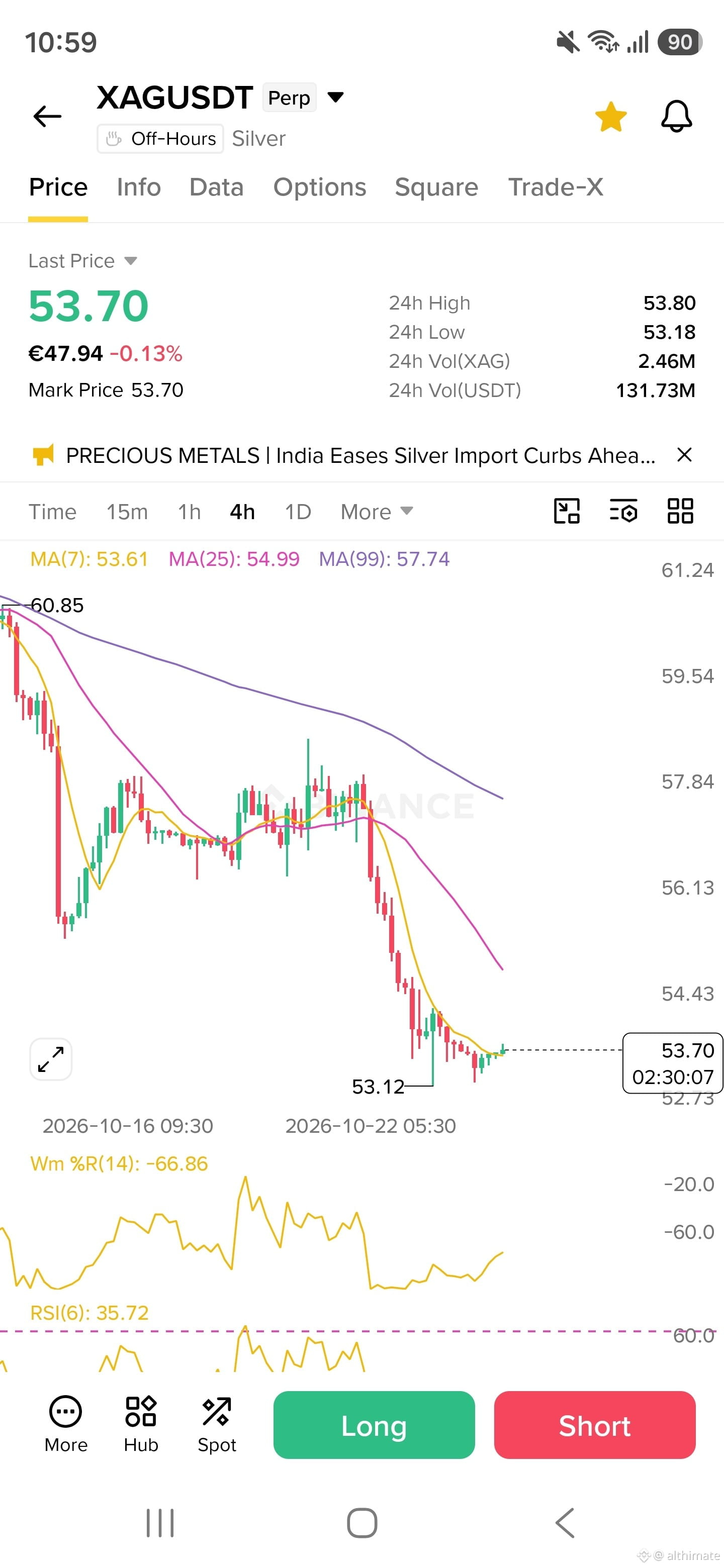
✨️ XAGUSDT PERP LONG
🟢 Buy Above: 53.50
🛑 Stop-Loss: 50.00
🎯 Targets:
T1: 57.00
T2: 60.00
T3: 66.00
#BinancePick #EarningsSeason #Silver $XAG
{future}(XAGUSDT)
✨️ XAGUSDT PERP LONG
🟢 Buy Above: 53.50
🛑 Stop-Loss: 50.00
🎯 Targets:
T1: 57.00
T2: 60.00
T3: 66.00
#BinancePick #EarningsSeason #Silver $XAG
🟢 Buy Above: 53.50
🛑 Stop-Loss: 50.00
🎯 Targets:
T1: 57.00
T2: 60.00
T3: 66.00
#BinancePick #EarningsSeason #Silver $XAG
46

·
--
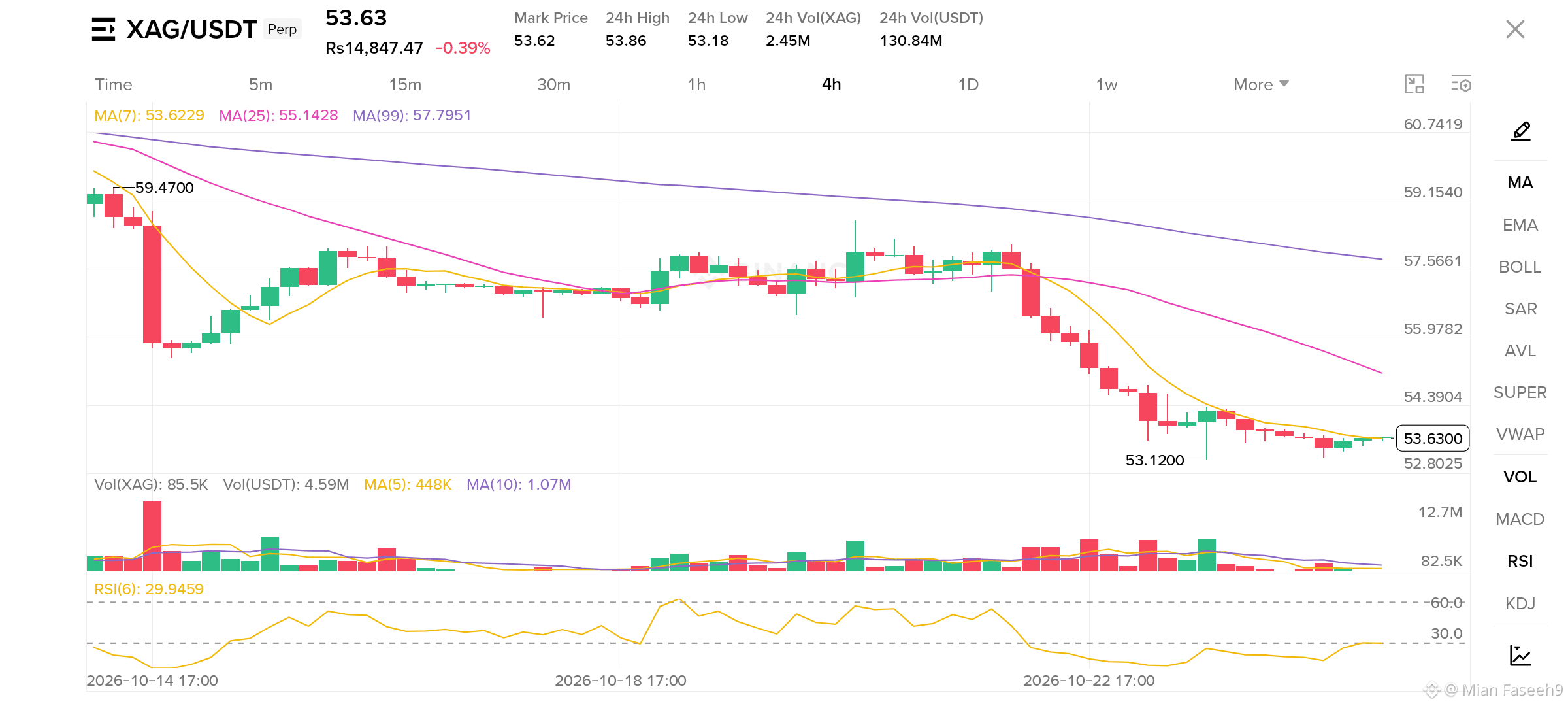
$XAG USDT at 53.63 - Is this Oversold Bottom?
Guys real talk, $XAG just hit 53.12 low and now at 53.63. My chart RSI is 29.94 which is fully oversold. Last time same level pe bounce aaya tha.
On 4H chart:
Support: 53.12 - 53.30 is strong
Resistance: 54.39 (MA7) and 55.14 (MA25)
I am not doing panic sell here. Volume is low, sellers are tired. I am looking for bounce till 54.40 - 55.14 if 53.12 holds. Below 52.80 close = more dip.
You think $XAG will bounce from here or dump more?
Follow me for daily XAU XAG chart updates.
#Silver #XAGUSDT #BinanceSquare #cryptotrading
If this analysis helped you, a small Tip is appreciated 🙏
{future}(XAGUSDT)
$XAG USDT at 53.63 - Is this Oversold Bottom?
Guys real talk, $XAG just hit 53.12 low and now at 53.63. My chart RSI is 29.94 which is fully oversold. Last time same level pe bounce aaya tha.
On 4H chart:
Support: 53.12 - 53.30 is strong
Resistance: 54.39 (MA7) and 55.14 (MA25)
I am not doing panic sell here. Volume is low, sellers are tired. I am looking for bounce till 54.40 - 55.14 if 53.12 holds. Below 52.80 close = more dip.
You think $XAG will bounce from here or dump more?
Follow me for daily XAU XAG chart updates.
#Silver #XAGUSDT #BinanceSquare #cryptotrading
If this analysis helped you, a small Tip is appreciated 🙏
Guys real talk, $XAG just hit 53.12 low and now at 53.63. My chart RSI is 29.94 which is fully oversold. Last time same level pe bounce aaya tha.
On 4H chart:
Support: 53.12 - 53.30 is strong
Resistance: 54.39 (MA7) and 55.14 (MA25)
I am not doing panic sell here. Volume is low, sellers are tired. I am looking for bounce till 54.40 - 55.14 if 53.12 holds. Below 52.80 close = more dip.
You think $XAG will bounce from here or dump more?
Follow me for daily XAU XAG chart updates.
#Silver #XAGUSDT #BinanceSquare #cryptotrading
If this analysis helped you, a small Tip is appreciated 🙏
Pi Network :
绝对会50一下
3
1
1.1k

·
--
Stepping away from the screens with $ETH idling at 2327.12. I'm closely tracking the Gold-Silver ratio near 68.5 instead. Central banks are aggressively loading physical bullion as the DXY weakens. Shifting into PAXG feels like a much cleaner hedge than fighting the current crypto noise. Real assets are shouting louder than digital ones tonight. $BTC
#Gold #Silver #ETH
Stepping away from the screens with $ETH idling at 2327.12. I'm closely tracking the Gold-Silver ratio near 68.5 instead. Central banks are aggressively loading physical bullion as the DXY weakens. Shifting into PAXG feels like a much cleaner hedge than fighting the current crypto noise. Real assets are shouting louder than digital ones tonight. $BTC
#Gold #Silver #ETH
#Gold #Silver #ETH
1
15

·
--
Thị trường hàng hóa vừa mở cửa phiên giao dịch đầu tuần với lực cầu áp đảo. Giá vàng giao ngay áp sát mốc 4.000 USD/ounce (ghi nhận ở 3.997 USD/ounce), trong khi giá bạc vọt lên 54,17 USD/ounce.
Đà tăng mạnh mẽ này phản ánh tâm lý phòng vệ dâng cao của giới đầu tư toàn cầu. Những bất ổn địa chính trị leo thang gần đây đang thúc đẩy dòng vốn tìm về các tài sản trú ẩn truyền thống với tốc độ nhanh hơn dự kiến.
Sự bứt phá của kim loại quý thường gây sức ép lên khẩu vị rủi ro chung của thị trường tài chính. Lợi suất trái phiếu và đồng USD có thể đối mặt với những nhịp biến động khó lường khi dòng tiền tái cơ cấu danh mục.
Đối với thị trường crypto, xu hướng trú ẩn này có thể khiến dòng thanh khoản ngắn hạn vào $BTC và altcoin bị phân tán. Tuy nhiên, nếu áp lực vĩ mô kéo dài, câu chuyện phòng hộ giá trị của tài sản kỹ thuật số sẽ sớm được kích hoạt trở lại.
#Gold #Silver #PreciousMetals #CryptoMarket
Thị trường hàng hóa vừa mở cửa phiên giao dịch đầu tuần với lực cầu áp đảo. Giá vàng giao ngay áp sát mốc 4.000 USD/ounce (ghi nhận ở 3.997 USD/ounce), trong khi giá bạc vọt lên 54,17 USD/ounce.
Đà tăng mạnh mẽ này phản ánh tâm lý phòng vệ dâng cao của giới đầu tư toàn cầu. Những bất ổn địa chính trị leo thang gần đây đang thúc đẩy dòng vốn tìm về các tài sản trú ẩn truyền thống với tốc độ nhanh hơn dự kiến.
Sự bứt phá của kim loại quý thường gây sức ép lên khẩu vị rủi ro chung của thị trường tài chính. Lợi suất trái phiếu và đồng USD có thể đối mặt với những nhịp biến động khó lường khi dòng tiền tái cơ cấu danh mục.
Đối với thị trường crypto, xu hướng trú ẩn này có thể khiến dòng thanh khoản ngắn hạn vào $BTC và altcoin bị phân tán. Tuy nhiên, nếu áp lực vĩ mô kéo dài, câu chuyện phòng hộ giá trị của tài sản kỹ thuật số sẽ sớm được kích hoạt trở lại.
#Gold #Silver #PreciousMetals #CryptoMarket
Đà tăng mạnh mẽ này phản ánh tâm lý phòng vệ dâng cao của giới đầu tư toàn cầu. Những bất ổn địa chính trị leo thang gần đây đang thúc đẩy dòng vốn tìm về các tài sản trú ẩn truyền thống với tốc độ nhanh hơn dự kiến.
Sự bứt phá của kim loại quý thường gây sức ép lên khẩu vị rủi ro chung của thị trường tài chính. Lợi suất trái phiếu và đồng USD có thể đối mặt với những nhịp biến động khó lường khi dòng tiền tái cơ cấu danh mục.
Đối với thị trường crypto, xu hướng trú ẩn này có thể khiến dòng thanh khoản ngắn hạn vào $BTC và altcoin bị phân tán. Tuy nhiên, nếu áp lực vĩ mô kéo dài, câu chuyện phòng hộ giá trị của tài sản kỹ thuật số sẽ sớm được kích hoạt trở lại.
#Gold #Silver #PreciousMetals #CryptoMarket
905
·
--
The Sunday Metal Audit: Decoding the Gold/Silver Ratio Before the Monday Global Open
Sunday nights are for auditing the macro divergence that most retail traders ignore. While the weekend crowd is busy liquidating on high-leverage perpetuals, I am focused on the massive shift in the Gold/Silver Ratio, which is currently sitting at 68.5. This isn't just a number; it represents a tightening spread between physical bullion and the digital proxies we trade on-chain.
Right now, spot gold is holding firm around 4140 per ounce, with spot silver maintaining its position at 60.27. When you look at the $GOLD spot reference near 3994.9, the premium on physical vs. tokenized assets is starting to tell a specific story about central bank accumulation. We are seeing a distinct inverse correlation with the DXY that suggests institutional players are front-running the Monday morning opening by moving into 1:1 backed assets like PAXG.
The tokenomics of tokenized gold are unique because they offer 24/7 liquidity while the physical bullion bars sit in vaults. Unlike standard crypto assets with massive unlock schedules or inflationary floats, the circulating supply of GOLD remains tied to actual physical reserves. This removes the supply-side shock risks we usually see in altcoins. With the GSR hovering where it is, silver is showing slightly higher relative strength, which usually precedes a volatility spike in the broader precious metals complex.
I am watching the whale flows into tokenized metals tonight. Large wallets are shifting stablecoin balances into commodities, likely as a hedge against the upcoming week's macro data releases. The delta between the 3994.9 reference and the physical spot is the most important metric on my screen right now.
Are you planning to increase your exposure to tokenized commodities as a hedge this week, or are you staying strictly in digital-native assets?
_
#Gold #Silver
The Sunday Metal Audit: Decoding the Gold/Silver Ratio Before the Monday Global Open
Sunday nights are for auditing the macro divergence that most retail traders ignore. While the weekend crowd is busy liquidating on high-leverage perpetuals, I am focused on the massive shift in the Gold/Silver Ratio, which is currently sitting at 68.5. This isn't just a number; it represents a tightening spread between physical bullion and the digital proxies we trade on-chain.
Right now, spot gold is holding firm around 4140 per ounce, with spot silver maintaining its position at 60.27. When you look at the $GOLD spot reference near 3994.9, the premium on physical vs. tokenized assets is starting to tell a specific story about central bank accumulation. We are seeing a distinct inverse correlation with the DXY that suggests institutional players are front-running the Monday morning opening by moving into 1:1 backed assets like PAXG.
The tokenomics of tokenized gold are unique because they offer 24/7 liquidity while the physical bullion bars sit in vaults. Unlike standard crypto assets with massive unlock schedules or inflationary floats, the circulating supply of GOLD remains tied to actual physical reserves. This removes the supply-side shock risks we usually see in altcoins. With the GSR hovering where it is, silver is showing slightly higher relative strength, which usually precedes a volatility spike in the broader precious metals complex.
I am watching the whale flows into tokenized metals tonight. Large wallets are shifting stablecoin balances into commodities, likely as a hedge against the upcoming week's macro data releases. The delta between the 3994.9 reference and the physical spot is the most important metric on my screen right now.
Are you planning to increase your exposure to tokenized commodities as a hedge this week, or are you staying strictly in digital-native assets?
_
#Gold #Silver
Sunday nights are for auditing the macro divergence that most retail traders ignore. While the weekend crowd is busy liquidating on high-leverage perpetuals, I am focused on the massive shift in the Gold/Silver Ratio, which is currently sitting at 68.5. This isn't just a number; it represents a tightening spread between physical bullion and the digital proxies we trade on-chain.
Right now, spot gold is holding firm around 4140 per ounce, with spot silver maintaining its position at 60.27. When you look at the $GOLD spot reference near 3994.9, the premium on physical vs. tokenized assets is starting to tell a specific story about central bank accumulation. We are seeing a distinct inverse correlation with the DXY that suggests institutional players are front-running the Monday morning opening by moving into 1:1 backed assets like PAXG.
The tokenomics of tokenized gold are unique because they offer 24/7 liquidity while the physical bullion bars sit in vaults. Unlike standard crypto assets with massive unlock schedules or inflationary floats, the circulating supply of GOLD remains tied to actual physical reserves. This removes the supply-side shock risks we usually see in altcoins. With the GSR hovering where it is, silver is showing slightly higher relative strength, which usually precedes a volatility spike in the broader precious metals complex.
I am watching the whale flows into tokenized metals tonight. Large wallets are shifting stablecoin balances into commodities, likely as a hedge against the upcoming week's macro data releases. The delta between the 3994.9 reference and the physical spot is the most important metric on my screen right now.
Are you planning to increase your exposure to tokenized commodities as a hedge this week, or are you staying strictly in digital-native assets?
_
#Gold #Silver

1
21

·
--
GOLD & SILVER UNDER PRESSURE — IS THE SAFE-HAVEN TRADE CHANGING?
Gold and silver are facing renewed selling pressure despite growing uncertainty across global markets.
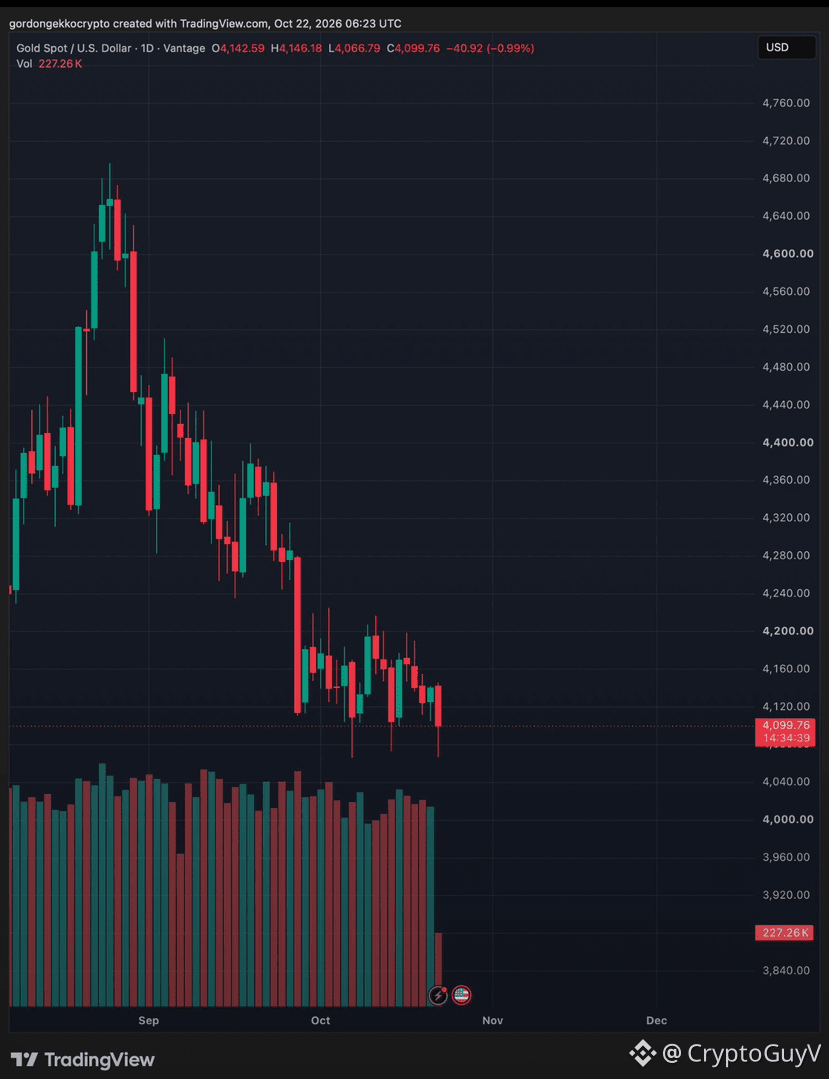
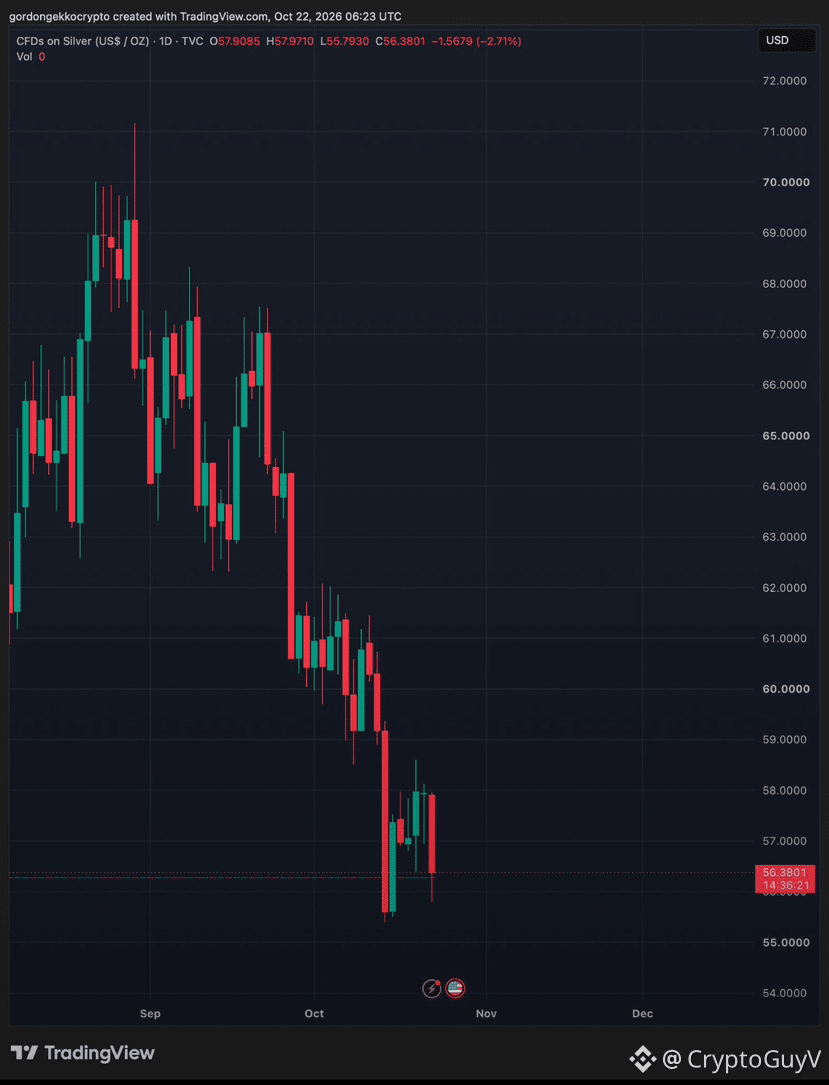
On October 22, gold fell around 1.2% to below $4,200 per ounce, while silver dropped approximately 3% toward $56.
The move is notable because precious metals often attract demand during periods of market stress.
WHAT IS DRIVING THE MOVE?
Investors are reassessing risk as technology stocks and cryptocurrencies weaken. However, instead of moving directly into gold, some market participants appear to be favoring traditional currency havens, including the Japanese yen.
Elevated US Treasury yields also remain an important factor. Higher yields can increase the opportunity cost of holding non-yielding assets such as gold and silver.
MARKET SIGNAL: BEARISH SHORT-TERM
The recent decline suggests that safe-haven demand alone may not be enough to support precious metals while yields remain elevated.
Traders should watch Treasury yields, the US dollar, and geopolitical developments for signs of a potential shift in momentum.
A rebound in gold or silver would need confirmation from price action rather than uncertainty alone.
Are you still bullish on gold as a long-term hedge, or do you expect further downside in the near term?
#Gold #Silver #XAUUSD #MarketAnalysis
$XAU
{future}(XAUUSDT)
GOLD & SILVER UNDER PRESSURE — IS THE SAFE-HAVEN TRADE CHANGING?
Gold and silver are facing renewed selling pressure despite growing uncertainty across global markets.
On October 22, gold fell around 1.2% to below $4,200 per ounce, while silver dropped approximately 3% toward $56.
The move is notable because precious metals often attract demand during periods of market stress.
WHAT IS DRIVING THE MOVE?
Investors are reassessing risk as technology stocks and cryptocurrencies weaken. However, instead of moving directly into gold, some market participants appear to be favoring traditional currency havens, including the Japanese yen.
Elevated US Treasury yields also remain an important factor. Higher yields can increase the opportunity cost of holding non-yielding assets such as gold and silver.
MARKET SIGNAL: BEARISH SHORT-TERM
The recent decline suggests that safe-haven demand alone may not be enough to support precious metals while yields remain elevated.
Traders should watch Treasury yields, the US dollar, and geopolitical developments for signs of a potential shift in momentum.
A rebound in gold or silver would need confirmation from price action rather than uncertainty alone.
Are you still bullish on gold as a long-term hedge, or do you expect further downside in the near term?
#Gold #Silver #XAUUSD #MarketAnalysis
$XAU
Gold and silver are facing renewed selling pressure despite growing uncertainty across global markets.
On October 22, gold fell around 1.2% to below $4,200 per ounce, while silver dropped approximately 3% toward $56.
The move is notable because precious metals often attract demand during periods of market stress.
WHAT IS DRIVING THE MOVE?
Investors are reassessing risk as technology stocks and cryptocurrencies weaken. However, instead of moving directly into gold, some market participants appear to be favoring traditional currency havens, including the Japanese yen.
Elevated US Treasury yields also remain an important factor. Higher yields can increase the opportunity cost of holding non-yielding assets such as gold and silver.
MARKET SIGNAL: BEARISH SHORT-TERM
The recent decline suggests that safe-haven demand alone may not be enough to support precious metals while yields remain elevated.
Traders should watch Treasury yields, the US dollar, and geopolitical developments for signs of a potential shift in momentum.
A rebound in gold or silver would need confirmation from price action rather than uncertainty alone.
Are you still bullish on gold as a long-term hedge, or do you expect further downside in the near term?
#Gold #Silver #XAUUSD #MarketAnalysis
$XAU
306

·
--
XAGUSDT Perpetual Market Update: Silver Price Analysis & Key Levels 📉Here is a quick market and technical update for XAGUSDT Perpetual (Silver) based on the 1-hour chart:
Index Price: Currently trading at $53.70, reflecting a -1.90% change over the past 24 hours.
24-Hour Trading Range: The price reached a 24h high of $54.77 and a 24h low of $53.11.
Volume & Turnover: 24h volume records 5.33M XAG with a total turnover of 286.38M USDT.
Chart Analysis (1H Timeframe): The chart illustrates a downward trend from previous highs near $77.59 down toward the current $53.70 zone, showing ongoing short-term volatility and recent interaction around the support levels.
What is your strategy for Silver right now? Are you accumulating at these levels or waiting for a reversal? Share your thoughts below! 👇
#Silver #xagusdt #BinanceSquareTalks #trading #Crypto #Commodities #TechnicalAnalysiss
XAGUSDT Perpetual Market Update: Silver Price Analysis & Key Levels 📉
Here is a quick market and technical update for XAGUSDT Perpetual (Silver) based on the 1-hour chart:
Index Price: Currently trading at $53.70, reflecting a -1.90% change over the past 24 hours.
24-Hour Trading Range: The price reached a 24h high of $54.77 and a 24h low of $53.11.
Volume & Turnover: 24h volume records 5.33M XAG with a total turnover of 286.38M USDT.
Chart Analysis (1H Timeframe): The chart illustrates a downward trend from previous highs near $77.59 down toward the current $53.70 zone, showing ongoing short-term volatility and recent interaction around the support levels.
What is your strategy for Silver right now? Are you accumulating at these levels or waiting for a reversal? Share your thoughts below! 👇
#Silver #xagusdt #BinanceSquareTalks #trading #Crypto #Commodities #TechnicalAnalysiss
Index Price: Currently trading at $53.70, reflecting a -1.90% change over the past 24 hours.
24-Hour Trading Range: The price reached a 24h high of $54.77 and a 24h low of $53.11.
Volume & Turnover: 24h volume records 5.33M XAG with a total turnover of 286.38M USDT.
Chart Analysis (1H Timeframe): The chart illustrates a downward trend from previous highs near $77.59 down toward the current $53.70 zone, showing ongoing short-term volatility and recent interaction around the support levels.
What is your strategy for Silver right now? Are you accumulating at these levels or waiting for a reversal? Share your thoughts below! 👇
#Silver #xagusdt #BinanceSquareTalks #trading #Crypto #Commodities #TechnicalAnalysiss
User-f4d2d64c:
Mixed earnings! Revenue beat but margins under pressure. Market reacting to profit miss. Let's see if $TSLA holds support here.
1
1
348

·
--
Bullish
Partly True
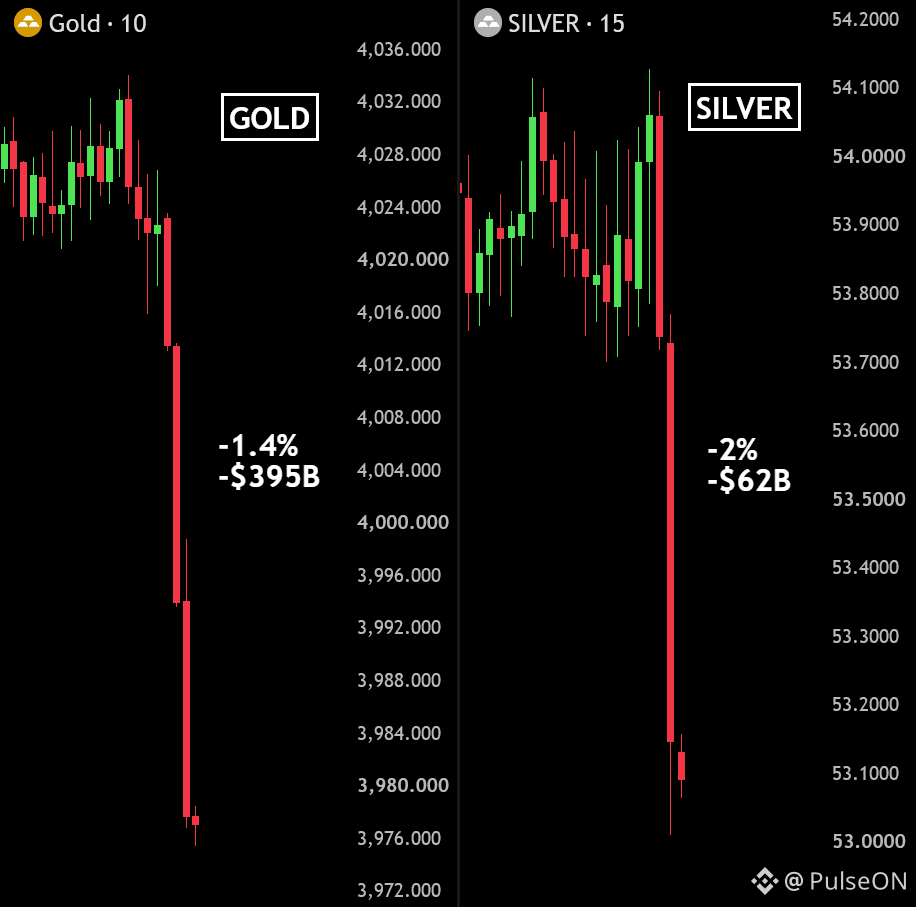
🚨 GOLD & SILVER GET HIT HARD! 📉
Over $450 billion in market value reportedly wiped out from gold and silver in just 60 minutes.
That’s a massive move in a short time. When gold and silver face this kind of pressure, traders across the market will be watching closely.
#Gold #Silver #Crypto #Bitcoin #Markets
🚨 GOLD & SILVER GET HIT HARD! 📉
Over $450 billion in market value reportedly wiped out from gold and silver in just 60 minutes.
That’s a massive move in a short time. When gold and silver face this kind of pressure, traders across the market will be watching closely.
#Gold #Silver #Crypto #Bitcoin #Markets
Over $450 billion in market value reportedly wiped out from gold and silver in just 60 minutes.
That’s a massive move in a short time. When gold and silver face this kind of pressure, traders across the market will be watching closely.
#Gold #Silver #Crypto #Bitcoin #Markets

2
1.4k

·
--
Bearish
Verified
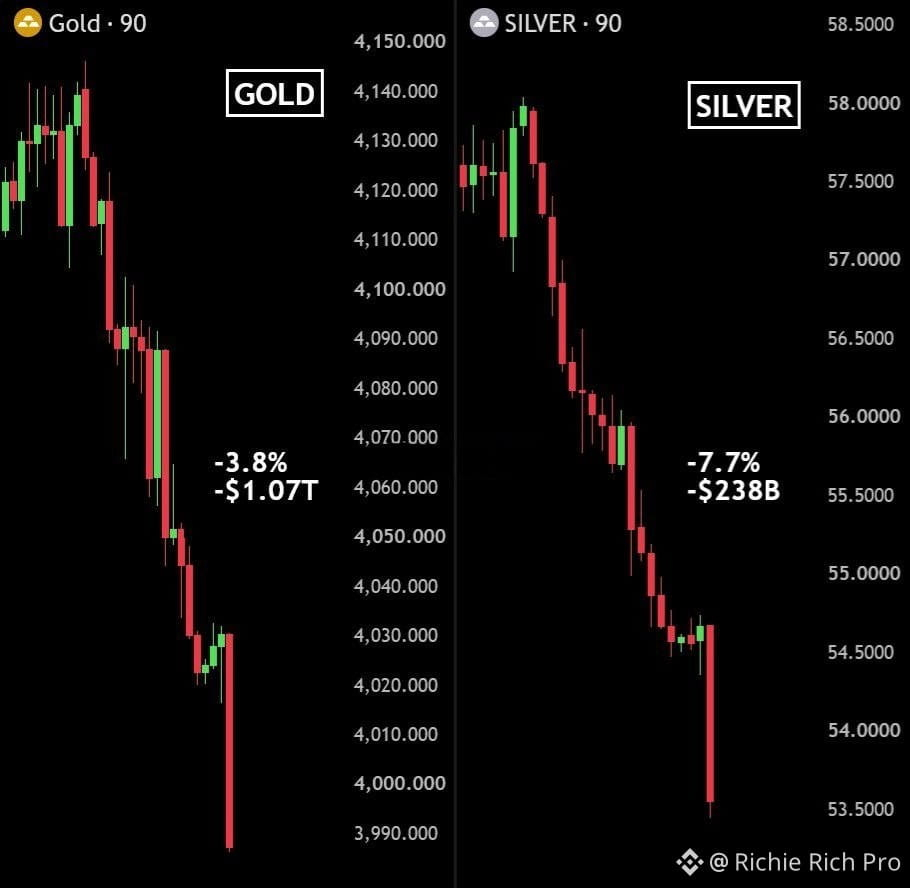
🚨 Historic Drop in Gold and Silver Prices; $1.3 Trillion Lost! 💥📉
🔻 The price of gold has fallen below $4,000, reaching its lowest level in 3 months.
⚪️ Silver has also plummeted to its lowest price in 11 months.
💸 Since yesterday, over $1.3 trillion in market value has been lost from gold and silver.
$GOLD.US #Silver #today
🚨 Historic Drop in Gold and Silver Prices; $1.3 Trillion Lost! 💥📉
🔻 The price of gold has fallen below $4,000, reaching its lowest level in 3 months.
⚪️ Silver has also plummeted to its lowest price in 11 months.
💸 Since yesterday, over $1.3 trillion in market value has been lost from gold and silver.
$GOLD.US #Silver #today
🔻 The price of gold has fallen below $4,000, reaching its lowest level in 3 months.
⚪️ Silver has also plummeted to its lowest price in 11 months.
💸 Since yesterday, over $1.3 trillion in market value has been lost from gold and silver.
$GOLD.US #Silver #today
3
1.2k

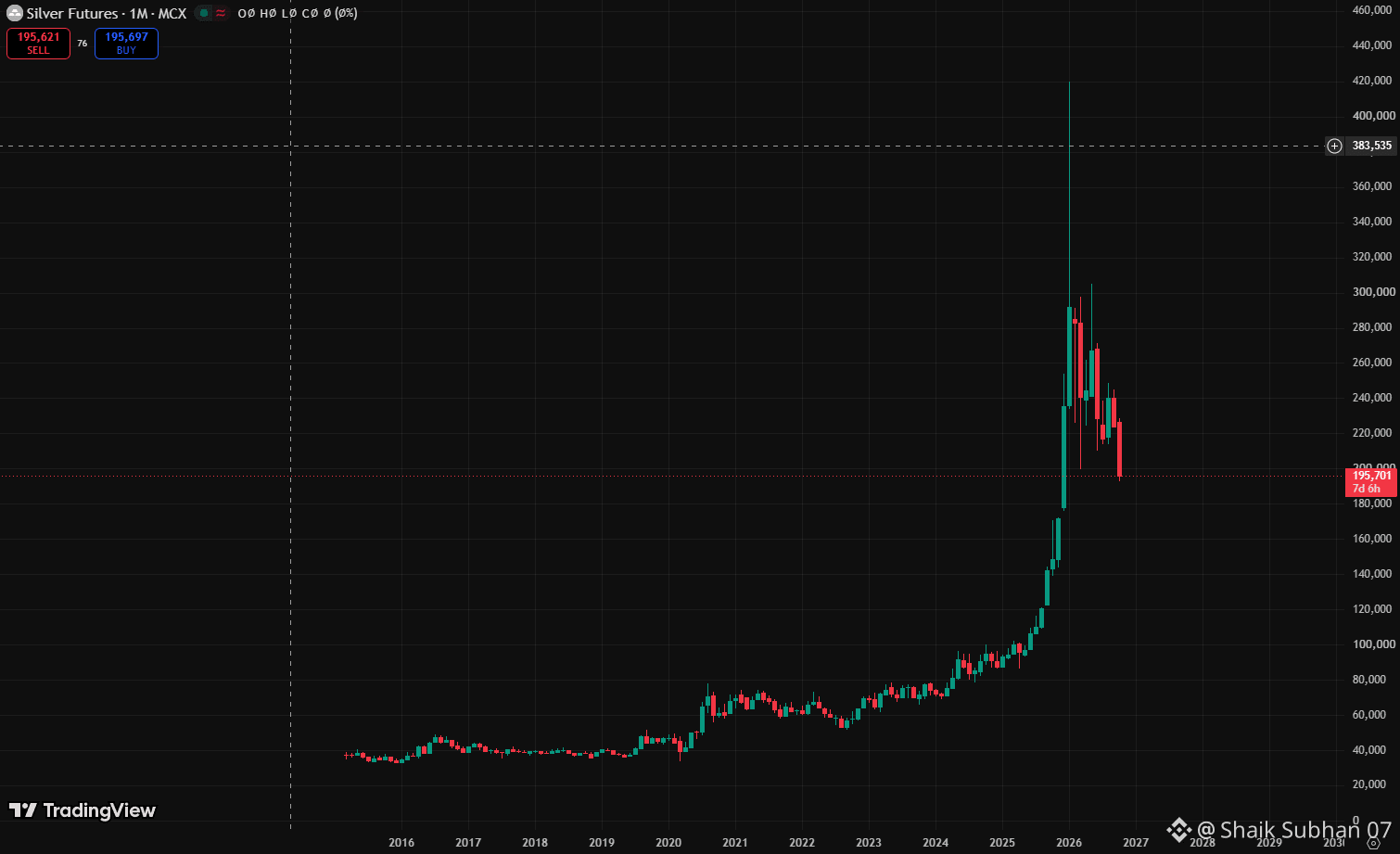
📉 SILVER'S MASSIVE RALLY… NOW COMES THE CORRECTION! 📈🔥
🚀 From ₹40,000 to nearly ₹300,000 — an unbelievable rally!
⚠️ Now silver is showing a sharp pullback.
💰 Is this a golden buying opportunity or the beginning of a bigger crash?
📊 Watch the levels. Manage your risk. Trade smart!
#Silver #SilverFutures #trading #stockmarket #TechnicalAnalysis
📉 SILVER'S MASSIVE RALLY… NOW COMES THE CORRECTION! 📈🔥
🚀 From ₹40,000 to nearly ₹300,000 — an unbelievable rally!
⚠️ Now silver is showing a sharp pullback.
💰 Is this a golden buying opportunity or the beginning of a bigger crash?
📊 Watch the levels. Manage your risk. Trade smart!
#Silver #SilverFutures #trading #stockmarket #TechnicalAnalysis
🚀 From ₹40,000 to nearly ₹300,000 — an unbelievable rally!
⚠️ Now silver is showing a sharp pullback.
💰 Is this a golden buying opportunity or the beginning of a bigger crash?
📊 Watch the levels. Manage your risk. Trade smart!
#Silver #SilverFutures #trading #stockmarket #TechnicalAnalysis
1
490

$AAPLB
{spot}(AAPLBUSDT)
$NVDAB
{spot}(NVDABUSDT)
SILVER SLIDES: LOWER HIGHS KEEP SELLERS IN CHARGE
◆━━━━━━━━━━━━━━━━━━◆
Market Overview
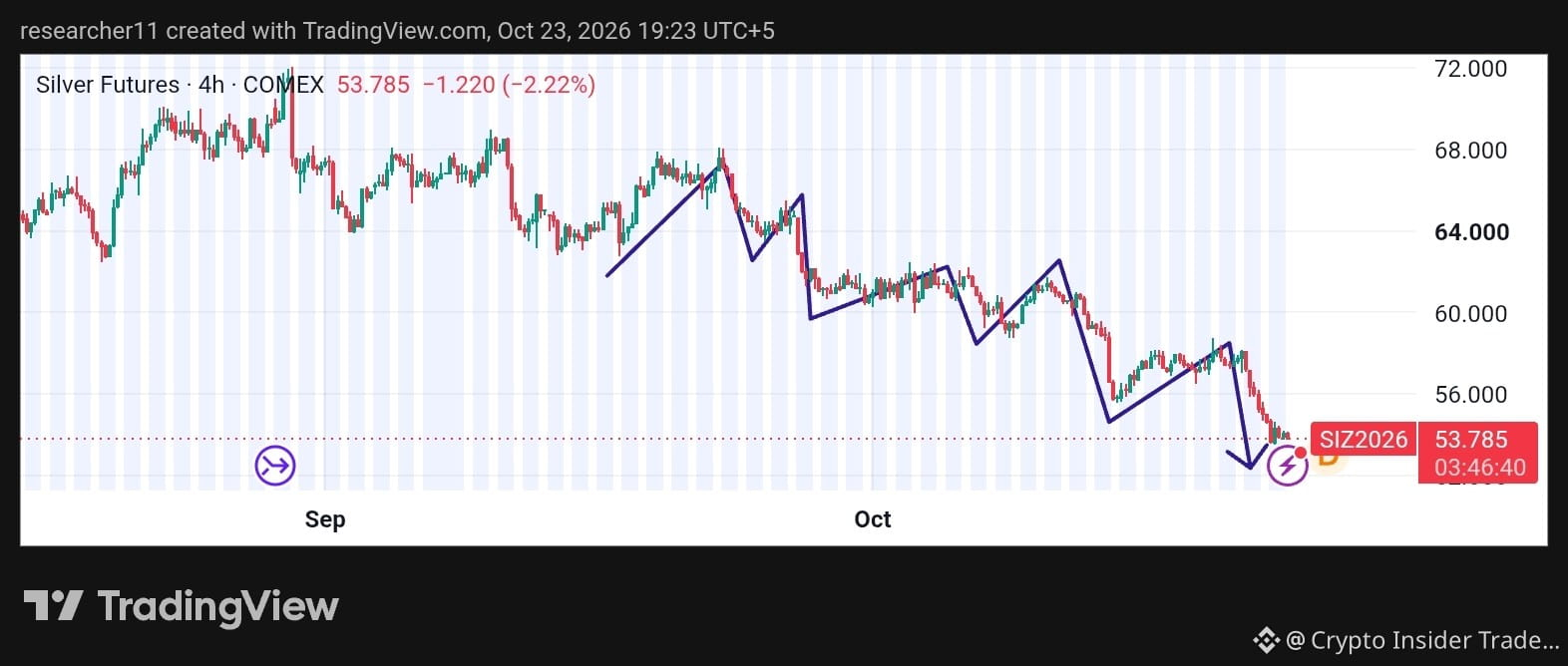
Silver Futures (SIZ2026, 4H) is trading near 53.78, down about 2.22% on the day. Since topping near 70 in early September, silver has dropped sharply, with volatility staying elevated on every bounce.
Technical Analysis
The chart shows a clear sequence of lower highs and lower lows. Each rally has faded below the previous peak, and each pullback has pushed to a deeper low. That is a classic bearish trend structure.
The most recent bounce stalled near 58.5 and reversed fast, showing sellers still defend rallies. Price is now probing the 53 to 54 zone, where buyers may try to react.
Scenarios
🟢 Bullish Case: A strong recovery above 56.00 would be the first sign of buyers regaining control, with 58.50 as the next major test.
🔴 Bearish Case: A clean break below 53.00 could open a move toward 52.00 and lower.
⚪ Neutral Case: Price may stabilize between 53.00 and 56.00 as momentum cools.
Key Levels
➤ Resistance: R1 56.00 | R2 58.50
➤ Support: S1 53.00 | S2 52.00
Context
Silver tends to move with gold but with sharper swings, so gold's reaction near 4,000 is worth watching.
Outlook
Trend remains bearish while price stays below 56.00. Watch for reaction at support. This is not financial advice.
◆━━━━━━━━━━━━━━━━━━◆
#Silver #EarningsSeason #EthereumHoodiTestnetGlamsterdamHardForkDelayed #BinancePick
$AAPLB
$NVDAB
SILVER SLIDES: LOWER HIGHS KEEP SELLERS IN CHARGE
◆━━━━━━━━━━━━━━━━━━◆
Market Overview
Silver Futures (SIZ2026, 4H) is trading near 53.78, down about 2.22% on the day. Since topping near 70 in early September, silver has dropped sharply, with volatility staying elevated on every bounce.
Technical Analysis
The chart shows a clear sequence of lower highs and lower lows. Each rally has faded below the previous peak, and each pullback has pushed to a deeper low. That is a classic bearish trend structure.
The most recent bounce stalled near 58.5 and reversed fast, showing sellers still defend rallies. Price is now probing the 53 to 54 zone, where buyers may try to react.
Scenarios
🟢 Bullish Case: A strong recovery above 56.00 would be the first sign of buyers regaining control, with 58.50 as the next major test.
🔴 Bearish Case: A clean break below 53.00 could open a move toward 52.00 and lower.
⚪ Neutral Case: Price may stabilize between 53.00 and 56.00 as momentum cools.
Key Levels
➤ Resistance: R1 56.00 | R2 58.50
➤ Support: S1 53.00 | S2 52.00
Context
Silver tends to move with gold but with sharper swings, so gold's reaction near 4,000 is worth watching.
Outlook
Trend remains bearish while price stays below 56.00. Watch for reaction at support. This is not financial advice.
◆━━━━━━━━━━━━━━━━━━◆
#Silver #EarningsSeason #EthereumHoodiTestnetGlamsterdamHardForkDelayed #BinancePick
$NVDAB
SILVER SLIDES: LOWER HIGHS KEEP SELLERS IN CHARGE
◆━━━━━━━━━━━━━━━━━━◆
Market Overview
Silver Futures (SIZ2026, 4H) is trading near 53.78, down about 2.22% on the day. Since topping near 70 in early September, silver has dropped sharply, with volatility staying elevated on every bounce.
Technical Analysis
The chart shows a clear sequence of lower highs and lower lows. Each rally has faded below the previous peak, and each pullback has pushed to a deeper low. That is a classic bearish trend structure.
The most recent bounce stalled near 58.5 and reversed fast, showing sellers still defend rallies. Price is now probing the 53 to 54 zone, where buyers may try to react.
Scenarios
🟢 Bullish Case: A strong recovery above 56.00 would be the first sign of buyers regaining control, with 58.50 as the next major test.
🔴 Bearish Case: A clean break below 53.00 could open a move toward 52.00 and lower.
⚪ Neutral Case: Price may stabilize between 53.00 and 56.00 as momentum cools.
Key Levels
➤ Resistance: R1 56.00 | R2 58.50
➤ Support: S1 53.00 | S2 52.00
Context
Silver tends to move with gold but with sharper swings, so gold's reaction near 4,000 is worth watching.
Outlook
Trend remains bearish while price stays below 56.00. Watch for reaction at support. This is not financial advice.
◆━━━━━━━━━━━━━━━━━━◆
#Silver #EarningsSeason #EthereumHoodiTestnetGlamsterdamHardForkDelayed #BinancePick
11


·
--
$XAG
· الدخول: 53.50 – 54.00
· الهدف الأول: 55.00
· الهدف الثاني: 56.37
· وقف الخسارة: 53.00
سبب الخطة:
الفضة في قناة هابطة بعد كسر قاع يوليو 54.77، مع تشبع بيعي قرب 53.05. منطقة 53.50-54.00 تمثل دعماً تاريخياً، بينما 55.00 حاجز نفسي و56.37 مقاومة فنية.
⚠️ تنبيه: ليس نصيحة مالية. المخاطر مرتفعة.
💬 إذا وجدت المنشور مفيدًا، يسعدني دعمك بإعادة نشره ومشاركته مع من قد يهتم بالمحتوى 😊
شكرًا لثقتكم وتقديركم 💛
#CryptoAnalysis #TradingSignals #crypto #cryptotrade #Silver
$XAG
· الدخول: 53.50 – 54.00
· الهدف الأول: 55.00
· الهدف الثاني: 56.37
· وقف الخسارة: 53.00
سبب الخطة:
الفضة في قناة هابطة بعد كسر قاع يوليو 54.77، مع تشبع بيعي قرب 53.05. منطقة 53.50-54.00 تمثل دعماً تاريخياً، بينما 55.00 حاجز نفسي و56.37 مقاومة فنية.
⚠️ تنبيه: ليس نصيحة مالية. المخاطر مرتفعة.
💬 إذا وجدت المنشور مفيدًا، يسعدني دعمك بإعادة نشره ومشاركته مع من قد يهتم بالمحتوى 😊
شكرًا لثقتكم وتقديركم 💛
#CryptoAnalysis #TradingSignals #crypto #cryptotrade #Silver
· الدخول: 53.50 – 54.00
· الهدف الأول: 55.00
· الهدف الثاني: 56.37
· وقف الخسارة: 53.00
سبب الخطة:
الفضة في قناة هابطة بعد كسر قاع يوليو 54.77، مع تشبع بيعي قرب 53.05. منطقة 53.50-54.00 تمثل دعماً تاريخياً، بينما 55.00 حاجز نفسي و56.37 مقاومة فنية.
⚠️ تنبيه: ليس نصيحة مالية. المخاطر مرتفعة.
💬 إذا وجدت المنشور مفيدًا، يسعدني دعمك بإعادة نشره ومشاركته مع من قد يهتم بالمحتوى 😊
شكرًا لثقتكم وتقديركم 💛
#CryptoAnalysis #TradingSignals #crypto #cryptotrade #Silver
103

·
--
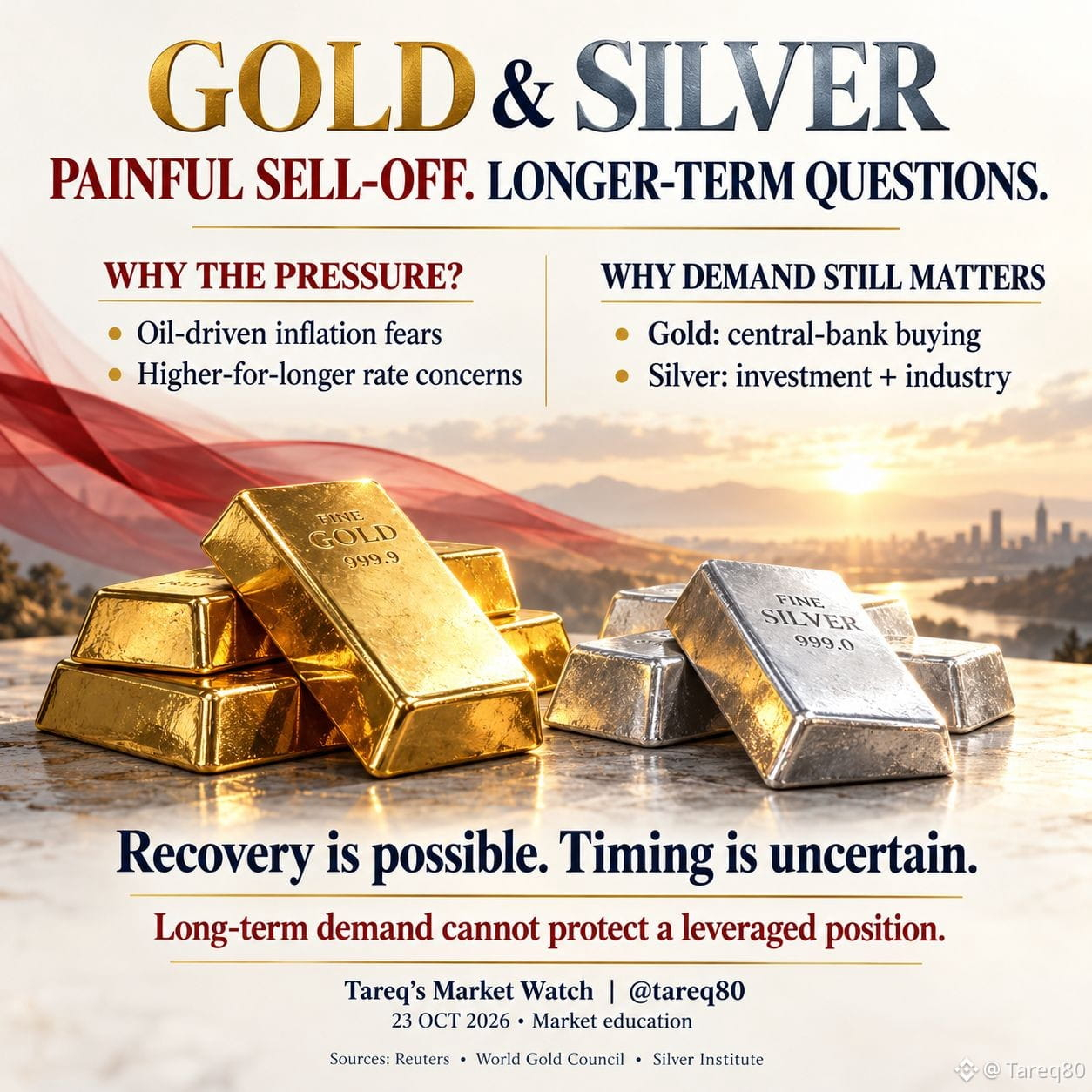
🔴 GOLD & SILVER: PAINFUL DAYS, BUT REASONS FOR HOPE
Oil-driven inflation fears and concerns about interest rates staying higher for longer have pressured metals. Silver has faced additional uncertainty because of its industrial exposure.
Yet longer-term demand hasn’t disappeared. Central banks continue buying gold, while silver remains important to industry and investors.
🌤️ Easing inflation, lower yields and renewed buying could support recovery—but nobody can promise when.
For holders: review your position size, time horizon and loss limit. Long-term demand cannot protect a leveraged trade from liquidation.
Stay hopeful. Stay disciplined. Protect your capital. 🤝
Follow @tareq80 for balanced market updates.
#Gold #Silver #RiskManagement
🔴 GOLD & SILVER: PAINFUL DAYS, BUT REASONS FOR HOPE
Oil-driven inflation fears and concerns about interest rates staying higher for longer have pressured metals. Silver has faced additional uncertainty because of its industrial exposure.
Yet longer-term demand hasn’t disappeared. Central banks continue buying gold, while silver remains important to industry and investors.
🌤️ Easing inflation, lower yields and renewed buying could support recovery—but nobody can promise when.
For holders: review your position size, time horizon and loss limit. Long-term demand cannot protect a leveraged trade from liquidation.
Stay hopeful. Stay disciplined. Protect your capital. 🤝
Follow @tareq80 for balanced market updates.
#Gold #Silver #RiskManagement
Oil-driven inflation fears and concerns about interest rates staying higher for longer have pressured metals. Silver has faced additional uncertainty because of its industrial exposure.
Yet longer-term demand hasn’t disappeared. Central banks continue buying gold, while silver remains important to industry and investors.
🌤️ Easing inflation, lower yields and renewed buying could support recovery—but nobody can promise when.
For holders: review your position size, time horizon and loss limit. Long-term demand cannot protect a leveraged trade from liquidation.
Stay hopeful. Stay disciplined. Protect your capital. 🤝
Follow @tareq80 for balanced market updates.
#Gold #Silver #RiskManagement
1
501

·
--
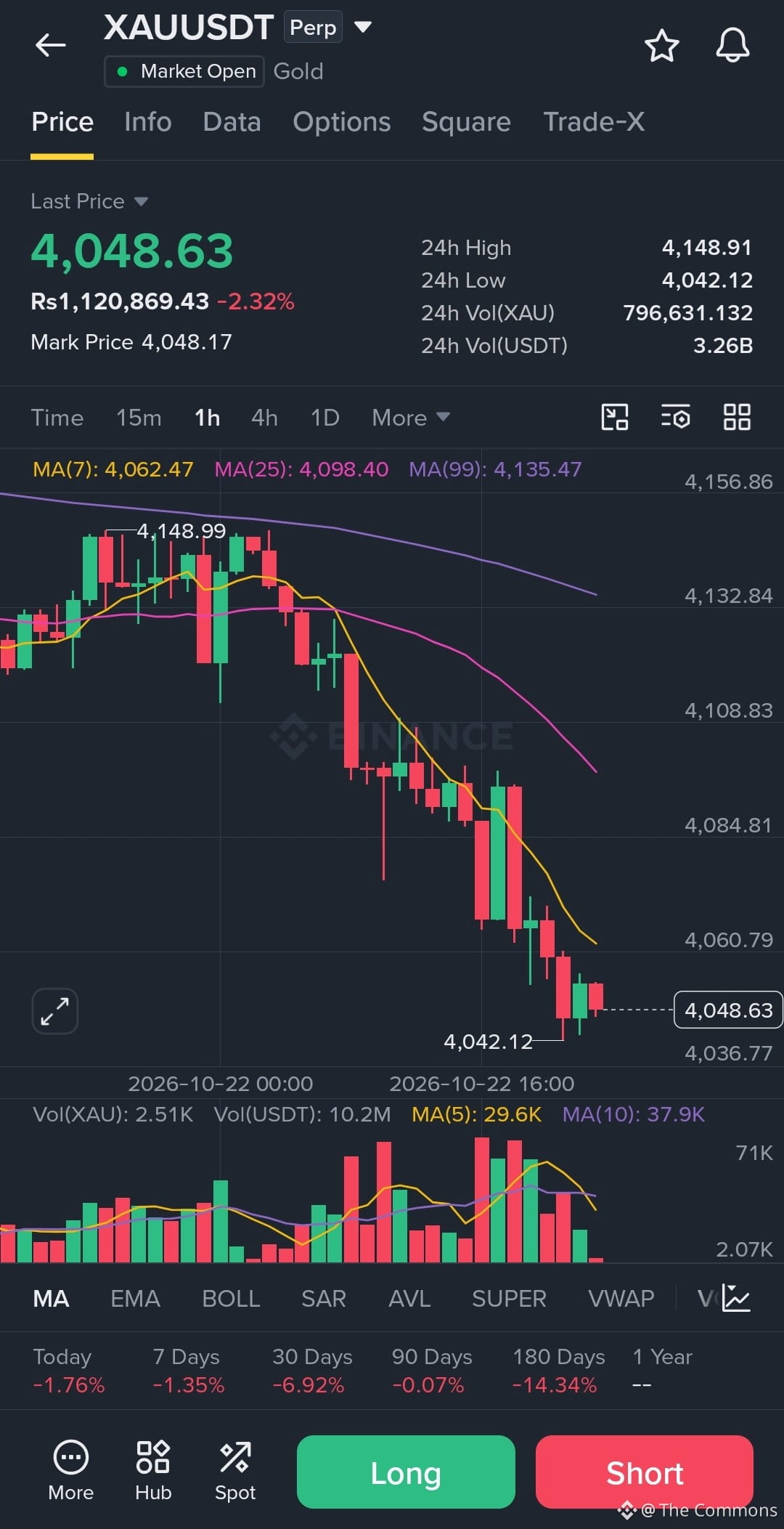
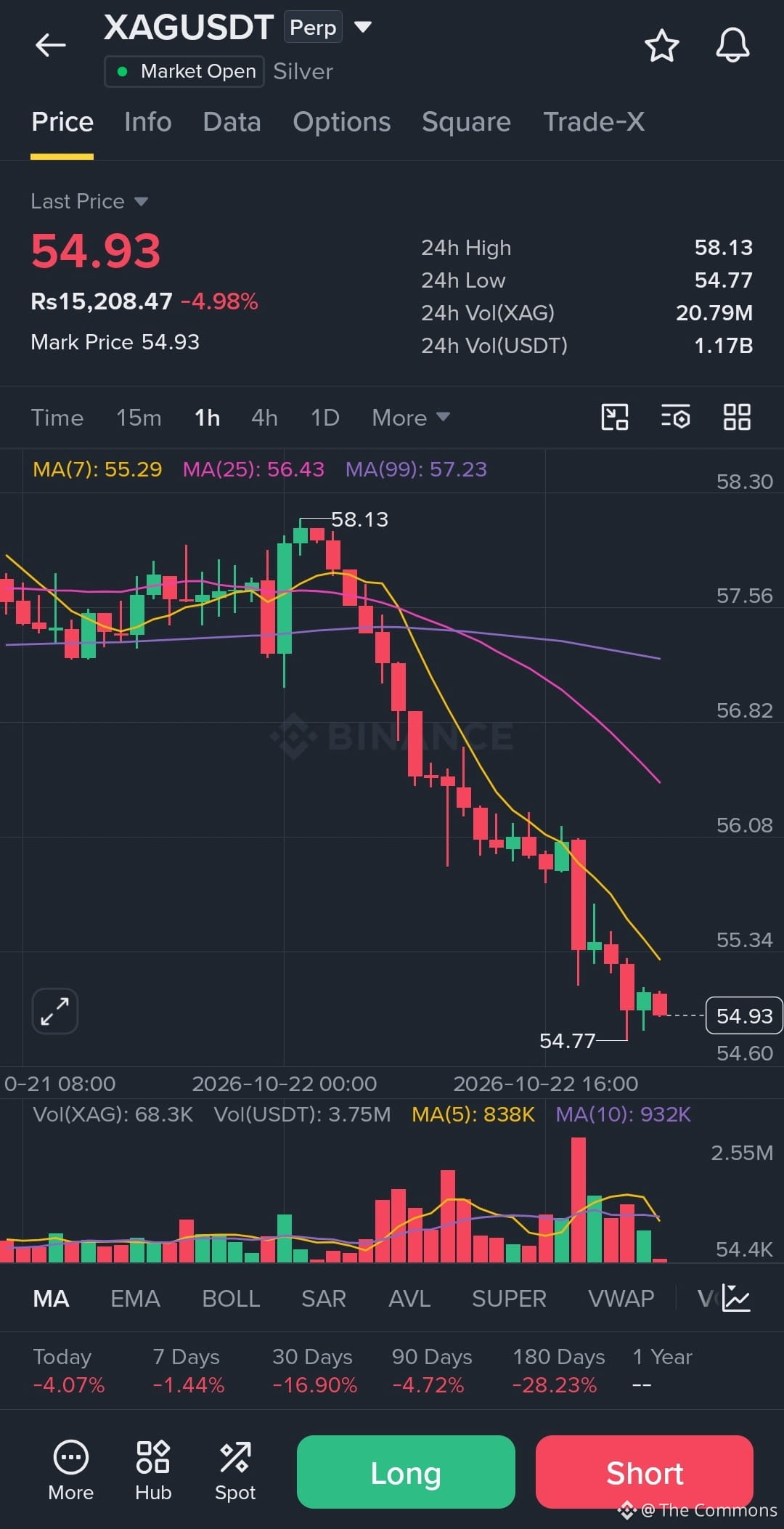
Even a KID in kindergarten knows where to buy Gold 🥇 and Silver 🥈 right now!
Buy here, take profits near $100 on $XAG and $5,600 on $XAU 💰📈
Sounds like easy money, right? 😂
But 99% of people will STILL miss this trade.
Why? Because trading isn’t just about numbers… IT’S ALL ABOUT PSYCHOLOGY. 🧠🔥
#Gold #Silver #tradingpsychology
#CryptoMarketAlert
{future}(XAGUSDT)
{future}(XAUUSDT)
Even a KID in kindergarten knows where to buy Gold 🥇 and Silver 🥈 right now!
Buy here, take profits near $100 on $XAG and $5,600 on $XAU 💰📈
Sounds like easy money, right? 😂
But 99% of people will STILL miss this trade.
Why? Because trading isn’t just about numbers… IT’S ALL ABOUT PSYCHOLOGY. 🧠🔥
#Gold #Silver #tradingpsychology
#CryptoMarketAlert
Buy here, take profits near $100 on $XAG and $5,600 on $XAU 💰📈
Sounds like easy money, right? 😂
But 99% of people will STILL miss this trade.
Why? Because trading isn’t just about numbers… IT’S ALL ABOUT PSYCHOLOGY. 🧠🔥
#Gold #Silver #tradingpsychology
#CryptoMarketAlert
TALAL ALi the KING6:
الفضه ستهبط ستهبط الى 50$
2
1
1.1k

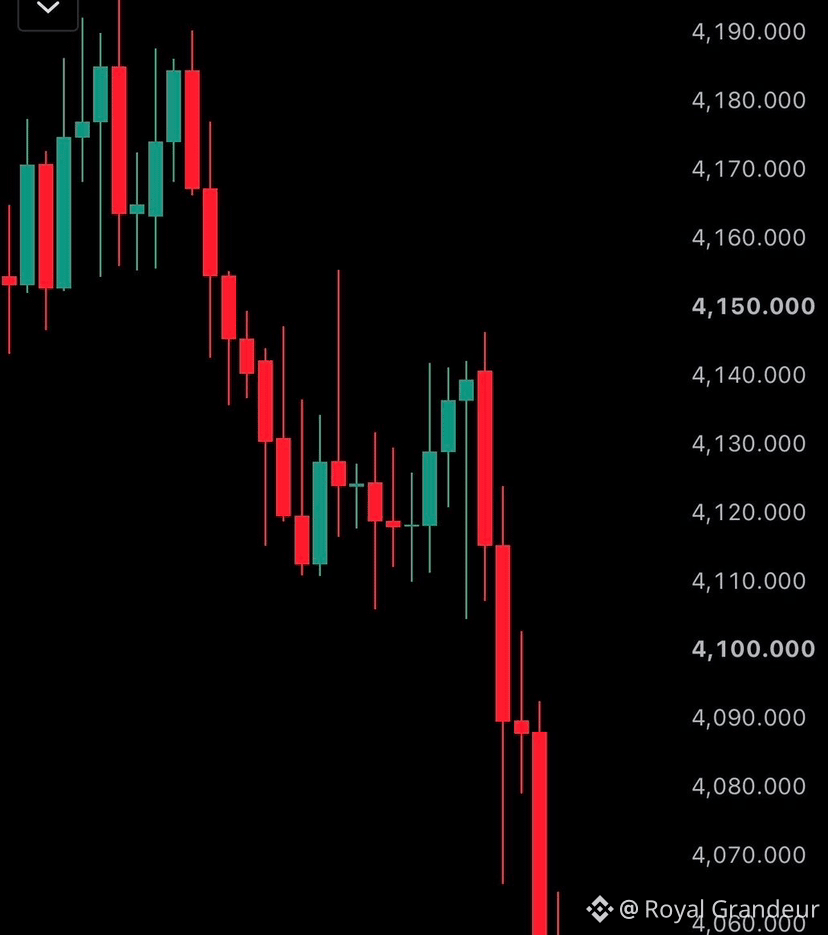
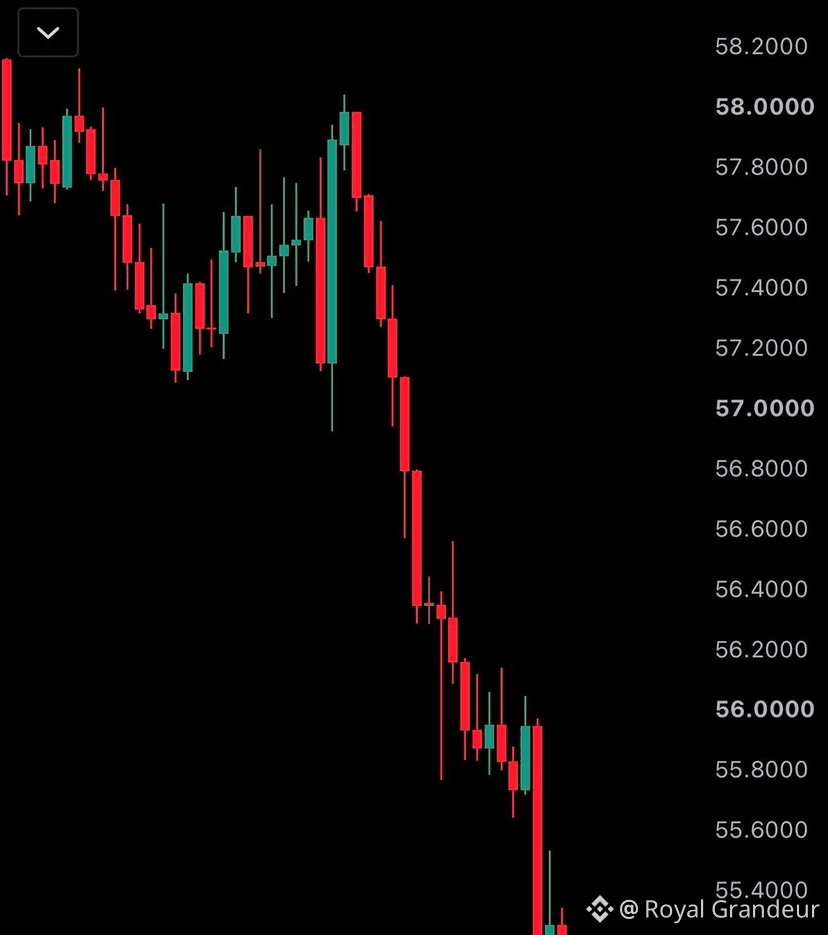

Spot silver tumbled sharply by 5% during today's trading session, falling to $55.07 per ounce amid broader asset realignments. Concurrently, US Treasury yields experienced notable downward pressure, with both the 2-year and 10-year benchmark yields declining by 10 basis points.
A single-session 5% drop in silver marks an aggressive unwinding of speculative positions and commodity hedges. Meanwhile, the parallel decline across short- and long-end Treasury yields highlights rapid recalibration in growth expectations and capital flows.
This simultaneous slide in precious metals and yields reflects broader macro de-risking across global financial markets. Lower yields generally support financial conditions, yet sharp commodity sell-offs often indicate underlying liquidity contractions across traditional desks.
For crypto markets, falling yields provide a favorable macro backdrop by lowering the opportunity cost of holding non-yielding assets. If volatility in traditional commodities subsides, capital may find renewed appetite for risk assets like $BTC in the coming sessions.
#Silver #TreasuryYields #MacroEconomics
Spot silver tumbled sharply by 5% during today's trading session, falling to $55.07 per ounce amid broader asset realignments. Concurrently, US Treasury yields experienced notable downward pressure, with both the 2-year and 10-year benchmark yields declining by 10 basis points.
A single-session 5% drop in silver marks an aggressive unwinding of speculative positions and commodity hedges. Meanwhile, the parallel decline across short- and long-end Treasury yields highlights rapid recalibration in growth expectations and capital flows.
This simultaneous slide in precious metals and yields reflects broader macro de-risking across global financial markets. Lower yields generally support financial conditions, yet sharp commodity sell-offs often indicate underlying liquidity contractions across traditional desks.
For crypto markets, falling yields provide a favorable macro backdrop by lowering the opportunity cost of holding non-yielding assets. If volatility in traditional commodities subsides, capital may find renewed appetite for risk assets like $BTC in the coming sessions.
#Silver #TreasuryYields #MacroEconomics
A single-session 5% drop in silver marks an aggressive unwinding of speculative positions and commodity hedges. Meanwhile, the parallel decline across short- and long-end Treasury yields highlights rapid recalibration in growth expectations and capital flows.
This simultaneous slide in precious metals and yields reflects broader macro de-risking across global financial markets. Lower yields generally support financial conditions, yet sharp commodity sell-offs often indicate underlying liquidity contractions across traditional desks.
For crypto markets, falling yields provide a favorable macro backdrop by lowering the opportunity cost of holding non-yielding assets. If volatility in traditional commodities subsides, capital may find renewed appetite for risk assets like $BTC in the coming sessions.
#Silver #TreasuryYields #MacroEconomics
287

·
--
Bullish
😤📉 $XAG (Silver) is testing every trader’s patience! Price swings up, reverses down, and leaves positions bleeding. No more emotional trades—watch support, resistance, and momentum before making a move. 💪📊 Anyone else done with silver’s roller coaster? 👀 #XAG #Silver
😤📉 $XAG (Silver) is testing every trader’s patience! Price swings up, reverses down, and leaves positions bleeding. No more emotional trades—watch support, resistance, and momentum before making a move. 💪📊 Anyone else done with silver’s roller coaster? 👀 #XAG #Silver
273

·
--
Bearish
Partly True
Did you LISTEN?
Gold and silver continue their COLLAPSE, just as I told you last month.
Another HALF A TRILLION dollars lost from their market caps in the last 24 hours.
Its time to pay attention..
Because what happens next will leave many sidelined and shocked.
#gold #silver
Did you LISTEN?
Gold and silver continue their COLLAPSE, just as I told you last month.
Another HALF A TRILLION dollars lost from their market caps in the last 24 hours.
Its time to pay attention..
Because what happens next will leave many sidelined and shocked.
#gold #silver
Gold and silver continue their COLLAPSE, just as I told you last month.
Another HALF A TRILLION dollars lost from their market caps in the last 24 hours.
Its time to pay attention..
Because what happens next will leave many sidelined and shocked.
#gold #silver
761
Log in to explore more content
Join global crypto users on Binance Square
⚡️ Get latest and useful information about crypto.
💬 Trusted by the world’s largest crypto exchange.
👍 Discover real insights from verified creators.
Email / Phone number
Trending Topics
1
#BinancePick
2.8M views
145,940 Discussing
2
#EarningsSeason
5.1M views
24,963 Discussing
3
#AnthropicTTMRevenueGrewAbout1200%
0 views
11 Discussing
4
#AnthropicS1ExpectedToday
684 views
37 Discussing
5
#SouthKoreaReportedlyWeighsFourthCryptoTaxDelay
8,405 views
221 Discussing
6
#FranklinTempletonFilesForTwoDividendToBitcoinETFs
14,513 views
334 Discussing
7
#StrategyMSTRSurpassesNasdaqInMarketCap
11,758 views
271 Discussing
8
#CanadaProposesStablecoinRedemptionWithin3BusinessDays
525 views
29 Discussing
9
#ElectrumWalletBugLetRogueServersStealFunds
17,127 views
384 Discussing
10
#ArgentineCourtDismissesLIBRACaseAgainstMilei
26,903 views
456 Discussing