

#ondo
ondo
8.4M views
21,970 Discussing
Hot
Latest

·
--
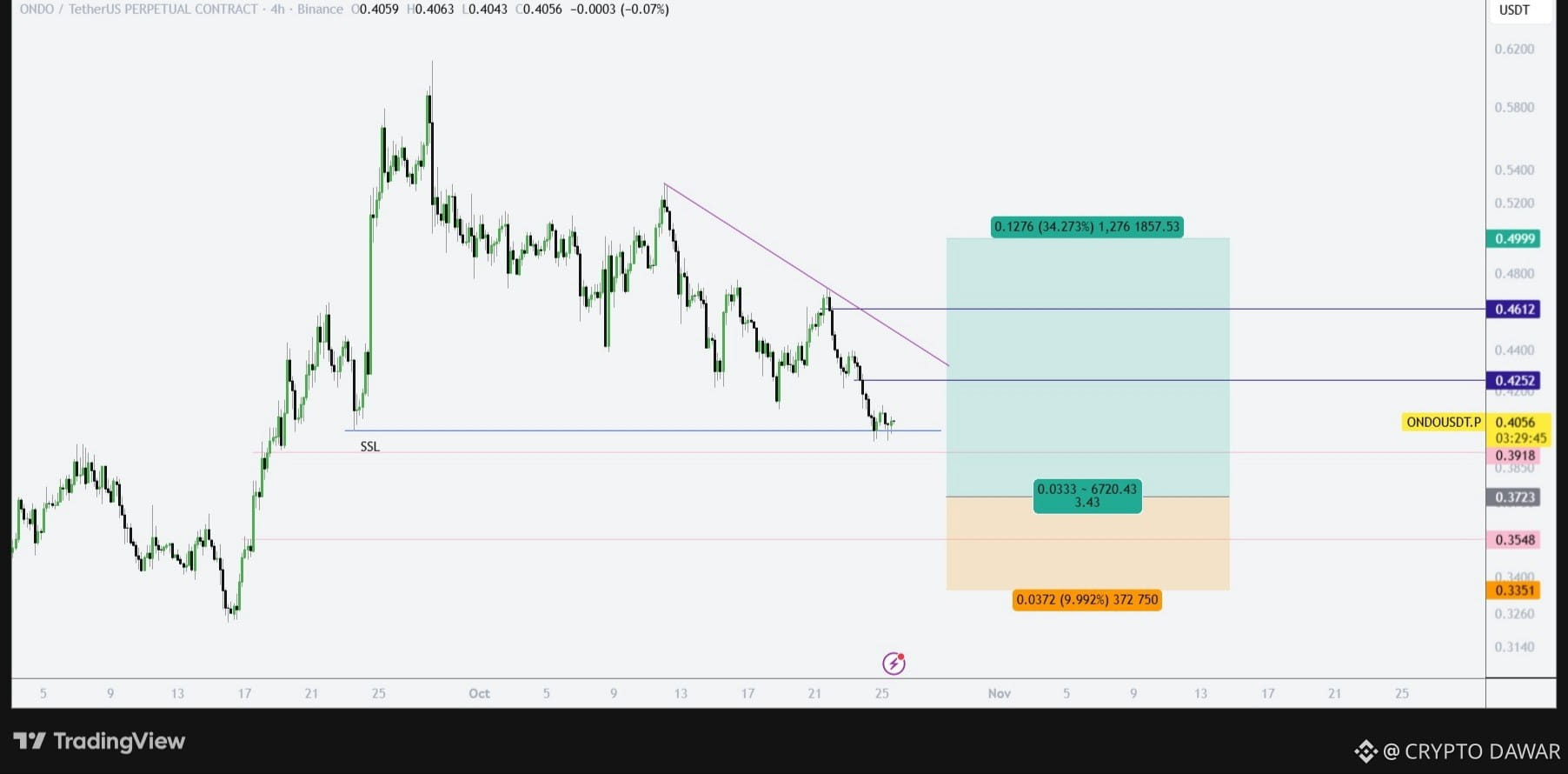
#ONDO Analysis- 👀
ONDO is giving us another chance to look for a Long
$ONDO
{future}(ONDOUSDT)
#CryptoDawar #EarningsSeason #BinancePick #Write2Earn
#ONDO Analysis- 👀
ONDO is giving us another chance to look for a Long
$ONDO
#CryptoDawar #EarningsSeason #BinancePick #Write2Earn
ONDO is giving us another chance to look for a Long
$ONDO
#CryptoDawar #EarningsSeason #BinancePick #Write2Earn
1
1
638

·
--
#ONDO
ONDO Price Jumps as Ondo Finance Unveils Exclusive OpenAI Pre-IPO Offering
Ondo Finance has announced an exclusive OpenAI pre-IPO offering as the $ONDO price climbed more than 2% on Monday. The new subscription plan comes as OpenAI delays its public listing, while rival Anthropic advances its IPO plans.
Ondo Finance Opens Exclusive OpenAI Pre-IPO Subscriptions
Ondo Finance announced that subscriptions for its OpenAI Private Market Note (OPAIPon) will open during the week of November 2. The offering will run for two weeks and will be available exclusively to eligible Ondo Private Clients.
To participate in the primary market offering, investors must register through Ondo’s Private Client program. The company has not mentioned the minimum investment criteria or the total allocation limits available to the subscribers.
The announcement comes after the launch of Ondo’s private markets platform earlier this month, which enabled tokenized exposure to private AI businesses. OPAIPon already offers 24/7 secondary trading of assets on Ondo Perps, and the new offering allows investors to subscribe directly to the platform if they are eligible.
OpenAI IPO Faces Delay as Anthropic Moves Closer to Public Listing
The offering follows OpenAI CEO Sam Altman’s decision to exclude a 2026 IPO based on concerns about the safety of AI. In an interview in September, Altman called it “an ill-advised moment to go public.
OpenAI may now seek to be listed in 2027, though it has yet to announce an official listing date. Meanwhile, rival Anthropic filed its public IPO prospectus with the SEC on Monday, seeking to list on Nasdaq under ANT.
The filing gives Anthropic a head start in the public listing race, but both firms have yet to pull the trigger on an IPO. Both firms are contenders for the AI marketplace, and Anthropic may be the first of the two to go public.#Write2Earn #W2E #EarningsSeason $ONDO
{spot}(ONDOUSDT)
#ONDO
ONDO Price Jumps as Ondo Finance Unveils Exclusive OpenAI Pre-IPO Offering
Ondo Finance has announced an exclusive OpenAI pre-IPO offering as the $ONDO price climbed more than 2% on Monday. The new subscription plan comes as OpenAI delays its public listing, while rival Anthropic advances its IPO plans.
Ondo Finance Opens Exclusive OpenAI Pre-IPO Subscriptions
Ondo Finance announced that subscriptions for its OpenAI Private Market Note (OPAIPon) will open during the week of November 2. The offering will run for two weeks and will be available exclusively to eligible Ondo Private Clients.
To participate in the primary market offering, investors must register through Ondo’s Private Client program. The company has not mentioned the minimum investment criteria or the total allocation limits available to the subscribers.
The announcement comes after the launch of Ondo’s private markets platform earlier this month, which enabled tokenized exposure to private AI businesses. OPAIPon already offers 24/7 secondary trading of assets on Ondo Perps, and the new offering allows investors to subscribe directly to the platform if they are eligible.
OpenAI IPO Faces Delay as Anthropic Moves Closer to Public Listing
The offering follows OpenAI CEO Sam Altman’s decision to exclude a 2026 IPO based on concerns about the safety of AI. In an interview in September, Altman called it “an ill-advised moment to go public.
OpenAI may now seek to be listed in 2027, though it has yet to announce an official listing date. Meanwhile, rival Anthropic filed its public IPO prospectus with the SEC on Monday, seeking to list on Nasdaq under ANT.
The filing gives Anthropic a head start in the public listing race, but both firms have yet to pull the trigger on an IPO. Both firms are contenders for the AI marketplace, and Anthropic may be the first of the two to go public.#Write2Earn #W2E #EarningsSeason $ONDO
ONDO Price Jumps as Ondo Finance Unveils Exclusive OpenAI Pre-IPO Offering
Ondo Finance has announced an exclusive OpenAI pre-IPO offering as the $ONDO price climbed more than 2% on Monday. The new subscription plan comes as OpenAI delays its public listing, while rival Anthropic advances its IPO plans.
Ondo Finance Opens Exclusive OpenAI Pre-IPO Subscriptions
Ondo Finance announced that subscriptions for its OpenAI Private Market Note (OPAIPon) will open during the week of November 2. The offering will run for two weeks and will be available exclusively to eligible Ondo Private Clients.
To participate in the primary market offering, investors must register through Ondo’s Private Client program. The company has not mentioned the minimum investment criteria or the total allocation limits available to the subscribers.
The announcement comes after the launch of Ondo’s private markets platform earlier this month, which enabled tokenized exposure to private AI businesses. OPAIPon already offers 24/7 secondary trading of assets on Ondo Perps, and the new offering allows investors to subscribe directly to the platform if they are eligible.
OpenAI IPO Faces Delay as Anthropic Moves Closer to Public Listing
The offering follows OpenAI CEO Sam Altman’s decision to exclude a 2026 IPO based on concerns about the safety of AI. In an interview in September, Altman called it “an ill-advised moment to go public.
OpenAI may now seek to be listed in 2027, though it has yet to announce an official listing date. Meanwhile, rival Anthropic filed its public IPO prospectus with the SEC on Monday, seeking to list on Nasdaq under ANT.
The filing gives Anthropic a head start in the public listing race, but both firms have yet to pull the trigger on an IPO. Both firms are contenders for the AI marketplace, and Anthropic may be the first of the two to go public.#Write2Earn #W2E #EarningsSeason $ONDO

2
97

·
--
Listen up, degens! I'm seeing major alpha on $ONDO. That fee-sharing vote just went through in April, 20% of protocol revenue sending straight to stakers! TVL is pumping to $3B+ while the token is still 88% off ATH. People are sleeping on this value capture. 🔥🚀💎 Are you filling your bags or staying poor? #ONDO #RWA
Listen up, degens! I'm seeing major alpha on $ONDO . That fee-sharing vote just went through in April, 20% of protocol revenue sending straight to stakers! TVL is pumping to $3B+ while the token is still 88% off ATH. People are sleeping on this value capture. 🔥🚀💎 Are you filling your bags or staying poor? #ONDO #RWA
138

·
--
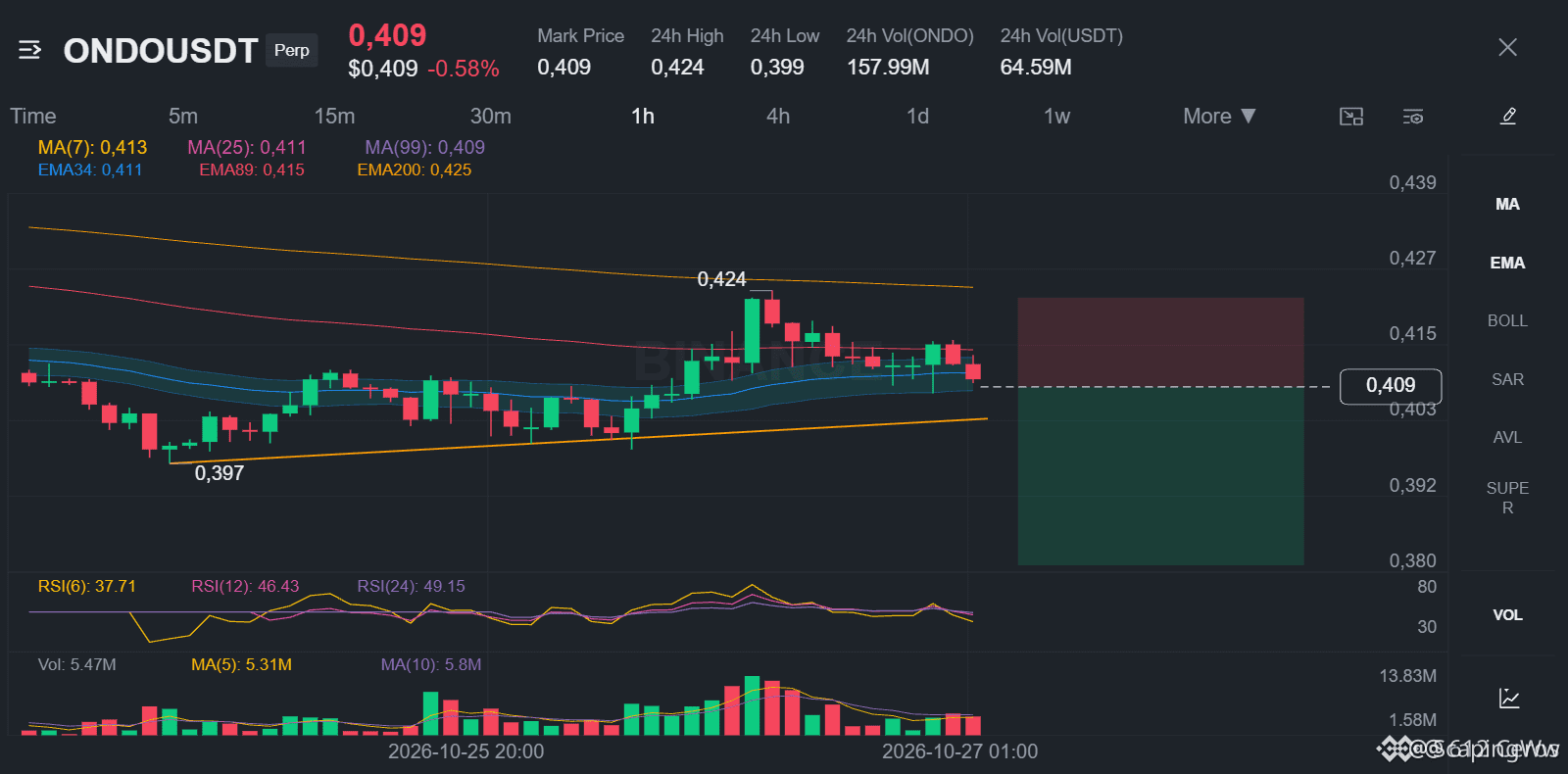
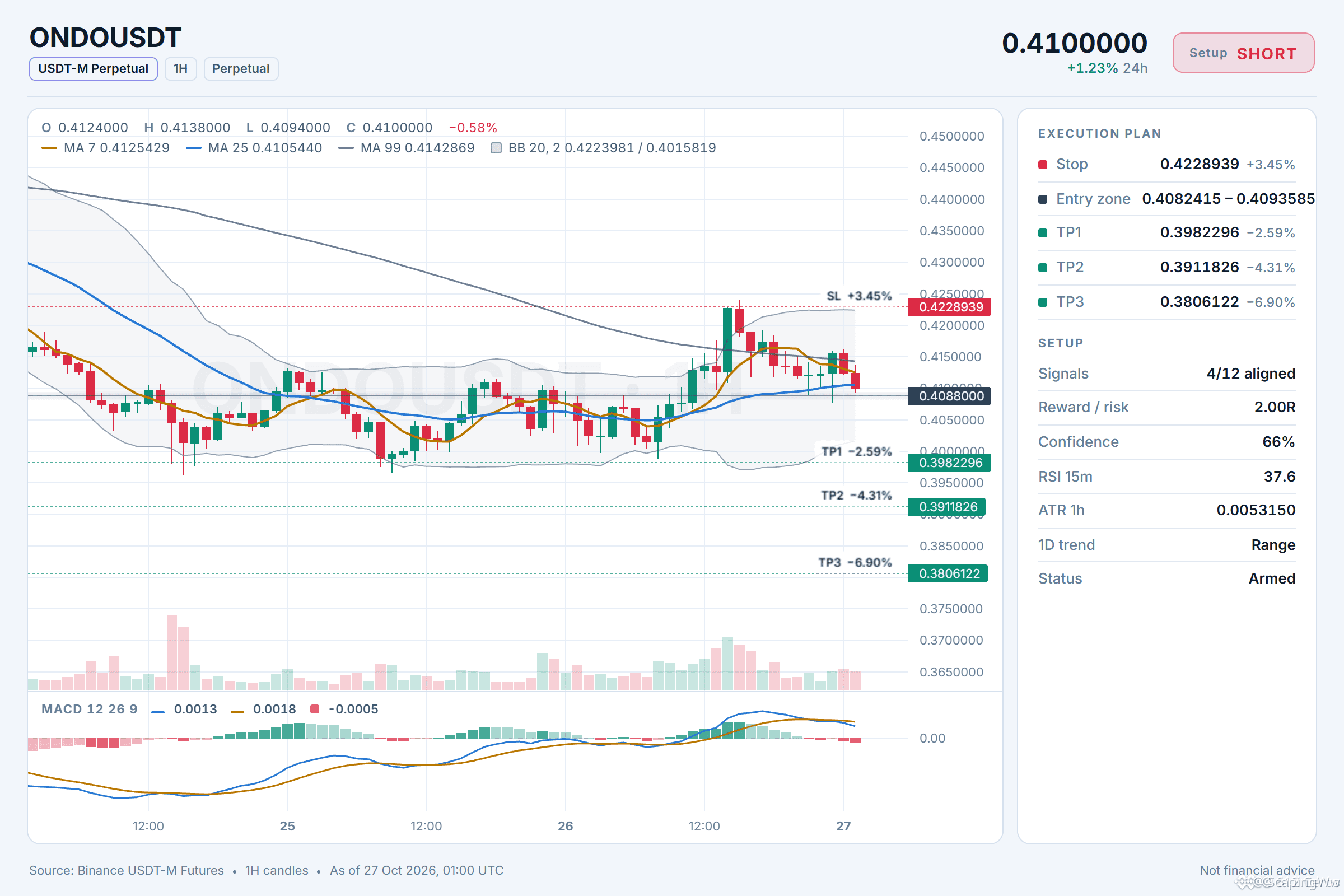
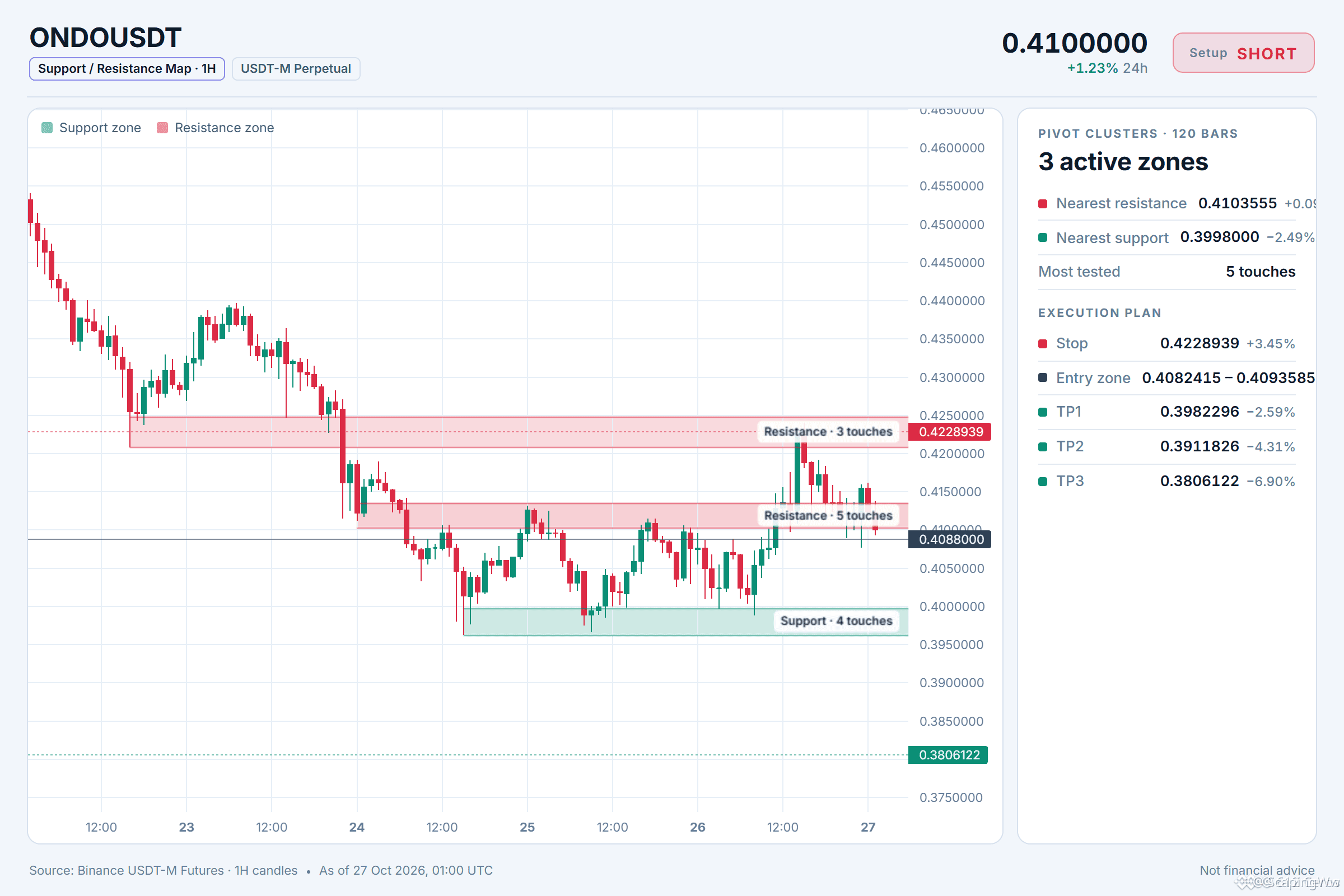
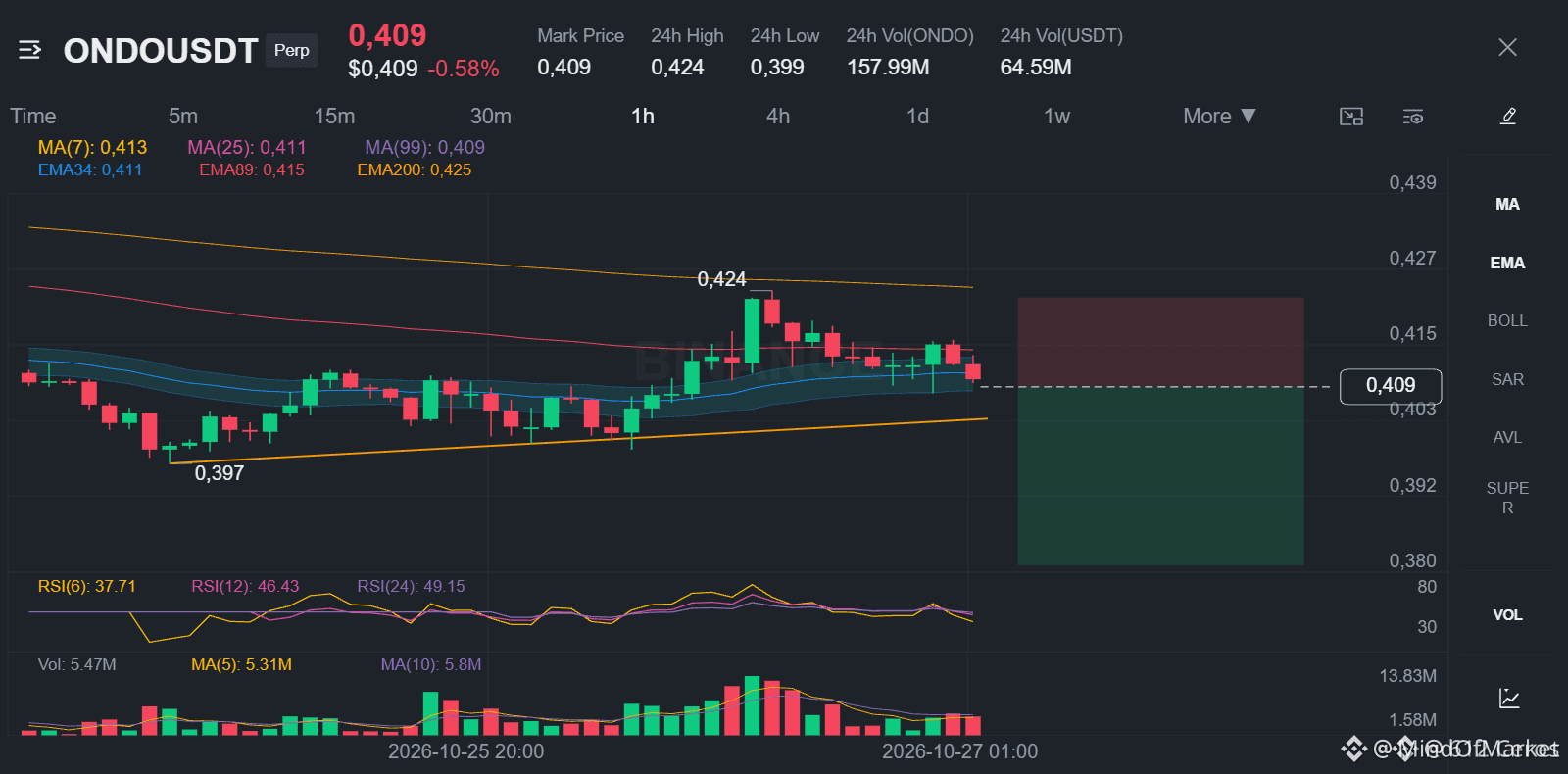
🔴 $ONDO SLIDES DEEP INTO BEARISH STACK – TIME TO RECLAIM LIQUIDITY! 🦈
Entry: 0.4082-0.4094 ⚡
Target: 0.3982/0.3912/0.3806 🚀
Stop Loss: 0.4229 ⚠️
📊 The 4‑hour chart keeps $ONDO locked below EMA50 and EMA200, while the 15‑min ADX spikes past 24, confirming sellers are in the driver’s seat. 🦈 Smart money is sweeping liquidity at the 0.409 zone, setting the stage for a clean down‑move.
⚡ Your plan: enter the tight range, lock half profit at 0.3982, then scale out deeper. Keep the size light and move the stop to breakeven after TP1. 👇 Are you ready to flip the bid and ride the downside?
⚠️ Not financial advice. Always manage your risk. 🛡️
🏷️ #ONDO #ShortSetup #Bearish #Crypto
🔥 🦈
🔴 $ONDO SLIDES DEEP INTO BEARISH STACK – TIME TO RECLAIM LIQUIDITY! 🦈
Entry: 0.4082-0.4094 ⚡
Target: 0.3982/0.3912/0.3806 🚀
Stop Loss: 0.4229 ⚠️
📊 The 4‑hour chart keeps $ONDO locked below EMA50 and EMA200, while the 15‑min ADX spikes past 24, confirming sellers are in the driver’s seat. 🦈 Smart money is sweeping liquidity at the 0.409 zone, setting the stage for a clean down‑move.
⚡ Your plan: enter the tight range, lock half profit at 0.3982, then scale out deeper. Keep the size light and move the stop to breakeven after TP1. 👇 Are you ready to flip the bid and ride the downside?
⚠️ Not financial advice. Always manage your risk. 🛡️
🏷️ #ONDO #ShortSetup #Bearish #Crypto
🔥 🦈
Entry: 0.4082-0.4094 ⚡
Target: 0.3982/0.3912/0.3806 🚀
Stop Loss: 0.4229 ⚠️
📊 The 4‑hour chart keeps $ONDO locked below EMA50 and EMA200, while the 15‑min ADX spikes past 24, confirming sellers are in the driver’s seat. 🦈 Smart money is sweeping liquidity at the 0.409 zone, setting the stage for a clean down‑move.
⚡ Your plan: enter the tight range, lock half profit at 0.3982, then scale out deeper. Keep the size light and move the stop to breakeven after TP1. 👇 Are you ready to flip the bid and ride the downside?
⚠️ Not financial advice. Always manage your risk. 🛡️
🏷️ #ONDO #ShortSetup #Bearish #Crypto
🔥 🦈
4

·
--
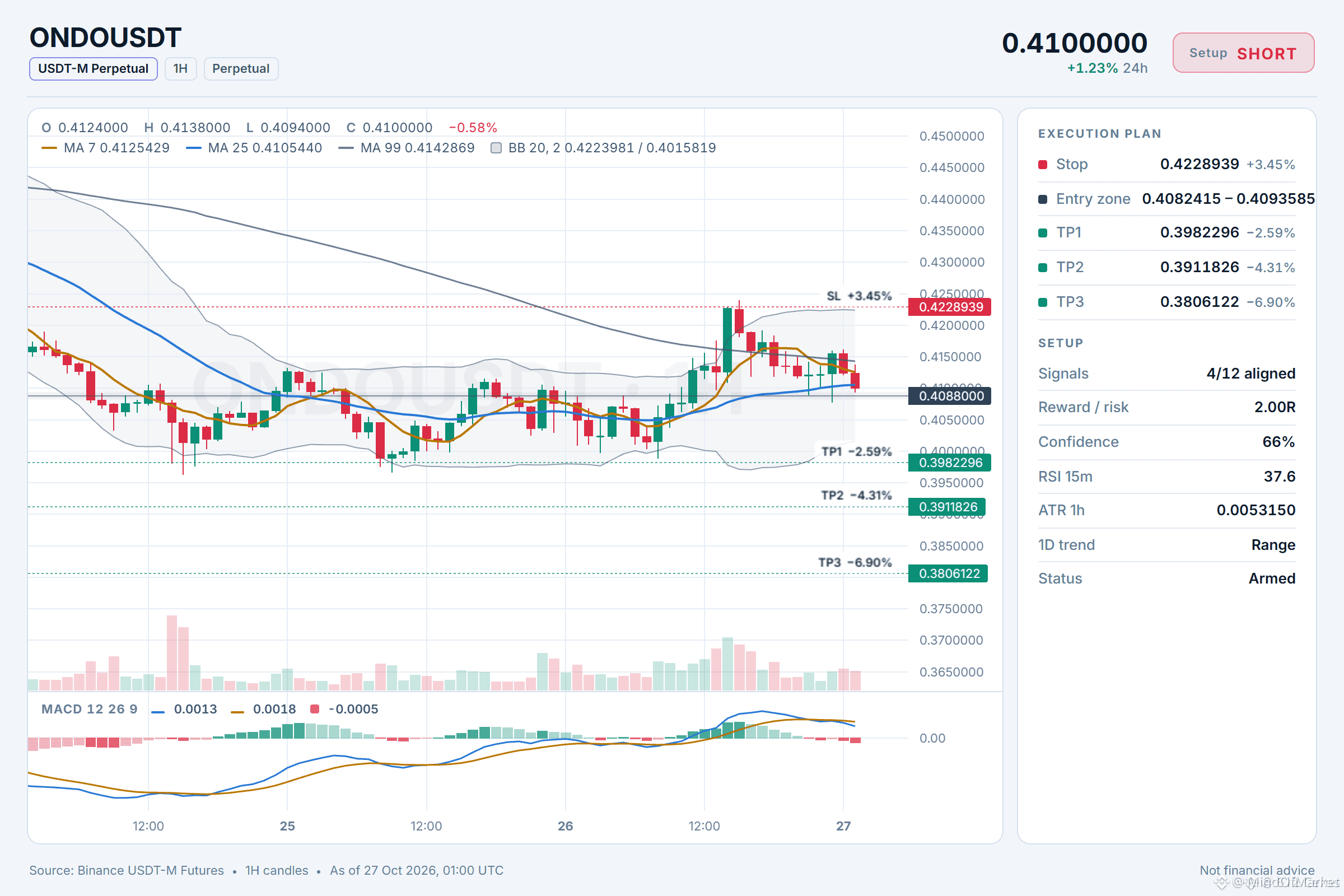
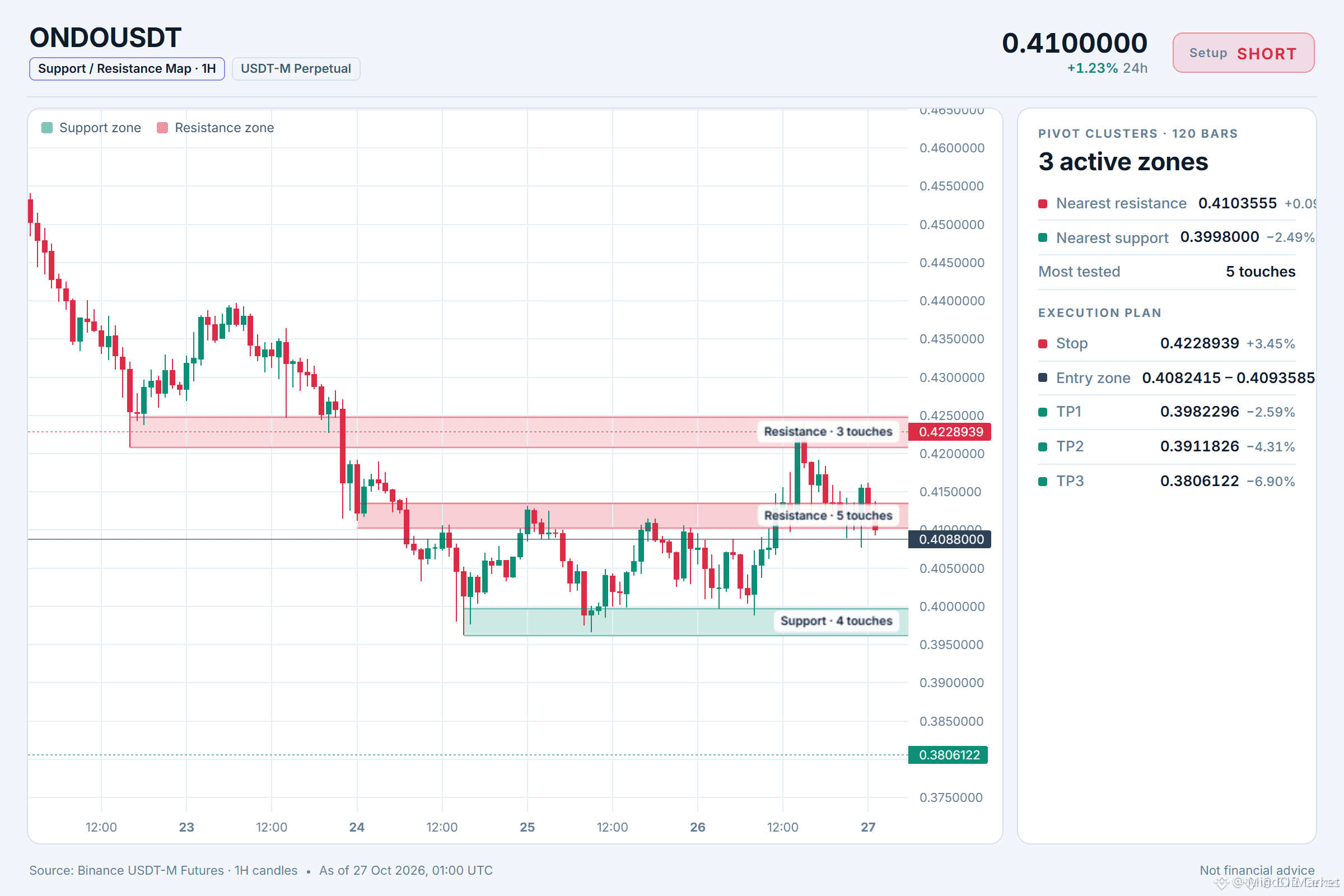
🔴 $ONDO PLUNGES THROUGH SELLER WALL – SHORT ALERT 📉
Entry: 0.4082415‑0.4093585 ⚡
Target: 0.3982296 / 0.3911826 / 0.3806122 🚀
Stop Loss: 0.4228939 ⚠️
📊 The 4H and 1H charts sit firmly below EMA50 & EMA200, confirming a multi‑timeframe downtrend. A 15‑minute ADX of 24.4 signals sellers are in control, while the price has respected the bearish stack zone on every retest. 🌊
⚡ Enter only within the tight 0.4082‑0.4094 range, liquidate 50% at TP1, then scale out at TP2 and TP3. After the first profit, shift the stop to breakeven to protect the remaining half. 💡
💬 How are you positioning your risk around the 0.4229 invalidation level? 👇
⚠️ Not financial advice. Always manage your risk. 🛡️
🏷️ #ONDO #ShortSetup #Liquidity #Technical #Crypto
🔥 🦈
🔴 $ONDO PLUNGES THROUGH SELLER WALL – SHORT ALERT 📉
Entry: 0.4082415‑0.4093585 ⚡
Target: 0.3982296 / 0.3911826 / 0.3806122 🚀
Stop Loss: 0.4228939 ⚠️
📊 The 4H and 1H charts sit firmly below EMA50 & EMA200, confirming a multi‑timeframe downtrend. A 15‑minute ADX of 24.4 signals sellers are in control, while the price has respected the bearish stack zone on every retest. 🌊
⚡ Enter only within the tight 0.4082‑0.4094 range, liquidate 50% at TP1, then scale out at TP2 and TP3. After the first profit, shift the stop to breakeven to protect the remaining half. 💡
💬 How are you positioning your risk around the 0.4229 invalidation level? 👇
⚠️ Not financial advice. Always manage your risk. 🛡️
🏷️ #ONDO #ShortSetup #Liquidity #Technical #Crypto
🔥 🦈
Entry: 0.4082415‑0.4093585 ⚡
Target: 0.3982296 / 0.3911826 / 0.3806122 🚀
Stop Loss: 0.4228939 ⚠️
📊 The 4H and 1H charts sit firmly below EMA50 & EMA200, confirming a multi‑timeframe downtrend. A 15‑minute ADX of 24.4 signals sellers are in control, while the price has respected the bearish stack zone on every retest. 🌊
⚡ Enter only within the tight 0.4082‑0.4094 range, liquidate 50% at TP1, then scale out at TP2 and TP3. After the first profit, shift the stop to breakeven to protect the remaining half. 💡
💬 How are you positioning your risk around the 0.4229 invalidation level? 👇
⚠️ Not financial advice. Always manage your risk. 🛡️
🏷️ #ONDO #ShortSetup #Liquidity #Technical #Crypto
🔥 🦈
6

🤖 ONDO BRINGS TOKENIZATION TO PRIVATE AI MARKETS!
Ondo plans to open subscriptions for a tokenized note linked to OpenAI's private-market value for eligible clients. 🌐 This highlights how blockchain may expand access to private-market exposure. ⚠️ Tokenized exposure is not the same as owning OpenAI shares. Eligibility, liquidity, and risks matter. #Ondo
{future}(ONDOUSDT)
#ONDO #OpenAI #RWA #Tokenization
🤖 ONDO BRINGS TOKENIZATION TO PRIVATE AI MARKETS!
Ondo plans to open subscriptions for a tokenized note linked to OpenAI's private-market value for eligible clients. 🌐 This highlights how blockchain may expand access to private-market exposure. ⚠️ Tokenized exposure is not the same as owning OpenAI shares. Eligibility, liquidity, and risks matter. #Ondo
#ONDO #OpenAI #RWA #Tokenization
Ondo plans to open subscriptions for a tokenized note linked to OpenAI's private-market value for eligible clients. 🌐 This highlights how blockchain may expand access to private-market exposure. ⚠️ Tokenized exposure is not the same as owning OpenAI shares. Eligibility, liquidity, and risks matter. #Ondo
#ONDO #OpenAI #RWA #Tokenization
1
74
·
--
🔴 $ONDO HEAVY SELL PRESSURE MOUNTING AS BUYERS LOSE GROUND AT KEY RESISTANCE! 📉
Entry: 0.347 - 0.357 🔥
Target: 0.343 - 0.315 🎯
Stop Loss: 0.380 ⚠️
$ONDO is crashing into a dense supply wall in the 0.347 - 0.357 zone where relentless sell orders are capping every attempt to push higher. 📉 Momentum is fading fast as aggressive distribution takes over the tape and late long positioning gets squeezed.
📊 Order flow clearly shows smart money leaning heavily into overhead resistance, paving the way for a high-velocity breakdown toward lower liquidity zones. 💡 With seller volume accelerating, the path of least resistance points sharply lower. 🤔 Are you riding this short setup or waiting to catch a bounce down below? 👇
⚠️ Not financial advice. Always manage your risk. 🛡️
🏷️ #ONDO #ShortSetup #Altcoins #Crypto
🐻 🩸
🔴 $ONDO HEAVY SELL PRESSURE MOUNTING AS BUYERS LOSE GROUND AT KEY RESISTANCE! 📉
Entry: 0.347 - 0.357 🔥
Target: 0.343 - 0.315 🎯
Stop Loss: 0.380 ⚠️
$ONDO is crashing into a dense supply wall in the 0.347 - 0.357 zone where relentless sell orders are capping every attempt to push higher. 📉 Momentum is fading fast as aggressive distribution takes over the tape and late long positioning gets squeezed.
📊 Order flow clearly shows smart money leaning heavily into overhead resistance, paving the way for a high-velocity breakdown toward lower liquidity zones. 💡 With seller volume accelerating, the path of least resistance points sharply lower. 🤔 Are you riding this short setup or waiting to catch a bounce down below? 👇
⚠️ Not financial advice. Always manage your risk. 🛡️
🏷️ #ONDO #ShortSetup #Altcoins #Crypto
🐻 🩸
Entry: 0.347 - 0.357 🔥
Target: 0.343 - 0.315 🎯
Stop Loss: 0.380 ⚠️
$ONDO is crashing into a dense supply wall in the 0.347 - 0.357 zone where relentless sell orders are capping every attempt to push higher. 📉 Momentum is fading fast as aggressive distribution takes over the tape and late long positioning gets squeezed.
📊 Order flow clearly shows smart money leaning heavily into overhead resistance, paving the way for a high-velocity breakdown toward lower liquidity zones. 💡 With seller volume accelerating, the path of least resistance points sharply lower. 🤔 Are you riding this short setup or waiting to catch a bounce down below? 👇
⚠️ Not financial advice. Always manage your risk. 🛡️
🏷️ #ONDO #ShortSetup #Altcoins #Crypto
🐻 🩸
6

·
--
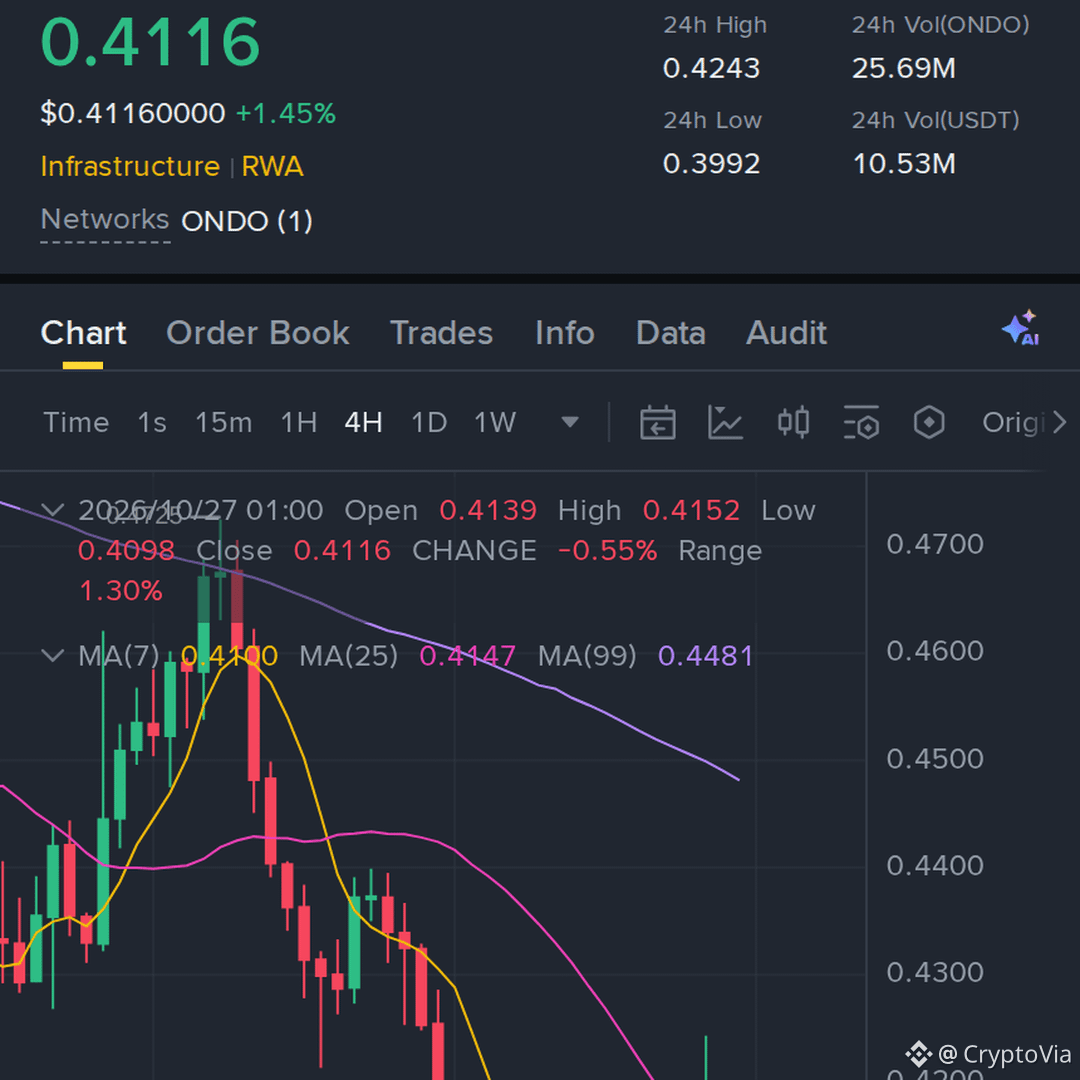
the structure on $ONDO, with a 49x leverage plan, is struggling to hold the recovery
Entry: 0.4111–0.4139
TP1: 0.3919 / TP2: 0.376 / TP3: 0.3548
Stop Loss: 0.4263
#ONDO #Write2Earn #Binance #crypto
the structure on $ONDO , with a 49x leverage plan, is struggling to hold the recovery
Entry: 0.4111–0.4139
TP1: 0.3919 / TP2: 0.376 / TP3: 0.3548
Stop Loss: 0.4263
#ONDO #Write2Earn #Binance #crypto
Entry: 0.4111–0.4139
TP1: 0.3919 / TP2: 0.376 / TP3: 0.3548
Stop Loss: 0.4263
#ONDO #Write2Earn #Binance #crypto
17

Market Focus: HYPE, CHIP and ONDO
HYPE is trading near $79.02, up about 2.4% over the latest 24 hours after moving between $74.99 and $80.65. With roughly $18.5M in spot turnover, Hyperliquid is showing strong participation and a recovery from the daily low, though the move remains sensitive to broader DeFi liquidity and market sentiment.
CHIP is trading around $0.05417, up approximately 19.0% in the latest 24 hours. The price expanded from a low of $0.04258 to a high of $0.05725, while spot turnover reached about $11.1M. This sharp move highlights strong momentum around the AI narrative, but the wide range also signals elevated volatility and potential rapid reversals.
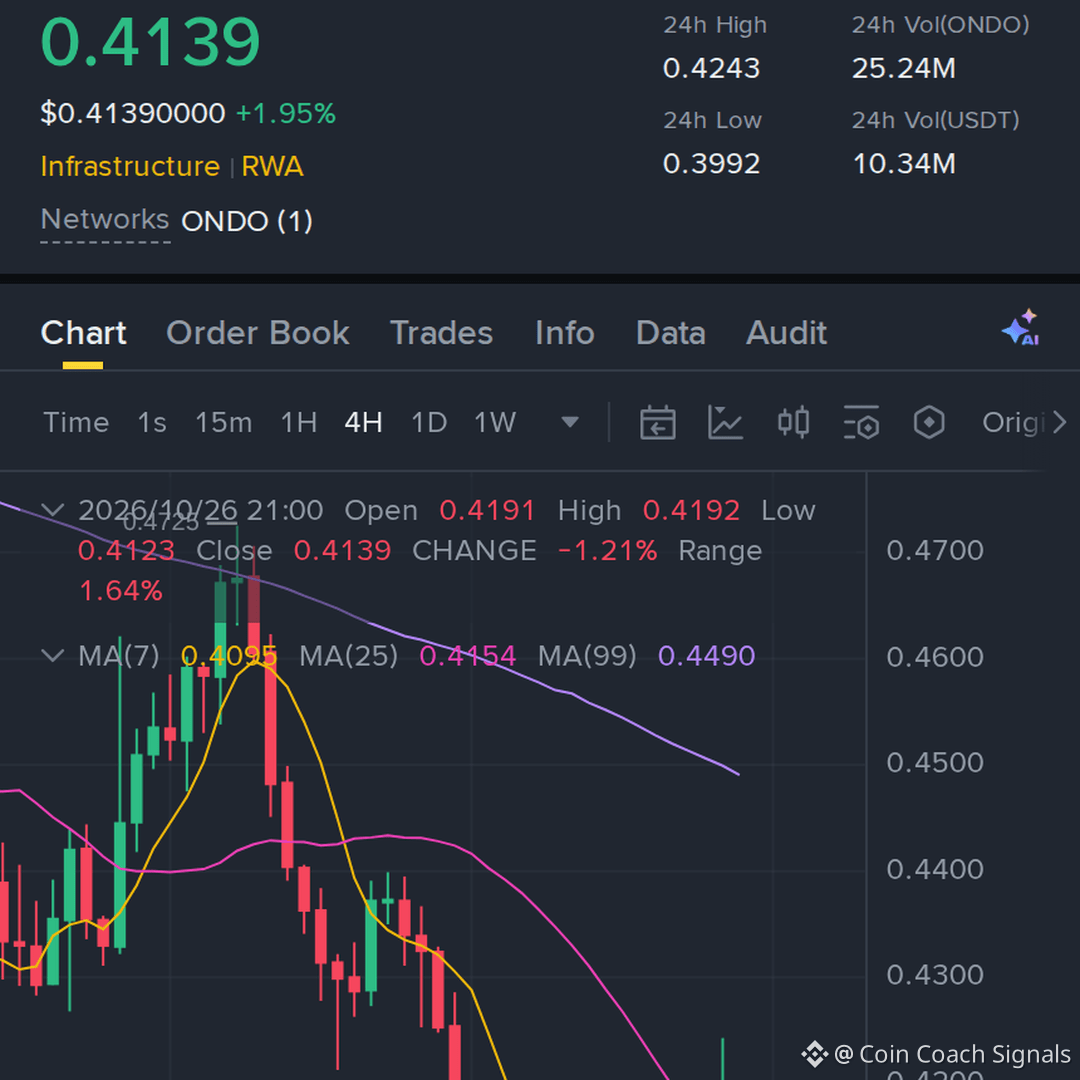
ONDO is changing hands near $0.4140, up about 1.5% over the latest 24 hours. After trading between $0.3992 and $0.4243, ONDO is holding a constructive range with more than $10.4M in spot volume. Its RWA narrative remains a key source of attention, although sustained volume will be important for continued momentum.
The market setup is clear: HYPE is showing steady DeFi strength, CHIP is carrying the highest momentum and volatility, while ONDO is consolidating with active interest in the RWA sector. Fast moving conditions reward patience, disciplined risk management, and close attention to liquidity.
#HYPE #CHIP #ONDO #CryptoMarket #Binance
$HYPE
{spot}(HYPEUSDT)
$CHIP
{spot}(CHIPUSDT)
$ONDO
{spot}(ONDOUSDT)
Market Focus: HYPE, CHIP and ONDO
HYPE is trading near $79.02, up about 2.4% over the latest 24 hours after moving between $74.99 and $80.65. With roughly $18.5M in spot turnover, Hyperliquid is showing strong participation and a recovery from the daily low, though the move remains sensitive to broader DeFi liquidity and market sentiment.
CHIP is trading around $0.05417, up approximately 19.0% in the latest 24 hours. The price expanded from a low of $0.04258 to a high of $0.05725, while spot turnover reached about $11.1M. This sharp move highlights strong momentum around the AI narrative, but the wide range also signals elevated volatility and potential rapid reversals.
ONDO is changing hands near $0.4140, up about 1.5% over the latest 24 hours. After trading between $0.3992 and $0.4243, ONDO is holding a constructive range with more than $10.4M in spot volume. Its RWA narrative remains a key source of attention, although sustained volume will be important for continued momentum.
The market setup is clear: HYPE is showing steady DeFi strength, CHIP is carrying the highest momentum and volatility, while ONDO is consolidating with active interest in the RWA sector. Fast moving conditions reward patience, disciplined risk management, and close attention to liquidity.
#HYPE #CHIP #ONDO #CryptoMarket #Binance
$HYPE
$CHIP
$ONDO
HYPE is trading near $79.02, up about 2.4% over the latest 24 hours after moving between $74.99 and $80.65. With roughly $18.5M in spot turnover, Hyperliquid is showing strong participation and a recovery from the daily low, though the move remains sensitive to broader DeFi liquidity and market sentiment.
CHIP is trading around $0.05417, up approximately 19.0% in the latest 24 hours. The price expanded from a low of $0.04258 to a high of $0.05725, while spot turnover reached about $11.1M. This sharp move highlights strong momentum around the AI narrative, but the wide range also signals elevated volatility and potential rapid reversals.
ONDO is changing hands near $0.4140, up about 1.5% over the latest 24 hours. After trading between $0.3992 and $0.4243, ONDO is holding a constructive range with more than $10.4M in spot volume. Its RWA narrative remains a key source of attention, although sustained volume will be important for continued momentum.
The market setup is clear: HYPE is showing steady DeFi strength, CHIP is carrying the highest momentum and volatility, while ONDO is consolidating with active interest in the RWA sector. Fast moving conditions reward patience, disciplined risk management, and close attention to liquidity.
#HYPE #CHIP #ONDO #CryptoMarket #Binance
$HYPE
$CHIP
$ONDO
9

·
--
Bullish
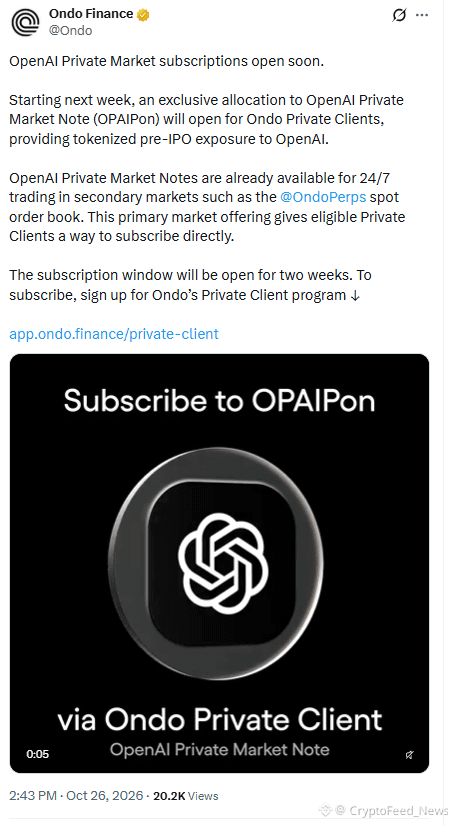
🚀 #OndoFinance plans to open subscriptions for its OpenAI-linked offering during the week of November 2, exclusively to eligible #ONDO Private Clients.
🔑 Key details:
📅 Subscription window lasts two weeks.
🤖 OPAIPon provides tokenized exposure linked to OpenAI’s share $OPENAI value at a qualifying liquidity event.
⚠️ These tokens are not OpenAI shares and provide no voting or dividend rights.
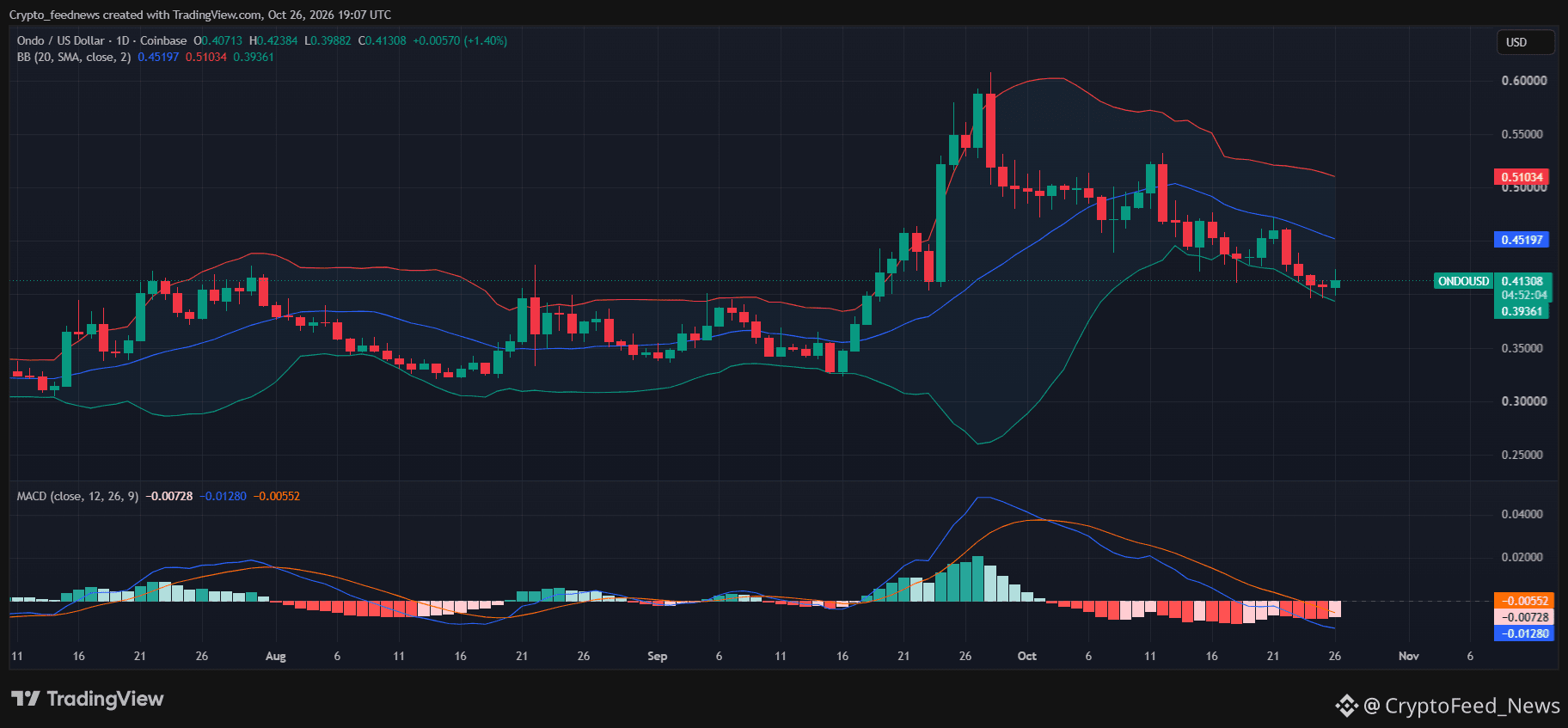
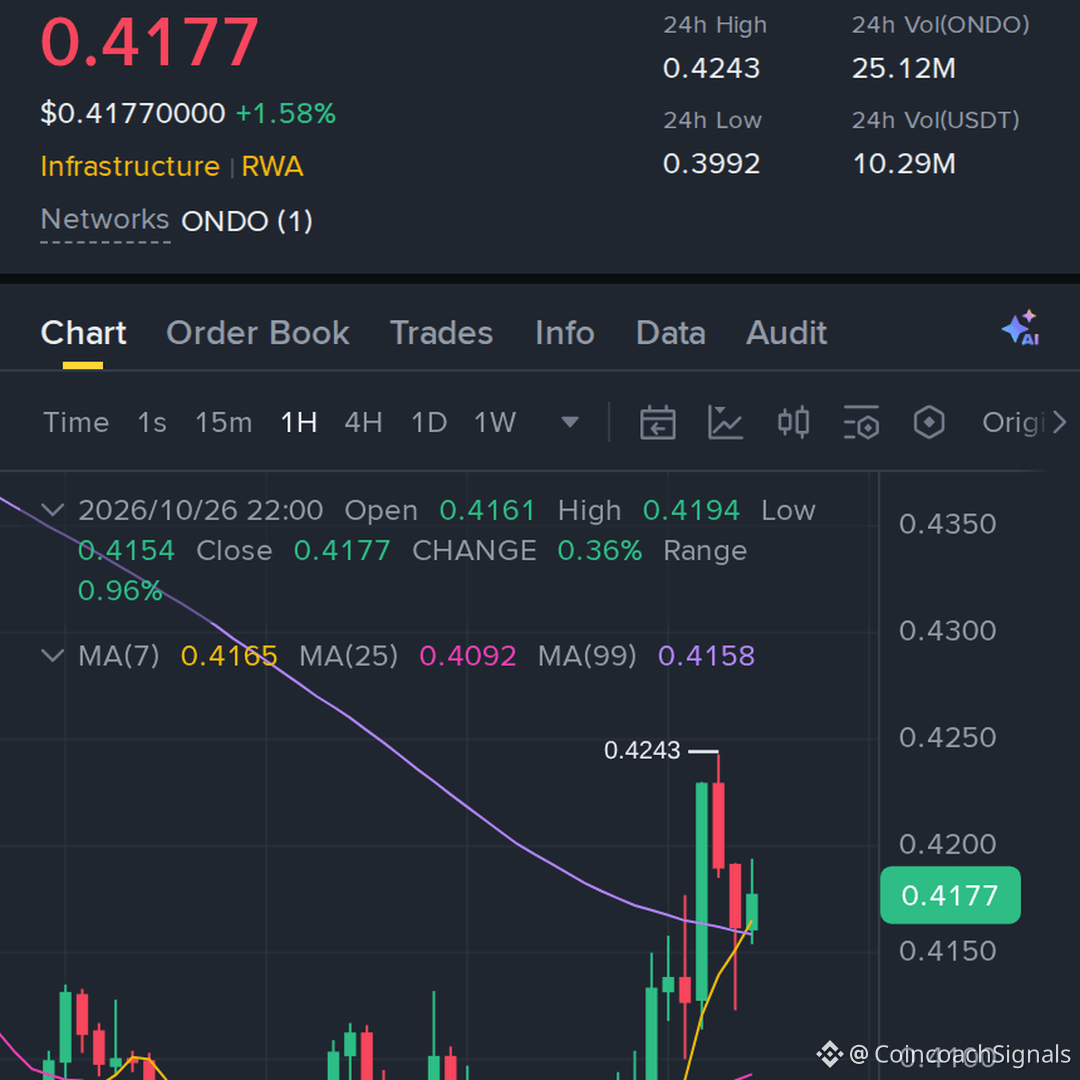
📈 $ONDO rose over 2% on Monday, reaching an intraday high near $0.423.
Meanwhile, OpenAI has not confirmed an IPO date, while rival Anthropic is reportedly moving ahead with its public-listing plans.
#Write2Earn
🚀 #OndoFinance plans to open subscriptions for its OpenAI-linked offering during the week of November 2, exclusively to eligible #ONDO Private Clients.
🔑 Key details:
📅 Subscription window lasts two weeks.
🤖 OPAIPon provides tokenized exposure linked to OpenAI’s share $OPENAI value at a qualifying liquidity event.
⚠️ These tokens are not OpenAI shares and provide no voting or dividend rights.
📈 $ONDO rose over 2% on Monday, reaching an intraday high near $0.423.
Meanwhile, OpenAI has not confirmed an IPO date, while rival Anthropic is reportedly moving ahead with its public-listing plans.
#Write2Earn
🔑 Key details:
📅 Subscription window lasts two weeks.
🤖 OPAIPon provides tokenized exposure linked to OpenAI’s share $OPENAI value at a qualifying liquidity event.
⚠️ These tokens are not OpenAI shares and provide no voting or dividend rights.
📈 $ONDO rose over 2% on Monday, reaching an intraday high near $0.423.
Meanwhile, OpenAI has not confirmed an IPO date, while rival Anthropic is reportedly moving ahead with its public-listing plans.
#Write2Earn
75

·
--
Bullish
$ONDO 🚀 ONDO (ONDO FINANCE) PRICE ANALYSIS 📊 | OCTOBER 26
🔥 Is ONDO Ready for a Breakout?
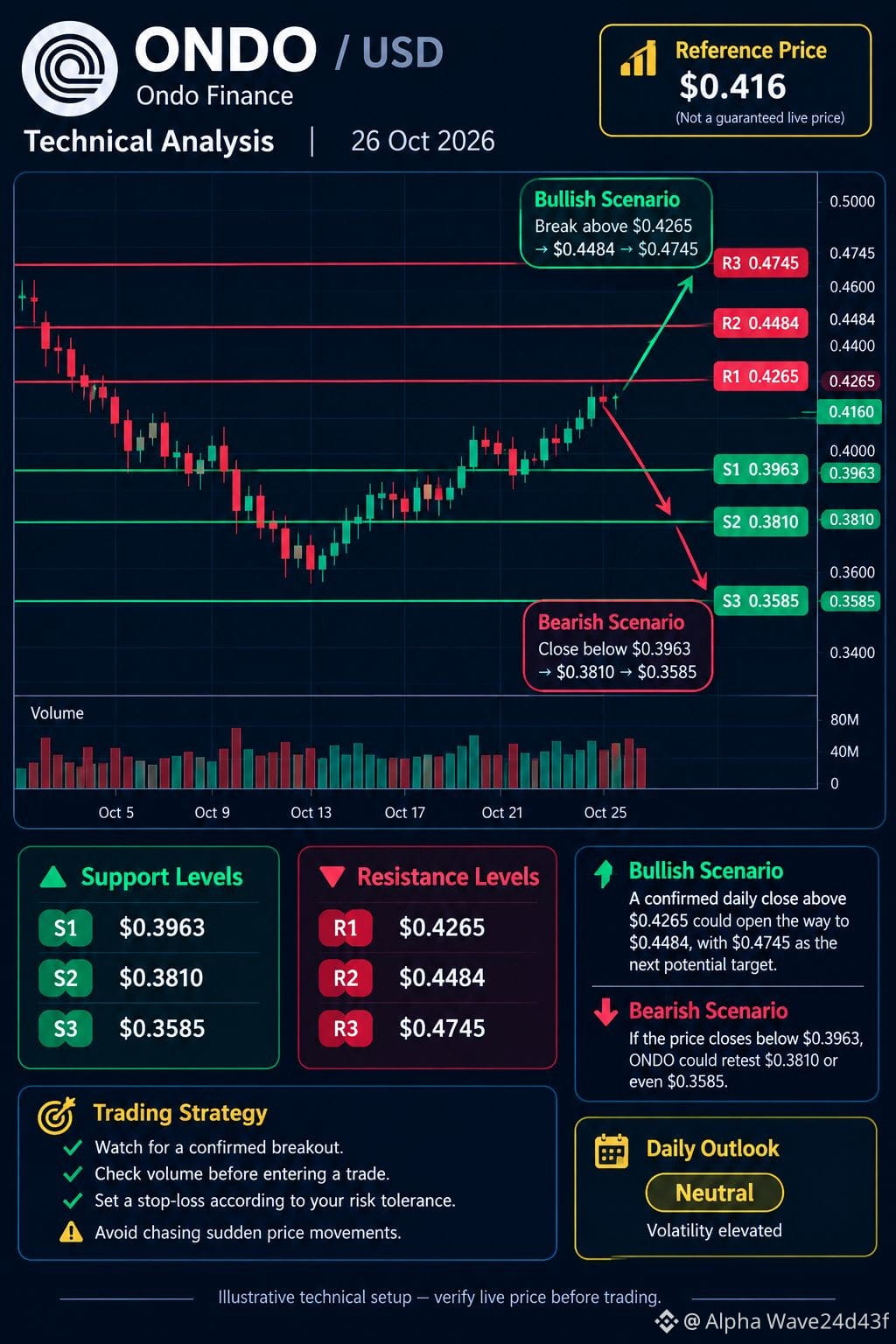
ONDO is trading near $0.416, with buyers attempting to push the price higher. The key level to watch is $0.4265. A confirmed breakout could strengthen the bullish setup, while losing support may trigger another pullback.
🟢 Key Support Levels
• S1: $0.3963
• S2: $0.3810
• S3: $0.3585
🔴 Key Resistance Levels
• R1: $0.4265
• R2: $0.4484
• R3: $0.4745
📈 Bullish Scenario: If ONDO breaks above $0.4265 with strong volume, the next potential targets are $0.4484 and $0.4745.
📉 Bearish Scenario: If the price falls below $0.3963, ONDO could retest $0.3810 or even $0.3585.
🎯 Trading Strategy
✅ Watch for a confirmed breakout.
✅ Check volume before entering a trade.
✅ Set a stop-loss according to your risk tolerance.
⚠️ Avoid chasing sudden price movements.
💬 Your Opinion:
Will ONDO break above $0.4265 and move toward $0.45, or will bears push it back toward $0.38?
🔥 Comment BULLISH 🚀 or BEARISH 📉 below!
#ONDO #OndoFinance #CryptoAnalysis #Altcoins #BinanceSquare
{spot}(ONDOUSDT)
$ONDO 🚀 ONDO (ONDO FINANCE) PRICE ANALYSIS 📊 | OCTOBER 26
🔥 Is ONDO Ready for a Breakout?
ONDO is trading near $0.416, with buyers attempting to push the price higher. The key level to watch is $0.4265. A confirmed breakout could strengthen the bullish setup, while losing support may trigger another pullback.
🟢 Key Support Levels
• S1: $0.3963
• S2: $0.3810
• S3: $0.3585
🔴 Key Resistance Levels
• R1: $0.4265
• R2: $0.4484
• R3: $0.4745
📈 Bullish Scenario: If ONDO breaks above $0.4265 with strong volume, the next potential targets are $0.4484 and $0.4745.
📉 Bearish Scenario: If the price falls below $0.3963, ONDO could retest $0.3810 or even $0.3585.
🎯 Trading Strategy
✅ Watch for a confirmed breakout.
✅ Check volume before entering a trade.
✅ Set a stop-loss according to your risk tolerance.
⚠️ Avoid chasing sudden price movements.
💬 Your Opinion:
Will ONDO break above $0.4265 and move toward $0.45, or will bears push it back toward $0.38?
🔥 Comment BULLISH 🚀 or BEARISH 📉 below!
#ONDO #OndoFinance #CryptoAnalysis #Altcoins #BinanceSquare
🔥 Is ONDO Ready for a Breakout?
ONDO is trading near $0.416, with buyers attempting to push the price higher. The key level to watch is $0.4265. A confirmed breakout could strengthen the bullish setup, while losing support may trigger another pullback.
🟢 Key Support Levels
• S1: $0.3963
• S2: $0.3810
• S3: $0.3585
🔴 Key Resistance Levels
• R1: $0.4265
• R2: $0.4484
• R3: $0.4745
📈 Bullish Scenario: If ONDO breaks above $0.4265 with strong volume, the next potential targets are $0.4484 and $0.4745.
📉 Bearish Scenario: If the price falls below $0.3963, ONDO could retest $0.3810 or even $0.3585.
🎯 Trading Strategy
✅ Watch for a confirmed breakout.
✅ Check volume before entering a trade.
✅ Set a stop-loss according to your risk tolerance.
⚠️ Avoid chasing sudden price movements.
💬 Your Opinion:
Will ONDO break above $0.4265 and move toward $0.45, or will bears push it back toward $0.38?
🔥 Comment BULLISH 🚀 or BEARISH 📉 below!
#ONDO #OndoFinance #CryptoAnalysis #Altcoins #BinanceSquare
92

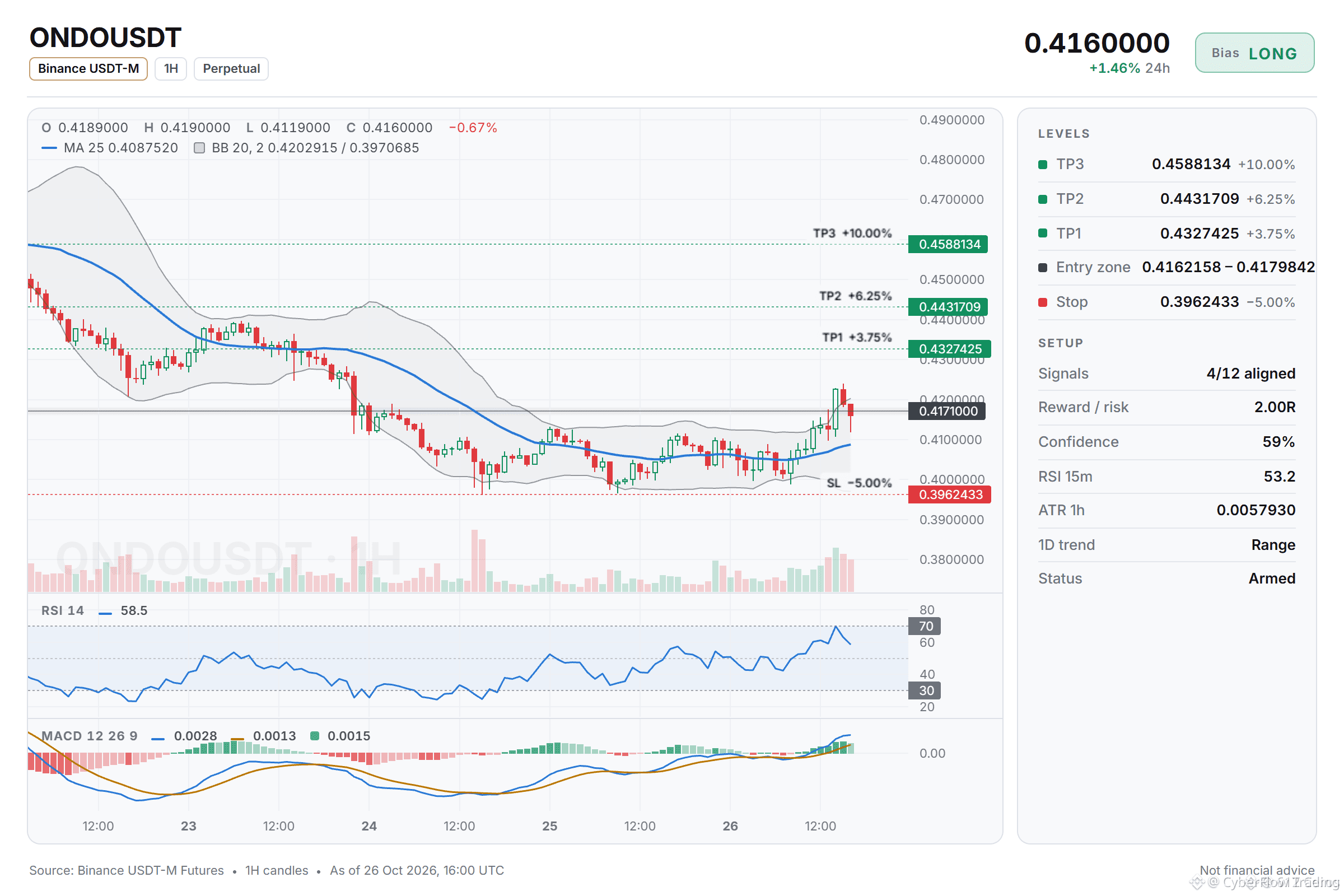
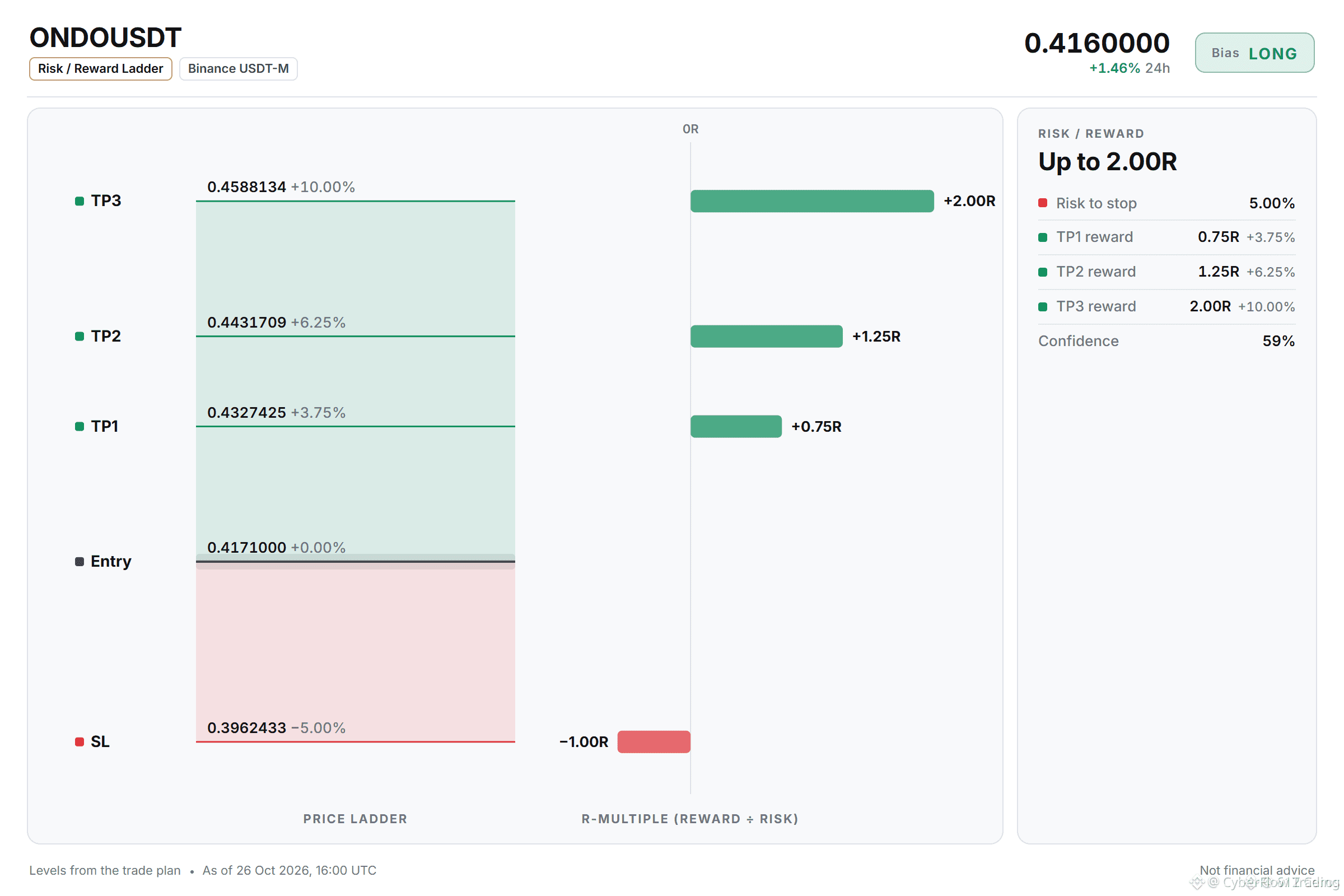
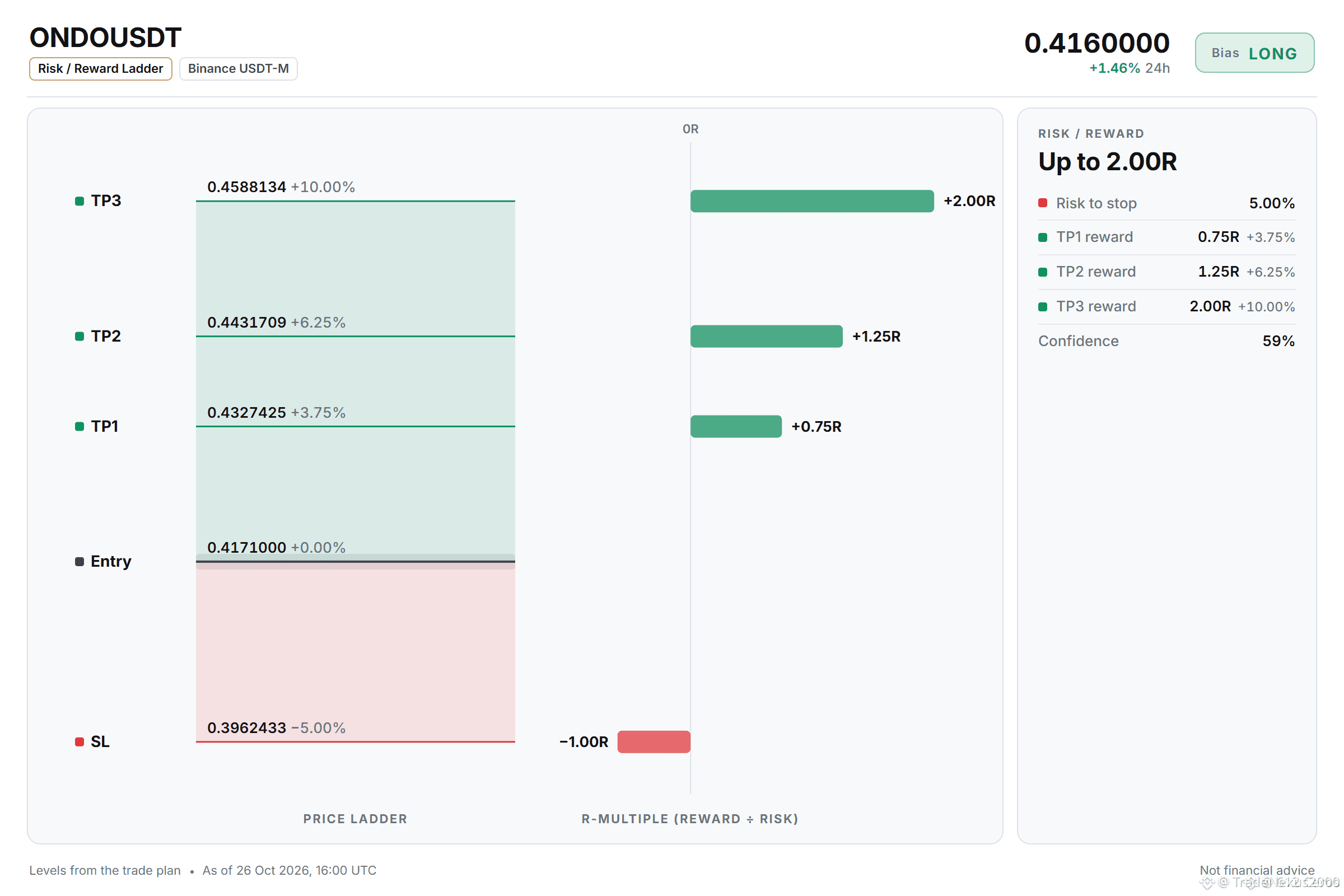
🚀 $ONDO READY TO BREAK ABOVE ZONE – LIGHT LONG WITH MODERATE CONVICTION 🟢
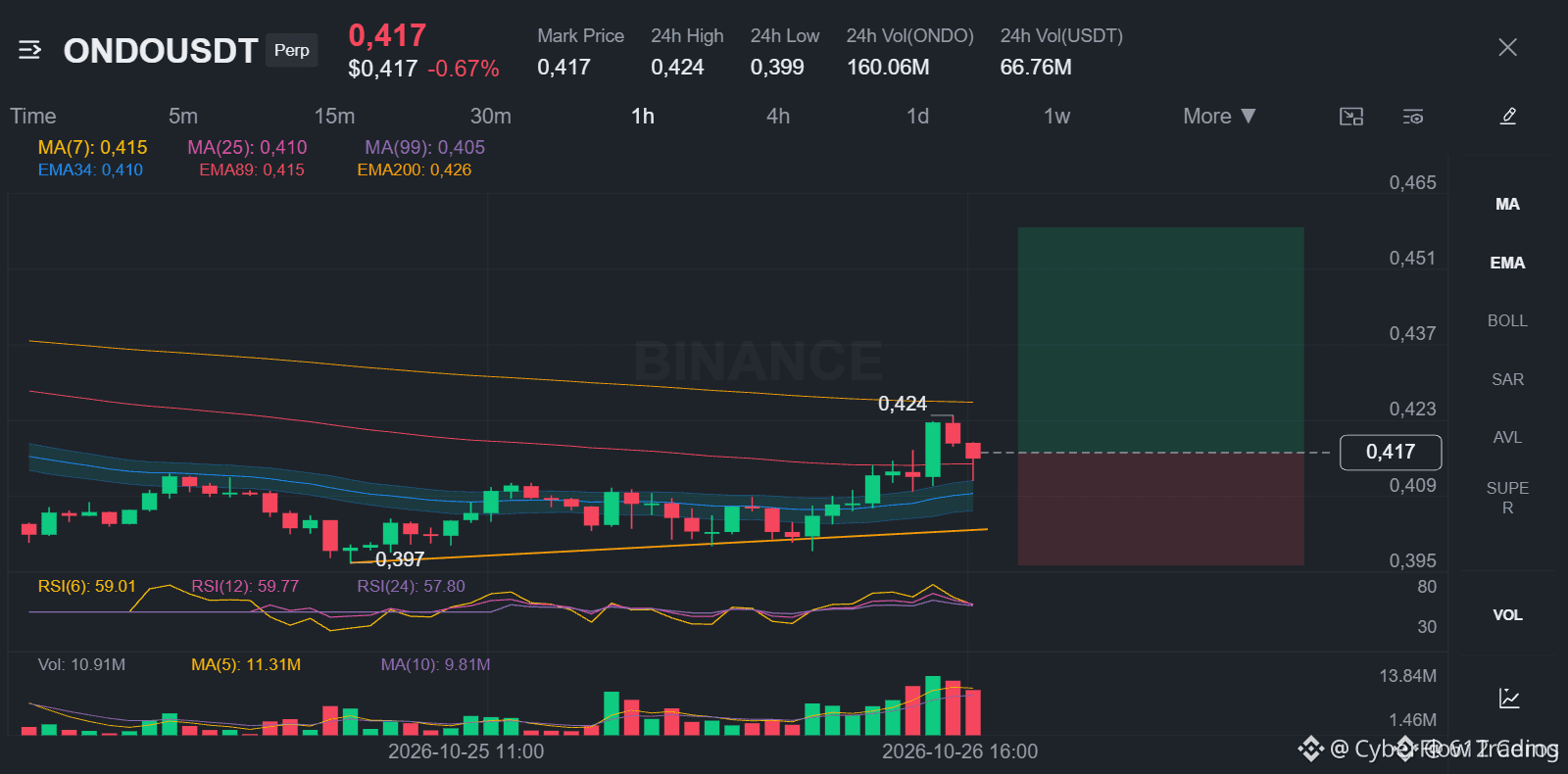
Entry: 0.4162158 – 0.4179842 ⚡
Target: 0.4327425 🚀
Target: 0.4431709 🚀
Target: 0.4588134 🚀
Stop Loss: 0.3962433 ⚠️
📊 Buyers are steering the ship, 15m ADX flashing 33.5 and 1h RSI holding 58.5 – momentum’s still alive. 🦈 BTC’s upward drift (corr 0.76) drags $ONDO along, and the 4‑hour EMA50/200 whisper a cautious downtrend, keeping conviction moderate. 💡 Slip into the tight 0.4162‑0.4180 band, lock 50% at TP1, then scale out as price climbs, nudging the stop to breakeven after the first win.
💬 How tight will you keep your stop once the trade hits TP1? 👇
⚠️ Not financial advice. Always manage your risk. 🛡️
🏷️ #ONDO #LongSetup #Crypto #Momentum
🔥 💎
🚀 $ONDO READY TO BREAK ABOVE ZONE – LIGHT LONG WITH MODERATE CONVICTION 🟢
Entry: 0.4162158 – 0.4179842 ⚡
Target: 0.4327425 🚀
Target: 0.4431709 🚀
Target: 0.4588134 🚀
Stop Loss: 0.3962433 ⚠️
📊 Buyers are steering the ship, 15m ADX flashing 33.5 and 1h RSI holding 58.5 – momentum’s still alive. 🦈 BTC’s upward drift (corr 0.76) drags $ONDO along, and the 4‑hour EMA50/200 whisper a cautious downtrend, keeping conviction moderate. 💡 Slip into the tight 0.4162‑0.4180 band, lock 50% at TP1, then scale out as price climbs, nudging the stop to breakeven after the first win.
💬 How tight will you keep your stop once the trade hits TP1? 👇
⚠️ Not financial advice. Always manage your risk. 🛡️
🏷️ #ONDO #LongSetup #Crypto #Momentum
🔥 💎
Entry: 0.4162158 – 0.4179842 ⚡
Target: 0.4327425 🚀
Target: 0.4431709 🚀
Target: 0.4588134 🚀
Stop Loss: 0.3962433 ⚠️
📊 Buyers are steering the ship, 15m ADX flashing 33.5 and 1h RSI holding 58.5 – momentum’s still alive. 🦈 BTC’s upward drift (corr 0.76) drags $ONDO along, and the 4‑hour EMA50/200 whisper a cautious downtrend, keeping conviction moderate. 💡 Slip into the tight 0.4162‑0.4180 band, lock 50% at TP1, then scale out as price climbs, nudging the stop to breakeven after the first win.
💬 How tight will you keep your stop once the trade hits TP1? 👇
⚠️ Not financial advice. Always manage your risk. 🛡️
🏷️ #ONDO #LongSetup #Crypto #Momentum
🔥 💎
4

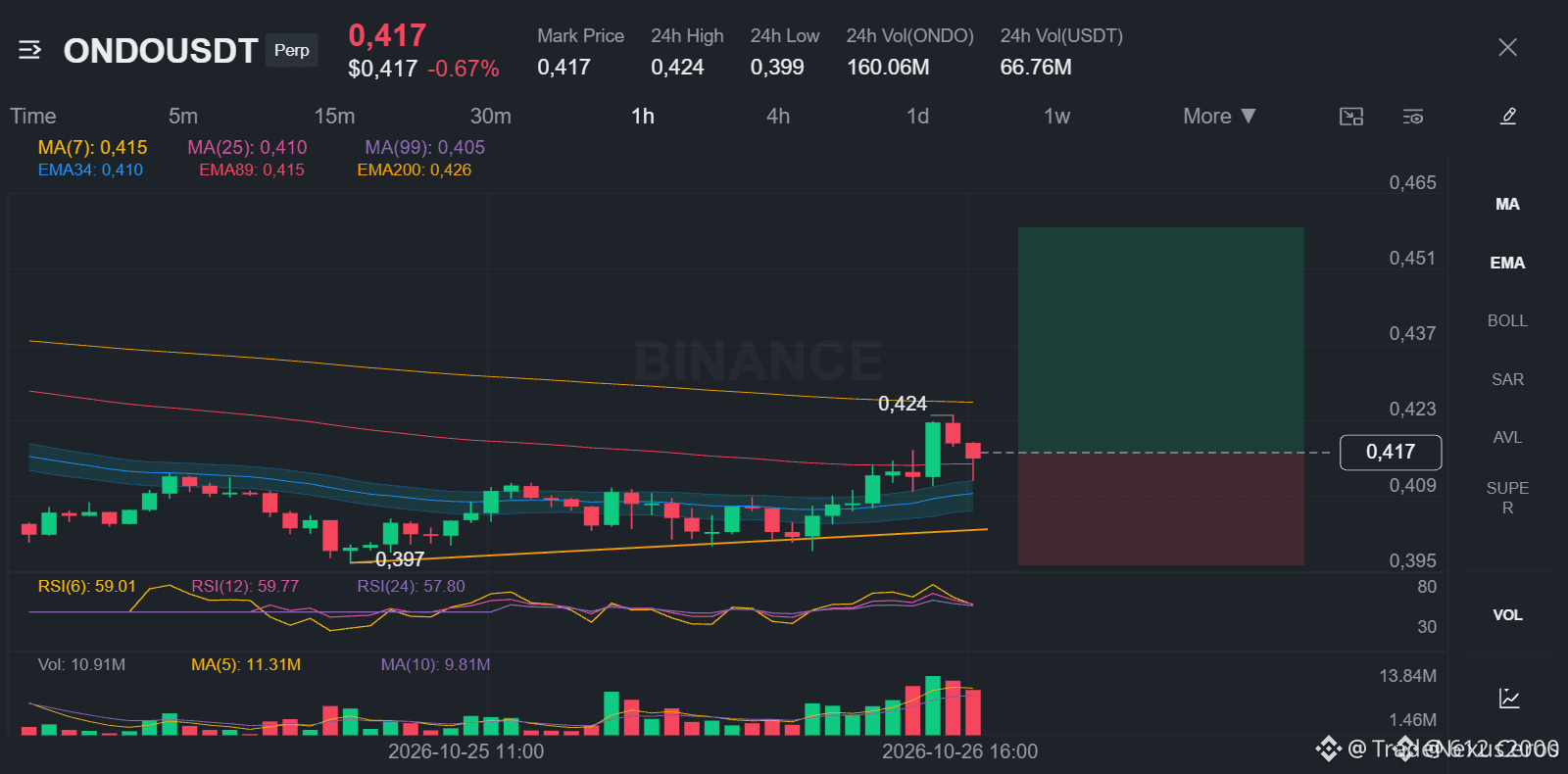
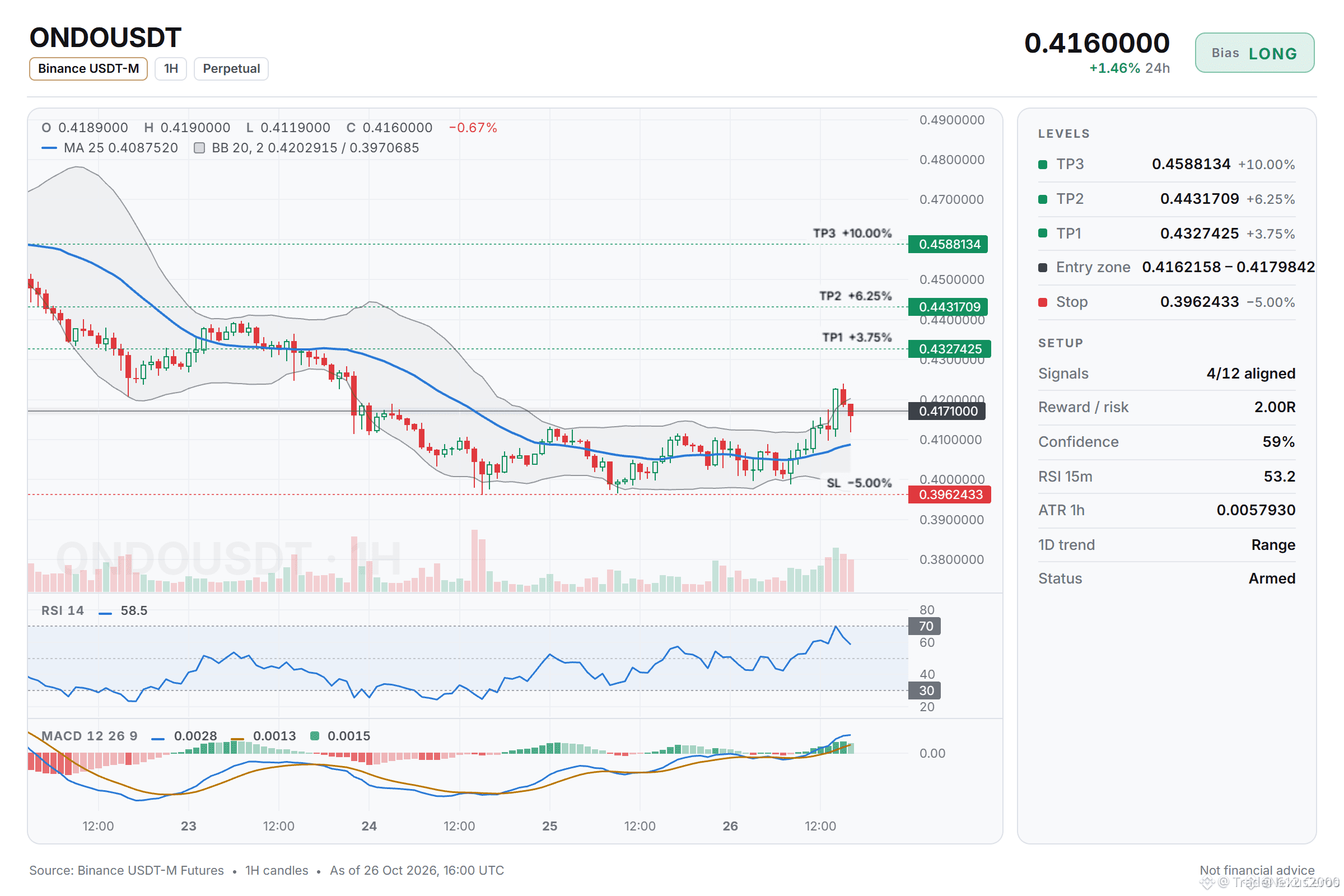
🚀 $ONDO LOOKS SET TO SURGE THROUGH BUYING ZONE! 📈
Entry: 0.4162158‑0.4179842 ⚡
Target: 0.4327425 🚀
Target: 0.4431709 🚀
Target: 0.4588134 🚀
Stop Loss: 0.3962433 ⚠️
📊 The 15‑minute ADX at 33.5 confirms buyers are steering the market, while the 1‑hour RSI holds steady at 58.5, indicating lingering bullish momentum. 🦈 BTC’s upward drift (corr 0.76) drags ONDO along, yet the 4‑hour EMA50/200 stack below price warns of a possible pullback. 📌 Moderate conviction calls for a light position, with a tiered exit plan to lock in 3.8‑10% gains and a stop moved to breakeven after TP1. 💡 How will you size your stake to balance risk and reward? 💬
⚠️ Not financial advice. Always manage your risk. 🛡️
🏷️ #ONDO #LongSetup #SmartMoney #Crypto #Trade
🔥 💎
🚀 $ONDO LOOKS SET TO SURGE THROUGH BUYING ZONE! 📈
Entry: 0.4162158‑0.4179842 ⚡
Target: 0.4327425 🚀
Target: 0.4431709 🚀
Target: 0.4588134 🚀
Stop Loss: 0.3962433 ⚠️
📊 The 15‑minute ADX at 33.5 confirms buyers are steering the market, while the 1‑hour RSI holds steady at 58.5, indicating lingering bullish momentum. 🦈 BTC’s upward drift (corr 0.76) drags ONDO along, yet the 4‑hour EMA50/200 stack below price warns of a possible pullback. 📌 Moderate conviction calls for a light position, with a tiered exit plan to lock in 3.8‑10% gains and a stop moved to breakeven after TP1. 💡 How will you size your stake to balance risk and reward? 💬
⚠️ Not financial advice. Always manage your risk. 🛡️
🏷️ #ONDO #LongSetup #SmartMoney #Crypto #Trade
🔥 💎
Entry: 0.4162158‑0.4179842 ⚡
Target: 0.4327425 🚀
Target: 0.4431709 🚀
Target: 0.4588134 🚀
Stop Loss: 0.3962433 ⚠️
📊 The 15‑minute ADX at 33.5 confirms buyers are steering the market, while the 1‑hour RSI holds steady at 58.5, indicating lingering bullish momentum. 🦈 BTC’s upward drift (corr 0.76) drags ONDO along, yet the 4‑hour EMA50/200 stack below price warns of a possible pullback. 📌 Moderate conviction calls for a light position, with a tiered exit plan to lock in 3.8‑10% gains and a stop moved to breakeven after TP1. 💡 How will you size your stake to balance risk and reward? 💬
⚠️ Not financial advice. Always manage your risk. 🛡️
🏷️ #ONDO #LongSetup #SmartMoney #Crypto #Trade
🔥 💎
5


·
--
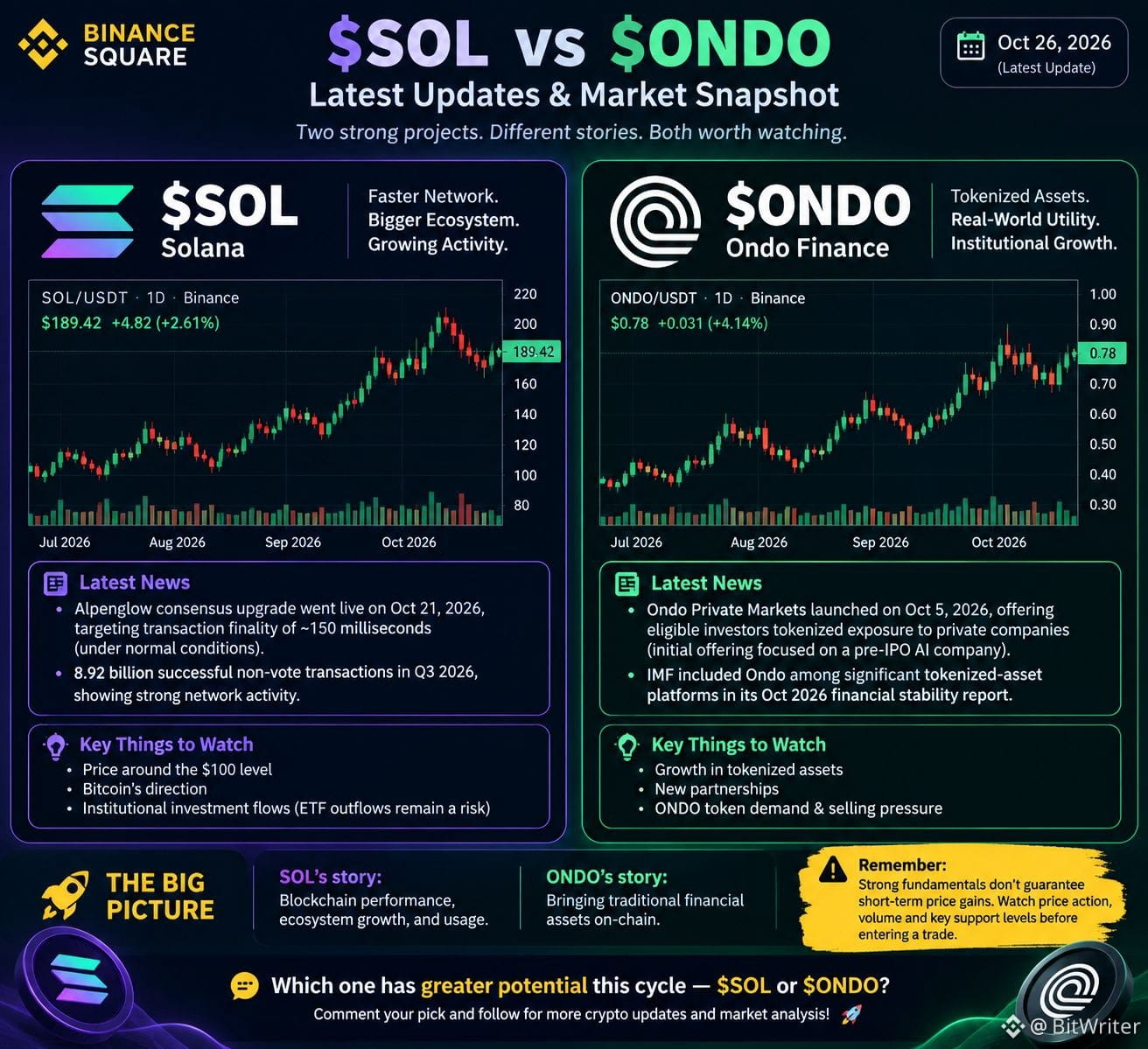
🚨 $SOL vs $ONDO: TWO CRYPTO PROJECTS TO WATCH! 🔥
🟣 $SOL (Solana)
Solana's Alpenglow upgrade is now live, targeting much faster transaction finality. Network activity is also growing, but SOL still faces market volatility and investment-flow risks.
🟢 $ONDO (Ondo Finance)
Ondo is expanding into tokenized real-world assets, including private-market investment products. Its growing presence in tokenization makes it a project worth watching.
📊 My take:
SOL's story is about blockchain performance and ecosystem growth.
ONDO's story is about bringing traditional financial assets on-chain .
👇 Which one has greater potential this cycle — $SOL or $ONDO?
Comment your pick and follow for more crypto updates and market analysis! 🚀
#solana #ONDO
{spot}(SOLUSDT)
{spot}(ONDOUSDT)
🚨 $SOL vs $ONDO: TWO CRYPTO PROJECTS TO WATCH! 🔥
🟣 $SOL (Solana)
Solana's Alpenglow upgrade is now live, targeting much faster transaction finality. Network activity is also growing, but SOL still faces market volatility and investment-flow risks.
🟢 $ONDO (Ondo Finance)
Ondo is expanding into tokenized real-world assets, including private-market investment products. Its growing presence in tokenization makes it a project worth watching.
📊 My take:
SOL's story is about blockchain performance and ecosystem growth.
ONDO's story is about bringing traditional financial assets on-chain .
👇 Which one has greater potential this cycle — $SOL or $ONDO?
Comment your pick and follow for more crypto updates and market analysis! 🚀
#solana #ONDO
🟣 $SOL (Solana)
Solana's Alpenglow upgrade is now live, targeting much faster transaction finality. Network activity is also growing, but SOL still faces market volatility and investment-flow risks.
🟢 $ONDO (Ondo Finance)
Ondo is expanding into tokenized real-world assets, including private-market investment products. Its growing presence in tokenization makes it a project worth watching.
📊 My take:
SOL's story is about blockchain performance and ecosystem growth.
ONDO's story is about bringing traditional financial assets on-chain .
👇 Which one has greater potential this cycle — $SOL or $ONDO?
Comment your pick and follow for more crypto updates and market analysis! 🚀
#solana #ONDO
38


·
--
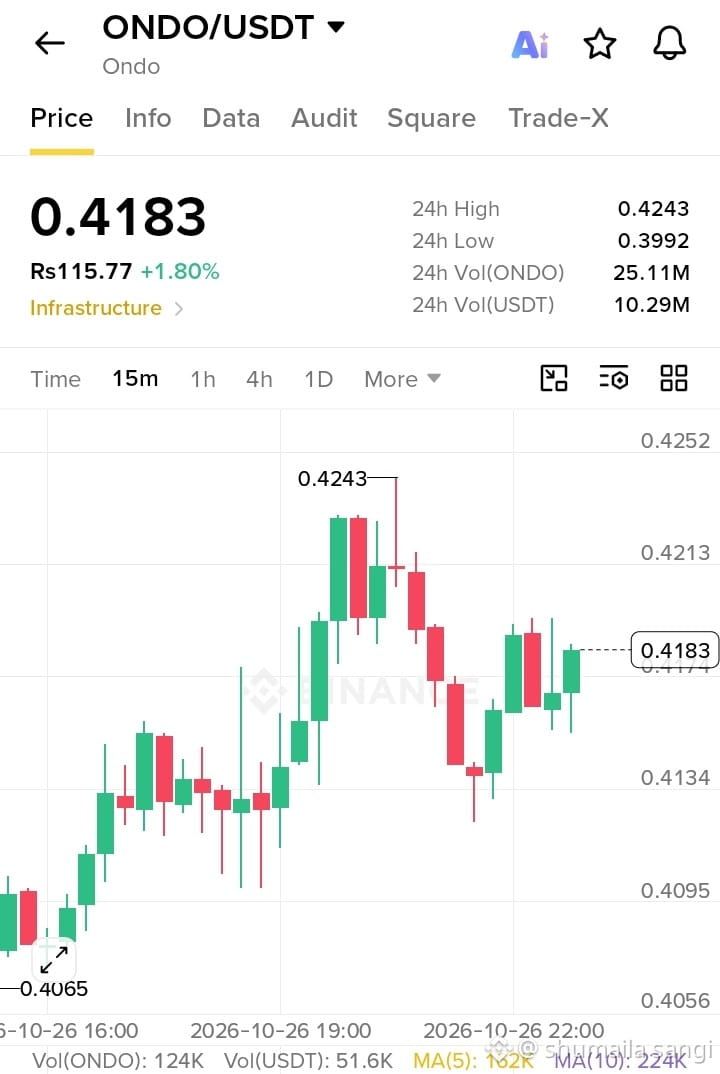
$ONDO holding $0.4183 on $10.25M daily volume shows measured interest.
The asset recently traded between a 23-hour low of $0.3992 and a high of $0.4243.
A bullish confirmation scenario depends on a sustained move past the $0.4243 high with expanding volume. Conversely, an invalidation risk remains if price slips below the $0.3992 low, pointing to exhausted momentum.
Will volume expand to support a push past the high, or will it fade below the low? Check the chart to see which level breaks first
Tap $ONDO for the live chart. #ONDO #BinanceSquare
$ONDO holding $0.4183 on $10.25M daily volume shows measured interest.
The asset recently traded between a 23-hour low of $0.3992 and a high of $0.4243.
A bullish confirmation scenario depends on a sustained move past the $0.4243 high with expanding volume. Conversely, an invalidation risk remains if price slips below the $0.3992 low, pointing to exhausted momentum.
Will volume expand to support a push past the high, or will it fade below the low? Check the chart to see which level breaks first
Tap $ONDO for the live chart. #ONDO #BinanceSquare
The asset recently traded between a 23-hour low of $0.3992 and a high of $0.4243.
A bullish confirmation scenario depends on a sustained move past the $0.4243 high with expanding volume. Conversely, an invalidation risk remains if price slips below the $0.3992 low, pointing to exhausted momentum.
Will volume expand to support a push past the high, or will it fade below the low? Check the chart to see which level breaks first
Tap $ONDO for the live chart. #ONDO #BinanceSquare
5



·
--
Everyone is chasing the next meme coin but very few are talking about real world asset tokenization
$ONDO is focused on bringing traditional financial assets onchain and this is a crypto narrative worth understanding
Do you think $ONDO and other RWA tokens could become a major part of the next crypto cycle or will meme coins still dominate the market
Share your opinion and let us discuss it
#Ondo #OndoCoin #usd #EarningsSeason #BinanceSquareTalks
{spot}(ONDOUSDT)
Everyone is chasing the next meme coin but very few are talking about real world asset tokenization
$ONDO is focused on bringing traditional financial assets onchain and this is a crypto narrative worth understanding
Do you think $ONDO and other RWA tokens could become a major part of the next crypto cycle or will meme coins still dominate the market
Share your opinion and let us discuss it
#Ondo #OndoCoin #usd #EarningsSeason #BinanceSquareTalks
$ONDO is focused on bringing traditional financial assets onchain and this is a crypto narrative worth understanding
Do you think $ONDO and other RWA tokens could become a major part of the next crypto cycle or will meme coins still dominate the market
Share your opinion and let us discuss it
#Ondo #OndoCoin #usd #EarningsSeason #BinanceSquareTalks
1
90

·
--
$ONDO 🚀 $ONDO LONG SETUP 🟢
$ONDO is showing impressive strength today, breaking above recent consolidation zones with solid buying pressure. The consistent upward momentum and healthy volume indicate that bulls are firmly in control of the trend.
📊 24h: +3.72% | Vol: $10,027,439.69
📈 TRADE PLAN
🔹 Entry: 0.4207
🛑 Stop Loss: 0.4137
🎯 TP1: 0.4312
🎯 TP2: 0.4382
🎯 TP3: 0.4487
⚖️ Risk:Reward (TP1): 1:1.50
🔔 Trigger: A sustained 15-minute candle close above the 0.4230 resistance level would confirm further bullish continuation for $ONDO.
⚠️ Risk Note: High volatility is common during breakouts; ensure your stop loss is strictly maintained to manage downside risk.
Always wait for the price to consolidate before confirming your position entry.
Click below 👇🏻 to trade
$ONDO
Follow @TZX_Crypto for more updates...
#ONDO #CryptoTrading #MarketAnalysis #BinanceSquare
$ONDO 🚀 $ONDO LONG SETUP 🟢
$ONDO is showing impressive strength today, breaking above recent consolidation zones with solid buying pressure. The consistent upward momentum and healthy volume indicate that bulls are firmly in control of the trend.
📊 24h: +3.72% | Vol: $10,027,439.69
📈 TRADE PLAN
🔹 Entry: 0.4207
🛑 Stop Loss: 0.4137
🎯 TP1: 0.4312
🎯 TP2: 0.4382
🎯 TP3: 0.4487
⚖️ Risk:Reward (TP1): 1:1.50
🔔 Trigger: A sustained 15-minute candle close above the 0.4230 resistance level would confirm further bullish continuation for $ONDO .
⚠️ Risk Note: High volatility is common during breakouts; ensure your stop loss is strictly maintained to manage downside risk.
Always wait for the price to consolidate before confirming your position entry.
Click below 👇🏻 to trade
$ONDO
Follow @TZX_Crypto for more updates...
#ONDO #CryptoTrading #MarketAnalysis #BinanceSquare
$ONDO is showing impressive strength today, breaking above recent consolidation zones with solid buying pressure. The consistent upward momentum and healthy volume indicate that bulls are firmly in control of the trend.
📊 24h: +3.72% | Vol: $10,027,439.69
📈 TRADE PLAN
🔹 Entry: 0.4207
🛑 Stop Loss: 0.4137
🎯 TP1: 0.4312
🎯 TP2: 0.4382
🎯 TP3: 0.4487
⚖️ Risk:Reward (TP1): 1:1.50
🔔 Trigger: A sustained 15-minute candle close above the 0.4230 resistance level would confirm further bullish continuation for $ONDO .
⚠️ Risk Note: High volatility is common during breakouts; ensure your stop loss is strictly maintained to manage downside risk.
Always wait for the price to consolidate before confirming your position entry.
Click below 👇🏻 to trade
$ONDO
Follow @TZX_Crypto for more updates...
#ONDO #CryptoTrading #MarketAnalysis #BinanceSquare
12
Log in to explore more content
Join global crypto users on Binance Square
⚡️ Get latest and useful information about crypto.
💬 Trusted by the world’s largest crypto exchange.
👍 Discover real insights from verified creators.
Email / Phone number
Trending Topics
1
#BinancePick
3.3M views
162,790 Discussing
2
#EarningsSeason
5.4M views
26,674 Discussing
3
#StrategySkipsBitcoinPurchasesSpends$205MOnSTRCBuybacks
290 views
17 Discussing
4
#BitmineAdds10452ETH
5,467 views
150 Discussing
5
#SouthKoreaConsidersEducationTaxOnCryptoExchanges
5,090 views
133 Discussing
6
#OCCUrgesCommunityBanksToEnterStablecoinPayments
4,253 views
85 Discussing
7
#RippleWinsFullApprovalAsNationalTrustBank
4,125 views
90 Discussing
8
#AkashSelectsSolanaAsMigrationTarget
2,357 views
31 Discussing
9
#OndoToOpenSubscriptionsForOpenAIPreIPOTokenizedNotes
154 views
11 Discussing
10
#AnthropicTTMRevenueGrewAbout1200%
54,541 views
554 Discussing