
#deepdrive
deepdrive
19 views
2 Discussing
Hot
Latest


0xSignal
·
--
$DASH Just Pumped 35% — But the Real Story Is Hidden Beneath the Price
🧠 0xSIGNAL RESEARCH — $DASH DEEP DIVE
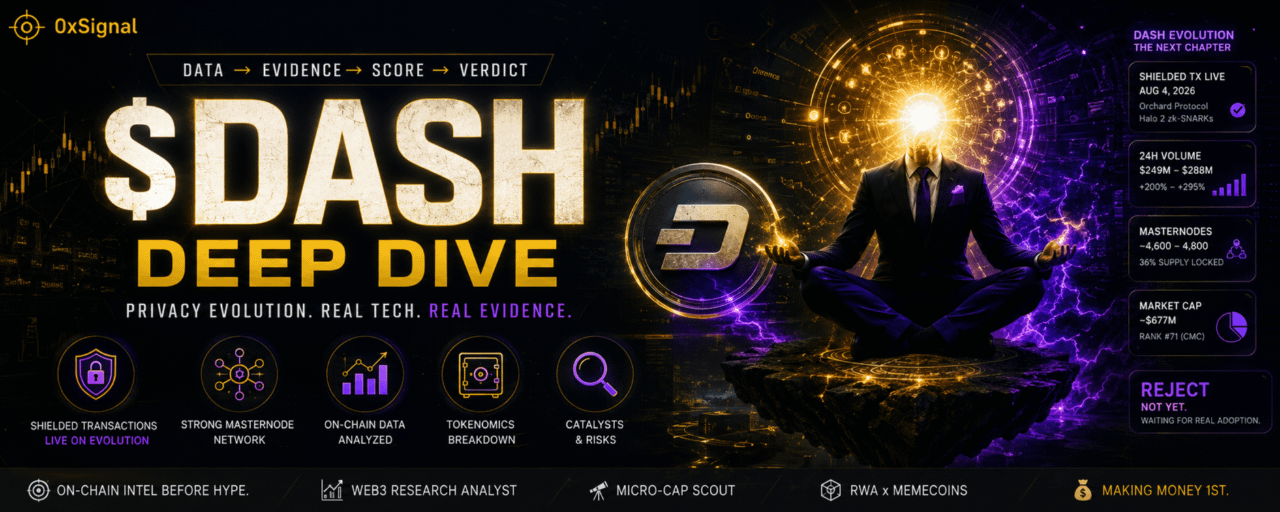
DATA → EVIDENCE → SCORE → VERDICT
Report Date: September 5, 2026
Analyst: 0xSignal Research
⚡ SNAPSHOT
One number needs context: liquidity.
DASH has recently traded through roughly 42–74 in a very short period around DashCon 2026. That's a huge range for an asset of this size.
So I wouldn't treat the current 52–53 price as a stable valuation. It's a fast-moving market where position size and execution matter.
🔥 WHY DASH IS MOVING
The current rally isn't happening in isolation.
Privacy coins have been one of crypto's strongest narratives, and DASH is now trying to reposition itself directly inside that trade.
Historically, DASH was primarily known as a payments-focused cryptocurrency with optional privacy features.
That's changing.
The biggest development is the rollout of shielded transactions on Evolution mainnet on August 4, 2026, using Zcash's Orchard protocol and Halo 2 zk-SNARK technology.
This matters because DASH is no longer asking the market to value privacy as a secondary feature.
It's trying to make privacy part of the core product.
The timing is also favorable.
Zcash and Monero have already demonstrated that the market is willing to assign significant valuations to privacy-focused assets.
But there's a catch:
DASH is late.
ZEC and XMR already own most of the mindshare.
DASH now has to prove it can take market share rather than simply benefit from the same narrative.
Assessment: 6/10
Sources: CoinGecko, ByteTree Research, Paybis, CoinMarketCap
🛠️ THE PRODUCT IS FINALLY HERE
This is the strongest part of the DASH story.
DASH is a 12-year-old network with a functioning two-tier architecture built around miners and masternodes.
InstantSend, ChainLocks and PrivateSend aren't future promises. They're established network features.
Evolution has also continued to ship.
Dash Platform v4.1.0 arrived on July 27, 2026, adding features including username transfers, Android/Kotlin SDKs and DashPay improvements.
Then came the bigger upgrade.
Shielded transactions went live on August 4.
That's important because this is an actual mainnet deployment—not a roadmap announcement.
The first notable merchant integration also arrived through NanoGPT, announced at DashCon 2026.
The rollout isn't complete yet.
Shielded Android support is targeted for September, and DashPay still needs to catch up with shielded functionality.
Still, the core privacy upgrade is live.
That's a meaningful change in the investment story.
Assessment: 7/10
Sources: dash.org official blog/roadmap, MEXC News, CoinMarketCap AI updates
👥 THE BIG QUESTION: ARE PEOPLE ACTUALLY USING IT?
This is where the thesis becomes harder.
DASH has roughly 4,600–4,800 active masternodes, depending on the source and date.
That's a real infrastructure base.
But masternodes don't automatically equal users.
What I really want to see is growth in:
Shielded transaction volumeActive shielded addressesWallet activityMerchant usageOverall transaction growth
The available evidence doesn't give us enough confidence yet.
DashSpend and DashPay exist, but independently verified active-user and transaction-growth figures weren't available in the sources reviewed.
NanoGPT is a useful first example, but one merchant integration doesn't establish a broad adoption trend.
This is probably the single biggest missing piece in the DASH thesis.
The technology has arrived. Now the market needs to see usage.
Assessment: 5/10
Sources: dashpay/dash GitHub wiki, Bitget research guide, dash.org
🪙 TOKENOMICS: BETTER THAN IT LOOKS, BUT NOT PERFECT
DASH has a hard maximum supply of 18,921,005 coins.
Approximately 45% of block rewards go to miners, 45% to masternodes and 10% to the treasury.
The masternode structure is particularly interesting.
Around 4.6M DASH, roughly 36% of circulating supply, is locked as masternode collateral.
That reduces the immediately tradable float.
It doesn't guarantee higher prices, but it does create a structural difference from assets where almost the entire supply is liquid.
The weakness is that DASH doesn't have a burn or buyback mechanism.
Emission continues, although it declines by roughly 7% every 383 days.
So the tokenomics are relatively disciplined, but they're not exceptional.
Assessment: 5/10
Sources: CoinMarketCap, dash.org docs, Crypto News Navigator
💰 FOLLOW THE MONEY — AND BE CAREFUL WITH THE LIQUIDITY
Trading volume exploded alongside the recent move.
Reported 24h volume reached roughly $249M–$288M, representing an increase of approximately 200–295% versus the previous day.
The timing makes sense: DashCon plus the shielded-mainnet narrative created a clear catalyst.
But there's another signal I care about more.
DASH has shown extremely wide price dispersion over a short period.
If an asset can move from roughly $42 to $74 around the same event window, liquidity is clearly something traders need to respect.
We also didn't find reliable independent data covering whale movements, exchange inflows/outflows or smart-money positioning.
So there's evidence of increased trading activity.
There's not enough evidence yet to tell us who is driving it or whether the demand will remain after the event cycle ends.
Assessment: 4/10
Sources: CoinMarketCap, CoinGecko, Bybit, multiple price-tracking aggregators
🧑💻 TEAM & EXECUTION
DASH has survived long enough to have something most newer projects don't: a proven operating history.
Founder Evan Duffield stepped away from day-to-day leadership in 2017 and now serves as an advisor.
Ryan Taylor has led Dash Core Group since 2017.
The core organization is estimated at roughly 40 people in 2026, down from approximately 46 in 2023.
The treasury system is also notable.
About 10% of block rewards goes into a governance-controlled treasury, giving DASH a native funding mechanism for development.
The problem is execution speed.
Evolution took years longer than initially expected.
Several shielded features also slipped before finally shipping in August 2026.
So the team is clearly still building.
But investors shouldn't ignore the historical delivery record.
Assessment: 6/10
Sources: dash.org news archive, LeadIQ, GetLatka, Finance Magnates
🎯 CAN DASH ACTUALLY 10X?
Let's forget the headline for a moment and do the math.
At approximately $52.87 and a ~$677M circulating market cap:
A $6.78B market cap isn't impossible in this sector.
For context, the September 2026 snapshot puts Monero around $9.8B and Zcash above $16B.
So DASH doesn't need to become the biggest privacy asset to reach $528.
It needs to capture a meaningful piece of the market currently assigned to ZEC and XMR.
That's possible.
But "possible" and "probable" are very different things.
🚀 WHAT COULD DRIVE THE NEXT MOVE?
1. Shielded Android
The September 2026 beta could make the new privacy functionality significantly more accessible.
2. Merchant adoption
NanoGPT is an interesting first step.
The real signal would be several independent merchants integrating shielded payments.
3. Privacy-sector rotation
If capital continues moving into privacy coins, smaller assets can benefit disproportionately.
DASH is considerably smaller than ZEC and XMR, which creates more room for percentage-based repricing.
⚠️ WHAT COULD BREAK THE THESIS?
Regulation
DASH carries an "Alleged SEC Securities" tag on major trackers.
Privacy assets also face increasing regulatory pressure, including EU restrictions expected to phase in by 2027.
That doesn't guarantee future delistings or enforcement.
It does make regulation a material risk.
Competition
Zcash and Monero are roughly 15–25x larger by market cap and already dominate the privacy narrative.
DASH has to compete for attention, liquidity and capital against much stronger incumbents.
Liquidity
The recent price swings are a warning.
Large moves on moderate absolute volume can create significant slippage.
Execution
The shielded upgrade is live, which is positive.
But DASH's history of delayed roadmap delivery means future announcements should be treated as expectations until they become working products.
Security
CoinGecko/CER showed a 32% security score as of September 4, 2026, while CertiK's separate rating was more favorable at 4.1.
The disagreement itself is worth noting.
I'd treat this as an area requiring additional diligence rather than declaring either a clean pass or a failure.
🐂 THE BULL CASE
The bullish version is simple.
Evolution works.
Shielded transactions gain meaningful adoption.
Android support arrives.
More merchants integrate shielded payments.
DASH becomes a credible third major privacy asset instead of a legacy payments project trying to catch the next narrative.
If that happens while capital continues flowing into privacy, the valuation gap with ZEC and XMR gives DASH significant room to re-rate.
That's where the 5X–10X argument becomes interesting.
⚖️ THE BASE CASE
DASH gets a strong narrative-driven revaluation.
The privacy upgrade attracts attention.
Price moves higher.
Then the excitement fades.
The market waits for actual usage data.
If shielded transactions, active addresses and merchant activity don't continue growing, investors may decide that the technology upgrade is interesting—but not enough to justify a permanent valuation reset.
🐻 THE BEAR CASE
The privacy rollout disappoints.
Mobile support gets delayed.
Regulatory pressure increases.
Liquidity remains weak.
The privacy narrative loses momentum.
Under that scenario, the recent rally could unwind and DASH could revisit the $30–40 region seen before the DashCon-driven move.
🚨 FINAL VERDICT: REJECT
DASH is a legitimate project.
It has been operating for more than a decade, development is active, and the latest shielded transaction upgrade is a genuine technological improvement.
But the investment case isn't proven yet.
The biggest problem isn't the technology.
It's adoption.
DASH has finally shipped the product that could make its privacy narrative much stronger. Now it needs to demonstrate that users, merchants and the broader ecosystem actually want it.
Right now, the available evidence isn't strong enough.
The competitive environment is also difficult. Zcash and Monero already dominate the privacy category, while DASH is entering the race with a smaller market cap, weaker mindshare and a history of delayed execution.
Then add regulatory uncertainty and thin liquidity.
The 10X math is possible.
The evidence isn't there yet to make it probable.
What would change my view?
I don't need another conference or another headline.
I want to see the numbers:
Shielded transaction volumeActive shielded addressesMerchant adoptionWallet activitySustained network usageDemand that survives after the current hype fades
If those metrics start trending higher, DASH deserves another look.
For now: REJECT.
Not because DASH is dead.
Because the evidence hasn't earned the conviction yet.
Data → Evidence → Score → Verdict.
Not financial advice. DYOR.
— 0xSignal Research
#DASH
DATA → EVIDENCE → SCORE → VERDICT
Report Date: September 5, 2026
Analyst: 0xSignal Research
⚡ SNAPSHOT
One number needs context: liquidity.
DASH has recently traded through roughly 42–74 in a very short period around DashCon 2026. That's a huge range for an asset of this size.
So I wouldn't treat the current 52–53 price as a stable valuation. It's a fast-moving market where position size and execution matter.
🔥 WHY DASH IS MOVING
The current rally isn't happening in isolation.
Privacy coins have been one of crypto's strongest narratives, and DASH is now trying to reposition itself directly inside that trade.
Historically, DASH was primarily known as a payments-focused cryptocurrency with optional privacy features.
That's changing.
The biggest development is the rollout of shielded transactions on Evolution mainnet on August 4, 2026, using Zcash's Orchard protocol and Halo 2 zk-SNARK technology.
This matters because DASH is no longer asking the market to value privacy as a secondary feature.
It's trying to make privacy part of the core product.
The timing is also favorable.
Zcash and Monero have already demonstrated that the market is willing to assign significant valuations to privacy-focused assets.
But there's a catch:
DASH is late.
ZEC and XMR already own most of the mindshare.
DASH now has to prove it can take market share rather than simply benefit from the same narrative.
Assessment: 6/10
Sources: CoinGecko, ByteTree Research, Paybis, CoinMarketCap
🛠️ THE PRODUCT IS FINALLY HERE
This is the strongest part of the DASH story.
DASH is a 12-year-old network with a functioning two-tier architecture built around miners and masternodes.
InstantSend, ChainLocks and PrivateSend aren't future promises. They're established network features.
Evolution has also continued to ship.
Dash Platform v4.1.0 arrived on July 27, 2026, adding features including username transfers, Android/Kotlin SDKs and DashPay improvements.
Then came the bigger upgrade.
Shielded transactions went live on August 4.
That's important because this is an actual mainnet deployment—not a roadmap announcement.
The first notable merchant integration also arrived through NanoGPT, announced at DashCon 2026.
The rollout isn't complete yet.
Shielded Android support is targeted for September, and DashPay still needs to catch up with shielded functionality.
Still, the core privacy upgrade is live.
That's a meaningful change in the investment story.
Assessment: 7/10
Sources: dash.org official blog/roadmap, MEXC News, CoinMarketCap AI updates
👥 THE BIG QUESTION: ARE PEOPLE ACTUALLY USING IT?
This is where the thesis becomes harder.
DASH has roughly 4,600–4,800 active masternodes, depending on the source and date.
That's a real infrastructure base.
But masternodes don't automatically equal users.
What I really want to see is growth in:
Shielded transaction volumeActive shielded addressesWallet activityMerchant usageOverall transaction growth
The available evidence doesn't give us enough confidence yet.
DashSpend and DashPay exist, but independently verified active-user and transaction-growth figures weren't available in the sources reviewed.
NanoGPT is a useful first example, but one merchant integration doesn't establish a broad adoption trend.
This is probably the single biggest missing piece in the DASH thesis.
The technology has arrived. Now the market needs to see usage.
Assessment: 5/10
Sources: dashpay/dash GitHub wiki, Bitget research guide, dash.org
🪙 TOKENOMICS: BETTER THAN IT LOOKS, BUT NOT PERFECT
DASH has a hard maximum supply of 18,921,005 coins.
Approximately 45% of block rewards go to miners, 45% to masternodes and 10% to the treasury.
The masternode structure is particularly interesting.
Around 4.6M DASH, roughly 36% of circulating supply, is locked as masternode collateral.
That reduces the immediately tradable float.
It doesn't guarantee higher prices, but it does create a structural difference from assets where almost the entire supply is liquid.
The weakness is that DASH doesn't have a burn or buyback mechanism.
Emission continues, although it declines by roughly 7% every 383 days.
So the tokenomics are relatively disciplined, but they're not exceptional.
Assessment: 5/10
Sources: CoinMarketCap, dash.org docs, Crypto News Navigator
💰 FOLLOW THE MONEY — AND BE CAREFUL WITH THE LIQUIDITY
Trading volume exploded alongside the recent move.
Reported 24h volume reached roughly $249M–$288M, representing an increase of approximately 200–295% versus the previous day.
The timing makes sense: DashCon plus the shielded-mainnet narrative created a clear catalyst.
But there's another signal I care about more.
DASH has shown extremely wide price dispersion over a short period.
If an asset can move from roughly $42 to $74 around the same event window, liquidity is clearly something traders need to respect.
We also didn't find reliable independent data covering whale movements, exchange inflows/outflows or smart-money positioning.
So there's evidence of increased trading activity.
There's not enough evidence yet to tell us who is driving it or whether the demand will remain after the event cycle ends.
Assessment: 4/10
Sources: CoinMarketCap, CoinGecko, Bybit, multiple price-tracking aggregators
🧑💻 TEAM & EXECUTION
DASH has survived long enough to have something most newer projects don't: a proven operating history.
Founder Evan Duffield stepped away from day-to-day leadership in 2017 and now serves as an advisor.
Ryan Taylor has led Dash Core Group since 2017.
The core organization is estimated at roughly 40 people in 2026, down from approximately 46 in 2023.
The treasury system is also notable.
About 10% of block rewards goes into a governance-controlled treasury, giving DASH a native funding mechanism for development.
The problem is execution speed.
Evolution took years longer than initially expected.
Several shielded features also slipped before finally shipping in August 2026.
So the team is clearly still building.
But investors shouldn't ignore the historical delivery record.
Assessment: 6/10
Sources: dash.org news archive, LeadIQ, GetLatka, Finance Magnates
🎯 CAN DASH ACTUALLY 10X?
Let's forget the headline for a moment and do the math.
At approximately $52.87 and a ~$677M circulating market cap:
A $6.78B market cap isn't impossible in this sector.
For context, the September 2026 snapshot puts Monero around $9.8B and Zcash above $16B.
So DASH doesn't need to become the biggest privacy asset to reach $528.
It needs to capture a meaningful piece of the market currently assigned to ZEC and XMR.
That's possible.
But "possible" and "probable" are very different things.
🚀 WHAT COULD DRIVE THE NEXT MOVE?
1. Shielded Android
The September 2026 beta could make the new privacy functionality significantly more accessible.
2. Merchant adoption
NanoGPT is an interesting first step.
The real signal would be several independent merchants integrating shielded payments.
3. Privacy-sector rotation
If capital continues moving into privacy coins, smaller assets can benefit disproportionately.
DASH is considerably smaller than ZEC and XMR, which creates more room for percentage-based repricing.
⚠️ WHAT COULD BREAK THE THESIS?
Regulation
DASH carries an "Alleged SEC Securities" tag on major trackers.
Privacy assets also face increasing regulatory pressure, including EU restrictions expected to phase in by 2027.
That doesn't guarantee future delistings or enforcement.
It does make regulation a material risk.
Competition
Zcash and Monero are roughly 15–25x larger by market cap and already dominate the privacy narrative.
DASH has to compete for attention, liquidity and capital against much stronger incumbents.
Liquidity
The recent price swings are a warning.
Large moves on moderate absolute volume can create significant slippage.
Execution
The shielded upgrade is live, which is positive.
But DASH's history of delayed roadmap delivery means future announcements should be treated as expectations until they become working products.
Security
CoinGecko/CER showed a 32% security score as of September 4, 2026, while CertiK's separate rating was more favorable at 4.1.
The disagreement itself is worth noting.
I'd treat this as an area requiring additional diligence rather than declaring either a clean pass or a failure.
🐂 THE BULL CASE
The bullish version is simple.
Evolution works.
Shielded transactions gain meaningful adoption.
Android support arrives.
More merchants integrate shielded payments.
DASH becomes a credible third major privacy asset instead of a legacy payments project trying to catch the next narrative.
If that happens while capital continues flowing into privacy, the valuation gap with ZEC and XMR gives DASH significant room to re-rate.
That's where the 5X–10X argument becomes interesting.
⚖️ THE BASE CASE
DASH gets a strong narrative-driven revaluation.
The privacy upgrade attracts attention.
Price moves higher.
Then the excitement fades.
The market waits for actual usage data.
If shielded transactions, active addresses and merchant activity don't continue growing, investors may decide that the technology upgrade is interesting—but not enough to justify a permanent valuation reset.
🐻 THE BEAR CASE
The privacy rollout disappoints.
Mobile support gets delayed.
Regulatory pressure increases.
Liquidity remains weak.
The privacy narrative loses momentum.
Under that scenario, the recent rally could unwind and DASH could revisit the $30–40 region seen before the DashCon-driven move.
🚨 FINAL VERDICT: REJECT
DASH is a legitimate project.
It has been operating for more than a decade, development is active, and the latest shielded transaction upgrade is a genuine technological improvement.
But the investment case isn't proven yet.
The biggest problem isn't the technology.
It's adoption.
DASH has finally shipped the product that could make its privacy narrative much stronger. Now it needs to demonstrate that users, merchants and the broader ecosystem actually want it.
Right now, the available evidence isn't strong enough.
The competitive environment is also difficult. Zcash and Monero already dominate the privacy category, while DASH is entering the race with a smaller market cap, weaker mindshare and a history of delayed execution.
Then add regulatory uncertainty and thin liquidity.
The 10X math is possible.
The evidence isn't there yet to make it probable.
What would change my view?
I don't need another conference or another headline.
I want to see the numbers:
Shielded transaction volumeActive shielded addressesMerchant adoptionWallet activitySustained network usageDemand that survives after the current hype fades
If those metrics start trending higher, DASH deserves another look.
For now: REJECT.
Not because DASH is dead.
Because the evidence hasn't earned the conviction yet.
Data → Evidence → Score → Verdict.
Not financial advice. DYOR.
— 0xSignal Research
#DASH
Log in to explore more content