

#cryptoresearch
cryptoresearch
330,121 views
1,422 Discussing
Hot
Latest

·
--
🔍 研究一个加密货币项目,究竟应该先看什么?
不要只看代币价格和社交媒体热度,真正有价值的研究需要多方面验证。
📄 白皮书: 项目究竟要解决什么问题?
👥 团队背景: 是否具备执行能力?
🪙 代币经济: 供应量、分配和解锁是否合理?
📊 链上数据: 是否存在真实、持续的使用需求?
⚠️ 竞争与风险: 项目的优势能否持续?
记住:路线图不等于实际进展,活跃地址不等于真实用户,代币解锁也不必然意味着价格下跌。
不要只寻找支持自己判断的证据,也要主动寻找可能推翻判断的信息。
你研究项目时,第一步通常会看什么?
#ONEA #Web3 #CryptoResearch
🔍 研究一个加密货币项目,究竟应该先看什么?
不要只看代币价格和社交媒体热度,真正有价值的研究需要多方面验证。
📄 白皮书: 项目究竟要解决什么问题?
👥 团队背景: 是否具备执行能力?
🪙 代币经济: 供应量、分配和解锁是否合理?
📊 链上数据: 是否存在真实、持续的使用需求?
⚠️ 竞争与风险: 项目的优势能否持续?
记住:路线图不等于实际进展,活跃地址不等于真实用户,代币解锁也不必然意味着价格下跌。
不要只寻找支持自己判断的证据,也要主动寻找可能推翻判断的信息。
你研究项目时,第一步通常会看什么?
#ONEA #Web3 #CryptoResearch
不要只看代币价格和社交媒体热度,真正有价值的研究需要多方面验证。
📄 白皮书: 项目究竟要解决什么问题?
👥 团队背景: 是否具备执行能力?
🪙 代币经济: 供应量、分配和解锁是否合理?
📊 链上数据: 是否存在真实、持续的使用需求?
⚠️ 竞争与风险: 项目的优势能否持续?
记住:路线图不等于实际进展,活跃地址不等于真实用户,代币解锁也不必然意味着价格下跌。
不要只寻找支持自己判断的证据,也要主动寻找可能推翻判断的信息。
你研究项目时,第一步通常会看什么?
#ONEA #Web3 #CryptoResearch
2
5

·
--
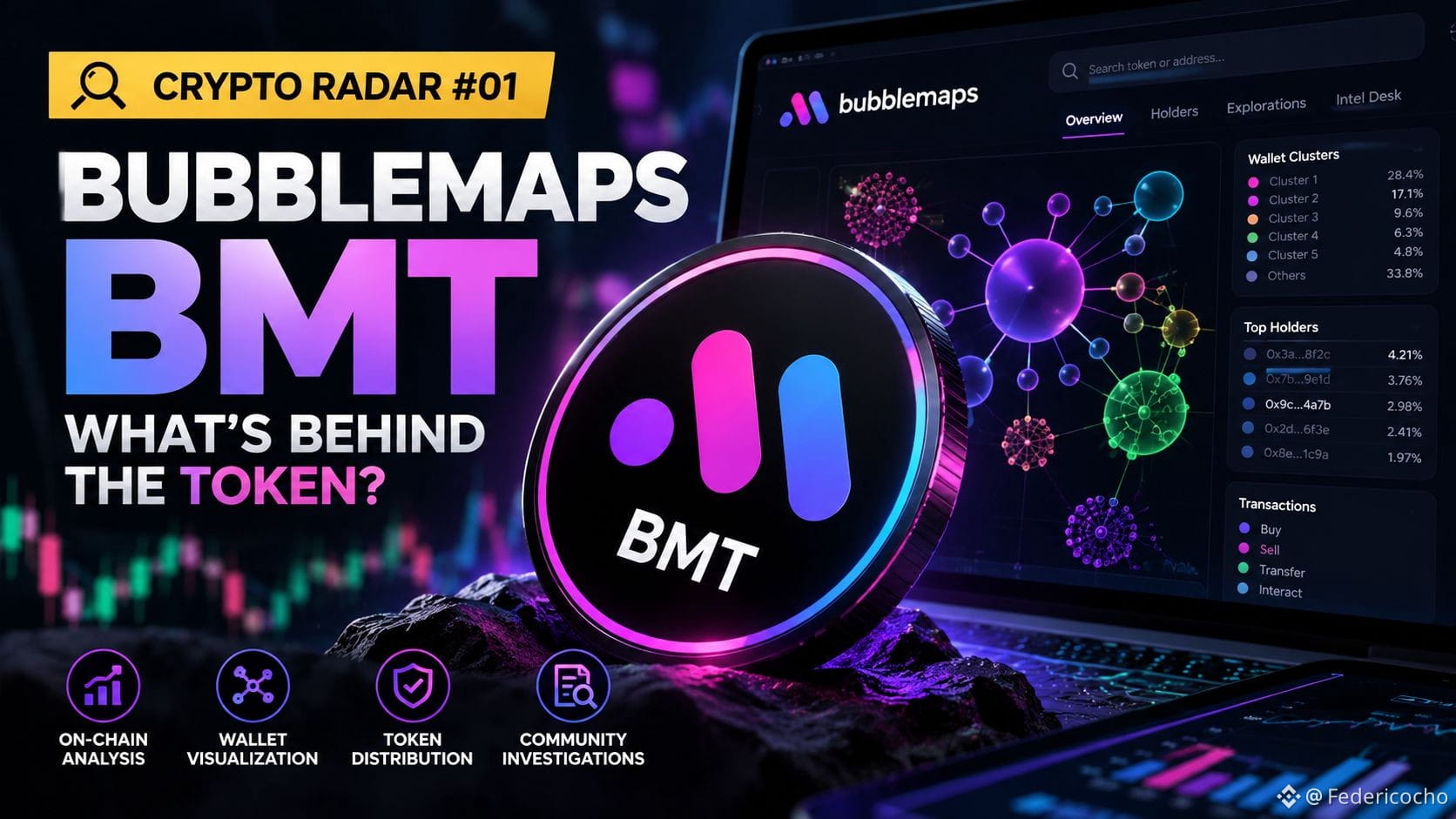
🔎 CRYPTO RADAR #01: BMT — WHAT'S BEHIND THE TOKEN?
Have you heard of Bubblemaps before noticing $BMT ?
🫧 What is Bubblemaps?
Bubblemaps is an on-chain analytics platform that visualizes connections between blockchain wallets, helping users investigate token distribution, wallet clusters, and potentially suspicious activity.
🪙 What is $BMT used for?
BMT is the token associated with the Bubblemaps ecosystem. It provides access to certain advanced features and plays a role in community-driven investigations through Intel Desk.
📊 Why is it on our radar?
Recent price action has caught our attention. But a sharp move alone doesn't prove that a project is gaining long-term traction.
👀 What should we investigate next?
• Trading volume and market liquidity
• Recent ecosystem developments
• Token distribution and upcoming unlocks
• Potential catalysts behind the price movement
⚠️ My take: BMT is worth researching further, but we need stronger evidence before drawing conclusions about its next move.
💬 Had you heard of Bubblemaps before? Which crypto project should we investigate next?
#BMT #Bubblemaps #CryptoResearch #BinanceSquare
🔎 CRYPTO RADAR #01: BMT — WHAT'S BEHIND THE TOKEN?
Have you heard of Bubblemaps before noticing $BMT ?
🫧 What is Bubblemaps?
Bubblemaps is an on-chain analytics platform that visualizes connections between blockchain wallets, helping users investigate token distribution, wallet clusters, and potentially suspicious activity.
🪙 What is $BMT used for?
BMT is the token associated with the Bubblemaps ecosystem. It provides access to certain advanced features and plays a role in community-driven investigations through Intel Desk.
📊 Why is it on our radar?
Recent price action has caught our attention. But a sharp move alone doesn't prove that a project is gaining long-term traction.
👀 What should we investigate next?
• Trading volume and market liquidity
• Recent ecosystem developments
• Token distribution and upcoming unlocks
• Potential catalysts behind the price movement
⚠️ My take: BMT is worth researching further, but we need stronger evidence before drawing conclusions about its next move.
💬 Had you heard of Bubblemaps before? Which crypto project should we investigate next?
#BMT #Bubblemaps #CryptoResearch #BinanceSquare
Have you heard of Bubblemaps before noticing $BMT ?
🫧 What is Bubblemaps?
Bubblemaps is an on-chain analytics platform that visualizes connections between blockchain wallets, helping users investigate token distribution, wallet clusters, and potentially suspicious activity.
🪙 What is $BMT used for?
BMT is the token associated with the Bubblemaps ecosystem. It provides access to certain advanced features and plays a role in community-driven investigations through Intel Desk.
📊 Why is it on our radar?
Recent price action has caught our attention. But a sharp move alone doesn't prove that a project is gaining long-term traction.
👀 What should we investigate next?
• Trading volume and market liquidity
• Recent ecosystem developments
• Token distribution and upcoming unlocks
• Potential catalysts behind the price movement
⚠️ My take: BMT is worth researching further, but we need stronger evidence before drawing conclusions about its next move.
💬 Had you heard of Bubblemaps before? Which crypto project should we investigate next?
#BMT #Bubblemaps #CryptoResearch #BinanceSquare
281

🔍 Before Buying an Altcoin, Ask These Questions!
Not every trending token becomes a successful project. Before researching any altcoin, I believe these points deserve attention:
✅ Does the project solve a real problem? ✅ Is the team and roadmap transparent? ✅ What is the token's supply and unlock schedule? ✅ Is there genuine community and developer activity? ✅ Are liquidity and trading volume sufficient?
A low token price does not automatically mean a coin is undervalued.
Do your own research instead of following hype or promises of guaranteed returns.
👇 Which altcoin project do you think deserves deeper research?
#Altcoins #CryptoResearch #Web3
🔍 Before Buying an Altcoin, Ask These Questions!
Not every trending token becomes a successful project. Before researching any altcoin, I believe these points deserve attention:
✅ Does the project solve a real problem? ✅ Is the team and roadmap transparent? ✅ What is the token's supply and unlock schedule? ✅ Is there genuine community and developer activity? ✅ Are liquidity and trading volume sufficient?
A low token price does not automatically mean a coin is undervalued.
Do your own research instead of following hype or promises of guaranteed returns.
👇 Which altcoin project do you think deserves deeper research?
#Altcoins #CryptoResearch #Web3
Not every trending token becomes a successful project. Before researching any altcoin, I believe these points deserve attention:
✅ Does the project solve a real problem? ✅ Is the team and roadmap transparent? ✅ What is the token's supply and unlock schedule? ✅ Is there genuine community and developer activity? ✅ Are liquidity and trading volume sufficient?
A low token price does not automatically mean a coin is undervalued.
Do your own research instead of following hype or promises of guaranteed returns.
👇 Which altcoin project do you think deserves deeper research?
#Altcoins #CryptoResearch #Web3
42
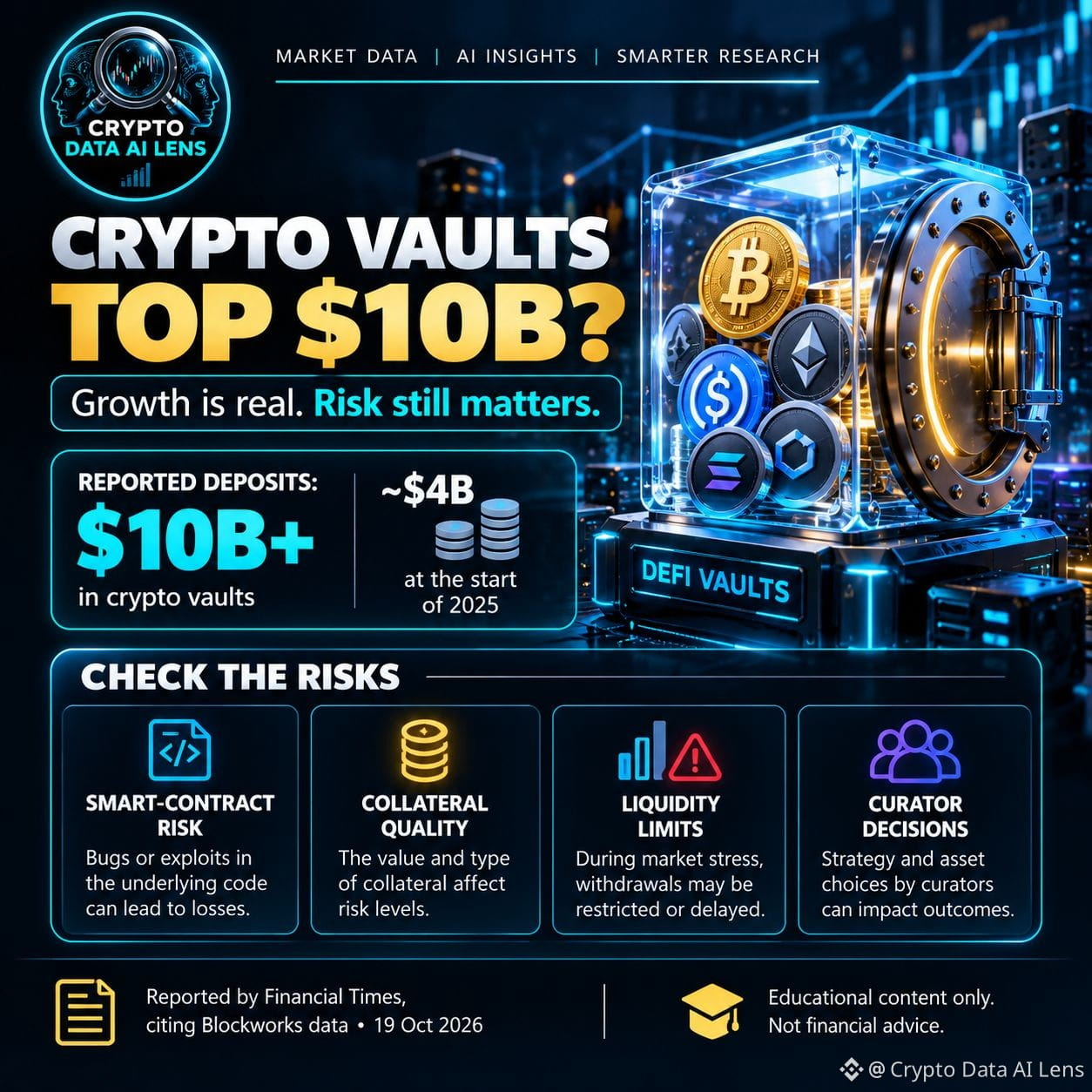
🔐 CRYPTO VAULTS TOP $10 BILLION | BUT WHAT’S THE RISK?
Crypto vaults are attracting attention as reported deposits have climbed above $10 billion, compared with around $4 billion at the start of 2025, according to Financial Times reporting citing Blockworks data. cite turn617659news8
But growth alone doesn’t tell the whole story. 👇
🔹 Smart-contract risk: Code vulnerabilities can expose funds to losses.
🔹 Collateral risk: Borrowed assets may be backed by collateral whose value can fall.
🔹 Liquidity risk: Withdrawals may become difficult during market stress.
🔹 Curator risk: Strategy decisions can affect a vault’s performance and risk.
📊 The key research question: How much risk sits behind the headline number?
A bigger market doesn’t automatically mean a safer market. Understand the structure, the underlying data and the risks before drawing conclusions.
💬 Which risk deserves the closest attention: smart contracts, collateral, liquidity, or curator decisions?
#CryptoEducation #DeFi #CryptoResearch #Blockchain #CryptoDataAILens
Educational content only | Not Financial Advice.
🔐 CRYPTO VAULTS TOP $10 BILLION | BUT WHAT’S THE RISK?
Crypto vaults are attracting attention as reported deposits have climbed above $10 billion, compared with around $4 billion at the start of 2025, according to Financial Times reporting citing Blockworks data. cite turn617659news8
But growth alone doesn’t tell the whole story. 👇
🔹 Smart-contract risk: Code vulnerabilities can expose funds to losses.
🔹 Collateral risk: Borrowed assets may be backed by collateral whose value can fall.
🔹 Liquidity risk: Withdrawals may become difficult during market stress.
🔹 Curator risk: Strategy decisions can affect a vault’s performance and risk.
📊 The key research question: How much risk sits behind the headline number?
A bigger market doesn’t automatically mean a safer market. Understand the structure, the underlying data and the risks before drawing conclusions.
💬 Which risk deserves the closest attention: smart contracts, collateral, liquidity, or curator decisions?
#CryptoEducation #DeFi #CryptoResearch #Blockchain #CryptoDataAILens
Educational content only | Not Financial Advice.
Crypto vaults are attracting attention as reported deposits have climbed above $10 billion, compared with around $4 billion at the start of 2025, according to Financial Times reporting citing Blockworks data. cite turn617659news8
But growth alone doesn’t tell the whole story. 👇
🔹 Smart-contract risk: Code vulnerabilities can expose funds to losses.
🔹 Collateral risk: Borrowed assets may be backed by collateral whose value can fall.
🔹 Liquidity risk: Withdrawals may become difficult during market stress.
🔹 Curator risk: Strategy decisions can affect a vault’s performance and risk.
📊 The key research question: How much risk sits behind the headline number?
A bigger market doesn’t automatically mean a safer market. Understand the structure, the underlying data and the risks before drawing conclusions.
💬 Which risk deserves the closest attention: smart contracts, collateral, liquidity, or curator decisions?
#CryptoEducation #DeFi #CryptoResearch #Blockchain #CryptoDataAILens
Educational content only | Not Financial Advice.
2

·
--
分享一个我觉得很实用的 DeFi 研究思路。
TVL 高,说明有一定规模的资金存入协议,但不等于协议收入高。
交易量大,说明发生了很多交易,但不代表每笔交易都能带来可观收入。
协议手续费可以反映用户为服务支付的成本,而协议实际留存的收入,还要看费用分配和业务结构。
如果一个项目的高收益主要依赖代币激励,就更要问一句:
激励减弱以后,这门生意还能不能运转?
看 DeFi,不能只看一个漂亮的数字。
把资金、使用、收入和激励放在一起,才能看得更完整。
#DeFi #Web3 #CryptoResearch
分享一个我觉得很实用的 DeFi 研究思路。
TVL 高,说明有一定规模的资金存入协议,但不等于协议收入高。
交易量大,说明发生了很多交易,但不代表每笔交易都能带来可观收入。
协议手续费可以反映用户为服务支付的成本,而协议实际留存的收入,还要看费用分配和业务结构。
如果一个项目的高收益主要依赖代币激励,就更要问一句:
激励减弱以后,这门生意还能不能运转?
看 DeFi,不能只看一个漂亮的数字。
把资金、使用、收入和激励放在一起,才能看得更完整。
#DeFi #Web3 #CryptoResearch
TVL 高,说明有一定规模的资金存入协议,但不等于协议收入高。
交易量大,说明发生了很多交易,但不代表每笔交易都能带来可观收入。
协议手续费可以反映用户为服务支付的成本,而协议实际留存的收入,还要看费用分配和业务结构。
如果一个项目的高收益主要依赖代币激励,就更要问一句:
激励减弱以后,这门生意还能不能运转?
看 DeFi,不能只看一个漂亮的数字。
把资金、使用、收入和激励放在一起,才能看得更完整。
#DeFi #Web3 #CryptoResearch
🔍 EVERYONE WANTS TO FIND THE NEXT BIG CRYPTO PROJECT.
But very few people want to do the boring work.
They want the 100x prediction.
They want the perfect entry.
They want someone else to do the research.
Real research means checking the team, technology, tokenomics, adoption, competition, and risks.
And even excellent research cannot eliminate uncertainty.
🚀 Which matters most when evaluating a project: technology, adoption, or tokenomics?
#CryptoResearch #altcoins #Web3 #CryptoInvesting #BinanceSquare
🔍 EVERYONE WANTS TO FIND THE NEXT BIG CRYPTO PROJECT.
But very few people want to do the boring work.
They want the 100x prediction.
They want the perfect entry.
They want someone else to do the research.
Real research means checking the team, technology, tokenomics, adoption, competition, and risks.
And even excellent research cannot eliminate uncertainty.
🚀 Which matters most when evaluating a project: technology, adoption, or tokenomics?
#CryptoResearch #altcoins #Web3 #CryptoInvesting #BinanceSquare
But very few people want to do the boring work.
They want the 100x prediction.
They want the perfect entry.
They want someone else to do the research.
Real research means checking the team, technology, tokenomics, adoption, competition, and risks.
And even excellent research cannot eliminate uncertainty.
🚀 Which matters most when evaluating a project: technology, adoption, or tokenomics?
#CryptoResearch #altcoins #Web3 #CryptoInvesting #BinanceSquare
2

·
--
Bullish
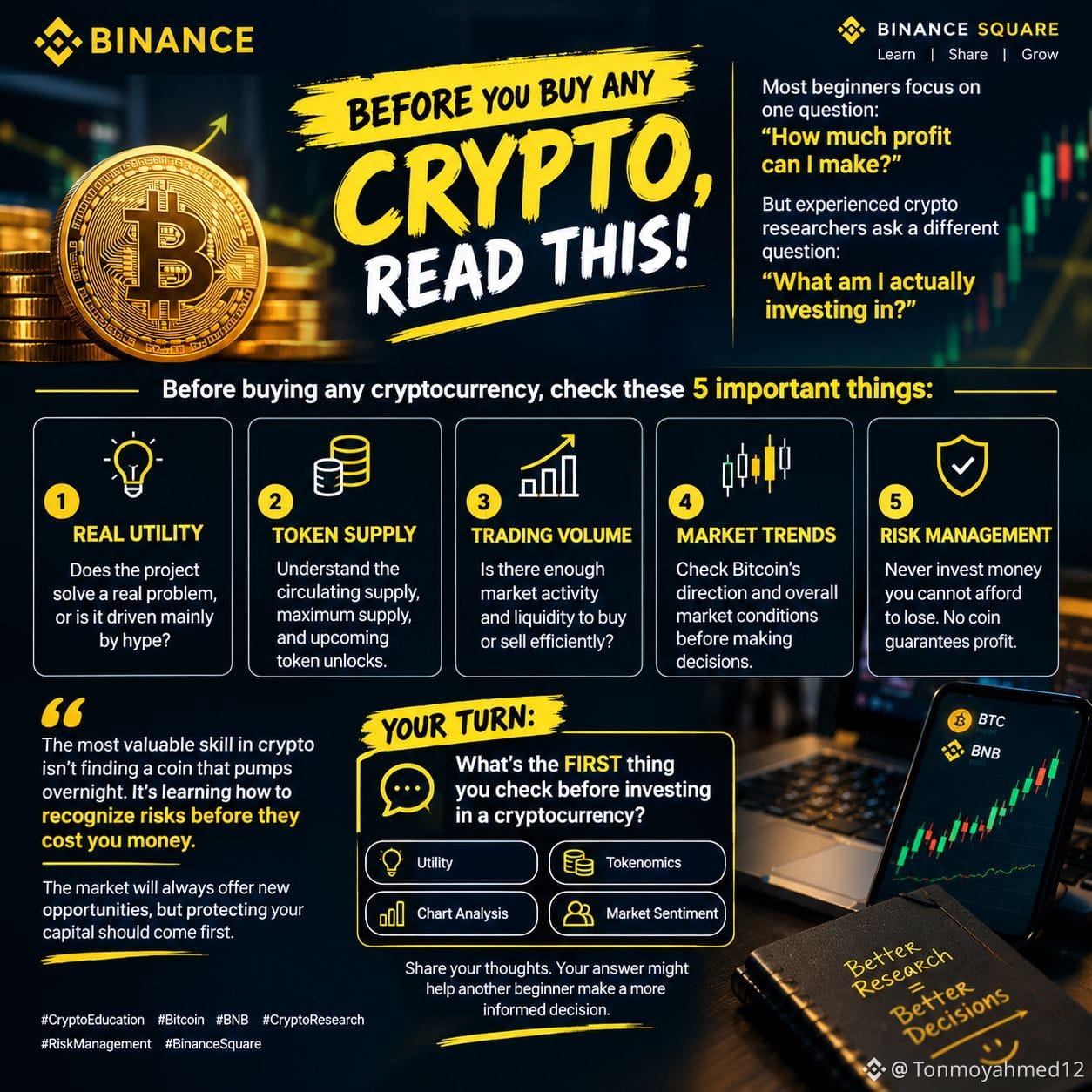
🚨 BEFORE YOU BUY ANY CRYPTO, READ THIS!
Most beginners focus on one question:
📈 “How much profit can I make?”
But experienced crypto researchers ask a different question:
🔍 “What am I actually investing in?”
Before buying any cryptocurrency, check these 5 important things:
1️⃣ Real Utility: Does the project solve a real problem, or is it driven mainly by hype?
2️⃣ Token Supply: Understand the circulating supply, maximum supply, and upcoming token unlocks.
3️⃣ Trading Volume: Is there enough market activity and liquidity to buy or sell efficiently?
4️⃣ Market Trends: Check Bitcoin's direction and overall market conditions before making decisions.
5️⃣ Risk Management: Never invest money you cannot afford to lose. No coin guarantees profit.
💡 The most valuable skill in crypto isn't finding a coin that pumps overnight. It's learning how to recognize risks before they cost you money.
The market will always offer new opportunities, but protecting your capital should come first.
👇 YOUR TURN: What's the FIRST thing you check before investing in a cryptocurrency: Utility, Tokenomics, Chart Analysis, or Market Sentiment?
Share your thoughts. Your answer might help another beginner make a more informed decision.
#CryptoEducation #Bitcoin #BNB #CryptoResearch #BinanceSquare
🚨 BEFORE YOU BUY ANY CRYPTO, READ THIS!
Most beginners focus on one question:
📈 “How much profit can I make?”
But experienced crypto researchers ask a different question:
🔍 “What am I actually investing in?”
Before buying any cryptocurrency, check these 5 important things:
1️⃣ Real Utility: Does the project solve a real problem, or is it driven mainly by hype?
2️⃣ Token Supply: Understand the circulating supply, maximum supply, and upcoming token unlocks.
3️⃣ Trading Volume: Is there enough market activity and liquidity to buy or sell efficiently?
4️⃣ Market Trends: Check Bitcoin's direction and overall market conditions before making decisions.
5️⃣ Risk Management: Never invest money you cannot afford to lose. No coin guarantees profit.
💡 The most valuable skill in crypto isn't finding a coin that pumps overnight. It's learning how to recognize risks before they cost you money.
The market will always offer new opportunities, but protecting your capital should come first.
👇 YOUR TURN: What's the FIRST thing you check before investing in a cryptocurrency: Utility, Tokenomics, Chart Analysis, or Market Sentiment?
Share your thoughts. Your answer might help another beginner make a more informed decision.
#CryptoEducation #Bitcoin #BNB #CryptoResearch #BinanceSquare
Most beginners focus on one question:
📈 “How much profit can I make?”
But experienced crypto researchers ask a different question:
🔍 “What am I actually investing in?”
Before buying any cryptocurrency, check these 5 important things:
1️⃣ Real Utility: Does the project solve a real problem, or is it driven mainly by hype?
2️⃣ Token Supply: Understand the circulating supply, maximum supply, and upcoming token unlocks.
3️⃣ Trading Volume: Is there enough market activity and liquidity to buy or sell efficiently?
4️⃣ Market Trends: Check Bitcoin's direction and overall market conditions before making decisions.
5️⃣ Risk Management: Never invest money you cannot afford to lose. No coin guarantees profit.
💡 The most valuable skill in crypto isn't finding a coin that pumps overnight. It's learning how to recognize risks before they cost you money.
The market will always offer new opportunities, but protecting your capital should come first.
👇 YOUR TURN: What's the FIRST thing you check before investing in a cryptocurrency: Utility, Tokenomics, Chart Analysis, or Market Sentiment?
Share your thoughts. Your answer might help another beginner make a more informed decision.
#CryptoEducation #Bitcoin #BNB #CryptoResearch #BinanceSquare
2
1
2
203

Article
Tron and Ethereum collected almost the same fees in one day. One is worth 10x more.In one 24-hour window, Ethereum paid about $895K in fees. Tron paid $890K.
One is valued at $312B. The other at $31.8B.
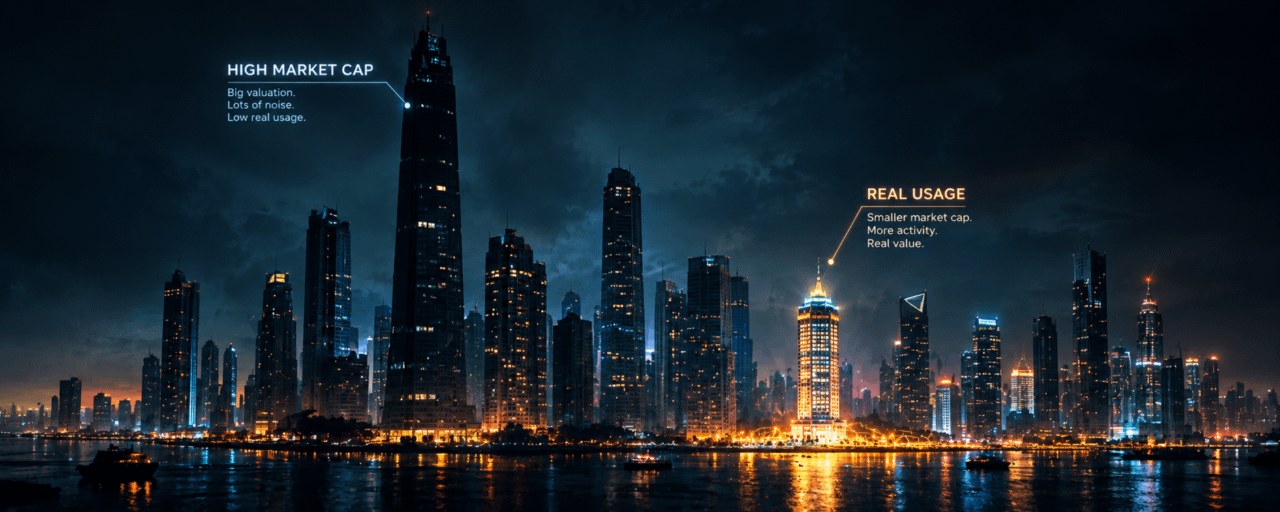
Same fees, 10x the price. So what is the market actually paying for?
That doesn’t mean Tron is cheap or Ethereum is expensive. Fees aren’t everything. But it tells you something: market cap is what people believe. Fees are what people actually pay.
So I did something simple. I took the current top 10 and asked the same four questions of each:
Where does the money come from? Who keeps it? Who is really using it? Do the partnerships produce anything real?
Not a buy list. A map of where the story and the numbers agree, and where they don’t.
1 · Bitcoin · $1.65T
The security bill is paid by price, not fees
Bitcoin isn’t a business, so don’t judge it like one. Its value is scarcity plus demand: ETF assets near $103B, 197 public companies holding it.
But look at what keeps the network secure. September fees were 87.53 BTC, about 0.63% of miner rewards. Roughly $7M for the month (my arithmetic).
The other 99.37% came from the block subsidy: newly created bitcoin, worth only what the market pays for it.
Long term, Bitcoin's security depends on its price holding up. That's the thing to watch.
2 · Ethereum · $312B
Real usage, thin base layer
Ethereum hosts $146.8B in stablecoins, $52B in DeFi and $13.5B in tokenized real-world assets. The usage is real. But the mainnet itself earned about $376K in chain revenue over 24 hours, because most activity moved to layer-2s.
Institutions are interested too: BlackRock's staking ETF grew from a $107M seed to over $250M in its first week. Yet spot ETH ETFs also had a 17-day outflow streak (~$708M). Real, but uneven.
Ethereum is the venue. The question is how much of the rent it keeps.
3 · Tether · $184BThe most profitable project here. Holders get none of it.
Tether made about $1.5B in operating profit in Q2, mostly from Treasury interest. It holds the reserves behind USDT and keeps the interest. USDT holders get nothing extra: they own a claim on $1, not a share of Tether.
The detail I'd watch: the reserve buffer halved in one quarter.
Tether earned about $1.5B in Q2 and USDT holders got none of it. Is that a flaw, or just how a stablecoin works?
4 · BNB · $102BThe burn is real. The profit proof isn't.
The July burn removed 1,615,827 BNB (about $931.7M). Supply is now 133.17M, heading toward 100M. But the burn is formula-driven, not paid from a verified revenue stream. It's supply reduction, not proof of profit. Binance's own profits are private, so I can't verify them.
The burn is real, the profit proof isn’t. Does a shrinking supply matter if nobody can verify the profit behind it?
5 · XRP · $88B
The story is growing. The ledger's income isn't.
The institutional headlines are real: Ondo, JPMorgan Kinexys and Mastercard settled tokenized Treasuries on XRPL in under five seconds. But settlement ran through RLUSD, with only fractions of XRP for fees. XRPL chain revenue was $1,027 over 24 hours.
The use case can succeed through RLUSD without XRP rising. If that happens, who is the story really for?
6 · USDC · $73.7B
Who keeps the interest?
Circle's Q2 revenue was $701M, almost all from reserve interest. But $410M went to distribution partners, mainly Coinbase. About 61.5 cents of every reserve dollar leaves Circle.
61.5 cents of every reserve dollar leaves Circle. Who really owns the USDC business, Circle or Coinbase?
7 · Solana · $67.7B
Apps earn more than the chain
Solana has 3.39M active addresses, $16.3B in stablecoins and $6.45B in TVL. Chain fees were $970K, but apps earned $5.4M in a day. Money is made on top of the chain, not by it.
Western Union's USDPT launched on Solana in May and added a Visa wallet in 37 markets in August. A real distribution channel. I found no volume data yet.
The pipes are working. The proof is volume, and it isn't public.
Apps earn $5.4M a day, the chain earns $0.97M. Would you rather own the road or the shops on it?
8 · TRON · $31.8B
The dollar highway
People in emerging markets use Tron to move USDT. That is why fees are real: someone pays them to send dollars. USDT is 97.77% of Tron's $94.8B stablecoin supply.
Caveats: TRON DAO reports $604M Q1 revenue, far above DefiLlama's run rate. Definitions differ, so I used the conservative number. Q1 was also net inflationary (+70.5M TRX), and it depends heavily on USDT and its founder.
A research lead, not a recommendation.
Real fees, but dependent on USDT and its founder. Is that a moat or a single point of failure?
9 · Hyperliquid · $22.2B
The one place revenue visibly reaches the token
$429M in revenue through mid-September, the most on CoinGecko's ranking. About 99% of eligible perp fees go to the Assistance Fund, which buys back HYPE. A June vote also sends about 90% of net USDC reserve yield there. The first payment was about $14.58M.
The risks are volume swings (weekly volume down 16%) and team unlocks. Supply counts also differ: 254.29M (CMC) vs 298.68M (Hyperliquid, late August).
The clearest value capture in the top 10. Also the most volume-sensitive.
The clearest value capture here, but only 10,126 active addresses behind it. Is that a strength or a warning?
10 · Zcash · $21B
Strong privacy usage, messy year
About 4.4M ZEC, roughly 26% of supply, is shielded. That's the project's best data point. Fee unavailable, and fees go to miners anyway.
This year: the Electric Coin Company team left in January, a critical Orchard flaw was disclosed in June (price bottomed near $410), then the Ironwood fix. ZEC has since risen roughly threefold to $1,241. Grayscale's ETF began trading August 25.
A fast price move after a consensus-level scare. Keep both facts in view.
The partnership test
New partnerships matter. Live ones matter more.
It's tempting to count: more new partners, more promising. I'd count a different way. A partnership announced is a promise. A partnership live is a fact. And a partnership with measurable volume is evidence.
Here is where the top 10 stands on new (2025–26) partnerships, split by stage. Green is live. Orange is pilot or sandbox.
Now the part that matters more: how fast does an announcement become something real? Two I could verify.
So what I'm watching isn't the number of announcements. It's the gap between "announced" and "live," and then between "live" and "volume."
What I'm taking from this
Three patterns stood out. Profit and holder value are different things (Tether, USDC). Great partnerships can flow around a token instead of through it (XRP, USDC). And the clearest links between money and token are rare (Hyperliquid, Tron).
Tron and Hyperliquid are my research leads. XRP is where the story runs ahead of the ledger. None of this is a price call.
Here's what I can't answer yet: if your favorite coin stopped trending tomorrow, would its network still make money?
#CryptoResearch #CryptoFundamentals #onchaindata #Stablecoins #Hyperliquid
Tron and Ethereum collected almost the same fees in one day. One is worth 10x more.
In one 24-hour window, Ethereum paid about $895K in fees. Tron paid $890K.
One is valued at $312B. The other at $31.8B.
Same fees, 10x the price. So what is the market actually paying for?
That doesn’t mean Tron is cheap or Ethereum is expensive. Fees aren’t everything. But it tells you something: market cap is what people believe. Fees are what people actually pay.
So I did something simple. I took the current top 10 and asked the same four questions of each:
Where does the money come from? Who keeps it? Who is really using it? Do the partnerships produce anything real?
Not a buy list. A map of where the story and the numbers agree, and where they don’t.
1 · Bitcoin · $1.65T
The security bill is paid by price, not fees
Bitcoin isn’t a business, so don’t judge it like one. Its value is scarcity plus demand: ETF assets near $103B, 197 public companies holding it.
But look at what keeps the network secure. September fees were 87.53 BTC, about 0.63% of miner rewards. Roughly $7M for the month (my arithmetic).
The other 99.37% came from the block subsidy: newly created bitcoin, worth only what the market pays for it.
Long term, Bitcoin's security depends on its price holding up. That's the thing to watch.
2 · Ethereum · $312B
Real usage, thin base layer
Ethereum hosts $146.8B in stablecoins, $52B in DeFi and $13.5B in tokenized real-world assets. The usage is real. But the mainnet itself earned about $376K in chain revenue over 24 hours, because most activity moved to layer-2s.
Institutions are interested too: BlackRock's staking ETF grew from a $107M seed to over $250M in its first week. Yet spot ETH ETFs also had a 17-day outflow streak (~$708M). Real, but uneven.
Ethereum is the venue. The question is how much of the rent it keeps.
3 · Tether · $184BThe most profitable project here. Holders get none of it.
Tether made about $1.5B in operating profit in Q2, mostly from Treasury interest. It holds the reserves behind USDT and keeps the interest. USDT holders get nothing extra: they own a claim on $1, not a share of Tether.
The detail I'd watch: the reserve buffer halved in one quarter.
Tether earned about $1.5B in Q2 and USDT holders got none of it. Is that a flaw, or just how a stablecoin works?
4 · BNB · $102BThe burn is real. The profit proof isn't.
The July burn removed 1,615,827 BNB (about $931.7M). Supply is now 133.17M, heading toward 100M. But the burn is formula-driven, not paid from a verified revenue stream. It's supply reduction, not proof of profit. Binance's own profits are private, so I can't verify them.
The burn is real, the profit proof isn’t. Does a shrinking supply matter if nobody can verify the profit behind it?
5 · XRP · $88B
The story is growing. The ledger's income isn't.
The institutional headlines are real: Ondo, JPMorgan Kinexys and Mastercard settled tokenized Treasuries on XRPL in under five seconds. But settlement ran through RLUSD, with only fractions of XRP for fees. XRPL chain revenue was $1,027 over 24 hours.
The use case can succeed through RLUSD without XRP rising. If that happens, who is the story really for?
6 · USDC · $73.7B
Who keeps the interest?
Circle's Q2 revenue was $701M, almost all from reserve interest. But $410M went to distribution partners, mainly Coinbase. About 61.5 cents of every reserve dollar leaves Circle.
61.5 cents of every reserve dollar leaves Circle. Who really owns the USDC business, Circle or Coinbase?
7 · Solana · $67.7B
Apps earn more than the chain
Solana has 3.39M active addresses, $16.3B in stablecoins and $6.45B in TVL. Chain fees were $970K, but apps earned $5.4M in a day. Money is made on top of the chain, not by it.
Western Union's USDPT launched on Solana in May and added a Visa wallet in 37 markets in August. A real distribution channel. I found no volume data yet.
The pipes are working. The proof is volume, and it isn't public.
Apps earn $5.4M a day, the chain earns $0.97M. Would you rather own the road or the shops on it?
8 · TRON · $31.8B
The dollar highway
People in emerging markets use Tron to move USDT. That is why fees are real: someone pays them to send dollars. USDT is 97.77% of Tron's $94.8B stablecoin supply.
Caveats: TRON DAO reports $604M Q1 revenue, far above DefiLlama's run rate. Definitions differ, so I used the conservative number. Q1 was also net inflationary (+70.5M TRX), and it depends heavily on USDT and its founder.
A research lead, not a recommendation.
Real fees, but dependent on USDT and its founder. Is that a moat or a single point of failure?
9 · Hyperliquid · $22.2B
The one place revenue visibly reaches the token
$429M in revenue through mid-September, the most on CoinGecko's ranking. About 99% of eligible perp fees go to the Assistance Fund, which buys back HYPE. A June vote also sends about 90% of net USDC reserve yield there. The first payment was about $14.58M.
The risks are volume swings (weekly volume down 16%) and team unlocks. Supply counts also differ: 254.29M (CMC) vs 298.68M (Hyperliquid, late August).
The clearest value capture in the top 10. Also the most volume-sensitive.
The clearest value capture here, but only 10,126 active addresses behind it. Is that a strength or a warning?
10 · Zcash · $21B
Strong privacy usage, messy year
About 4.4M ZEC, roughly 26% of supply, is shielded. That's the project's best data point. Fee unavailable, and fees go to miners anyway.
This year: the Electric Coin Company team left in January, a critical Orchard flaw was disclosed in June (price bottomed near $410), then the Ironwood fix. ZEC has since risen roughly threefold to $1,241. Grayscale's ETF began trading August 25.
A fast price move after a consensus-level scare. Keep both facts in view.
The partnership test
New partnerships matter. Live ones matter more.
It's tempting to count: more new partners, more promising. I'd count a different way. A partnership announced is a promise. A partnership live is a fact. And a partnership with measurable volume is evidence.
Here is where the top 10 stands on new (2025–26) partnerships, split by stage. Green is live. Orange is pilot or sandbox.
Now the part that matters more: how fast does an announcement become something real? Two I could verify.
So what I'm watching isn't the number of announcements. It's the gap between "announced" and "live," and then between "live" and "volume."
What I'm taking from this
Three patterns stood out. Profit and holder value are different things (Tether, USDC). Great partnerships can flow around a token instead of through it (XRP, USDC). And the clearest links between money and token are rare (Hyperliquid, Tron).
Tron and Hyperliquid are my research leads. XRP is where the story runs ahead of the ledger. None of this is a price call.
Here's what I can't answer yet: if your favorite coin stopped trending tomorrow, would its network still make money?
#CryptoResearch #CryptoFundamentals #onchaindata #Stablecoins #Hyperliquid
One is valued at $312B. The other at $31.8B.
Same fees, 10x the price. So what is the market actually paying for?
That doesn’t mean Tron is cheap or Ethereum is expensive. Fees aren’t everything. But it tells you something: market cap is what people believe. Fees are what people actually pay.
So I did something simple. I took the current top 10 and asked the same four questions of each:
Where does the money come from? Who keeps it? Who is really using it? Do the partnerships produce anything real?
Not a buy list. A map of where the story and the numbers agree, and where they don’t.
1 · Bitcoin · $1.65T
The security bill is paid by price, not fees
Bitcoin isn’t a business, so don’t judge it like one. Its value is scarcity plus demand: ETF assets near $103B, 197 public companies holding it.
But look at what keeps the network secure. September fees were 87.53 BTC, about 0.63% of miner rewards. Roughly $7M for the month (my arithmetic).
The other 99.37% came from the block subsidy: newly created bitcoin, worth only what the market pays for it.
Long term, Bitcoin's security depends on its price holding up. That's the thing to watch.
2 · Ethereum · $312B
Real usage, thin base layer
Ethereum hosts $146.8B in stablecoins, $52B in DeFi and $13.5B in tokenized real-world assets. The usage is real. But the mainnet itself earned about $376K in chain revenue over 24 hours, because most activity moved to layer-2s.
Institutions are interested too: BlackRock's staking ETF grew from a $107M seed to over $250M in its first week. Yet spot ETH ETFs also had a 17-day outflow streak (~$708M). Real, but uneven.
Ethereum is the venue. The question is how much of the rent it keeps.
3 · Tether · $184BThe most profitable project here. Holders get none of it.
Tether made about $1.5B in operating profit in Q2, mostly from Treasury interest. It holds the reserves behind USDT and keeps the interest. USDT holders get nothing extra: they own a claim on $1, not a share of Tether.
The detail I'd watch: the reserve buffer halved in one quarter.
Tether earned about $1.5B in Q2 and USDT holders got none of it. Is that a flaw, or just how a stablecoin works?
4 · BNB · $102BThe burn is real. The profit proof isn't.
The July burn removed 1,615,827 BNB (about $931.7M). Supply is now 133.17M, heading toward 100M. But the burn is formula-driven, not paid from a verified revenue stream. It's supply reduction, not proof of profit. Binance's own profits are private, so I can't verify them.
The burn is real, the profit proof isn’t. Does a shrinking supply matter if nobody can verify the profit behind it?
5 · XRP · $88B
The story is growing. The ledger's income isn't.
The institutional headlines are real: Ondo, JPMorgan Kinexys and Mastercard settled tokenized Treasuries on XRPL in under five seconds. But settlement ran through RLUSD, with only fractions of XRP for fees. XRPL chain revenue was $1,027 over 24 hours.
The use case can succeed through RLUSD without XRP rising. If that happens, who is the story really for?
6 · USDC · $73.7B
Who keeps the interest?
Circle's Q2 revenue was $701M, almost all from reserve interest. But $410M went to distribution partners, mainly Coinbase. About 61.5 cents of every reserve dollar leaves Circle.
61.5 cents of every reserve dollar leaves Circle. Who really owns the USDC business, Circle or Coinbase?
7 · Solana · $67.7B
Apps earn more than the chain
Solana has 3.39M active addresses, $16.3B in stablecoins and $6.45B in TVL. Chain fees were $970K, but apps earned $5.4M in a day. Money is made on top of the chain, not by it.
Western Union's USDPT launched on Solana in May and added a Visa wallet in 37 markets in August. A real distribution channel. I found no volume data yet.
The pipes are working. The proof is volume, and it isn't public.
Apps earn $5.4M a day, the chain earns $0.97M. Would you rather own the road or the shops on it?
8 · TRON · $31.8B
The dollar highway
People in emerging markets use Tron to move USDT. That is why fees are real: someone pays them to send dollars. USDT is 97.77% of Tron's $94.8B stablecoin supply.
Caveats: TRON DAO reports $604M Q1 revenue, far above DefiLlama's run rate. Definitions differ, so I used the conservative number. Q1 was also net inflationary (+70.5M TRX), and it depends heavily on USDT and its founder.
A research lead, not a recommendation.
Real fees, but dependent on USDT and its founder. Is that a moat or a single point of failure?
9 · Hyperliquid · $22.2B
The one place revenue visibly reaches the token
$429M in revenue through mid-September, the most on CoinGecko's ranking. About 99% of eligible perp fees go to the Assistance Fund, which buys back HYPE. A June vote also sends about 90% of net USDC reserve yield there. The first payment was about $14.58M.
The risks are volume swings (weekly volume down 16%) and team unlocks. Supply counts also differ: 254.29M (CMC) vs 298.68M (Hyperliquid, late August).
The clearest value capture in the top 10. Also the most volume-sensitive.
The clearest value capture here, but only 10,126 active addresses behind it. Is that a strength or a warning?
10 · Zcash · $21B
Strong privacy usage, messy year
About 4.4M ZEC, roughly 26% of supply, is shielded. That's the project's best data point. Fee unavailable, and fees go to miners anyway.
This year: the Electric Coin Company team left in January, a critical Orchard flaw was disclosed in June (price bottomed near $410), then the Ironwood fix. ZEC has since risen roughly threefold to $1,241. Grayscale's ETF began trading August 25.
A fast price move after a consensus-level scare. Keep both facts in view.
The partnership test
New partnerships matter. Live ones matter more.
It's tempting to count: more new partners, more promising. I'd count a different way. A partnership announced is a promise. A partnership live is a fact. And a partnership with measurable volume is evidence.
Here is where the top 10 stands on new (2025–26) partnerships, split by stage. Green is live. Orange is pilot or sandbox.
Now the part that matters more: how fast does an announcement become something real? Two I could verify.
So what I'm watching isn't the number of announcements. It's the gap between "announced" and "live," and then between "live" and "volume."
What I'm taking from this
Three patterns stood out. Profit and holder value are different things (Tether, USDC). Great partnerships can flow around a token instead of through it (XRP, USDC). And the clearest links between money and token are rare (Hyperliquid, Tron).
Tron and Hyperliquid are my research leads. XRP is where the story runs ahead of the ledger. None of this is a price call.
Here's what I can't answer yet: if your favorite coin stopped trending tomorrow, would its network still make money?
#CryptoResearch #CryptoFundamentals #onchaindata #Stablecoins #Hyperliquid
光明社区关山:
85558
4
7
13
618

·
--
📚 Weekly Crypto Learning Recap
This week, I focused on building a stronger foundation in crypto research and Web3.
🔹 Altcoins: Learned how to evaluate use cases, tokenomics, liquidity, volume, and ecosystem growth.
🔹 Meme Coins: Explored DOGE, SHIB, PEPE, BONK, FLOKI, WIF and others using a basic research framework.
🔹 Crypto Investment: Learned why market cap, circulating supply, token unlocks, liquidity, and risk management matter.
🔹 Crypto Term: Market Cap = Price × Circulating Supply.
🔹 Web3: Continued exploring projects, communities, and the importance of genuine participation over hype.
🔹 Key lesson: DYOR isn't just a phrase. A simple research checklist can help reduce emotional and FOMO-driven decisions.
🚀 Next week: More crypto research, market analysis, and Web3 learning.
#Web3 #CryptoResearch #Altcoins #BinanceSquareBTC
📚 Weekly Crypto Learning Recap
This week, I focused on building a stronger foundation in crypto research and Web3.
🔹 Altcoins: Learned how to evaluate use cases, tokenomics, liquidity, volume, and ecosystem growth.
🔹 Meme Coins: Explored DOGE, SHIB, PEPE, BONK, FLOKI, WIF and others using a basic research framework.
🔹 Crypto Investment: Learned why market cap, circulating supply, token unlocks, liquidity, and risk management matter.
🔹 Crypto Term: Market Cap = Price × Circulating Supply.
🔹 Web3: Continued exploring projects, communities, and the importance of genuine participation over hype.
🔹 Key lesson: DYOR isn't just a phrase. A simple research checklist can help reduce emotional and FOMO-driven decisions.
🚀 Next week: More crypto research, market analysis, and Web3 learning.
#Web3 #CryptoResearch #Altcoins #BinanceSquareBTC
This week, I focused on building a stronger foundation in crypto research and Web3.
🔹 Altcoins: Learned how to evaluate use cases, tokenomics, liquidity, volume, and ecosystem growth.
🔹 Meme Coins: Explored DOGE, SHIB, PEPE, BONK, FLOKI, WIF and others using a basic research framework.
🔹 Crypto Investment: Learned why market cap, circulating supply, token unlocks, liquidity, and risk management matter.
🔹 Crypto Term: Market Cap = Price × Circulating Supply.
🔹 Web3: Continued exploring projects, communities, and the importance of genuine participation over hype.
🔹 Key lesson: DYOR isn't just a phrase. A simple research checklist can help reduce emotional and FOMO-driven decisions.
🚀 Next week: More crypto research, market analysis, and Web3 learning.
#Web3 #CryptoResearch #Altcoins #BinanceSquareBTC
89

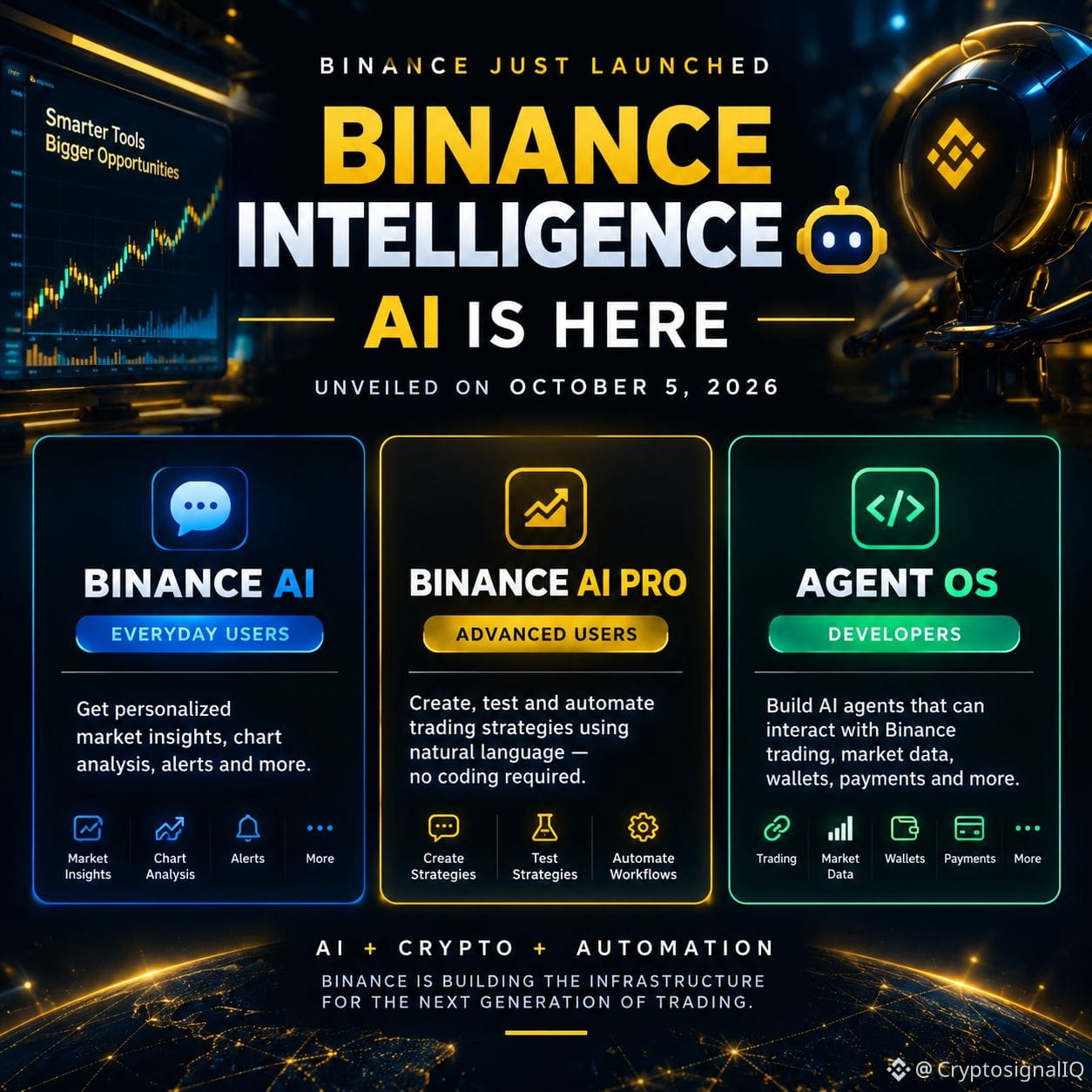
#BinanceLaunchesBinanceIntelligence Binance Intelligence is here
Navigate the crypto ecosystem with clearer, data-driven context. Binance Intelligence brings together market trends, asset developments, ecosystem activity, and key narratives to help you cut through the noise and better understand what’s shaping Web3.
Whether you’re following major market moves, exploring new projects, or keeping up with the latest ecosystem developments, Binance Intelligence makes research more accessible and easier to navigate.
Crypto markets are volatile and involve risk. Always do your own research and make decisions based on your own goals and risk tolerance.
BinanceLaunches #BinanceLaunchesBinanceIntelligence #CryptoResearch
#BinanceLaunchesBinanceIntelligence Binance Intelligence is here
Navigate the crypto ecosystem with clearer, data-driven context. Binance Intelligence brings together market trends, asset developments, ecosystem activity, and key narratives to help you cut through the noise and better understand what’s shaping Web3.
Whether you’re following major market moves, exploring new projects, or keeping up with the latest ecosystem developments, Binance Intelligence makes research more accessible and easier to navigate.
Crypto markets are volatile and involve risk. Always do your own research and make decisions based on your own goals and risk tolerance.
BinanceLaunches #BinanceLaunchesBinanceIntelligence #CryptoResearch
Navigate the crypto ecosystem with clearer, data-driven context. Binance Intelligence brings together market trends, asset developments, ecosystem activity, and key narratives to help you cut through the noise and better understand what’s shaping Web3.
Whether you’re following major market moves, exploring new projects, or keeping up with the latest ecosystem developments, Binance Intelligence makes research more accessible and easier to navigate.
Crypto markets are volatile and involve risk. Always do your own research and make decisions based on your own goals and risk tolerance.
BinanceLaunches #BinanceLaunchesBinanceIntelligence #CryptoResearch
2
241

📊 دراسة لبنك فيلادلفيا الاحتياطي: سلوك صغار متداولي البيتكوين بعد تنبيهات "الحيتان"
كشفت دراسة حديثة أجراها بنك الاحتياطي الفيدرالي في فيلادلفيا عن أن صغار متداولي البيتكوين غالباً ما يتفاعلون بسرعة مع تنبيهات تحركات "الحيتان" الكبيرة في السوق. وتشير الدراسة إلى أن هذا السلوك قد يسهم في تقلبات البيتكوين وديناميكيات السوق، مما يعكس تحيزات سلوكية محتملة بين هؤلاء المتداولين وتأثيرها على كفاءة السوق.
━━━━━━━━━━━━━━
📊 التأثير: 📈 مرتفع
🏷️ BITCOIN
#Bitcoin #MarketAnalysis #CryptoResearch #TradingBehavior #EconomicStudy
📰 المصدر: cryptobriefing.com
📊 دراسة لبنك فيلادلفيا الاحتياطي: سلوك صغار متداولي البيتكوين بعد تنبيهات "الحيتان"
كشفت دراسة حديثة أجراها بنك الاحتياطي الفيدرالي في فيلادلفيا عن أن صغار متداولي البيتكوين غالباً ما يتفاعلون بسرعة مع تنبيهات تحركات "الحيتان" الكبيرة في السوق. وتشير الدراسة إلى أن هذا السلوك قد يسهم في تقلبات البيتكوين وديناميكيات السوق، مما يعكس تحيزات سلوكية محتملة بين هؤلاء المتداولين وتأثيرها على كفاءة السوق.
━━━━━━━━━━━━━━
📊 التأثير: 📈 مرتفع
🏷️ BITCOIN
#Bitcoin #MarketAnalysis #CryptoResearch #TradingBehavior #EconomicStudy
📰 المصدر: cryptobriefing.com
كشفت دراسة حديثة أجراها بنك الاحتياطي الفيدرالي في فيلادلفيا عن أن صغار متداولي البيتكوين غالباً ما يتفاعلون بسرعة مع تنبيهات تحركات "الحيتان" الكبيرة في السوق. وتشير الدراسة إلى أن هذا السلوك قد يسهم في تقلبات البيتكوين وديناميكيات السوق، مما يعكس تحيزات سلوكية محتملة بين هؤلاء المتداولين وتأثيرها على كفاءة السوق.
━━━━━━━━━━━━━━
📊 التأثير: 📈 مرتفع
🏷️ BITCOIN
#Bitcoin #MarketAnalysis #CryptoResearch #TradingBehavior #EconomicStudy
📰 المصدر: cryptobriefing.com
25

·
--
Mirar hacia el cierre de 2026 y comienzos de 2027 exige filtrar el ruido y seguir el rastro de las métricas on-chain: retención de capital, demanda técnica y adopción institucional.
Lejos de la especulación vacía, estas tres narrativas muestran fundamentos medibles:
🔹 SUI | Ejecución L1 y retención de liquidez
Su arquitectura en Move y ejecución paralela demostró absorber picos severos de actividad sin saturar la red ni encarecer tarifas. La métrica clave no es el marketing, sino el crecimiento sostenido de su TVL y la liquidez que permanece dentro del ecosistema DeFi.
🔹 TAO | Infraestructura real de IA descentralizada
Frente a proyectos que solo son envoltorios de APIs comerciales, Bittensor estructura incentivos económicos para subredes de cómputo, validación y machine learning. Resuelve una necesidad crítica: capacidad computacional descentralizada con demanda institucional tangible.
🔹 ONDO | Tokenización institucional (RWA)
Lidera la integración de bonos del tesoro y deuda respaldada en blockchain. Al generar rendimiento en dólares reales, se ha consolidado como un canal estratégico para tesorerías Web3 y fondos que buscan estabilidad frente a la volatilidad del mercado retail.
---
⚠️ *Nota: Contenido exclusivamente educativo y de investigación on-chain. No constituye asesoría financiera ni recomendación de inversión. Haz siempre tu propia investigación (DYOR).*
¿Qué narrativa ves con mayor solidez para el próximo ciclo: infraestructura de alto rendimiento o activos del mundo real (RWA)? 👇
---
$SUI $TAO $ONDO $BTC
{spot}(SUIUSDT)
{spot}(TAOUSDT)
{spot}(ONDOUSDT)
#Write2Earn #BinanceSquare #CryptoResearch #Altcoins #RWA
Mirar hacia el cierre de 2026 y comienzos de 2027 exige filtrar el ruido y seguir el rastro de las métricas on-chain: retención de capital, demanda técnica y adopción institucional.
Lejos de la especulación vacía, estas tres narrativas muestran fundamentos medibles:
🔹 SUI | Ejecución L1 y retención de liquidez
Su arquitectura en Move y ejecución paralela demostró absorber picos severos de actividad sin saturar la red ni encarecer tarifas. La métrica clave no es el marketing, sino el crecimiento sostenido de su TVL y la liquidez que permanece dentro del ecosistema DeFi.
🔹 TAO | Infraestructura real de IA descentralizada
Frente a proyectos que solo son envoltorios de APIs comerciales, Bittensor estructura incentivos económicos para subredes de cómputo, validación y machine learning. Resuelve una necesidad crítica: capacidad computacional descentralizada con demanda institucional tangible.
🔹 ONDO | Tokenización institucional (RWA)
Lidera la integración de bonos del tesoro y deuda respaldada en blockchain. Al generar rendimiento en dólares reales, se ha consolidado como un canal estratégico para tesorerías Web3 y fondos que buscan estabilidad frente a la volatilidad del mercado retail.
---
⚠️ *Nota: Contenido exclusivamente educativo y de investigación on-chain. No constituye asesoría financiera ni recomendación de inversión. Haz siempre tu propia investigación (DYOR).*
¿Qué narrativa ves con mayor solidez para el próximo ciclo: infraestructura de alto rendimiento o activos del mundo real (RWA)? 👇
---
$SUI $TAO $ONDO $BTC
#Write2Earn #BinanceSquare #CryptoResearch #Altcoins #RWA
Lejos de la especulación vacía, estas tres narrativas muestran fundamentos medibles:
🔹 SUI | Ejecución L1 y retención de liquidez
Su arquitectura en Move y ejecución paralela demostró absorber picos severos de actividad sin saturar la red ni encarecer tarifas. La métrica clave no es el marketing, sino el crecimiento sostenido de su TVL y la liquidez que permanece dentro del ecosistema DeFi.
🔹 TAO | Infraestructura real de IA descentralizada
Frente a proyectos que solo son envoltorios de APIs comerciales, Bittensor estructura incentivos económicos para subredes de cómputo, validación y machine learning. Resuelve una necesidad crítica: capacidad computacional descentralizada con demanda institucional tangible.
🔹 ONDO | Tokenización institucional (RWA)
Lidera la integración de bonos del tesoro y deuda respaldada en blockchain. Al generar rendimiento en dólares reales, se ha consolidado como un canal estratégico para tesorerías Web3 y fondos que buscan estabilidad frente a la volatilidad del mercado retail.
---
⚠️ *Nota: Contenido exclusivamente educativo y de investigación on-chain. No constituye asesoría financiera ni recomendación de inversión. Haz siempre tu propia investigación (DYOR).*
¿Qué narrativa ves con mayor solidez para el próximo ciclo: infraestructura de alto rendimiento o activos del mundo real (RWA)? 👇
---
$SUI $TAO $ONDO $BTC
#Write2Earn #BinanceSquare #CryptoResearch #Altcoins #RWA
320

·
--
📊 How I Audit Any Crypto Project Before Putting Money In
With thousands of tokens in the market, 95% of them will go to zero.
Before I ever consider adding a token to my watchlist, I run it through this quick 4-step reality check:
1️⃣ On-Chain Revenue vs. Inflation: Is the project generating real protocol revenue, or are yield rewards paid purely in newly minted inflation?
2️⃣ Token Unlocks & Vests: Check tokenomics. If massive investor unlocks are coming up in 30–60 days, expect price pressure.
3️⃣ Developer Activity: Is GitHub active with real commits, or did development stall after token launch?
4️⃣ Utility & Retention: Does the product solve a real problem, or is it relying on a short-term marketing campaign?
Trading hype works until liquidity dries up. Researching fundamentals is what keeps you in the game long term.
🔍 What’s the first thing you check before buying a token? Let’s compare notes below. 👇 BP-46E0C96EC431
#BinanceSquare #CryptoResearch #CryptoEducation #fundamentalanalysis $BTC $BNB
📊 How I Audit Any Crypto Project Before Putting Money In
With thousands of tokens in the market, 95% of them will go to zero.
Before I ever consider adding a token to my watchlist, I run it through this quick 4-step reality check:
1️⃣ On-Chain Revenue vs. Inflation: Is the project generating real protocol revenue, or are yield rewards paid purely in newly minted inflation?
2️⃣ Token Unlocks & Vests: Check tokenomics. If massive investor unlocks are coming up in 30–60 days, expect price pressure.
3️⃣ Developer Activity: Is GitHub active with real commits, or did development stall after token launch?
4️⃣ Utility & Retention: Does the product solve a real problem, or is it relying on a short-term marketing campaign?
Trading hype works until liquidity dries up. Researching fundamentals is what keeps you in the game long term.
🔍 What’s the first thing you check before buying a token? Let’s compare notes below. 👇 BP-46E0C96EC431
#BinanceSquare #CryptoResearch #CryptoEducation #fundamentalanalysis $BTC $BNB
With thousands of tokens in the market, 95% of them will go to zero.
Before I ever consider adding a token to my watchlist, I run it through this quick 4-step reality check:
1️⃣ On-Chain Revenue vs. Inflation: Is the project generating real protocol revenue, or are yield rewards paid purely in newly minted inflation?
2️⃣ Token Unlocks & Vests: Check tokenomics. If massive investor unlocks are coming up in 30–60 days, expect price pressure.
3️⃣ Developer Activity: Is GitHub active with real commits, or did development stall after token launch?
4️⃣ Utility & Retention: Does the product solve a real problem, or is it relying on a short-term marketing campaign?
Trading hype works until liquidity dries up. Researching fundamentals is what keeps you in the game long term.
🔍 What’s the first thing you check before buying a token? Let’s compare notes below. 👇 BP-46E0C96EC431
#BinanceSquare #CryptoResearch #CryptoEducation #fundamentalanalysis $BTC $BNB
1
66

·
--
JPMorgan is doubling down on crypto research, hiring a Vice President-level analyst for its global research team in New York. The role carries a $200k–$285k salary and demands 4–7 years of crypto market experience, with a strong preference for derivatives expertise.
This move signals that top-tier finance is no longer treating digital assets as a niche—they're integrating them into cross-asset strategies alongside FX and macro research. The new hire will challenge existing narratives, write institutional-grade reports, and bridge crypto insights to senior stakeholders.
The spec is telling: they want someone who understands both spot and derivatives, can stress-test hype, and apply traditional finance rigor to crypto. For the market, this reinforces the shift toward professional analysis and risk management, not just speculation.
$BTC $ETH #CryptoResearch #InstitutionalAdoption
JPMorgan is doubling down on crypto research, hiring a Vice President-level analyst for its global research team in New York. The role carries a $200k–$285k salary and demands 4–7 years of crypto market experience, with a strong preference for derivatives expertise.
This move signals that top-tier finance is no longer treating digital assets as a niche—they're integrating them into cross-asset strategies alongside FX and macro research. The new hire will challenge existing narratives, write institutional-grade reports, and bridge crypto insights to senior stakeholders.
The spec is telling: they want someone who understands both spot and derivatives, can stress-test hype, and apply traditional finance rigor to crypto. For the market, this reinforces the shift toward professional analysis and risk management, not just speculation.
$BTC $ETH #CryptoResearch #InstitutionalAdoption
This move signals that top-tier finance is no longer treating digital assets as a niche—they're integrating them into cross-asset strategies alongside FX and macro research. The new hire will challenge existing narratives, write institutional-grade reports, and bridge crypto insights to senior stakeholders.
The spec is telling: they want someone who understands both spot and derivatives, can stress-test hype, and apply traditional finance rigor to crypto. For the market, this reinforces the shift toward professional analysis and risk management, not just speculation.
$BTC $ETH #CryptoResearch #InstitutionalAdoption
116

·
--
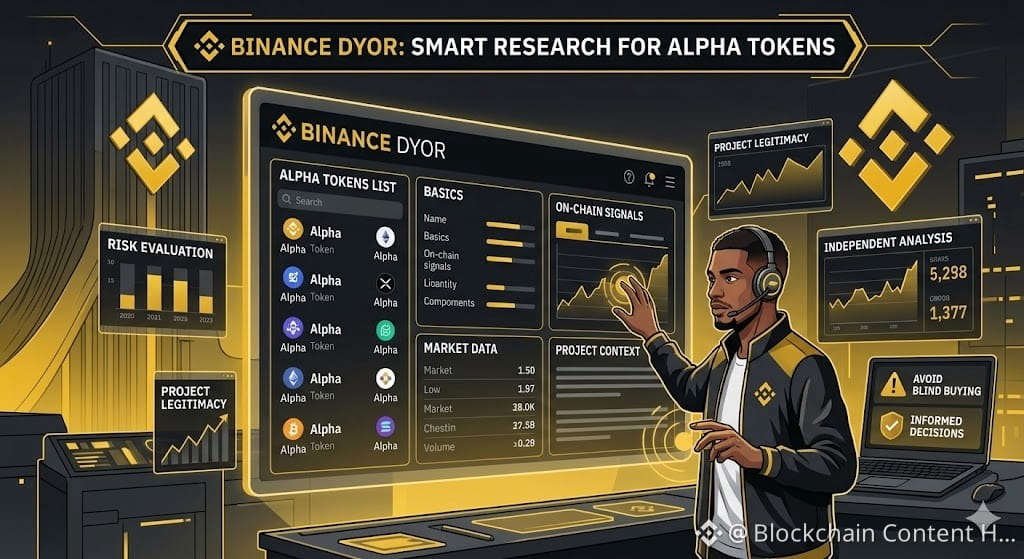
Binance has introduced DYOR, a built-in research hub dedicated to Binance Alpha tokens. It centralizes key token information — including basics, on-chain signals, market data, and project context — all in one place. Designed to help users make more informed decisions before trading early-stage tokens, DYOR aims to cut down on blind buying by giving traders a quick and reliable way to evaluate risk and project legitimacy.
#DYOR #BinanceAlpha #CryptoResearch #InformedTrading
Binance has introduced DYOR, a built-in research hub dedicated to Binance Alpha tokens. It centralizes key token information — including basics, on-chain signals, market data, and project context — all in one place. Designed to help users make more informed decisions before trading early-stage tokens, DYOR aims to cut down on blind buying by giving traders a quick and reliable way to evaluate risk and project legitimacy.
#DYOR #BinanceAlpha #CryptoResearch #InformedTrading
#DYOR #BinanceAlpha #CryptoResearch #InformedTrading
152

📋 DYOR Guide: Five Steps to Evaluate Any Crypto Project
On June 30, 2026, with 17,419 active cryptocurrencies, research is essential. Step 1: Read the whitepaper — does the problem make sense? Step 2: Check the team — are they public and credible? Step 3: Analyze tokenomics — total supply, inflation rate, distribution.
Step 4: Evaluate community and ecosystem — active development, real usage. Step 5: Check market data — volume, liquidity, exchanges listed. Following this framework helps separate genuine projects from hype-driven tokens.
📌 Key Takeaway:
Five-step research framework — whitepaper, team, tokenomics, ecosystem, market data — helps filter quality projects from noise in a 17,419-coin market.
#DYOR #CryptoResearch #Education
#BinanceAlphaAlert
📋 DYOR Guide: Five Steps to Evaluate Any Crypto Project
On June 30, 2026, with 17,419 active cryptocurrencies, research is essential. Step 1: Read the whitepaper — does the problem make sense? Step 2: Check the team — are they public and credible? Step 3: Analyze tokenomics — total supply, inflation rate, distribution.
Step 4: Evaluate community and ecosystem — active development, real usage. Step 5: Check market data — volume, liquidity, exchanges listed. Following this framework helps separate genuine projects from hype-driven tokens.
📌 Key Takeaway:
Five-step research framework — whitepaper, team, tokenomics, ecosystem, market data — helps filter quality projects from noise in a 17,419-coin market.
#DYOR #CryptoResearch #Education
#BinanceAlphaAlert
On June 30, 2026, with 17,419 active cryptocurrencies, research is essential. Step 1: Read the whitepaper — does the problem make sense? Step 2: Check the team — are they public and credible? Step 3: Analyze tokenomics — total supply, inflation rate, distribution.
Step 4: Evaluate community and ecosystem — active development, real usage. Step 5: Check market data — volume, liquidity, exchanges listed. Following this framework helps separate genuine projects from hype-driven tokens.
📌 Key Takeaway:
Five-step research framework — whitepaper, team, tokenomics, ecosystem, market data — helps filter quality projects from noise in a 17,419-coin market.
#DYOR #CryptoResearch #Education
#BinanceAlphaAlert
62

💎 Hidden Gem Research #002 | RE
Most investors ask:
Has the price dropped enough to buy?
I ask a different question:
"Does the project still have a reason to exist?"
📊 Project Snapshot
• Project: RE
• Market Cap: ~$123M
• 24H Volume: ~$127M
• ATH: $1.08
• Current Price: ~$0.60 (around 45% below ATH)
✅ Why It's On My Watchlist
🔹 Strong trading volume shows the market is paying attention.
🔹 The **Real World Asset (RWA)** sector remains one of the most discussed narratives in crypto.
🔹 The project still has room to recover if market sentiment improves.
⚠️ Biggest Risk
The current circulating supply is only a portion of the maximum supply.
Future token unlocks could increase selling pressure, so this is an important factor to monitor.
📌 My View
I'm not calling RE a guaranteed winner.
I'm adding it to my watchlist because the risk-to-reward looks interesting at current levels.
The next few weeks will be more important than the last few months.
Always do your own research before investing.
━━━━━━━━━━━━━━
📊 HiddenGemAlpha Score
🟢 Narrative: **8/10**
🟢 Liquidity: **8.5/10**
🟡 Risk Level: **Medium**
⭐ Overall Watchlist Score: **7.9/10**
Follow @HiddenGemAlpha for research-driven crypto insights—not hype.
#REZ #RWA #altcoins #BinanceSquare #CryptoResearch
💎 Hidden Gem Research #002 | RE
Most investors ask:
Has the price dropped enough to buy?
I ask a different question:
"Does the project still have a reason to exist?"
📊 Project Snapshot
• Project: RE
• Market Cap: ~$123M
• 24H Volume: ~$127M
• ATH: $1.08
• Current Price: ~$0.60 (around 45% below ATH)
✅ Why It's On My Watchlist
🔹 Strong trading volume shows the market is paying attention.
🔹 The **Real World Asset (RWA)** sector remains one of the most discussed narratives in crypto.
🔹 The project still has room to recover if market sentiment improves.
⚠️ Biggest Risk
The current circulating supply is only a portion of the maximum supply.
Future token unlocks could increase selling pressure, so this is an important factor to monitor.
📌 My View
I'm not calling RE a guaranteed winner.
I'm adding it to my watchlist because the risk-to-reward looks interesting at current levels.
The next few weeks will be more important than the last few months.
Always do your own research before investing.
━━━━━━━━━━━━━━
📊 HiddenGemAlpha Score
🟢 Narrative: **8/10**
🟢 Liquidity: **8.5/10**
🟡 Risk Level: **Medium**
⭐ Overall Watchlist Score: **7.9/10**
Follow @HiddenGemAlpha for research-driven crypto insights—not hype.
#REZ #RWA #altcoins #BinanceSquare #CryptoResearch
Most investors ask:
Has the price dropped enough to buy?
I ask a different question:
"Does the project still have a reason to exist?"
📊 Project Snapshot
• Project: RE
• Market Cap: ~$123M
• 24H Volume: ~$127M
• ATH: $1.08
• Current Price: ~$0.60 (around 45% below ATH)
✅ Why It's On My Watchlist
🔹 Strong trading volume shows the market is paying attention.
🔹 The **Real World Asset (RWA)** sector remains one of the most discussed narratives in crypto.
🔹 The project still has room to recover if market sentiment improves.
⚠️ Biggest Risk
The current circulating supply is only a portion of the maximum supply.
Future token unlocks could increase selling pressure, so this is an important factor to monitor.
📌 My View
I'm not calling RE a guaranteed winner.
I'm adding it to my watchlist because the risk-to-reward looks interesting at current levels.
The next few weeks will be more important than the last few months.
Always do your own research before investing.
━━━━━━━━━━━━━━
📊 HiddenGemAlpha Score
🟢 Narrative: **8/10**
🟢 Liquidity: **8.5/10**
🟡 Risk Level: **Medium**
⭐ Overall Watchlist Score: **7.9/10**
Follow @HiddenGemAlpha for research-driven crypto insights—not hype.
#REZ #RWA #altcoins #BinanceSquare #CryptoResearch
237

·
--
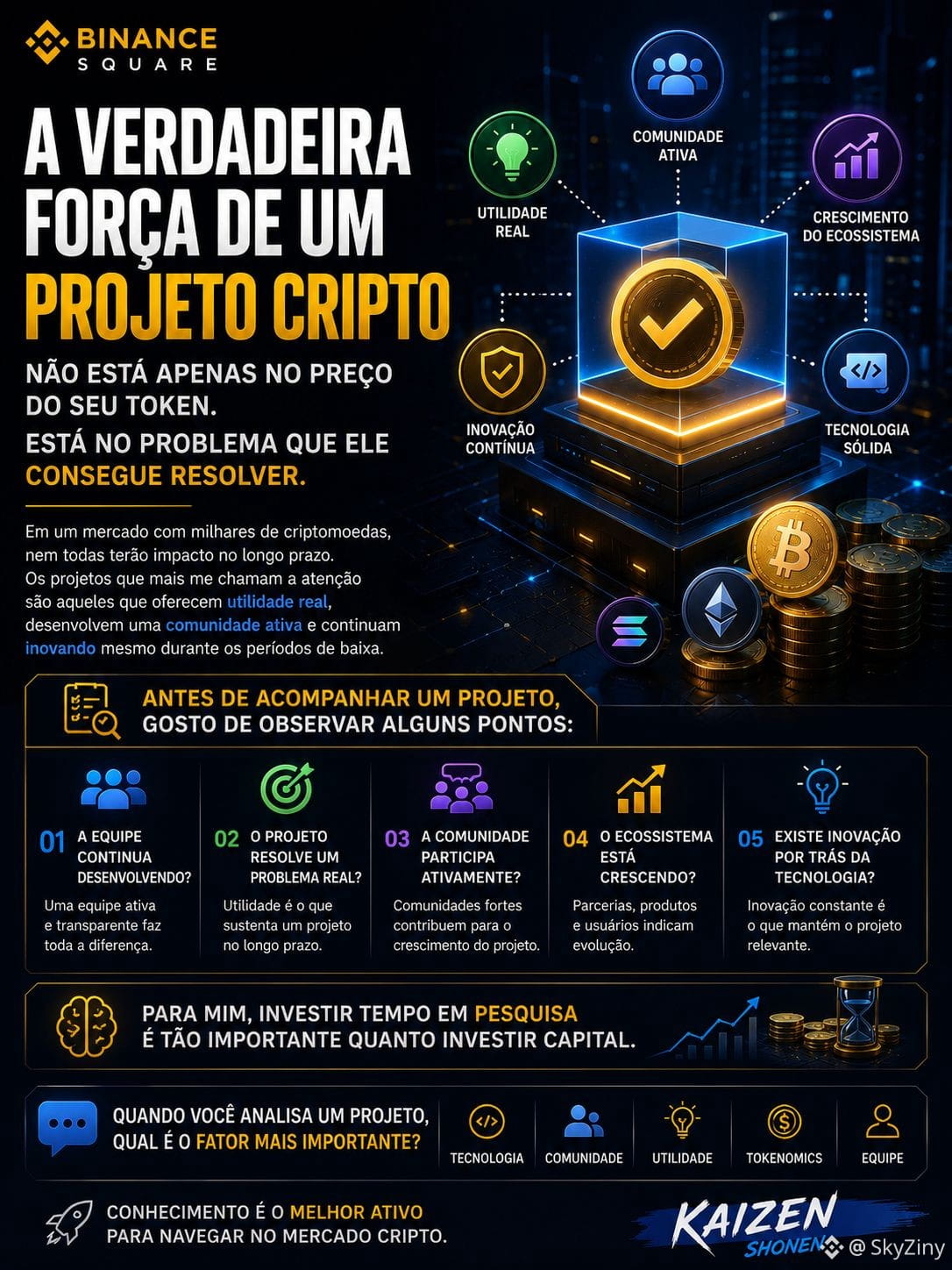
🚀 A verdadeira força de um projeto cripto não está apenas no preço do seu token. Está no problema que ele consegue resolver.
Em um mercado com milhares de criptomoedas, nem todas terão impacto no longo prazo. Os projetos que mais me chamam a atenção são aqueles que oferecem utilidade real, desenvolvem uma comunidade ativa e continuam inovando mesmo durante os períodos de baixa.
Antes de acompanhar um projeto, gosto de observar alguns pontos:
🔍 A equipe continua desenvolvendo? 🌍 O projeto resolve um problema real? 🤝 A comunidade participa ativamente? 📈 O ecossistema está crescendo? 💡 Existe inovação por trás da tecnologia?
Para mim, investir tempo em pesquisa é tão importante quanto investir capital.
No fim das contas, conhecimento continua sendo o melhor ativo para navegar no mercado cripto com mais confiança.
💬 Quando você analisa um projeto, qual é o fator mais importante: tecnologia, comunidade, utilidade, tokenomics ou equipe?
#crypto #blockchain #Web3 #CryptoResearch #SkyZinyJourney
🚀 A verdadeira força de um projeto cripto não está apenas no preço do seu token. Está no problema que ele consegue resolver.
Em um mercado com milhares de criptomoedas, nem todas terão impacto no longo prazo. Os projetos que mais me chamam a atenção são aqueles que oferecem utilidade real, desenvolvem uma comunidade ativa e continuam inovando mesmo durante os períodos de baixa.
Antes de acompanhar um projeto, gosto de observar alguns pontos:
🔍 A equipe continua desenvolvendo? 🌍 O projeto resolve um problema real? 🤝 A comunidade participa ativamente? 📈 O ecossistema está crescendo? 💡 Existe inovação por trás da tecnologia?
Para mim, investir tempo em pesquisa é tão importante quanto investir capital.
No fim das contas, conhecimento continua sendo o melhor ativo para navegar no mercado cripto com mais confiança.
💬 Quando você analisa um projeto, qual é o fator mais importante: tecnologia, comunidade, utilidade, tokenomics ou equipe?
#crypto #blockchain #Web3 #CryptoResearch #SkyZinyJourney
Em um mercado com milhares de criptomoedas, nem todas terão impacto no longo prazo. Os projetos que mais me chamam a atenção são aqueles que oferecem utilidade real, desenvolvem uma comunidade ativa e continuam inovando mesmo durante os períodos de baixa.
Antes de acompanhar um projeto, gosto de observar alguns pontos:
🔍 A equipe continua desenvolvendo? 🌍 O projeto resolve um problema real? 🤝 A comunidade participa ativamente? 📈 O ecossistema está crescendo? 💡 Existe inovação por trás da tecnologia?
Para mim, investir tempo em pesquisa é tão importante quanto investir capital.
No fim das contas, conhecimento continua sendo o melhor ativo para navegar no mercado cripto com mais confiança.
💬 Quando você analisa um projeto, qual é o fator mais importante: tecnologia, comunidade, utilidade, tokenomics ou equipe?
#crypto #blockchain #Web3 #CryptoResearch #SkyZinyJourney
2
171

·
--
我现在用AI研究Crypto,主要做这4件事
① 整理行业资料
② 总结项目白皮书
③ 翻译海外信息
④ 梳理自己的投资逻辑
以前需要几个小时。
现在可以大幅减少信息整理时间。
但最后的判断:
还是自己做。
#AI #CryptoResearch #AITools
我现在用AI研究Crypto,主要做这4件事
① 整理行业资料
② 总结项目白皮书
③ 翻译海外信息
④ 梳理自己的投资逻辑
以前需要几个小时。
现在可以大幅减少信息整理时间。
但最后的判断:
还是自己做。
#AI #CryptoResearch #AITools
① 整理行业资料
② 总结项目白皮书
③ 翻译海外信息
④ 梳理自己的投资逻辑
以前需要几个小时。
现在可以大幅减少信息整理时间。
但最后的判断:
还是自己做。
#AI #CryptoResearch #AITools

301
📚 How to Research a Crypto Project: Due Diligence Checklist for New Investors
On July 4, 2026, with 17,387 coins tracked, knowing how to research projects is essential. Start with the whitepaper — does it solve a real problem? Then check the team, tokenomics, and community.
Data sources like CoinGecko provide key metrics: market cap ($2.26T), volume ($64.58B), and price action. For Bitcoin $BTC at $62,612, the fundamentals are well-established. For smaller projects, deeper digging is needed.
Look at: GitHub activity (are developers building?), token distribution (is it centralized?), and real users (not just bots). If a project's only narrative is 'price go up,' it's a speculation, not an investment.
📌 Key Takeaway:
Due diligence separates informed investors from gamblers. Whitepaper + team + tokenomics + community + usage = the five pillars of crypto research.
#CryptoResearch #DYOR #Educational
#BinanceAlphaAlert
📚 How to Research a Crypto Project: Due Diligence Checklist for New Investors
On July 4, 2026, with 17,387 coins tracked, knowing how to research projects is essential. Start with the whitepaper — does it solve a real problem? Then check the team, tokenomics, and community.
Data sources like CoinGecko provide key metrics: market cap ($2.26T), volume ($64.58B), and price action. For Bitcoin $BTC at $62,612, the fundamentals are well-established. For smaller projects, deeper digging is needed.
Look at: GitHub activity (are developers building?), token distribution (is it centralized?), and real users (not just bots). If a project's only narrative is 'price go up,' it's a speculation, not an investment.
📌 Key Takeaway:
Due diligence separates informed investors from gamblers. Whitepaper + team + tokenomics + community + usage = the five pillars of crypto research.
#CryptoResearch #DYOR #Educational
#BinanceAlphaAlert
On July 4, 2026, with 17,387 coins tracked, knowing how to research projects is essential. Start with the whitepaper — does it solve a real problem? Then check the team, tokenomics, and community.
Data sources like CoinGecko provide key metrics: market cap ($2.26T), volume ($64.58B), and price action. For Bitcoin $BTC at $62,612, the fundamentals are well-established. For smaller projects, deeper digging is needed.
Look at: GitHub activity (are developers building?), token distribution (is it centralized?), and real users (not just bots). If a project's only narrative is 'price go up,' it's a speculation, not an investment.
📌 Key Takeaway:
Due diligence separates informed investors from gamblers. Whitepaper + team + tokenomics + community + usage = the five pillars of crypto research.
#CryptoResearch #DYOR #Educational
#BinanceAlphaAlert
103
Log in to explore more content
Join global crypto users on Binance Square
⚡️ Get latest and useful information about crypto.
💬 Trusted by the world’s largest crypto exchange.
👍 Discover real insights from verified creators.
Email / Phone number
Trending Topics
1
#BinancePick
3.4M views
164,946 Discussing
2
#EarningsSeason
5.5M views
26,907 Discussing
3
#StrategySkipsBitcoinPurchasesSpends$205MOnSTRCBuybacks
916 views
26 Discussing
4
#BitmineAdds10452ETH
9,962 views
237 Discussing
5
#SouthKoreaConsidersEducationTaxOnCryptoExchanges
8,096 views
215 Discussing
6
#OCCUrgesCommunityBanksToEnterStablecoinPayments
7,698 views
132 Discussing
7
#RippleWinsFullApprovalAsNationalTrustBank
7,069 views
140 Discussing
8
#AkashSelectsSolanaAsMigrationTarget
4,476 views
63 Discussing
9
#OndoToOpenSubscriptionsForOpenAIPreIPOTokenizedNotes
331 views
19 Discussing
10
#AnthropicTTMRevenueGrewAbout1200%
60,034 views
607 Discussing