
#cryptomyths
cryptomyths
251,165 views
140 Discussing
Hot
Latest

·
--
❌ 3 Mitos sobre el mundo Cripto que la gente sigue creyendo en 2026 🧠👇
El espacio Web3 avanza rápido, pero hay varios prejuicios del pasado que todavía alejan a muchas personas. Aclaremos la realidad de 3 de los más comunes:
1️⃣ Mito: "Necesitas comprar 1 Bitcoin entero para empezar"
Realidad: Cripto es infinitamente divisible. Puedes empezar a explorar, ahorrar o aprender con fracciones de moneda (satoshis) desde $1 USD.
2️⃣ Mito: "Las transacciones son 100% anónimas y se usan para cosas ilegales"
Realidad: La gran mayoría de blockchains son públicas y trazables. Cada transacción queda registrada en un libro contable transparente, lo que hace que rastrear fondos sea mucho más fácil que con el dinero en efectivo tradicional.
3️⃣ Mito: "Es solo una burbuja sin ningún valor intrínseco"
Realidad: Detrás del mercado financiero hay tecnología: contratos inteligentes, finanzas descentralizadas, optimización de pagos transfronterizos e infraestructura distribuida utilizada por grandes instituciones globales.
💡 Consejo: Antes de juzgar un sector o una tecnología, investiga cómo funciona su infraestructura y qué problema resuelve.
👇 ¿Qué otro mito escuchas con frecuencia cuando hablas de cripto? ¡Nos vemos en los comentarios!
$BTC
#BinanceSquare #CryptoMyths #web3兼职 #Bitcoin #cryptoeducation
❌ 3 Mitos sobre el mundo Cripto que la gente sigue creyendo en 2026 🧠👇
El espacio Web3 avanza rápido, pero hay varios prejuicios del pasado que todavía alejan a muchas personas. Aclaremos la realidad de 3 de los más comunes:
1️⃣ Mito: "Necesitas comprar 1 Bitcoin entero para empezar"
Realidad: Cripto es infinitamente divisible. Puedes empezar a explorar, ahorrar o aprender con fracciones de moneda (satoshis) desde $1 USD.
2️⃣ Mito: "Las transacciones son 100% anónimas y se usan para cosas ilegales"
Realidad: La gran mayoría de blockchains son públicas y trazables. Cada transacción queda registrada en un libro contable transparente, lo que hace que rastrear fondos sea mucho más fácil que con el dinero en efectivo tradicional.
3️⃣ Mito: "Es solo una burbuja sin ningún valor intrínseco"
Realidad: Detrás del mercado financiero hay tecnología: contratos inteligentes, finanzas descentralizadas, optimización de pagos transfronterizos e infraestructura distribuida utilizada por grandes instituciones globales.
💡 Consejo: Antes de juzgar un sector o una tecnología, investiga cómo funciona su infraestructura y qué problema resuelve.
👇 ¿Qué otro mito escuchas con frecuencia cuando hablas de cripto? ¡Nos vemos en los comentarios!
$BTC
#BinanceSquare #CryptoMyths #web3兼职 #Bitcoin #cryptoeducation
El espacio Web3 avanza rápido, pero hay varios prejuicios del pasado que todavía alejan a muchas personas. Aclaremos la realidad de 3 de los más comunes:
1️⃣ Mito: "Necesitas comprar 1 Bitcoin entero para empezar"
Realidad: Cripto es infinitamente divisible. Puedes empezar a explorar, ahorrar o aprender con fracciones de moneda (satoshis) desde $1 USD.
2️⃣ Mito: "Las transacciones son 100% anónimas y se usan para cosas ilegales"
Realidad: La gran mayoría de blockchains son públicas y trazables. Cada transacción queda registrada en un libro contable transparente, lo que hace que rastrear fondos sea mucho más fácil que con el dinero en efectivo tradicional.
3️⃣ Mito: "Es solo una burbuja sin ningún valor intrínseco"
Realidad: Detrás del mercado financiero hay tecnología: contratos inteligentes, finanzas descentralizadas, optimización de pagos transfronterizos e infraestructura distribuida utilizada por grandes instituciones globales.
💡 Consejo: Antes de juzgar un sector o una tecnología, investiga cómo funciona su infraestructura y qué problema resuelve.
👇 ¿Qué otro mito escuchas con frecuencia cuando hablas de cripto? ¡Nos vemos en los comentarios!
$BTC
#BinanceSquare #CryptoMyths #web3兼职 #Bitcoin #cryptoeducation
1
156

·
--
"Buy the dip always works." This lie almost completely wiped out my ADA and SOL bags using leverage, and it’s why so many of you lose everything. A "dip" at 50x leverage isn't a dip, it's a 2% drop from your entry and boom, you're liquidated. You don't have infinite money to keep buying lower, and sometimes that dip isn't a dip at all—it's the market rolling over or a project dying. What's actually true is that buying the dip only works if you have endless capital and zero leverage, letting you weather any storm. For the rest of us, it’s just catching a falling knife. Are your pockets deep enough to never get cut?
#CryptoMyths #LeverageFails #RiskManagement #FuturesTrading #TradeSmart
"Buy the dip always works." This lie almost completely wiped out my ADA and SOL bags using leverage, and it’s why so many of you lose everything. A "dip" at 50x leverage isn't a dip, it's a 2% drop from your entry and boom, you're liquidated. You don't have infinite money to keep buying lower, and sometimes that dip isn't a dip at all—it's the market rolling over or a project dying. What's actually true is that buying the dip only works if you have endless capital and zero leverage, letting you weather any storm. For the rest of us, it’s just catching a falling knife. Are your pockets deep enough to never get cut?
#CryptoMyths #LeverageFails #RiskManagement #FuturesTrading #TradeSmart
#CryptoMyths #LeverageFails #RiskManagement #FuturesTrading #TradeSmart

68
🧠 MYTH: CRYPTO HAS NO REAL USE CASE.
I hear this every week.
Let me show you reality.
MYTH 1:
"Bitcoin is just for criminals."
FACT:
The traditional banking system processes
billions in money laundering annually.
Bitcoin transactions are fully traceable
on a public blockchain.
Cash is anonymous. Bitcoin is not.
MYTH 2:
"Crypto has no intrinsic value."
FACT:
. Western Union's stablecoin runs on Solana
. Israel's national stablecoin runs on Solana
. JP Morgan manages stablecoin reserves
. $15.35 billion in tokenized US Treasuries
live on blockchains right now
. These are real assets. Real use. Real value.
MYTH 3:
"Only young people use crypto."
FACT:
. Morgan Stanley holds $29.9M SOL ETF
. BlackRock manages BTC ETF
. Charles Schwab offers spot BTC + ETH
to 35 million retail clients
. Strategy holds 843,738 Bitcoin
MYTH 4:
"Governments will ban it."
FACT:
. US just passed the CLARITY Act
. El Salvador made it legal tender
. US has a crypto-friendly Fed Chair
. Regulation is arriving — not banning
The question is not if crypto has use.
The question is how fast the use grows.
Save this. Use it next time someone says
"crypto has no value." 👇
⚠️ Educational only. Not financial advice. DYOR.
#CryptoMyths #Bitcoin #BlockchainFacts
#JackDailyBrief #BinanceSquare #May2026 #BTC
$BTC
{spot}(BTCUSDT)
$ETH
{spot}(ETHUSDT)
$XRP
{spot}(XRPUSDT)
🧠 MYTH: CRYPTO HAS NO REAL USE CASE.
I hear this every week.
Let me show you reality.
MYTH 1:
"Bitcoin is just for criminals."
FACT:
The traditional banking system processes
billions in money laundering annually.
Bitcoin transactions are fully traceable
on a public blockchain.
Cash is anonymous. Bitcoin is not.
MYTH 2:
"Crypto has no intrinsic value."
FACT:
. Western Union's stablecoin runs on Solana
. Israel's national stablecoin runs on Solana
. JP Morgan manages stablecoin reserves
. $15.35 billion in tokenized US Treasuries
live on blockchains right now
. These are real assets. Real use. Real value.
MYTH 3:
"Only young people use crypto."
FACT:
. Morgan Stanley holds $29.9M SOL ETF
. BlackRock manages BTC ETF
. Charles Schwab offers spot BTC + ETH
to 35 million retail clients
. Strategy holds 843,738 Bitcoin
MYTH 4:
"Governments will ban it."
FACT:
. US just passed the CLARITY Act
. El Salvador made it legal tender
. US has a crypto-friendly Fed Chair
. Regulation is arriving — not banning
The question is not if crypto has use.
The question is how fast the use grows.
Save this. Use it next time someone says
"crypto has no value." 👇
⚠️ Educational only. Not financial advice. DYOR.
#CryptoMyths #Bitcoin #BlockchainFacts
#JackDailyBrief #BinanceSquare #May2026 #BTC
$BTC
$ETH
$XRP
I hear this every week.
Let me show you reality.
MYTH 1:
"Bitcoin is just for criminals."
FACT:
The traditional banking system processes
billions in money laundering annually.
Bitcoin transactions are fully traceable
on a public blockchain.
Cash is anonymous. Bitcoin is not.
MYTH 2:
"Crypto has no intrinsic value."
FACT:
. Western Union's stablecoin runs on Solana
. Israel's national stablecoin runs on Solana
. JP Morgan manages stablecoin reserves
. $15.35 billion in tokenized US Treasuries
live on blockchains right now
. These are real assets. Real use. Real value.
MYTH 3:
"Only young people use crypto."
FACT:
. Morgan Stanley holds $29.9M SOL ETF
. BlackRock manages BTC ETF
. Charles Schwab offers spot BTC + ETH
to 35 million retail clients
. Strategy holds 843,738 Bitcoin
MYTH 4:
"Governments will ban it."
FACT:
. US just passed the CLARITY Act
. El Salvador made it legal tender
. US has a crypto-friendly Fed Chair
. Regulation is arriving — not banning
The question is not if crypto has use.
The question is how fast the use grows.
Save this. Use it next time someone says
"crypto has no value." 👇
⚠️ Educational only. Not financial advice. DYOR.
#CryptoMyths #Bitcoin #BlockchainFacts
#JackDailyBrief #BinanceSquare #May2026 #BTC
$BTC
$ETH
$XRP
109

·
--
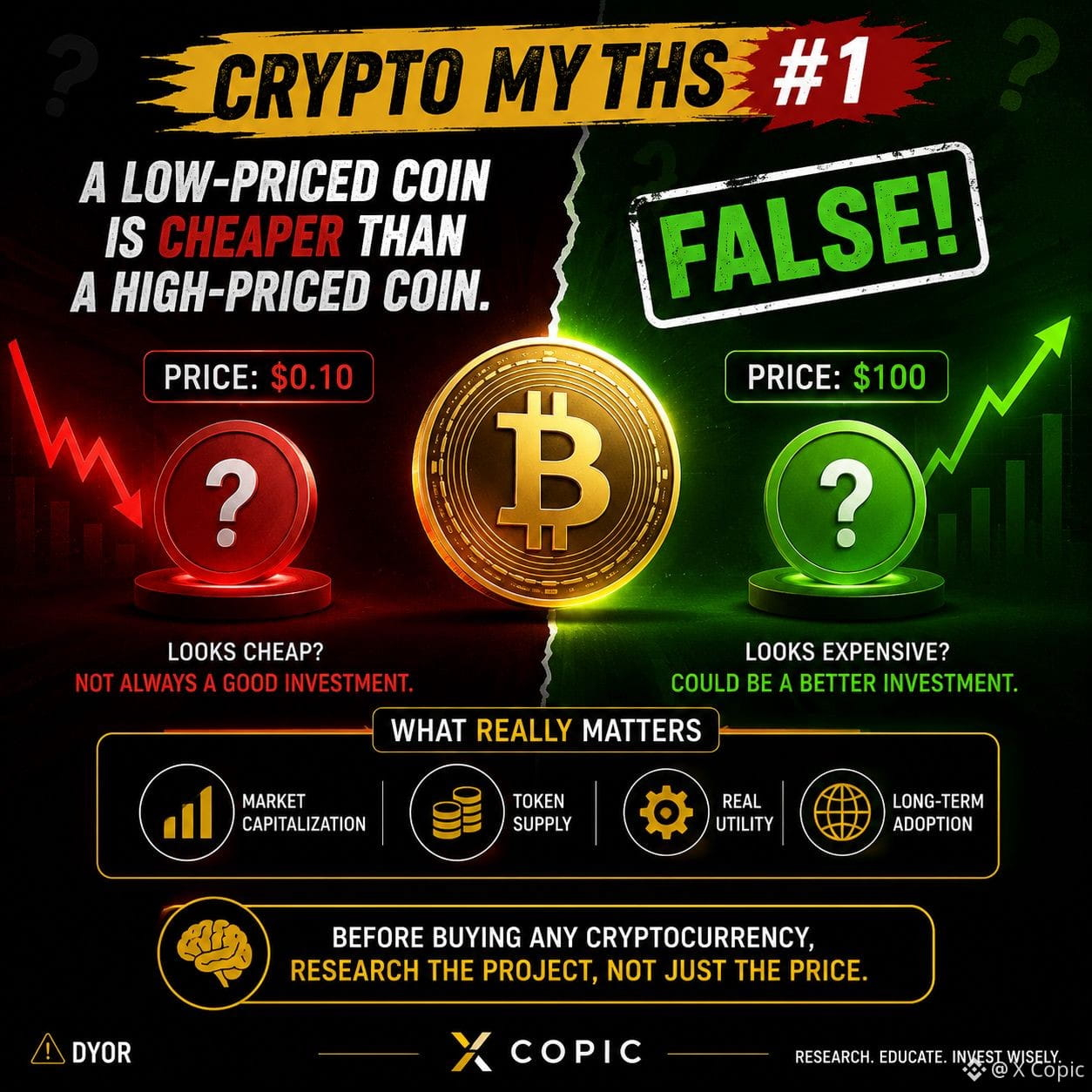
🚨 Crypto Myth #1
"A low-priced coin is cheaper than a high-priced coin."
❌ False.
A coin priced at $0.10 isn't automatically a better opportunity than one priced at $100.
Price alone tells you almost nothing.
What matters is:
• Market Capitalization 📊
• Token Supply 🪙
• Real Utility ⚙️
• Long-Term Adoption 🌍
Many new investors buy low-priced coins because they "look cheap."
Experienced investors ask a different question:
"Is this project actually worth its valuation?"
The market doesn't reward investors who buy the cheapest coin.
It rewards those who understand value.
🧠 Before buying any cryptocurrency, research the project—not just the price.
The cheapest-looking investment isn't always the best investment.
#CryptoMyths #CryptoEducation #Investing #Research #DYOR
🚨 Crypto Myth #1
"A low-priced coin is cheaper than a high-priced coin."
❌ False.
A coin priced at $0.10 isn't automatically a better opportunity than one priced at $100.
Price alone tells you almost nothing.
What matters is:
• Market Capitalization 📊
• Token Supply 🪙
• Real Utility ⚙️
• Long-Term Adoption 🌍
Many new investors buy low-priced coins because they "look cheap."
Experienced investors ask a different question:
"Is this project actually worth its valuation?"
The market doesn't reward investors who buy the cheapest coin.
It rewards those who understand value.
🧠 Before buying any cryptocurrency, research the project—not just the price.
The cheapest-looking investment isn't always the best investment.
#CryptoMyths #CryptoEducation #Investing #Research #DYOR
"A low-priced coin is cheaper than a high-priced coin."
❌ False.
A coin priced at $0.10 isn't automatically a better opportunity than one priced at $100.
Price alone tells you almost nothing.
What matters is:
• Market Capitalization 📊
• Token Supply 🪙
• Real Utility ⚙️
• Long-Term Adoption 🌍
Many new investors buy low-priced coins because they "look cheap."
Experienced investors ask a different question:
"Is this project actually worth its valuation?"
The market doesn't reward investors who buy the cheapest coin.
It rewards those who understand value.
🧠 Before buying any cryptocurrency, research the project—not just the price.
The cheapest-looking investment isn't always the best investment.
#CryptoMyths #CryptoEducation #Investing #Research #DYOR
64

·
--
MYTH BUSTER 🔨: "Bitcoin dropping = crypto is about to crash"
NOT NECESSARILY - context matters here.
$BTC's pullback from this week's $65K high back to the $63K zone lines up almost exactly with a broader risk-off wave: a sixth day of U.S.-Iran military tensions, oil prices spiking as the Strait of Hormuz stays effectively closed, and an AI-stock selloff that's dragging down risk assets across the board - not just crypto.
In fact, one technical measure is currently flagging Bitcoin as oversold heading into the weekend, and spot Bitcoin ETFs just snapped a 10-day outflow streak with their largest single-day inflow in two months.
So the drop isn't a crypto-specific breakdown - it's crypto trading like a risk asset during a geopolitical shock. Those are very different setups with very different implications.
Save this so you don't panic-sell the next headline-driven dip 📌
#CryptoMyths #Bitcoin #BTC #Geopolitics #Binance
MYTH BUSTER 🔨: "Bitcoin dropping = crypto is about to crash"
NOT NECESSARILY - context matters here.
$BTC 's pullback from this week's $65K high back to the $63K zone lines up almost exactly with a broader risk-off wave: a sixth day of U.S.-Iran military tensions, oil prices spiking as the Strait of Hormuz stays effectively closed, and an AI-stock selloff that's dragging down risk assets across the board - not just crypto.
In fact, one technical measure is currently flagging Bitcoin as oversold heading into the weekend, and spot Bitcoin ETFs just snapped a 10-day outflow streak with their largest single-day inflow in two months.
So the drop isn't a crypto-specific breakdown - it's crypto trading like a risk asset during a geopolitical shock. Those are very different setups with very different implications.
Save this so you don't panic-sell the next headline-driven dip 📌
#CryptoMyths #Bitcoin #BTC #Geopolitics #Binance
NOT NECESSARILY - context matters here.
$BTC 's pullback from this week's $65K high back to the $63K zone lines up almost exactly with a broader risk-off wave: a sixth day of U.S.-Iran military tensions, oil prices spiking as the Strait of Hormuz stays effectively closed, and an AI-stock selloff that's dragging down risk assets across the board - not just crypto.
In fact, one technical measure is currently flagging Bitcoin as oversold heading into the weekend, and spot Bitcoin ETFs just snapped a 10-day outflow streak with their largest single-day inflow in two months.
So the drop isn't a crypto-specific breakdown - it's crypto trading like a risk asset during a geopolitical shock. Those are very different setups with very different implications.
Save this so you don't panic-sell the next headline-driven dip 📌
#CryptoMyths #Bitcoin #BTC #Geopolitics #Binance
72

🛑 The Reality Check: What They Don’t Tell You About Crypto SuccessIf you scroll through crypto social media, it looks incredibly easy: someone turns $100 into $10,000 overnight, buys a luxury car, and quits their job.
But behind the screens, the reality of successful investing looks completely different. Let’s break down the myths versus the actual truths of the market:
### 🚫 Myth #1: You need to trade every single day to make money.
* **The Reality:** Over-trading is the fastest way to lose your capital to fees and bad emotional decisions. Some of the most profitable investors make only 4 or 5 major moves a year. They spend 90% of their time researching, watching, and waiting for the absolute perfect setup. **In crypto, doing nothing is often a highly profitable strategy.**
### 🚫 Myth #2: You have to find the "Next 100x Gem" to build wealth.
* **The Reality:** Chasing 100x micro-cap tokens is basically gambling. If you put $1,000 into a coin that drops to zero, you are back to square one. True portfolio growth happens by compounding solid, consistent wins. A 2x or 3x gain on a fundamentally strong asset like Bitcoin or top-tier ecosystem tokens—using proper position sizing—will build sustainable wealth over time.
### 🚫 Myth #3: Winners never take losses.
* **The Reality:** Even the best pro traders in the world lose 40% to 50% of their trades. The difference? When they lose, they lose *small* because they use a strict Stop-Loss. When they win, they win *big* because they let their profits run. It’s not about having a 100% win rate; it’s about risk-to-reward ratios.
The Takeaway for Today:
Stop comparing your Chapter 1 to someone else's Chapter 20. Crypto isn't a get-rich-quick scheme; it's a skill game. Master your emotions, protect your capital, and let the market structure work for you.
*#CryptoMyths #TradingReality #InvestorMindset #BİNANCESQUARE #LearnAndEarnQuiz *
🛑 The Reality Check: What They Don’t Tell You About Crypto Success
If you scroll through crypto social media, it looks incredibly easy: someone turns $100 into $10,000 overnight, buys a luxury car, and quits their job.
But behind the screens, the reality of successful investing looks completely different. Let’s break down the myths versus the actual truths of the market:
### 🚫 Myth #1: You need to trade every single day to make money.
* **The Reality:** Over-trading is the fastest way to lose your capital to fees and bad emotional decisions. Some of the most profitable investors make only 4 or 5 major moves a year. They spend 90% of their time researching, watching, and waiting for the absolute perfect setup. **In crypto, doing nothing is often a highly profitable strategy.**
### 🚫 Myth #2: You have to find the "Next 100x Gem" to build wealth.
* **The Reality:** Chasing 100x micro-cap tokens is basically gambling. If you put $1,000 into a coin that drops to zero, you are back to square one. True portfolio growth happens by compounding solid, consistent wins. A 2x or 3x gain on a fundamentally strong asset like Bitcoin or top-tier ecosystem tokens—using proper position sizing—will build sustainable wealth over time.
### 🚫 Myth #3: Winners never take losses.
* **The Reality:** Even the best pro traders in the world lose 40% to 50% of their trades. The difference? When they lose, they lose *small* because they use a strict Stop-Loss. When they win, they win *big* because they let their profits run. It’s not about having a 100% win rate; it’s about risk-to-reward ratios.
The Takeaway for Today:
Stop comparing your Chapter 1 to someone else's Chapter 20. Crypto isn't a get-rich-quick scheme; it's a skill game. Master your emotions, protect your capital, and let the market structure work for you.
*#CryptoMyths #TradingReality #InvestorMindset #BİNANCESQUARE #LearnAndEarnQuiz *
But behind the screens, the reality of successful investing looks completely different. Let’s break down the myths versus the actual truths of the market:
### 🚫 Myth #1: You need to trade every single day to make money.
* **The Reality:** Over-trading is the fastest way to lose your capital to fees and bad emotional decisions. Some of the most profitable investors make only 4 or 5 major moves a year. They spend 90% of their time researching, watching, and waiting for the absolute perfect setup. **In crypto, doing nothing is often a highly profitable strategy.**
### 🚫 Myth #2: You have to find the "Next 100x Gem" to build wealth.
* **The Reality:** Chasing 100x micro-cap tokens is basically gambling. If you put $1,000 into a coin that drops to zero, you are back to square one. True portfolio growth happens by compounding solid, consistent wins. A 2x or 3x gain on a fundamentally strong asset like Bitcoin or top-tier ecosystem tokens—using proper position sizing—will build sustainable wealth over time.
### 🚫 Myth #3: Winners never take losses.
* **The Reality:** Even the best pro traders in the world lose 40% to 50% of their trades. The difference? When they lose, they lose *small* because they use a strict Stop-Loss. When they win, they win *big* because they let their profits run. It’s not about having a 100% win rate; it’s about risk-to-reward ratios.
The Takeaway for Today:
Stop comparing your Chapter 1 to someone else's Chapter 20. Crypto isn't a get-rich-quick scheme; it's a skill game. Master your emotions, protect your capital, and let the market structure work for you.
*#CryptoMyths #TradingReality #InvestorMindset #BİNANCESQUARE #LearnAndEarnQuiz *
1
87

·
--
🛑 MYTH: "Crypto is just a Ponzi scheme"
FACT CHECK 👇
✅ Bitcoin has a fixed, transparent supply cap of 21 million — publicly verifiable by anyone
✅ No central person collects money and pays "returns" — it runs on open-source code
✅ It's been operating for 17 years without collapsing on itself
Doesn't mean it's risk-free — but it's not what people think it is.
Know someone who still thinks this? Tag or Share them 🤝🏻
$BTC
{spot}(BTCUSDT)
$ETH
{spot}(ETHUSDT)
$SOL
{spot}(SOLUSDT)
⚠️ Not financial advice. Always DYOR.
#Bitcoin #CryptoMyths #Blockchain #EducationalContent #MrCurious
🛑 MYTH: "Crypto is just a Ponzi scheme"
FACT CHECK 👇
✅ Bitcoin has a fixed, transparent supply cap of 21 million — publicly verifiable by anyone
✅ No central person collects money and pays "returns" — it runs on open-source code
✅ It's been operating for 17 years without collapsing on itself
Doesn't mean it's risk-free — but it's not what people think it is.
Know someone who still thinks this? Tag or Share them 🤝🏻
$BTC
$ETH
$SOL
⚠️ Not financial advice. Always DYOR.
#Bitcoin #CryptoMyths #Blockchain #EducationalContent #MrCurious
FACT CHECK 👇
✅ Bitcoin has a fixed, transparent supply cap of 21 million — publicly verifiable by anyone
✅ No central person collects money and pays "returns" — it runs on open-source code
✅ It's been operating for 17 years without collapsing on itself
Doesn't mean it's risk-free — but it's not what people think it is.
Know someone who still thinks this? Tag or Share them 🤝🏻
$BTC
$ETH
$SOL
⚠️ Not financial advice. Always DYOR.
#Bitcoin #CryptoMyths #Blockchain #EducationalContent #MrCurious

4
282
·
--
MYTH BUSTER 🔨: "Bitcoin dominance falling = instant altseason"
FALSE (right now, at least).
The Altcoin Season Index needs 75%+ of the top altcoins outperforming BTC over a 90-day window to confirm a real altseason. As of this week that index is still sitting well below that threshold.
What's actually happening in 2026 is narrative-driven rotation - money flooding into individual sectors or single tokens (like this week's MemeCore or DEXE moves) rather than a broad, market-wide lift.
So seeing one or two alts pump 20-80% does NOT mean altseason has started. It means capital is being selective, and you need to be too.
Save this so you stop FOMO-ing into every green candle 📌
#CryptoMyths #Altseason #Binance
MYTH BUSTER 🔨: "Bitcoin dominance falling = instant altseason"
FALSE (right now, at least).
The Altcoin Season Index needs 75%+ of the top altcoins outperforming BTC over a 90-day window to confirm a real altseason. As of this week that index is still sitting well below that threshold.
What's actually happening in 2026 is narrative-driven rotation - money flooding into individual sectors or single tokens (like this week's MemeCore or DEXE moves) rather than a broad, market-wide lift.
So seeing one or two alts pump 20-80% does NOT mean altseason has started. It means capital is being selective, and you need to be too.
Save this so you stop FOMO-ing into every green candle 📌
#CryptoMyths #Altseason #Binance
FALSE (right now, at least).
The Altcoin Season Index needs 75%+ of the top altcoins outperforming BTC over a 90-day window to confirm a real altseason. As of this week that index is still sitting well below that threshold.
What's actually happening in 2026 is narrative-driven rotation - money flooding into individual sectors or single tokens (like this week's MemeCore or DEXE moves) rather than a broad, market-wide lift.
So seeing one or two alts pump 20-80% does NOT mean altseason has started. It means capital is being selective, and you need to be too.
Save this so you stop FOMO-ing into every green candle 📌
#CryptoMyths #Altseason #Binance
222
·
--
"Buy the dip always works." That's what I kept telling myself when I saw ADA, DOGE, SOL falling, trying to catch those "dips" with 50x, 100x leverage. My $600 gone in a single night proved that myth wrong the hard way. A 10% dip on spot means you're down a bit. A 10% dip on 100x leverage means you're already wiped out five times over if you had enough margin for 2% drawdown. You don't have infinite capital to keep buying lower, especially when borrowing big. What's actually true is that a dip only "works" if you have no leverage, an endless wallet, and no time constraints. For the rest of us, it's a faster way to liquidation without a clear strategy. How many "dips" can your portfolio actually survive before you're completely out of the game?
#CryptoMyths #TradingTips #LeverageKills #RiskManagement #FuturesTrading
"Buy the dip always works." That's what I kept telling myself when I saw ADA, DOGE, SOL falling, trying to catch those "dips" with 50x, 100x leverage. My $600 gone in a single night proved that myth wrong the hard way. A 10% dip on spot means you're down a bit. A 10% dip on 100x leverage means you're already wiped out five times over if you had enough margin for 2% drawdown. You don't have infinite capital to keep buying lower, especially when borrowing big. What's actually true is that a dip only "works" if you have no leverage, an endless wallet, and no time constraints. For the rest of us, it's a faster way to liquidation without a clear strategy. How many "dips" can your portfolio actually survive before you're completely out of the game?
#CryptoMyths #TradingTips #LeverageKills #RiskManagement #FuturesTrading
#CryptoMyths #TradingTips #LeverageKills #RiskManagement #FuturesTrading
101
·
--
Technical analysis tells you exactly where crypto prices are headed. Myth! If TA truly gave you a roadmap to riches, every self-proclaimed guru out there would be a billionaire, and I wouldn't have watched my 100x SOL long evaporate because a 'perfect' pattern ignored a massive market dump. Charts are reflections of past data and present sentiment, not crystal balls. They can't predict a sudden whale liquidation or a random FUD tweet that tanks everything. What TA *can* do is help you identify potential support/resistance zones and manage your risk with probabilities. Are you using charts to *predict* the future, or to *prepare* for different possibilities?
#CryptoMyths #TradingTips #RiskManagement #TAisntMagic
Technical analysis tells you exactly where crypto prices are headed. Myth! If TA truly gave you a roadmap to riches, every self-proclaimed guru out there would be a billionaire, and I wouldn't have watched my 100x SOL long evaporate because a 'perfect' pattern ignored a massive market dump. Charts are reflections of past data and present sentiment, not crystal balls. They can't predict a sudden whale liquidation or a random FUD tweet that tanks everything. What TA *can* do is help you identify potential support/resistance zones and manage your risk with probabilities. Are you using charts to *predict* the future, or to *prepare* for different possibilities?
#CryptoMyths #TradingTips #RiskManagement #TAisntMagic
#CryptoMyths #TradingTips #RiskManagement #TAisntMagic
19

$XMR $ZEC $STRK : NOT ALL PRIVACY COINS ARE THE SAME 🔥
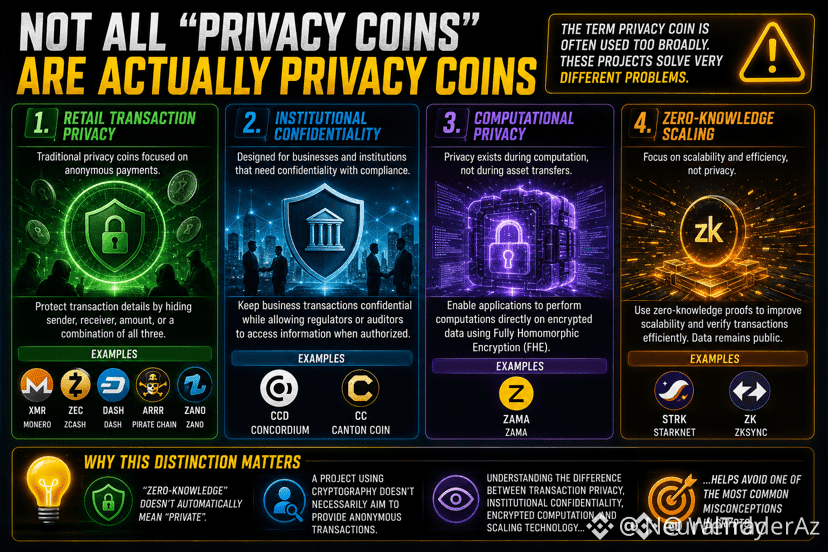
The term “privacy coin” is often thrown around carelessly. In reality, Monero hides transaction details for retail privacy. Starknet uses zero-knowledge proofs for scaling, not anonymity. And Zama enables computation on encrypted data through FHE — no transaction hiding at all.
Understanding whether a project serves retail privacy, institutional confidentiality, or scaling technology is essential before labeling it. This confusion leads to mispriced risk and missed opportunities.
How do you classify privacy when zero-knowledge proofs are used for scaling and not anonymity?
Not financial advice. Always manage your risk.
#XMR #PrivacyCoins #CryptoEducation #Blockchain #CryptoMyths
🔥
$XMR $ZEC $STRK : NOT ALL PRIVACY COINS ARE THE SAME 🔥
The term “privacy coin” is often thrown around carelessly. In reality, Monero hides transaction details for retail privacy. Starknet uses zero-knowledge proofs for scaling, not anonymity. And Zama enables computation on encrypted data through FHE — no transaction hiding at all.
Understanding whether a project serves retail privacy, institutional confidentiality, or scaling technology is essential before labeling it. This confusion leads to mispriced risk and missed opportunities.
How do you classify privacy when zero-knowledge proofs are used for scaling and not anonymity?
Not financial advice. Always manage your risk.
#XMR #PrivacyCoins #CryptoEducation #Blockchain #CryptoMyths
🔥
The term “privacy coin” is often thrown around carelessly. In reality, Monero hides transaction details for retail privacy. Starknet uses zero-knowledge proofs for scaling, not anonymity. And Zama enables computation on encrypted data through FHE — no transaction hiding at all.
Understanding whether a project serves retail privacy, institutional confidentiality, or scaling technology is essential before labeling it. This confusion leads to mispriced risk and missed opportunities.
How do you classify privacy when zero-knowledge proofs are used for scaling and not anonymity?
Not financial advice. Always manage your risk.
#XMR #PrivacyCoins #CryptoEducation #Blockchain #CryptoMyths
🔥
2
267
🚫 CRYPTO MYTH BUSTED.
"Bitcoin has no real value.
It is backed by nothing."
Let us think about this carefully.
The U.S. Dollar is backed by... what?
Since 1971 the dollar has NOT
been backed by gold.
It is backed by:
. Trust in the U.S. government
. Military power
. Global trade agreements
. Habit
Bitcoin is backed by:
. Mathematical proof
. 17 years of unbroken operation
. Decentralized global network
. Finite supply of 21 million
. Energy (proof of work)
. 560 million users worldwide
The dollar loses 3-7% of its
value every year to inflation.
Bitcoin's supply never inflates.
Not by 1 satoshi. Ever.
Which one is "backed by nothing?"
That is the question worth asking. 🤔
⚠️ Educational only. Not financial advice. DYOR.
#bitcoin #BTC #CryptoMyths
#JackDailyBrief #BinanceSquare
#CryptoEducation #Crypto2026
#MythBusted
$BTC
{spot}(BTCUSDT)
$ETH
{spot}(ETHUSDT)
$BNB
{spot}(BNBUSDT)
🚫 CRYPTO MYTH BUSTED.
"Bitcoin has no real value.
It is backed by nothing."
Let us think about this carefully.
The U.S. Dollar is backed by... what?
Since 1971 the dollar has NOT
been backed by gold.
It is backed by:
. Trust in the U.S. government
. Military power
. Global trade agreements
. Habit
Bitcoin is backed by:
. Mathematical proof
. 17 years of unbroken operation
. Decentralized global network
. Finite supply of 21 million
. Energy (proof of work)
. 560 million users worldwide
The dollar loses 3-7% of its
value every year to inflation.
Bitcoin's supply never inflates.
Not by 1 satoshi. Ever.
Which one is "backed by nothing?"
That is the question worth asking. 🤔
⚠️ Educational only. Not financial advice. DYOR.
#bitcoin #BTC #CryptoMyths
#JackDailyBrief #BinanceSquare
#CryptoEducation #Crypto2026
#MythBusted
$BTC
$ETH
$BNB
"Bitcoin has no real value.
It is backed by nothing."
Let us think about this carefully.
The U.S. Dollar is backed by... what?
Since 1971 the dollar has NOT
been backed by gold.
It is backed by:
. Trust in the U.S. government
. Military power
. Global trade agreements
. Habit
Bitcoin is backed by:
. Mathematical proof
. 17 years of unbroken operation
. Decentralized global network
. Finite supply of 21 million
. Energy (proof of work)
. 560 million users worldwide
The dollar loses 3-7% of its
value every year to inflation.
Bitcoin's supply never inflates.
Not by 1 satoshi. Ever.
Which one is "backed by nothing?"
That is the question worth asking. 🤔
⚠️ Educational only. Not financial advice. DYOR.
#bitcoin #BTC #CryptoMyths
#JackDailyBrief #BinanceSquare
#CryptoEducation #Crypto2026
#MythBusted
$BTC
$ETH
$BNB
67

·
--
Article
The LUNC to $1 Dream: Hype, Reality, and the Trillion-Dollar Math ProblemThe Terra Luna Classic (LUNC) community is one of the most resilient and passionate in crypto. Since the ecosystem collapse, the unifying cry has been: "When LUNC hits $1?"
It’s an exciting dream. If you hold LUNC today, a surge to $1 would be life-changing. But is it grounded in reality, or is it a mathematical impossibility? Let’s break down the facts and the numbers.
The Math That Doesn’t Lie
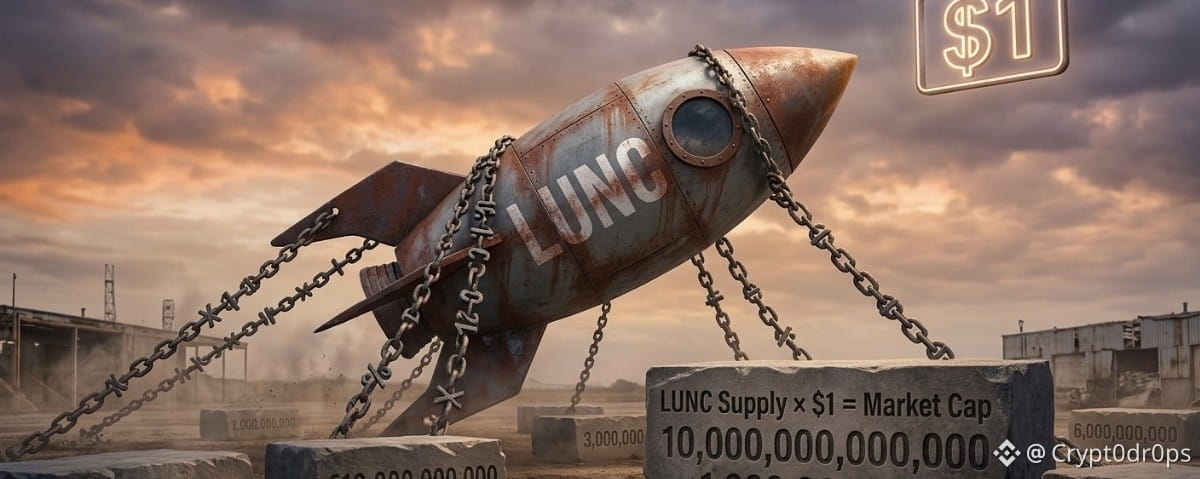
The single biggest obstacle to LUNC reaching $1 is the one metric many investors overlook: Market Capitalization. Market Cap is calculated as:
Price × Circulating Supply = Market Capitalization
To understand why $1 is difficult, we have to look at LUNC's supply. Before the crash, the supply was in the millions. Today, due to hyperinflation during the collapse, the circulating supply is roughly 6.8 trillion LUNC.
Now, let's apply the $1 goal:
$1 (Target Price) × 6,800,000,000,000 (Supply) = $6.8 Trillion Market Cap
Placing $6.8 Trillion in Context
To understand why a $6.8 trillion market cap is astronomically unlikely, we have to compare it to other assets:
Bitcoin (BTC) at its all-time high: ~ $1.28 Trillion
The Entire Cryptocurrency Market Cap (combined): ~$1 - $2 Trillion (depending on market conditions)
Apple Inc. (world's most valuable company): ~$3 Trillion
For LUNC to hit $1, it would need to be worth more than double the value of Apple, and over five times the value of all cryptocurrencies combined, including Bitcoin and Ethereum. It would require more capital to flow into this one community token than exists in the entire crypto industry today.
"But What About the Burns?"
The main counter-argument is the 1.2% burn tax and ecosystem burns. Yes, burning reduces supply. However, the scale of the supply reduction needed is nearly incomprehensible.
To reach a price of $1 even with a high market cap of, say, $10 billion (which is still very optimistic), the supply would need to be reduced from 6.8 trillion down to 10 billion. That means 99.9% of all LUNC must be burned.
At current burn rates (even with Binance supporting the burns), achieving this reduction would take decades, assuming no new LUNC is ever minted and trading volume remains high consistently.
The Conclusion: Community vs. Calculation
There is no doubt that the LUNC community's efforts have been heroic in stabilizing the network, introducing burning mechanisms, and proposing utility upgrades. Positive developments can absolutely lead to price increases and significant percentage gains.
However, setting a target of $1 is not just optimistic; it ignores the fundamental laws of market dynamics and supply. It can lead to unrealistic expectations and reckless investment strategies.
As an educated investor, focus on realistic growth, actual ecosystem utility projects (like the USTC repeg efforts), and network stability, rather than the allure of the "trillion-dollar math problem."
What are your realistic price predictions for LUNC in this cycle? Let’s discuss in the comments below! 👇
Disclaimer: This article is for educational and informational purposes only and should not be considered financial advice. Always do your own research.
$LUNC #TerraLunaClassic #BinanceSquareTalks #CryptoEducation #MarketCap #CryptoMyths
{spot}(LUNCUSDT)
The LUNC to $1 Dream: Hype, Reality, and the Trillion-Dollar Math Problem
The Terra Luna Classic (LUNC) community is one of the most resilient and passionate in crypto. Since the ecosystem collapse, the unifying cry has been: "When LUNC hits $1?"
It’s an exciting dream. If you hold LUNC today, a surge to $1 would be life-changing. But is it grounded in reality, or is it a mathematical impossibility? Let’s break down the facts and the numbers.
The Math That Doesn’t Lie
The single biggest obstacle to LUNC reaching $1 is the one metric many investors overlook: Market Capitalization. Market Cap is calculated as:
Price × Circulating Supply = Market Capitalization
To understand why $1 is difficult, we have to look at LUNC's supply. Before the crash, the supply was in the millions. Today, due to hyperinflation during the collapse, the circulating supply is roughly 6.8 trillion LUNC.
Now, let's apply the $1 goal:
$1 (Target Price) × 6,800,000,000,000 (Supply) = $6.8 Trillion Market Cap
Placing $6.8 Trillion in Context
To understand why a $6.8 trillion market cap is astronomically unlikely, we have to compare it to other assets:
Bitcoin (BTC) at its all-time high: ~ $1.28 Trillion
The Entire Cryptocurrency Market Cap (combined): ~$1 - $2 Trillion (depending on market conditions)
Apple Inc. (world's most valuable company): ~$3 Trillion
For LUNC to hit $1, it would need to be worth more than double the value of Apple, and over five times the value of all cryptocurrencies combined, including Bitcoin and Ethereum. It would require more capital to flow into this one community token than exists in the entire crypto industry today.
"But What About the Burns?"
The main counter-argument is the 1.2% burn tax and ecosystem burns. Yes, burning reduces supply. However, the scale of the supply reduction needed is nearly incomprehensible.
To reach a price of $1 even with a high market cap of, say, $10 billion (which is still very optimistic), the supply would need to be reduced from 6.8 trillion down to 10 billion. That means 99.9% of all LUNC must be burned.
At current burn rates (even with Binance supporting the burns), achieving this reduction would take decades, assuming no new LUNC is ever minted and trading volume remains high consistently.
The Conclusion: Community vs. Calculation
There is no doubt that the LUNC community's efforts have been heroic in stabilizing the network, introducing burning mechanisms, and proposing utility upgrades. Positive developments can absolutely lead to price increases and significant percentage gains.
However, setting a target of $1 is not just optimistic; it ignores the fundamental laws of market dynamics and supply. It can lead to unrealistic expectations and reckless investment strategies.
As an educated investor, focus on realistic growth, actual ecosystem utility projects (like the USTC repeg efforts), and network stability, rather than the allure of the "trillion-dollar math problem."
What are your realistic price predictions for LUNC in this cycle? Let’s discuss in the comments below! 👇
Disclaimer: This article is for educational and informational purposes only and should not be considered financial advice. Always do your own research.
$LUNC #TerraLunaClassic #BinanceSquareTalks #CryptoEducation #MarketCap #CryptoMyths
It’s an exciting dream. If you hold LUNC today, a surge to $1 would be life-changing. But is it grounded in reality, or is it a mathematical impossibility? Let’s break down the facts and the numbers.
The Math That Doesn’t Lie
The single biggest obstacle to LUNC reaching $1 is the one metric many investors overlook: Market Capitalization. Market Cap is calculated as:
Price × Circulating Supply = Market Capitalization
To understand why $1 is difficult, we have to look at LUNC's supply. Before the crash, the supply was in the millions. Today, due to hyperinflation during the collapse, the circulating supply is roughly 6.8 trillion LUNC.
Now, let's apply the $1 goal:
$1 (Target Price) × 6,800,000,000,000 (Supply) = $6.8 Trillion Market Cap
Placing $6.8 Trillion in Context
To understand why a $6.8 trillion market cap is astronomically unlikely, we have to compare it to other assets:
Bitcoin (BTC) at its all-time high: ~ $1.28 Trillion
The Entire Cryptocurrency Market Cap (combined): ~$1 - $2 Trillion (depending on market conditions)
Apple Inc. (world's most valuable company): ~$3 Trillion
For LUNC to hit $1, it would need to be worth more than double the value of Apple, and over five times the value of all cryptocurrencies combined, including Bitcoin and Ethereum. It would require more capital to flow into this one community token than exists in the entire crypto industry today.
"But What About the Burns?"
The main counter-argument is the 1.2% burn tax and ecosystem burns. Yes, burning reduces supply. However, the scale of the supply reduction needed is nearly incomprehensible.
To reach a price of $1 even with a high market cap of, say, $10 billion (which is still very optimistic), the supply would need to be reduced from 6.8 trillion down to 10 billion. That means 99.9% of all LUNC must be burned.
At current burn rates (even with Binance supporting the burns), achieving this reduction would take decades, assuming no new LUNC is ever minted and trading volume remains high consistently.
The Conclusion: Community vs. Calculation
There is no doubt that the LUNC community's efforts have been heroic in stabilizing the network, introducing burning mechanisms, and proposing utility upgrades. Positive developments can absolutely lead to price increases and significant percentage gains.
However, setting a target of $1 is not just optimistic; it ignores the fundamental laws of market dynamics and supply. It can lead to unrealistic expectations and reckless investment strategies.
As an educated investor, focus on realistic growth, actual ecosystem utility projects (like the USTC repeg efforts), and network stability, rather than the allure of the "trillion-dollar math problem."
What are your realistic price predictions for LUNC in this cycle? Let’s discuss in the comments below! 👇
Disclaimer: This article is for educational and informational purposes only and should not be considered financial advice. Always do your own research.
$LUNC #TerraLunaClassic #BinanceSquareTalks #CryptoEducation #MarketCap #CryptoMyths
5
325
·
--
"If I understand the chart, I can predict the move." Man, I bought into that lie harder than I went 100x on DOGE last year. Charts show patterns, sure, but they don't show the multi-million dollar whale order waiting to dump or some random news event that wipes out all your "perfect" indicators. They definitely don't show the cascade of liquidations once price starts dipping. That $600 I lost? Chart said go up. Reality said "rekt." Charts are tools for probabilities, not crystal balls for certainties. They reflect the past, not dictate the future. The only thing you can truly predict is that risk management is your only defense. Are you trading patterns, or just hoping for a miracle?
#CryptoTrading #FuturesTrading #RiskManagement #CryptoMyths #DontGetRekt
"If I understand the chart, I can predict the move." Man, I bought into that lie harder than I went 100x on DOGE last year. Charts show patterns, sure, but they don't show the multi-million dollar whale order waiting to dump or some random news event that wipes out all your "perfect" indicators. They definitely don't show the cascade of liquidations once price starts dipping. That $600 I lost? Chart said go up. Reality said "rekt." Charts are tools for probabilities, not crystal balls for certainties. They reflect the past, not dictate the future. The only thing you can truly predict is that risk management is your only defense. Are you trading patterns, or just hoping for a miracle?
#CryptoTrading #FuturesTrading #RiskManagement #CryptoMyths #DontGetRekt
#CryptoTrading #FuturesTrading #RiskManagement #CryptoMyths #DontGetRekt
36
·
--
The "Cheap Coin" Trap* 🪙
Newbies: “$BTC is too expensive. I’ll buy $0.001 coins instead.”
Meanwhile $30 into $BTC at $60k = $33 when it hits $66k. 10% gain.
That $0.001 coin needs to hit $0.0011 for the same 10%.
But it went to $0.0005 instead. You’re down 50%.
Price per coin means nothing. % moves everything.
$BNB $SOL $ETH $AVAX — units don’t matter, math does.
What “cheap coin” rugged you this year? 👇
#CryptoMyths #PriceAction #BNB #BTC #ETH #BeginnerMistakes #NotFinancialAdvice
The "Cheap Coin" Trap* 🪙
Newbies: “$BTC is too expensive. I’ll buy $0.001 coins instead.”
Meanwhile $30 into $BTC at $60k = $33 when it hits $66k. 10% gain.
That $0.001 coin needs to hit $0.0011 for the same 10%.
But it went to $0.0005 instead. You’re down 50%.
Price per coin means nothing. % moves everything.
$BNB $SOL $ETH $AVAX — units don’t matter, math does.
What “cheap coin” rugged you this year? 👇
#CryptoMyths #PriceAction #BNB #BTC #ETH #BeginnerMistakes #NotFinancialAdvice
Newbies: “$BTC is too expensive. I’ll buy $0.001 coins instead.”
Meanwhile $30 into $BTC at $60k = $33 when it hits $66k. 10% gain.
That $0.001 coin needs to hit $0.0011 for the same 10%.
But it went to $0.0005 instead. You’re down 50%.
Price per coin means nothing. % moves everything.
$BNB $SOL $ETH $AVAX — units don’t matter, math does.
What “cheap coin” rugged you this year? 👇
#CryptoMyths #PriceAction #BNB #BTC #ETH #BeginnerMistakes #NotFinancialAdvice
1
128
Log in to explore more content
Join global crypto users on Binance Square
⚡️ Get latest and useful information about crypto.
💬 Trusted by the world’s largest crypto exchange.
👍 Discover real insights from verified creators.
Email / Phone number
Trending Topics
1
#USAugustPPIRisesLessThanExpected
1,473 views
95 Discussing
2
#SECApprovesNasdaqTexasCommodityTrustRule
3,275 views
157 Discussing
3
#ECBRaisesRatesSecondTimeTo2.5%
1,559 views
106 Discussing
4
#USContinuingJoblessClaims1.774M
6,509 views
204 Discussing
5
#USAugustPPIYoYRisesTo5.4%
5,839 views
155 Discussing
6
#AppleDebutsFoldablePhone
67,485 views
1,223 Discussing
7
#TSMCAugustRevenueUp53.3%YoY
17,752 views
465 Discussing
8
#IranSaysReadyToEscalateWarWithUS
24,731 views
461 Discussing
9
#EUExtendsCentralContactPointToCASPs
21,190 views
478 Discussing
10
#US10YTreasuryYieldHitsHighestSinceNov2023
47,560 views
715 Discussing