

#xrpl
xrpl
2.7M views
3,868 Discussing
Hot
Latest

·
--
Verified
🚨 XRP JUST GOT A NEW DATE TO WATCH
The XRP Ledger’s Batch V1.1 upgrade is no longer expected to activate on September 29.
After validator support changed, the activation countdown restarted — making October 9 the earliest possible activation date.
What does Batch bring?
It can bundle up to eight linked transactions into one operation, allowing them to succeed together or fail together.
That could be useful for payments, token swaps, platform fees and delivery-versus-payment transactions.
Meanwhile, U.S. XRP ETFs have continued attracting capital, with cumulative net inflows now around $1.79B.
So XRP has both a protocol catalyst and continued institutional attention in focus.
🚨 XRP UPDATE: Batch V1.1 now has October 9 as the earliest activation date. Click the $XRP setup below 🫵🏻 to review the structure and watch the next reaction.
$XRP
{future}(XRPUSDT)
.
.
#xrp #XRPL #Write2Earn
🚨 XRP JUST GOT A NEW DATE TO WATCH
The XRP Ledger’s Batch V1.1 upgrade is no longer expected to activate on September 29.
After validator support changed, the activation countdown restarted — making October 9 the earliest possible activation date.
What does Batch bring?
It can bundle up to eight linked transactions into one operation, allowing them to succeed together or fail together.
That could be useful for payments, token swaps, platform fees and delivery-versus-payment transactions.
Meanwhile, U.S. XRP ETFs have continued attracting capital, with cumulative net inflows now around $1.79B.
So XRP has both a protocol catalyst and continued institutional attention in focus.
🚨 XRP UPDATE: Batch V1.1 now has October 9 as the earliest activation date. Click the $XRP setup below 🫵🏻 to review the structure and watch the next reaction.
$XRP
.
.
#xrp #XRPL #Write2Earn
The XRP Ledger’s Batch V1.1 upgrade is no longer expected to activate on September 29.
After validator support changed, the activation countdown restarted — making October 9 the earliest possible activation date.
What does Batch bring?
It can bundle up to eight linked transactions into one operation, allowing them to succeed together or fail together.
That could be useful for payments, token swaps, platform fees and delivery-versus-payment transactions.
Meanwhile, U.S. XRP ETFs have continued attracting capital, with cumulative net inflows now around $1.79B.
So XRP has both a protocol catalyst and continued institutional attention in focus.
🚨 XRP UPDATE: Batch V1.1 now has October 9 as the earliest activation date. Click the $XRP setup below 🫵🏻 to review the structure and watch the next reaction.
$XRP
.
.
#xrp #XRPL #Write2Earn
3
3.2k

·
--
🎷 One thing I’m learning from trading $XRP :
You don’t have to catch every move.
Sometimes I watch the price move without me and immediately think, “I should’ve bought there” or “I should’ve sold there.” 😅
But chasing usually turns a missed opportunity into a bad trade.
There will always be another setup.
Still learning. Still trading. Just trying to get a little better each time. 🎷
#xrp #XRPL
🎷 One thing I’m learning from trading $XRP :
You don’t have to catch every move.
Sometimes I watch the price move without me and immediately think, “I should’ve bought there” or “I should’ve sold there.” 😅
But chasing usually turns a missed opportunity into a bad trade.
There will always be another setup.
Still learning. Still trading. Just trying to get a little better each time. 🎷
#xrp #XRPL
You don’t have to catch every move.
Sometimes I watch the price move without me and immediately think, “I should’ve bought there” or “I should’ve sold there.” 😅
But chasing usually turns a missed opportunity into a bad trade.
There will always be another setup.
Still learning. Still trading. Just trying to get a little better each time. 🎷
#xrp #XRPL
269

🚨 XRP LEDGER JUST ENTERED A NEW REAL-WORLD USE CASE 👀🇧🇷
Ripple and Brazil’s CSD BR have announced a new partnership to bring live financial-asset record keeping onto the XRP Ledger.
The first phase will involve BTG Pactual investment fund shares. 🏦⚡
This is more than just another crypto headline — it puts XRPL technology into an actual financial-market infrastructure environment.
🔥 Now the question everyone will be watching:
Can real-world institutional use translate into stronger demand for XRP?
What do you think? 👇
Is this a major XRP development or just another step in a long-term story?
#Ripple #XRPL #CryptoNewss #Crypto #Blockchain
🚨 XRP LEDGER JUST ENTERED A NEW REAL-WORLD USE CASE 👀🇧🇷
Ripple and Brazil’s CSD BR have announced a new partnership to bring live financial-asset record keeping onto the XRP Ledger.
The first phase will involve BTG Pactual investment fund shares. 🏦⚡
This is more than just another crypto headline — it puts XRPL technology into an actual financial-market infrastructure environment.
🔥 Now the question everyone will be watching:
Can real-world institutional use translate into stronger demand for XRP?
What do you think? 👇
Is this a major XRP development or just another step in a long-term story?
#Ripple #XRPL #CryptoNewss #Crypto #Blockchain
Ripple and Brazil’s CSD BR have announced a new partnership to bring live financial-asset record keeping onto the XRP Ledger.
The first phase will involve BTG Pactual investment fund shares. 🏦⚡
This is more than just another crypto headline — it puts XRPL technology into an actual financial-market infrastructure environment.
🔥 Now the question everyone will be watching:
Can real-world institutional use translate into stronger demand for XRP?
What do you think? 👇
Is this a major XRP development or just another step in a long-term story?
#Ripple #XRPL #CryptoNewss #Crypto #Blockchain
40

If you're still ignoring real-world finance integrations because they don't pump overnight, stop now.
Traders keep getting wrecked chasing meme FOMO while actual infrastructure news flies under the radar. You miss the real entries then buy the top once everyone else has already piled in.
Brazil's CSD just tapped the XRP Ledger for real-time ownership verification. That's a traditional finance heavyweight using $XRP's rails to confirm who owns what in seconds instead of the usual multi-day delays.
We've seen this movie with $ETH RWA projects that talked a big game but mostly stayed in testnet. $XLM had its corridor announcements that never quite landed at this scale either.
This one feels different. An actual central securities depository in Brazil implementing it, not another vague partnership. Quiet, unsexy work that tends to compound later even if it doesn't trend today.
Where do you think this puts XRPL versus the other chains still chasing the same RWA story?
#XRP #XRPL #RWA
If you're still ignoring real-world finance integrations because they don't pump overnight, stop now.
Traders keep getting wrecked chasing meme FOMO while actual infrastructure news flies under the radar. You miss the real entries then buy the top once everyone else has already piled in.
Brazil's CSD just tapped the XRP Ledger for real-time ownership verification. That's a traditional finance heavyweight using $XRP 's rails to confirm who owns what in seconds instead of the usual multi-day delays.
We've seen this movie with $ETH RWA projects that talked a big game but mostly stayed in testnet. $XLM had its corridor announcements that never quite landed at this scale either.
This one feels different. An actual central securities depository in Brazil implementing it, not another vague partnership. Quiet, unsexy work that tends to compound later even if it doesn't trend today.
Where do you think this puts XRPL versus the other chains still chasing the same RWA story?
#XRP #XRPL #RWA
Traders keep getting wrecked chasing meme FOMO while actual infrastructure news flies under the radar. You miss the real entries then buy the top once everyone else has already piled in.
Brazil's CSD just tapped the XRP Ledger for real-time ownership verification. That's a traditional finance heavyweight using $XRP 's rails to confirm who owns what in seconds instead of the usual multi-day delays.
We've seen this movie with $ETH RWA projects that talked a big game but mostly stayed in testnet. $XLM had its corridor announcements that never quite landed at this scale either.
This one feels different. An actual central securities depository in Brazil implementing it, not another vague partnership. Quiet, unsexy work that tends to compound later even if it doesn't trend today.
Where do you think this puts XRPL versus the other chains still chasing the same RWA story?
#XRP #XRPL #RWA
28

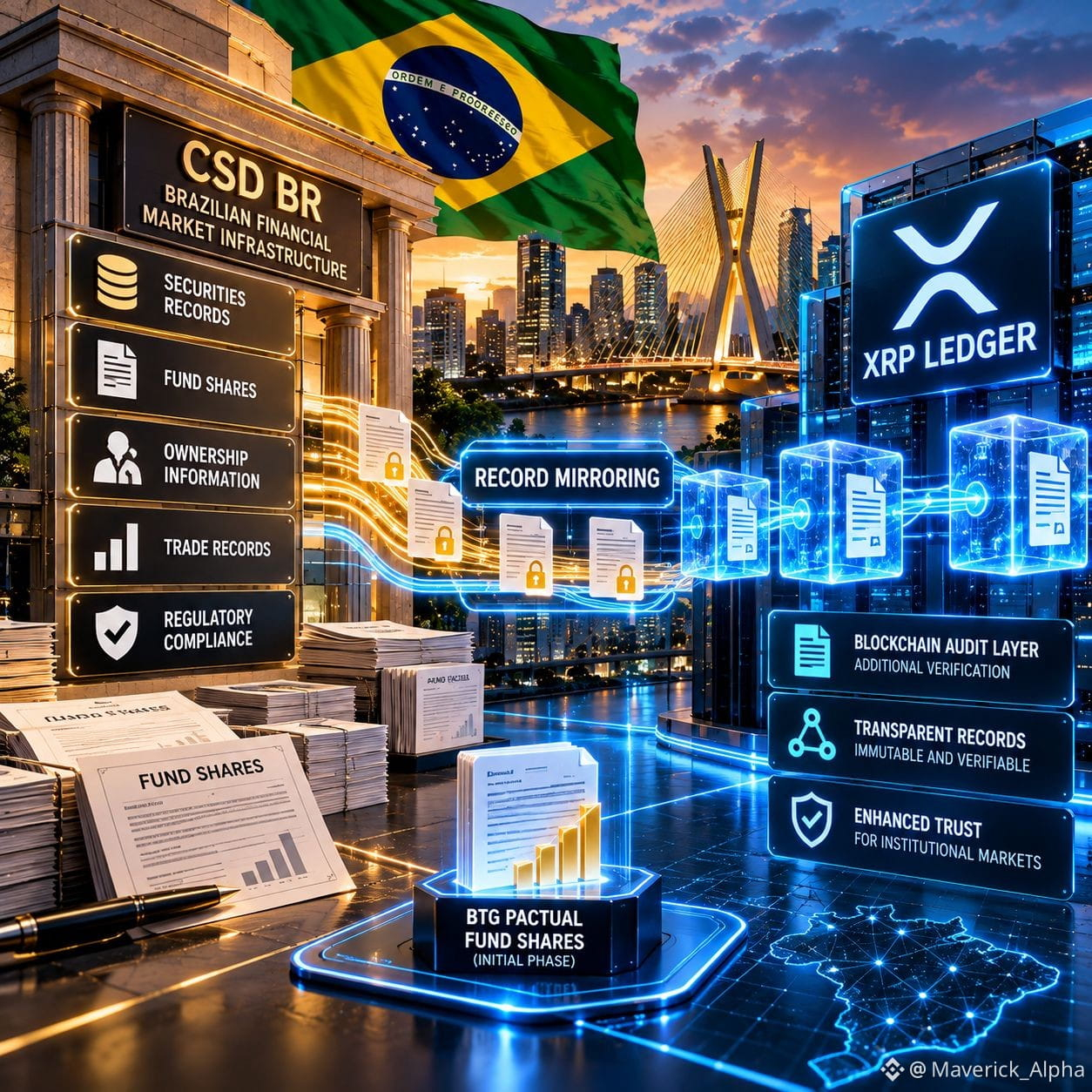
XRP LEDGER ENTERS BRAZIL'S FINANCIAL INFRASTRUCTURE
Brazil's CSD BR is now using the XRP Ledger to mirror ownership records for BTG Pactual fund shares.
CSD BR remains the official record keeper, while XRPL adds a blockchain layer for verification and auditing.
The project covers a financial infrastructure with more than BRL 22 trillion in registered assets.
Future phases could explore native asset issuance and regulated trading on blockchain.
MY FINAL TAKE
This is bigger than a price story: it's a real-world test of blockchain inside regulated financial infrastructure.
Could Brazil become a major hub for tokenized assets on XRPL?
#XRPL #RWA
$XRP
{future}(XRPUSDT)
XRP LEDGER ENTERS BRAZIL'S FINANCIAL INFRASTRUCTURE
Brazil's CSD BR is now using the XRP Ledger to mirror ownership records for BTG Pactual fund shares.
CSD BR remains the official record keeper, while XRPL adds a blockchain layer for verification and auditing.
The project covers a financial infrastructure with more than BRL 22 trillion in registered assets.
Future phases could explore native asset issuance and regulated trading on blockchain.
MY FINAL TAKE
This is bigger than a price story: it's a real-world test of blockchain inside regulated financial infrastructure.
Could Brazil become a major hub for tokenized assets on XRPL?
#XRPL #RWA
$XRP
Brazil's CSD BR is now using the XRP Ledger to mirror ownership records for BTG Pactual fund shares.
CSD BR remains the official record keeper, while XRPL adds a blockchain layer for verification and auditing.
The project covers a financial infrastructure with more than BRL 22 trillion in registered assets.
Future phases could explore native asset issuance and regulated trading on blockchain.
MY FINAL TAKE
This is bigger than a price story: it's a real-world test of blockchain inside regulated financial infrastructure.
Could Brazil become a major hub for tokenized assets on XRPL?
#XRPL #RWA
$XRP
73


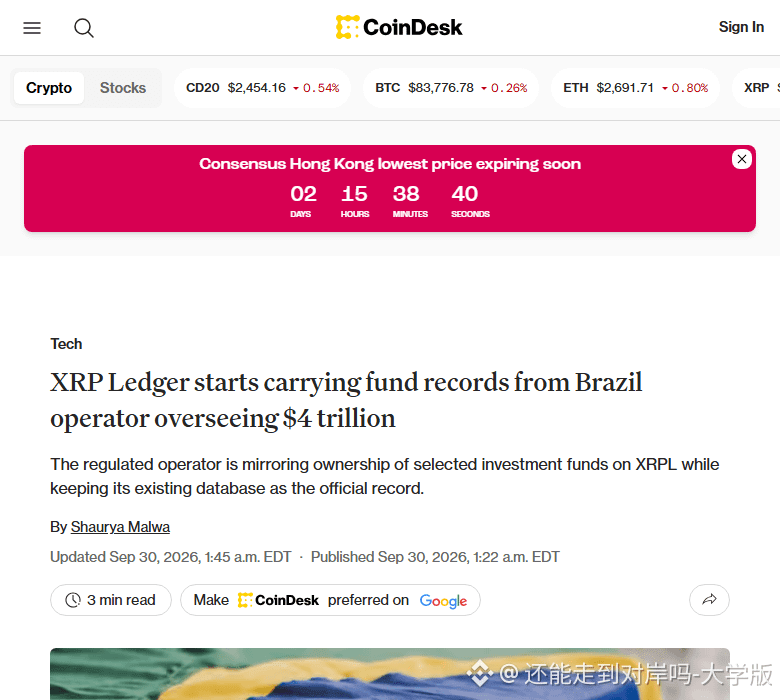
$4 trillion is the massive scale of traditional assets entering the XRP Ledger as Brazilian infrastructure firm Vortx starts anchoring fund records on-chain. This bridge between institutional legacy systems and public ledgers proves enterprise utility is shifting past pure speculation. Watch how transaction throughput and network finality handle heavy institutional data loads moving forward. #Write2Earn $XRP #XRPL #CryptoNews
$4 trillion is the massive scale of traditional assets entering the XRP Ledger as Brazilian infrastructure firm Vortx starts anchoring fund records on-chain. This bridge between institutional legacy systems and public ledgers proves enterprise utility is shifting past pure speculation. Watch how transaction throughput and network finality handle heavy institutional data loads moving forward. #Write2Earn $XRP #XRPL #CryptoNews

71

·
--
Is $XRP ready to break its price ceiling? 🚀
Forget relying solely on ZEC and QNT’s delayed breakout playbooks. XRP’s price discovery now hinges on two critical factors: sustained ETF inflows and the adoption of the XRPL BatchV1_1 upgrade.
Institutional demand and network utility are the real catalysts to watch for the next major move. 📈
#XRP #CryptoNews #XRPL
Is $XRP ready to break its price ceiling? 🚀
Forget relying solely on ZEC and QNT’s delayed breakout playbooks. XRP’s price discovery now hinges on two critical factors: sustained ETF inflows and the adoption of the XRPL BatchV1_1 upgrade.
Institutional demand and network utility are the real catalysts to watch for the next major move. 📈
#XRP #CryptoNews #XRPL
Forget relying solely on ZEC and QNT’s delayed breakout playbooks. XRP’s price discovery now hinges on two critical factors: sustained ETF inflows and the adoption of the XRPL BatchV1_1 upgrade.
Institutional demand and network utility are the real catalysts to watch for the next major move. 📈
#XRP #CryptoNews #XRPL
·
--
🎷 Been spending more time exploring the XRP Ledger lately, and honestly there’s a lot more happening on XRPL than just $XRP price action.
Tokens, NFTs, DEX trading, projects… still plenty for me to learn.
I’ll share the interesting stuff I come across — and probably a few lessons from my own trades along the way. 😅
What part of the XRPL ecosystem are you following the most right now?
#xrp #XRPL
🎷 Been spending more time exploring the XRP Ledger lately, and honestly there’s a lot more happening on XRPL than just $XRP price action.
Tokens, NFTs, DEX trading, projects… still plenty for me to learn.
I’ll share the interesting stuff I come across — and probably a few lessons from my own trades along the way. 😅
What part of the XRPL ecosystem are you following the most right now?
#xrp #XRPL
Tokens, NFTs, DEX trading, projects… still plenty for me to learn.
I’ll share the interesting stuff I come across — and probably a few lessons from my own trades along the way. 😅
What part of the XRPL ecosystem are you following the most right now?
#xrp #XRPL
AngelOfCrypto_-:
nice
2
1
450

Verified
“US$4 TRILHÕES estão indo para o XRP Ledger.”
Você provavelmente vai ver alguma versão dessa manchete hoje.
Mas não foi isso que aconteceu.
E a história REAL já é interessante o suficiente.
A CSD BR, empresa autorizada no mercado financeiro brasileiro, começou a registrar no XRP Ledger uma representação de participações em fundos selecionados do BTG Pactual.
E aqui está o número gigante:
a infraestrutura da CSD BR possui mais de R$22 TRILHÕES em ativos registrados.
Aproximadamente US$4 trilhões.
Mas atenção:
esses US$4 trilhões NÃO foram tokenizados no XRPL.
A primeira fase começa com fundos selecionados do BTG.
O registro oficial continua sendo o sistema da CSD BR.
O XRP Ledger funciona como uma segunda camada de registro e verificação.
Pra mim, justamente por isso a notícia é interessante.
Não é uma promessa de “um dia os bancos usarão blockchain”.
É blockchain pública sendo testada dentro de uma infraestrutura financeira regulada e com ativos reais.
E se essa fase funcionar, o próximo passo estudado é ainda maior:
emissão e negociação de ativos diretamente no XRPL, incluindo instrumentos ligados ao mercado imobiliário e agronegócio.
Agora vem a pergunta que eu acho mais importante:
isso é bullish para o ECOSSISTEMA XRPL.
Mas quanto desse valor realmente será capturado pelo token $XRP ?
Essa resposta ainda precisa aparecer.
$XRP #XRPL #RWA #Tokenization #crypto
Você acha que a próxima grande adoção de blockchain virá do DeFi…
ou justamente dos mercados financeiros tradicionais?
{spot}(XRPUSDT)
“US$4 TRILHÕES estão indo para o XRP Ledger.”
Você provavelmente vai ver alguma versão dessa manchete hoje.
Mas não foi isso que aconteceu.
E a história REAL já é interessante o suficiente.
A CSD BR, empresa autorizada no mercado financeiro brasileiro, começou a registrar no XRP Ledger uma representação de participações em fundos selecionados do BTG Pactual.
E aqui está o número gigante:
a infraestrutura da CSD BR possui mais de R$22 TRILHÕES em ativos registrados.
Aproximadamente US$4 trilhões.
Mas atenção:
esses US$4 trilhões NÃO foram tokenizados no XRPL.
A primeira fase começa com fundos selecionados do BTG.
O registro oficial continua sendo o sistema da CSD BR.
O XRP Ledger funciona como uma segunda camada de registro e verificação.
Pra mim, justamente por isso a notícia é interessante.
Não é uma promessa de “um dia os bancos usarão blockchain”.
É blockchain pública sendo testada dentro de uma infraestrutura financeira regulada e com ativos reais.
E se essa fase funcionar, o próximo passo estudado é ainda maior:
emissão e negociação de ativos diretamente no XRPL, incluindo instrumentos ligados ao mercado imobiliário e agronegócio.
Agora vem a pergunta que eu acho mais importante:
isso é bullish para o ECOSSISTEMA XRPL.
Mas quanto desse valor realmente será capturado pelo token $XRP ?
Essa resposta ainda precisa aparecer.
$XRP #XRPL #RWA #Tokenization #crypto
Você acha que a próxima grande adoção de blockchain virá do DeFi…
ou justamente dos mercados financeiros tradicionais?
Você provavelmente vai ver alguma versão dessa manchete hoje.
Mas não foi isso que aconteceu.
E a história REAL já é interessante o suficiente.
A CSD BR, empresa autorizada no mercado financeiro brasileiro, começou a registrar no XRP Ledger uma representação de participações em fundos selecionados do BTG Pactual.
E aqui está o número gigante:
a infraestrutura da CSD BR possui mais de R$22 TRILHÕES em ativos registrados.
Aproximadamente US$4 trilhões.
Mas atenção:
esses US$4 trilhões NÃO foram tokenizados no XRPL.
A primeira fase começa com fundos selecionados do BTG.
O registro oficial continua sendo o sistema da CSD BR.
O XRP Ledger funciona como uma segunda camada de registro e verificação.
Pra mim, justamente por isso a notícia é interessante.
Não é uma promessa de “um dia os bancos usarão blockchain”.
É blockchain pública sendo testada dentro de uma infraestrutura financeira regulada e com ativos reais.
E se essa fase funcionar, o próximo passo estudado é ainda maior:
emissão e negociação de ativos diretamente no XRPL, incluindo instrumentos ligados ao mercado imobiliário e agronegócio.
Agora vem a pergunta que eu acho mais importante:
isso é bullish para o ECOSSISTEMA XRPL.
Mas quanto desse valor realmente será capturado pelo token $XRP ?
Essa resposta ainda precisa aparecer.
$XRP #XRPL #RWA #Tokenization #crypto
Você acha que a próxima grande adoção de blockchain virá do DeFi…
ou justamente dos mercados financeiros tradicionais?
1
5.1k

·
--
Verified
巴西CSD BR把基金份额镜像上XRPL:镜像≠权属搬家持牌中央证券存管,第一次用公链做证券持仓镜像。
注意:不是把巴西 BRL 22 万亿全搬上链。
1️⃣ Ripple 9/29 官方稿:CSD BR × Ripple 一期进入实盘环境。CSD BR 持有巴西央行/CVM 授权的登记、中央存管与结算牌照;存量注册资产超 BRL 22 万亿——那是基础设施底座,不是本期上链规模。
2️⃣ 首批资产:BTG Pactual 基金份额。用 XRPL Multi-Purpose Token(MPT)做代币化镜像;官方权属/登记/存管/结算仍在 CSD BR 系统。链上是额外查询与审计层,授权参与方可近实时对账。
3️⃣ 权限环境:仅巴西企业/银行客户,走 KYC/AML。CSD BR 保留发行与治理控制,含冻结与监管/司法要求下的 clawback。
4️⃣ 路线图(未给日期):镜像验证后,才谈原生发行、授权机构间交易,以及巴西固收里的 CRI/CRA。隐私机制后续再加。
我的筛选:镜像先行,比口号式“全量代币化”老实。
镜像≠权属搬家。
合作≠22 万亿上链。
试运行≠原生发行已开。
跟 Absa×Ripple 那种“资产清单未公布”不是一回事——这次有牌照 CSD + 具名银行基金份额 + 官方权属仍在链下。
$XRP 更多是网络费/储备角色,不等于机构必须囤一大仓 $XRP。
不构成投资建议。
来源:Ripple Press(2026-09-29)+ crypto.news
#XRPL #Ripple #巴西 #RWA #代币化
巴西CSD BR把基金份额镜像上XRPL:镜像≠权属搬家
持牌中央证券存管,第一次用公链做证券持仓镜像。
注意:不是把巴西 BRL 22 万亿全搬上链。
1️⃣ Ripple 9/29 官方稿:CSD BR × Ripple 一期进入实盘环境。CSD BR 持有巴西央行/CVM 授权的登记、中央存管与结算牌照;存量注册资产超 BRL 22 万亿——那是基础设施底座,不是本期上链规模。
2️⃣ 首批资产:BTG Pactual 基金份额。用 XRPL Multi-Purpose Token(MPT)做代币化镜像;官方权属/登记/存管/结算仍在 CSD BR 系统。链上是额外查询与审计层,授权参与方可近实时对账。
3️⃣ 权限环境:仅巴西企业/银行客户,走 KYC/AML。CSD BR 保留发行与治理控制,含冻结与监管/司法要求下的 clawback。
4️⃣ 路线图(未给日期):镜像验证后,才谈原生发行、授权机构间交易,以及巴西固收里的 CRI/CRA。隐私机制后续再加。
我的筛选:镜像先行,比口号式“全量代币化”老实。
镜像≠权属搬家。
合作≠22 万亿上链。
试运行≠原生发行已开。
跟 Absa×Ripple 那种“资产清单未公布”不是一回事——这次有牌照 CSD + 具名银行基金份额 + 官方权属仍在链下。
$XRP 更多是网络费/储备角色,不等于机构必须囤一大仓 $XRP 。
不构成投资建议。
来源:Ripple Press(2026-09-29)+ crypto.news
#XRPL #Ripple #巴西 #RWA #代币化
注意:不是把巴西 BRL 22 万亿全搬上链。
1️⃣ Ripple 9/29 官方稿:CSD BR × Ripple 一期进入实盘环境。CSD BR 持有巴西央行/CVM 授权的登记、中央存管与结算牌照;存量注册资产超 BRL 22 万亿——那是基础设施底座,不是本期上链规模。
2️⃣ 首批资产:BTG Pactual 基金份额。用 XRPL Multi-Purpose Token(MPT)做代币化镜像;官方权属/登记/存管/结算仍在 CSD BR 系统。链上是额外查询与审计层,授权参与方可近实时对账。
3️⃣ 权限环境:仅巴西企业/银行客户,走 KYC/AML。CSD BR 保留发行与治理控制,含冻结与监管/司法要求下的 clawback。
4️⃣ 路线图(未给日期):镜像验证后,才谈原生发行、授权机构间交易,以及巴西固收里的 CRI/CRA。隐私机制后续再加。
我的筛选:镜像先行,比口号式“全量代币化”老实。
镜像≠权属搬家。
合作≠22 万亿上链。
试运行≠原生发行已开。
跟 Absa×Ripple 那种“资产清单未公布”不是一回事——这次有牌照 CSD + 具名银行基金份额 + 官方权属仍在链下。
$XRP 更多是网络费/储备角色,不等于机构必须囤一大仓 $XRP 。
不构成投资建议。
来源:Ripple Press(2026-09-29)+ crypto.news
#XRPL #Ripple #巴西 #RWA #代币化
1
1.1k


·
--
Bullish
Verified
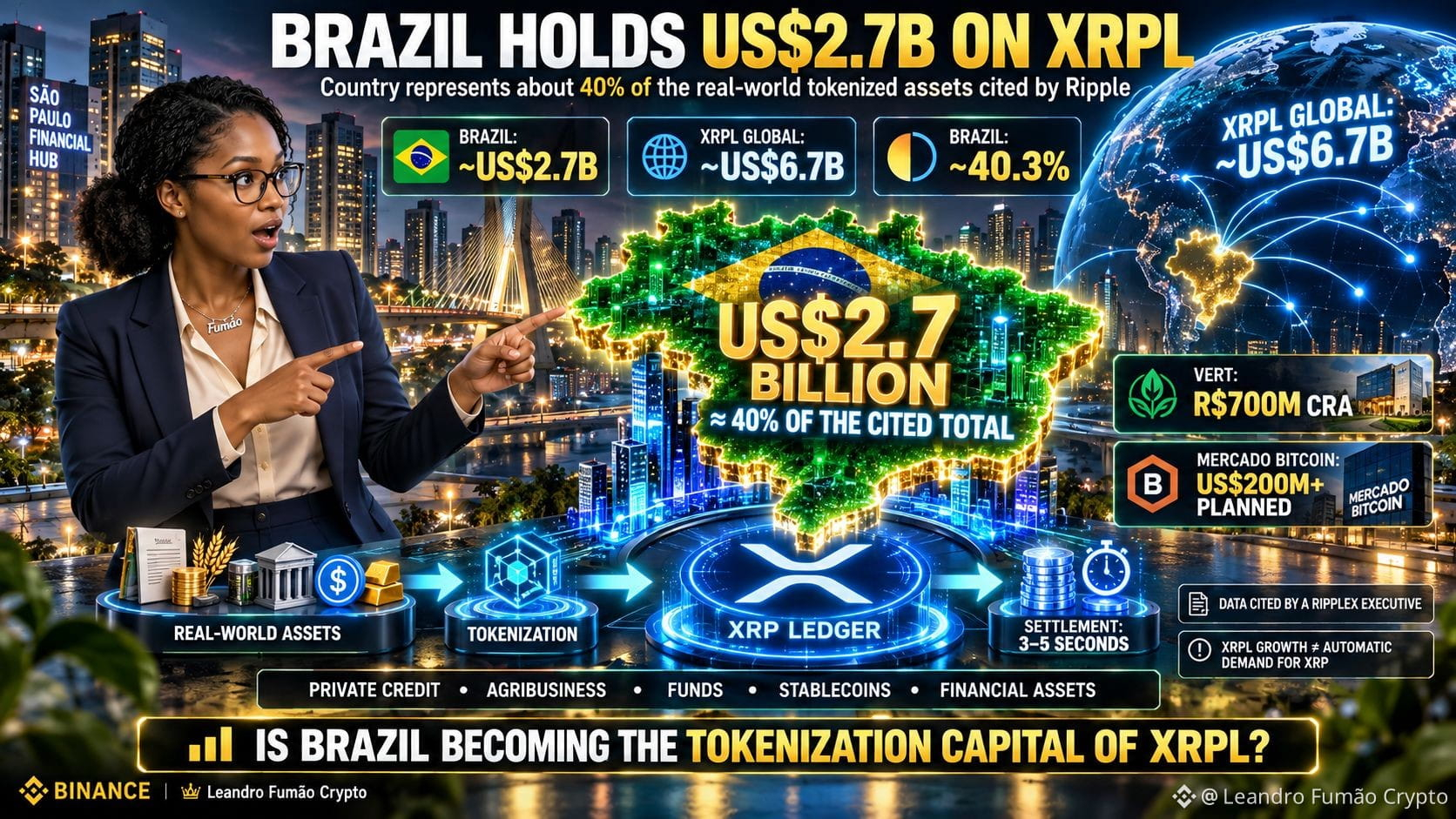
˗ˋˏ🚨ˎˊ˗ BRASIL JÁ CONCENTRA ~40% DOS ATIVOS REAIS NO XRPL❗
😱 O Brasil acaba de aparecer como um dos maiores polos institucionais do $XRP Ledger.
Segundo Markus Infanger, vice-presidente sênior da RippleX, existem cerca de US$ 6,7 bilhões em ativos financeiros reais tokenizados no XRPL e aproximadamente US$ 2,7 bilhões estariam no Brasil.
Isso coloca o país em cerca de:
🇧🇷 40,3% DO TOTAL CITADO
O avanço envolve principalmente crédito privado, stablecoins, agronegócio, fundos e outros produtos financeiros tokenizados.
Um exemplo concreto é a VERT, que colocou uma operação de CRA de R$ 700 milhões em infraestrutura baseada no XRPL e em sua EVM Sidechain. A empresa também planejava expandir a plataforma para uma carteira adicional superior a US$ 500 milhões.
Outro é o Mercado Bitcoin, que anunciou planos para tokenizar mais de US$ 200 milhões em ativos regulados no XRP Ledger.
A lógica é poderosa:
ATIVO TRADICIONAL → TOKENIZAÇÃO → XRPL → LIQUIDAÇÃO EM SEGUNDOS
Segundo Infanger, determinadas estruturas podem liquidar em cerca de 3–5 segundos, enquanto mercados tradicionais podem operar em D+1 ou mais.
⚠️ Mas há uma nuance: os US$ 2,7 bilhões são um número informado por um executivo da Ripple, e “ativo tokenizado” pode abranger diferentes estruturas de emissão e registro. Isso não significa necessariamente US$ 2,7 bilhões disponíveis para negociação pública ou DeFi e também não significa demanda automática por XRP.
O ponto maior é outro:
o Brasil está virando um laboratório real de finanças tokenizadas no XRPL.
💬 🇧🇷 O BRASIL ESTÁ SE TORNANDO A CAPITAL DA TOKENIZAÇÃO NO $XRP LEDGER?
⚠️ Lembre-se: Esta é uma análise informativa.
𓂃˖˳·˖ ִֶָ ⋆📖⋆ ִֶָ˖·˳˖𓂃 ִֶָSempre faça sua própria pesquisa antes de investir.
#XRPL #XRP’ #Tokenization
˗ˋˏ🚨ˎˊ˗ BRASIL JÁ CONCENTRA ~40% DOS ATIVOS REAIS NO XRPL❗
😱 O Brasil acaba de aparecer como um dos maiores polos institucionais do $XRP Ledger.
Segundo Markus Infanger, vice-presidente sênior da RippleX, existem cerca de US$ 6,7 bilhões em ativos financeiros reais tokenizados no XRPL e aproximadamente US$ 2,7 bilhões estariam no Brasil.
Isso coloca o país em cerca de:
🇧🇷 40,3% DO TOTAL CITADO
O avanço envolve principalmente crédito privado, stablecoins, agronegócio, fundos e outros produtos financeiros tokenizados.
Um exemplo concreto é a VERT, que colocou uma operação de CRA de R$ 700 milhões em infraestrutura baseada no XRPL e em sua EVM Sidechain. A empresa também planejava expandir a plataforma para uma carteira adicional superior a US$ 500 milhões.
Outro é o Mercado Bitcoin, que anunciou planos para tokenizar mais de US$ 200 milhões em ativos regulados no XRP Ledger.
A lógica é poderosa:
ATIVO TRADICIONAL → TOKENIZAÇÃO → XRPL → LIQUIDAÇÃO EM SEGUNDOS
Segundo Infanger, determinadas estruturas podem liquidar em cerca de 3–5 segundos, enquanto mercados tradicionais podem operar em D+1 ou mais.
⚠️ Mas há uma nuance: os US$ 2,7 bilhões são um número informado por um executivo da Ripple, e “ativo tokenizado” pode abranger diferentes estruturas de emissão e registro. Isso não significa necessariamente US$ 2,7 bilhões disponíveis para negociação pública ou DeFi e também não significa demanda automática por XRP.
O ponto maior é outro:
o Brasil está virando um laboratório real de finanças tokenizadas no XRPL.
💬 🇧🇷 O BRASIL ESTÁ SE TORNANDO A CAPITAL DA TOKENIZAÇÃO NO $XRP LEDGER?
⚠️ Lembre-se: Esta é uma análise informativa.
𓂃˖˳·˖ ִֶָ ⋆📖⋆ ִֶָ˖·˳˖𓂃 ִֶָSempre faça sua própria pesquisa antes de investir.
#XRPL #XRP’ #Tokenization
😱 O Brasil acaba de aparecer como um dos maiores polos institucionais do $XRP Ledger.
Segundo Markus Infanger, vice-presidente sênior da RippleX, existem cerca de US$ 6,7 bilhões em ativos financeiros reais tokenizados no XRPL e aproximadamente US$ 2,7 bilhões estariam no Brasil.
Isso coloca o país em cerca de:
🇧🇷 40,3% DO TOTAL CITADO
O avanço envolve principalmente crédito privado, stablecoins, agronegócio, fundos e outros produtos financeiros tokenizados.
Um exemplo concreto é a VERT, que colocou uma operação de CRA de R$ 700 milhões em infraestrutura baseada no XRPL e em sua EVM Sidechain. A empresa também planejava expandir a plataforma para uma carteira adicional superior a US$ 500 milhões.
Outro é o Mercado Bitcoin, que anunciou planos para tokenizar mais de US$ 200 milhões em ativos regulados no XRP Ledger.
A lógica é poderosa:
ATIVO TRADICIONAL → TOKENIZAÇÃO → XRPL → LIQUIDAÇÃO EM SEGUNDOS
Segundo Infanger, determinadas estruturas podem liquidar em cerca de 3–5 segundos, enquanto mercados tradicionais podem operar em D+1 ou mais.
⚠️ Mas há uma nuance: os US$ 2,7 bilhões são um número informado por um executivo da Ripple, e “ativo tokenizado” pode abranger diferentes estruturas de emissão e registro. Isso não significa necessariamente US$ 2,7 bilhões disponíveis para negociação pública ou DeFi e também não significa demanda automática por XRP.
O ponto maior é outro:
o Brasil está virando um laboratório real de finanças tokenizadas no XRPL.
💬 🇧🇷 O BRASIL ESTÁ SE TORNANDO A CAPITAL DA TOKENIZAÇÃO NO $XRP LEDGER?
⚠️ Lembre-se: Esta é uma análise informativa.
𓂃˖˳·˖ ִֶָ ⋆📖⋆ ִֶָ˖·˳˖𓂃 ִֶָSempre faça sua própria pesquisa antes de investir.
#XRPL #XRP’ #Tokenization
Ronaldo ID 402721857 :
O Brasil é um país da corrupção, a era do 9 dedos voltou com tudo, tá quebrando tudo, ninguém aguenta mais.
1
3
1.9k
Holding $XRP 7.6K USDT
🚨 XRPL’S INSTITUTIONAL UPGRADE IS ALMOST HERE 🚨
The XRP Ledger is approaching two major upgrades designed to unlock safer, more sophisticated financial applications. ⚡
🔹 Atomic Batches
Multiple transactions can execute as one indivisible operation: either everything succeeds or nothing happens.
This could reduce settlement risk and prevent funds from becoming trapped when one party fails to complete its obligation.
🔹 Permission Delegation
Institutions will be able to delegate specific account permissions to departments or external services—without exposing the account’s primary private key. 🔐
Validator support has reportedly crossed the required threshold, with activation expected:
📅 Permission Delegation: October 5
📅 Atomic Batches: October 9
Meanwhile, Ripple pioneer and cryptographer Nik Bougalis has returned to XRPL development, proposing deeper architectural improvements focused on security, reliability and institutional scale.
But here is the important reality:
⚙️ Protocol upgrades create infrastructure.
🏦 Real adoption comes when banks and fintechs build products on it.
💧 Long-term XRP demand will depend on actual usage—not upgrades alone.
XRPL is laying the technical foundation. Now the market must prove the business case.
#XRPL
$XRP
$RLUSD
🚨 XRPL’S INSTITUTIONAL UPGRADE IS ALMOST HERE 🚨
The XRP Ledger is approaching two major upgrades designed to unlock safer, more sophisticated financial applications. ⚡
🔹 Atomic Batches
Multiple transactions can execute as one indivisible operation: either everything succeeds or nothing happens.
This could reduce settlement risk and prevent funds from becoming trapped when one party fails to complete its obligation.
🔹 Permission Delegation
Institutions will be able to delegate specific account permissions to departments or external services—without exposing the account’s primary private key. 🔐
Validator support has reportedly crossed the required threshold, with activation expected:
📅 Permission Delegation: October 5
📅 Atomic Batches: October 9
Meanwhile, Ripple pioneer and cryptographer Nik Bougalis has returned to XRPL development, proposing deeper architectural improvements focused on security, reliability and institutional scale.
But here is the important reality:
⚙️ Protocol upgrades create infrastructure.
🏦 Real adoption comes when banks and fintechs build products on it.
💧 Long-term XRP demand will depend on actual usage—not upgrades alone.
XRPL is laying the technical foundation. Now the market must prove the business case.
#XRPL
$XRP
$RLUSD
The XRP Ledger is approaching two major upgrades designed to unlock safer, more sophisticated financial applications. ⚡
🔹 Atomic Batches
Multiple transactions can execute as one indivisible operation: either everything succeeds or nothing happens.
This could reduce settlement risk and prevent funds from becoming trapped when one party fails to complete its obligation.
🔹 Permission Delegation
Institutions will be able to delegate specific account permissions to departments or external services—without exposing the account’s primary private key. 🔐
Validator support has reportedly crossed the required threshold, with activation expected:
📅 Permission Delegation: October 5
📅 Atomic Batches: October 9
Meanwhile, Ripple pioneer and cryptographer Nik Bougalis has returned to XRPL development, proposing deeper architectural improvements focused on security, reliability and institutional scale.
But here is the important reality:
⚙️ Protocol upgrades create infrastructure.
🏦 Real adoption comes when banks and fintechs build products on it.
💧 Long-term XRP demand will depend on actual usage—not upgrades alone.
XRPL is laying the technical foundation. Now the market must prove the business case.
#XRPL
$XRP
$RLUSD
119

·
--
Verified
⚡️ $XRP : XRPL АКТИВУЄ BATCH (XLS-56) СЬОГОДНІ!
29 вересня о 14:06 UTC XRPL запускає оновлення XLS-56 за підтримки 82.8% валідаторів 🔧 Паралельно спотові ETF фіксують 11 тижнів притоків (+$75.6M).
Ціна 1.4839, RSI(6) нейтральний 48. Консолідуємося вище середньої лінії Боллінджера — ринок готує вихід з діапазону.
🎯 Сетап:
• Вхід: $1.4300 – $1.4850
• TP: $1.6000 / $1.7000 / $1.8500
• SL: $1.3800
Берете $XRP під апгрейд чи чекаєте підтвердження після 14:06?
#xrp #XRPL #crypto #BinanceSquare
{spot}(XRPUSDT)
⚡️ $XRP : XRPL АКТИВУЄ BATCH (XLS-56) СЬОГОДНІ!
29 вересня о 14:06 UTC XRPL запускає оновлення XLS-56 за підтримки 82.8% валідаторів 🔧 Паралельно спотові ETF фіксують 11 тижнів притоків (+$75.6M).
Ціна 1.4839, RSI(6) нейтральний 48. Консолідуємося вище середньої лінії Боллінджера — ринок готує вихід з діапазону.
🎯 Сетап:
• Вхід: $1.4300 – $1.4850
• TP: $1.6000 / $1.7000 / $1.8500
• SL: $1.3800
Берете $XRP під апгрейд чи чекаєте підтвердження після 14:06?
#xrp #XRPL #crypto #BinanceSquare
29 вересня о 14:06 UTC XRPL запускає оновлення XLS-56 за підтримки 82.8% валідаторів 🔧 Паралельно спотові ETF фіксують 11 тижнів притоків (+$75.6M).
Ціна 1.4839, RSI(6) нейтральний 48. Консолідуємося вище середньої лінії Боллінджера — ринок готує вихід з діапазону.
🎯 Сетап:
• Вхід: $1.4300 – $1.4850
• TP: $1.6000 / $1.7000 / $1.8500
• SL: $1.3800
Берете $XRP під апгрейд чи чекаєте підтвердження після 14:06?
#xrp #XRPL #crypto #BinanceSquare
1
10
1k
·
--
Verified
🚨 XRP JUST GOT A NEW DATE — AND THE STORY IS GETTING MORE INTERESTING 🚨
$XRP holders were watching September 29.
Now that date has changed.
The XRP Ledger’s BatchV1_1 upgrade was delayed after validator support briefly dropped below the required 80% threshold. Support later returned to 30 of 35 validators, restarting the activation countdown — putting the earliest possible activation around October 9.
But here’s where it gets interesting…
Batch could bundle up to 8 linked transactions into one operation, including all-or-nothing settlement for tokenized assets.
And the XRPL story doesn’t stop there.
RLUSD circulation reached roughly $2.49B, while stablecoins on the XRP Ledger increased about 6% in one week.
Then there’s AI.
Ripple’s XRPL AI Starter Kit now supports Stripe and Tempo’s Machine Payments Protocol, enabling automated payments using XRP and RLUSD.
New upgrade date. Growing stablecoin activity. AI payment infrastructure.
The next few weeks could reveal how much of this translates into actual XRPL usage.
$XRP
{future}(XRPUSDT)
.
.
#xrp #XRPL #Write2Earn
🚨 XRP JUST GOT A NEW DATE — AND THE STORY IS GETTING MORE INTERESTING 🚨
$XRP holders were watching September 29.
Now that date has changed.
The XRP Ledger’s BatchV1_1 upgrade was delayed after validator support briefly dropped below the required 80% threshold. Support later returned to 30 of 35 validators, restarting the activation countdown — putting the earliest possible activation around October 9.
But here’s where it gets interesting…
Batch could bundle up to 8 linked transactions into one operation, including all-or-nothing settlement for tokenized assets.
And the XRPL story doesn’t stop there.
RLUSD circulation reached roughly $2.49B, while stablecoins on the XRP Ledger increased about 6% in one week.
Then there’s AI.
Ripple’s XRPL AI Starter Kit now supports Stripe and Tempo’s Machine Payments Protocol, enabling automated payments using XRP and RLUSD.
New upgrade date. Growing stablecoin activity. AI payment infrastructure.
The next few weeks could reveal how much of this translates into actual XRPL usage.
$XRP
.
.
#xrp #XRPL #Write2Earn
$XRP holders were watching September 29.
Now that date has changed.
The XRP Ledger’s BatchV1_1 upgrade was delayed after validator support briefly dropped below the required 80% threshold. Support later returned to 30 of 35 validators, restarting the activation countdown — putting the earliest possible activation around October 9.
But here’s where it gets interesting…
Batch could bundle up to 8 linked transactions into one operation, including all-or-nothing settlement for tokenized assets.
And the XRPL story doesn’t stop there.
RLUSD circulation reached roughly $2.49B, while stablecoins on the XRP Ledger increased about 6% in one week.
Then there’s AI.
Ripple’s XRPL AI Starter Kit now supports Stripe and Tempo’s Machine Payments Protocol, enabling automated payments using XRP and RLUSD.
New upgrade date. Growing stablecoin activity. AI payment infrastructure.
The next few weeks could reveal how much of this translates into actual XRPL usage.
$XRP
.
.
#xrp #XRPL #Write2Earn
crepto guide:
need 6 follow please follow me
4
27
16.8k


·
--
🚨 这条老牌公链要在11天内连上两个大升级,这次冲的是机构?
真正要看的不是"改了什么",而是它终于开始拆掉大机构不敢用的那两道门槛
群组:[点击进入玖玖短线策略群](https://app.binance.com/uni-qr/BHeWgpet)
👀 XRP账本(XRPL)正逼近一次不小的网络升级。XRPL基金会社区负责人Vet透露,两项基础修正——Batch批量结算和Permission Delegation权限委托——已进入验证者审批的最后阶段。
📊 两项修正预计11天后在主网上线。批量结算(XLS-56)拿到85%到94%的验证者支持,多笔操作被打包成不可分割的原子批次,只有各方都履约才会执行,计划2026年10月9日落地。
🔥 权限委托(XLS-75)支持率82%,已进入激活等待期,计划2026年10月5日上线——它允许机构把账户权限授予第三方或内部部门,而不必暴露主私钥。
💡 这俩看着偏技术,其实正好卡住机构进场的两个痛点:结算时资金会不会卡在半路,以及合规要求下权限怎么分。真正值得关注的不是改了啥,而是XRPL在补的,正是大机构不敢用它做自动化支付的前提。
⚠️ 但也要清醒:协议层把地基铺好,只是第一步。升级能不能转成对XRP的实际需求,取决于大型金融科技公司什么时候真的用起来、用得有多深,这中间的不确定性一点没少。
👀 一派说基础设施补齐就是价值前奏,另一派说协议升级从来不等于币价兑现,你站哪边?评论区站队👇
点击头像观看直播 + 加入玖玖聊天群获取每日策略🚀
#XRP #XRPL #Web3
🚨 这条老牌公链要在11天内连上两个大升级,这次冲的是机构?
真正要看的不是"改了什么",而是它终于开始拆掉大机构不敢用的那两道门槛
群组:点击进入玖玖短线策略群
👀 XRP账本(XRPL)正逼近一次不小的网络升级。XRPL基金会社区负责人Vet透露,两项基础修正——Batch批量结算和Permission Delegation权限委托——已进入验证者审批的最后阶段。
📊 两项修正预计11天后在主网上线。批量结算(XLS-56)拿到85%到94%的验证者支持,多笔操作被打包成不可分割的原子批次,只有各方都履约才会执行,计划2026年10月9日落地。
🔥 权限委托(XLS-75)支持率82%,已进入激活等待期,计划2026年10月5日上线——它允许机构把账户权限授予第三方或内部部门,而不必暴露主私钥。
💡 这俩看着偏技术,其实正好卡住机构进场的两个痛点:结算时资金会不会卡在半路,以及合规要求下权限怎么分。真正值得关注的不是改了啥,而是XRPL在补的,正是大机构不敢用它做自动化支付的前提。
⚠️ 但也要清醒:协议层把地基铺好,只是第一步。升级能不能转成对XRP的实际需求,取决于大型金融科技公司什么时候真的用起来、用得有多深,这中间的不确定性一点没少。
👀 一派说基础设施补齐就是价值前奏,另一派说协议升级从来不等于币价兑现,你站哪边?评论区站队👇
点击头像观看直播 + 加入玖玖聊天群获取每日策略🚀
#XRP #XRPL #Web3
真正要看的不是"改了什么",而是它终于开始拆掉大机构不敢用的那两道门槛
群组:点击进入玖玖短线策略群
👀 XRP账本(XRPL)正逼近一次不小的网络升级。XRPL基金会社区负责人Vet透露,两项基础修正——Batch批量结算和Permission Delegation权限委托——已进入验证者审批的最后阶段。
📊 两项修正预计11天后在主网上线。批量结算(XLS-56)拿到85%到94%的验证者支持,多笔操作被打包成不可分割的原子批次,只有各方都履约才会执行,计划2026年10月9日落地。
🔥 权限委托(XLS-75)支持率82%,已进入激活等待期,计划2026年10月5日上线——它允许机构把账户权限授予第三方或内部部门,而不必暴露主私钥。
💡 这俩看着偏技术,其实正好卡住机构进场的两个痛点:结算时资金会不会卡在半路,以及合规要求下权限怎么分。真正值得关注的不是改了啥,而是XRPL在补的,正是大机构不敢用它做自动化支付的前提。
⚠️ 但也要清醒:协议层把地基铺好,只是第一步。升级能不能转成对XRP的实际需求,取决于大型金融科技公司什么时候真的用起来、用得有多深,这中间的不确定性一点没少。
👀 一派说基础设施补齐就是价值前奏,另一派说协议升级从来不等于币价兑现,你站哪边?评论区站队👇
点击头像观看直播 + 加入玖玖聊天群获取每日策略🚀
#XRP #XRPL #Web3
249
·
--
🎷 Welcome to JazzXRP
Just XRP. Just vibin’. 😎
I created this account to document my journey with $XRP and the XRP Ledger — from learning about XRPL projects and tokens to sharing my own trading observations and experiences.
I’m not here to predict the next moonshot. 🚀
I’d rather learn, explore and share what I discover along the way.
Expect posts about:
🔹 $XRP market observations
🔹 XRPL projects & tokens
🔹 My trading observations & lessons
🔹 NFTs and the wider XRPL ecosystem
If XRP and XRPL are your thing too, welcome aboard. 🎷
Just XRP. Just vibin’. 🎷
#xrp #XRPL
🎷 Welcome to JazzXRP
Just XRP. Just vibin’. 😎
I created this account to document my journey with $XRP and the XRP Ledger — from learning about XRPL projects and tokens to sharing my own trading observations and experiences.
I’m not here to predict the next moonshot. 🚀
I’d rather learn, explore and share what I discover along the way.
Expect posts about:
🔹 $XRP market observations
🔹 XRPL projects & tokens
🔹 My trading observations & lessons
🔹 NFTs and the wider XRPL ecosystem
If XRP and XRPL are your thing too, welcome aboard. 🎷
Just XRP. Just vibin’. 🎷
#xrp #XRPL
Just XRP. Just vibin’. 😎
I created this account to document my journey with $XRP and the XRP Ledger — from learning about XRPL projects and tokens to sharing my own trading observations and experiences.
I’m not here to predict the next moonshot. 🚀
I’d rather learn, explore and share what I discover along the way.
Expect posts about:
🔹 $XRP market observations
🔹 XRPL projects & tokens
🔹 My trading observations & lessons
🔹 NFTs and the wider XRPL ecosystem
If XRP and XRPL are your thing too, welcome aboard. 🎷
Just XRP. Just vibin’. 🎷
#xrp #XRPL
Silent Node:
Hi there! I just joined Binance Square today too. Best of luck on your crypto journey!"
3
1
295

·
--
🚨 XRP HAS A NEW DEADLINE — AND THE MARKET JUST GOT A SURPRISE 🚨
$XRP just got an important XRPL update that many traders may have missed.
The Batch V1.1 upgrade was pushed back after validator support briefly fell below the required 80% threshold. It has since regained support, putting the earliest activation around October 9, if support holds for the required period.
Why does this matter?
Batch is designed to bundle up to 8 linked transactions into one operation, including atomic payment-and-delivery transactions that could be useful for tokenized assets and institutional workflows.
And there's another development catching attention:
Ripple's RLUSD supply has reached roughly $2.49B, while stablecoin supply on XRPL reportedly increased about 6% over the past week.
So the interesting question isn't simply “Will XRP pump?”
It's:
What happens to attention if these XRPL developments start translating into real usage? 👀
$XRP
{future}(XRPUSDT)
.
.
#XRP #XRPL #Write2Earn
🚨 XRP HAS A NEW DEADLINE — AND THE MARKET JUST GOT A SURPRISE 🚨
$XRP just got an important XRPL update that many traders may have missed.
The Batch V1.1 upgrade was pushed back after validator support briefly fell below the required 80% threshold. It has since regained support, putting the earliest activation around October 9, if support holds for the required period.
Why does this matter?
Batch is designed to bundle up to 8 linked transactions into one operation, including atomic payment-and-delivery transactions that could be useful for tokenized assets and institutional workflows.
And there's another development catching attention:
Ripple's RLUSD supply has reached roughly $2.49B, while stablecoin supply on XRPL reportedly increased about 6% over the past week.
So the interesting question isn't simply “Will XRP pump?”
It's:
What happens to attention if these XRPL developments start translating into real usage? 👀
$XRP
.
.
#XRP #XRPL #Write2Earn
$XRP just got an important XRPL update that many traders may have missed.
The Batch V1.1 upgrade was pushed back after validator support briefly fell below the required 80% threshold. It has since regained support, putting the earliest activation around October 9, if support holds for the required period.
Why does this matter?
Batch is designed to bundle up to 8 linked transactions into one operation, including atomic payment-and-delivery transactions that could be useful for tokenized assets and institutional workflows.
And there's another development catching attention:
Ripple's RLUSD supply has reached roughly $2.49B, while stablecoin supply on XRPL reportedly increased about 6% over the past week.
So the interesting question isn't simply “Will XRP pump?”
It's:
What happens to attention if these XRPL developments start translating into real usage? 👀
$XRP
.
.
#XRP #XRPL #Write2Earn
40
·
--
Bullish
Verified
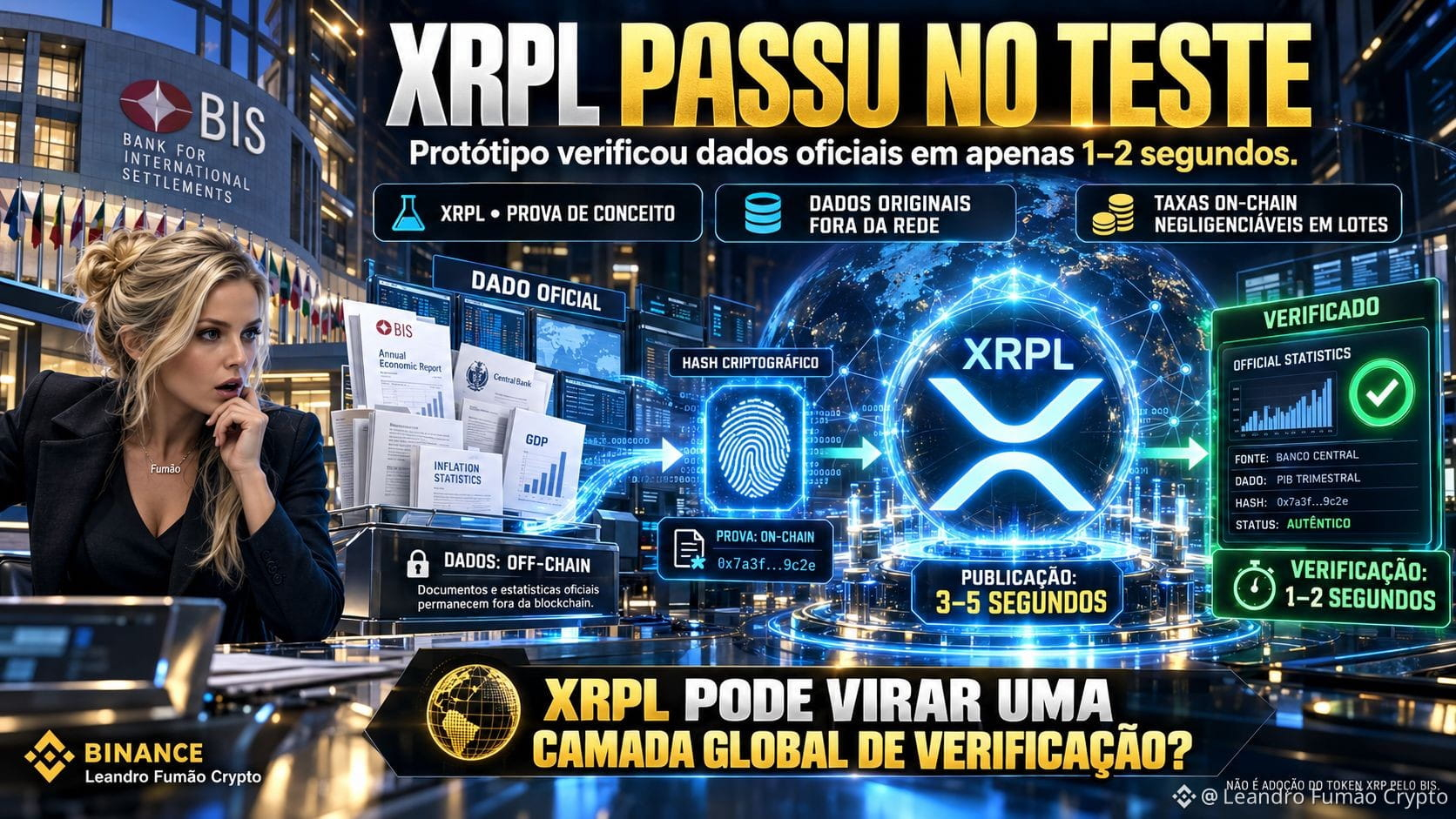
📝🏃🏼♂️💨𝕏ℝℙ𝕃 ℙ𝔸𝕊𝕊𝕆𝕌 𝔼𝕄 𝕌𝕄 𝕋𝔼𝕊𝕋𝔼 𝔻𝔼 𝕊𝔼𝔾𝕌ℕ𝔻𝕆𝕊⚜️
Um novo estudo publicado pelo Bank for International Settlements (BIS) colocou o $XRP Ledger em um teste institucional pouco comum.
O objetivo não era movimentar dinheiro.
Era verificar se informações oficiais poderiam ter sua origem e integridade comprovadas por blockchain.
O sistema criou uma impressão digital criptográfica dos dados e registrou um resumo no XRP Ledger.
Resultado do Protótipo
⚡ Publicação: 3–5 segundos
⚡ Verificação: 1–2 segundos
🔐 Dados originais permanecem fora da blockchain
Ou seja, milhares de conjuntos de dados podem ser protegidos por uma única âncora criptográfica, mantendo as informações confidenciais fora da rede.
E existe outro detalhe importante:
As taxas on-chain foram consideradas negligenciáveis com uso de lotes, segundo o modelo econômico apresentado no estudo.
⚠️ Mas Atenção
Isso não significa que o BIS adotou $XRP ou XRPL em produção.
Trata-se de uma prova de conceito, e o próprio documento afirma que os resultados foram obtidos em condições controladas. Além disso, as opiniões do paper não representam necessariamente o BIS ou seus bancos centrais membros.
Mesmo assim, o teste mostra algo interessante:
O XRPL pode servir não apenas para movimentar valor, mas também como camada pública de verificação de dados para instituições e sistemas automatizados inclusive agentes de IA.
O XRP Ledger está começando a mostrar utilidade muito além dos pagamentos?
#XRP’ #XRPL #Ripple💰
📝🏃🏼♂️💨𝕏ℝℙ𝕃 ℙ𝔸𝕊𝕊𝕆𝕌 𝔼𝕄 𝕌𝕄 𝕋𝔼𝕊𝕋𝔼 𝔻𝔼 𝕊𝔼𝔾𝕌ℕ𝔻𝕆𝕊⚜️
Um novo estudo publicado pelo Bank for International Settlements (BIS) colocou o $XRP Ledger em um teste institucional pouco comum.
O objetivo não era movimentar dinheiro.
Era verificar se informações oficiais poderiam ter sua origem e integridade comprovadas por blockchain.
O sistema criou uma impressão digital criptográfica dos dados e registrou um resumo no XRP Ledger.
Resultado do Protótipo
⚡ Publicação: 3–5 segundos
⚡ Verificação: 1–2 segundos
🔐 Dados originais permanecem fora da blockchain
Ou seja, milhares de conjuntos de dados podem ser protegidos por uma única âncora criptográfica, mantendo as informações confidenciais fora da rede.
E existe outro detalhe importante:
As taxas on-chain foram consideradas negligenciáveis com uso de lotes, segundo o modelo econômico apresentado no estudo.
⚠️ Mas Atenção
Isso não significa que o BIS adotou $XRP ou XRPL em produção.
Trata-se de uma prova de conceito, e o próprio documento afirma que os resultados foram obtidos em condições controladas. Além disso, as opiniões do paper não representam necessariamente o BIS ou seus bancos centrais membros.
Mesmo assim, o teste mostra algo interessante:
O XRPL pode servir não apenas para movimentar valor, mas também como camada pública de verificação de dados para instituições e sistemas automatizados inclusive agentes de IA.
O XRP Ledger está começando a mostrar utilidade muito além dos pagamentos?
#XRP’ #XRPL #Ripple💰
Um novo estudo publicado pelo Bank for International Settlements (BIS) colocou o $XRP Ledger em um teste institucional pouco comum.
O objetivo não era movimentar dinheiro.
Era verificar se informações oficiais poderiam ter sua origem e integridade comprovadas por blockchain.
O sistema criou uma impressão digital criptográfica dos dados e registrou um resumo no XRP Ledger.
Resultado do Protótipo
⚡ Publicação: 3–5 segundos
⚡ Verificação: 1–2 segundos
🔐 Dados originais permanecem fora da blockchain
Ou seja, milhares de conjuntos de dados podem ser protegidos por uma única âncora criptográfica, mantendo as informações confidenciais fora da rede.
E existe outro detalhe importante:
As taxas on-chain foram consideradas negligenciáveis com uso de lotes, segundo o modelo econômico apresentado no estudo.
⚠️ Mas Atenção
Isso não significa que o BIS adotou $XRP ou XRPL em produção.
Trata-se de uma prova de conceito, e o próprio documento afirma que os resultados foram obtidos em condições controladas. Além disso, as opiniões do paper não representam necessariamente o BIS ou seus bancos centrais membros.
Mesmo assim, o teste mostra algo interessante:
O XRPL pode servir não apenas para movimentar valor, mas também como camada pública de verificação de dados para instituições e sistemas automatizados inclusive agentes de IA.
O XRP Ledger está começando a mostrar utilidade muito além dos pagamentos?
#XRP’ #XRPL #Ripple💰
Shae Malouf kLk1:
Sei não essas histórias são velhas o que enteresa e o preço isso da so serve pro donos kkkk
2
7
1.9k
Log in to explore more content
Join global crypto users on Binance Square
⚡️ Get latest and useful information about crypto.
💬 Trusted by the world’s largest crypto exchange.
👍 Discover real insights from verified creators.
Email / Phone number
Trending Topics
1
#BitcoinClears$85200
4,558 views
136 Discussing
2
#AltcoinSeasonIndexHoldsAbove60For5Days
27,549 views
849 Discussing
3
#USADPAdds90000JobsInSeptember
11,463 views
480 Discussing
4
#USCorePCEEasesTo3%InAugust
9,233 views
395 Discussing
5
#KospiPostsWorstQuarterSince2020
7,328 views
407 Discussing
6
#SECToClarifyOnChainFundraisingRules
17,874 views
574 Discussing
7
#UKFCAOpensCryptoFirmAuthorization
19,454 views
500 Discussing
8
#JapanMOFStudyGroupOnTokenizedGovtBonds
16,234 views
400 Discussing
9
#QNTRises287%
71,375 views
836 Discussing
10
#TrumpRejectsAIRulesForVoluntaryAudits
43,374 views
744 Discussing