
#stakingeconomics
stakingeconomics
232 views
9 Discussing
Hot
Latest

·
--
Article
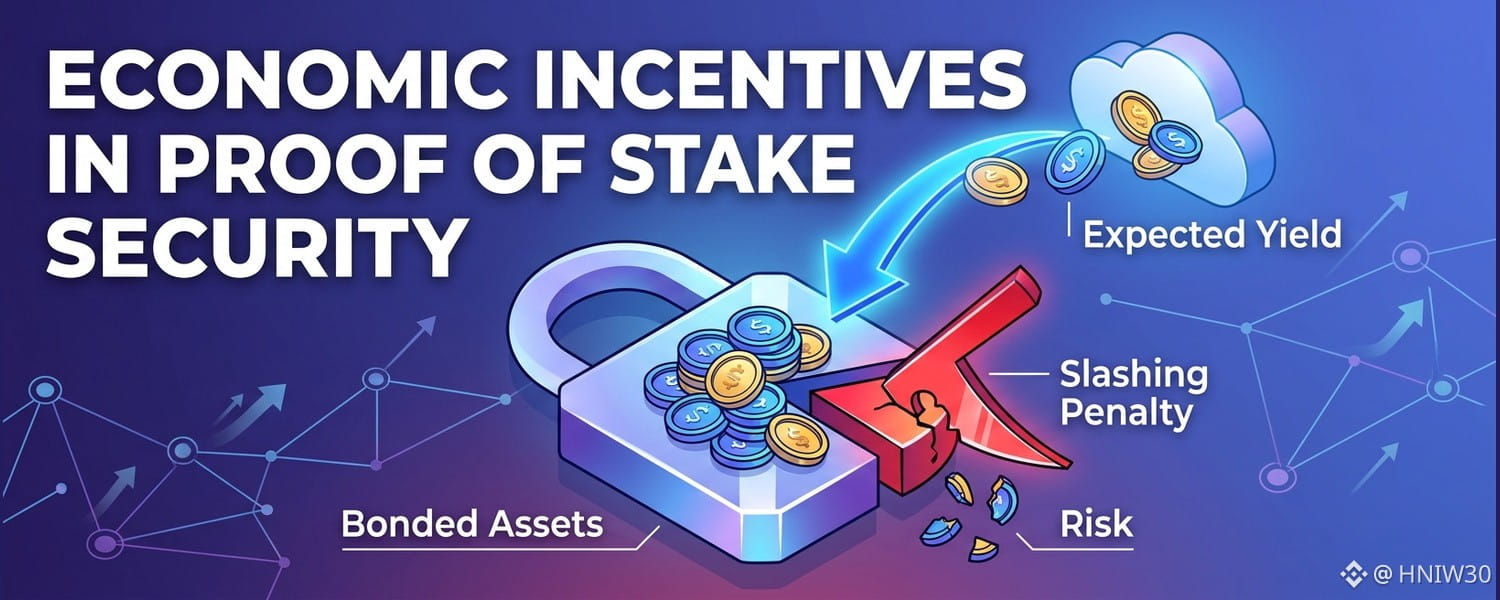
Economic Incentives in Proof of Stake SecurityStaking architectures transform consensus security from resource consumption into capital commitment. In proof of stake systems, block validation rights and emission distributions correlate directly with bonded assets. This dynamic establishes an endogenous cost structure where network defense relies on collateral value rather than operational expenditures. Market participants must assess whether expected yield adequately compensates for liquidity restriction.
The foundational incentive structure operates through programmatic issuance schedules balanced against operational penalties. Validators commit capital to smart contracts or native ledger accounts, generating base yields derived from programmatic inflation and transaction processing fees. When validators execute correct transaction state transitions, the network distributes newly minted tokens according to predetermined mathematical curves, calibrating rewards to systemic participation rates.
Slashing mechanisms represent the critical counterweight to nominal protocol returns. Malicious behavior, including double signing or protocol equivocation, triggers automated reductions of committed principal. This dynamic imposes asymmetric downside risks on dishonest validators. Economic models demonstrate that for rational actors, the potential gain from a chain reorganization must exceed the aggregated market value of all slashed capital, establishing deterministic security thresholds.
Unbonding latency introduces an implicit liquidity premium into validator economics. When capital remains locked during unbonding intervals, market participants surrender opportunity costs associated with alternate deployments or secondary market hedging. If native asset volatility accelerates, illiquid staked capital experiences portfolio friction. Rational delegators therefore demand an economic spread between gross staking returns and the prevailing risk free digital hurdle rate.
Delegation economies alter validator market structures through economies of scale. Individual token holders who lack infrastructural capabilities delegate stake to professional node operators in exchange for fee cuts. This separation of capital ownership from validation infrastructure fosters competitive margin compression. Node operators reduce management commissions to attract aggregate voting weight, which can inadvertently heighten concentration risk across primary validation clusters.
Liquid staking derivatives emerge as an endogenous market response to address systemic liquidity constraints. By issuing synthetic receipts against locked collateral, protocols enable participants to retain validation yields while deploying capital into secondary money markets. However, this structure introduces layered composability risks and depegging contingencies. If the market value of the derivative diverges from underlying reserves, leveraged positions face rapid liquidation cascades.
Long term stability in staking economies ultimately hinges on sustainable fee generation rather than perpetual token inflation. As issuance curves mature and protocol dilution decreases, validator revenue must increasingly derive from authentic transactional activity. Networks unable to generate robust fee velocity risk security degradation, as diminishing real returns incentivize capital flight toward more productive yield opportunities across the broader digital asset landscape.
#ProofOfStake
#StakingEconomics
Economic Incentives in Proof of Stake Security
Staking architectures transform consensus security from resource consumption into capital commitment. In proof of stake systems, block validation rights and emission distributions correlate directly with bonded assets. This dynamic establishes an endogenous cost structure where network defense relies on collateral value rather than operational expenditures. Market participants must assess whether expected yield adequately compensates for liquidity restriction.
The foundational incentive structure operates through programmatic issuance schedules balanced against operational penalties. Validators commit capital to smart contracts or native ledger accounts, generating base yields derived from programmatic inflation and transaction processing fees. When validators execute correct transaction state transitions, the network distributes newly minted tokens according to predetermined mathematical curves, calibrating rewards to systemic participation rates.
Slashing mechanisms represent the critical counterweight to nominal protocol returns. Malicious behavior, including double signing or protocol equivocation, triggers automated reductions of committed principal. This dynamic imposes asymmetric downside risks on dishonest validators. Economic models demonstrate that for rational actors, the potential gain from a chain reorganization must exceed the aggregated market value of all slashed capital, establishing deterministic security thresholds.
Unbonding latency introduces an implicit liquidity premium into validator economics. When capital remains locked during unbonding intervals, market participants surrender opportunity costs associated with alternate deployments or secondary market hedging. If native asset volatility accelerates, illiquid staked capital experiences portfolio friction. Rational delegators therefore demand an economic spread between gross staking returns and the prevailing risk free digital hurdle rate.
Delegation economies alter validator market structures through economies of scale. Individual token holders who lack infrastructural capabilities delegate stake to professional node operators in exchange for fee cuts. This separation of capital ownership from validation infrastructure fosters competitive margin compression. Node operators reduce management commissions to attract aggregate voting weight, which can inadvertently heighten concentration risk across primary validation clusters.
Liquid staking derivatives emerge as an endogenous market response to address systemic liquidity constraints. By issuing synthetic receipts against locked collateral, protocols enable participants to retain validation yields while deploying capital into secondary money markets. However, this structure introduces layered composability risks and depegging contingencies. If the market value of the derivative diverges from underlying reserves, leveraged positions face rapid liquidation cascades.
Long term stability in staking economies ultimately hinges on sustainable fee generation rather than perpetual token inflation. As issuance curves mature and protocol dilution decreases, validator revenue must increasingly derive from authentic transactional activity. Networks unable to generate robust fee velocity risk security degradation, as diminishing real returns incentivize capital flight toward more productive yield opportunities across the broader digital asset landscape.
#ProofOfStake
#StakingEconomics
117

·
--
🚨 Lido’s proposed ETH staking route demands an entry bond over 13x higher than the default.
This could reduce collateral per ETH at full capacity, affecting fee efficiency.
Smart money may favor operators with stronger funding profiles to capture gains.
Market implication: higher barriers could concentrate power among well-capitalized validators.
Will this shift staking dynamics toward institutional dominance?
#StakingEconomics
$ETH #TradingSignal #CryptoAnalysis

22

·
--
Proof-of-Stake networks have a security budget problem - and most people are ignoring it.
In PoW, miners sell coins to cover energy costs, creating sell pressure but also a clear security floor: attack cost = energy cost. In PoS, validators earn staking rewards (new issuance) plus transaction fees. The long-term question is: what happens when issuance drops and fees must carry the load?
$ETH is already stress-testing this. Post-merge issuance is low, but blob fee revenue from L2s has become a meaningful component of validator income. The ETH security model is quietly shifting from inflation-funded to fee-funded - a healthier but riskier transition.
$SOL takes a different approach: fixed 1.5% annual inflation declining over time, offset by growing validator fee revenue as network activity rises. It is betting on usage compounding faster than issuance compression.
$ADA faces a version of this with its Voltaire era. Cardano treasury and staking rewards are still heavily issuance-driven. The long-term sustainability thesis requires fee volume to scale before the reserve depletes - a multi-decade timeline with real execution risk.
The question every investor should ask: does this chain have a credible path to fee-funded security before its inflation runway ends?
Security budgets are the sleeper issue of the next cycle. The chains that solve this quietly will be the ones still standing at the end of it.
#ProofOfStake #CryptoSecurity #StakingEconomics #BlockchainInfrastructure #CryptoInvesting
89
·
--
The most important number in any proof-of-stake network is not its TPS — it is its Nakamoto coefficient.
The Nakamoto coefficient tells you how many validators would need to collude to compromise the network. A chain boasting 10,000 validators but with 60% of stake concentrated in 5 entities has a Nakamoto coefficient of 5. That is not decentralization — that is a board meeting.
Why does this matter?
First, regulatory capture risk. A small validator set means a small list of legal targets. A single coordinated action by regulators across a handful of jurisdictions could force censorship at the consensus layer — not the application layer.
Second, liveness guarantees. Institutional operators share data centers, cloud providers, and upgrade schedules. A correlated failure takes down a larger percentage of stake than the raw validator count suggests.
Third, governance integrity. Low Nakamoto coefficients mean fewer entities are deciding protocol upgrades. That is not code law — that is an oligarchy with good PR.
The good news: ZK-proof validator sets, lightweight node clients, and distributed staking protocols are actively pushing these numbers higher. Client diversity is improving. Delegated staking is decentralizing beyond exchange custodians.
Before you assess any L1, look up its Nakamoto coefficient. Everything else is marketing.
$ETH $SOL $BNB
#CryptoResearch #BlockchainSecurity #Decentralization #Layer1 #StakingEconomics
57
·
--
Polkadot’s staking design contains a mechanic most L1 comparisons miss entirely: the ideal staking rate is protocol-defined, and inflation adjusts dynamically around it.
Here’s how it works. DOT targets roughly 50% of total supply staked. When actual participation falls below that target, inflation rises — rewarding validators and nominators more generously to attract more staked capital. When participation exceeds the target, inflation falls, reducing the reward per unit staked and organically encouraging excess capital toward other uses like liquidity, governance, and Coretime deployments.
This creates a self-correcting security budget. The network is always paying market-rate to secure itself — no more, no less.
Compare that to fixed-issuance chains where validator rewards are locked regardless of whether the network is over- or under-staked. You either overpay for security in quiet periods or underpay under stress.
For investors, the DOT staking participation rate carries real signal. A rate significantly below 50% means higher APY is available but also implies disengagement. A rate well above 50% means capital is locked competing for compressed yield — often a sign that Coretime, governance, or liquidity deployments are less attractive at that moment.
The inflation-as-incentive dial is monetary policy baked into the protocol itself, not left to governance votes. That’s a fundamentally different security economics model.
$DOT $ETH $ADA
#Polkadot #StakingEconomics #DOT #CryptoInvesting #Layer1
93
Log in to explore more content
Join global crypto users on Binance Square
⚡️ Get latest and useful information about crypto.
💬 Trusted by the world’s largest crypto exchange.
👍 Discover real insights from verified creators.
Email / Phone number
Trending Topics
1
#CanBTCReboundAfterFallingBelow60K?
0 views
126 Discussing
2
#GlobalStocksFaceLongestLosingStreakSince2023
0 views
275 Discussing
3
#AnthropicPlungesTowardIPOPriceonDay2
0 views
46 Discussing
4
#GaoTengBitcoinETFListsOnHKEX
0 views
265 Discussing
5
#TradFiForBeginners
946,825 views
5,539 Discussing
6
#NvidiaBoardReportedlySplitOverHuang’sReturn
258,674 views
2,414 Discussing
7
#TetherBurns8BillionUSDTInPast20Days
0 views
103 Discussing
8
#BitcoinWalletSignatureFlawExploitableWithinSeconds
0 views
45 Discussing
9
#CanGTA6'sLaunchLiftTTWOShares?
207,868 views
1,717 Discussing
10
#HongKongProposesSFCLicensingForFourVirtualAssetServices
404 views
32 Discussing