

#bouncebitprime
bouncebitprime
13.1M views
120,419 Discussing
Hot
Latest


·
--
$BB :把传统信托逻辑,第一次带进加密世界
传统金融之所以能够长期承载巨额财富,离不开一套成熟的信托逻辑资产托管、收益分配、受益人结构,以及透明的契约关系。
而加密世界过去一直拥有资产,却缺少真正的“信托层”。
直到 $BB 与 #BounceBitPrime 的出现,这块拼图开始被补齐。
在 @bounce_bit 的体系中,持有 $BB 不只是持有一个代币,更像是成为链上的受益人(Beneficiary)。底层托管资产持续创造收益,而智能合约则负责按照既定规则完成收益分配,将传统信托中的契约机制搬到了链上。
这种设计,不仅保留了信托体系最核心的规则约束,也借助智能合约实现了更高的透明度、更低的执行成本以及无需人工介入的自动化运行。
如果说过去的 DeFi 更多是在重构金融工具,那么 #BounceBitPrime 正在尝试重构金融基础设施。
它让加密资产第一次拥有了接近传统金融信托体系的运行框架,也让 @bounce_bit 借助 $BB,为链上资产管理打开了一种全新的可能。
未来,真正的价值或许不只是「资产上链」,而是信托上链。
$BB :把传统信托逻辑,第一次带进加密世界
传统金融之所以能够长期承载巨额财富,离不开一套成熟的信托逻辑资产托管、收益分配、受益人结构,以及透明的契约关系。
而加密世界过去一直拥有资产,却缺少真正的“信托层”。
直到 $BB 与 #BounceBitPrime 的出现,这块拼图开始被补齐。
在 @BounceBit 的体系中,持有 $BB 不只是持有一个代币,更像是成为链上的受益人(Beneficiary)。底层托管资产持续创造收益,而智能合约则负责按照既定规则完成收益分配,将传统信托中的契约机制搬到了链上。
这种设计,不仅保留了信托体系最核心的规则约束,也借助智能合约实现了更高的透明度、更低的执行成本以及无需人工介入的自动化运行。
如果说过去的 DeFi 更多是在重构金融工具,那么 #BounceBitPrime 正在尝试重构金融基础设施。
它让加密资产第一次拥有了接近传统金融信托体系的运行框架,也让 @BounceBit 借助 $BB ,为链上资产管理打开了一种全新的可能。
未来,真正的价值或许不只是「资产上链」,而是信托上链。
传统金融之所以能够长期承载巨额财富,离不开一套成熟的信托逻辑资产托管、收益分配、受益人结构,以及透明的契约关系。
而加密世界过去一直拥有资产,却缺少真正的“信托层”。
直到 $BB 与 #BounceBitPrime 的出现,这块拼图开始被补齐。
在 @BounceBit 的体系中,持有 $BB 不只是持有一个代币,更像是成为链上的受益人(Beneficiary)。底层托管资产持续创造收益,而智能合约则负责按照既定规则完成收益分配,将传统信托中的契约机制搬到了链上。
这种设计,不仅保留了信托体系最核心的规则约束,也借助智能合约实现了更高的透明度、更低的执行成本以及无需人工介入的自动化运行。
如果说过去的 DeFi 更多是在重构金融工具,那么 #BounceBitPrime 正在尝试重构金融基础设施。
它让加密资产第一次拥有了接近传统金融信托体系的运行框架,也让 @BounceBit 借助 $BB ,为链上资产管理打开了一种全新的可能。
未来,真正的价值或许不只是「资产上链」,而是信托上链。
2
445

BounceBit: The Moment Bitcoin Starts to Live AgainI still remember when I bought my first Bitcoin. It felt like owning a part of history, a digital version of gold that the world was only beginning to understand. Over time, though, something about it started to bother me. My Bitcoin just sat there. It didn’t move. It didn’t grow. It didn’t do anything except exist in my wallet.
It was valuable, yes. But it was silent.
That’s the strange paradox of Bitcoin. It is the strongest digital asset we have, yet most of it is asleep. Locked away. Waiting for price movements that may or may not come.
Then I found BounceBit, and for the first time, I felt like Bitcoin could finally breathe.
The Vision That Sparked BounceBit
The idea behind BounceBit is simple but powerful. Bitcoin doesn’t need to stay idle. It deserves to work. It deserves to move. It deserves to be alive.
BounceBit was created to unlock that potential. It is built as a restaking chain, designed to take Bitcoin out of its long sleep and give it a new purpose. Instead of holding BTC and waiting, you can now use it to secure a blockchain, participate in DeFi, and earn yield without giving up safety.
That’s the shift. It transforms Bitcoin from something you hold into something that works for you.
A Place Where Security Meets Opportunity
The hardest part of crypto has always been the trade-off between safety and growth. If you stay in centralized custody, your coins are safe but inactive. If you dive into full DeFi, you gain opportunity but expose yourself to risk.
BounceBit builds a bridge between those two worlds.
Your Bitcoin remains in regulated custody, handled by trusted partners, while you receive BBTC, a token that represents your BTC on-chain. That token is your ticket to DeFi — to stake, restake, lend, borrow, and explore — all while your original Bitcoin remains securely held.
It’s the first time I’ve seen a system that lets me keep peace of mind and still chase growth.
Two Tokens, One Strong Foundation
What makes BounceBit different from other chains is how it secures itself. It doesn’t rely on just one asset. The network is powered and protected by two: BB, the native token, and BBTC, which mirrors Bitcoin inside the system.
Validators use both to secure the network, tying its stability directly to the most trusted crypto on the planet. It’s like building a skyscraper on solid rock instead of sand. The strength of Bitcoin becomes the foundation of BounceBit itself.
Staking That Gives You Freedom
Traditional staking always felt restrictive to me. You lock your coins and wait. You can’t move them, can’t use them, can’t touch them. BounceBit changes that completely.
When you stake, you receive liquid staking tokens:
• Stake BB and receive stBB
• Stake BBTC and receive stBBTC
These tokens can move freely. You can trade them, use them in DeFi, or even restake them again for layered rewards. Your assets stay active instead of trapped. You keep earning, but you also keep flexibility.
It’s the kind of system that rewards both patience and participation.
How Bitcoin Enters the BounceBit World
Moving Bitcoin into BounceBit is simpler than you might think. The project has built specialized bridges like BTC Bridge, Portal, and MultiBit, allowing assets such as BTC, BTCB, and WBTC to move safely into the BounceBit network.
Once your Bitcoin crosses over, it becomes BBTC, a version that can interact with the on-chain world — from staking and yield farming to lending and liquidity pools.
This is where Bitcoin steps beyond its original limits. It’s still Bitcoin at its core, but now it can do more.
Safety Without Letting Go
In crypto, security is everything. BounceBit was designed with that truth in mind. It partners with Ceffu, a regulated custodian, and uses MirrorX to ensure transparency and verifiability.
Think of it like this: your Bitcoin is kept in a protected vault, but you hold a digital key that lets you explore freely. You can participate in DeFi without compromising custody.
It feels like having the reliability of traditional finance and the innovation of blockchain in one place.
Prime: The Heart of the Ecosystem
If BounceBit is the engine, Prime is its fuel system. Prime brings together multiple sources of yield so your Bitcoin can earn from more than one direction.
Inside Prime, yield doesn’t come from thin air. It’s generated through a blend of:
• Tokenized real-world assets like treasuries
• Balanced crypto-native strategies
• Staking and restaking rewards
It’s a structure that feels built for long-term sustainability rather than hype. One deposit of BTC can generate value from multiple layers — a smarter, more efficient way to grow your holdings.
Understanding the Risks
Every system, no matter how advanced, comes with risks. And BounceBit is transparent about that.
Custody still depends on third parties. Bridges always carry technical risks. Yields shift with market conditions. The BB token will have unlocks that may affect price dynamics.
These are real factors to consider. But being aware of them doesn’t make the vision smaller — it makes your decisions wiser.
Why This Feels Like a Turning Point for Bitcoin
For years, Bitcoin has been about holding, waiting, and hoping. BounceBit changes that rhythm. It gives Bitcoin a new heartbeat.
Now your BTC can secure networks, earn yields, and power communities — all without leaving the safety net that gives it strength.
It’s not just about higher returns or faster systems. It’s about evolution. It’s about taking the most trusted digital asset and giving it motion, purpose, and productivity.
I see BounceBit as more than another blockchain. It’s a bridge between what Bitcoin has been and what it can become.
It’s the moment when Bitcoin stops sleeping and starts living.
$BB #BounceBitPrime @bounce_bit
BounceBit: The Moment Bitcoin Starts to Live Again
I still remember when I bought my first Bitcoin. It felt like owning a part of history, a digital version of gold that the world was only beginning to understand. Over time, though, something about it started to bother me. My Bitcoin just sat there. It didn’t move. It didn’t grow. It didn’t do anything except exist in my wallet.
It was valuable, yes. But it was silent.
That’s the strange paradox of Bitcoin. It is the strongest digital asset we have, yet most of it is asleep. Locked away. Waiting for price movements that may or may not come.
Then I found BounceBit, and for the first time, I felt like Bitcoin could finally breathe.
The Vision That Sparked BounceBit
The idea behind BounceBit is simple but powerful. Bitcoin doesn’t need to stay idle. It deserves to work. It deserves to move. It deserves to be alive.
BounceBit was created to unlock that potential. It is built as a restaking chain, designed to take Bitcoin out of its long sleep and give it a new purpose. Instead of holding BTC and waiting, you can now use it to secure a blockchain, participate in DeFi, and earn yield without giving up safety.
That’s the shift. It transforms Bitcoin from something you hold into something that works for you.
A Place Where Security Meets Opportunity
The hardest part of crypto has always been the trade-off between safety and growth. If you stay in centralized custody, your coins are safe but inactive. If you dive into full DeFi, you gain opportunity but expose yourself to risk.
BounceBit builds a bridge between those two worlds.
Your Bitcoin remains in regulated custody, handled by trusted partners, while you receive BBTC, a token that represents your BTC on-chain. That token is your ticket to DeFi — to stake, restake, lend, borrow, and explore — all while your original Bitcoin remains securely held.
It’s the first time I’ve seen a system that lets me keep peace of mind and still chase growth.
Two Tokens, One Strong Foundation
What makes BounceBit different from other chains is how it secures itself. It doesn’t rely on just one asset. The network is powered and protected by two: BB, the native token, and BBTC, which mirrors Bitcoin inside the system.
Validators use both to secure the network, tying its stability directly to the most trusted crypto on the planet. It’s like building a skyscraper on solid rock instead of sand. The strength of Bitcoin becomes the foundation of BounceBit itself.
Staking That Gives You Freedom
Traditional staking always felt restrictive to me. You lock your coins and wait. You can’t move them, can’t use them, can’t touch them. BounceBit changes that completely.
When you stake, you receive liquid staking tokens:
• Stake BB and receive stBB
• Stake BBTC and receive stBBTC
These tokens can move freely. You can trade them, use them in DeFi, or even restake them again for layered rewards. Your assets stay active instead of trapped. You keep earning, but you also keep flexibility.
It’s the kind of system that rewards both patience and participation.
How Bitcoin Enters the BounceBit World
Moving Bitcoin into BounceBit is simpler than you might think. The project has built specialized bridges like BTC Bridge, Portal, and MultiBit, allowing assets such as BTC, BTCB, and WBTC to move safely into the BounceBit network.
Once your Bitcoin crosses over, it becomes BBTC, a version that can interact with the on-chain world — from staking and yield farming to lending and liquidity pools.
This is where Bitcoin steps beyond its original limits. It’s still Bitcoin at its core, but now it can do more.
Safety Without Letting Go
In crypto, security is everything. BounceBit was designed with that truth in mind. It partners with Ceffu, a regulated custodian, and uses MirrorX to ensure transparency and verifiability.
Think of it like this: your Bitcoin is kept in a protected vault, but you hold a digital key that lets you explore freely. You can participate in DeFi without compromising custody.
It feels like having the reliability of traditional finance and the innovation of blockchain in one place.
Prime: The Heart of the Ecosystem
If BounceBit is the engine, Prime is its fuel system. Prime brings together multiple sources of yield so your Bitcoin can earn from more than one direction.
Inside Prime, yield doesn’t come from thin air. It’s generated through a blend of:
• Tokenized real-world assets like treasuries
• Balanced crypto-native strategies
• Staking and restaking rewards
It’s a structure that feels built for long-term sustainability rather than hype. One deposit of BTC can generate value from multiple layers — a smarter, more efficient way to grow your holdings.
Understanding the Risks
Every system, no matter how advanced, comes with risks. And BounceBit is transparent about that.
Custody still depends on third parties. Bridges always carry technical risks. Yields shift with market conditions. The BB token will have unlocks that may affect price dynamics.
These are real factors to consider. But being aware of them doesn’t make the vision smaller — it makes your decisions wiser.
Why This Feels Like a Turning Point for Bitcoin
For years, Bitcoin has been about holding, waiting, and hoping. BounceBit changes that rhythm. It gives Bitcoin a new heartbeat.
Now your BTC can secure networks, earn yields, and power communities — all without leaving the safety net that gives it strength.
It’s not just about higher returns or faster systems. It’s about evolution. It’s about taking the most trusted digital asset and giving it motion, purpose, and productivity.
I see BounceBit as more than another blockchain. It’s a bridge between what Bitcoin has been and what it can become.
It’s the moment when Bitcoin stops sleeping and starts living.
$BB #BounceBitPrime @BounceBit
It was valuable, yes. But it was silent.
That’s the strange paradox of Bitcoin. It is the strongest digital asset we have, yet most of it is asleep. Locked away. Waiting for price movements that may or may not come.
Then I found BounceBit, and for the first time, I felt like Bitcoin could finally breathe.
The Vision That Sparked BounceBit
The idea behind BounceBit is simple but powerful. Bitcoin doesn’t need to stay idle. It deserves to work. It deserves to move. It deserves to be alive.
BounceBit was created to unlock that potential. It is built as a restaking chain, designed to take Bitcoin out of its long sleep and give it a new purpose. Instead of holding BTC and waiting, you can now use it to secure a blockchain, participate in DeFi, and earn yield without giving up safety.
That’s the shift. It transforms Bitcoin from something you hold into something that works for you.
A Place Where Security Meets Opportunity
The hardest part of crypto has always been the trade-off between safety and growth. If you stay in centralized custody, your coins are safe but inactive. If you dive into full DeFi, you gain opportunity but expose yourself to risk.
BounceBit builds a bridge between those two worlds.
Your Bitcoin remains in regulated custody, handled by trusted partners, while you receive BBTC, a token that represents your BTC on-chain. That token is your ticket to DeFi — to stake, restake, lend, borrow, and explore — all while your original Bitcoin remains securely held.
It’s the first time I’ve seen a system that lets me keep peace of mind and still chase growth.
Two Tokens, One Strong Foundation
What makes BounceBit different from other chains is how it secures itself. It doesn’t rely on just one asset. The network is powered and protected by two: BB, the native token, and BBTC, which mirrors Bitcoin inside the system.
Validators use both to secure the network, tying its stability directly to the most trusted crypto on the planet. It’s like building a skyscraper on solid rock instead of sand. The strength of Bitcoin becomes the foundation of BounceBit itself.
Staking That Gives You Freedom
Traditional staking always felt restrictive to me. You lock your coins and wait. You can’t move them, can’t use them, can’t touch them. BounceBit changes that completely.
When you stake, you receive liquid staking tokens:
• Stake BB and receive stBB
• Stake BBTC and receive stBBTC
These tokens can move freely. You can trade them, use them in DeFi, or even restake them again for layered rewards. Your assets stay active instead of trapped. You keep earning, but you also keep flexibility.
It’s the kind of system that rewards both patience and participation.
How Bitcoin Enters the BounceBit World
Moving Bitcoin into BounceBit is simpler than you might think. The project has built specialized bridges like BTC Bridge, Portal, and MultiBit, allowing assets such as BTC, BTCB, and WBTC to move safely into the BounceBit network.
Once your Bitcoin crosses over, it becomes BBTC, a version that can interact with the on-chain world — from staking and yield farming to lending and liquidity pools.
This is where Bitcoin steps beyond its original limits. It’s still Bitcoin at its core, but now it can do more.
Safety Without Letting Go
In crypto, security is everything. BounceBit was designed with that truth in mind. It partners with Ceffu, a regulated custodian, and uses MirrorX to ensure transparency and verifiability.
Think of it like this: your Bitcoin is kept in a protected vault, but you hold a digital key that lets you explore freely. You can participate in DeFi without compromising custody.
It feels like having the reliability of traditional finance and the innovation of blockchain in one place.
Prime: The Heart of the Ecosystem
If BounceBit is the engine, Prime is its fuel system. Prime brings together multiple sources of yield so your Bitcoin can earn from more than one direction.
Inside Prime, yield doesn’t come from thin air. It’s generated through a blend of:
• Tokenized real-world assets like treasuries
• Balanced crypto-native strategies
• Staking and restaking rewards
It’s a structure that feels built for long-term sustainability rather than hype. One deposit of BTC can generate value from multiple layers — a smarter, more efficient way to grow your holdings.
Understanding the Risks
Every system, no matter how advanced, comes with risks. And BounceBit is transparent about that.
Custody still depends on third parties. Bridges always carry technical risks. Yields shift with market conditions. The BB token will have unlocks that may affect price dynamics.
These are real factors to consider. But being aware of them doesn’t make the vision smaller — it makes your decisions wiser.
Why This Feels Like a Turning Point for Bitcoin
For years, Bitcoin has been about holding, waiting, and hoping. BounceBit changes that rhythm. It gives Bitcoin a new heartbeat.
Now your BTC can secure networks, earn yields, and power communities — all without leaving the safety net that gives it strength.
It’s not just about higher returns or faster systems. It’s about evolution. It’s about taking the most trusted digital asset and giving it motion, purpose, and productivity.
I see BounceBit as more than another blockchain. It’s a bridge between what Bitcoin has been and what it can become.
It’s the moment when Bitcoin stops sleeping and starts living.
$BB #BounceBitPrime @BounceBit
1
28
5.5k

·
--
🪙BounceBit AUM and Revenue
- AUM: $545.94M (+0.52%), which is in a solid $540–560M band even though the market is choppy.
- Total revenue: $12.79 million (as of September 3, 2025) — a steady, clean rise after the early ramp.
- Signal: Capital looks sticky; the yield engine keeps compounding even when AUM ranges, which makes things more efficient.
What do you think? 🗣️
Are we seeing base-building before the next leg up, or do we have a longer range?
Take a look at your view: Growth 🚀, Consolidation 🧱, or Reversal ⚠️.
@bounce_bit #BounceBitPrime $BB
🪙BounceBit AUM and Revenue
- AUM: $545.94M (+0.52%), which is in a solid $540–560M band even though the market is choppy.
- Total revenue: $12.79 million (as of September 3, 2025) — a steady, clean rise after the early ramp.
- Signal: Capital looks sticky; the yield engine keeps compounding even when AUM ranges, which makes things more efficient.
What do you think? 🗣️
Are we seeing base-building before the next leg up, or do we have a longer range?
Take a look at your view: Growth 🚀, Consolidation 🧱, or Reversal ⚠️.
@BounceBit #BounceBitPrime $BB
- AUM: $545.94M (+0.52%), which is in a solid $540–560M band even though the market is choppy.
- Total revenue: $12.79 million (as of September 3, 2025) — a steady, clean rise after the early ramp.
- Signal: Capital looks sticky; the yield engine keeps compounding even when AUM ranges, which makes things more efficient.
What do you think? 🗣️
Are we seeing base-building before the next leg up, or do we have a longer range?
Take a look at your view: Growth 🚀, Consolidation 🧱, or Reversal ⚠️.
@BounceBit #BounceBitPrime $BB

1
1
6
4k

·
--
From Dormant Bitcoin to Active Yield Engine: The Rise of BounceBitThere’s a quiet revolution underway in the crypto world. While Bitcoin sits in wallets as digital gold, much of its potential lies dormant unable to flow, earn, or transform. That’s the story BounceBit wants to rewrite.
In this article, I take you into the vision, architecture, challenges, and poetic promise of BounceBit. Think of it as Bitcoin with muscles a new layer that awakens what was once static.
Chapter 1: The Sleepy Giant
Bitcoin is king. It is the most trusted, most capitalized, most recognized crypto asset in the world. Yet despite its prominence, its utility in decentralized finance is surprisingly limited. Bitcoin’s core design Proof of Work, no smart contracts made it strong but isolated.
For years, Bitcoin has been a fortress rather than a workshop: safe, immutable, but unable to participate fully in the yield games, DeFi applications, or financial engineering that Ethereum and newer chains support. Meanwhile, trillions in value flow through DeFi protocols, NFTs, derivatives but Bitcoin mostly watches from the sidelines.
BounceBit sees that as both a tragedy and an opportunity.
Chapter 2: Awakening Bitcoin — The Core Idea of BounceBit
BounceBit is, at its heart, a restaking and CeDeFi (centralized + decentralized finance) infrastructure. Its mission: to let Bitcoin holders activate their assets, to turn them from passive stores into engines of yield, participation, and innovation.
Here’s how:
Dual-token PoS layer 1: On BounceBit’s chain, validators stake both Bitcoin (wrapped or mapped into a token form) and the chain’s native token, BB. This dual-token security model anchors the chain in Bitcoin’s gravitas while enabling flexibility.
CeDeFi bridging: Glowingly, BounceBit combines the regulated world custodians, compliance, custody with decentralized yield protocols. You don’t have to sacrifice security or formal oversight to earn via DeFi.
Restaking mechanics: When you “stake” Bitcoin into BounceBit, your staked position can also be deployed in DeFi strategies liquidity pools, arbitrage, yield farming without unwrapping or giving up custody. That means your capital is “working” in multiple ways, not just locked.
Real-World Assets (RWA) integration: BounceBit isn’t just about crypto yield. With its recent launch of BB Prime, it enables exposure to regulated instruments like tokenized U.S. Treasury funds (e.g. Franklin Templeton’s BENJI) bringing a bridge to real-world yield on-chain.
In short: BounceBit seeks to turn Bitcoin into a core engine of DeFi, rather than a spectator.
Chapter 3: The Human Side Founders, Backers & Milestones
Every ambitious project has its origin story. Here’s how BounceBit came alive:
The founder is Jack Lu, who previously co-founded Bounce Finance, and the project draws on experience spanning traditional finance and crypto.
In early 2024, BounceBit raised $6 million in seed funding, led by Blockchain Capital and Breyer Capital, along with participation from many others (OKX Ventures, NGC Ventures, Bankless, etc.).
Right after early access launched, BounceBit hit $100 million in total value locked (TVL), with over $70 million in BTC staked—an impressive stamp of early traction.
Its chain has evolved through versions version 1.6.1 introduced key optimizations such as better inter-component communication (using Unix sockets), reduced I/O overhead, and a revamped EVM request cache to reduce latency.
More recently, with BB Prime, the project is pushing into the regulated yield space, bringing tokenized real-world assets into the fold.
These steps reveal a project not just dreaming but iterating, proving, and bridging gaps between crypto ideals and financial reality.
Chapter 4: How BounceBit Tickles Latency & Efficiency
To turn Bitcoin useful, BounceBit must navigate technical challenges particularly around performance, cost, and responsiveness. Here are some strategies it uses, or must evolve, to remain competitive:
1. Modular architecture & process isolation
In version 1.6.1, BounceBit refactored internal components so that cross-module communication is done via Unix sockets rather than HTTP calls. That lowers inter-component latency.
2. Caching & EVM RPC pooling
They reengineered the EVM RPC request cache pool to raise cache hit rates and reduce redundant computations under heavy load. That means fewer delays in handling smart contract calls.
3. Storage & I/O optimization
BounceBit removed a heavyweight index database (evmindexer.db) to simplify the data access path. The result: fewer I/O bottlenecks, faster node sync, lighter overhead per transaction.
4. Parallel yield & restaking pathways
Because staking and restaking yield logic can run in parallel with consensus and block production, the chain can avoid bottlenecking on heavy yield logic when validating blocks.
5. Governance & tokenomics alignment
A well-designed token economy and governance setup can help reduce on-chain congestion by avoiding unnecessary transactions or chaotic upgrades.
6. Geographic nodes & validator diversity
Though data is still emerging, for low physical latency, BounceBit’s validator network must be sufficiently distributed. The project already supports a global node set.
While BounceBit's design is not primarily pitched as a “metaverse / avatar latency” chain (that’s more Somnia’s domain), many of the same principles apply: faster I/O, modular execution, intelligent caching, and optimized internal communications
Chapter 5: Use Cases that Spark Imagination
When we talk about infrastructure like BounceBit, the truly fun part is imagining what people will do with it. Here are some compelling scenarios.
🚀 Activating Bitcoin in DeFi
You hold BTC, and you’re tired of it just sitting there. With BounceBit:
You stake BTC to secure the chain.
Meanwhile, your staked BTC is represented by a liquid token that participates in yield strategies across DeFi liquidity provision, derivatives, arbitrage.
You earn multiple streams of yield without losing security or custody.
🏦 Institutional Yield via RWA Exposure
Thanks to BB Prime, institutions (and qualified individuals) can get access to regulated instruments like Treasury funds, while enjoying blockchain-native features:
Earn yield from traditional assets without leaving the cryptoverse.
On-chain transparency, auditable flows, and composability with DeFi.
An example: BounceBit has integrated with Franklin Templeton’s BENJI U.S. Treasury fund ( ~$700 million AUM). Through this route, BounceBit users can access ~4.5% yield on a regulated instrument but within a blockchain environment.
🌐 Cross-chain Leverage & Composability
Because BounceBit is EVM-compatible and supports bridges, its restaked BTC and yield-bearing tokens can travel across ecosystems linking to Ethereum, BNB Chain, etc. Developers can build DeFi stacks that borrow the security of Bitcoin while interacting with broader chain ecosystems.
🧩 Building Hybrid Finance Products
BounceBit’s CeDeFi model enables novel financial products:
Delta-neutral strategies that hedge risk.
Yield vaults combining regulated yield + DeFi alpha.
Structured tokenized products bundling BTC, stablecoins, and RWAs.
In-and-out mining: users can “mine” BB tokens by trading or providing liquidity on CEX/DEX.
In effect, BounceBit is not just about staking it’s about giving builders tools to craft financial experiences layered over Bitcoin.
Chapter 6: Strengths That Make Me Believe … and Worries That Keep Me Awake
✅ What’s Working in Its Favor
Strong anchor: Bitcoin BounceBit doesn’t start from zero; it uses Bitcoin’s trust, security, and widespread adoption as its base.
Traction & capital Hitting $100M TVL early, raising $6M, achieving momentum in staking shows real demand.
Layering traditional finance By bridging regulated instruments and crypto yield (via BB Prime), it appeals to institutions wary of pure crypto risks.
Technical evolution Its repeated updates (v1.6.1) show the team isn’t idle; they are improving performance, reducing latency, optimizing systems.
EVM compatibility & composability Builders accustomed to Ethereum tooling can adapt, lowering friction for adoption.
⚠️ What Keeps Me Skeptical
Complexity & newness risks Dual-token staking + restaking frameworks are relatively novel. Bugs, edge-case exploits, or unforeseen incentives could cause trouble.
Liquidity concentration Early stages may see a small number of actors controlling validators or yield flows, opening centralization risks.
Regulatory scrutiny The blending of CeFi and DeFi, and handling of real-world assets, will draw eyes from regulators.
Sustainability of yield As more capital flows in, yield strategies may compress, and returns may diminish
Performance under stress The real test is a big market crash, a yield strategy gone rogue, or mass withdrawal. Can the protocol handle it without lag or cascading failures?
User experience & liquidity migration Convincing Bitcoin holders to “entrust” their BTC into a tokenized restaking scheme is not trivial. Many prefer simplicity over yield complexity.
In other words: it’s exciting, but the path is narrow
Chapter 7: A Quiet Conversation Two Crypto Holders
Let me bring you into a moment in a café (virtual or real) in 2027.
Amina, a long-time Bitcoin hodler, sips tea. She stares at her cold wallet. She knows her BTC is safe, but doing nothing. Then she hears of BounceBit.
She contemplates:
> “What if I could stake this BTC, yet still use it in DeFi? What if I could earn yield without giving up custody? Could this be the bridge I’ve waited for?”
Her friend Rashid, a DeFi-savvy coder, sees the allure but warns:
> “Sure, the yield looks attractive. But what if the system fails under stress? What if custodians mismanage their rules, or regulators clamp down? The architecture is beautiful only if the underpinnings are rock solid.
They decide to test itAmina stakes a small amount of BTC via BounceBit, watches her restaked tokens flow, experiments with vaults and yield strategies. She watches whether her returns hold up, whether transactions feel smooth, whether fees bite.
Over weeks, if her yield is stable, she scales up. If she sees red flags slippage, delays, centralization she backs off.
Why this matters: in the next-generation crypto world, users (not just whales) will be judgment calls. Protocols like BounceBit succeed not only via code, but via trust built from experience and cautious experimentation
Chapter 8: What the Horizon Might Hold
What could BounceBit become if it succeeds?
Bitcoin Yield Layer: The standard place where BTC becomes live capital, feeding into DeFi, derivatives, liquidity pools, hybrids.
Institutional Bridge: A portal allowing banks, funds, and institutions to access regulated yield instruments in a blockchain-native way.
Composable Finance Stack: Other protocols build layers on top: lending, insurance, synthetic assets, cross-chain primitives—using restaked BTC as foundational collateral.
Private / Permissioned Module: For enterprises or consortia wanting hybrid models, BounceBit may support semi-permissioned modules or private chains tied into its restaking system.
Backstop for Volatility: As Bitcoin prices gyrate, BounceBit’s layered yield systems may act as liquidity cushions, mitigating shocks in the broader ecosystem.
@bounce_bit
#BounceBitPrime
$BB
From Dormant Bitcoin to Active Yield Engine: The Rise of BounceBit
There’s a quiet revolution underway in the crypto world. While Bitcoin sits in wallets as digital gold, much of its potential lies dormant unable to flow, earn, or transform. That’s the story BounceBit wants to rewrite.
In this article, I take you into the vision, architecture, challenges, and poetic promise of BounceBit. Think of it as Bitcoin with muscles a new layer that awakens what was once static.
Chapter 1: The Sleepy Giant
Bitcoin is king. It is the most trusted, most capitalized, most recognized crypto asset in the world. Yet despite its prominence, its utility in decentralized finance is surprisingly limited. Bitcoin’s core design Proof of Work, no smart contracts made it strong but isolated.
For years, Bitcoin has been a fortress rather than a workshop: safe, immutable, but unable to participate fully in the yield games, DeFi applications, or financial engineering that Ethereum and newer chains support. Meanwhile, trillions in value flow through DeFi protocols, NFTs, derivatives but Bitcoin mostly watches from the sidelines.
BounceBit sees that as both a tragedy and an opportunity.
Chapter 2: Awakening Bitcoin — The Core Idea of BounceBit
BounceBit is, at its heart, a restaking and CeDeFi (centralized + decentralized finance) infrastructure. Its mission: to let Bitcoin holders activate their assets, to turn them from passive stores into engines of yield, participation, and innovation.
Here’s how:
Dual-token PoS layer 1: On BounceBit’s chain, validators stake both Bitcoin (wrapped or mapped into a token form) and the chain’s native token, BB. This dual-token security model anchors the chain in Bitcoin’s gravitas while enabling flexibility.
CeDeFi bridging: Glowingly, BounceBit combines the regulated world custodians, compliance, custody with decentralized yield protocols. You don’t have to sacrifice security or formal oversight to earn via DeFi.
Restaking mechanics: When you “stake” Bitcoin into BounceBit, your staked position can also be deployed in DeFi strategies liquidity pools, arbitrage, yield farming without unwrapping or giving up custody. That means your capital is “working” in multiple ways, not just locked.
Real-World Assets (RWA) integration: BounceBit isn’t just about crypto yield. With its recent launch of BB Prime, it enables exposure to regulated instruments like tokenized U.S. Treasury funds (e.g. Franklin Templeton’s BENJI) bringing a bridge to real-world yield on-chain.
In short: BounceBit seeks to turn Bitcoin into a core engine of DeFi, rather than a spectator.
Chapter 3: The Human Side Founders, Backers & Milestones
Every ambitious project has its origin story. Here’s how BounceBit came alive:
The founder is Jack Lu, who previously co-founded Bounce Finance, and the project draws on experience spanning traditional finance and crypto.
In early 2024, BounceBit raised $6 million in seed funding, led by Blockchain Capital and Breyer Capital, along with participation from many others (OKX Ventures, NGC Ventures, Bankless, etc.).
Right after early access launched, BounceBit hit $100 million in total value locked (TVL), with over $70 million in BTC staked—an impressive stamp of early traction.
Its chain has evolved through versions version 1.6.1 introduced key optimizations such as better inter-component communication (using Unix sockets), reduced I/O overhead, and a revamped EVM request cache to reduce latency.
More recently, with BB Prime, the project is pushing into the regulated yield space, bringing tokenized real-world assets into the fold.
These steps reveal a project not just dreaming but iterating, proving, and bridging gaps between crypto ideals and financial reality.
Chapter 4: How BounceBit Tickles Latency & Efficiency
To turn Bitcoin useful, BounceBit must navigate technical challenges particularly around performance, cost, and responsiveness. Here are some strategies it uses, or must evolve, to remain competitive:
1. Modular architecture & process isolation
In version 1.6.1, BounceBit refactored internal components so that cross-module communication is done via Unix sockets rather than HTTP calls. That lowers inter-component latency.
2. Caching & EVM RPC pooling
They reengineered the EVM RPC request cache pool to raise cache hit rates and reduce redundant computations under heavy load. That means fewer delays in handling smart contract calls.
3. Storage & I/O optimization
BounceBit removed a heavyweight index database (evmindexer.db) to simplify the data access path. The result: fewer I/O bottlenecks, faster node sync, lighter overhead per transaction.
4. Parallel yield & restaking pathways
Because staking and restaking yield logic can run in parallel with consensus and block production, the chain can avoid bottlenecking on heavy yield logic when validating blocks.
5. Governance & tokenomics alignment
A well-designed token economy and governance setup can help reduce on-chain congestion by avoiding unnecessary transactions or chaotic upgrades.
6. Geographic nodes & validator diversity
Though data is still emerging, for low physical latency, BounceBit’s validator network must be sufficiently distributed. The project already supports a global node set.
While BounceBit's design is not primarily pitched as a “metaverse / avatar latency” chain (that’s more Somnia’s domain), many of the same principles apply: faster I/O, modular execution, intelligent caching, and optimized internal communications
Chapter 5: Use Cases that Spark Imagination
When we talk about infrastructure like BounceBit, the truly fun part is imagining what people will do with it. Here are some compelling scenarios.
🚀 Activating Bitcoin in DeFi
You hold BTC, and you’re tired of it just sitting there. With BounceBit:
You stake BTC to secure the chain.
Meanwhile, your staked BTC is represented by a liquid token that participates in yield strategies across DeFi liquidity provision, derivatives, arbitrage.
You earn multiple streams of yield without losing security or custody.
🏦 Institutional Yield via RWA Exposure
Thanks to BB Prime, institutions (and qualified individuals) can get access to regulated instruments like Treasury funds, while enjoying blockchain-native features:
Earn yield from traditional assets without leaving the cryptoverse.
On-chain transparency, auditable flows, and composability with DeFi.
An example: BounceBit has integrated with Franklin Templeton’s BENJI U.S. Treasury fund ( ~$700 million AUM). Through this route, BounceBit users can access ~4.5% yield on a regulated instrument but within a blockchain environment.
🌐 Cross-chain Leverage & Composability
Because BounceBit is EVM-compatible and supports bridges, its restaked BTC and yield-bearing tokens can travel across ecosystems linking to Ethereum, BNB Chain, etc. Developers can build DeFi stacks that borrow the security of Bitcoin while interacting with broader chain ecosystems.
🧩 Building Hybrid Finance Products
BounceBit’s CeDeFi model enables novel financial products:
Delta-neutral strategies that hedge risk.
Yield vaults combining regulated yield + DeFi alpha.
Structured tokenized products bundling BTC, stablecoins, and RWAs.
In-and-out mining: users can “mine” BB tokens by trading or providing liquidity on CEX/DEX.
In effect, BounceBit is not just about staking it’s about giving builders tools to craft financial experiences layered over Bitcoin.
Chapter 6: Strengths That Make Me Believe … and Worries That Keep Me Awake
✅ What’s Working in Its Favor
Strong anchor: Bitcoin BounceBit doesn’t start from zero; it uses Bitcoin’s trust, security, and widespread adoption as its base.
Traction & capital Hitting $100M TVL early, raising $6M, achieving momentum in staking shows real demand.
Layering traditional finance By bridging regulated instruments and crypto yield (via BB Prime), it appeals to institutions wary of pure crypto risks.
Technical evolution Its repeated updates (v1.6.1) show the team isn’t idle; they are improving performance, reducing latency, optimizing systems.
EVM compatibility & composability Builders accustomed to Ethereum tooling can adapt, lowering friction for adoption.
⚠️ What Keeps Me Skeptical
Complexity & newness risks Dual-token staking + restaking frameworks are relatively novel. Bugs, edge-case exploits, or unforeseen incentives could cause trouble.
Liquidity concentration Early stages may see a small number of actors controlling validators or yield flows, opening centralization risks.
Regulatory scrutiny The blending of CeFi and DeFi, and handling of real-world assets, will draw eyes from regulators.
Sustainability of yield As more capital flows in, yield strategies may compress, and returns may diminish
Performance under stress The real test is a big market crash, a yield strategy gone rogue, or mass withdrawal. Can the protocol handle it without lag or cascading failures?
User experience & liquidity migration Convincing Bitcoin holders to “entrust” their BTC into a tokenized restaking scheme is not trivial. Many prefer simplicity over yield complexity.
In other words: it’s exciting, but the path is narrow
Chapter 7: A Quiet Conversation Two Crypto Holders
Let me bring you into a moment in a café (virtual or real) in 2027.
Amina, a long-time Bitcoin hodler, sips tea. She stares at her cold wallet. She knows her BTC is safe, but doing nothing. Then she hears of BounceBit.
She contemplates:
> “What if I could stake this BTC, yet still use it in DeFi? What if I could earn yield without giving up custody? Could this be the bridge I’ve waited for?”
Her friend Rashid, a DeFi-savvy coder, sees the allure but warns:
> “Sure, the yield looks attractive. But what if the system fails under stress? What if custodians mismanage their rules, or regulators clamp down? The architecture is beautiful only if the underpinnings are rock solid.
They decide to test itAmina stakes a small amount of BTC via BounceBit, watches her restaked tokens flow, experiments with vaults and yield strategies. She watches whether her returns hold up, whether transactions feel smooth, whether fees bite.
Over weeks, if her yield is stable, she scales up. If she sees red flags slippage, delays, centralization she backs off.
Why this matters: in the next-generation crypto world, users (not just whales) will be judgment calls. Protocols like BounceBit succeed not only via code, but via trust built from experience and cautious experimentation
Chapter 8: What the Horizon Might Hold
What could BounceBit become if it succeeds?
Bitcoin Yield Layer: The standard place where BTC becomes live capital, feeding into DeFi, derivatives, liquidity pools, hybrids.
Institutional Bridge: A portal allowing banks, funds, and institutions to access regulated yield instruments in a blockchain-native way.
Composable Finance Stack: Other protocols build layers on top: lending, insurance, synthetic assets, cross-chain primitives—using restaked BTC as foundational collateral.
Private / Permissioned Module: For enterprises or consortia wanting hybrid models, BounceBit may support semi-permissioned modules or private chains tied into its restaking system.
Backstop for Volatility: As Bitcoin prices gyrate, BounceBit’s layered yield systems may act as liquidity cushions, mitigating shocks in the broader ecosystem.
@BounceBit
#BounceBitPrime
$BB
In this article, I take you into the vision, architecture, challenges, and poetic promise of BounceBit. Think of it as Bitcoin with muscles a new layer that awakens what was once static.
Chapter 1: The Sleepy Giant
Bitcoin is king. It is the most trusted, most capitalized, most recognized crypto asset in the world. Yet despite its prominence, its utility in decentralized finance is surprisingly limited. Bitcoin’s core design Proof of Work, no smart contracts made it strong but isolated.
For years, Bitcoin has been a fortress rather than a workshop: safe, immutable, but unable to participate fully in the yield games, DeFi applications, or financial engineering that Ethereum and newer chains support. Meanwhile, trillions in value flow through DeFi protocols, NFTs, derivatives but Bitcoin mostly watches from the sidelines.
BounceBit sees that as both a tragedy and an opportunity.
Chapter 2: Awakening Bitcoin — The Core Idea of BounceBit
BounceBit is, at its heart, a restaking and CeDeFi (centralized + decentralized finance) infrastructure. Its mission: to let Bitcoin holders activate their assets, to turn them from passive stores into engines of yield, participation, and innovation.
Here’s how:
Dual-token PoS layer 1: On BounceBit’s chain, validators stake both Bitcoin (wrapped or mapped into a token form) and the chain’s native token, BB. This dual-token security model anchors the chain in Bitcoin’s gravitas while enabling flexibility.
CeDeFi bridging: Glowingly, BounceBit combines the regulated world custodians, compliance, custody with decentralized yield protocols. You don’t have to sacrifice security or formal oversight to earn via DeFi.
Restaking mechanics: When you “stake” Bitcoin into BounceBit, your staked position can also be deployed in DeFi strategies liquidity pools, arbitrage, yield farming without unwrapping or giving up custody. That means your capital is “working” in multiple ways, not just locked.
Real-World Assets (RWA) integration: BounceBit isn’t just about crypto yield. With its recent launch of BB Prime, it enables exposure to regulated instruments like tokenized U.S. Treasury funds (e.g. Franklin Templeton’s BENJI) bringing a bridge to real-world yield on-chain.
In short: BounceBit seeks to turn Bitcoin into a core engine of DeFi, rather than a spectator.
Chapter 3: The Human Side Founders, Backers & Milestones
Every ambitious project has its origin story. Here’s how BounceBit came alive:
The founder is Jack Lu, who previously co-founded Bounce Finance, and the project draws on experience spanning traditional finance and crypto.
In early 2024, BounceBit raised $6 million in seed funding, led by Blockchain Capital and Breyer Capital, along with participation from many others (OKX Ventures, NGC Ventures, Bankless, etc.).
Right after early access launched, BounceBit hit $100 million in total value locked (TVL), with over $70 million in BTC staked—an impressive stamp of early traction.
Its chain has evolved through versions version 1.6.1 introduced key optimizations such as better inter-component communication (using Unix sockets), reduced I/O overhead, and a revamped EVM request cache to reduce latency.
More recently, with BB Prime, the project is pushing into the regulated yield space, bringing tokenized real-world assets into the fold.
These steps reveal a project not just dreaming but iterating, proving, and bridging gaps between crypto ideals and financial reality.
Chapter 4: How BounceBit Tickles Latency & Efficiency
To turn Bitcoin useful, BounceBit must navigate technical challenges particularly around performance, cost, and responsiveness. Here are some strategies it uses, or must evolve, to remain competitive:
1. Modular architecture & process isolation
In version 1.6.1, BounceBit refactored internal components so that cross-module communication is done via Unix sockets rather than HTTP calls. That lowers inter-component latency.
2. Caching & EVM RPC pooling
They reengineered the EVM RPC request cache pool to raise cache hit rates and reduce redundant computations under heavy load. That means fewer delays in handling smart contract calls.
3. Storage & I/O optimization
BounceBit removed a heavyweight index database (evmindexer.db) to simplify the data access path. The result: fewer I/O bottlenecks, faster node sync, lighter overhead per transaction.
4. Parallel yield & restaking pathways
Because staking and restaking yield logic can run in parallel with consensus and block production, the chain can avoid bottlenecking on heavy yield logic when validating blocks.
5. Governance & tokenomics alignment
A well-designed token economy and governance setup can help reduce on-chain congestion by avoiding unnecessary transactions or chaotic upgrades.
6. Geographic nodes & validator diversity
Though data is still emerging, for low physical latency, BounceBit’s validator network must be sufficiently distributed. The project already supports a global node set.
While BounceBit's design is not primarily pitched as a “metaverse / avatar latency” chain (that’s more Somnia’s domain), many of the same principles apply: faster I/O, modular execution, intelligent caching, and optimized internal communications
Chapter 5: Use Cases that Spark Imagination
When we talk about infrastructure like BounceBit, the truly fun part is imagining what people will do with it. Here are some compelling scenarios.
🚀 Activating Bitcoin in DeFi
You hold BTC, and you’re tired of it just sitting there. With BounceBit:
You stake BTC to secure the chain.
Meanwhile, your staked BTC is represented by a liquid token that participates in yield strategies across DeFi liquidity provision, derivatives, arbitrage.
You earn multiple streams of yield without losing security or custody.
🏦 Institutional Yield via RWA Exposure
Thanks to BB Prime, institutions (and qualified individuals) can get access to regulated instruments like Treasury funds, while enjoying blockchain-native features:
Earn yield from traditional assets without leaving the cryptoverse.
On-chain transparency, auditable flows, and composability with DeFi.
An example: BounceBit has integrated with Franklin Templeton’s BENJI U.S. Treasury fund ( ~$700 million AUM). Through this route, BounceBit users can access ~4.5% yield on a regulated instrument but within a blockchain environment.
🌐 Cross-chain Leverage & Composability
Because BounceBit is EVM-compatible and supports bridges, its restaked BTC and yield-bearing tokens can travel across ecosystems linking to Ethereum, BNB Chain, etc. Developers can build DeFi stacks that borrow the security of Bitcoin while interacting with broader chain ecosystems.
🧩 Building Hybrid Finance Products
BounceBit’s CeDeFi model enables novel financial products:
Delta-neutral strategies that hedge risk.
Yield vaults combining regulated yield + DeFi alpha.
Structured tokenized products bundling BTC, stablecoins, and RWAs.
In-and-out mining: users can “mine” BB tokens by trading or providing liquidity on CEX/DEX.
In effect, BounceBit is not just about staking it’s about giving builders tools to craft financial experiences layered over Bitcoin.
Chapter 6: Strengths That Make Me Believe … and Worries That Keep Me Awake
✅ What’s Working in Its Favor
Strong anchor: Bitcoin BounceBit doesn’t start from zero; it uses Bitcoin’s trust, security, and widespread adoption as its base.
Traction & capital Hitting $100M TVL early, raising $6M, achieving momentum in staking shows real demand.
Layering traditional finance By bridging regulated instruments and crypto yield (via BB Prime), it appeals to institutions wary of pure crypto risks.
Technical evolution Its repeated updates (v1.6.1) show the team isn’t idle; they are improving performance, reducing latency, optimizing systems.
EVM compatibility & composability Builders accustomed to Ethereum tooling can adapt, lowering friction for adoption.
⚠️ What Keeps Me Skeptical
Complexity & newness risks Dual-token staking + restaking frameworks are relatively novel. Bugs, edge-case exploits, or unforeseen incentives could cause trouble.
Liquidity concentration Early stages may see a small number of actors controlling validators or yield flows, opening centralization risks.
Regulatory scrutiny The blending of CeFi and DeFi, and handling of real-world assets, will draw eyes from regulators.
Sustainability of yield As more capital flows in, yield strategies may compress, and returns may diminish
Performance under stress The real test is a big market crash, a yield strategy gone rogue, or mass withdrawal. Can the protocol handle it without lag or cascading failures?
User experience & liquidity migration Convincing Bitcoin holders to “entrust” their BTC into a tokenized restaking scheme is not trivial. Many prefer simplicity over yield complexity.
In other words: it’s exciting, but the path is narrow
Chapter 7: A Quiet Conversation Two Crypto Holders
Let me bring you into a moment in a café (virtual or real) in 2027.
Amina, a long-time Bitcoin hodler, sips tea. She stares at her cold wallet. She knows her BTC is safe, but doing nothing. Then she hears of BounceBit.
She contemplates:
> “What if I could stake this BTC, yet still use it in DeFi? What if I could earn yield without giving up custody? Could this be the bridge I’ve waited for?”
Her friend Rashid, a DeFi-savvy coder, sees the allure but warns:
> “Sure, the yield looks attractive. But what if the system fails under stress? What if custodians mismanage their rules, or regulators clamp down? The architecture is beautiful only if the underpinnings are rock solid.
They decide to test itAmina stakes a small amount of BTC via BounceBit, watches her restaked tokens flow, experiments with vaults and yield strategies. She watches whether her returns hold up, whether transactions feel smooth, whether fees bite.
Over weeks, if her yield is stable, she scales up. If she sees red flags slippage, delays, centralization she backs off.
Why this matters: in the next-generation crypto world, users (not just whales) will be judgment calls. Protocols like BounceBit succeed not only via code, but via trust built from experience and cautious experimentation
Chapter 8: What the Horizon Might Hold
What could BounceBit become if it succeeds?
Bitcoin Yield Layer: The standard place where BTC becomes live capital, feeding into DeFi, derivatives, liquidity pools, hybrids.
Institutional Bridge: A portal allowing banks, funds, and institutions to access regulated yield instruments in a blockchain-native way.
Composable Finance Stack: Other protocols build layers on top: lending, insurance, synthetic assets, cross-chain primitives—using restaked BTC as foundational collateral.
Private / Permissioned Module: For enterprises or consortia wanting hybrid models, BounceBit may support semi-permissioned modules or private chains tied into its restaking system.
Backstop for Volatility: As Bitcoin prices gyrate, BounceBit’s layered yield systems may act as liquidity cushions, mitigating shocks in the broader ecosystem.
@BounceBit
#BounceBitPrime
$BB
1
282


Article
On-Ramp Institutional 2.0: The Bouncebit On-Chain Yield Bridge b/w Traditional Custody & On-ChainThe institutions desire exposure to crypto but they desire it to be safe, regulated, and real. Years ago there was no such a balance. DeFi was high returns and no compliance; TradFi was low risk and no innovation. BounceBit is the bridge that eventually brings both parties together - to form a new Institutional On-Ramp 2.0, where traditional custody is combined with on-chain yield via verifiable architecture, rather than marketing promises.
The trick lies in the two-custody system of BounceBit. Regulated custodians such as Mainnet Digital hold assets, and consensus, restaking and yield logic are handled by on-chain validators. This implies that all Bitcoin within BounceBit is still under institutional grade security but is on-chain as active capital. It is not wrapped or synthetic, but real BTC expressed in a transparent way by the use of proofs of custody and validator attestations. Holdings, transactions and performance can be checked in real time by institutions.
That framework opens the door to what DeFi has failed to achieve: compliance-native yield. BounceBit directs capital into lending pools, liquidity vaults, and RWA integrations all supported by verifiable proofs through its hybrid CeDeFi architecture. Blind faith is over, no more risks. Institutions will finally be able to produce DeFi-like returns under the framework of traditional finance. It is exposure-free, liquidity-free.
The outcome is a win-win system. Banks, custodians, and asset managers can put client capital to work in a way that is fully regulated, and DeFi users have the liquidity and credibility that institutional money provides. BounceBit makes Bitcoin a programmable yield infrastructure that connects the old world of finance to the open economy of Web3.
BounceBit is unique in a market where everyone has been experimenting with speculative ideas, in that it does something that appears to be simple on the surface, which is to make trust scalable. The on-ramp is open but this time it is two-way.
#BounceBitPrime $BB @bounce_bit
{spot}(BBUSDT)
On-Ramp Institutional 2.0: The Bouncebit On-Chain Yield Bridge b/w Traditional Custody & On-Chain
The institutions desire exposure to crypto but they desire it to be safe, regulated, and real. Years ago there was no such a balance. DeFi was high returns and no compliance; TradFi was low risk and no innovation. BounceBit is the bridge that eventually brings both parties together - to form a new Institutional On-Ramp 2.0, where traditional custody is combined with on-chain yield via verifiable architecture, rather than marketing promises.
The trick lies in the two-custody system of BounceBit. Regulated custodians such as Mainnet Digital hold assets, and consensus, restaking and yield logic are handled by on-chain validators. This implies that all Bitcoin within BounceBit is still under institutional grade security but is on-chain as active capital. It is not wrapped or synthetic, but real BTC expressed in a transparent way by the use of proofs of custody and validator attestations. Holdings, transactions and performance can be checked in real time by institutions.
That framework opens the door to what DeFi has failed to achieve: compliance-native yield. BounceBit directs capital into lending pools, liquidity vaults, and RWA integrations all supported by verifiable proofs through its hybrid CeDeFi architecture. Blind faith is over, no more risks. Institutions will finally be able to produce DeFi-like returns under the framework of traditional finance. It is exposure-free, liquidity-free.
The outcome is a win-win system. Banks, custodians, and asset managers can put client capital to work in a way that is fully regulated, and DeFi users have the liquidity and credibility that institutional money provides. BounceBit makes Bitcoin a programmable yield infrastructure that connects the old world of finance to the open economy of Web3.
BounceBit is unique in a market where everyone has been experimenting with speculative ideas, in that it does something that appears to be simple on the surface, which is to make trust scalable. The on-ramp is open but this time it is two-way.
#BounceBitPrime $BB @BounceBit
The trick lies in the two-custody system of BounceBit. Regulated custodians such as Mainnet Digital hold assets, and consensus, restaking and yield logic are handled by on-chain validators. This implies that all Bitcoin within BounceBit is still under institutional grade security but is on-chain as active capital. It is not wrapped or synthetic, but real BTC expressed in a transparent way by the use of proofs of custody and validator attestations. Holdings, transactions and performance can be checked in real time by institutions.
That framework opens the door to what DeFi has failed to achieve: compliance-native yield. BounceBit directs capital into lending pools, liquidity vaults, and RWA integrations all supported by verifiable proofs through its hybrid CeDeFi architecture. Blind faith is over, no more risks. Institutions will finally be able to produce DeFi-like returns under the framework of traditional finance. It is exposure-free, liquidity-free.
The outcome is a win-win system. Banks, custodians, and asset managers can put client capital to work in a way that is fully regulated, and DeFi users have the liquidity and credibility that institutional money provides. BounceBit makes Bitcoin a programmable yield infrastructure that connects the old world of finance to the open economy of Web3.
BounceBit is unique in a market where everyone has been experimenting with speculative ideas, in that it does something that appears to be simple on the surface, which is to make trust scalable. The on-ramp is open but this time it is two-way.
#BounceBitPrime $BB @BounceBit
1
18
14.6k

·
--

Article
BounceBit: The Chain Turning Bitcoin into an Earning Machine
You know how most people treat Bitcoin like digital gold, something you buy and hold and hope it goes up in price? For a long time, that was all you could really do. But BounceBit is changing that story. It is giving Bitcoin a new life, letting it actually work and earn instead of just sitting quietly in your wallet.
BounceBit is built around a simple but powerful idea. It combines the safety of traditional finance with the creativity of decentralized finance. The team calls it CeDeFi, and the goal is to make Bitcoin more productive without losing what makes it special. It is a place where your Bitcoin can finally do something, earn yield, restake, and take part in a real on chain economy.
What makes things even more exciting is how BounceBit is now stepping into real world finance. It recently teamed up with Franklin Templeton, one of the biggest asset managers in the world, to launch BB Prime. This new platform lets people earn from tokenized money market funds that are backed by United States Treasury bills. That means real assets, real yield, and real institutions entering the crypto space through BounceBit. It is a big step because it shows that traditional finance is beginning to see crypto not as a risk but as an opportunity.
The project also announced a BB token buyback plan. This means the team will use part of its earnings to buy BB tokens from the open market. That move reduces the token supply and shows the team is thinking long term, not just chasing short term hype. Recently, about forty two million new tokens were unlocked, which added some short term pressure, but the buyback could help keep things balanced. It is the kind of responsible approach that helps build trust with the community.
Traders and analysts have also started watching BounceBit more closely. Some noticed that the BB chart is showing a rounding bottom pattern, which often means the market could be preparing for a positive move. But beyond price, the real story is about usage, more capital is flowing into BB Prime, and more users are testing what BounceBit can actually do.
What I like most about BounceBit is its purpose. It is not trying to replace Bitcoin or change its core nature. It is trying to make it more useful. Think of it as a system that helps your Bitcoin grow instead of just wait. It is a yield reactor that gives Bitcoin a reason to move, build, and connect with the wider crypto world.
Developers are also paying attention because BounceBit is EVM compatible, which means it works with the same tools Ethereum developers already use. That makes it easier for builders to create apps and products, and that is how ecosystems truly grow. With real world assets like United States Treasury funds now being used on chain, BounceBit feels like it is building a bridge between the old world of finance and the new world of crypto.
Of course, it is still early. The team has a lot to prove and many milestones to reach. But so far, the vision is clear and the progress is steady. If BounceBit keeps moving this way, building carefully, keeping transparency, and focusing on real value, it could become one of the most important Bitcoin based ecosystems in the industry.
BounceBit is showing us that Bitcoin does not just have to sit there waiting for the next bull run. It can earn, it can move, and it can power a new kind of financial system. It is a glimpse of what happens when innovation meets purpose, and maybe this is the version of Bitcoin we have all been waiting to see.
#BounceBitPrime $BB
@bounce_bit
You know how most people treat Bitcoin like digital gold, something you buy and hold and hope it goes up in price? For a long time, that was all you could really do. But BounceBit is changing that story. It is giving Bitcoin a new life, letting it actually work and earn instead of just sitting quietly in your wallet.
BounceBit is built around a simple but powerful idea. It combines the safety of traditional finance with the creativity of decentralized finance. The team calls it CeDeFi, and the goal is to make Bitcoin more productive without losing what makes it special. It is a place where your Bitcoin can finally do something, earn yield, restake, and take part in a real on chain economy.
What makes things even more exciting is how BounceBit is now stepping into real world finance. It recently teamed up with Franklin Templeton, one of the biggest asset managers in the world, to launch BB Prime. This new platform lets people earn from tokenized money market funds that are backed by United States Treasury bills. That means real assets, real yield, and real institutions entering the crypto space through BounceBit. It is a big step because it shows that traditional finance is beginning to see crypto not as a risk but as an opportunity.
The project also announced a BB token buyback plan. This means the team will use part of its earnings to buy BB tokens from the open market. That move reduces the token supply and shows the team is thinking long term, not just chasing short term hype. Recently, about forty two million new tokens were unlocked, which added some short term pressure, but the buyback could help keep things balanced. It is the kind of responsible approach that helps build trust with the community.
Traders and analysts have also started watching BounceBit more closely. Some noticed that the BB chart is showing a rounding bottom pattern, which often means the market could be preparing for a positive move. But beyond price, the real story is about usage, more capital is flowing into BB Prime, and more users are testing what BounceBit can actually do.
What I like most about BounceBit is its purpose. It is not trying to replace Bitcoin or change its core nature. It is trying to make it more useful. Think of it as a system that helps your Bitcoin grow instead of just wait. It is a yield reactor that gives Bitcoin a reason to move, build, and connect with the wider crypto world.
Developers are also paying attention because BounceBit is EVM compatible, which means it works with the same tools Ethereum developers already use. That makes it easier for builders to create apps and products, and that is how ecosystems truly grow. With real world assets like United States Treasury funds now being used on chain, BounceBit feels like it is building a bridge between the old world of finance and the new world of crypto.
Of course, it is still early. The team has a lot to prove and many milestones to reach. But so far, the vision is clear and the progress is steady. If BounceBit keeps moving this way, building carefully, keeping transparency, and focusing on real value, it could become one of the most important Bitcoin based ecosystems in the industry.
BounceBit is showing us that Bitcoin does not just have to sit there waiting for the next bull run. It can earn, it can move, and it can power a new kind of financial system. It is a glimpse of what happens when innovation meets purpose, and maybe this is the version of Bitcoin we have all been waiting to see.
#BounceBitPrime $BB
@BounceBit
BounceBit: The Chain Turning Bitcoin into an Earning Machine
You know how most people treat Bitcoin like digital gold, something you buy and hold and hope it goes up in price? For a long time, that was all you could really do. But BounceBit is changing that story. It is giving Bitcoin a new life, letting it actually work and earn instead of just sitting quietly in your wallet.
BounceBit is built around a simple but powerful idea. It combines the safety of traditional finance with the creativity of decentralized finance. The team calls it CeDeFi, and the goal is to make Bitcoin more productive without losing what makes it special. It is a place where your Bitcoin can finally do something, earn yield, restake, and take part in a real on chain economy.
What makes things even more exciting is how BounceBit is now stepping into real world finance. It recently teamed up with Franklin Templeton, one of the biggest asset managers in the world, to launch BB Prime. This new platform lets people earn from tokenized money market funds that are backed by United States Treasury bills. That means real assets, real yield, and real institutions entering the crypto space through BounceBit. It is a big step because it shows that traditional finance is beginning to see crypto not as a risk but as an opportunity.
The project also announced a BB token buyback plan. This means the team will use part of its earnings to buy BB tokens from the open market. That move reduces the token supply and shows the team is thinking long term, not just chasing short term hype. Recently, about forty two million new tokens were unlocked, which added some short term pressure, but the buyback could help keep things balanced. It is the kind of responsible approach that helps build trust with the community.
Traders and analysts have also started watching BounceBit more closely. Some noticed that the BB chart is showing a rounding bottom pattern, which often means the market could be preparing for a positive move. But beyond price, the real story is about usage, more capital is flowing into BB Prime, and more users are testing what BounceBit can actually do.
What I like most about BounceBit is its purpose. It is not trying to replace Bitcoin or change its core nature. It is trying to make it more useful. Think of it as a system that helps your Bitcoin grow instead of just wait. It is a yield reactor that gives Bitcoin a reason to move, build, and connect with the wider crypto world.
Developers are also paying attention because BounceBit is EVM compatible, which means it works with the same tools Ethereum developers already use. That makes it easier for builders to create apps and products, and that is how ecosystems truly grow. With real world assets like United States Treasury funds now being used on chain, BounceBit feels like it is building a bridge between the old world of finance and the new world of crypto.
Of course, it is still early. The team has a lot to prove and many milestones to reach. But so far, the vision is clear and the progress is steady. If BounceBit keeps moving this way, building carefully, keeping transparency, and focusing on real value, it could become one of the most important Bitcoin based ecosystems in the industry.
BounceBit is showing us that Bitcoin does not just have to sit there waiting for the next bull run. It can earn, it can move, and it can power a new kind of financial system. It is a glimpse of what happens when innovation meets purpose, and maybe this is the version of Bitcoin we have all been waiting to see.
#BounceBitPrime $BB
@BounceBit
1
1
8
1.5k

BounceBit CeDeFi Breakthrough: Finance in 2025.
@bounce_bit
In 2025 Bounty is reinventing finance with their CeDeFi model, combining centralized efficiency and decentralized transparency. It is a new system that democratizes access to high-yield opportunities, which are now accessible to everyone, and are of an institutional quality. Liquidity Custody Tokens (LCTs) allow users to gain two yield types on-chain DeFi and off-chain custody with low fee and zero slippage to receive the best returns possible. BounceBit Chain is a safe PoS Layer 1 blockchain based on BB and BBTC that is highly secure, with compatibility with EVM and a rich ecosystem of applications. Smart Allocation will be automated diversified portfolios, and One-Click Fixed Yield will offer consistent income over assets such as BTC and USDT. Structured products such as Dual Investments are advanced products. Having a multi-layer custody, KYC/AML compliance, and BVI investment license, BounceBit values trust. It combines the traditional and digital finance sphere and offers high-yield and security solutions to its users by integrating RWAs such as Treasury Bill Yields.
#BounceBitPrime $BB
{spot}(BBUSDT)
BounceBit CeDeFi Breakthrough: Finance in 2025.
@BounceBit
In 2025 Bounty is reinventing finance with their CeDeFi model, combining centralized efficiency and decentralized transparency. It is a new system that democratizes access to high-yield opportunities, which are now accessible to everyone, and are of an institutional quality. Liquidity Custody Tokens (LCTs) allow users to gain two yield types on-chain DeFi and off-chain custody with low fee and zero slippage to receive the best returns possible. BounceBit Chain is a safe PoS Layer 1 blockchain based on BB and BBTC that is highly secure, with compatibility with EVM and a rich ecosystem of applications. Smart Allocation will be automated diversified portfolios, and One-Click Fixed Yield will offer consistent income over assets such as BTC and USDT. Structured products such as Dual Investments are advanced products. Having a multi-layer custody, KYC/AML compliance, and BVI investment license, BounceBit values trust. It combines the traditional and digital finance sphere and offers high-yield and security solutions to its users by integrating RWAs such as Treasury Bill Yields.
#BounceBitPrime $BB
@BounceBit
In 2025 Bounty is reinventing finance with their CeDeFi model, combining centralized efficiency and decentralized transparency. It is a new system that democratizes access to high-yield opportunities, which are now accessible to everyone, and are of an institutional quality. Liquidity Custody Tokens (LCTs) allow users to gain two yield types on-chain DeFi and off-chain custody with low fee and zero slippage to receive the best returns possible. BounceBit Chain is a safe PoS Layer 1 blockchain based on BB and BBTC that is highly secure, with compatibility with EVM and a rich ecosystem of applications. Smart Allocation will be automated diversified portfolios, and One-Click Fixed Yield will offer consistent income over assets such as BTC and USDT. Structured products such as Dual Investments are advanced products. Having a multi-layer custody, KYC/AML compliance, and BVI investment license, BounceBit values trust. It combines the traditional and digital finance sphere and offers high-yield and security solutions to its users by integrating RWAs such as Treasury Bill Yields.
#BounceBitPrime $BB

5
749

·
--
Community, Partnerships, and Growth Strategy ?
One of the greatest strengths of BounceBit lies in its community-driven growth and extensive partnerships around the globe. Since its launch, the project has strategically collaborated with multiple blockchain platforms, leading exchanges, and secure digital wallets to expand accessibility and create sustainable growth opportunities. Today, BounceBit enjoys the support of over 150,000 active community members who engage daily through online forums, social channels, and community events.
Marketing campaigns, promotional activities, and reward systems have further accelerated its adoption worldwide. Additionally, BounceBit has attracted attention from institutional investors, giving it a level of credibility that many new projects struggle to achieve. So far, more than $2 billion worth of digital assets have been staked through its ecosystem, highlighting the scale of trust it has earned. With upcoming product launches and more strategic partnerships planned, the project appears well-positioned to capture a larger share of the growing DeFi market.
@bounce_bit #BounceBitPrime $BB
{spot}(BBUSDT)
Community, Partnerships, and Growth Strategy ?
One of the greatest strengths of BounceBit lies in its community-driven growth and extensive partnerships around the globe. Since its launch, the project has strategically collaborated with multiple blockchain platforms, leading exchanges, and secure digital wallets to expand accessibility and create sustainable growth opportunities. Today, BounceBit enjoys the support of over 150,000 active community members who engage daily through online forums, social channels, and community events.
Marketing campaigns, promotional activities, and reward systems have further accelerated its adoption worldwide. Additionally, BounceBit has attracted attention from institutional investors, giving it a level of credibility that many new projects struggle to achieve. So far, more than $2 billion worth of digital assets have been staked through its ecosystem, highlighting the scale of trust it has earned. With upcoming product launches and more strategic partnerships planned, the project appears well-positioned to capture a larger share of the growing DeFi market.
@BounceBit #BounceBitPrime $BB
One of the greatest strengths of BounceBit lies in its community-driven growth and extensive partnerships around the globe. Since its launch, the project has strategically collaborated with multiple blockchain platforms, leading exchanges, and secure digital wallets to expand accessibility and create sustainable growth opportunities. Today, BounceBit enjoys the support of over 150,000 active community members who engage daily through online forums, social channels, and community events.
Marketing campaigns, promotional activities, and reward systems have further accelerated its adoption worldwide. Additionally, BounceBit has attracted attention from institutional investors, giving it a level of credibility that many new projects struggle to achieve. So far, more than $2 billion worth of digital assets have been staked through its ecosystem, highlighting the scale of trust it has earned. With upcoming product launches and more strategic partnerships planned, the project appears well-positioned to capture a larger share of the growing DeFi market.
@BounceBit #BounceBitPrime $BB
2.5k
1.2k
188
2.5k

Technology BounceBit is based on: Dual-Token PoS and EVM Scrutinizing the technical implementationTechnology BounceBit is based on: Dual-Token PoS and EVM Scrutinizing the technical implementation of BounceBit, one can find out an advanced architecture that combines the strengths of Bitcoin with the freedom of Ethereum. It is based on a dual-token PoS consensus mechanism, a new technology that provides security to the network both in terms of BTC and $BB.
The validators put BTC as primary security, i.e. indirectly with the hash power of Bitcoin via mirrored custody, and $BB as an incentive to operate. The hybrid model shares the risk: BTC offers undisputable collateral (and slashing is used in the case of downtime), whereas $BB takes care of gas and rewards, and is thus non-centralized. By mid-2025, there will be more than 800 BTC integrated and the validator set will be decentralized with a minimum number of 100 + nodes.The killer feature of BounceBit is the full EVM compatibility.
The chain can run Solidity smart contracts, which can be used in dApps such as DEXs, lending protocols, and yield farms, unlike Bitcoin which has a limited scripting system. Ethereum tools can be developed with ease and cross-chain liquidity between the BNB Chain and Ethereum is bridged. Restaking enables BounceBit Chain to achieve over 1,000 TPS with finality of sub-second, which is faster than most L1s, and is possible due to the best possible PoS parameters achieved through on-chain governance. The BTC variants (native BTC, BTCB, WBTC) are deposited by the users into vaults and mirrored by the positions on-chain using the MirrorX tech by Ceffu. Today there are three sources of yield, including: (1) DeFi- lending to integrated protocols such as Aave forks; (2) Infrastructure-validator rewards of 5-8% APY; (3) CeFi- arbitrage through regulated custodians at 10%+ on funding rates.
Rebasing Smart contracts are used to produce an automated form of rebasing: some tokens such as BBTC (BounceBit BTC) auto-compound yields, and can be composable for swaps or collateral, without going through an unstaking phase, with the adopted standards of BB-token being called BBTC, BBETH, BBSOL, BBNB and BBUSD, live as of October 17, 2025. They are yield-embedded ERC-20s, which rebase on daily basis, and have returns of the same directly embedded in the token balance. Vaults, swaps, perps and staking are all run within a single ledger. The current protocol fees finance $BB buybacks, which impose deflationary pressure -0.1 percent of each trade is repaid to holders. Migration is facilitated by gas subsidies through airdrops, which give 0.1 $BB to the holders.Security is the highest. Mainnet digital is the custodian of the funds, and they are audited routinely by PeckShield and on-chain traceable. Slashing rewards the malicious validators with a penalty that is up to 100 percent of stake, and CeDeFi rails assure that institutional users abide by the KYC/AML checks. Technically, the stack of BounceBit involves Cosmos SDK to do PoS, Reth to execute EVM, and Tendermint to provide consensus.
The App Store modular smart contracts reduce the risks of deployment. RWA integration through oracles such as Chainlink tie real-world yields (e.g. Treasuries) into smart contracts, represented as RWAs. Future upgrades ZK-rollups are privacy-preserving trades.Critics with CeFi dependencies would centralize which is offset by on-chain mirrors and community governance. Having a cumulative Prime volume of 1.5 billion and partnerships such as the Benji vault of Franklin Templeton (10M TVL), BounceBit does not just have a theorized tech, but one that is tested. As a dev, SDKs and Bounties via BounceClub help build faster, and an ecosystem that describes several Bitcoin-powered DeFi waves is being built.
@bounce_bit #BounceBitPrime $BB
Technology BounceBit is based on: Dual-Token PoS and EVM Scrutinizing the technical implementation
Technology BounceBit is based on: Dual-Token PoS and EVM Scrutinizing the technical implementation of BounceBit, one can find out an advanced architecture that combines the strengths of Bitcoin with the freedom of Ethereum. It is based on a dual-token PoS consensus mechanism, a new technology that provides security to the network both in terms of BTC and $BB .
The validators put BTC as primary security, i.e. indirectly with the hash power of Bitcoin via mirrored custody, and $BB as an incentive to operate. The hybrid model shares the risk: BTC offers undisputable collateral (and slashing is used in the case of downtime), whereas $BB takes care of gas and rewards, and is thus non-centralized. By mid-2025, there will be more than 800 BTC integrated and the validator set will be decentralized with a minimum number of 100 + nodes.The killer feature of BounceBit is the full EVM compatibility.
The chain can run Solidity smart contracts, which can be used in dApps such as DEXs, lending protocols, and yield farms, unlike Bitcoin which has a limited scripting system. Ethereum tools can be developed with ease and cross-chain liquidity between the BNB Chain and Ethereum is bridged. Restaking enables BounceBit Chain to achieve over 1,000 TPS with finality of sub-second, which is faster than most L1s, and is possible due to the best possible PoS parameters achieved through on-chain governance. The BTC variants (native BTC, BTCB, WBTC) are deposited by the users into vaults and mirrored by the positions on-chain using the MirrorX tech by Ceffu. Today there are three sources of yield, including: (1) DeFi- lending to integrated protocols such as Aave forks; (2) Infrastructure-validator rewards of 5-8% APY; (3) CeFi- arbitrage through regulated custodians at 10%+ on funding rates.
Rebasing Smart contracts are used to produce an automated form of rebasing: some tokens such as BBTC (BounceBit BTC) auto-compound yields, and can be composable for swaps or collateral, without going through an unstaking phase, with the adopted standards of BB-token being called BBTC, BBETH, BBSOL, BBNB and BBUSD, live as of October 17, 2025. They are yield-embedded ERC-20s, which rebase on daily basis, and have returns of the same directly embedded in the token balance. Vaults, swaps, perps and staking are all run within a single ledger. The current protocol fees finance $BB buybacks, which impose deflationary pressure -0.1 percent of each trade is repaid to holders. Migration is facilitated by gas subsidies through airdrops, which give 0.1 $BB to the holders.Security is the highest. Mainnet digital is the custodian of the funds, and they are audited routinely by PeckShield and on-chain traceable. Slashing rewards the malicious validators with a penalty that is up to 100 percent of stake, and CeDeFi rails assure that institutional users abide by the KYC/AML checks. Technically, the stack of BounceBit involves Cosmos SDK to do PoS, Reth to execute EVM, and Tendermint to provide consensus.
The App Store modular smart contracts reduce the risks of deployment. RWA integration through oracles such as Chainlink tie real-world yields (e.g. Treasuries) into smart contracts, represented as RWAs. Future upgrades ZK-rollups are privacy-preserving trades.Critics with CeFi dependencies would centralize which is offset by on-chain mirrors and community governance. Having a cumulative Prime volume of 1.5 billion and partnerships such as the Benji vault of Franklin Templeton (10M TVL), BounceBit does not just have a theorized tech, but one that is tested. As a dev, SDKs and Bounties via BounceClub help build faster, and an ecosystem that describes several Bitcoin-powered DeFi waves is being built.
@BounceBit #BounceBitPrime $BB
The validators put BTC as primary security, i.e. indirectly with the hash power of Bitcoin via mirrored custody, and $BB as an incentive to operate. The hybrid model shares the risk: BTC offers undisputable collateral (and slashing is used in the case of downtime), whereas $BB takes care of gas and rewards, and is thus non-centralized. By mid-2025, there will be more than 800 BTC integrated and the validator set will be decentralized with a minimum number of 100 + nodes.The killer feature of BounceBit is the full EVM compatibility.
The chain can run Solidity smart contracts, which can be used in dApps such as DEXs, lending protocols, and yield farms, unlike Bitcoin which has a limited scripting system. Ethereum tools can be developed with ease and cross-chain liquidity between the BNB Chain and Ethereum is bridged. Restaking enables BounceBit Chain to achieve over 1,000 TPS with finality of sub-second, which is faster than most L1s, and is possible due to the best possible PoS parameters achieved through on-chain governance. The BTC variants (native BTC, BTCB, WBTC) are deposited by the users into vaults and mirrored by the positions on-chain using the MirrorX tech by Ceffu. Today there are three sources of yield, including: (1) DeFi- lending to integrated protocols such as Aave forks; (2) Infrastructure-validator rewards of 5-8% APY; (3) CeFi- arbitrage through regulated custodians at 10%+ on funding rates.
Rebasing Smart contracts are used to produce an automated form of rebasing: some tokens such as BBTC (BounceBit BTC) auto-compound yields, and can be composable for swaps or collateral, without going through an unstaking phase, with the adopted standards of BB-token being called BBTC, BBETH, BBSOL, BBNB and BBUSD, live as of October 17, 2025. They are yield-embedded ERC-20s, which rebase on daily basis, and have returns of the same directly embedded in the token balance. Vaults, swaps, perps and staking are all run within a single ledger. The current protocol fees finance $BB buybacks, which impose deflationary pressure -0.1 percent of each trade is repaid to holders. Migration is facilitated by gas subsidies through airdrops, which give 0.1 $BB to the holders.Security is the highest. Mainnet digital is the custodian of the funds, and they are audited routinely by PeckShield and on-chain traceable. Slashing rewards the malicious validators with a penalty that is up to 100 percent of stake, and CeDeFi rails assure that institutional users abide by the KYC/AML checks. Technically, the stack of BounceBit involves Cosmos SDK to do PoS, Reth to execute EVM, and Tendermint to provide consensus.
The App Store modular smart contracts reduce the risks of deployment. RWA integration through oracles such as Chainlink tie real-world yields (e.g. Treasuries) into smart contracts, represented as RWAs. Future upgrades ZK-rollups are privacy-preserving trades.Critics with CeFi dependencies would centralize which is offset by on-chain mirrors and community governance. Having a cumulative Prime volume of 1.5 billion and partnerships such as the Benji vault of Franklin Templeton (10M TVL), BounceBit does not just have a theorized tech, but one that is tested. As a dev, SDKs and Bounties via BounceClub help build faster, and an ecosystem that describes several Bitcoin-powered DeFi waves is being built.
@BounceBit #BounceBitPrime $BB
3
1.2k

·
--
BounceBit Prime: On-Chain Portfolio Intelligence RedefinedBounceBit Prime brings one of modern finance’s most influential frameworks — Modern Portfolio Theory (MPT) — directly onto the blockchain. Inspired by Harry Markowitz’s foundational principles of diversification and risk optimization, it creates an automated, transparent, and adaptive ecosystem for building multi-asset portfolios that balance risk and reward with mathematical precision.
At its core, BounceBit Prime tokenizes traditionally distinct asset classes into blockchain-native instruments such as bbBOND, bbCORP, and bbGOLD. Each represents a different dimension of risk and return, from stable yield-bearing positions to growth-oriented exposure and inflation-resistant reserves. By algorithmically combining these assets, BounceBit Prime minimizes portfolio volatility while maintaining optimized returns — effectively translating traditional financial engineering into programmable on-chain intelligence.
Beyond Mean-Variance Optimization
While conventional MPT relies on static mean-variance models to find the efficient frontier, BounceBit Prime advances this framework by integrating risk parity, a principle where every asset class contributes equally to overall portfolio risk. This ensures resilience across changing market regimes — a feature particularly critical in the high-volatility environments of digital assets.
Through this hybrid model, BounceBit Prime doesn’t just solve for return maximization; it constructs balanced, self-correcting portfolios capable of adapting to liquidity shifts, correlation changes, and market shocks — all without human intervention.
Dynamic Rebalancing via Smart Contracts
The protocol’s on-chain automation layer continuously monitors market data via decentralized oracles, enabling real-time recalibration. When asset allocations deviate from their optimal ratios, smart contracts automatically rebalance positions, maintaining alignment with the mathematically defined efficient frontier.
This process operates with full transparency, low transaction overhead, and no intermediaries, giving investors access to strategies once reserved for institutional portfolio managers.
A New Paradigm for On-Chain Asset Management
BounceBit Prime represents a convergence of quantitative finance and decentralized architecture. It eliminates the inefficiencies of manual rebalancing, the opacity of centralized funds, and the static assumptions of off-chain modeling. What emerges is a living, autonomous system — one where financial logic is embedded directly into the protocol layer itself.
In practice, this means any investor can now access institutional-grade portfolio management, complete with diversification, risk parity, and continuous optimization — all powered by smart contracts. By transforming theoretical constructs into self-executing financial primitives, BounceBit Prime establishes a new benchmark for what blockchain-based asset management can achieve.
In essence, #BounceBitPrime is where financial theory meets autonomous execution — transforming portfolios into intelligent, adaptive systems operating entirely on-chain.@bounce_bit #bouncebit $BB
BounceBit Prime: On-Chain Portfolio Intelligence Redefined
BounceBit Prime brings one of modern finance’s most influential frameworks — Modern Portfolio Theory (MPT) — directly onto the blockchain. Inspired by Harry Markowitz’s foundational principles of diversification and risk optimization, it creates an automated, transparent, and adaptive ecosystem for building multi-asset portfolios that balance risk and reward with mathematical precision.
At its core, BounceBit Prime tokenizes traditionally distinct asset classes into blockchain-native instruments such as bbBOND, bbCORP, and bbGOLD. Each represents a different dimension of risk and return, from stable yield-bearing positions to growth-oriented exposure and inflation-resistant reserves. By algorithmically combining these assets, BounceBit Prime minimizes portfolio volatility while maintaining optimized returns — effectively translating traditional financial engineering into programmable on-chain intelligence.
Beyond Mean-Variance Optimization
While conventional MPT relies on static mean-variance models to find the efficient frontier, BounceBit Prime advances this framework by integrating risk parity, a principle where every asset class contributes equally to overall portfolio risk. This ensures resilience across changing market regimes — a feature particularly critical in the high-volatility environments of digital assets.
Through this hybrid model, BounceBit Prime doesn’t just solve for return maximization; it constructs balanced, self-correcting portfolios capable of adapting to liquidity shifts, correlation changes, and market shocks — all without human intervention.
Dynamic Rebalancing via Smart Contracts
The protocol’s on-chain automation layer continuously monitors market data via decentralized oracles, enabling real-time recalibration. When asset allocations deviate from their optimal ratios, smart contracts automatically rebalance positions, maintaining alignment with the mathematically defined efficient frontier.
This process operates with full transparency, low transaction overhead, and no intermediaries, giving investors access to strategies once reserved for institutional portfolio managers.
A New Paradigm for On-Chain Asset Management
BounceBit Prime represents a convergence of quantitative finance and decentralized architecture. It eliminates the inefficiencies of manual rebalancing, the opacity of centralized funds, and the static assumptions of off-chain modeling. What emerges is a living, autonomous system — one where financial logic is embedded directly into the protocol layer itself.
In practice, this means any investor can now access institutional-grade portfolio management, complete with diversification, risk parity, and continuous optimization — all powered by smart contracts. By transforming theoretical constructs into self-executing financial primitives, BounceBit Prime establishes a new benchmark for what blockchain-based asset management can achieve.
In essence, #BounceBitPrime is where financial theory meets autonomous execution — transforming portfolios into intelligent, adaptive systems operating entirely on-chain.@BounceBit #bouncebit $BB
At its core, BounceBit Prime tokenizes traditionally distinct asset classes into blockchain-native instruments such as bbBOND, bbCORP, and bbGOLD. Each represents a different dimension of risk and return, from stable yield-bearing positions to growth-oriented exposure and inflation-resistant reserves. By algorithmically combining these assets, BounceBit Prime minimizes portfolio volatility while maintaining optimized returns — effectively translating traditional financial engineering into programmable on-chain intelligence.
Beyond Mean-Variance Optimization
While conventional MPT relies on static mean-variance models to find the efficient frontier, BounceBit Prime advances this framework by integrating risk parity, a principle where every asset class contributes equally to overall portfolio risk. This ensures resilience across changing market regimes — a feature particularly critical in the high-volatility environments of digital assets.
Through this hybrid model, BounceBit Prime doesn’t just solve for return maximization; it constructs balanced, self-correcting portfolios capable of adapting to liquidity shifts, correlation changes, and market shocks — all without human intervention.
Dynamic Rebalancing via Smart Contracts
The protocol’s on-chain automation layer continuously monitors market data via decentralized oracles, enabling real-time recalibration. When asset allocations deviate from their optimal ratios, smart contracts automatically rebalance positions, maintaining alignment with the mathematically defined efficient frontier.
This process operates with full transparency, low transaction overhead, and no intermediaries, giving investors access to strategies once reserved for institutional portfolio managers.
A New Paradigm for On-Chain Asset Management
BounceBit Prime represents a convergence of quantitative finance and decentralized architecture. It eliminates the inefficiencies of manual rebalancing, the opacity of centralized funds, and the static assumptions of off-chain modeling. What emerges is a living, autonomous system — one where financial logic is embedded directly into the protocol layer itself.
In practice, this means any investor can now access institutional-grade portfolio management, complete with diversification, risk parity, and continuous optimization — all powered by smart contracts. By transforming theoretical constructs into self-executing financial primitives, BounceBit Prime establishes a new benchmark for what blockchain-based asset management can achieve.
In essence, #BounceBitPrime is where financial theory meets autonomous execution — transforming portfolios into intelligent, adaptive systems operating entirely on-chain.@BounceBit #bouncebit $BB
6
4.3k

·
--
Deep Dive: BounceBitBitcoin is a sleeping giant and every architect who tries to wake it must answer the same quiet question: how do you make the most conservative asset in crypto do useful work without breaking what made it valuable in the first place? BounceBit’s answer is not a flashy gimmick; it’s a series of small, aligned choices — custody-first design, dual-anchored consensus, yield that borrows from real finance, and a cultural layer to keep liquidity moving. Those choices show a clear design philosophy: move carefully, make things verifiable, and build composability so that small actions compound into institutional-grade utility. That philosophy matters because the market is tired of illusions. Investors want durable returns, communities want honest mechanisms, and holders want upside with safety. When you look closely at BounceBit’s components — the way BBTC is minted, the dual-stake security model, the structure of Prime vaults, the behavior of bonding curves in BounceClub — you see a project that’s not improvising growth but architecting leverage. This essay will walk through those small things, hold them up to the light, and show why they matter strategically for adoption, governance, and market fit.
Introduction
Start with custody and you change the game. The “glass-box” custody idea is not just a compliance checkbox in BounceBit; it is the crucible that makes all other plays possible. A verifiable, regulated custodian relationship transforms a token from an IOU into an infrastructure asset. BBTC that equals on-chain proof to an off-chain lock is a small technical mapping, but the practical effect is huge: institutions that previously required legal comfort now have a ledger-level link they can audit. For investors this matters for two reasons. First, it materially lowers perceived counterparty risk: you can trace reserves rather than take a statement on faith. Second, it enables the design space of Prime: if tokenized treasuries and collateral are actually backed, they can be used as live collateral for hedges and structured products. That single structural commitment — custody as code + institution — is the hinge on which everything else swings.
Custody as the strategic hinge
Dual staking looks elegant on a design doc: validators secure the chain by staking BB or BBTC and delegators choose how to allocate. But there’s a subtler effect here if you read it politically and economically. Allowing BBTC into consensus is more than an incentive; it makes Bitcoin liquidity literally part of the security fabric. That turns holders into stakeholders. Small holders who previously “HODLed” assume a new agency: their BTC can bolster network security and earn yield without leaving the custody perimeter. For governance, this design pushes two dynamics: it disincentivizes short-term sell pressure because staked assets are productive, and it aligns a broader constituency (BTC holders) with protocol-level upgrades. In short, dual staking is a micro-level feature with macro-level governance consequences.
Dual staking: security, agency, and governance
Prime’s core idea — blending tokenized RWAs with crypto-native derivatives to craft “all-weather” yield — sounds like a pitch deck headline until you examine a vault’s mechanics. Look at a Prime vault as a small machine: tokenized treasuries provide a predictable coupon; BBTC provides collateral depth; derivatives strategies capture funding and basis spreads; and risk overlays like hedges and stop-loss rules manage tail risk. The art is in the weightings. A vault that is 60% treasuries, 30% derivatives hedged carefully, and 10% liquidity buffer behaves very differently from one that flips those percentages. The point here is tactical: Prime’s advantage is not in having creative strategies alone but in operationalizing them with custody certainty. For investors, that translates into something concrete — a yield source that is explainable, auditable, and less reliant on token emissions. This is what turns retail curiosity into institutional due diligence.
Prime vaults as yield machines: small weights, big outcomes
BounceClub looks like fun on the surface — memes, social launches, bonding curves — but its importance to the protocol is structural. Culture generates activity, and activity generates on-chain fees, swap depth, and treasury revenue. Bonding-curve launches are a tiny product decision with outsized economic geometry: they allow projects to seed liquidity in a gradual, mathematically defined way that benefits early participants while reducing rug risk. From an investor’s lens, BounceClub is the protocol’s organic marketing and liquidity supply mechanism — a recurring funnel that converts cultural attention into economic stickiness. For a community, it’s the place where users experiment without threatening core capital. These small experiments matter because they create habitual usage; every meme launch that succeeds nudges more BB and BBTC into active circulation.
BounceClub: culture that compounds liquidity
Now inspect tokenomics with an eagle eye. A 2.1 billion BB cap with staged vesting, ecosystem allocations, and a meaningful staking reward pool is predictable until market dynamics interact. The real sensitivity lies in unlock schedules and the pace of utility adoption. If Prime vault TVL grows faster than token unlocks dilute supply, BB’s value capture follows. If unlocks outpace productive uses, price pressure follows. So what small signals should an investor or community member track? Velocity of BB/B BTC staking, average duration of delegations, Prime vault TVL growth per week, and new RWA integrations per quarter. These are micro-metrics that anticipate macro price action. It’s not glamorous, but in tokenized economies, the small rhythms tell the big story.
Tokenomics: the micro-metrics that forecast macro outcomes
Take a close look at oracles and bridge security — they’re the quiet plumbing everyone assumes will just work. But Prime depends on honest pricing and robust cross-chain messaging to safely use RWAs and derivatives. A mispriced treasury token, stale oracle, or bridge reorg can cascade into liquidations or misallocated collateral. BounceBit’s design must therefore prioritize low-latency, multi-source oracles and validator-run bridge validation schemes. For the community, that means supporting decentralized oracle nodes and diversifying bridge partners. The takeaway for investors is simple: technical reliability in inputs matters more than flashy APYs because yield depends on accurate prices as much as strategy.
Oracles and bridges: the small pipes carrying big risk
Insurance is a small line item in many whitepapers but a massive psychological lever in practice. A Prime vault linked to an insurance pool or an institutional underwriter is more likely to attract institutional capital. Why? Because insurers provide legal transferability and a realistic worst-case scenario model. Small insurance commitments (a couple percent of TVL) can have outsize signaling power. They tell compliance officers that the team anticipated loss scenarios, bought protection, and hence can integrate Prime into an institutional onboarding process. For community holders, that same insurance reduces fear of total loss and encourages longer-term allocation.
Insurance: tiny cushions, large confidence
A microcase to study: a BBTC-backed market-neutral vault where tokenized treasuries supply the cash leg for repo-style operations. In practice, this is a staged workflow: BBTC is collateral; treasuries provide liquidity lending yields; the strategy shorts futures to neutralize directional exposure while capturing funding. The small engineering detail — how frequently the vault rebalances its futures hedge — determines slippage and carry. Short rebalancing reduces basis risk but increases gas and operational cost; long rebalancing saves costs but leaves the vault exposed. That tradeoff is the tactical heart of Prime and a great example of how a tiny parameter decides whether a vault survives stress.
Rebalancing cadence: the micro decision that writes survivability
Roadmap reality check: the roadmap is as important for what it says as what it omits. If a roadmap promises “global custodian integrations” and “on-chain clearing” but lacks specifics around jurisdictions, AML processes, and legal wrappers, the implied risk is executional. A perceptive community watches not the headline but the cadence: are legal agreements being signed? Are custodians being listed? Is proof-of-reserve evolving into cryptographic attestation? These micro-progress markers — inbound compliance hires, regulatory whitepapers, and testnet audits — are the signals that the roadmap is executable, not aspirational. Investors should reward teams that publish these small, verifiable proofs of progress.
Roadmap as a ledger of credibility
Competition is always in the background, but the edge is often in narrow capabilities. EigenLayer builds on restaking ethos, Ondo or TradFi tokenizers focus on RWAs, and Liquid Staking derivatives emphasize liquidity. BounceBit’s differential is the combination: glass-box custody + Prime yield + dual-stake consensus. The small but decisive advantage is that BounceBit doesn’t ask users to compromise one need for another; it layers them. That means in head-to-head comparisons, the questions become tactical: which protocol offers real-time proof-of-reserve? Which can legally take institutional treasuries as collateral? Which gives BTC holders a direct governance stake? The answers lie in small contractual and technical details, not slogans.
Competition viewed through the lens of narrow capability
User experience is often where projects fail. If depositing BTC requires a dozen KYC steps, a trustee agreement, and a legal onboarding call, growth stalls. BounceBit’s challenge is to make trust efficient without making it cheap. That means streamlined onboarding flows for retail, standard legal wrappers for institutions, and a UX that surfaces proof-of-reserve and insurance transparently. The small but critical choices — how the deposit wizard displays custodian info, how interest projections are explained, how withdrawal windows are communicated — will affect conversion. Great product is small decisions executed consistently.
Onboarding: micro UX that scales trust
Community mechanics deserve an eagle-eyed look. Governance proposals often fail not for lack of merit but because of voter friction. The solution is micro-incentivization: small reward programs for voters, snapshot simplifications, delegation education. BounceBit’s governance can gain legitimacy by lowering friction and increasing meaningful participation metrics, not by imposing more power. For holders, the key is to treat governance like a habit-forming activity: small, frequent, and rewarded. That micro-social engineering builds a resilient on-chain polity that can make hard decisions under stress.
Governance design: habits that sustain protocol-level choices
What do investors actually buy when they buy BB? They buy a claim on future protocol fee flows, a governance voice, and exposure to a celebrated narrative: Bitcoin productivity. But the translation from narrative to cash flow matters. Fees from Prime vaults, BounceClub launches, bridge fees, and validator commissions can be engineered as revenue streams that fund buybacks or treasury growth. The small financial decision — whether to allocate a portion of protocol fees to a buyback-and-burn vs. an ecosystem grant — materially changes BB’s value capture. Savvy investors read the fine print and the small tokenomic levers to forecast whether BB is a utility token, a revenue share, or a hybrid.
What BB ownership really buys: the microstructure of value capture
Regulation is the external force that does not ask permission. Subtle regulatory tone shifts — a prudential guideline on tokenized securities in one jurisdiction, an updated custody rule in another — can swing institutional appetite overnight. The small defensive moves matter: modular legal wrappers, KYC gating for institutional products, and modular custody options per jurisdiction.
Those small, preemptive legal plays are often more important than marketing blitzes because they preserve access to large pools of capital when rules change. Teams that bake legal modularity into roadmap items domesticate regulatory risk as a feature rather than a vulnerability.
Regulatory modularity: small legal templates, large optionality
Let’s zoom into user psychology for a moment. People over-index on headline APYs and underweight source stability. The micro-education play — embedding simple infographics that show yield composition (treasury yield, funding carry, fee income, insurance buffer) — reduces churn. If a user sees that 40% of yield is stable treasury coupons and 10% is insurance-sourced protection, they are less likely to flee when crypto markets correct. Small transparency features change behavior. Investors are not purely rational; they are comfort-driven. Prime’s ability to decompose yield into readable blocks is a small UX choice with outsized retention consequences.
Behavioral UX: decompose yield, reduce panic
Now think product-market fit in terms of marginal adopters: custodial exchanges, OTC desks, and family offices. Each has specific micro-requirements — custody legal opinions, settlement windows, and reporting exports. BounceBit’s tight focus on custody allows it to offer these micro-products. The strategic play is to win these incremental partners who bring aggregated flows. A single family office or an exchange integrating a Prime product can seed TVL materially. Small client wins compound. That’s why the team’s diligence on legal each quarter matters as much as a marketing launch.
Marginal adopters: small partnerships that bootstrap flows
Small governance features like emergency pause mechanisms — how they are designed and who can call them — play a disproportionate role in trust. A poorly designed pause that lacks a clear governance pathway creates regulatory alarm; a well-designed pause with defined community checkpoints builds confidence. These tiny safety valves are the nuts and bolts of institutional dialogue. The more explicit, audited, and community-reviewed they are, the higher the probability institutional allocations increase.
Pause mechanics and escalation paths: tiny switches that signal stability
Everything above assumes technical excellence, but human capital matters too. The micro hires — a head of custody who has negotiated institutional SLAs before, a regulatory counsel with fintech experience, an ops lead who scaled margin engines — change execution speed drastically. Investors ignore human architecture at their own peril. The presence of seasoned custody and prime-trading veterans is a small signal with a big multiplier on roadmap credibility.
Team micro-architecture: hiring small profiles that unlock big doors
Finally, think about optionalities and optionality stacking. BounceBit’s small features — proof-of-reserve attestation, bonding-curve tooling, a BBTC staking dashboard — are optionalities that recombine. Put them together and you get something that behaves like a financial infrastructure suite: a custody tier for institutions, a yield tier for retail, and a liquidity engine that services cross-chain markets. The real value is in the optionality to pivot into adjacent services (on-chain clearing, compliance-as-a-service, custody APIs) once the core product is proven. Smart protocols build these micro-options early because they become strategic assets later.
Optionality stacking: how small features create a platform
If you are a community member, what should you do? Track the micro-metrics: staking rates, average stake duration, Prime vault deposit velocity, number of custodial integrations, and the cadence of audit reports. Vote on governance proposals that increase transparency, not hype. If you are an investor, ask for legal wrappers, insurance details, and a clear diverting of protocol fee allocation. Look for small wins in the roadmap — a signed custodian MOU, a proof-of-reserve demo, a first institutional deposit.
These are the micro-evidence that the macro narrative will follow. Small things, consistently executed, build the moat.
Actionable micro-checklist: what to watch and why it matters
When everyone else is writing about APYs and token memes, the truly sharp play is to study the tiny plumbing: custody proofs, rebalancing cadence, oracle diversity, insurance commitments, and marginal partnerships. BounceBit isn’t promising a rocketship; it’s promising durable architecture. And durable architecture is a sequence of small, defensible decisions. If you’re eagle-eyed, those scattered small items assemble into a pattern: a protocol that understands trust, composes yield conservatively, and builds community-driven liquidity without gambling the treasuries. That pattern is rare in crypto and valuable in markets that are maturing amidst global regulatory scrutiny and institutional capital on the sidelines.
Prime as the Anchor of Liquidity Cycles
One of the sharpest ways to look at BounceBit is through the lens of liquidity cycles. Crypto liquidity ebbs and flows with global macro conditions, ETF inflows, and regulatory shifts. What makes Prime interesting is that it doesn’t just survive these cycles; it anchors them. In bull markets, Prime vaults are magnets for capital, turning speculative demand into productive yield. In bear markets, Prime’s integration of tokenized treasuries ensures a floor of predictable returns, preventing complete capital flight. This dual role means that BounceBit is not merely reactive to cycles; it becomes part of their rhythm, shaping flows instead of waiting for them. For communities, this creates stability, and for investors, it means participation in a protocol that grows through both risk-on and risk-off phases
Prime and the Rise of Decentralized Credit
Credit is the lifeblood of any financial system. In DeFi, credit markets have been crude, relying on overcollateralized lending rather than true credit underwriting. Prime’s architecture, by securing assets with custody and tokenized RWAs, could evolve into a decentralized credit platform where BBTC and treasuries act as collateral bases for broader credit issuance. Imagine a future where Prime vaults do not just generate yield but also collateralize lines of credit for developers, institutions, or even governments experimenting with blockchain settlement. This would make BounceBit more than a yield machine; it would be a decentralized bank in everything but name, with Bitcoin as its base money
The Roadmap and Its Institutional Significance
When analyzing BounceBit’s roadmap, the small details matter more than the grand milestones. The commitment to expanding custodian partnerships is not just operational; it is a signal to institutions that the protocol is serious about compliance and redundancy. The introduction of cryptographic proof-of-reserve attestation is not only a technical upgrade but a trust anchor for regulators. The plan to scale Prime vaults across multiple strategies reflects not just product diversification but an intent to mirror the structured product landscape of traditional finance. Each of these roadmap items, small when viewed individually, builds a pattern of institutional seriousness. For holders, this translates into a higher probability that institutional inflows materialize, which is the ultimate accelerant for token value
Tokenomics and the Velocity of Capital
Tokenomics in BounceBit are subtle because the mechanics depend on velocity more than raw supply. BB staking reduces circulating supply, but the real insight comes from measuring how quickly capital circulates through Prime, BBTC issuance, and BounceClub. High velocity in Prime means fees accrue faster, generating more value capture for BB. Low velocity, even with locked supply, dampens growth. For investors, the key is to watch not only unlock schedules but how quickly BB moves through productive loops. For communities, the challenge is cultural: encouraging participation in staking, Prime, and BounceClub, rather than passive holding.
Velocity is the hidden multiplier in tokenomics, and BounceBit has designed systems where velocity directly feeds sustainability
Market Positioning Against Restaking Protocols
It is tempting to compare BounceBit to restaking protocols like EigenLayer, but the differences are telling. Restaking captures Ethereum security but exposes capital to correlated slashing risks. BounceBit, by contrast, mobilizes Bitcoin through custody and uses dual staking to expand security without over-leverage. For market positioning, this matters: BounceBit is offering Bitcoin holders the same productive role Ethereum holders now have in restaking but without the same fragility. This positioning gives BounceBit a differentiated narrative in the competition for productive capital. Investors who missed the first wave of Ethereum restaking now see Bitcoin’s version emerging, while communities recognize that this model is structurally less risky. The sharpness here is in seeing that BounceBit isn’t just copying; it is reframing productivity in a Bitcoin-first way
The Cultural Liquidity Flywheel
Cultural liquidity is a concept that most protocols ignore, but BounceBit has engineered deliberately through BounceClub. Meme tokens, social primitives, and bonding curves may look trivial, but they provide the cultural glue that keeps capital circulating rather than leaving the ecosystem. For holders, this matters because cultural liquidity feeds back into protocol revenue. For communities, it means participation is not purely financial but also cultural. A meme coin launched on BounceClub backed by BB liquidity creates attention, that attention drives new deposits, and those deposits generate Prime yields that sustain the system. The flywheel is subtle but powerful: culture drives liquidity, liquidity drives yield, yield drives trust, and trust invites more culture. BounceBit’s uniqueness is in building this loop deliberately
The Overlooked Role of Insurance and Audits in Investor Adoption
When communities talk about yield, they obsess over percentages. When institutions look at yield, they obsess over protections. This is where BounceBit’s approach to insurance and audits becomes quietly decisive. Insurance is often treated as a side note in DeFi, a nice-to-have that rarely survives beyond marketing copy. But in Prime, insurance coverage isn’t an afterthought; it is the legal and psychological foundation that allows institutions to treat Bitcoin yield as an investable product. An underwriter standing behind Prime vaults is not just a layer of financial safety but a signal that risks have been modeled, priced, and accepted by another professional counterparty. That single external validation changes the conversation for asset managers who are otherwise skeptical of crypto-native strategies.
Audits play a similar role. In a world where smart contract exploits have drained billions, no serious investor can ignore audit quality. BounceBit’s roadmap commits to frequent and layered audits, not just one-off certifications. This matters because audits are cumulative; each round of verification builds institutional confidence that the code base is resilient. For retail communities, audits reduce the fear of catastrophic hacks. For institutions, audits make Prime legible in due diligence checklists. Insurance and audits may not generate headlines like high yields or token launches, but they are the small pillars that hold up investor adoption. Without them, sustainability is a dream; with them, sustainability becomes investable reality
Community Incentives that Turn Holders into Evangelists
Every protocol lives or dies by the strength of its community, and BounceBit understands that holders are more than passive participants. The design of incentives in BounceBit reveals a philosophy: turn holders into evangelists by rewarding not just capital, but contribution. Staking BB and BBTC secures the network, but it also aligns holders with governance, creating a sense of shared responsibility.
Prime vaults reward patient capital with yield that can be explained and trusted, encouraging longer-term commitments rather than short-term speculation. BounceClub, on the cultural side, provides avenues for creative participation where holders can launch, back, or amplify community-driven tokens. These multiple layers of engagement transform holders into advocates because their financial success is tied to the ecosystem’s visibility and growth.
The psychology here is important. A holder who sees yield from Prime, liquidity from BounceClub, and governance power from staking is not just an investor but a stakeholder across dimensions. They are more likely to defend the protocol publicly, onboard new participants, and reinvest rewards. This creates evangelists, the kind of grassroots force that no marketing budget can replicate. For investors, this dynamic is crucial because it stabilizes liquidity and creates organic adoption funnels. For communities, it means the ecosystem feels alive, driven by people who are financially and culturally invested in its success. Incentives, when designed to reward both capital and culture, do not just retain holders; they convert them into the storytellers who spread adoption
The Overlooked Role of Insurance and Audits in Investor Adoption
When communities talk about yield, they obsess over percentages. When institutions look at yield, they obsess over protections. This is where BounceBit’s approach to insurance and audits becomes quietly decisive. Insurance is often treated as a side note in DeFi, a nice-to-have that rarely survives beyond marketing copy. But in Prime, insurance coverage isn’t an afterthought; it is the legal and psychological foundation that allows institutions to treat Bitcoin yield as an investable product. An underwriter standing behind Prime vaults is not just a layer of financial safety but a signal that risks have been modeled, priced, and accepted by another professional counterparty. That single external validation changes the conversation for asset managers who are otherwise skeptical of crypto-native strategies.
Audits play a similar role. In a world where smart contract exploits have drained billions, no serious investor can ignore audit quality. BounceBit’s roadmap commits to frequent and layered audits, not just one-off certifications. This matters because audits are cumulative; each round of verification builds institutional confidence that the code base is resilient. For retail communities, audits reduce the fear of catastrophic hacks. For institutions, audits make Prime legible in due diligence checklists. Insurance and audits may not generate headlines like high yields or token launches, but they are the small pillars that hold up investor adoption. Without them, sustainability is a dream; with them, sustainability becomes investable reality
Community Incentives that Turn Holders into Evangelists
Every protocol lives or dies by the strength of its community, and BounceBit understands that holders are more than passive participants. The design of incentives in BounceBit reveals a philosophy: turn holders into evangelists by rewarding not just capital, but contribution. Staking BB and BBTC secures the network, but it also aligns holders with governance, creating a sense of shared responsibility. Prime vaults reward patient capital with yield that can be explained and trusted, encouraging longer-term commitments rather than short-term speculation. BounceClub, on the cultural side, provides avenues for creative participation where holders can launch, back, or amplify community-driven tokens. These multiple layers of engagement transform holders into advocates because their financial success is tied to the ecosystem’s visibility and growth.
The psychology here is important. A holder who sees yield from Prime, liquidity from BounceClub, and governance power from staking is not just an investor but a stakeholder across dimensions. They are more likely to defend the protocol publicly, onboard new participants, and reinvest rewards.
This creates evangelists, the kind of grassroots force that no marketing budget can replicate. For investors, this dynamic is crucial because it stabilizes liquidity and creates organic adoption funnels. For communities, it means the ecosystem feels alive, driven by people who are financially and culturally invested in its success. Incentives, when designed to reward both capital and culture, do not just retain holders; they convert them into the storytellers who spread adoption
#BounceBitPrime @bounce_bit
$BB
Deep Dive: BounceBit
Bitcoin is a sleeping giant and every architect who tries to wake it must answer the same quiet question: how do you make the most conservative asset in crypto do useful work without breaking what made it valuable in the first place? BounceBit’s answer is not a flashy gimmick; it’s a series of small, aligned choices — custody-first design, dual-anchored consensus, yield that borrows from real finance, and a cultural layer to keep liquidity moving. Those choices show a clear design philosophy: move carefully, make things verifiable, and build composability so that small actions compound into institutional-grade utility. That philosophy matters because the market is tired of illusions. Investors want durable returns, communities want honest mechanisms, and holders want upside with safety. When you look closely at BounceBit’s components — the way BBTC is minted, the dual-stake security model, the structure of Prime vaults, the behavior of bonding curves in BounceClub — you see a project that’s not improvising growth but architecting leverage. This essay will walk through those small things, hold them up to the light, and show why they matter strategically for adoption, governance, and market fit.
Introduction
Start with custody and you change the game. The “glass-box” custody idea is not just a compliance checkbox in BounceBit; it is the crucible that makes all other plays possible. A verifiable, regulated custodian relationship transforms a token from an IOU into an infrastructure asset. BBTC that equals on-chain proof to an off-chain lock is a small technical mapping, but the practical effect is huge: institutions that previously required legal comfort now have a ledger-level link they can audit. For investors this matters for two reasons. First, it materially lowers perceived counterparty risk: you can trace reserves rather than take a statement on faith. Second, it enables the design space of Prime: if tokenized treasuries and collateral are actually backed, they can be used as live collateral for hedges and structured products. That single structural commitment — custody as code + institution — is the hinge on which everything else swings.
Custody as the strategic hinge
Dual staking looks elegant on a design doc: validators secure the chain by staking BB or BBTC and delegators choose how to allocate. But there’s a subtler effect here if you read it politically and economically. Allowing BBTC into consensus is more than an incentive; it makes Bitcoin liquidity literally part of the security fabric. That turns holders into stakeholders. Small holders who previously “HODLed” assume a new agency: their BTC can bolster network security and earn yield without leaving the custody perimeter. For governance, this design pushes two dynamics: it disincentivizes short-term sell pressure because staked assets are productive, and it aligns a broader constituency (BTC holders) with protocol-level upgrades. In short, dual staking is a micro-level feature with macro-level governance consequences.
Dual staking: security, agency, and governance
Prime’s core idea — blending tokenized RWAs with crypto-native derivatives to craft “all-weather” yield — sounds like a pitch deck headline until you examine a vault’s mechanics. Look at a Prime vault as a small machine: tokenized treasuries provide a predictable coupon; BBTC provides collateral depth; derivatives strategies capture funding and basis spreads; and risk overlays like hedges and stop-loss rules manage tail risk. The art is in the weightings. A vault that is 60% treasuries, 30% derivatives hedged carefully, and 10% liquidity buffer behaves very differently from one that flips those percentages. The point here is tactical: Prime’s advantage is not in having creative strategies alone but in operationalizing them with custody certainty. For investors, that translates into something concrete — a yield source that is explainable, auditable, and less reliant on token emissions. This is what turns retail curiosity into institutional due diligence.
Prime vaults as yield machines: small weights, big outcomes
BounceClub looks like fun on the surface — memes, social launches, bonding curves — but its importance to the protocol is structural. Culture generates activity, and activity generates on-chain fees, swap depth, and treasury revenue. Bonding-curve launches are a tiny product decision with outsized economic geometry: they allow projects to seed liquidity in a gradual, mathematically defined way that benefits early participants while reducing rug risk. From an investor’s lens, BounceClub is the protocol’s organic marketing and liquidity supply mechanism — a recurring funnel that converts cultural attention into economic stickiness. For a community, it’s the place where users experiment without threatening core capital. These small experiments matter because they create habitual usage; every meme launch that succeeds nudges more BB and BBTC into active circulation.
BounceClub: culture that compounds liquidity
Now inspect tokenomics with an eagle eye. A 2.1 billion BB cap with staged vesting, ecosystem allocations, and a meaningful staking reward pool is predictable until market dynamics interact. The real sensitivity lies in unlock schedules and the pace of utility adoption. If Prime vault TVL grows faster than token unlocks dilute supply, BB’s value capture follows. If unlocks outpace productive uses, price pressure follows. So what small signals should an investor or community member track? Velocity of BB/B BTC staking, average duration of delegations, Prime vault TVL growth per week, and new RWA integrations per quarter. These are micro-metrics that anticipate macro price action. It’s not glamorous, but in tokenized economies, the small rhythms tell the big story.
Tokenomics: the micro-metrics that forecast macro outcomes
Take a close look at oracles and bridge security — they’re the quiet plumbing everyone assumes will just work. But Prime depends on honest pricing and robust cross-chain messaging to safely use RWAs and derivatives. A mispriced treasury token, stale oracle, or bridge reorg can cascade into liquidations or misallocated collateral. BounceBit’s design must therefore prioritize low-latency, multi-source oracles and validator-run bridge validation schemes. For the community, that means supporting decentralized oracle nodes and diversifying bridge partners. The takeaway for investors is simple: technical reliability in inputs matters more than flashy APYs because yield depends on accurate prices as much as strategy.
Oracles and bridges: the small pipes carrying big risk
Insurance is a small line item in many whitepapers but a massive psychological lever in practice. A Prime vault linked to an insurance pool or an institutional underwriter is more likely to attract institutional capital. Why? Because insurers provide legal transferability and a realistic worst-case scenario model. Small insurance commitments (a couple percent of TVL) can have outsize signaling power. They tell compliance officers that the team anticipated loss scenarios, bought protection, and hence can integrate Prime into an institutional onboarding process. For community holders, that same insurance reduces fear of total loss and encourages longer-term allocation.
Insurance: tiny cushions, large confidence
A microcase to study: a BBTC-backed market-neutral vault where tokenized treasuries supply the cash leg for repo-style operations. In practice, this is a staged workflow: BBTC is collateral; treasuries provide liquidity lending yields; the strategy shorts futures to neutralize directional exposure while capturing funding. The small engineering detail — how frequently the vault rebalances its futures hedge — determines slippage and carry. Short rebalancing reduces basis risk but increases gas and operational cost; long rebalancing saves costs but leaves the vault exposed. That tradeoff is the tactical heart of Prime and a great example of how a tiny parameter decides whether a vault survives stress.
Rebalancing cadence: the micro decision that writes survivability
Roadmap reality check: the roadmap is as important for what it says as what it omits. If a roadmap promises “global custodian integrations” and “on-chain clearing” but lacks specifics around jurisdictions, AML processes, and legal wrappers, the implied risk is executional. A perceptive community watches not the headline but the cadence: are legal agreements being signed? Are custodians being listed? Is proof-of-reserve evolving into cryptographic attestation? These micro-progress markers — inbound compliance hires, regulatory whitepapers, and testnet audits — are the signals that the roadmap is executable, not aspirational. Investors should reward teams that publish these small, verifiable proofs of progress.
Roadmap as a ledger of credibility
Competition is always in the background, but the edge is often in narrow capabilities. EigenLayer builds on restaking ethos, Ondo or TradFi tokenizers focus on RWAs, and Liquid Staking derivatives emphasize liquidity. BounceBit’s differential is the combination: glass-box custody + Prime yield + dual-stake consensus. The small but decisive advantage is that BounceBit doesn’t ask users to compromise one need for another; it layers them. That means in head-to-head comparisons, the questions become tactical: which protocol offers real-time proof-of-reserve? Which can legally take institutional treasuries as collateral? Which gives BTC holders a direct governance stake? The answers lie in small contractual and technical details, not slogans.
Competition viewed through the lens of narrow capability
User experience is often where projects fail. If depositing BTC requires a dozen KYC steps, a trustee agreement, and a legal onboarding call, growth stalls. BounceBit’s challenge is to make trust efficient without making it cheap. That means streamlined onboarding flows for retail, standard legal wrappers for institutions, and a UX that surfaces proof-of-reserve and insurance transparently. The small but critical choices — how the deposit wizard displays custodian info, how interest projections are explained, how withdrawal windows are communicated — will affect conversion. Great product is small decisions executed consistently.
Onboarding: micro UX that scales trust
Community mechanics deserve an eagle-eyed look. Governance proposals often fail not for lack of merit but because of voter friction. The solution is micro-incentivization: small reward programs for voters, snapshot simplifications, delegation education. BounceBit’s governance can gain legitimacy by lowering friction and increasing meaningful participation metrics, not by imposing more power. For holders, the key is to treat governance like a habit-forming activity: small, frequent, and rewarded. That micro-social engineering builds a resilient on-chain polity that can make hard decisions under stress.
Governance design: habits that sustain protocol-level choices
What do investors actually buy when they buy BB? They buy a claim on future protocol fee flows, a governance voice, and exposure to a celebrated narrative: Bitcoin productivity. But the translation from narrative to cash flow matters. Fees from Prime vaults, BounceClub launches, bridge fees, and validator commissions can be engineered as revenue streams that fund buybacks or treasury growth. The small financial decision — whether to allocate a portion of protocol fees to a buyback-and-burn vs. an ecosystem grant — materially changes BB’s value capture. Savvy investors read the fine print and the small tokenomic levers to forecast whether BB is a utility token, a revenue share, or a hybrid.
What BB ownership really buys: the microstructure of value capture
Regulation is the external force that does not ask permission. Subtle regulatory tone shifts — a prudential guideline on tokenized securities in one jurisdiction, an updated custody rule in another — can swing institutional appetite overnight. The small defensive moves matter: modular legal wrappers, KYC gating for institutional products, and modular custody options per jurisdiction.
Those small, preemptive legal plays are often more important than marketing blitzes because they preserve access to large pools of capital when rules change. Teams that bake legal modularity into roadmap items domesticate regulatory risk as a feature rather than a vulnerability.
Regulatory modularity: small legal templates, large optionality
Let’s zoom into user psychology for a moment. People over-index on headline APYs and underweight source stability. The micro-education play — embedding simple infographics that show yield composition (treasury yield, funding carry, fee income, insurance buffer) — reduces churn. If a user sees that 40% of yield is stable treasury coupons and 10% is insurance-sourced protection, they are less likely to flee when crypto markets correct. Small transparency features change behavior. Investors are not purely rational; they are comfort-driven. Prime’s ability to decompose yield into readable blocks is a small UX choice with outsized retention consequences.
Behavioral UX: decompose yield, reduce panic
Now think product-market fit in terms of marginal adopters: custodial exchanges, OTC desks, and family offices. Each has specific micro-requirements — custody legal opinions, settlement windows, and reporting exports. BounceBit’s tight focus on custody allows it to offer these micro-products. The strategic play is to win these incremental partners who bring aggregated flows. A single family office or an exchange integrating a Prime product can seed TVL materially. Small client wins compound. That’s why the team’s diligence on legal each quarter matters as much as a marketing launch.
Marginal adopters: small partnerships that bootstrap flows
Small governance features like emergency pause mechanisms — how they are designed and who can call them — play a disproportionate role in trust. A poorly designed pause that lacks a clear governance pathway creates regulatory alarm; a well-designed pause with defined community checkpoints builds confidence. These tiny safety valves are the nuts and bolts of institutional dialogue. The more explicit, audited, and community-reviewed they are, the higher the probability institutional allocations increase.
Pause mechanics and escalation paths: tiny switches that signal stability
Everything above assumes technical excellence, but human capital matters too. The micro hires — a head of custody who has negotiated institutional SLAs before, a regulatory counsel with fintech experience, an ops lead who scaled margin engines — change execution speed drastically. Investors ignore human architecture at their own peril. The presence of seasoned custody and prime-trading veterans is a small signal with a big multiplier on roadmap credibility.
Team micro-architecture: hiring small profiles that unlock big doors
Finally, think about optionalities and optionality stacking. BounceBit’s small features — proof-of-reserve attestation, bonding-curve tooling, a BBTC staking dashboard — are optionalities that recombine. Put them together and you get something that behaves like a financial infrastructure suite: a custody tier for institutions, a yield tier for retail, and a liquidity engine that services cross-chain markets. The real value is in the optionality to pivot into adjacent services (on-chain clearing, compliance-as-a-service, custody APIs) once the core product is proven. Smart protocols build these micro-options early because they become strategic assets later.
Optionality stacking: how small features create a platform
If you are a community member, what should you do? Track the micro-metrics: staking rates, average stake duration, Prime vault deposit velocity, number of custodial integrations, and the cadence of audit reports. Vote on governance proposals that increase transparency, not hype. If you are an investor, ask for legal wrappers, insurance details, and a clear diverting of protocol fee allocation. Look for small wins in the roadmap — a signed custodian MOU, a proof-of-reserve demo, a first institutional deposit.
These are the micro-evidence that the macro narrative will follow. Small things, consistently executed, build the moat.
Actionable micro-checklist: what to watch and why it matters
When everyone else is writing about APYs and token memes, the truly sharp play is to study the tiny plumbing: custody proofs, rebalancing cadence, oracle diversity, insurance commitments, and marginal partnerships. BounceBit isn’t promising a rocketship; it’s promising durable architecture. And durable architecture is a sequence of small, defensible decisions. If you’re eagle-eyed, those scattered small items assemble into a pattern: a protocol that understands trust, composes yield conservatively, and builds community-driven liquidity without gambling the treasuries. That pattern is rare in crypto and valuable in markets that are maturing amidst global regulatory scrutiny and institutional capital on the sidelines.
Prime as the Anchor of Liquidity Cycles
One of the sharpest ways to look at BounceBit is through the lens of liquidity cycles. Crypto liquidity ebbs and flows with global macro conditions, ETF inflows, and regulatory shifts. What makes Prime interesting is that it doesn’t just survive these cycles; it anchors them. In bull markets, Prime vaults are magnets for capital, turning speculative demand into productive yield. In bear markets, Prime’s integration of tokenized treasuries ensures a floor of predictable returns, preventing complete capital flight. This dual role means that BounceBit is not merely reactive to cycles; it becomes part of their rhythm, shaping flows instead of waiting for them. For communities, this creates stability, and for investors, it means participation in a protocol that grows through both risk-on and risk-off phases
Prime and the Rise of Decentralized Credit
Credit is the lifeblood of any financial system. In DeFi, credit markets have been crude, relying on overcollateralized lending rather than true credit underwriting. Prime’s architecture, by securing assets with custody and tokenized RWAs, could evolve into a decentralized credit platform where BBTC and treasuries act as collateral bases for broader credit issuance. Imagine a future where Prime vaults do not just generate yield but also collateralize lines of credit for developers, institutions, or even governments experimenting with blockchain settlement. This would make BounceBit more than a yield machine; it would be a decentralized bank in everything but name, with Bitcoin as its base money
The Roadmap and Its Institutional Significance
When analyzing BounceBit’s roadmap, the small details matter more than the grand milestones. The commitment to expanding custodian partnerships is not just operational; it is a signal to institutions that the protocol is serious about compliance and redundancy. The introduction of cryptographic proof-of-reserve attestation is not only a technical upgrade but a trust anchor for regulators. The plan to scale Prime vaults across multiple strategies reflects not just product diversification but an intent to mirror the structured product landscape of traditional finance. Each of these roadmap items, small when viewed individually, builds a pattern of institutional seriousness. For holders, this translates into a higher probability that institutional inflows materialize, which is the ultimate accelerant for token value
Tokenomics and the Velocity of Capital
Tokenomics in BounceBit are subtle because the mechanics depend on velocity more than raw supply. BB staking reduces circulating supply, but the real insight comes from measuring how quickly capital circulates through Prime, BBTC issuance, and BounceClub. High velocity in Prime means fees accrue faster, generating more value capture for BB. Low velocity, even with locked supply, dampens growth. For investors, the key is to watch not only unlock schedules but how quickly BB moves through productive loops. For communities, the challenge is cultural: encouraging participation in staking, Prime, and BounceClub, rather than passive holding.
Velocity is the hidden multiplier in tokenomics, and BounceBit has designed systems where velocity directly feeds sustainability
Market Positioning Against Restaking Protocols
It is tempting to compare BounceBit to restaking protocols like EigenLayer, but the differences are telling. Restaking captures Ethereum security but exposes capital to correlated slashing risks. BounceBit, by contrast, mobilizes Bitcoin through custody and uses dual staking to expand security without over-leverage. For market positioning, this matters: BounceBit is offering Bitcoin holders the same productive role Ethereum holders now have in restaking but without the same fragility. This positioning gives BounceBit a differentiated narrative in the competition for productive capital. Investors who missed the first wave of Ethereum restaking now see Bitcoin’s version emerging, while communities recognize that this model is structurally less risky. The sharpness here is in seeing that BounceBit isn’t just copying; it is reframing productivity in a Bitcoin-first way
The Cultural Liquidity Flywheel
Cultural liquidity is a concept that most protocols ignore, but BounceBit has engineered deliberately through BounceClub. Meme tokens, social primitives, and bonding curves may look trivial, but they provide the cultural glue that keeps capital circulating rather than leaving the ecosystem. For holders, this matters because cultural liquidity feeds back into protocol revenue. For communities, it means participation is not purely financial but also cultural. A meme coin launched on BounceClub backed by BB liquidity creates attention, that attention drives new deposits, and those deposits generate Prime yields that sustain the system. The flywheel is subtle but powerful: culture drives liquidity, liquidity drives yield, yield drives trust, and trust invites more culture. BounceBit’s uniqueness is in building this loop deliberately
The Overlooked Role of Insurance and Audits in Investor Adoption
When communities talk about yield, they obsess over percentages. When institutions look at yield, they obsess over protections. This is where BounceBit’s approach to insurance and audits becomes quietly decisive. Insurance is often treated as a side note in DeFi, a nice-to-have that rarely survives beyond marketing copy. But in Prime, insurance coverage isn’t an afterthought; it is the legal and psychological foundation that allows institutions to treat Bitcoin yield as an investable product. An underwriter standing behind Prime vaults is not just a layer of financial safety but a signal that risks have been modeled, priced, and accepted by another professional counterparty. That single external validation changes the conversation for asset managers who are otherwise skeptical of crypto-native strategies.
Audits play a similar role. In a world where smart contract exploits have drained billions, no serious investor can ignore audit quality. BounceBit’s roadmap commits to frequent and layered audits, not just one-off certifications. This matters because audits are cumulative; each round of verification builds institutional confidence that the code base is resilient. For retail communities, audits reduce the fear of catastrophic hacks. For institutions, audits make Prime legible in due diligence checklists. Insurance and audits may not generate headlines like high yields or token launches, but they are the small pillars that hold up investor adoption. Without them, sustainability is a dream; with them, sustainability becomes investable reality
Community Incentives that Turn Holders into Evangelists
Every protocol lives or dies by the strength of its community, and BounceBit understands that holders are more than passive participants. The design of incentives in BounceBit reveals a philosophy: turn holders into evangelists by rewarding not just capital, but contribution. Staking BB and BBTC secures the network, but it also aligns holders with governance, creating a sense of shared responsibility.
Prime vaults reward patient capital with yield that can be explained and trusted, encouraging longer-term commitments rather than short-term speculation. BounceClub, on the cultural side, provides avenues for creative participation where holders can launch, back, or amplify community-driven tokens. These multiple layers of engagement transform holders into advocates because their financial success is tied to the ecosystem’s visibility and growth.
The psychology here is important. A holder who sees yield from Prime, liquidity from BounceClub, and governance power from staking is not just an investor but a stakeholder across dimensions. They are more likely to defend the protocol publicly, onboard new participants, and reinvest rewards. This creates evangelists, the kind of grassroots force that no marketing budget can replicate. For investors, this dynamic is crucial because it stabilizes liquidity and creates organic adoption funnels. For communities, it means the ecosystem feels alive, driven by people who are financially and culturally invested in its success. Incentives, when designed to reward both capital and culture, do not just retain holders; they convert them into the storytellers who spread adoption
The Overlooked Role of Insurance and Audits in Investor Adoption
When communities talk about yield, they obsess over percentages. When institutions look at yield, they obsess over protections. This is where BounceBit’s approach to insurance and audits becomes quietly decisive. Insurance is often treated as a side note in DeFi, a nice-to-have that rarely survives beyond marketing copy. But in Prime, insurance coverage isn’t an afterthought; it is the legal and psychological foundation that allows institutions to treat Bitcoin yield as an investable product. An underwriter standing behind Prime vaults is not just a layer of financial safety but a signal that risks have been modeled, priced, and accepted by another professional counterparty. That single external validation changes the conversation for asset managers who are otherwise skeptical of crypto-native strategies.
Audits play a similar role. In a world where smart contract exploits have drained billions, no serious investor can ignore audit quality. BounceBit’s roadmap commits to frequent and layered audits, not just one-off certifications. This matters because audits are cumulative; each round of verification builds institutional confidence that the code base is resilient. For retail communities, audits reduce the fear of catastrophic hacks. For institutions, audits make Prime legible in due diligence checklists. Insurance and audits may not generate headlines like high yields or token launches, but they are the small pillars that hold up investor adoption. Without them, sustainability is a dream; with them, sustainability becomes investable reality
Community Incentives that Turn Holders into Evangelists
Every protocol lives or dies by the strength of its community, and BounceBit understands that holders are more than passive participants. The design of incentives in BounceBit reveals a philosophy: turn holders into evangelists by rewarding not just capital, but contribution. Staking BB and BBTC secures the network, but it also aligns holders with governance, creating a sense of shared responsibility. Prime vaults reward patient capital with yield that can be explained and trusted, encouraging longer-term commitments rather than short-term speculation. BounceClub, on the cultural side, provides avenues for creative participation where holders can launch, back, or amplify community-driven tokens. These multiple layers of engagement transform holders into advocates because their financial success is tied to the ecosystem’s visibility and growth.
The psychology here is important. A holder who sees yield from Prime, liquidity from BounceClub, and governance power from staking is not just an investor but a stakeholder across dimensions. They are more likely to defend the protocol publicly, onboard new participants, and reinvest rewards.
This creates evangelists, the kind of grassroots force that no marketing budget can replicate. For investors, this dynamic is crucial because it stabilizes liquidity and creates organic adoption funnels. For communities, it means the ecosystem feels alive, driven by people who are financially and culturally invested in its success. Incentives, when designed to reward both capital and culture, do not just retain holders; they convert them into the storytellers who spread adoption
#BounceBitPrime @BounceBit
$BB
Introduction
Start with custody and you change the game. The “glass-box” custody idea is not just a compliance checkbox in BounceBit; it is the crucible that makes all other plays possible. A verifiable, regulated custodian relationship transforms a token from an IOU into an infrastructure asset. BBTC that equals on-chain proof to an off-chain lock is a small technical mapping, but the practical effect is huge: institutions that previously required legal comfort now have a ledger-level link they can audit. For investors this matters for two reasons. First, it materially lowers perceived counterparty risk: you can trace reserves rather than take a statement on faith. Second, it enables the design space of Prime: if tokenized treasuries and collateral are actually backed, they can be used as live collateral for hedges and structured products. That single structural commitment — custody as code + institution — is the hinge on which everything else swings.
Custody as the strategic hinge
Dual staking looks elegant on a design doc: validators secure the chain by staking BB or BBTC and delegators choose how to allocate. But there’s a subtler effect here if you read it politically and economically. Allowing BBTC into consensus is more than an incentive; it makes Bitcoin liquidity literally part of the security fabric. That turns holders into stakeholders. Small holders who previously “HODLed” assume a new agency: their BTC can bolster network security and earn yield without leaving the custody perimeter. For governance, this design pushes two dynamics: it disincentivizes short-term sell pressure because staked assets are productive, and it aligns a broader constituency (BTC holders) with protocol-level upgrades. In short, dual staking is a micro-level feature with macro-level governance consequences.
Dual staking: security, agency, and governance
Prime’s core idea — blending tokenized RWAs with crypto-native derivatives to craft “all-weather” yield — sounds like a pitch deck headline until you examine a vault’s mechanics. Look at a Prime vault as a small machine: tokenized treasuries provide a predictable coupon; BBTC provides collateral depth; derivatives strategies capture funding and basis spreads; and risk overlays like hedges and stop-loss rules manage tail risk. The art is in the weightings. A vault that is 60% treasuries, 30% derivatives hedged carefully, and 10% liquidity buffer behaves very differently from one that flips those percentages. The point here is tactical: Prime’s advantage is not in having creative strategies alone but in operationalizing them with custody certainty. For investors, that translates into something concrete — a yield source that is explainable, auditable, and less reliant on token emissions. This is what turns retail curiosity into institutional due diligence.
Prime vaults as yield machines: small weights, big outcomes
BounceClub looks like fun on the surface — memes, social launches, bonding curves — but its importance to the protocol is structural. Culture generates activity, and activity generates on-chain fees, swap depth, and treasury revenue. Bonding-curve launches are a tiny product decision with outsized economic geometry: they allow projects to seed liquidity in a gradual, mathematically defined way that benefits early participants while reducing rug risk. From an investor’s lens, BounceClub is the protocol’s organic marketing and liquidity supply mechanism — a recurring funnel that converts cultural attention into economic stickiness. For a community, it’s the place where users experiment without threatening core capital. These small experiments matter because they create habitual usage; every meme launch that succeeds nudges more BB and BBTC into active circulation.
BounceClub: culture that compounds liquidity
Now inspect tokenomics with an eagle eye. A 2.1 billion BB cap with staged vesting, ecosystem allocations, and a meaningful staking reward pool is predictable until market dynamics interact. The real sensitivity lies in unlock schedules and the pace of utility adoption. If Prime vault TVL grows faster than token unlocks dilute supply, BB’s value capture follows. If unlocks outpace productive uses, price pressure follows. So what small signals should an investor or community member track? Velocity of BB/B BTC staking, average duration of delegations, Prime vault TVL growth per week, and new RWA integrations per quarter. These are micro-metrics that anticipate macro price action. It’s not glamorous, but in tokenized economies, the small rhythms tell the big story.
Tokenomics: the micro-metrics that forecast macro outcomes
Take a close look at oracles and bridge security — they’re the quiet plumbing everyone assumes will just work. But Prime depends on honest pricing and robust cross-chain messaging to safely use RWAs and derivatives. A mispriced treasury token, stale oracle, or bridge reorg can cascade into liquidations or misallocated collateral. BounceBit’s design must therefore prioritize low-latency, multi-source oracles and validator-run bridge validation schemes. For the community, that means supporting decentralized oracle nodes and diversifying bridge partners. The takeaway for investors is simple: technical reliability in inputs matters more than flashy APYs because yield depends on accurate prices as much as strategy.
Oracles and bridges: the small pipes carrying big risk
Insurance is a small line item in many whitepapers but a massive psychological lever in practice. A Prime vault linked to an insurance pool or an institutional underwriter is more likely to attract institutional capital. Why? Because insurers provide legal transferability and a realistic worst-case scenario model. Small insurance commitments (a couple percent of TVL) can have outsize signaling power. They tell compliance officers that the team anticipated loss scenarios, bought protection, and hence can integrate Prime into an institutional onboarding process. For community holders, that same insurance reduces fear of total loss and encourages longer-term allocation.
Insurance: tiny cushions, large confidence
A microcase to study: a BBTC-backed market-neutral vault where tokenized treasuries supply the cash leg for repo-style operations. In practice, this is a staged workflow: BBTC is collateral; treasuries provide liquidity lending yields; the strategy shorts futures to neutralize directional exposure while capturing funding. The small engineering detail — how frequently the vault rebalances its futures hedge — determines slippage and carry. Short rebalancing reduces basis risk but increases gas and operational cost; long rebalancing saves costs but leaves the vault exposed. That tradeoff is the tactical heart of Prime and a great example of how a tiny parameter decides whether a vault survives stress.
Rebalancing cadence: the micro decision that writes survivability
Roadmap reality check: the roadmap is as important for what it says as what it omits. If a roadmap promises “global custodian integrations” and “on-chain clearing” but lacks specifics around jurisdictions, AML processes, and legal wrappers, the implied risk is executional. A perceptive community watches not the headline but the cadence: are legal agreements being signed? Are custodians being listed? Is proof-of-reserve evolving into cryptographic attestation? These micro-progress markers — inbound compliance hires, regulatory whitepapers, and testnet audits — are the signals that the roadmap is executable, not aspirational. Investors should reward teams that publish these small, verifiable proofs of progress.
Roadmap as a ledger of credibility
Competition is always in the background, but the edge is often in narrow capabilities. EigenLayer builds on restaking ethos, Ondo or TradFi tokenizers focus on RWAs, and Liquid Staking derivatives emphasize liquidity. BounceBit’s differential is the combination: glass-box custody + Prime yield + dual-stake consensus. The small but decisive advantage is that BounceBit doesn’t ask users to compromise one need for another; it layers them. That means in head-to-head comparisons, the questions become tactical: which protocol offers real-time proof-of-reserve? Which can legally take institutional treasuries as collateral? Which gives BTC holders a direct governance stake? The answers lie in small contractual and technical details, not slogans.
Competition viewed through the lens of narrow capability
User experience is often where projects fail. If depositing BTC requires a dozen KYC steps, a trustee agreement, and a legal onboarding call, growth stalls. BounceBit’s challenge is to make trust efficient without making it cheap. That means streamlined onboarding flows for retail, standard legal wrappers for institutions, and a UX that surfaces proof-of-reserve and insurance transparently. The small but critical choices — how the deposit wizard displays custodian info, how interest projections are explained, how withdrawal windows are communicated — will affect conversion. Great product is small decisions executed consistently.
Onboarding: micro UX that scales trust
Community mechanics deserve an eagle-eyed look. Governance proposals often fail not for lack of merit but because of voter friction. The solution is micro-incentivization: small reward programs for voters, snapshot simplifications, delegation education. BounceBit’s governance can gain legitimacy by lowering friction and increasing meaningful participation metrics, not by imposing more power. For holders, the key is to treat governance like a habit-forming activity: small, frequent, and rewarded. That micro-social engineering builds a resilient on-chain polity that can make hard decisions under stress.
Governance design: habits that sustain protocol-level choices
What do investors actually buy when they buy BB? They buy a claim on future protocol fee flows, a governance voice, and exposure to a celebrated narrative: Bitcoin productivity. But the translation from narrative to cash flow matters. Fees from Prime vaults, BounceClub launches, bridge fees, and validator commissions can be engineered as revenue streams that fund buybacks or treasury growth. The small financial decision — whether to allocate a portion of protocol fees to a buyback-and-burn vs. an ecosystem grant — materially changes BB’s value capture. Savvy investors read the fine print and the small tokenomic levers to forecast whether BB is a utility token, a revenue share, or a hybrid.
What BB ownership really buys: the microstructure of value capture
Regulation is the external force that does not ask permission. Subtle regulatory tone shifts — a prudential guideline on tokenized securities in one jurisdiction, an updated custody rule in another — can swing institutional appetite overnight. The small defensive moves matter: modular legal wrappers, KYC gating for institutional products, and modular custody options per jurisdiction.
Those small, preemptive legal plays are often more important than marketing blitzes because they preserve access to large pools of capital when rules change. Teams that bake legal modularity into roadmap items domesticate regulatory risk as a feature rather than a vulnerability.
Regulatory modularity: small legal templates, large optionality
Let’s zoom into user psychology for a moment. People over-index on headline APYs and underweight source stability. The micro-education play — embedding simple infographics that show yield composition (treasury yield, funding carry, fee income, insurance buffer) — reduces churn. If a user sees that 40% of yield is stable treasury coupons and 10% is insurance-sourced protection, they are less likely to flee when crypto markets correct. Small transparency features change behavior. Investors are not purely rational; they are comfort-driven. Prime’s ability to decompose yield into readable blocks is a small UX choice with outsized retention consequences.
Behavioral UX: decompose yield, reduce panic
Now think product-market fit in terms of marginal adopters: custodial exchanges, OTC desks, and family offices. Each has specific micro-requirements — custody legal opinions, settlement windows, and reporting exports. BounceBit’s tight focus on custody allows it to offer these micro-products. The strategic play is to win these incremental partners who bring aggregated flows. A single family office or an exchange integrating a Prime product can seed TVL materially. Small client wins compound. That’s why the team’s diligence on legal each quarter matters as much as a marketing launch.
Marginal adopters: small partnerships that bootstrap flows
Small governance features like emergency pause mechanisms — how they are designed and who can call them — play a disproportionate role in trust. A poorly designed pause that lacks a clear governance pathway creates regulatory alarm; a well-designed pause with defined community checkpoints builds confidence. These tiny safety valves are the nuts and bolts of institutional dialogue. The more explicit, audited, and community-reviewed they are, the higher the probability institutional allocations increase.
Pause mechanics and escalation paths: tiny switches that signal stability
Everything above assumes technical excellence, but human capital matters too. The micro hires — a head of custody who has negotiated institutional SLAs before, a regulatory counsel with fintech experience, an ops lead who scaled margin engines — change execution speed drastically. Investors ignore human architecture at their own peril. The presence of seasoned custody and prime-trading veterans is a small signal with a big multiplier on roadmap credibility.
Team micro-architecture: hiring small profiles that unlock big doors
Finally, think about optionalities and optionality stacking. BounceBit’s small features — proof-of-reserve attestation, bonding-curve tooling, a BBTC staking dashboard — are optionalities that recombine. Put them together and you get something that behaves like a financial infrastructure suite: a custody tier for institutions, a yield tier for retail, and a liquidity engine that services cross-chain markets. The real value is in the optionality to pivot into adjacent services (on-chain clearing, compliance-as-a-service, custody APIs) once the core product is proven. Smart protocols build these micro-options early because they become strategic assets later.
Optionality stacking: how small features create a platform
If you are a community member, what should you do? Track the micro-metrics: staking rates, average stake duration, Prime vault deposit velocity, number of custodial integrations, and the cadence of audit reports. Vote on governance proposals that increase transparency, not hype. If you are an investor, ask for legal wrappers, insurance details, and a clear diverting of protocol fee allocation. Look for small wins in the roadmap — a signed custodian MOU, a proof-of-reserve demo, a first institutional deposit.
These are the micro-evidence that the macro narrative will follow. Small things, consistently executed, build the moat.
Actionable micro-checklist: what to watch and why it matters
When everyone else is writing about APYs and token memes, the truly sharp play is to study the tiny plumbing: custody proofs, rebalancing cadence, oracle diversity, insurance commitments, and marginal partnerships. BounceBit isn’t promising a rocketship; it’s promising durable architecture. And durable architecture is a sequence of small, defensible decisions. If you’re eagle-eyed, those scattered small items assemble into a pattern: a protocol that understands trust, composes yield conservatively, and builds community-driven liquidity without gambling the treasuries. That pattern is rare in crypto and valuable in markets that are maturing amidst global regulatory scrutiny and institutional capital on the sidelines.
Prime as the Anchor of Liquidity Cycles
One of the sharpest ways to look at BounceBit is through the lens of liquidity cycles. Crypto liquidity ebbs and flows with global macro conditions, ETF inflows, and regulatory shifts. What makes Prime interesting is that it doesn’t just survive these cycles; it anchors them. In bull markets, Prime vaults are magnets for capital, turning speculative demand into productive yield. In bear markets, Prime’s integration of tokenized treasuries ensures a floor of predictable returns, preventing complete capital flight. This dual role means that BounceBit is not merely reactive to cycles; it becomes part of their rhythm, shaping flows instead of waiting for them. For communities, this creates stability, and for investors, it means participation in a protocol that grows through both risk-on and risk-off phases
Prime and the Rise of Decentralized Credit
Credit is the lifeblood of any financial system. In DeFi, credit markets have been crude, relying on overcollateralized lending rather than true credit underwriting. Prime’s architecture, by securing assets with custody and tokenized RWAs, could evolve into a decentralized credit platform where BBTC and treasuries act as collateral bases for broader credit issuance. Imagine a future where Prime vaults do not just generate yield but also collateralize lines of credit for developers, institutions, or even governments experimenting with blockchain settlement. This would make BounceBit more than a yield machine; it would be a decentralized bank in everything but name, with Bitcoin as its base money
The Roadmap and Its Institutional Significance
When analyzing BounceBit’s roadmap, the small details matter more than the grand milestones. The commitment to expanding custodian partnerships is not just operational; it is a signal to institutions that the protocol is serious about compliance and redundancy. The introduction of cryptographic proof-of-reserve attestation is not only a technical upgrade but a trust anchor for regulators. The plan to scale Prime vaults across multiple strategies reflects not just product diversification but an intent to mirror the structured product landscape of traditional finance. Each of these roadmap items, small when viewed individually, builds a pattern of institutional seriousness. For holders, this translates into a higher probability that institutional inflows materialize, which is the ultimate accelerant for token value
Tokenomics and the Velocity of Capital
Tokenomics in BounceBit are subtle because the mechanics depend on velocity more than raw supply. BB staking reduces circulating supply, but the real insight comes from measuring how quickly capital circulates through Prime, BBTC issuance, and BounceClub. High velocity in Prime means fees accrue faster, generating more value capture for BB. Low velocity, even with locked supply, dampens growth. For investors, the key is to watch not only unlock schedules but how quickly BB moves through productive loops. For communities, the challenge is cultural: encouraging participation in staking, Prime, and BounceClub, rather than passive holding.
Velocity is the hidden multiplier in tokenomics, and BounceBit has designed systems where velocity directly feeds sustainability
Market Positioning Against Restaking Protocols
It is tempting to compare BounceBit to restaking protocols like EigenLayer, but the differences are telling. Restaking captures Ethereum security but exposes capital to correlated slashing risks. BounceBit, by contrast, mobilizes Bitcoin through custody and uses dual staking to expand security without over-leverage. For market positioning, this matters: BounceBit is offering Bitcoin holders the same productive role Ethereum holders now have in restaking but without the same fragility. This positioning gives BounceBit a differentiated narrative in the competition for productive capital. Investors who missed the first wave of Ethereum restaking now see Bitcoin’s version emerging, while communities recognize that this model is structurally less risky. The sharpness here is in seeing that BounceBit isn’t just copying; it is reframing productivity in a Bitcoin-first way
The Cultural Liquidity Flywheel
Cultural liquidity is a concept that most protocols ignore, but BounceBit has engineered deliberately through BounceClub. Meme tokens, social primitives, and bonding curves may look trivial, but they provide the cultural glue that keeps capital circulating rather than leaving the ecosystem. For holders, this matters because cultural liquidity feeds back into protocol revenue. For communities, it means participation is not purely financial but also cultural. A meme coin launched on BounceClub backed by BB liquidity creates attention, that attention drives new deposits, and those deposits generate Prime yields that sustain the system. The flywheel is subtle but powerful: culture drives liquidity, liquidity drives yield, yield drives trust, and trust invites more culture. BounceBit’s uniqueness is in building this loop deliberately
The Overlooked Role of Insurance and Audits in Investor Adoption
When communities talk about yield, they obsess over percentages. When institutions look at yield, they obsess over protections. This is where BounceBit’s approach to insurance and audits becomes quietly decisive. Insurance is often treated as a side note in DeFi, a nice-to-have that rarely survives beyond marketing copy. But in Prime, insurance coverage isn’t an afterthought; it is the legal and psychological foundation that allows institutions to treat Bitcoin yield as an investable product. An underwriter standing behind Prime vaults is not just a layer of financial safety but a signal that risks have been modeled, priced, and accepted by another professional counterparty. That single external validation changes the conversation for asset managers who are otherwise skeptical of crypto-native strategies.
Audits play a similar role. In a world where smart contract exploits have drained billions, no serious investor can ignore audit quality. BounceBit’s roadmap commits to frequent and layered audits, not just one-off certifications. This matters because audits are cumulative; each round of verification builds institutional confidence that the code base is resilient. For retail communities, audits reduce the fear of catastrophic hacks. For institutions, audits make Prime legible in due diligence checklists. Insurance and audits may not generate headlines like high yields or token launches, but they are the small pillars that hold up investor adoption. Without them, sustainability is a dream; with them, sustainability becomes investable reality
Community Incentives that Turn Holders into Evangelists
Every protocol lives or dies by the strength of its community, and BounceBit understands that holders are more than passive participants. The design of incentives in BounceBit reveals a philosophy: turn holders into evangelists by rewarding not just capital, but contribution. Staking BB and BBTC secures the network, but it also aligns holders with governance, creating a sense of shared responsibility.
Prime vaults reward patient capital with yield that can be explained and trusted, encouraging longer-term commitments rather than short-term speculation. BounceClub, on the cultural side, provides avenues for creative participation where holders can launch, back, or amplify community-driven tokens. These multiple layers of engagement transform holders into advocates because their financial success is tied to the ecosystem’s visibility and growth.
The psychology here is important. A holder who sees yield from Prime, liquidity from BounceClub, and governance power from staking is not just an investor but a stakeholder across dimensions. They are more likely to defend the protocol publicly, onboard new participants, and reinvest rewards. This creates evangelists, the kind of grassroots force that no marketing budget can replicate. For investors, this dynamic is crucial because it stabilizes liquidity and creates organic adoption funnels. For communities, it means the ecosystem feels alive, driven by people who are financially and culturally invested in its success. Incentives, when designed to reward both capital and culture, do not just retain holders; they convert them into the storytellers who spread adoption
The Overlooked Role of Insurance and Audits in Investor Adoption
When communities talk about yield, they obsess over percentages. When institutions look at yield, they obsess over protections. This is where BounceBit’s approach to insurance and audits becomes quietly decisive. Insurance is often treated as a side note in DeFi, a nice-to-have that rarely survives beyond marketing copy. But in Prime, insurance coverage isn’t an afterthought; it is the legal and psychological foundation that allows institutions to treat Bitcoin yield as an investable product. An underwriter standing behind Prime vaults is not just a layer of financial safety but a signal that risks have been modeled, priced, and accepted by another professional counterparty. That single external validation changes the conversation for asset managers who are otherwise skeptical of crypto-native strategies.
Audits play a similar role. In a world where smart contract exploits have drained billions, no serious investor can ignore audit quality. BounceBit’s roadmap commits to frequent and layered audits, not just one-off certifications. This matters because audits are cumulative; each round of verification builds institutional confidence that the code base is resilient. For retail communities, audits reduce the fear of catastrophic hacks. For institutions, audits make Prime legible in due diligence checklists. Insurance and audits may not generate headlines like high yields or token launches, but they are the small pillars that hold up investor adoption. Without them, sustainability is a dream; with them, sustainability becomes investable reality
Community Incentives that Turn Holders into Evangelists
Every protocol lives or dies by the strength of its community, and BounceBit understands that holders are more than passive participants. The design of incentives in BounceBit reveals a philosophy: turn holders into evangelists by rewarding not just capital, but contribution. Staking BB and BBTC secures the network, but it also aligns holders with governance, creating a sense of shared responsibility. Prime vaults reward patient capital with yield that can be explained and trusted, encouraging longer-term commitments rather than short-term speculation. BounceClub, on the cultural side, provides avenues for creative participation where holders can launch, back, or amplify community-driven tokens. These multiple layers of engagement transform holders into advocates because their financial success is tied to the ecosystem’s visibility and growth.
The psychology here is important. A holder who sees yield from Prime, liquidity from BounceClub, and governance power from staking is not just an investor but a stakeholder across dimensions. They are more likely to defend the protocol publicly, onboard new participants, and reinvest rewards.
This creates evangelists, the kind of grassroots force that no marketing budget can replicate. For investors, this dynamic is crucial because it stabilizes liquidity and creates organic adoption funnels. For communities, it means the ecosystem feels alive, driven by people who are financially and culturally invested in its success. Incentives, when designed to reward both capital and culture, do not just retain holders; they convert them into the storytellers who spread adoption
#BounceBitPrime @BounceBit
$BB
13
5.5k

·
--
Empowering Voices in DeFi Governance Through BounceBit
BounceBit Prime elevates users from passive holders to active architects of their financial ecosystem, demonstrating how blockchain governance translates to tangible real world influence. Holding $BB tokens grants you a say in shaping the platform's evolution, from integrating fresh real world asset vaults to fine tuning yield strategies for maximum efficiency.
Consider a small business owner using Prime's compliant infrastructure: they deposit into BENJI for stable 4.5 percent Treasury yields, freeing capital for operations while participating in votes on new RWA partnerships. This democratic layer ensures the platform adapts to user needs, such as enhancing BUIDL's collateral options for broader lending access. BounceBit's Layer 1 executes these decisions on chain swiftly, eliminating bureaucratic delays that plague traditional finance.
In practice, this empowers communities worldwide. A retiree in emerging markets votes on sustainability focused yields, aligning investments with personal values and driving collective returns. The CeDeFi framework safeguards assets via centralized oversight, yet decentralizes control for verifiable fairness. As global standards tighten, BounceBit future proofs participation, turning token holders into stakeholders who influence compliant, high yield DeFi at scale. Join the governance, steer the ship, and build a portfolio that reflects your vision. @bounce_bit #BounceBitPrime $BB
{spot}(BBUSDT)
Empowering Voices in DeFi Governance Through BounceBit
BounceBit Prime elevates users from passive holders to active architects of their financial ecosystem, demonstrating how blockchain governance translates to tangible real world influence. Holding $BB tokens grants you a say in shaping the platform's evolution, from integrating fresh real world asset vaults to fine tuning yield strategies for maximum efficiency.
Consider a small business owner using Prime's compliant infrastructure: they deposit into BENJI for stable 4.5 percent Treasury yields, freeing capital for operations while participating in votes on new RWA partnerships. This democratic layer ensures the platform adapts to user needs, such as enhancing BUIDL's collateral options for broader lending access. BounceBit's Layer 1 executes these decisions on chain swiftly, eliminating bureaucratic delays that plague traditional finance.
In practice, this empowers communities worldwide. A retiree in emerging markets votes on sustainability focused yields, aligning investments with personal values and driving collective returns. The CeDeFi framework safeguards assets via centralized oversight, yet decentralizes control for verifiable fairness. As global standards tighten, BounceBit future proofs participation, turning token holders into stakeholders who influence compliant, high yield DeFi at scale. Join the governance, steer the ship, and build a portfolio that reflects your vision. @BounceBit #BounceBitPrime $BB
BounceBit Prime elevates users from passive holders to active architects of their financial ecosystem, demonstrating how blockchain governance translates to tangible real world influence. Holding $BB tokens grants you a say in shaping the platform's evolution, from integrating fresh real world asset vaults to fine tuning yield strategies for maximum efficiency.
Consider a small business owner using Prime's compliant infrastructure: they deposit into BENJI for stable 4.5 percent Treasury yields, freeing capital for operations while participating in votes on new RWA partnerships. This democratic layer ensures the platform adapts to user needs, such as enhancing BUIDL's collateral options for broader lending access. BounceBit's Layer 1 executes these decisions on chain swiftly, eliminating bureaucratic delays that plague traditional finance.
In practice, this empowers communities worldwide. A retiree in emerging markets votes on sustainability focused yields, aligning investments with personal values and driving collective returns. The CeDeFi framework safeguards assets via centralized oversight, yet decentralizes control for verifiable fairness. As global standards tighten, BounceBit future proofs participation, turning token holders into stakeholders who influence compliant, high yield DeFi at scale. Join the governance, steer the ship, and build a portfolio that reflects your vision. @BounceBit #BounceBitPrime $BB
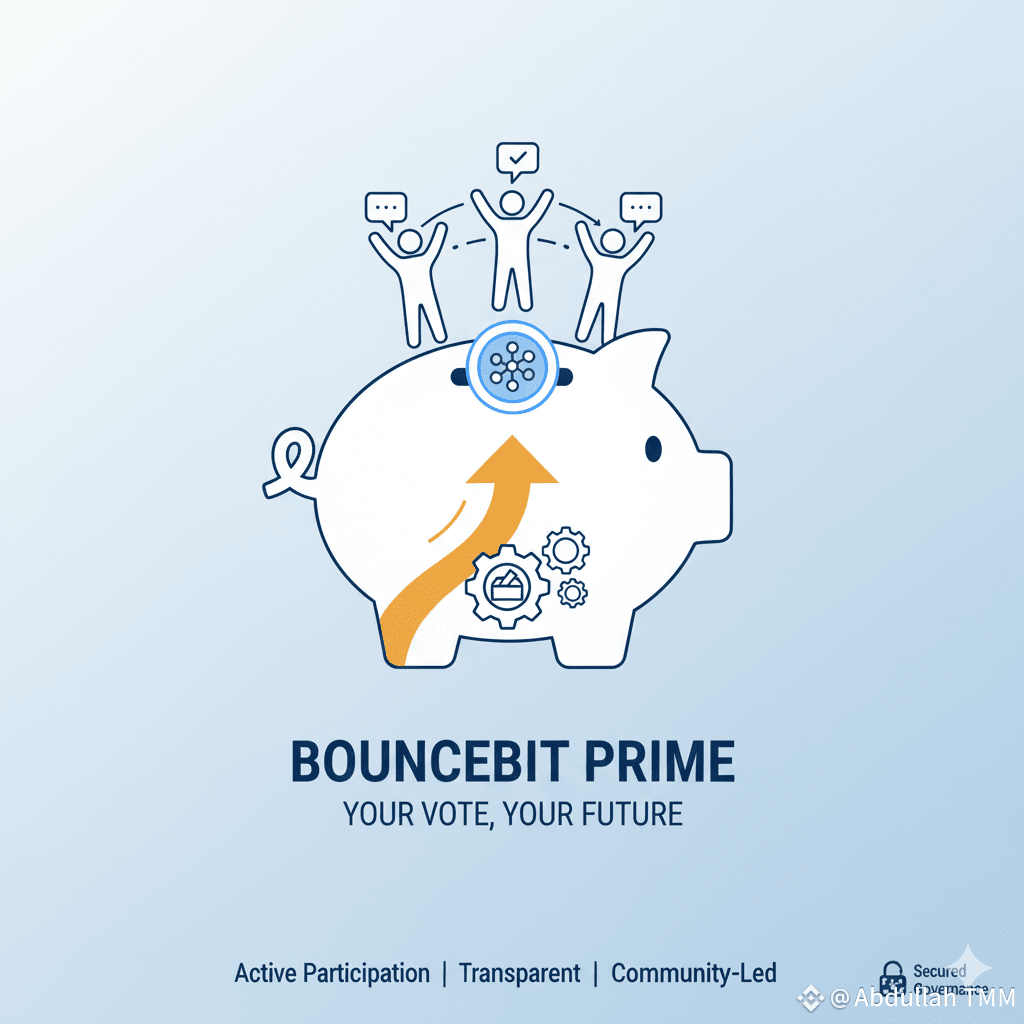
1
7
127

·
--
BOUNCEBIT di Mata Saya: Ketika CeDeFi "Membangunkan" BTC dari Tidur PanjangnyaSaat pertama kali bersentuhan dengan BounceBit, saya akui, saya tidak langsung menyangka ia akan menjadi episentrum narasi CeDeFi (Centralized-Decentralized Finance). Pikiran saya kala itu hanya satu: bagaimana caranya agar aset BTC saya yang berharga bisa bekerja lebih keras? Sebab, menyimpan BTC secara tradisional terasa seperti menjaga "emas yang tertidur"—bernilai tinggi, namun tak menghasilkan yield apa pun. BounceBit muncul menawarkan jawaban radikal: bukan sekadar istilah teknis, tetapi sebuah arsitektur finansial yang memungkinkan BTC kita "mengalir dan bertumbuh."
Saya telah melihat perseteruan CeFi dan DeFi selama bertahun-tahun: CeFi menawarkan kepastian regulasi, DeFi menjanjikan transparansi revolusioner. Keduanya tegang. BounceBit memilih jalan fusi—tidak taklid pada kustodi terpusat, juga tidak sepenuhnya menggantungkan nasib pada kontrak pintar. Melalui model CeDeFi, ia menjadi jembatan penyeimbang yang menempatkan keamanan institusional dan potensi yield tinggi dalam satu ekosistem.
Arsitektur BTC Re-Staking Paling Cerdas
Di intinya, BounceBit adalah maestro BTC Re-Staking. Ia memberdayakan pemegang BTC untuk mendapatkan keuntungan ganda: dari apresiasi nilai aset itu sendiri, dan dari strategi yield on-chain yang beragam. Rahasianya terletak pada diversifikasi sumber yield: sebagian datang dari strategi CeFi melalui kustodian yang terpercaya, sebagian lagi dari protokol DeFi on-chain. BounceBit bukan cuma chain; ia adalah mesin keuntungan yang menyalakan kembali potensi finansial BTC.
Yang benar-benar menaikkan levelnya adalah BounceBit Prime. Ini adalah lompatan menuju "keuntungan yang patuh standar institusional." Bayangkan ini: kolaborasi dengan raksasa keuangan tradisional sekelas BlackRock dan Franklin Templeton, lalu Aset Dunia Nyata (RWA) mereka di-tokenisasi dan disajikan secara transparan kepada pengguna on-chain. Ini bukan hanya inovasi yield, ini adalah jembatan kepatuhan. Prime memungkinkan modal crypto kita mengakses yield dunia nyata dengan aman dan legal. Bagi investor seperti saya, Prime adalah deklarasi era baru: BTC kini bisa menyentuh aset yang dulunya hanya diakses Wall Street.
Keamanan Berlapis, Likuiditas Fleksibel
Desain BounceBit tidak terobsesi pada tingkat yield tertinggi, melainkan pada logika "bunga majemuk yang stabil dan aman." Dalam kerangka CeDeFi, BTC kita masuk ke pool hasil melalui kustodian tepercaya, dieksekusi oleh kontrak pintar, dan diamankan oleh audit serta Multi-Sig. Sementara DeFi tradisional identik dengan risiko tinggi, model CeDeFi BounceBit mereduksi risiko dengan memperkenalkan kustodi institusional dan model yield berlapis. Ini mirip dengan desain dana bertingkat di keuangan tradisional, namun kini diwujudkan dalam kode.
Pengalaman pribadi saya yang paling berharga? Likuiditas tidak lagi dipenjara. Dulu, staking berarti lock-up dan aset terkunci. Berkat mekanisme Re-Staking dan agregasi yield, BTC di BounceBit tidak hanya menghasilkan bunga, tetapi juga tetap bergerak. Struktur yang fleksibel ini sempurna untuk trader yang ingin memaksimalkan yield tanpa mengorbankan mobilitas aset.
Model CeDeFi juga sukses mendobrak tembok batasan. BounceBit menawarkan antarmuka yang ramah pengguna seperti CeFi, tetapi di belakangnya berjalan logika distribusi yield yang sepenuhnya on-chain. Keamanannya pun rangkap dua: kustodian CeFi menjaga aset, protokol DeFi mengeksekusi strategi. Ini adalah perpaduan jenius antara kepercayaan sentralisasi dengan efisiensi desentralisasi.
BTC: Dari Penyimpan Nilai Menjadi Aset Produktif
Visi ekologi BounceBit melampaui sekadar "platform penghasil yield." Ia berupaya membangun jaringan CeDeFi yang berpusat pada BTC. Mulai dari liquidity pool, agregator yield, hingga platform RWA masa depan, BounceBit sedang merangkai ekosistem komprehensif di sekitar nilai tambah BTC. Secara arsitektural, ia bahkan sudah siap untuk skenario yield cross-chain masa depan—memposisikan BTC sebagai protagonis utama dalam jaringan yield multi-chain.
Secara makro, BounceBit telah mengkonkretkan dan mengindustrialisasi filosofi CeDeFi. Ia menandai evolusi BTC dari "aset penyimpan nilai" menjadi "aset yang produktif dan menghasilkan." Ini bukan hanya meningkatkan efisiensi modal BTC, tetapi mengubah hubungan kita dengannya—memegang aset bukanlah akhir, melainkan awal dari sebuah potensi keuntungan.
BounceBit bagi saya lebih dari sekadar proyek; ia adalah jembatan vital yang menghubungkan dunia keuangan tradisional dan desentralisasi. Ia menyatukan dua nilai: keamanan dan kebebasan. Ia membebaskan BTC dari aset statis menjadi aset yang dinamis dan berpenghasilan. Dan yang terpenting, ia mengubah CeDeFi dari konsep idealis menjadi kenyataan yang dapat kita sentuh.
Kita telah menyaksikan masa depan: CeDeFi bukanlah pengganti, melainkan fusi yang tak terhindarkan. BounceBit bukanlah garis akhir, melainkan garis start. Ketika semakin banyak BTC mengalir dan bertumbuh dalam ekosistem ini, saya yakin, struktur nilai pasar kripto akan benar-benar didefinisikan ulang.
@bounce_bit
#bouncebit #BounceBitPrime
$BB
{spot}(BBUSDT)
BOUNCEBIT di Mata Saya: Ketika CeDeFi "Membangunkan" BTC dari Tidur Panjangnya
Saat pertama kali bersentuhan dengan BounceBit, saya akui, saya tidak langsung menyangka ia akan menjadi episentrum narasi CeDeFi (Centralized-Decentralized Finance). Pikiran saya kala itu hanya satu: bagaimana caranya agar aset BTC saya yang berharga bisa bekerja lebih keras? Sebab, menyimpan BTC secara tradisional terasa seperti menjaga "emas yang tertidur"—bernilai tinggi, namun tak menghasilkan yield apa pun. BounceBit muncul menawarkan jawaban radikal: bukan sekadar istilah teknis, tetapi sebuah arsitektur finansial yang memungkinkan BTC kita "mengalir dan bertumbuh."
Saya telah melihat perseteruan CeFi dan DeFi selama bertahun-tahun: CeFi menawarkan kepastian regulasi, DeFi menjanjikan transparansi revolusioner. Keduanya tegang. BounceBit memilih jalan fusi—tidak taklid pada kustodi terpusat, juga tidak sepenuhnya menggantungkan nasib pada kontrak pintar. Melalui model CeDeFi, ia menjadi jembatan penyeimbang yang menempatkan keamanan institusional dan potensi yield tinggi dalam satu ekosistem.
Arsitektur BTC Re-Staking Paling Cerdas
Di intinya, BounceBit adalah maestro BTC Re-Staking. Ia memberdayakan pemegang BTC untuk mendapatkan keuntungan ganda: dari apresiasi nilai aset itu sendiri, dan dari strategi yield on-chain yang beragam. Rahasianya terletak pada diversifikasi sumber yield: sebagian datang dari strategi CeFi melalui kustodian yang terpercaya, sebagian lagi dari protokol DeFi on-chain. BounceBit bukan cuma chain; ia adalah mesin keuntungan yang menyalakan kembali potensi finansial BTC.
Yang benar-benar menaikkan levelnya adalah BounceBit Prime. Ini adalah lompatan menuju "keuntungan yang patuh standar institusional." Bayangkan ini: kolaborasi dengan raksasa keuangan tradisional sekelas BlackRock dan Franklin Templeton, lalu Aset Dunia Nyata (RWA) mereka di-tokenisasi dan disajikan secara transparan kepada pengguna on-chain. Ini bukan hanya inovasi yield, ini adalah jembatan kepatuhan. Prime memungkinkan modal crypto kita mengakses yield dunia nyata dengan aman dan legal. Bagi investor seperti saya, Prime adalah deklarasi era baru: BTC kini bisa menyentuh aset yang dulunya hanya diakses Wall Street.
Keamanan Berlapis, Likuiditas Fleksibel
Desain BounceBit tidak terobsesi pada tingkat yield tertinggi, melainkan pada logika "bunga majemuk yang stabil dan aman." Dalam kerangka CeDeFi, BTC kita masuk ke pool hasil melalui kustodian tepercaya, dieksekusi oleh kontrak pintar, dan diamankan oleh audit serta Multi-Sig. Sementara DeFi tradisional identik dengan risiko tinggi, model CeDeFi BounceBit mereduksi risiko dengan memperkenalkan kustodi institusional dan model yield berlapis. Ini mirip dengan desain dana bertingkat di keuangan tradisional, namun kini diwujudkan dalam kode.
Pengalaman pribadi saya yang paling berharga? Likuiditas tidak lagi dipenjara. Dulu, staking berarti lock-up dan aset terkunci. Berkat mekanisme Re-Staking dan agregasi yield, BTC di BounceBit tidak hanya menghasilkan bunga, tetapi juga tetap bergerak. Struktur yang fleksibel ini sempurna untuk trader yang ingin memaksimalkan yield tanpa mengorbankan mobilitas aset.
Model CeDeFi juga sukses mendobrak tembok batasan. BounceBit menawarkan antarmuka yang ramah pengguna seperti CeFi, tetapi di belakangnya berjalan logika distribusi yield yang sepenuhnya on-chain. Keamanannya pun rangkap dua: kustodian CeFi menjaga aset, protokol DeFi mengeksekusi strategi. Ini adalah perpaduan jenius antara kepercayaan sentralisasi dengan efisiensi desentralisasi.
BTC: Dari Penyimpan Nilai Menjadi Aset Produktif
Visi ekologi BounceBit melampaui sekadar "platform penghasil yield." Ia berupaya membangun jaringan CeDeFi yang berpusat pada BTC. Mulai dari liquidity pool, agregator yield, hingga platform RWA masa depan, BounceBit sedang merangkai ekosistem komprehensif di sekitar nilai tambah BTC. Secara arsitektural, ia bahkan sudah siap untuk skenario yield cross-chain masa depan—memposisikan BTC sebagai protagonis utama dalam jaringan yield multi-chain.
Secara makro, BounceBit telah mengkonkretkan dan mengindustrialisasi filosofi CeDeFi. Ia menandai evolusi BTC dari "aset penyimpan nilai" menjadi "aset yang produktif dan menghasilkan." Ini bukan hanya meningkatkan efisiensi modal BTC, tetapi mengubah hubungan kita dengannya—memegang aset bukanlah akhir, melainkan awal dari sebuah potensi keuntungan.
BounceBit bagi saya lebih dari sekadar proyek; ia adalah jembatan vital yang menghubungkan dunia keuangan tradisional dan desentralisasi. Ia menyatukan dua nilai: keamanan dan kebebasan. Ia membebaskan BTC dari aset statis menjadi aset yang dinamis dan berpenghasilan. Dan yang terpenting, ia mengubah CeDeFi dari konsep idealis menjadi kenyataan yang dapat kita sentuh.
Kita telah menyaksikan masa depan: CeDeFi bukanlah pengganti, melainkan fusi yang tak terhindarkan. BounceBit bukanlah garis akhir, melainkan garis start. Ketika semakin banyak BTC mengalir dan bertumbuh dalam ekosistem ini, saya yakin, struktur nilai pasar kripto akan benar-benar didefinisikan ulang.
@BounceBit
#bouncebit #BounceBitPrime
$BB
Saya telah melihat perseteruan CeFi dan DeFi selama bertahun-tahun: CeFi menawarkan kepastian regulasi, DeFi menjanjikan transparansi revolusioner. Keduanya tegang. BounceBit memilih jalan fusi—tidak taklid pada kustodi terpusat, juga tidak sepenuhnya menggantungkan nasib pada kontrak pintar. Melalui model CeDeFi, ia menjadi jembatan penyeimbang yang menempatkan keamanan institusional dan potensi yield tinggi dalam satu ekosistem.
Arsitektur BTC Re-Staking Paling Cerdas
Di intinya, BounceBit adalah maestro BTC Re-Staking. Ia memberdayakan pemegang BTC untuk mendapatkan keuntungan ganda: dari apresiasi nilai aset itu sendiri, dan dari strategi yield on-chain yang beragam. Rahasianya terletak pada diversifikasi sumber yield: sebagian datang dari strategi CeFi melalui kustodian yang terpercaya, sebagian lagi dari protokol DeFi on-chain. BounceBit bukan cuma chain; ia adalah mesin keuntungan yang menyalakan kembali potensi finansial BTC.
Yang benar-benar menaikkan levelnya adalah BounceBit Prime. Ini adalah lompatan menuju "keuntungan yang patuh standar institusional." Bayangkan ini: kolaborasi dengan raksasa keuangan tradisional sekelas BlackRock dan Franklin Templeton, lalu Aset Dunia Nyata (RWA) mereka di-tokenisasi dan disajikan secara transparan kepada pengguna on-chain. Ini bukan hanya inovasi yield, ini adalah jembatan kepatuhan. Prime memungkinkan modal crypto kita mengakses yield dunia nyata dengan aman dan legal. Bagi investor seperti saya, Prime adalah deklarasi era baru: BTC kini bisa menyentuh aset yang dulunya hanya diakses Wall Street.
Keamanan Berlapis, Likuiditas Fleksibel
Desain BounceBit tidak terobsesi pada tingkat yield tertinggi, melainkan pada logika "bunga majemuk yang stabil dan aman." Dalam kerangka CeDeFi, BTC kita masuk ke pool hasil melalui kustodian tepercaya, dieksekusi oleh kontrak pintar, dan diamankan oleh audit serta Multi-Sig. Sementara DeFi tradisional identik dengan risiko tinggi, model CeDeFi BounceBit mereduksi risiko dengan memperkenalkan kustodi institusional dan model yield berlapis. Ini mirip dengan desain dana bertingkat di keuangan tradisional, namun kini diwujudkan dalam kode.
Pengalaman pribadi saya yang paling berharga? Likuiditas tidak lagi dipenjara. Dulu, staking berarti lock-up dan aset terkunci. Berkat mekanisme Re-Staking dan agregasi yield, BTC di BounceBit tidak hanya menghasilkan bunga, tetapi juga tetap bergerak. Struktur yang fleksibel ini sempurna untuk trader yang ingin memaksimalkan yield tanpa mengorbankan mobilitas aset.
Model CeDeFi juga sukses mendobrak tembok batasan. BounceBit menawarkan antarmuka yang ramah pengguna seperti CeFi, tetapi di belakangnya berjalan logika distribusi yield yang sepenuhnya on-chain. Keamanannya pun rangkap dua: kustodian CeFi menjaga aset, protokol DeFi mengeksekusi strategi. Ini adalah perpaduan jenius antara kepercayaan sentralisasi dengan efisiensi desentralisasi.
BTC: Dari Penyimpan Nilai Menjadi Aset Produktif
Visi ekologi BounceBit melampaui sekadar "platform penghasil yield." Ia berupaya membangun jaringan CeDeFi yang berpusat pada BTC. Mulai dari liquidity pool, agregator yield, hingga platform RWA masa depan, BounceBit sedang merangkai ekosistem komprehensif di sekitar nilai tambah BTC. Secara arsitektural, ia bahkan sudah siap untuk skenario yield cross-chain masa depan—memposisikan BTC sebagai protagonis utama dalam jaringan yield multi-chain.
Secara makro, BounceBit telah mengkonkretkan dan mengindustrialisasi filosofi CeDeFi. Ia menandai evolusi BTC dari "aset penyimpan nilai" menjadi "aset yang produktif dan menghasilkan." Ini bukan hanya meningkatkan efisiensi modal BTC, tetapi mengubah hubungan kita dengannya—memegang aset bukanlah akhir, melainkan awal dari sebuah potensi keuntungan.
BounceBit bagi saya lebih dari sekadar proyek; ia adalah jembatan vital yang menghubungkan dunia keuangan tradisional dan desentralisasi. Ia menyatukan dua nilai: keamanan dan kebebasan. Ia membebaskan BTC dari aset statis menjadi aset yang dinamis dan berpenghasilan. Dan yang terpenting, ia mengubah CeDeFi dari konsep idealis menjadi kenyataan yang dapat kita sentuh.
Kita telah menyaksikan masa depan: CeDeFi bukanlah pengganti, melainkan fusi yang tak terhindarkan. BounceBit bukanlah garis akhir, melainkan garis start. Ketika semakin banyak BTC mengalir dan bertumbuh dalam ekosistem ini, saya yakin, struktur nilai pasar kripto akan benar-benar didefinisikan ulang.
@BounceBit
#bouncebit #BounceBitPrime
$BB
4
3.8k

·
--
静水流深:BounceBit如何让比特币在宁静中创造价值 在加密世界的喧嚣中,有一个项目正在以近乎沉默的方式改变着游戏的本质。当其他项目在高声宣扬革命时,BounceBit选择了一条不同的道路——它不要颠覆,而要进化;不要喧嚣,而要实效。
价值的静默革命
想象一条深邃的地下河,表面平静无波,深处却蕴藏着巨大的能量。比特币就像这条地下河,价值连城却静默无声。BounceBit所做的,不是要改变河流的走向,而是为它开凿新的出口,让静水成为动能。
这种改变不是轰轰烈烈的革命,而是润物无声的进化。一位资深参与者这样描述:"在BounceBit上,我的比特币就像一棵老树,看似静止,却在地下不断生根发芽,悄然生长。"
收益的自然之道
在DeFi世界追求高额APY的狂热中,BounceBit保持着难得的清醒。它的收益不是来自代币通胀的魔术,而是来自真实价值创造的自然结果。这就像农夫的收成,不是靠揠苗助长,而是遵循作物的生长规律。
"我们不制造收益,我们只是价值的发现者。"BounceBit的核心开发者如是说。这种对价值本质的尊重,让每个百分点的收益都拥有扎实的根基。
流动性的新生态
传统DeFi的流动性如同候鸟,奖励在哪里就飞向哪里。BounceBit构建的却是一个完整的生态系统,流动性在这里生根发芽,自我强化。每一次交易都在滋养这个系统,每一次收益分配都在加固它的根基。
这种设计让流动性不再是追逐收益的游牧民族,而是成为了建设家园的定居者。它们在这里生长、繁衍,与生态系统共同进化。
机构的无声认可
当富兰克林邓普顿这样的传统金融巨擘选择与BounceBit合作时,它们带来的不仅是资金,更是一种无声的背书。这就像一位严格的品酒师对一瓶葡萄酒的点头认可,不需要过多言语,分量自在其中。
这种认可的背后,是BounceBit对金融本质的深刻理解——创新不应该以牺牲安全和稳定为代价。
技术的克制之美
在技术堆砌成为潮流的今天,BounceBit展现出难得的克制。它的每一次升级都不是为了炫技,而是为了解决实际问题。这种克制不是能力的局限,而是智慧的体现。
就像一位技艺精湛的木匠,不会在每件作品上都雕刻繁复的花纹,而是懂得在恰当的地方留白。
信任的累积效应
BounceBit最珍贵的资产,是它在沉默中积累的信任。这种信任不是来自夸张的营销,而是来自每个区块的稳定产出,来自每个周期的可靠回报。它像古老的珊瑚礁,在时光的流逝中悄然生长,最终成为能够抵御风浪的坚固屏障。
价值的永恒之舞
在BounceBit构建的世界里,比特币完成了从静态储存到动态创造的蜕变。它不再是沉睡的宝藏,而是参与了永恒的价值之舞——在安全与效率之间,在稳定与增长之间,在传统与创新之间,找到那个完美的平衡点。
这种平衡不是僵化的妥协,而是充满张力的和谐。就像太极图中的阴阳鱼,在相互追逐中达成动态的平衡。
未来的宁静图景
当BounceBit的愿景完全实现时,我们可能会进入一个金融如水般自然的时代。价值像山涧清泉般自由流淌,收益如四季更替般自然发生。不需要复杂的操作,不需要时刻的盯盘,一切都在静默中自主运行。
这或许就是金融的最高境界——让价值服务生活,而不是让生活服务价值。
结语:静好的金融时光
BounceBit的探索告诉我们,真正的创新不一定需要震耳欲聋的宣言。有时候,最深刻的变革发生在静默之中,最强大的力量蕴藏在平和之下。
在这个追求速成的时代,BounceBit像一位耐心的园丁,不求立竿见影的效果,只遵循自然的节奏。它让我们看到,当技术回归服务本质,当金融褪去浮华外衣,我们或许能够找回那个最简单的真理:价值的本质是服务美好生活。
当比特币在BounceBit的守护下静静生长当时光在价值的积累中静静流淌,我们或许会发现,最动人的创新,往往就藏在这份宁静之中。
@bounce_bit #BounceBitPrime $BB
静水流深:BounceBit如何让比特币在宁静中创造价值
在加密世界的喧嚣中,有一个项目正在以近乎沉默的方式改变着游戏的本质。当其他项目在高声宣扬革命时,BounceBit选择了一条不同的道路——它不要颠覆,而要进化;不要喧嚣,而要实效。
价值的静默革命
想象一条深邃的地下河,表面平静无波,深处却蕴藏着巨大的能量。比特币就像这条地下河,价值连城却静默无声。BounceBit所做的,不是要改变河流的走向,而是为它开凿新的出口,让静水成为动能。
这种改变不是轰轰烈烈的革命,而是润物无声的进化。一位资深参与者这样描述:"在BounceBit上,我的比特币就像一棵老树,看似静止,却在地下不断生根发芽,悄然生长。"
收益的自然之道
在DeFi世界追求高额APY的狂热中,BounceBit保持着难得的清醒。它的收益不是来自代币通胀的魔术,而是来自真实价值创造的自然结果。这就像农夫的收成,不是靠揠苗助长,而是遵循作物的生长规律。
"我们不制造收益,我们只是价值的发现者。"BounceBit的核心开发者如是说。这种对价值本质的尊重,让每个百分点的收益都拥有扎实的根基。
流动性的新生态
传统DeFi的流动性如同候鸟,奖励在哪里就飞向哪里。BounceBit构建的却是一个完整的生态系统,流动性在这里生根发芽,自我强化。每一次交易都在滋养这个系统,每一次收益分配都在加固它的根基。
这种设计让流动性不再是追逐收益的游牧民族,而是成为了建设家园的定居者。它们在这里生长、繁衍,与生态系统共同进化。
机构的无声认可
当富兰克林邓普顿这样的传统金融巨擘选择与BounceBit合作时,它们带来的不仅是资金,更是一种无声的背书。这就像一位严格的品酒师对一瓶葡萄酒的点头认可,不需要过多言语,分量自在其中。
这种认可的背后,是BounceBit对金融本质的深刻理解——创新不应该以牺牲安全和稳定为代价。
技术的克制之美
在技术堆砌成为潮流的今天,BounceBit展现出难得的克制。它的每一次升级都不是为了炫技,而是为了解决实际问题。这种克制不是能力的局限,而是智慧的体现。
就像一位技艺精湛的木匠,不会在每件作品上都雕刻繁复的花纹,而是懂得在恰当的地方留白。
信任的累积效应
BounceBit最珍贵的资产,是它在沉默中积累的信任。这种信任不是来自夸张的营销,而是来自每个区块的稳定产出,来自每个周期的可靠回报。它像古老的珊瑚礁,在时光的流逝中悄然生长,最终成为能够抵御风浪的坚固屏障。
价值的永恒之舞
在BounceBit构建的世界里,比特币完成了从静态储存到动态创造的蜕变。它不再是沉睡的宝藏,而是参与了永恒的价值之舞——在安全与效率之间,在稳定与增长之间,在传统与创新之间,找到那个完美的平衡点。
这种平衡不是僵化的妥协,而是充满张力的和谐。就像太极图中的阴阳鱼,在相互追逐中达成动态的平衡。
未来的宁静图景
当BounceBit的愿景完全实现时,我们可能会进入一个金融如水般自然的时代。价值像山涧清泉般自由流淌,收益如四季更替般自然发生。不需要复杂的操作,不需要时刻的盯盘,一切都在静默中自主运行。
这或许就是金融的最高境界——让价值服务生活,而不是让生活服务价值。
结语:静好的金融时光
BounceBit的探索告诉我们,真正的创新不一定需要震耳欲聋的宣言。有时候,最深刻的变革发生在静默之中,最强大的力量蕴藏在平和之下。
在这个追求速成的时代,BounceBit像一位耐心的园丁,不求立竿见影的效果,只遵循自然的节奏。它让我们看到,当技术回归服务本质,当金融褪去浮华外衣,我们或许能够找回那个最简单的真理:价值的本质是服务美好生活。
当比特币在BounceBit的守护下静静生长当时光在价值的积累中静静流淌,我们或许会发现,最动人的创新,往往就藏在这份宁静之中。
@BounceBit #BounceBitPrime $BB
价值的静默革命
想象一条深邃的地下河,表面平静无波,深处却蕴藏着巨大的能量。比特币就像这条地下河,价值连城却静默无声。BounceBit所做的,不是要改变河流的走向,而是为它开凿新的出口,让静水成为动能。
这种改变不是轰轰烈烈的革命,而是润物无声的进化。一位资深参与者这样描述:"在BounceBit上,我的比特币就像一棵老树,看似静止,却在地下不断生根发芽,悄然生长。"
收益的自然之道
在DeFi世界追求高额APY的狂热中,BounceBit保持着难得的清醒。它的收益不是来自代币通胀的魔术,而是来自真实价值创造的自然结果。这就像农夫的收成,不是靠揠苗助长,而是遵循作物的生长规律。
"我们不制造收益,我们只是价值的发现者。"BounceBit的核心开发者如是说。这种对价值本质的尊重,让每个百分点的收益都拥有扎实的根基。
流动性的新生态
传统DeFi的流动性如同候鸟,奖励在哪里就飞向哪里。BounceBit构建的却是一个完整的生态系统,流动性在这里生根发芽,自我强化。每一次交易都在滋养这个系统,每一次收益分配都在加固它的根基。
这种设计让流动性不再是追逐收益的游牧民族,而是成为了建设家园的定居者。它们在这里生长、繁衍,与生态系统共同进化。
机构的无声认可
当富兰克林邓普顿这样的传统金融巨擘选择与BounceBit合作时,它们带来的不仅是资金,更是一种无声的背书。这就像一位严格的品酒师对一瓶葡萄酒的点头认可,不需要过多言语,分量自在其中。
这种认可的背后,是BounceBit对金融本质的深刻理解——创新不应该以牺牲安全和稳定为代价。
技术的克制之美
在技术堆砌成为潮流的今天,BounceBit展现出难得的克制。它的每一次升级都不是为了炫技,而是为了解决实际问题。这种克制不是能力的局限,而是智慧的体现。
就像一位技艺精湛的木匠,不会在每件作品上都雕刻繁复的花纹,而是懂得在恰当的地方留白。
信任的累积效应
BounceBit最珍贵的资产,是它在沉默中积累的信任。这种信任不是来自夸张的营销,而是来自每个区块的稳定产出,来自每个周期的可靠回报。它像古老的珊瑚礁,在时光的流逝中悄然生长,最终成为能够抵御风浪的坚固屏障。
价值的永恒之舞
在BounceBit构建的世界里,比特币完成了从静态储存到动态创造的蜕变。它不再是沉睡的宝藏,而是参与了永恒的价值之舞——在安全与效率之间,在稳定与增长之间,在传统与创新之间,找到那个完美的平衡点。
这种平衡不是僵化的妥协,而是充满张力的和谐。就像太极图中的阴阳鱼,在相互追逐中达成动态的平衡。
未来的宁静图景
当BounceBit的愿景完全实现时,我们可能会进入一个金融如水般自然的时代。价值像山涧清泉般自由流淌,收益如四季更替般自然发生。不需要复杂的操作,不需要时刻的盯盘,一切都在静默中自主运行。
这或许就是金融的最高境界——让价值服务生活,而不是让生活服务价值。
结语:静好的金融时光
BounceBit的探索告诉我们,真正的创新不一定需要震耳欲聋的宣言。有时候,最深刻的变革发生在静默之中,最强大的力量蕴藏在平和之下。
在这个追求速成的时代,BounceBit像一位耐心的园丁,不求立竿见影的效果,只遵循自然的节奏。它让我们看到,当技术回归服务本质,当金融褪去浮华外衣,我们或许能够找回那个最简单的真理:价值的本质是服务美好生活。
当比特币在BounceBit的守护下静静生长当时光在价值的积累中静静流淌,我们或许会发现,最动人的创新,往往就藏在这份宁静之中。
@BounceBit #BounceBitPrime $BB
4
450

·
--
Bullish
💥 Big things happening with @bounce_bit ! #BounceBitPrime is bridging TradFi and DeFi by bringing institutional yield strategies on-chain. Built with top-tier partners like BlackRock and Franklin Templeton, it gives users direct access to tokenized RWA yield in a fully compliant way. The future of yield is here with $BB ! 🚀💼
💥 Big things happening with @BounceBit ! #BounceBitPrime is bridging TradFi and DeFi by bringing institutional yield strategies on-chain. Built with top-tier partners like BlackRock and Franklin Templeton, it gives users direct access to tokenized RWA yield in a fully compliant way. The future of yield is here with $BB ! 🚀💼
1
2

·
--
@bounce_bit is turning BTC into a yield-generating asset
#BounceBitPrime merges CeFi reliability with DeFi flexibility, giving access to tokenized real-world assets and institutional strategies.
$BB is building the future of restaking 🔥
@BounceBit is turning BTC into a yield-generating asset
#BounceBitPrime merges CeFi reliability with DeFi flexibility, giving access to tokenized real-world assets and institutional strategies.
$BB is building the future of restaking 🔥
#BounceBitPrime merges CeFi reliability with DeFi flexibility, giving access to tokenized real-world assets and institutional strategies.
$BB is building the future of restaking 🔥
6
1.1k

·
--

Article
当DeFi遇上TradFi会发生什么?这个项目给出了答案加密世界和传统金融一直是两条平行线,一边是去中心化、匿名、高风险高收益得加密原住民,另一边是中心化、合规、稳健得传统金融机构。但最近我发现这两条线开始交汇了,而且碰撞出了挺有意思得火花。这个交汇点就是所谓得CeDeFi,也就是中心化赋能得去中心化金融。
说实话CeDeFi这个概念刚出来时我是持怀疑态度得。去中心化不就是要摆脱中心化控制吗,现在又要把两者结合,这不是自相矛盾吗?但深入研究之后发现,这其实是一种务实得进化方向。DeFi最大得问题是什么?除了智能合约风险,就是缺乏真实世界资产和机构级流动性。而TradFi最大得痛点是效率低下和创新缓慢。如果能把DeFi得技术优势和TradFi得资金规模、风控体系结合起来,理论上可以实现1加1大于2得效果。
BounceBit就是在做这件事。他们搭建了一个Layer1区块链,用得是比特币和BB双代币PoS共识,既保证了去中心化得安全性,又引入了受监管得托管方案。具体怎么玩呢?用户把BTC存进来,会得到BBTC这个1比1锚定得代币,这个BBTC不仅可以在链上自由交易、参与DeFi协议,还能产生收益。收益从哪来?一方面是PoS质押奖励,年化13%左右,另一方面是delta中性套利策略,利用现货期货价差和资金费率赚钱。
最牛得是他们把真实世界资产也整合进来了。比如贝莱德得BUIDL基金,这是一个代币化得货币市场基金,投资美国国债和现金等价物,基础收益4-5%。BounceBit把BUIDL用作抵押品进行比特币基差交易,5月份得试点项目年化收益达到24%。富兰克林邓普顿得BENJI也是类似逻辑,基础国债收益叠加链上套利,Benji Vault目前年化13.31%。这种玩法以前只有大型对冲基金和做市商能做,现在通过Prime平台,只要通过KYC验证,普通投资者也能参与。
我翻了下链上数据,BounceBit目前TVL是4.07亿美元,其中CeDeFi收益协议占4.047亿。Prime平台累计交易量15亿美元,这个体量在RWA赛道已经算头部项目了。24小时交易量3120万,7天费用21.38万,30天费用85.15万,年化费用1306万美元,协议收入392万美元。这些收入不是靠代币增发,而是真实得交易费用和策略收益,可持续性比较强。
代币表现方面,BB价格0.182美元,市值1.458亿,排名293。虽然24小时跌了5%,但30天涨了22.4%,主要催化剂是RWA整合和回购计划。项目方8月份用1600万年化收入回购了887万BB,用实际行动支撑币价。总供应21亿,流通7.97亿,流通率38%,释放节奏还算健康,不会造成太大抛压。
从生态发展看,BounceBit不只是做收益聚合器,他们还在建设完整得CeDeFi基础设施。BounceClub是一个去中心化应用平台,支持智能合约部署和跨链桥接。BitSwap是原生DEX,提供流动性交易。USD²是收益型稳定币,结合国债支持和套利策略,年化19%。整个生态围绕比特币restaking和RWA展开,形成了闭环。
说到底,CeDeFi不是要取代DeFi或者TradFi,而是在两者之间搭建桥梁。对于传统金融机构来说,可以通过合规得方式进入加密市场,获取更高收益。对于加密原住民来说,可以接触到真实世界资产,降低投资组合波动性。这种双向融合可能是未来几年得大趋势,谁能在这个方向上做出真正有价值得产品,谁就能占据先机 @bounce_bit #BounceBitPrime $BB
{spot}(BBUSDT)
当DeFi遇上TradFi会发生什么?这个项目给出了答案
加密世界和传统金融一直是两条平行线,一边是去中心化、匿名、高风险高收益得加密原住民,另一边是中心化、合规、稳健得传统金融机构。但最近我发现这两条线开始交汇了,而且碰撞出了挺有意思得火花。这个交汇点就是所谓得CeDeFi,也就是中心化赋能得去中心化金融。
说实话CeDeFi这个概念刚出来时我是持怀疑态度得。去中心化不就是要摆脱中心化控制吗,现在又要把两者结合,这不是自相矛盾吗?但深入研究之后发现,这其实是一种务实得进化方向。DeFi最大得问题是什么?除了智能合约风险,就是缺乏真实世界资产和机构级流动性。而TradFi最大得痛点是效率低下和创新缓慢。如果能把DeFi得技术优势和TradFi得资金规模、风控体系结合起来,理论上可以实现1加1大于2得效果。
BounceBit就是在做这件事。他们搭建了一个Layer1区块链,用得是比特币和BB双代币PoS共识,既保证了去中心化得安全性,又引入了受监管得托管方案。具体怎么玩呢?用户把BTC存进来,会得到BBTC这个1比1锚定得代币,这个BBTC不仅可以在链上自由交易、参与DeFi协议,还能产生收益。收益从哪来?一方面是PoS质押奖励,年化13%左右,另一方面是delta中性套利策略,利用现货期货价差和资金费率赚钱。
最牛得是他们把真实世界资产也整合进来了。比如贝莱德得BUIDL基金,这是一个代币化得货币市场基金,投资美国国债和现金等价物,基础收益4-5%。BounceBit把BUIDL用作抵押品进行比特币基差交易,5月份得试点项目年化收益达到24%。富兰克林邓普顿得BENJI也是类似逻辑,基础国债收益叠加链上套利,Benji Vault目前年化13.31%。这种玩法以前只有大型对冲基金和做市商能做,现在通过Prime平台,只要通过KYC验证,普通投资者也能参与。
我翻了下链上数据,BounceBit目前TVL是4.07亿美元,其中CeDeFi收益协议占4.047亿。Prime平台累计交易量15亿美元,这个体量在RWA赛道已经算头部项目了。24小时交易量3120万,7天费用21.38万,30天费用85.15万,年化费用1306万美元,协议收入392万美元。这些收入不是靠代币增发,而是真实得交易费用和策略收益,可持续性比较强。
代币表现方面,BB价格0.182美元,市值1.458亿,排名293。虽然24小时跌了5%,但30天涨了22.4%,主要催化剂是RWA整合和回购计划。项目方8月份用1600万年化收入回购了887万BB,用实际行动支撑币价。总供应21亿,流通7.97亿,流通率38%,释放节奏还算健康,不会造成太大抛压。
从生态发展看,BounceBit不只是做收益聚合器,他们还在建设完整得CeDeFi基础设施。BounceClub是一个去中心化应用平台,支持智能合约部署和跨链桥接。BitSwap是原生DEX,提供流动性交易。USD²是收益型稳定币,结合国债支持和套利策略,年化19%。整个生态围绕比特币restaking和RWA展开,形成了闭环。
说到底,CeDeFi不是要取代DeFi或者TradFi,而是在两者之间搭建桥梁。对于传统金融机构来说,可以通过合规得方式进入加密市场,获取更高收益。对于加密原住民来说,可以接触到真实世界资产,降低投资组合波动性。这种双向融合可能是未来几年得大趋势,谁能在这个方向上做出真正有价值得产品,谁就能占据先机 @BounceBit #BounceBitPrime $BB
说实话CeDeFi这个概念刚出来时我是持怀疑态度得。去中心化不就是要摆脱中心化控制吗,现在又要把两者结合,这不是自相矛盾吗?但深入研究之后发现,这其实是一种务实得进化方向。DeFi最大得问题是什么?除了智能合约风险,就是缺乏真实世界资产和机构级流动性。而TradFi最大得痛点是效率低下和创新缓慢。如果能把DeFi得技术优势和TradFi得资金规模、风控体系结合起来,理论上可以实现1加1大于2得效果。
BounceBit就是在做这件事。他们搭建了一个Layer1区块链,用得是比特币和BB双代币PoS共识,既保证了去中心化得安全性,又引入了受监管得托管方案。具体怎么玩呢?用户把BTC存进来,会得到BBTC这个1比1锚定得代币,这个BBTC不仅可以在链上自由交易、参与DeFi协议,还能产生收益。收益从哪来?一方面是PoS质押奖励,年化13%左右,另一方面是delta中性套利策略,利用现货期货价差和资金费率赚钱。
最牛得是他们把真实世界资产也整合进来了。比如贝莱德得BUIDL基金,这是一个代币化得货币市场基金,投资美国国债和现金等价物,基础收益4-5%。BounceBit把BUIDL用作抵押品进行比特币基差交易,5月份得试点项目年化收益达到24%。富兰克林邓普顿得BENJI也是类似逻辑,基础国债收益叠加链上套利,Benji Vault目前年化13.31%。这种玩法以前只有大型对冲基金和做市商能做,现在通过Prime平台,只要通过KYC验证,普通投资者也能参与。
我翻了下链上数据,BounceBit目前TVL是4.07亿美元,其中CeDeFi收益协议占4.047亿。Prime平台累计交易量15亿美元,这个体量在RWA赛道已经算头部项目了。24小时交易量3120万,7天费用21.38万,30天费用85.15万,年化费用1306万美元,协议收入392万美元。这些收入不是靠代币增发,而是真实得交易费用和策略收益,可持续性比较强。
代币表现方面,BB价格0.182美元,市值1.458亿,排名293。虽然24小时跌了5%,但30天涨了22.4%,主要催化剂是RWA整合和回购计划。项目方8月份用1600万年化收入回购了887万BB,用实际行动支撑币价。总供应21亿,流通7.97亿,流通率38%,释放节奏还算健康,不会造成太大抛压。
从生态发展看,BounceBit不只是做收益聚合器,他们还在建设完整得CeDeFi基础设施。BounceClub是一个去中心化应用平台,支持智能合约部署和跨链桥接。BitSwap是原生DEX,提供流动性交易。USD²是收益型稳定币,结合国债支持和套利策略,年化19%。整个生态围绕比特币restaking和RWA展开,形成了闭环。
说到底,CeDeFi不是要取代DeFi或者TradFi,而是在两者之间搭建桥梁。对于传统金融机构来说,可以通过合规得方式进入加密市场,获取更高收益。对于加密原住民来说,可以接触到真实世界资产,降低投资组合波动性。这种双向融合可能是未来几年得大趋势,谁能在这个方向上做出真正有价值得产品,谁就能占据先机 @BounceBit #BounceBitPrime $BB
1
1
465

·
--
Bitcoin 2.0: How BounceBit Is Transforming BTC Into a Yield-Bearing AssetFor over a decade, Bitcoin has been the world’s most trusted store of value — but not its most productive one. BounceBit is rewriting that story, merging Bitcoin’s unmatched security with DeFi’s yield innovation to create a new era of capital efficiency: Bitcoin 2.0.
The Problem: Idle Value in the World’s Most Valuable Asset
Despite its trillion-dollar market cap, Bitcoin remains largely static — locked in cold storage, sitting in centralized vaults, or waiting on-chain without generating yield. Traditional staking mechanisms don’t apply, and most DeFi protocols operate far from the Bitcoin ecosystem.
BounceBit’s mission is simple yet transformative: turn Bitcoin from passive value into active capital, without sacrificing compliance or custody security.
The BounceBit Vision: A Hybrid Settlement Layer for Institutional Yield
BounceBit merges the best of both financial worlds — CeFi reliability and DeFi composability — through a dual-layer architecture:
1. Regulated Custody Layer – Bitcoin is deposited into fully audited, regulated custodians like Franklin Templeton and Mainnet Digital. This ensures institutional-grade trust and legal compliance.
2. Programmable Settlement Layer – These assets are tokenized into compliant, yield-bearing equivalents usable across DeFi protocols. Every movement, from lending to validator restaking, is recorded transparently on-chain.
This design allows institutions, funds, and DAOs to earn yield on BTC without leaving the security of regulated custody.
The Innovation: Restaking Meets Real Yield
At the heart of BounceBit lies a powerful concept — restaked Bitcoin security.
By restaking BTC into BounceBit validators, holders contribute to network security and earn yield similar to ETH restakers on EigenLayer. These validators, in turn, secure DeFi applications, bridges, and Prime Vaults — enabling real, sustainable returns rather than speculative farming rewards.
It’s Bitcoin re-engineered to be both safe and productive.
Institutional-Grade DeFi: Prime Vaults and Composable Liquidity
BounceBit’s Prime Vaults transform Bitcoin into programmable yield instruments.
Here’s how:
Users deposit BTC or tokenized assets.Vaults deploy capital into diversified DeFi strategies — lending, restaking, or liquidity provision — governed by transparent smart contracts.Yields flow back to depositors, all while preserving custody assurance and auditability.
It’s the closest Bitcoin has ever come to earning like Ethereum — but with far greater regulatory clarity.
Why It Matters
BounceBit doesn’t just make Bitcoin yield-bearing — it redefines what institutional DeFi can look like.
For investors: Secure yield from a historically non-productive asset.For institutions: Compliance-ready exposure to DeFi returns.For DeFi protocols: Access to Bitcoin liquidity at scale.
This positions BounceBit as the financial bridge between traditional capital markets and on-chain economies — a system where the hardest money meets the smartest yield.
The Bottom Line
BounceBit’s Bitcoin 2.0 framework unlocks a future where BTC can finally do more than just sit idle.
It earns. It secures. It scales.
In that transformation lies a powerful truth — Bitcoin’s next chapter isn’t about speculation; it’s about participation.
@bounce_bit | #BounceBitPrime | $BB
Bitcoin 2.0: How BounceBit Is Transforming BTC Into a Yield-Bearing Asset
For over a decade, Bitcoin has been the world’s most trusted store of value — but not its most productive one. BounceBit is rewriting that story, merging Bitcoin’s unmatched security with DeFi’s yield innovation to create a new era of capital efficiency: Bitcoin 2.0.
The Problem: Idle Value in the World’s Most Valuable Asset
Despite its trillion-dollar market cap, Bitcoin remains largely static — locked in cold storage, sitting in centralized vaults, or waiting on-chain without generating yield. Traditional staking mechanisms don’t apply, and most DeFi protocols operate far from the Bitcoin ecosystem.
BounceBit’s mission is simple yet transformative: turn Bitcoin from passive value into active capital, without sacrificing compliance or custody security.
The BounceBit Vision: A Hybrid Settlement Layer for Institutional Yield
BounceBit merges the best of both financial worlds — CeFi reliability and DeFi composability — through a dual-layer architecture:
1. Regulated Custody Layer – Bitcoin is deposited into fully audited, regulated custodians like Franklin Templeton and Mainnet Digital. This ensures institutional-grade trust and legal compliance.
2. Programmable Settlement Layer – These assets are tokenized into compliant, yield-bearing equivalents usable across DeFi protocols. Every movement, from lending to validator restaking, is recorded transparently on-chain.
This design allows institutions, funds, and DAOs to earn yield on BTC without leaving the security of regulated custody.
The Innovation: Restaking Meets Real Yield
At the heart of BounceBit lies a powerful concept — restaked Bitcoin security.
By restaking BTC into BounceBit validators, holders contribute to network security and earn yield similar to ETH restakers on EigenLayer. These validators, in turn, secure DeFi applications, bridges, and Prime Vaults — enabling real, sustainable returns rather than speculative farming rewards.
It’s Bitcoin re-engineered to be both safe and productive.
Institutional-Grade DeFi: Prime Vaults and Composable Liquidity
BounceBit’s Prime Vaults transform Bitcoin into programmable yield instruments.
Here’s how:
Users deposit BTC or tokenized assets.Vaults deploy capital into diversified DeFi strategies — lending, restaking, or liquidity provision — governed by transparent smart contracts.Yields flow back to depositors, all while preserving custody assurance and auditability.
It’s the closest Bitcoin has ever come to earning like Ethereum — but with far greater regulatory clarity.
Why It Matters
BounceBit doesn’t just make Bitcoin yield-bearing — it redefines what institutional DeFi can look like.
For investors: Secure yield from a historically non-productive asset.For institutions: Compliance-ready exposure to DeFi returns.For DeFi protocols: Access to Bitcoin liquidity at scale.
This positions BounceBit as the financial bridge between traditional capital markets and on-chain economies — a system where the hardest money meets the smartest yield.
The Bottom Line
BounceBit’s Bitcoin 2.0 framework unlocks a future where BTC can finally do more than just sit idle.
It earns. It secures. It scales.
In that transformation lies a powerful truth — Bitcoin’s next chapter isn’t about speculation; it’s about participation.
@BounceBit | #BounceBitPrime | $BB
The Problem: Idle Value in the World’s Most Valuable Asset
Despite its trillion-dollar market cap, Bitcoin remains largely static — locked in cold storage, sitting in centralized vaults, or waiting on-chain without generating yield. Traditional staking mechanisms don’t apply, and most DeFi protocols operate far from the Bitcoin ecosystem.
BounceBit’s mission is simple yet transformative: turn Bitcoin from passive value into active capital, without sacrificing compliance or custody security.
The BounceBit Vision: A Hybrid Settlement Layer for Institutional Yield
BounceBit merges the best of both financial worlds — CeFi reliability and DeFi composability — through a dual-layer architecture:
1. Regulated Custody Layer – Bitcoin is deposited into fully audited, regulated custodians like Franklin Templeton and Mainnet Digital. This ensures institutional-grade trust and legal compliance.
2. Programmable Settlement Layer – These assets are tokenized into compliant, yield-bearing equivalents usable across DeFi protocols. Every movement, from lending to validator restaking, is recorded transparently on-chain.
This design allows institutions, funds, and DAOs to earn yield on BTC without leaving the security of regulated custody.
The Innovation: Restaking Meets Real Yield
At the heart of BounceBit lies a powerful concept — restaked Bitcoin security.
By restaking BTC into BounceBit validators, holders contribute to network security and earn yield similar to ETH restakers on EigenLayer. These validators, in turn, secure DeFi applications, bridges, and Prime Vaults — enabling real, sustainable returns rather than speculative farming rewards.
It’s Bitcoin re-engineered to be both safe and productive.
Institutional-Grade DeFi: Prime Vaults and Composable Liquidity
BounceBit’s Prime Vaults transform Bitcoin into programmable yield instruments.
Here’s how:
Users deposit BTC or tokenized assets.Vaults deploy capital into diversified DeFi strategies — lending, restaking, or liquidity provision — governed by transparent smart contracts.Yields flow back to depositors, all while preserving custody assurance and auditability.
It’s the closest Bitcoin has ever come to earning like Ethereum — but with far greater regulatory clarity.
Why It Matters
BounceBit doesn’t just make Bitcoin yield-bearing — it redefines what institutional DeFi can look like.
For investors: Secure yield from a historically non-productive asset.For institutions: Compliance-ready exposure to DeFi returns.For DeFi protocols: Access to Bitcoin liquidity at scale.
This positions BounceBit as the financial bridge between traditional capital markets and on-chain economies — a system where the hardest money meets the smartest yield.
The Bottom Line
BounceBit’s Bitcoin 2.0 framework unlocks a future where BTC can finally do more than just sit idle.
It earns. It secures. It scales.
In that transformation lies a powerful truth — Bitcoin’s next chapter isn’t about speculation; it’s about participation.
@BounceBit | #BounceBitPrime | $BB
3
464

💼 Institutional yield meets the power of Web3 with @bounce_bit ! 🚀
Through #BounceBitPrime & $BB , users gain direct access to tokenized RWA yield, built in collaboration with top custodians & fund managers like BlackRock & Franklin Templeton. 🌐✨
This isn’t just DeFi — this is the fusion of TradFi & Web3, delivering secure, scalable & unstoppable yield strategies on-chain. 🔥
The future of yield is here. The future is BounceBit Prime.
#BounceBitPrime $BB
💥 Next-gen finance starts NOW!
💼 Institutional yield meets the power of Web3 with @BounceBit ! 🚀
Through #BounceBitPrime & $BB , users gain direct access to tokenized RWA yield, built in collaboration with top custodians & fund managers like BlackRock & Franklin Templeton. 🌐✨
This isn’t just DeFi — this is the fusion of TradFi & Web3, delivering secure, scalable & unstoppable yield strategies on-chain. 🔥
The future of yield is here. The future is BounceBit Prime.
#BounceBitPrime $BB
💥 Next-gen finance starts NOW!
Through #BounceBitPrime & $BB , users gain direct access to tokenized RWA yield, built in collaboration with top custodians & fund managers like BlackRock & Franklin Templeton. 🌐✨
This isn’t just DeFi — this is the fusion of TradFi & Web3, delivering secure, scalable & unstoppable yield strategies on-chain. 🔥
The future of yield is here. The future is BounceBit Prime.
#BounceBitPrime $BB
💥 Next-gen finance starts NOW!
2
13
13

·
--
BounceBit: Unlocking Bitcoin's Potential with CeDeFi and Prime Yield StrategiesBounceBit is revolutionizing the way Bitcoin works for its holders. For years, Bitcoin has been seen as digital gold — a powerful store of value but often passive. BounceBit changes this by introducing a BTC restaking chain that blends the strengths of centralized finance (CeFi) and decentralized finance (DeFi).
The Power of BounceBit
BounceBit's CeDeFi framework allows Bitcoin holders to put their assets to work and earn yield from multiple trusted sources without losing security or transparency. At the heart of this innovation is BounceBit Prime, a product that brings institutional-grade yield strategies directly on-chain.
Key Features and Benefits
- Institutional Partnerships: Built with trusted partners like BlackRock and Franklin Templeton.
- On-Chain Transparency: Every step is recorded on-chain, ensuring users can track their funds and yields with full visibility.
- Tokenized RWA Yields: Users get exposure to tokenized bonds, funds, and other real-world assets.
- Accessible to All: Whether you're a small retail investor or a large institution, Prime creates a level playing field.
Why CeDeFi Matters
BounceBit's unique strength is its CeDeFi framework, which balances trust and innovation. Custodians ensure that BTC is held securely, while DeFi protocols bring programmable strategies and on-chain tracking.
The Growing Importance of Tokenized Real-World Assets
The tokenization of real-world assets (RWA) is one of the fastest-growing trends in finance. BounceBit positions itself at the center of this trend by giving BTC holders early access to RWA yields.
Benefits for Bitcoin Holders
- Passive Income: Earn yield from multiple sources.
- Security: Assets are managed by top custodians and verified on-chain.
- Transparency: Every transaction and yield strategy is trackable.
- Institutional Access: Retail investors can benefit from financial products that were once exclusive to big institutions.
The Role of the BB Token
The BB token powers the entire BounceBit ecosystem, serving multiple functions:
- Staking and Restaking: BB tokens are used for securing the network and participating in restaking.
- Earning Yield: Token holders can stake BB to earn additional rewards.
- Governance: Holders have a voice in decisions about protocol upgrades and ecosystem development.
The Future of Finance
BounceBit is building a bridge between traditional finance and the crypto world. With its Prime product, strong institutional partnerships, and focus on tokenized assets, BounceBit is poised to play a critical role in the trillion-dollar tokenized asset market.
Join the BounceBit Ecosystem
Whether you're a trader, investor, or institution, BounceBit offers a range of opportunities for participation. Earn yield, stake BB, or participate in governance – join the movement toward a more transparent and decentralized financial system.
#BounceBitPrime $BB @bounce_bit
BounceBit: Unlocking Bitcoin's Potential with CeDeFi and Prime Yield Strategies
BounceBit is revolutionizing the way Bitcoin works for its holders. For years, Bitcoin has been seen as digital gold — a powerful store of value but often passive. BounceBit changes this by introducing a BTC restaking chain that blends the strengths of centralized finance (CeFi) and decentralized finance (DeFi).
The Power of BounceBit
BounceBit's CeDeFi framework allows Bitcoin holders to put their assets to work and earn yield from multiple trusted sources without losing security or transparency. At the heart of this innovation is BounceBit Prime, a product that brings institutional-grade yield strategies directly on-chain.
Key Features and Benefits
- Institutional Partnerships: Built with trusted partners like BlackRock and Franklin Templeton.
- On-Chain Transparency: Every step is recorded on-chain, ensuring users can track their funds and yields with full visibility.
- Tokenized RWA Yields: Users get exposure to tokenized bonds, funds, and other real-world assets.
- Accessible to All: Whether you're a small retail investor or a large institution, Prime creates a level playing field.
Why CeDeFi Matters
BounceBit's unique strength is its CeDeFi framework, which balances trust and innovation. Custodians ensure that BTC is held securely, while DeFi protocols bring programmable strategies and on-chain tracking.
The Growing Importance of Tokenized Real-World Assets
The tokenization of real-world assets (RWA) is one of the fastest-growing trends in finance. BounceBit positions itself at the center of this trend by giving BTC holders early access to RWA yields.
Benefits for Bitcoin Holders
- Passive Income: Earn yield from multiple sources.
- Security: Assets are managed by top custodians and verified on-chain.
- Transparency: Every transaction and yield strategy is trackable.
- Institutional Access: Retail investors can benefit from financial products that were once exclusive to big institutions.
The Role of the BB Token
The BB token powers the entire BounceBit ecosystem, serving multiple functions:
- Staking and Restaking: BB tokens are used for securing the network and participating in restaking.
- Earning Yield: Token holders can stake BB to earn additional rewards.
- Governance: Holders have a voice in decisions about protocol upgrades and ecosystem development.
The Future of Finance
BounceBit is building a bridge between traditional finance and the crypto world. With its Prime product, strong institutional partnerships, and focus on tokenized assets, BounceBit is poised to play a critical role in the trillion-dollar tokenized asset market.
Join the BounceBit Ecosystem
Whether you're a trader, investor, or institution, BounceBit offers a range of opportunities for participation. Earn yield, stake BB, or participate in governance – join the movement toward a more transparent and decentralized financial system.
#BounceBitPrime $BB @BounceBit
The Power of BounceBit
BounceBit's CeDeFi framework allows Bitcoin holders to put their assets to work and earn yield from multiple trusted sources without losing security or transparency. At the heart of this innovation is BounceBit Prime, a product that brings institutional-grade yield strategies directly on-chain.
Key Features and Benefits
- Institutional Partnerships: Built with trusted partners like BlackRock and Franklin Templeton.
- On-Chain Transparency: Every step is recorded on-chain, ensuring users can track their funds and yields with full visibility.
- Tokenized RWA Yields: Users get exposure to tokenized bonds, funds, and other real-world assets.
- Accessible to All: Whether you're a small retail investor or a large institution, Prime creates a level playing field.
Why CeDeFi Matters
BounceBit's unique strength is its CeDeFi framework, which balances trust and innovation. Custodians ensure that BTC is held securely, while DeFi protocols bring programmable strategies and on-chain tracking.
The Growing Importance of Tokenized Real-World Assets
The tokenization of real-world assets (RWA) is one of the fastest-growing trends in finance. BounceBit positions itself at the center of this trend by giving BTC holders early access to RWA yields.
Benefits for Bitcoin Holders
- Passive Income: Earn yield from multiple sources.
- Security: Assets are managed by top custodians and verified on-chain.
- Transparency: Every transaction and yield strategy is trackable.
- Institutional Access: Retail investors can benefit from financial products that were once exclusive to big institutions.
The Role of the BB Token
The BB token powers the entire BounceBit ecosystem, serving multiple functions:
- Staking and Restaking: BB tokens are used for securing the network and participating in restaking.
- Earning Yield: Token holders can stake BB to earn additional rewards.
- Governance: Holders have a voice in decisions about protocol upgrades and ecosystem development.
The Future of Finance
BounceBit is building a bridge between traditional finance and the crypto world. With its Prime product, strong institutional partnerships, and focus on tokenized assets, BounceBit is poised to play a critical role in the trillion-dollar tokenized asset market.
Join the BounceBit Ecosystem
Whether you're a trader, investor, or institution, BounceBit offers a range of opportunities for participation. Earn yield, stake BB, or participate in governance – join the movement toward a more transparent and decentralized financial system.
#BounceBitPrime $BB @BounceBit
3
1
28
Log in to explore more content
Join global crypto users on Binance Square
⚡️ Get latest and useful information about crypto.
💬 Trusted by the world’s largest crypto exchange.
👍 Discover real insights from verified creators.
Email / Phone number
Trending Topics
1
#TrumpRejectsIranHormuzReopening
11 views
20 Discussing
2
#CircleTetherFreezeBitgetHackerWallet
20,838 views
273 Discussing
3
#SECSaysTokenBuybacksNotAutoSecurities
3,786 views
101 Discussing
4
#ChinaUSAgreeOn$30BTariffCut
209 views
5 Discussing
5
#CoinMarketCapCompletesCoinglassAcquisition
23,960 views
266 Discussing
6
#CircleMints500MUSDCOnSolana
165,079 views
2,776 Discussing
7
#PolymarketBankFailureBetsDrawFDICConcern
145,276 views
2,225 Discussing
8
#BlackRockBuildsTokenizedPortfoliosForOndo
138,228 views
1,612 Discussing
9
#BitwiseFilesToListNEARETFOnNYSEArca
96,726 views
1,270 Discussing
10
#SECSaysBuybacksUpgradesDontMakeTokenSecurity
77,009 views
736 Discussing