
QuantGIass
984 Posts

QuantGIass
Report
Block User
39 Following
106 Followers
135 Liked
Posts
All
Quotes
Videos
PINNED
·
--
The Big Short’s Last Interview: For Every $1 of AI Spending Announced, Market Value Rises by $3. This episode, let’s tell the story. The real-life prototype of the film *The Big Short*, Michael Burry, nearly disappeared from public view after 2008. In December 2025, he sat down on a podcast by *The Big Short* author Michael Lewis, saying this might be his last interview.
“Much of today’s and tomorrow’s demand isn’t driven by end customers. A lot of it, and maybe even most of it, is propped up by financing—off-balance-sheet and opaque.” 2026.7.24
#空头 #Ai #泡沫 #美股
The Big Short’s Last Interview: For Every $1 of AI Spending Announced, Market Value Rises by $3. This episode, let’s tell the story. The real-life prototype of the film *The Big Short*, Michael Burry, nearly disappeared from public view after 2008. In December 2025, he sat down on a podcast by *The Big Short* author Michael Lewis, saying this might be his last interview.
“Much of today’s and tomorrow’s demand isn’t driven by end customers. A lot of it, and maybe even most of it, is propped up by financing—off-balance-sheet and opaque.” 2026.7.24
#空头 #Ai #泡沫 #美股
“Much of today’s and tomorrow’s demand isn’t driven by end customers. A lot of it, and maybe even most of it, is propped up by financing—off-balance-sheet and opaque.” 2026.7.24
#空头 #Ai #泡沫 #美股
1
561
·
--
An automatically running pool can also be reviewed first to see who is eligible to enter.
As described by Uniswap: with v4’s Permissioned Pools, hooks are combined with virtual accounting, allowing assets that require permission to be used in an automated market-making mechanism, while compliance checks are enforced at the protocol level. Recent progress related to Superstate has brought this design back into the conversation. $UNI corresponds to the Uniswap protocol ecosystem here.
I think what’s worth understanding is: automatic execution solves the workflow problem, eligibility checks solve the boundary of participation—these two are not in conflict. You can’t assume that any wallet can be used just because something is “on-chain,” and you also can’t treat a technical standard as proof that all assets have already been opened.
When reading announcements like this, first distinguish what capabilities the standard has, and how far the specific product has been opened, and then look at the applicable conditions. #Uniswap permissioned pools
An automatically running pool can also be reviewed first to see who is eligible to enter.
As described by Uniswap: with v4’s Permissioned Pools, hooks are combined with virtual accounting, allowing assets that require permission to be used in an automated market-making mechanism, while compliance checks are enforced at the protocol level. Recent progress related to Superstate has brought this design back into the conversation. $UNI corresponds to the Uniswap protocol ecosystem here.
I think what’s worth understanding is: automatic execution solves the workflow problem, eligibility checks solve the boundary of participation—these two are not in conflict. You can’t assume that any wallet can be used just because something is “on-chain,” and you also can’t treat a technical standard as proof that all assets have already been opened.
When reading announcements like this, first distinguish what capabilities the standard has, and how far the specific product has been opened, and then look at the applicable conditions. #Uniswap permissioned pools
As described by Uniswap: with v4’s Permissioned Pools, hooks are combined with virtual accounting, allowing assets that require permission to be used in an automated market-making mechanism, while compliance checks are enforced at the protocol level. Recent progress related to Superstate has brought this design back into the conversation. $UNI corresponds to the Uniswap protocol ecosystem here.
I think what’s worth understanding is: automatic execution solves the workflow problem, eligibility checks solve the boundary of participation—these two are not in conflict. You can’t assume that any wallet can be used just because something is “on-chain,” and you also can’t treat a technical standard as proof that all assets have already been opened.
When reading announcements like this, first distinguish what capabilities the standard has, and how far the specific product has been opened, and then look at the applicable conditions. #Uniswap permissioned pools

194
·
--
A loyalty app wins when fans can use the perks, not when they learn the chain's name.
Avalanche highlighted Uptop at its Summit, showing everyday spending becoming fan rewards on the $AVAX ecosystem. Uptop's September 15 Wolverine Rewards announcement says Michigan fans can earn points through game attendance and qualifying purchases, then exchange them for perks. Existing credit or debit cards can be linked.
My test is practical: which purchases qualify, what can points actually redeem, and how easily can users resolve missing credit? Those details matter more than a partnership headline.
These are loyalty benefits, not evidence of investment returns. Repeat use and successful redemptions would be stronger adoption evidence than a stage demo. #OnchainFanRewards
A loyalty app wins when fans can use the perks, not when they learn the chain's name.
Avalanche highlighted Uptop at its Summit, showing everyday spending becoming fan rewards on the $AVAX ecosystem. Uptop's September 15 Wolverine Rewards announcement says Michigan fans can earn points through game attendance and qualifying purchases, then exchange them for perks. Existing credit or debit cards can be linked.
My test is practical: which purchases qualify, what can points actually redeem, and how easily can users resolve missing credit? Those details matter more than a partnership headline.
These are loyalty benefits, not evidence of investment returns. Repeat use and successful redemptions would be stronger adoption evidence than a stage demo. #OnchainFanRewards
Avalanche highlighted Uptop at its Summit, showing everyday spending becoming fan rewards on the $AVAX ecosystem. Uptop's September 15 Wolverine Rewards announcement says Michigan fans can earn points through game attendance and qualifying purchases, then exchange them for perks. Existing credit or debit cards can be linked.
My test is practical: which purchases qualify, what can points actually redeem, and how easily can users resolve missing credit? Those details matter more than a partnership headline.
These are loyalty benefits, not evidence of investment returns. Repeat use and successful redemptions would be stronger adoption evidence than a stage demo. #OnchainFanRewards

87
·
--
Bank integration with blockchain is often not about creating one more wallet—it’s about keeping legacy systems running.
On September 17, Bottomline announced the launch of Global Pay Connect and a strategic partnership with Chainlink: banks can continue using their existing Bottomline connection to connect to multiple blockchain networks via a single unified interface. Chainlink infrastructure corresponding to $LINK is part of this effort.
What I care about more is this kind of incremental transformation: payment messages, data, and compliance controls must still be seamlessly connected—making the network accessible is only the first step. The customer coverage mentioned in the announcement cannot be taken directly as the number of banks that are already on-chain; the total payment volume handled by the company over the year is also not the on-chain flow for this new service.
What’s worth looking at next are specific bank go-live cases, the supported payment routes, and verifiable evidence of actual usage. #Bank Payment Interconnection
Bank integration with blockchain is often not about creating one more wallet—it’s about keeping legacy systems running.
On September 17, Bottomline announced the launch of Global Pay Connect and a strategic partnership with Chainlink: banks can continue using their existing Bottomline connection to connect to multiple blockchain networks via a single unified interface. Chainlink infrastructure corresponding to $LINK is part of this effort.
What I care about more is this kind of incremental transformation: payment messages, data, and compliance controls must still be seamlessly connected—making the network accessible is only the first step. The customer coverage mentioned in the announcement cannot be taken directly as the number of banks that are already on-chain; the total payment volume handled by the company over the year is also not the on-chain flow for this new service.
What’s worth looking at next are specific bank go-live cases, the supported payment routes, and verifiable evidence of actual usage. #Bank Payment Interconnection
On September 17, Bottomline announced the launch of Global Pay Connect and a strategic partnership with Chainlink: banks can continue using their existing Bottomline connection to connect to multiple blockchain networks via a single unified interface. Chainlink infrastructure corresponding to $LINK is part of this effort.
What I care about more is this kind of incremental transformation: payment messages, data, and compliance controls must still be seamlessly connected—making the network accessible is only the first step. The customer coverage mentioned in the announcement cannot be taken directly as the number of banks that are already on-chain; the total payment volume handled by the company over the year is also not the on-chain flow for this new service.
What’s worth looking at next are specific bank go-live cases, the supported payment routes, and verifiable evidence of actual usage. #Bank Payment Interconnection

76
·
--
$INJ arrives on Solana—what’s worth watching isn’t just that it has added a name, but which applications have truly “caught” it.
Injective officially announced that INJ is now live on Solana, confirming Raydium as the day-one partner; another day-one partner, LaunchOnSF, supports creators in choosing INJ as the base paired asset for a new token.
My take: this incremental change is at the application entry points and composition ways. But having available assets doesn’t directly imply that all original-chain functions are also available, nor can you identify it solely by the name of the token.
Next, I’ll check the official asset identifiers, wallet support, and the specific documentation for each application: which actions already have explicit support, and which ones still need to be confirmed separately. The partner list is only the starting point—the real question is how many steps users can avoid, and how that improves the experience. #INJ ecosystem integration
$INJ arrives on Solana—what’s worth watching isn’t just that it has added a name, but which applications have truly “caught” it.
Injective officially announced that INJ is now live on Solana, confirming Raydium as the day-one partner; another day-one partner, LaunchOnSF, supports creators in choosing INJ as the base paired asset for a new token.
My take: this incremental change is at the application entry points and composition ways. But having available assets doesn’t directly imply that all original-chain functions are also available, nor can you identify it solely by the name of the token.
Next, I’ll check the official asset identifiers, wallet support, and the specific documentation for each application: which actions already have explicit support, and which ones still need to be confirmed separately. The partner list is only the starting point—the real question is how many steps users can avoid, and how that improves the experience. #INJ ecosystem integration
Injective officially announced that INJ is now live on Solana, confirming Raydium as the day-one partner; another day-one partner, LaunchOnSF, supports creators in choosing INJ as the base paired asset for a new token.
My take: this incremental change is at the application entry points and composition ways. But having available assets doesn’t directly imply that all original-chain functions are also available, nor can you identify it solely by the name of the token.
Next, I’ll check the official asset identifiers, wallet support, and the specific documentation for each application: which actions already have explicit support, and which ones still need to be confirmed separately. The partner list is only the starting point—the real question is how many steps users can avoid, and how that improves the experience. #INJ ecosystem integration

136
·
--
$XAUT and a platform built around it do not share the same lifecycle.
Tether's June 17 notice set September 17, 2026 as the date after which users who had not returned aUSD₮ would no longer recover their XAU₮ through Alloy. The notice concerns Alloy and aUSD₮, while explicitly retaining XAU₮ among Tether's core priorities.
That distinction matters: a collateral-backed product winding down is not the same announcement as its underlying asset shutting down. Nor does a dated notice prove the interface's current operational state.
My takeaway: evaluate the asset, the application and the exit mechanism separately. For unresolved Alloy cases, the issuer's official support channel—not a social-media workaround—is the relevant source of clarification. #AlloyWindDown
$XAUT and a platform built around it do not share the same lifecycle.
Tether's June 17 notice set September 17, 2026 as the date after which users who had not returned aUSD₮ would no longer recover their XAU₮ through Alloy. The notice concerns Alloy and aUSD₮, while explicitly retaining XAU₮ among Tether's core priorities.
That distinction matters: a collateral-backed product winding down is not the same announcement as its underlying asset shutting down. Nor does a dated notice prove the interface's current operational state.
My takeaway: evaluate the asset, the application and the exit mechanism separately. For unresolved Alloy cases, the issuer's official support channel—not a social-media workaround—is the relevant source of clarification. #AlloyWindDown
Tether's June 17 notice set September 17, 2026 as the date after which users who had not returned aUSD₮ would no longer recover their XAU₮ through Alloy. The notice concerns Alloy and aUSD₮, while explicitly retaining XAU₮ among Tether's core priorities.
That distinction matters: a collateral-backed product winding down is not the same announcement as its underlying asset shutting down. Nor does a dated notice prove the interface's current operational state.
My takeaway: evaluate the asset, the application and the exit mechanism separately. For unresolved Alloy cases, the issuer's official support channel—not a social-media workaround—is the relevant source of clarification. #AlloyWindDown

27
·
--
SPICE for $NEAR —what’s worth understanding isn’t just a speed number, but a different way of dividing responsibilities.
An NEAR official June 22 technical preview explains this: separate arranging transactions in order and reaching consensus from the actual execution computation, so that complex tasks don’t have to hold up the generation of subsequent blocks. It’s like first confirming the work order number, then handing it to the workstation for processing—confirming the number doesn’t mean the product is already finished.
This also clarifies a boundary that’s easy to confuse: faster block production doesn’t mean that every complex operation completes at the same time. The official also specifically notes that cross-shard atomic transactions require further updates after SPICE, so you can’t treat the two capabilities as a single delivery.
My observation point is whether the application-side waiting time is truly shortened, and which capabilities already have evidence of being live. The technical preview talks about design; real experience shows delivery. #NEAR protocol design
SPICE for $NEAR —what’s worth understanding isn’t just a speed number, but a different way of dividing responsibilities.
An NEAR official June 22 technical preview explains this: separate arranging transactions in order and reaching consensus from the actual execution computation, so that complex tasks don’t have to hold up the generation of subsequent blocks. It’s like first confirming the work order number, then handing it to the workstation for processing—confirming the number doesn’t mean the product is already finished.
This also clarifies a boundary that’s easy to confuse: faster block production doesn’t mean that every complex operation completes at the same time. The official also specifically notes that cross-shard atomic transactions require further updates after SPICE, so you can’t treat the two capabilities as a single delivery.
My observation point is whether the application-side waiting time is truly shortened, and which capabilities already have evidence of being live. The technical preview talks about design; real experience shows delivery. #NEAR protocol design
An NEAR official June 22 technical preview explains this: separate arranging transactions in order and reaching consensus from the actual execution computation, so that complex tasks don’t have to hold up the generation of subsequent blocks. It’s like first confirming the work order number, then handing it to the workstation for processing—confirming the number doesn’t mean the product is already finished.
This also clarifies a boundary that’s easy to confuse: faster block production doesn’t mean that every complex operation completes at the same time. The official also specifically notes that cross-shard atomic transactions require further updates after SPICE, so you can’t treat the two capabilities as a single delivery.
My observation point is whether the application-side waiting time is truly shortened, and which capabilities already have evidence of being live. The technical preview talks about design; real experience shows delivery. #NEAR protocol design

182
·
--
$SOL With this upgrade, it feels more like enlarging the envelope rather than speeding up the delivery truck.
Solana’s official upgrade page confirms that on September 15, the mainnet will enable v1 transactions. The per-transaction data limit increases from 1232 bytes to 4096 bytes. What used to be unable to fit into a single transaction—the parts requiring splitting, multisig, and batch operations—now has a chance to be packed into one go and executed as a whole.
For users, the value may mean fewer transactions to break things into and fewer extra confirmation waits. But a larger data capacity doesn’t automatically mean throughput per second increases by the same ratio. The old transaction format can still be used; applications that want to take advantage of the new space will need to adapt to v1.
I’d really like to see which wallets and apps genuinely reduce the number of steps—not just stare at the expansion multiple. What kind of on-chain operation do you most want to require a couple fewer confirmation rounds? #Solana transaction upgrade
$SOL With this upgrade, it feels more like enlarging the envelope rather than speeding up the delivery truck.
Solana’s official upgrade page confirms that on September 15, the mainnet will enable v1 transactions. The per-transaction data limit increases from 1232 bytes to 4096 bytes. What used to be unable to fit into a single transaction—the parts requiring splitting, multisig, and batch operations—now has a chance to be packed into one go and executed as a whole.
For users, the value may mean fewer transactions to break things into and fewer extra confirmation waits. But a larger data capacity doesn’t automatically mean throughput per second increases by the same ratio. The old transaction format can still be used; applications that want to take advantage of the new space will need to adapt to v1.
I’d really like to see which wallets and apps genuinely reduce the number of steps—not just stare at the expansion multiple. What kind of on-chain operation do you most want to require a couple fewer confirmation rounds? #Solana transaction upgrade
Solana’s official upgrade page confirms that on September 15, the mainnet will enable v1 transactions. The per-transaction data limit increases from 1232 bytes to 4096 bytes. What used to be unable to fit into a single transaction—the parts requiring splitting, multisig, and batch operations—now has a chance to be packed into one go and executed as a whole.
For users, the value may mean fewer transactions to break things into and fewer extra confirmation waits. But a larger data capacity doesn’t automatically mean throughput per second increases by the same ratio. The old transaction format can still be used; applications that want to take advantage of the new space will need to adapt to v1.
I’d really like to see which wallets and apps genuinely reduce the number of steps—not just stare at the expansion multiple. What kind of on-chain operation do you most want to require a couple fewer confirmation rounds? #Solana transaction upgrade

85
·
--
$ZEC upgrade the percentages in the voting—don’t rush to compare them side by side.
On September 14, the Zcash Foundation announced: In the ZCAP survey, there were 198 eligible members, 135 voted, and the participation rate was 68%; for each question, voters can also abstain individually. This is a survey by the community consultation group, not a statement from all token holders.
Meanwhile, token holders who voted follow a different set of eligibility rules: it is based on eligible ZEC in the Ironwood pool at the specified snapshot time. Even though both sides answer similar questions, you can’t directly mix and match the number of people, the amount of coins, and the support percentages.
I think the governance results will first ask: who is eligible, who actually participates, and how abstentions are counted. A 68% participation rate is not a 68% support rate; once you figure out the denominator, you’ll know where the consensus coverage actually reaches. #Zcash community governance
$ZEC upgrade the percentages in the voting—don’t rush to compare them side by side.
On September 14, the Zcash Foundation announced: In the ZCAP survey, there were 198 eligible members, 135 voted, and the participation rate was 68%; for each question, voters can also abstain individually. This is a survey by the community consultation group, not a statement from all token holders.
Meanwhile, token holders who voted follow a different set of eligibility rules: it is based on eligible ZEC in the Ironwood pool at the specified snapshot time. Even though both sides answer similar questions, you can’t directly mix and match the number of people, the amount of coins, and the support percentages.
I think the governance results will first ask: who is eligible, who actually participates, and how abstentions are counted. A 68% participation rate is not a 68% support rate; once you figure out the denominator, you’ll know where the consensus coverage actually reaches. #Zcash community governance
On September 14, the Zcash Foundation announced: In the ZCAP survey, there were 198 eligible members, 135 voted, and the participation rate was 68%; for each question, voters can also abstain individually. This is a survey by the community consultation group, not a statement from all token holders.
Meanwhile, token holders who voted follow a different set of eligibility rules: it is based on eligible ZEC in the Ironwood pool at the specified snapshot time. Even though both sides answer similar questions, you can’t directly mix and match the number of people, the amount of coins, and the support percentages.
I think the governance results will first ask: who is eligible, who actually participates, and how abstentions are counted. A 68% participation rate is not a 68% support rate; once you figure out the denominator, you’ll know where the consensus coverage actually reaches. #Zcash community governance

223
·
--
$USDC has one ticker, but its support lifecycle depends on the chain.
Circle's September 10 notice sets different milestones for Noble: new minting through Circle Mint stops October 13, 2026; the Noble USDC contract and CCTP routes pause January 12, 2027; manual redemption begins January 13, subject to eligibility requirements.
The distinction matters: stopping new issuance is not the same as stopping existing transfers. This is a Noble-specific wind-down, not a shutdown of USDC everywhere.
My takeaway: wallet support labels need a chain, a service and a date—not just a token symbol. Check the official notice for route-specific limits. #NobleUSDCUpdate
$USDC has one ticker, but its support lifecycle depends on the chain.
Circle's September 10 notice sets different milestones for Noble: new minting through Circle Mint stops October 13, 2026; the Noble USDC contract and CCTP routes pause January 12, 2027; manual redemption begins January 13, subject to eligibility requirements.
The distinction matters: stopping new issuance is not the same as stopping existing transfers. This is a Noble-specific wind-down, not a shutdown of USDC everywhere.
My takeaway: wallet support labels need a chain, a service and a date—not just a token symbol. Check the official notice for route-specific limits. #NobleUSDCUpdate
Circle's September 10 notice sets different milestones for Noble: new minting through Circle Mint stops October 13, 2026; the Noble USDC contract and CCTP routes pause January 12, 2027; manual redemption begins January 13, subject to eligibility requirements.
The distinction matters: stopping new issuance is not the same as stopping existing transfers. This is a Noble-specific wind-down, not a shutdown of USDC everywhere.
My takeaway: wallet support labels need a chain, a service and a date—not just a token symbol. Check the official notice for route-specific limits. #NobleUSDCUpdate

69
·
--
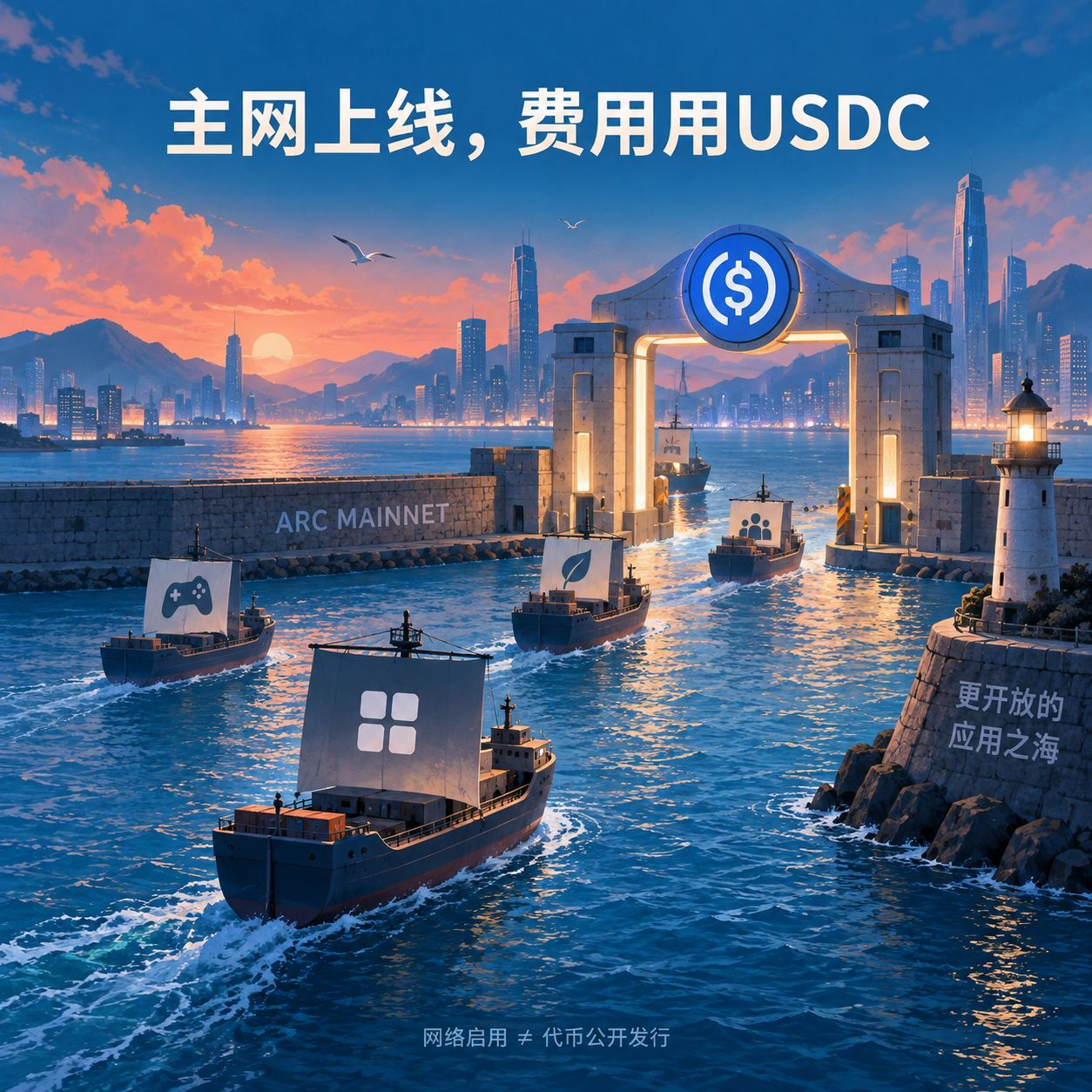
$USDC Added one more direct use: paying Arc mainnet network fees.
On September 16, Circle announced the launch of Arc's public mainnet. Fees are paid in USDC, and users are not required to have a native token with price volatility prepared in advance. For payment applications, the significance is that fee budgets can be expressed in USD terms, rather than having to manage an additional fuel asset.
But don’t equate the mainnet launch with a public token offering. The announcement is explicit: ARC initial minting is only a technical milestone and does not constitute a commitment to a public offering. The optional privacy features are also still under development.
What I care about more is the actual fees after launch, payment reliability, and how the application is being used—not assuming that every feature in the roadmap has already been delivered. #Arc mainnet launch
$USDC Added one more direct use: paying Arc mainnet network fees.
On September 16, Circle announced the launch of Arc's public mainnet. Fees are paid in USDC, and users are not required to have a native token with price volatility prepared in advance. For payment applications, the significance is that fee budgets can be expressed in USD terms, rather than having to manage an additional fuel asset.
But don’t equate the mainnet launch with a public token offering. The announcement is explicit: ARC initial minting is only a technical milestone and does not constitute a commitment to a public offering. The optional privacy features are also still under development.
What I care about more is the actual fees after launch, payment reliability, and how the application is being used—not assuming that every feature in the roadmap has already been delivered. #Arc mainnet launch
On September 16, Circle announced the launch of Arc's public mainnet. Fees are paid in USDC, and users are not required to have a native token with price volatility prepared in advance. For payment applications, the significance is that fee budgets can be expressed in USD terms, rather than having to manage an additional fuel asset.
But don’t equate the mainnet launch with a public token offering. The announcement is explicit: ARC initial minting is only a technical milestone and does not constitute a commitment to a public offering. The optional privacy features are also still under development.
What I care about more is the actual fees after launch, payment reliability, and how the application is being used—not assuming that every feature in the roadmap has already been delivered. #Arc mainnet launch
59
·
--
In the $ETH roadmap, what is most worth distinguishing is not the terminology, but the level of maturity.
The Ethereum Foundation scheduled this protocol team Q&A for September 16 at 14:00 UTC. The September 9 preview clearly distinguished three states: Glamsterdam is in public testing, Hegotá is still converging on the scope of the upgrade, and longer-term work is still determining its direction.
Therefore, when researchers discuss a technology, that does not mean it has already been confirmed for the next upgrade; and entering testing does not mean the mainnet date has already been set. When reading the Q&A, I would prioritize three answers: which specifications have been finalized, what issues testing has exposed, and which dependencies remain unresolved. They explain progress better than a single roadmap chart.
#EthereumProtocolProgress
In the $ETH roadmap, what is most worth distinguishing is not the terminology, but the level of maturity.
The Ethereum Foundation scheduled this protocol team Q&A for September 16 at 14:00 UTC. The September 9 preview clearly distinguished three states: Glamsterdam is in public testing, Hegotá is still converging on the scope of the upgrade, and longer-term work is still determining its direction.
Therefore, when researchers discuss a technology, that does not mean it has already been confirmed for the next upgrade; and entering testing does not mean the mainnet date has already been set. When reading the Q&A, I would prioritize three answers: which specifications have been finalized, what issues testing has exposed, and which dependencies remain unresolved. They explain progress better than a single roadmap chart.
#EthereumProtocolProgress
The Ethereum Foundation scheduled this protocol team Q&A for September 16 at 14:00 UTC. The September 9 preview clearly distinguished three states: Glamsterdam is in public testing, Hegotá is still converging on the scope of the upgrade, and longer-term work is still determining its direction.
Therefore, when researchers discuss a technology, that does not mean it has already been confirmed for the next upgrade; and entering testing does not mean the mainnet date has already been set. When reading the Q&A, I would prioritize three answers: which specifications have been finalized, what issues testing has exposed, and which dependencies remain unresolved. They explain progress better than a single roadmap chart.
#EthereumProtocolProgress

162
·
--
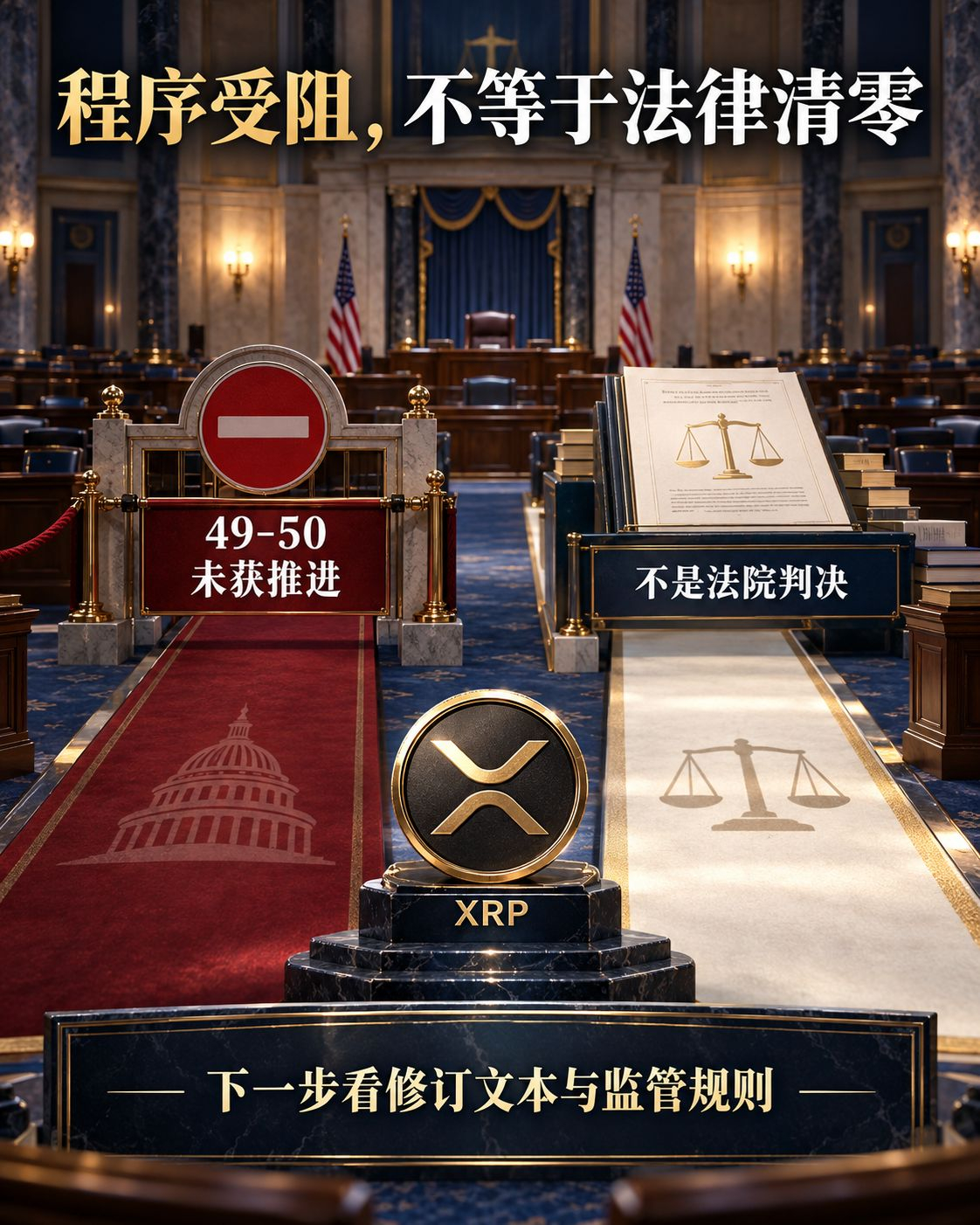
$XRP Related regulatory narrative appeared last night around a node that is easy to misinterpret: the U.S. Senate, with a vote of 49 to 50, failed to pass the procedural motion to advance the “Digital Asset Market Clarity Act.”
This means the bill has not yet entered the next stage for the moment, but it does not mean the Senate has already issued a final rejection of the bill’s provisions, nor that a court has re-adjudicated XRP. The judicial outcomes previously reached around XRP will also not be automatically erased by a single legislative procedural vote.
The real disagreement centers on ethical constraints, anti-money-laundering measures, prediction markets, and the enforcement capacity of regulators. The next step should be to watch whether the revised text will restart the process, and what rules the SEC and the CFTC will lay out before Congress passes legislation. #U.S. crypto regulation
$XRP Related regulatory narrative appeared last night around a node that is easy to misinterpret: the U.S. Senate, with a vote of 49 to 50, failed to pass the procedural motion to advance the “Digital Asset Market Clarity Act.”
This means the bill has not yet entered the next stage for the moment, but it does not mean the Senate has already issued a final rejection of the bill’s provisions, nor that a court has re-adjudicated XRP. The judicial outcomes previously reached around XRP will also not be automatically erased by a single legislative procedural vote.
The real disagreement centers on ethical constraints, anti-money-laundering measures, prediction markets, and the enforcement capacity of regulators. The next step should be to watch whether the revised text will restart the process, and what rules the SEC and the CFTC will lay out before Congress passes legislation. #U.S. crypto regulation
This means the bill has not yet entered the next stage for the moment, but it does not mean the Senate has already issued a final rejection of the bill’s provisions, nor that a court has re-adjudicated XRP. The judicial outcomes previously reached around XRP will also not be automatically erased by a single legislative procedural vote.
The real disagreement centers on ethical constraints, anti-money-laundering measures, prediction markets, and the enforcement capacity of regulators. The next step should be to watch whether the revised text will restart the process, and what rules the SEC and the CFTC will lay out before Congress passes legislation. #U.S. crypto regulation
135
Log in to explore more content
Join global crypto users on Binance Square
⚡️ Get latest and useful information about crypto.
💬 Trusted by the world’s largest crypto exchange.
👍 Discover real insights from verified creators.
Email / Phone number
Trending Topics
NEARSurges26%Past$3.45
4,208 views
56 Discussing
🚀 $NEAR surged to $3.45, with trading volume exploding 156% to $2.08B.
The trigger? Confidential perpetual trading powered by #Hyperliquid $HYPE
🔒 Positions can stay private
🌐 35+ blockchains supported
📊 50+ markets
⚡ Up to 40x leverage
#Near handles the privacy and cross-chain layer, while Hyperliquid executes the perps.
But the rally isn't over yet.
🎯 $3.00 — immediate psychological level
🚀 $3.50 — key breakout target
NEAR's TVL also reached $70M earlier this week. 👀#NEARSurges26%Past$3.45
CryptoFeed_News
·0 Likes
·82 views
BOJHikesRatesTo31YearHigh
10,719 views
369 Discussing
ChainlinkPowersBottomlinePaymentPlatform
14,627 views
410 Discussing