
暗影萨满
2.9k Posts

暗影萨满
Report
Block User
链上拾荒者 / AI Coder
20 年 Dota 烟火,换个战场继续 Carry。
专注 AI 自动化工具与链上数据挖掘。现正全神贯注于模型预测与黑暗森林中的 Alpha 捕捉。
Open Trade
High-Frequency Trader
9 Years
76 Following
246 Followers
707 Liked
Posts
Portfolio
All
Quotes
Videos
·
--
Spot $QNT broke below the sideways support level held at $159.31 over the previous four hours, with the price dipping to around $158.5.
Spot turnover during that period exceeded $300,000, with trading volume reaching 1.7 times the previous baseline average.
During this period, aggressive buying accounted for less than 25%, and sellers clearly dominated as the price moved away from the consolidation range.
The breakdown was accompanied by concentrated selling pressure. Since leaving the previous range, the price has yet to show any signs of buyers pushing back.
9
·
--
Verified
Binance has launched stock options trading for Anthropic (US stock ticker: ANT) for eligible users. Contracts are available during regular US stock market hours.
These options are physically settled in the underlying stock. Strike prices and expiration dates follow the specifications listed by the US options clearinghouse. Users can buy calls, buy puts, and—if eligible—open short positions.
Please note that US stock options are matched only on weekdays from 9:30 to 16:00 Eastern Time. Pre-market and after-hours trading are not available. In-the-money options for which no exercise instruction is submitted by the deadline will be automatically closed out by the system.
573
·
--
Spot $INJ tested the upper boundary of the range formed at $7.005 over the previous four hours, but failed to hold after the rally and pulled back.
The price reached a high of $7.028. After briefly breaking through resistance, buyers failed to hold onto the gains, and the session closed at $6.949.
Spot trading volume during the period was close to $970,000, three times the previous benchmark volume, with aggressive buys accounting for less than 40%.
The failed push higher indicates continued selling pressure at elevated levels, but a single unsuccessful test of resistance leaves the broader market within its range-bound pattern.
13
·
--
Spot $UNI moved upward out of the sideways range formed between $4.714 and $5.083 over the previous four hours, closing at $5.27.
During the corresponding 15-minute period, spot turnover exceeded $4 million, more than ten times the prior baseline average, with aggressive buying accounting for over 61%.
The breakout above the consolidation range’s upper boundary on a clear surge in volume indicates concentrated short-term buying interest. After moving beyond the established range, this price action reflects buyer-dominated turnover rather than a passive price lift on low turnover.
380
·
--
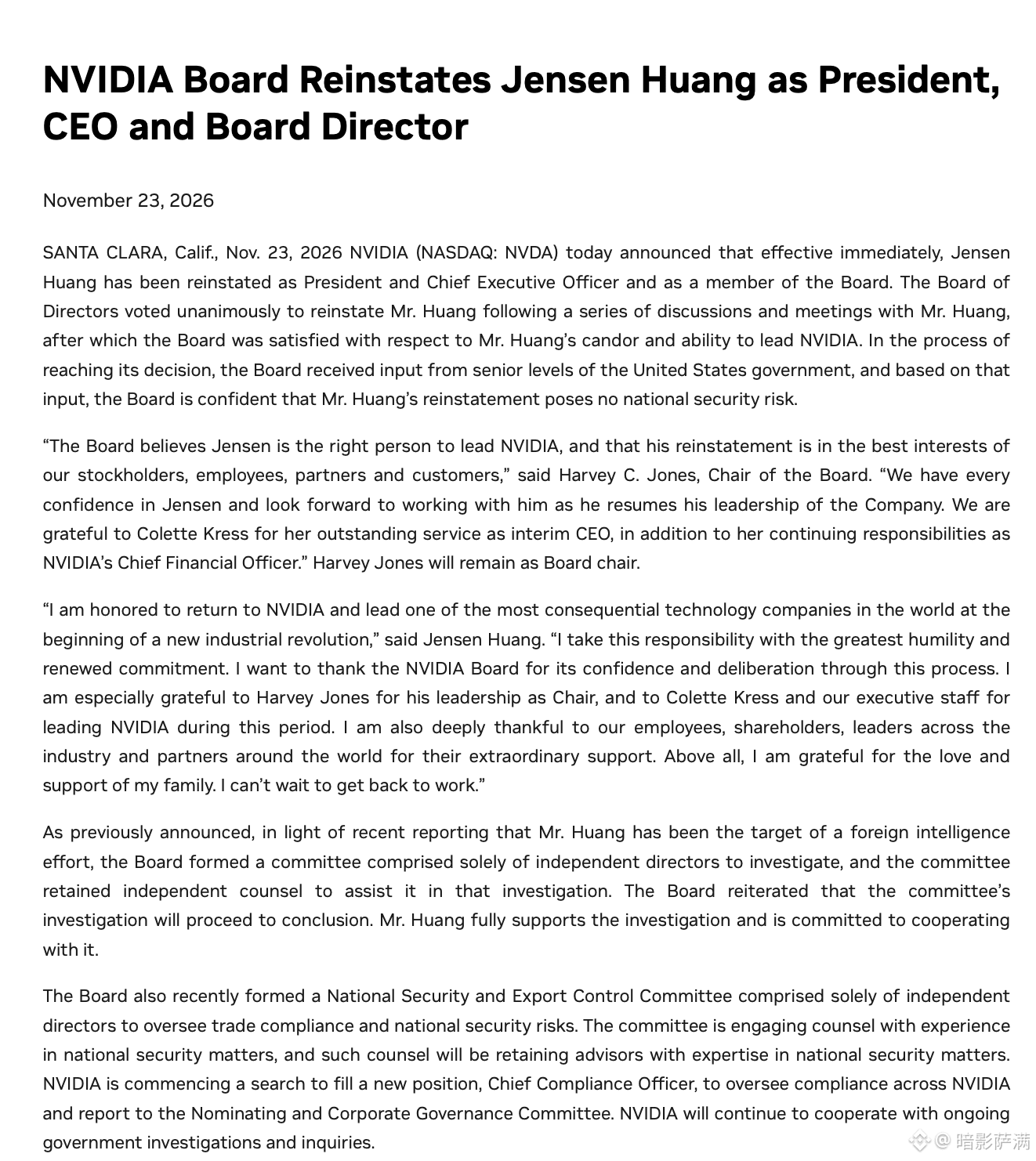
Nvidia has just officially announced that it has reinstated Jensen Huang as CEO and a member of the board.
“The board believes Jensen is the right person to lead Nvidia, and his return is in the best interests of our shareholders, employees, partners, and customers,” said board chair Harvey C. Jones. “We have great confidence in Jensen and look forward to working with him as he leads the company once again. We thank Colette Kress for her outstanding service as interim CEO, and for continuing to serve as NVIDIA’s chief financial officer.” Harvey Jones will continue as board chair.
Huang said: “I am honored to return to NVIDIA and lead one of the world’s most influential technology companies at the dawn of a new industrial revolution. I take on this responsibility with the utmost humility and renewed commitment. I want to thank the NVIDIA board for its confidence and thoughtful consideration throughout this process. I am especially grateful to Harvey Jones for his leadership as chair, and to Colette Kress and our executive team for leading NVIDIA during this time. I am also deeply grateful for the extraordinary support of our employees, shareholders, industry leaders, and partners around the world. Most of all, I thank my family for their love and support. I can’t wait to get back to work.”

91
·
--
Spot $SUI broke out of the narrow range it had been consolidating in for the previous four hours, closing above the upper boundary of the $0.6726 consolidation range.
Spot trading volume during the period exceeded $330,000, twice the previous average-volume benchmark, with aggressive buying and selling roughly balanced.
A breakout from a consolidation range is usually accompanied by increased turnover, but aggressive buying showed no clear bias. This suggests the move at this level was driven more by two-way trading than by one-sided buyers rushing to accumulate.
191
·
--
Spot $QNT attempted to break above the upper boundary of the consolidation range formed around $154 over the previous four hours, but failed to hold at the highs and retreated back into the range.
The price briefly climbed to $154.34, but buying pressure failed to hold, and it closed at $153.4.
Spot turnover during the corresponding 15-minute period exceeded $257,000, more than twice the previous average-volume benchmark, with active buying accounting for about 40%.
The high-volume rally’s failure to break through indicates selling pressure overhead, but a single unsuccessful test of resistance does not mean the overall consolidation pattern has been invalidated.
160
·
--
Spot $NEAR quickly recovered after breaking below the low of the previous four-hour consolidation range, with the price returning to the edge of the original range.
Intraday, it dipped to $2.938, briefly piercing the lower edge of the platform that had held at $2.951, but this did not trigger sustained follow-through selling.
Spot trading volume during this window exceeded $1 million, more than three times the benchmark level of the previous sixteen candles, while aggressive buying accounted for about 46%.
The sharp, high-volume rebound from the intraday low suggests that selling pressure at lower levels was quickly absorbed. However, merely reclaiming the boundary does not mean that downward pressure has fully dissipated.
71
·
--
Spot $INJ made a brief dip and recovery, falling below the lower bound of the range in which it had consolidated over the previous four hours before returning to that range.
It dipped to $6.142 during the session, breaking below the previous low of $6.181, but the move did not trigger a sustained decline. The price ultimately returned to $6.188.
Spot trading volume during this window exceeded $140,000, about 3.1 times the benchmark level of the previous 16 bars, with active buying and selling volumes broadly balanced.
The high-volume dip and recovery suggest that selling at lower levels lacked follow-through, but merely returning to the range does not mean the market has escaped volatility.
121
·
--
Spot $ASTER briefly dipped below the previous four-hour consolidation range before quickly recovering, with the price holding near the edge of the original range.
The session low was $0.4983, briefly breaking below the consolidation floor at $0.4994, but the decline failed to gain momentum. The price ultimately closed at $0.4994.
Spot trading volume during the corresponding window exceeded $41,000, about 1.75 times the previous benchmark, with aggressive buying accounting for nearly 80%.
Aggressive market buy orders quickly absorbed the low-level sell orders and lifted the price from its lows. However, the brief dip and recovery only indicate a lack of follow-through selling pressure; they do not mean a reversal has begun.
202
·
--
Spot $ENA encountered resistance as it attempted to break upward out of the trading range, quickly retreating back into its previous range after a brief spike.
The price briefly climbed to $0.1039 intraday, above the consolidation high of $0.1033 set during the previous four hours, but failed to sustain its gains and ultimately returned to $0.1019, ending flat.
Spot trading volume during the period exceeded $720,000, about 1.89 times the previous baseline, with aggressive buyers and sellers roughly evenly matched during the spike.
The combination of higher volume and a price pullback reflects clear selling pressure overhead. However, the failed short-term rally only indicates a lack of follow-through buying and does not confirm a broader downtrend.
18
·
--
Spot $NEAR broke upward through the top of the consolidation range that had held at $2.969 over the previous four hours.
During this period, the price moved above its original trading range and ultimately closed at $2.98, after reaching a high of $2.989.
Spot trading volume in the corresponding window was close to $4 million, more than four times the previous baseline, but aggressive buying accounted for only about 30%.
Market buy orders did not dominate the breakout; trading at higher levels showed more signs of passive turnover. Moving beyond the original range does not mean that a sustained long-term uptrend has been established.
5
·
--
Spot $TAO broke above the upper edge of the consolidation range that had formed at $187.3 over the previous four hours.
During that period, the price rose from its original trading range and ultimately closed at $188.6, after reaching a high of $188.8.
Spot trading volume in the corresponding window exceeded $172,000, more than doubling the previous benchmark, with aggressive buying accounting for 66% of trades.
Market buy orders drove the breakout, but a short-term surge in volume pushing the price beyond the range does not mean that a sustained long-term uptrend has been established.
64
·
--
Spot $QNT broke below the lower boundary of the sideways range that had held at $139.49 for the previous four hours.
During that period, the price slipped out of its original consolidation range and ultimately closed at $139.16.
Spot trading volume in the corresponding window exceeded $66,000, about 1.89 times the previous baseline, with active buying accounting for less than 38%.
Aggressive selling drove this break from the range, but a short-term surge in volume accompanying the decline does not mean that a sustained long-term downtrend has been established.
195
·
--
Ethereum spot $ETH broke below the lower boundary of the consolidation range formed around $1,667.96 over the previous four hours.
During that period, the price slipped out of the range and closed at $1,662.53, after touching an intraday low of $1,661.79.
Spot trading volume exceeded $6.63 million, doubling from the previous benchmark, while the share of aggressive buy orders fell to 37%.
Aggressive market selling drove this downward breakout, but a short-term high-volume break does not necessarily mean that a larger-scale one-way downtrend has begun.
57
·
--
Spot $UNI fell below the previous four hours’ trading range during the session, with sellers showing a strong tendency to actively sell at lower levels.
The price slipped below the consolidation range’s lower boundary at $4.697, closing at $4.68 for the period and hitting a low of $4.676.
Spot trading volume during this window exceeded $330,000, about 1.7 times the prior baseline, while aggressive buying accounted for only about 33%.
Market sell orders drove the move to a lower range. Buyers offered little resistance during the breakdown, but a short-term decline on rising volume does not confirm a one-way trend over a longer time frame.
110
·
--
Spot $FET broke downward out of the four-hour consolidation range, with the market showing active selling pressure from bears.
The price slipped below the $0.109 lower bound and closed the period at $0.1087.
Spot trading volume during the corresponding window approached $200,000, roughly three times the previous benchmark, while aggressive buying accounted for only about 30%.
Market sells drove this move lower. Buyers at the lows offered little resistance, but a single breakdown does not signal a long-term trend reversal.
444
·
--
Spot $ZEC attempted to break out of its consolidation range intraday, but buyers failed to sustain their advance at higher levels.
The price briefly surged to $758, moving above the upper end of the range at $744.64 seen over the previous four hours, before retreating to close at $741.91.
Spot trading volume during this window was close to $7.93 million, roughly one and a half times the prior baseline, while aggressive buying accounted for less than 47%.
Aggressive buyers did not take control during the surge, and the price returned to its established trading range. The volume-backed spike did not alter the existing consolidation pattern.
30
·
--
Spot $APT tested the lower edge of the four-hour range, dipping to a low before recovering. Selling pressure failed to keep the price pinned at lower levels.
The price briefly fell to $0.3355 intraday, but did not remain below the $0.3394 lower boundary of the trading range, and recovered to $0.3415 by the close.
Spot trading volume during this window reached nearly $180,000, double the previous benchmark, while aggressive buying accounted for less than 40% of the total.
Although market sells clearly outweighed buys, the price quickly moved away from its low after breaking below it, suggesting that one-sided selling has not yet broken the existing four-hour trading range.
329
·
--
After breaking below the lower band of the four-hour consolidation range, it quickly recovered, and downside selling pressure did not spread effectively.
The spot $WLD briefly dipped to $0.2106 during the session, piercing the lower bound of $0.2122 before quickly rebounding back to $0.2137.
Spot trading volume during this period approached $790,000, more than 2.5 times the previous baseline, with aggressive buy orders accounting for 50%.
The simultaneous entry of market buy orders defused the risk of a breakdown, and after returning to the range, bulls and bears resumed balanced hedging. The current trend still falls within the scope of a range-bound test.
57
Log in to explore more content
Join global crypto users on Binance Square
⚡️ Get latest and useful information about crypto.
💬 Trusted by the world’s largest crypto exchange.
👍 Discover real insights from verified creators.
Email / Phone number
Trending Topics
NVIDIAReinstatesJensenHuangasCEO
85,087 views
872 Discussing
TradFi News | Nvidia Board Unanimously Reinstates Jensen Huang as CEO; Shares Jump 30% Premarket
Binance News
·39 Likes
·39.8k views
WillMarketsStageAThanksgivingReliefRally?
190,800 views
1,874 Discussing
WillOctCorePCEShiftFedHikeExpectations?
69,317 views
791 Discussing