
SA 战士 - SILENT SPARK
9.8k Posts

SA 战士 - SILENT SPARK
Skilled in content writing, influencer and trader...
Frequent Trader
11.7 Months
931 Following
7.0K+ Followers
7.5K+ Liked
Posts
All
Quotes
Live
The more I looked into how institutions actually use public blockchains the more one thing bothered me.
Every balance is visible. Every transfer amount is visible forever. If a fund moves a large position the market can see it before the fund even reacts. Patterns in transfers start to reveal who trades with who and how often. That's not some edge case. That's just what a public ledger does by default and it's a real cost for anyone managing real money.
This is the actual problem Hedger on Dusk is built around. Not privacy as a feature you toggle on. Privacy as a requirement for any serious institution to touch a public chain at all.
What surprised me is how the workflow handles this. It's not privacy bolted onto a normal transfer. Configure sets the eligibility rules for who can even participate. Verify checks identity and compliance status against those rules. Protect applies encryption and zero knowledge proofs to the transfer itself. Transfer moves the asset while balances and amounts stay hidden from public view. Audit lets a reviewer selectively see what they're allowed to see without exposing everything to everyone else.
That's the part that clicked for me. Privacy and oversight usually get treated like opposites. Here they're built into the same flow. A reviewer can confirm a transfer was compliant without that transfer ever becoming public market data.
For institutions that's the real blocker with public chains right now. Not scalability. Not fees. Exposure.
Curious how others weigh this tradeoff.
#dusk $DUSK @Dusk
What matters most for institutions onchain ???
Every balance is visible. Every transfer amount is visible forever. If a fund moves a large position the market can see it before the fund even reacts. Patterns in transfers start to reveal who trades with who and how often. That's not some edge case. That's just what a public ledger does by default and it's a real cost for anyone managing real money.
This is the actual problem Hedger on Dusk is built around. Not privacy as a feature you toggle on. Privacy as a requirement for any serious institution to touch a public chain at all.
What surprised me is how the workflow handles this. It's not privacy bolted onto a normal transfer. Configure sets the eligibility rules for who can even participate. Verify checks identity and compliance status against those rules. Protect applies encryption and zero knowledge proofs to the transfer itself. Transfer moves the asset while balances and amounts stay hidden from public view. Audit lets a reviewer selectively see what they're allowed to see without exposing everything to everyone else.
That's the part that clicked for me. Privacy and oversight usually get treated like opposites. Here they're built into the same flow. A reviewer can confirm a transfer was compliant without that transfer ever becoming public market data.
For institutions that's the real blocker with public chains right now. Not scalability. Not fees. Exposure.
Curious how others weigh this tradeoff.
#dusk $DUSK @Dusk
What matters most for institutions onchain ???
Transaction privacy
Regulatory auditability
Both need to coexist
18 hr(s) left
I started digging into a question that why crypto privacy projects never make it into serious finance and it comes down to one stubborn assumption. Everyone assumed you had to pick a side. Either the ledger stays fully open and every balance and trade sits there for anyone to see or it stays fully hidden and no regulator will ever touch it. That binary has quietly killed a lot of good ideas.
Then I read into Hedger which is Dusk Network's confidential transaction system built for DuskEVM and it approaches the problem differently. Instead of choosing openness or secrecy it encrypts balances and transaction amounts by default using homomorphic encryption based on ElGamal over elliptic curves. That means computations can happen directly on encrypted data without ever decrypting it first. Zero knowledge proofs sit alongside that to prove a transaction is valid without revealing what's actually inside it.
Here's what surprised me. Dusk's own research describes optional compliance hooks built into the same system so specific auditors can retrieve transaction amounts or intervene when legally required. Nothing gets exposed by default but nothing stays permanently unreachable either. Proofs reportedly generate client side in under two seconds which actually matters if this is meant to run inside normal EVM tooling instead of some separate closed environment.
It reframed the whole debate for me. Privacy and compliance were never really opposites. They just needed a system designed to hold both at once instead of forcing a choice between them.
#dusk $DUSK @Dusk
Which matters more to you when real money starts moving on chain ??
Then I read into Hedger which is Dusk Network's confidential transaction system built for DuskEVM and it approaches the problem differently. Instead of choosing openness or secrecy it encrypts balances and transaction amounts by default using homomorphic encryption based on ElGamal over elliptic curves. That means computations can happen directly on encrypted data without ever decrypting it first. Zero knowledge proofs sit alongside that to prove a transaction is valid without revealing what's actually inside it.
Here's what surprised me. Dusk's own research describes optional compliance hooks built into the same system so specific auditors can retrieve transaction amounts or intervene when legally required. Nothing gets exposed by default but nothing stays permanently unreachable either. Proofs reportedly generate client side in under two seconds which actually matters if this is meant to run inside normal EVM tooling instead of some separate closed environment.
It reframed the whole debate for me. Privacy and compliance were never really opposites. They just needed a system designed to hold both at once instead of forcing a choice between them.
#dusk $DUSK @Dusk
Which matters more to you when real money starts moving on chain ??
Full transparency
50%
Full anonymity
50%
Reviewable privacy
0%
2 votes • Voting closed
I kept hearing tokenized money market fund thrown around like it was one simple thing until I actually looked into what happens when you buy one. Turns out most of them work the same way. A custodial fund holds the real shares off chain and a token gets minted that just points to that off chain position. You don't own the fund. You own a claim on someone else's promise that the fund exists and will honor redemption.
That distinction sounds small until you think about what happens during stress. If the custodian freezes redemptions or the bridge breaks or the off chain registry falls behind the on chain token supply your ownership is only as good as that intermediary's willingness and ability to make good on it.
What got me curious about Dusk is the opposite design. The idea is that the token itself is meant to be the actual on chain record of ownership. There's no separate off chain ledger you're hoping stays in sync. When a transfer happens it settles atomically and that settlement is the ownership change itself instead of an instruction sent somewhere else to update a private book.
That's the real difference between holding an IOU and holding the asset itself. Instant settlement isn't just a speed feature here. It's what actually makes the ownership real instead of promised.
#dusk $DUSK @Dusk
Poll: Which would you trust more with real money ?
That distinction sounds small until you think about what happens during stress. If the custodian freezes redemptions or the bridge breaks or the off chain registry falls behind the on chain token supply your ownership is only as good as that intermediary's willingness and ability to make good on it.
What got me curious about Dusk is the opposite design. The idea is that the token itself is meant to be the actual on chain record of ownership. There's no separate off chain ledger you're hoping stays in sync. When a transfer happens it settles atomically and that settlement is the ownership change itself instead of an instruction sent somewhere else to update a private book.
That's the real difference between holding an IOU and holding the asset itself. Instant settlement isn't just a speed feature here. It's what actually makes the ownership real instead of promised.
#dusk $DUSK @Dusk
Poll: Which would you trust more with real money ?
Wrapped custodial token
0%
Native on chain ownership
0%
Depends entirely on the issuer
0%
0 votes • Voting closed
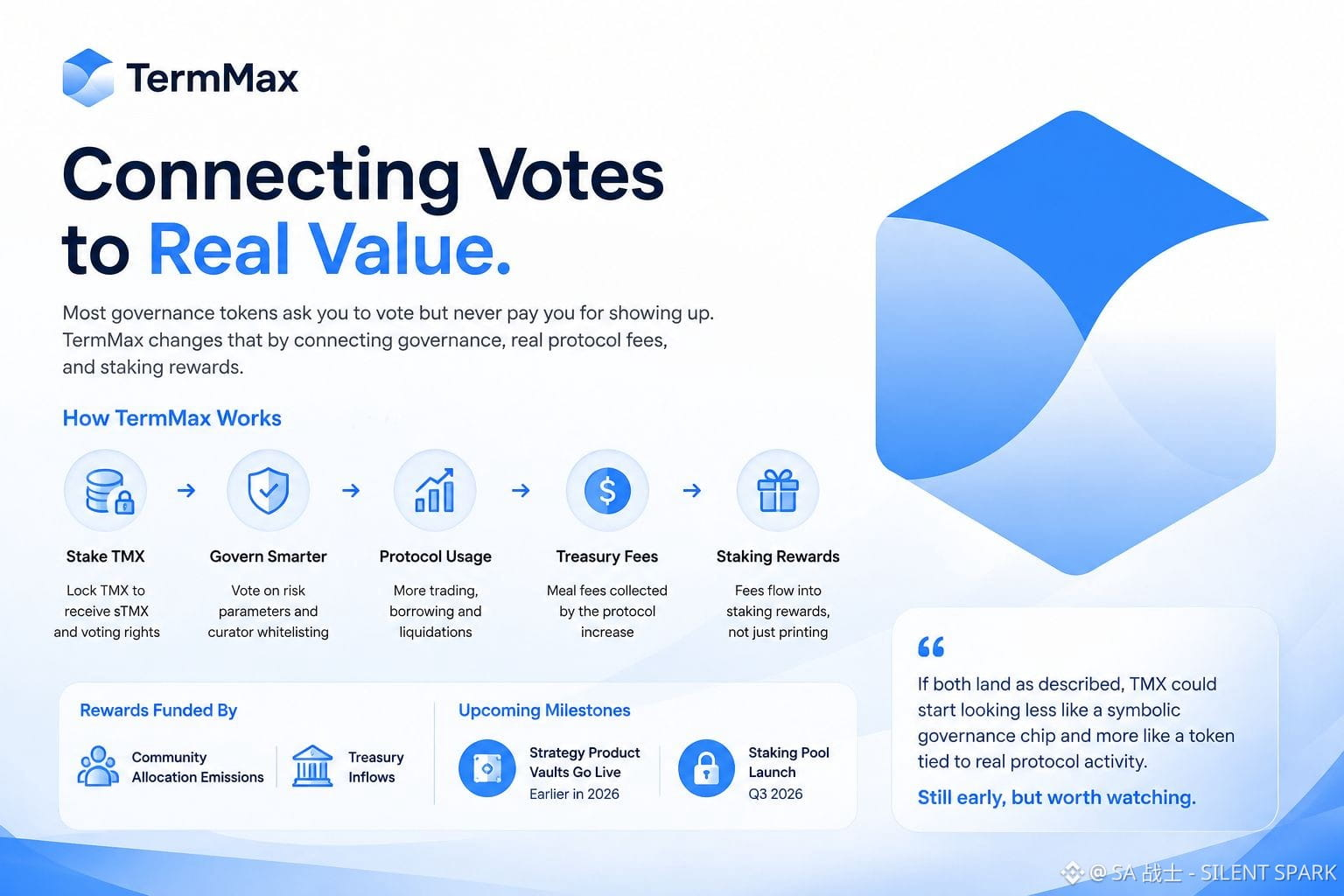
Most governance tokens ask you to vote but never pay you for showing up. You lock a token. You get voting rights. Then nothing happens. There's no real link between that vote and the money the protocol is actually making. That's one of DeFi's oldest unsolved problems.
This matters because holders end up guessing whether they're early backers of a real business or just unpaid voters on parameters nobody outside the protocol cares about. It's hard to build lasting incentives around a vote that may never get used.
TermMax introduces an alternative approach. It's a lending and fixed rate trading protocol built around FT and XT tokens. TMX can be staked for sTMX with rewards funded from two sources: Community allocation emissions and Treasury inflows. The Treasury collects real fees from FT and XT trading borrowing and liquidations. So when protocol usage rises those fees rise too which flows straight into staking rewards rather than just token printing.
Staking also brings sharper governance power over risk parameters and curator whitelisting decisions that shape how the whole system runs.
What stood out to me is the timing. A staking pool launch is planned for Q3 2026 right after Strategy Product Vaults go live earlier that year. If both land as described TMX could start looking less like a symbolic governance chip and more like a token tied to real protocol activity. Still early but worth watching.
#termmax @TermMax
This matters because holders end up guessing whether they're early backers of a real business or just unpaid voters on parameters nobody outside the protocol cares about. It's hard to build lasting incentives around a vote that may never get used.
TermMax introduces an alternative approach. It's a lending and fixed rate trading protocol built around FT and XT tokens. TMX can be staked for sTMX with rewards funded from two sources: Community allocation emissions and Treasury inflows. The Treasury collects real fees from FT and XT trading borrowing and liquidations. So when protocol usage rises those fees rise too which flows straight into staking rewards rather than just token printing.
Staking also brings sharper governance power over risk parameters and curator whitelisting decisions that shape how the whole system runs.
What stood out to me is the timing. A staking pool launch is planned for Q3 2026 right after Strategy Product Vaults go live earlier that year. If both land as described TMX could start looking less like a symbolic governance chip and more like a token tied to real protocol activity. Still early but worth watching.
#termmax @TermMax
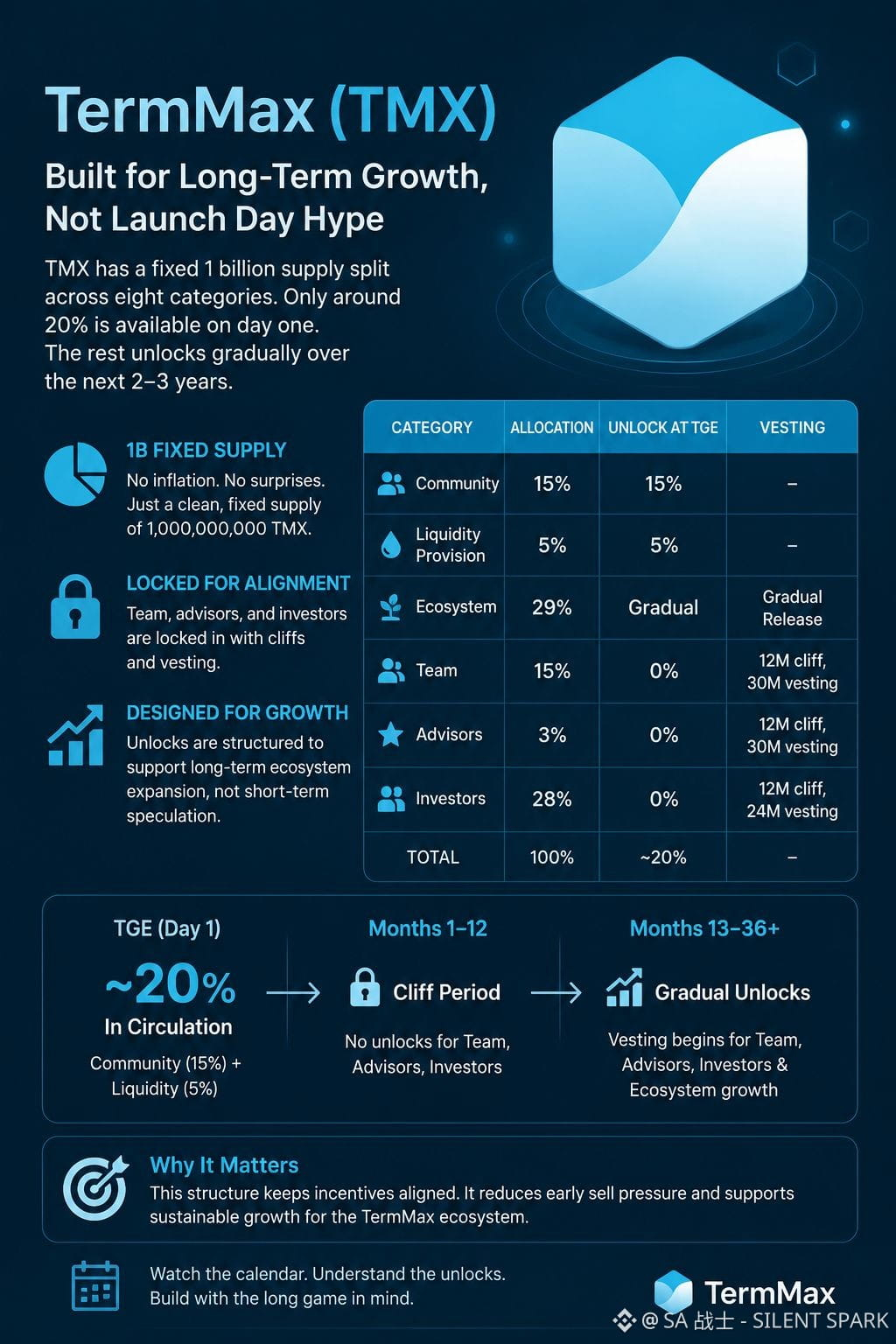
Most people size up a token by glancing at total supply and calling it a day. That's a mistake. Two tokens can both have a billion units and behave completely differently depending on how much unlocks immediately versus how much stays locked.
This matters for more than just traders. Long term holders need to know if they're buying steady dilution or a token that's already mostly circulating. Most surprise unlock dumps were never surprises. Someone just skipped the schedule.
I went through TermMax's allocation table and it's a clean example. TMX has a fixed 1 billion supply split across eight categories. Community holds 15% and Liquidity Provision holds 5% and both unlock at TGE. Ecosystem takes the largest share at 29% released gradually to fund growth. Team holds 15% and Advisors hold 3% both behind a 12 month cliff followed by 30 months of vesting. Investors hold 28% under a 12 month cliff and 24 months of vesting after.
Add it up and only around 20% of TMX sits in the open market on day one. The rest arrives slowly over the next two to three years. Anyone modeling sell pressure may want to watch the calendar as closely as the chart.
What stood out to me is how this keeps team and investor incentives tied to the protocol's growth instead of launch day hype. That doesn't promise anything about price. But it does suggest the token could be designed to track how TermMax matures rather than front run it.
#termmax @TermMax
This matters for more than just traders. Long term holders need to know if they're buying steady dilution or a token that's already mostly circulating. Most surprise unlock dumps were never surprises. Someone just skipped the schedule.
I went through TermMax's allocation table and it's a clean example. TMX has a fixed 1 billion supply split across eight categories. Community holds 15% and Liquidity Provision holds 5% and both unlock at TGE. Ecosystem takes the largest share at 29% released gradually to fund growth. Team holds 15% and Advisors hold 3% both behind a 12 month cliff followed by 30 months of vesting. Investors hold 28% under a 12 month cliff and 24 months of vesting after.
Add it up and only around 20% of TMX sits in the open market on day one. The rest arrives slowly over the next two to three years. Anyone modeling sell pressure may want to watch the calendar as closely as the chart.
What stood out to me is how this keeps team and investor incentives tied to the protocol's growth instead of launch day hype. That doesn't promise anything about price. But it does suggest the token could be designed to track how TermMax matures rather than front run it.
#termmax @TermMax
I kept seeing the phrase compliant DeFi everywhere and honestly I didn't trust it. Most of the time it just means a KYC form and a geofence stapled onto a chain that has zero real regulatory status underneath. So I went and looked into how Dusk's NPEX partnership actually works and it's a completely different setup than what I expected.
NPEX isn't just some crypto friendly partner. It's a real Dutch exchange founded in 2008 and regulated by the AFM. It holds an MTF license a Broker license and an ECSP license. Through this partnership those licenses now live at Dusk's protocol layer instead of sitting inside a single app.
Here's what surprised me. That means any application built on Dusk inherits the same regulated perimeter by default. You're not asking every new app to go chase its own license and hope it holds up under scrutiny. The compliance is baked into the base layer itself.
The simple way I think about it now is app layer compliance is a sticker on the box. Protocol layer compliance is the material the box is made from. One can be peeled off. The other can't.
This gives me an actual filter now for telling which chains can genuinely host regulated finance and which ones are just repeating the word compliant a lot.
#dusk $DUSK @Dusk
What matters more to you when picking infrastructure for regulated assets ?
NPEX isn't just some crypto friendly partner. It's a real Dutch exchange founded in 2008 and regulated by the AFM. It holds an MTF license a Broker license and an ECSP license. Through this partnership those licenses now live at Dusk's protocol layer instead of sitting inside a single app.
Here's what surprised me. That means any application built on Dusk inherits the same regulated perimeter by default. You're not asking every new app to go chase its own license and hope it holds up under scrutiny. The compliance is baked into the base layer itself.
The simple way I think about it now is app layer compliance is a sticker on the box. Protocol layer compliance is the material the box is made from. One can be peeled off. The other can't.
This gives me an actual filter now for telling which chains can genuinely host regulated finance and which ones are just repeating the word compliant a lot.
#dusk $DUSK @Dusk
What matters more to you when picking infrastructure for regulated assets ?
Protocol level licensing
100%
App layer KYC checks
0%
Doesn't matter if it works
0%
4 votes • Voting closed
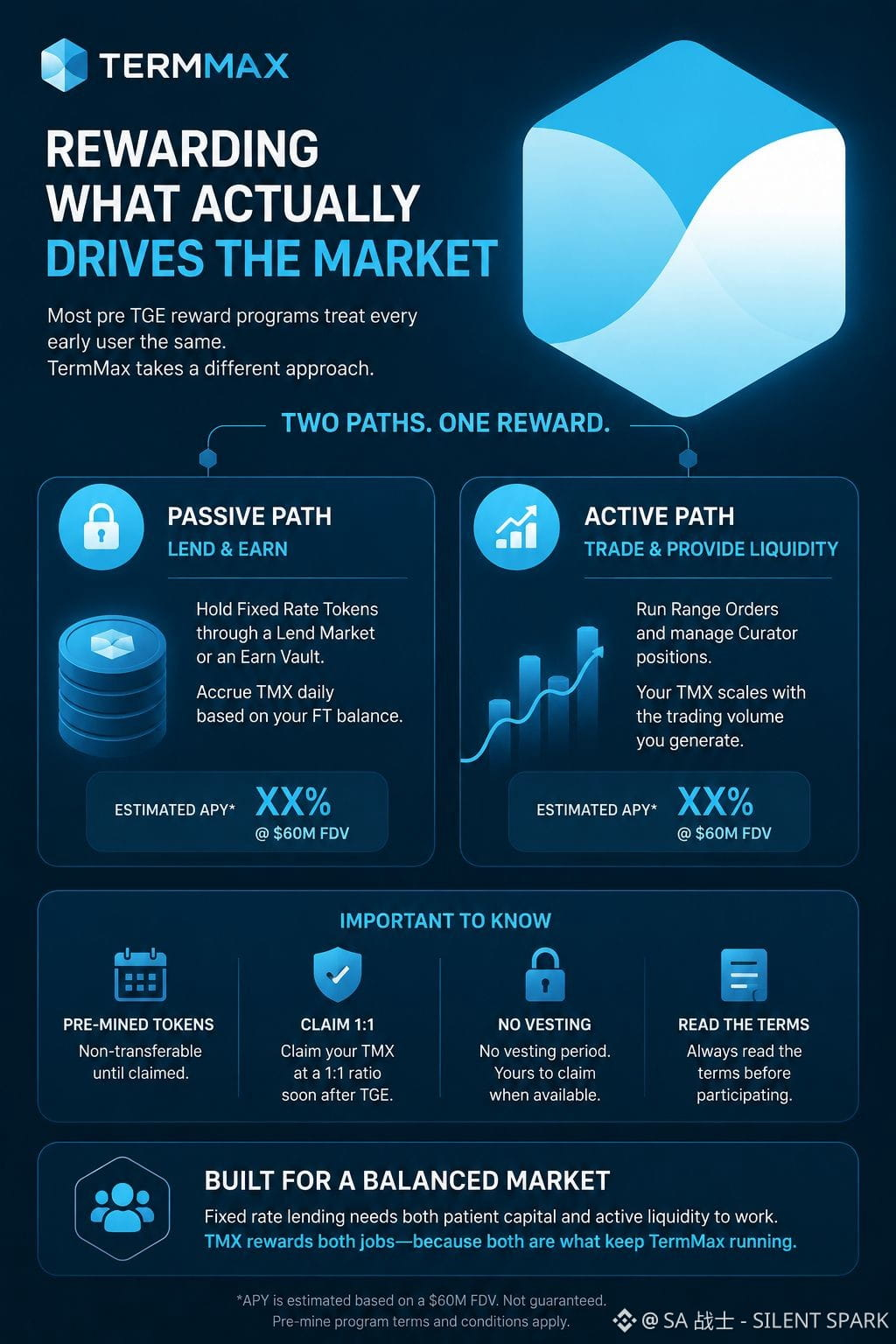
Most pre TGE reward programs treat every early user the same. Deposit capital and wait. Collect points. Whether you're a passive holder or an active liquidity provider you get lumped into one undifferentiated farming bucket.
That's a real mismatch. A lender parking funds for months isn't taking the same risk as someone actively quoting prices and absorbing volume. Treating both identically ignores what each side actually contributes.
TermMax is a fixed rate lending protocol nearing its TGE. Its pre mine program separates these two behaviors instead of lumping them together. Hold Fixed Rate Tokens through a Lend Market or an Earn Vault and you accrue TMX daily based on your FT balance. That's the passive path. Or run Range Orders and manage Curator positions and your TMX scales with the trading volume you generate. That's the active path.
What stood out to me is the APY on both paths gets estimated against a $60M FDV giving depositors a rough sense of what daily accrual could mean once TMX trades. Still nothing here is promised. Pre mined tokens stay non transferable until claimed at a 1:1 ratio soon after TGE with no vesting so read the terms first.
The way I see it this split says something about how TermMax views its own market. Fixed rate lending needs both patient capital and active liquidity to work. TMX tied to both jobs suggests the token is meant to track what actually keeps the protocol running.
#termmax @TermMax
That's a real mismatch. A lender parking funds for months isn't taking the same risk as someone actively quoting prices and absorbing volume. Treating both identically ignores what each side actually contributes.
TermMax is a fixed rate lending protocol nearing its TGE. Its pre mine program separates these two behaviors instead of lumping them together. Hold Fixed Rate Tokens through a Lend Market or an Earn Vault and you accrue TMX daily based on your FT balance. That's the passive path. Or run Range Orders and manage Curator positions and your TMX scales with the trading volume you generate. That's the active path.
What stood out to me is the APY on both paths gets estimated against a $60M FDV giving depositors a rough sense of what daily accrual could mean once TMX trades. Still nothing here is promised. Pre mined tokens stay non transferable until claimed at a 1:1 ratio soon after TGE with no vesting so read the terms first.
The way I see it this split says something about how TermMax views its own market. Fixed rate lending needs both patient capital and active liquidity to work. TMX tied to both jobs suggests the token is meant to track what actually keeps the protocol running.
#termmax @TermMax
Verified
Dusk is doing a Binance Square AMA today at 15:00 CEST and it's worth clearing your calendar for. You get both Emanuele Francioni the CEO and Hein Dauven the CTO in the same session which is rare, usually it's one or the other.If you've been following the DuskDS, DuskEVM, DuskVM structure and still have questions this is the place to bring them.
For now let me explain what i learn, I kept seeing "privacy" thrown around by different chains and honestly got skeptical because usually it just means one shielded pool bolted onto an otherwise public chain. So I went digging into how Dusk actually structures this across its stack and it wasn't what I expected.
Basically Dusk splits the job into three layers instead of cramming everything into one. DuskDS sits at the bottom and handles settlement consensus and data availability. It runs a proof of stake system called Succinct Attestation that gives deterministic finality which matters if you're settling regulated assets and can't afford probabilistic confirmation.
Here's what surprised me. On top of that sits DuskEVM which is built as an OP Stack rollup so Solidity developers get normal EVM tooling. Privacy there comes through something called Hedger which mixes homomorphic encryption with zero knowledge proofs instead of leaning on ZK alone.
Then there's DuskVM the native Rust and WASM environment where contracts are privacy aware from the start instead of having privacy added later.
That's when it clicked for me. Same settlement guarantees underneath the whole time but each layer gets privacy in a way that actually fits how developers build there instead of forcing one method everywhere.
#dusk $DUSK @Dusk
Which layer would you actually build on ?
For now let me explain what i learn, I kept seeing "privacy" thrown around by different chains and honestly got skeptical because usually it just means one shielded pool bolted onto an otherwise public chain. So I went digging into how Dusk actually structures this across its stack and it wasn't what I expected.
Basically Dusk splits the job into three layers instead of cramming everything into one. DuskDS sits at the bottom and handles settlement consensus and data availability. It runs a proof of stake system called Succinct Attestation that gives deterministic finality which matters if you're settling regulated assets and can't afford probabilistic confirmation.
Here's what surprised me. On top of that sits DuskEVM which is built as an OP Stack rollup so Solidity developers get normal EVM tooling. Privacy there comes through something called Hedger which mixes homomorphic encryption with zero knowledge proofs instead of leaning on ZK alone.
Then there's DuskVM the native Rust and WASM environment where contracts are privacy aware from the start instead of having privacy added later.
That's when it clicked for me. Same settlement guarantees underneath the whole time but each layer gets privacy in a way that actually fits how developers build there instead of forcing one method everywhere.
#dusk $DUSK @Dusk
Which layer would you actually build on ?
DuskEVM for familiar tooling
67%
DuskVM for native privacy
0%
Still deciding
33%
3 votes • Voting closed
DeFi has made borrowing easy. Predictable borrowing is another story.
Floating rates can change the economics of a position after you've entered it. That creates friction for traders and makes capital planning harder for larger users.
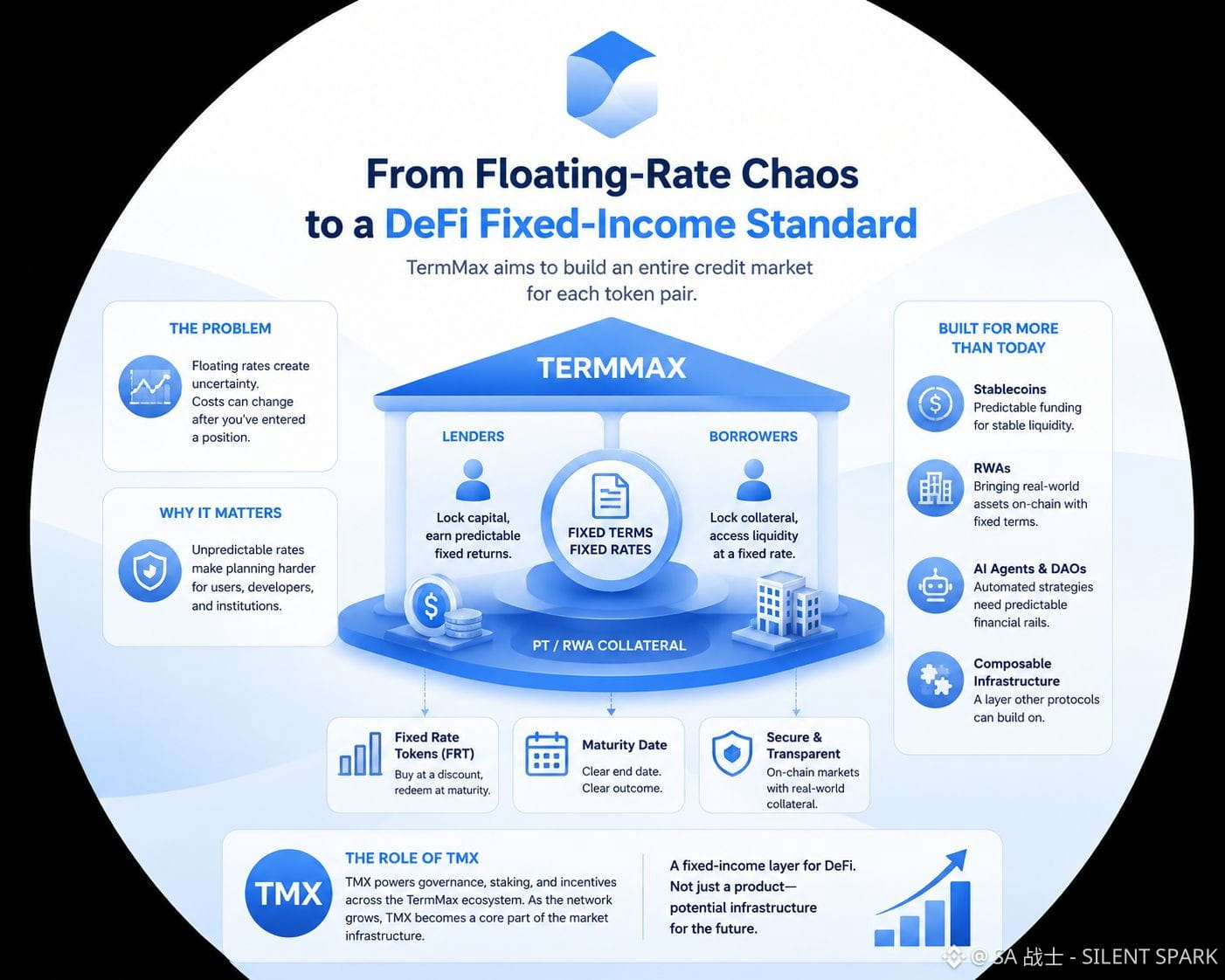
What stood out to me about TermMax is that it isn't just trying to offer another lending market. Its stated goal is to build an entire credit market for each token pair.
The basic idea is familiar from fixed income. A market has a debt asset. Collateral. A fixed rate. And a maturity date. Lenders can buy Fixed Rate Tokens at a discount and redeem them at maturity. Borrowers can lock collateral and receive liquidity with the cost defined upfront.
That structure gets more interesting when the collateral can include yield bearing assets such as PTs and potentially RWAs. It creates a framework where different forms of collateral could support their own term markets instead of everything relying on one floating rate pool.
The way I see it the bigger question is infrastructure. If DeFi starts needing predictable rates for stablecoins RWAs or institutional strategies then a reusable fixed income layer could become useful beyond TermMax itself.
TMX is strategically tied to that ecosystem through governance staking and incentives. If the network expands its market infrastructure those functions give the token a role beyond simple speculation.
The thesis is interesting. Execution adoption and risk management will determine how far it goes.
#termmax @TermMax
Floating rates can change the economics of a position after you've entered it. That creates friction for traders and makes capital planning harder for larger users.
What stood out to me about TermMax is that it isn't just trying to offer another lending market. Its stated goal is to build an entire credit market for each token pair.
The basic idea is familiar from fixed income. A market has a debt asset. Collateral. A fixed rate. And a maturity date. Lenders can buy Fixed Rate Tokens at a discount and redeem them at maturity. Borrowers can lock collateral and receive liquidity with the cost defined upfront.
That structure gets more interesting when the collateral can include yield bearing assets such as PTs and potentially RWAs. It creates a framework where different forms of collateral could support their own term markets instead of everything relying on one floating rate pool.
The way I see it the bigger question is infrastructure. If DeFi starts needing predictable rates for stablecoins RWAs or institutional strategies then a reusable fixed income layer could become useful beyond TermMax itself.
TMX is strategically tied to that ecosystem through governance staking and incentives. If the network expands its market infrastructure those functions give the token a role beyond simple speculation.
The thesis is interesting. Execution adoption and risk management will determine how far it goes.
#termmax @TermMax
Everyone in RWA talks about "bringing assets onchain." Almost nobody asks which part of the asset actually made the trip.
Look closely at most tokenized RWAs and you'll find a receipt not the asset. The bond, the T-bill, the property title it's still sitting in a legacy registry with a custodian holding the record regulators actually recognize. The token just points at it. Trade the token all day and legally nothing has moved until someone off-chain reconciles the two systems.
That's the part that gets glossed over. Regulated markets don't really price convenience they price counterparty risk and settlement finality. A wrapped asset inherits blockchain's UX (fast, composable, 24/7) but not its core promise, because the "truth" still lives somewhere a smart contract can't see. You've added a reconciliation layer, not removed one.
Native issuance is a different bet entirely. If issuance, transfer and servicing all happen onchain, there's no shadow ledger to check against the chain is the record full stop. Fewer places for two versions of reality to diverge is structurally a different risk profile than tokenization gives you.
This is the distinction Dusk's architecture is built around treating "how much of the lifecycle is onchain" as the real question not "is there a token."
Genuinely curious where people land on this :
#dusk $DUSK @Dusk
For regulated securities, which lifecycle stage matters most to move onchain first ?
Look closely at most tokenized RWAs and you'll find a receipt not the asset. The bond, the T-bill, the property title it's still sitting in a legacy registry with a custodian holding the record regulators actually recognize. The token just points at it. Trade the token all day and legally nothing has moved until someone off-chain reconciles the two systems.
That's the part that gets glossed over. Regulated markets don't really price convenience they price counterparty risk and settlement finality. A wrapped asset inherits blockchain's UX (fast, composable, 24/7) but not its core promise, because the "truth" still lives somewhere a smart contract can't see. You've added a reconciliation layer, not removed one.
Native issuance is a different bet entirely. If issuance, transfer and servicing all happen onchain, there's no shadow ledger to check against the chain is the record full stop. Fewer places for two versions of reality to diverge is structurally a different risk profile than tokenization gives you.
This is the distinction Dusk's architecture is built around treating "how much of the lifecycle is onchain" as the real question not "is there a token."
Genuinely curious where people land on this :
#dusk $DUSK @Dusk
For regulated securities, which lifecycle stage matters most to move onchain first ?
Issuance
100%
Transfer & custody
0%
Servicing & settlement
0%
5 votes • Voting closed
I am truly grateful to receive my reward from the GRVT Campaign 🎉 🎊 🎉
A big thank you to Binance Square and the CreatorPad team for creating opportunities that encourage creators to learn, share, and grow within the Web3 community. Every campaign is a chance to explore new ideas, improve my content, and connect with amazing people.
I am thankful for the recognition and support, and this reward motivates me to keep creating valuable, educational content for the crypto community.
Looking forward to participating in more exciting campaigns. Congratulations to all the fellow creators who were rewarded... 👏👏🤑🤑
#BinanceSquare #Createrpad
A big thank you to Binance Square and the CreatorPad team for creating opportunities that encourage creators to learn, share, and grow within the Web3 community. Every campaign is a chance to explore new ideas, improve my content, and connect with amazing people.
I am thankful for the recognition and support, and this reward motivates me to keep creating valuable, educational content for the crypto community.
Looking forward to participating in more exciting campaigns. Congratulations to all the fellow creators who were rewarded... 👏👏🤑🤑
#BinanceSquare #Createrpad
Log in to explore more content