

老九说币
339 Posts

老九说币
Report
Block User
逍遥,自在,清净,喜乐。BP-30BE034BD1C2
315 Following
18.5K+ Followers
7.0K+ Liked
Posts
Portfolio
·
--
More and more discussion about $CASH is happening on the Binance Square. Personally, I think the community atmosphere is pretty good. I genuinely hope the project can do solid work, rather than relying only on short-term hype. Here are my honest thoughts.
SR-F19B333EA9365F2A8859E75D
More and more discussion about $CASH is happening on the Binance Square. Personally, I think the community atmosphere is pretty good. I genuinely hope the project can do solid work, rather than relying only on short-term hype. Here are my honest thoughts.
SR-F19B333EA9365F2A8859E75D
SR-F19B333EA9365F2A8859E75D
151
·
--
Brothers, the sun is still shining bright, 227 points, 5 PM. Don't forget to set your alarm ⏰.
Brothers, the sun is still shining bright, 227 points, 5 PM. Don't forget to set your alarm ⏰.

304
·
--
Binance has heard the community's call, it's coming, waiting to announce scores and timing #ALPHA
Binance has heard the community's call, it's coming, waiting to announce scores and timing #ALPHA

324
·
--
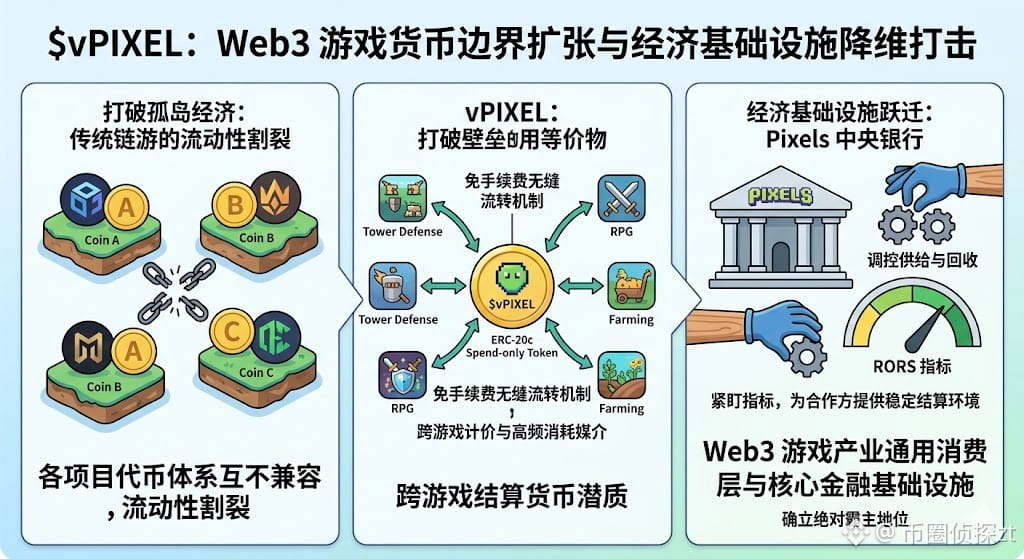
In the history of currency evolution, true cross-border circulation often starts with the elimination of trading friction. The definition of $vPIXEL in the whitepaper @pixels — a "Spend-only Token" based on ERC-20c technology — seems designed to sidestep the sell pressure of the main coin, but it's actually brewing a currency boundary expansion in the Web3 gaming arena.
Breaking the "island economy" with a universal equivalent
Currently, the blockchain gaming sector is generally plagued by an "island economy," where the token systems of various projects are incompatible, leading to extreme liquidity fragmentation. In the decentralized publishing blueprint outlined by Pixels, $vPIXEL acts as the universal equivalent that breaks down barriers. When a vast number of external sub-games connect to this network, they don’t need to build extremely fragile underlying token models from scratch; instead, they can directly use $vPIXEL as the pricing metric for internal goods and a medium for high-frequency consumption. This fee-free seamless flow mechanism allows $vPIXEL to break free from the limitations of a single farming scenario, starting to show real potential to become a "cross-game settlement currency."
A leap from application layer to "economic infrastructure"
If an address can earn $vPIXEL in a tower defense sub-game and then frictionlessly spend it on crafting gear in another role-playing game, Pixels would undergo a fundamental dimensional shift in its industry status. At this point, it’s no longer just a decentralized app store providing a traffic entry point; it transforms into the "underlying central bank" of the entire blockchain gaming ecosystem. By closely monitoring RORS (Return on Reward Spend), Pixels macroscopically adjusts the total supply and recycling of $vPIXEL across the network, providing all partners with a stable settlement environment.
Once the cross-ecosystem circulation network of $vPIXEL is fully formed, Pixels' moat will extend infinitely outward. It will completely transcend the traditional definition of a gaming platform, establishing itself as the absolute dominant force in the Web3 gaming industry’s universal consumption layer and core financial infrastructure. #pixel $PIXEL
{future}(PIXELUSDT)
In the history of currency evolution, true cross-border circulation often starts with the elimination of trading friction. The definition of $vPIXEL in the whitepaper @Pixels — a "Spend-only Token" based on ERC-20c technology — seems designed to sidestep the sell pressure of the main coin, but it's actually brewing a currency boundary expansion in the Web3 gaming arena.
Breaking the "island economy" with a universal equivalent
Currently, the blockchain gaming sector is generally plagued by an "island economy," where the token systems of various projects are incompatible, leading to extreme liquidity fragmentation. In the decentralized publishing blueprint outlined by Pixels, $vPIXEL acts as the universal equivalent that breaks down barriers. When a vast number of external sub-games connect to this network, they don’t need to build extremely fragile underlying token models from scratch; instead, they can directly use $vPIXEL as the pricing metric for internal goods and a medium for high-frequency consumption. This fee-free seamless flow mechanism allows $vPIXEL to break free from the limitations of a single farming scenario, starting to show real potential to become a "cross-game settlement currency."
A leap from application layer to "economic infrastructure"
If an address can earn $vPIXEL in a tower defense sub-game and then frictionlessly spend it on crafting gear in another role-playing game, Pixels would undergo a fundamental dimensional shift in its industry status. At this point, it’s no longer just a decentralized app store providing a traffic entry point; it transforms into the "underlying central bank" of the entire blockchain gaming ecosystem. By closely monitoring RORS (Return on Reward Spend), Pixels macroscopically adjusts the total supply and recycling of $vPIXEL across the network, providing all partners with a stable settlement environment.
Once the cross-ecosystem circulation network of $vPIXEL is fully formed, Pixels' moat will extend infinitely outward. It will completely transcend the traditional definition of a gaming platform, establishing itself as the absolute dominant force in the Web3 gaming industry’s universal consumption layer and core financial infrastructure. #pixel $PIXEL
Breaking the "island economy" with a universal equivalent
Currently, the blockchain gaming sector is generally plagued by an "island economy," where the token systems of various projects are incompatible, leading to extreme liquidity fragmentation. In the decentralized publishing blueprint outlined by Pixels, $vPIXEL acts as the universal equivalent that breaks down barriers. When a vast number of external sub-games connect to this network, they don’t need to build extremely fragile underlying token models from scratch; instead, they can directly use $vPIXEL as the pricing metric for internal goods and a medium for high-frequency consumption. This fee-free seamless flow mechanism allows $vPIXEL to break free from the limitations of a single farming scenario, starting to show real potential to become a "cross-game settlement currency."
A leap from application layer to "economic infrastructure"
If an address can earn $vPIXEL in a tower defense sub-game and then frictionlessly spend it on crafting gear in another role-playing game, Pixels would undergo a fundamental dimensional shift in its industry status. At this point, it’s no longer just a decentralized app store providing a traffic entry point; it transforms into the "underlying central bank" of the entire blockchain gaming ecosystem. By closely monitoring RORS (Return on Reward Spend), Pixels macroscopically adjusts the total supply and recycling of $vPIXEL across the network, providing all partners with a stable settlement environment.
Once the cross-ecosystem circulation network of $vPIXEL is fully formed, Pixels' moat will extend infinitely outward. It will completely transcend the traditional definition of a gaming platform, establishing itself as the absolute dominant force in the Web3 gaming industry’s universal consumption layer and core financial infrastructure. #pixel $PIXEL
219
·
--
Article
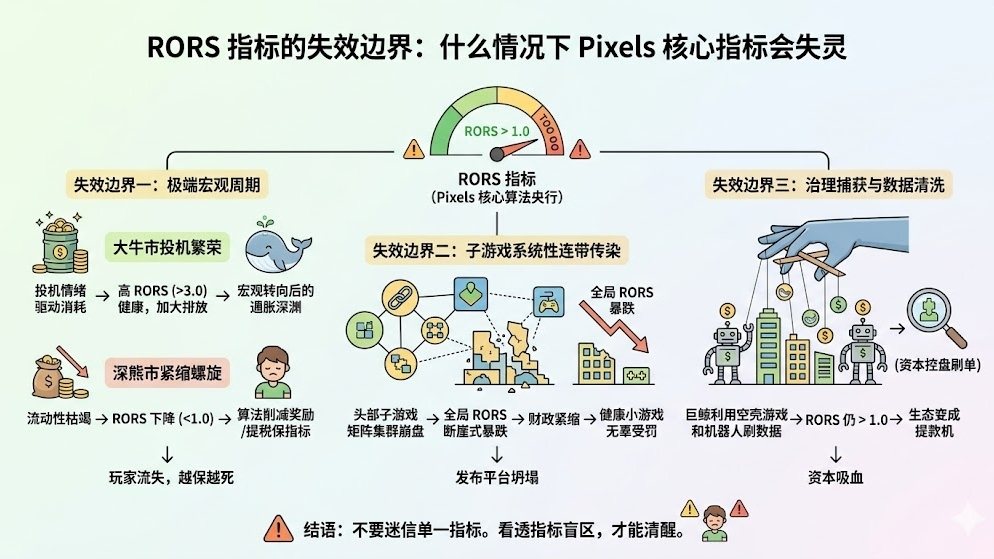
RORS Metric's Failure Boundaries: Under What Conditions Will Pixels' Core Metrics Fail?In Pixels' latest strategic white paper, RORS (Return on Reward Spend) is positioned as the ecosystem's 'North Star metric.' The white paper confidently states that as long as RORS is maintained above 1.0 (meaning for every 1 token spent in rewards, it generates more than 1 token in net ecosystem revenue), <a>...</a> it can completely escape the death spiral of traditional Play-to-Earn and achieve perpetual operation.
From an economic design perspective, RORS really does outperform traditional DAU (Daily Active Users) or trading volume metrics by several dimensions. However, any economic model penned in a white paper assumes the market operates in an 'ideal rational state.' When we stress-test this model in the brutally speculative real-world environment of Web3, we find that the proud algorithm has three extremely dangerous failure boundaries.
RORS Metric's Failure Boundaries: Under What Conditions Will Pixels' Core Metrics Fail?
In Pixels' latest strategic white paper, RORS (Return on Reward Spend) is positioned as the ecosystem's 'North Star metric.' The white paper confidently states that as long as RORS is maintained above 1.0 (meaning for every 1 token spent in rewards, it generates more than 1 token in net ecosystem revenue), <a>...</a> it can completely escape the death spiral of traditional Play-to-Earn and achieve perpetual operation.
From an economic design perspective, RORS really does outperform traditional DAU (Daily Active Users) or trading volume metrics by several dimensions. However, any economic model penned in a white paper assumes the market operates in an 'ideal rational state.' When we stress-test this model in the brutally speculative real-world environment of Web3, we find that the proud algorithm has three extremely dangerous failure boundaries.
From an economic design perspective, RORS really does outperform traditional DAU (Daily Active Users) or trading volume metrics by several dimensions. However, any economic model penned in a white paper assumes the market operates in an 'ideal rational state.' When we stress-test this model in the brutally speculative real-world environment of Web3, we find that the proud algorithm has three extremely dangerous failure boundaries.
1
1
161
·
--
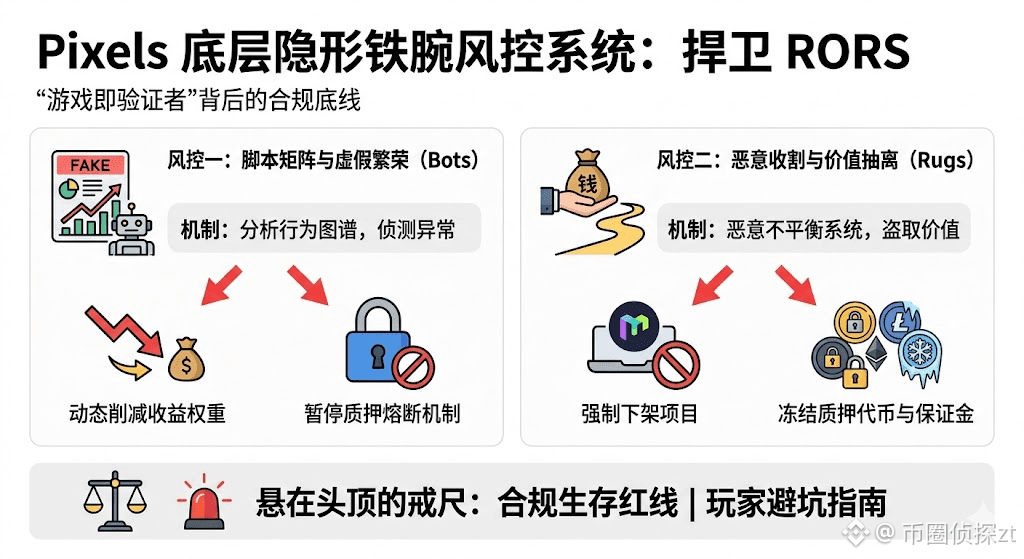
While flipping through the latest strategic document for @pixels , I was met with terms like 'ecosystem support' and 'reward alignment' everywhere. The team has boldly introduced an innovative model where 'gaming equals validation,' promising to distribute tokens to quality sub-games based on player retention and spending data. However, as a scrutinizer focused on Web3 compliance and anti-fraud, we need to uncover the shadows behind this sunny document: where there's massive token emissions, there are inevitably lurking gray market schemes attempting to pull something shady.
To defend the baseline of RORS (Reward Outlay Return Rate), the officials have embedded a 'hardcore risk control system' in the underlying smart contracts that is conveniently left out of the whitepaper.
Since traffic data is directly linked to token distribution, there are bound to be subpar dev teams trying to game the system by deploying bot scripts in bulk and faking on-chain activity to siphon off the system's $PIXEL emissions.
In response to this 'data spamming' behavior, Pixels' backend smart analysis engine will trigger penalties as soon as it detects an abnormal concentration of activity patterns. Step one is cutting incentives, forcibly downgrading the game's revenue weight; if violations persist, it kicks in a halting mechanism for staking. The dedicated staking pool for the implicated game will be physically locked, completely severing its new funding and traffic channels.
An even worse scenario is that some project teams might disguise themselves under the guise of ecological construction, exploiting an imbalanced numerical system to maliciously harvest players' earned $vPIXEL and try to cash out quickly.
For such actions that directly undermine the cornerstone of ecological trust, the system will reveal its harshest card: mandatory delisting. Not only will this game be instantly erased from the release platform, but to compensate for the losses to players and the ecosystem, the system's risk control protocol is likely to trigger staking freezes. The tokens used by malicious project teams as an entry deposit or protective staking will be directly locked and may even be confiscated by the system.
'Gaming equals validation' grants sub-games significant autonomy, but this also means extremely high compliance requirements. On this decentralized release platform, there are no unregulated ATMs. Understanding this covert penalty mechanism is not only a survival red line that B-end developers must avoid crossing, but also a core guideline for regular players to grasp when choosing to stake in the game pool. #pixel $PIXEL
{future}(PIXELUSDT)
While flipping through the latest strategic document for @Pixels , I was met with terms like 'ecosystem support' and 'reward alignment' everywhere. The team has boldly introduced an innovative model where 'gaming equals validation,' promising to distribute tokens to quality sub-games based on player retention and spending data. However, as a scrutinizer focused on Web3 compliance and anti-fraud, we need to uncover the shadows behind this sunny document: where there's massive token emissions, there are inevitably lurking gray market schemes attempting to pull something shady.
To defend the baseline of RORS (Reward Outlay Return Rate), the officials have embedded a 'hardcore risk control system' in the underlying smart contracts that is conveniently left out of the whitepaper.
Since traffic data is directly linked to token distribution, there are bound to be subpar dev teams trying to game the system by deploying bot scripts in bulk and faking on-chain activity to siphon off the system's $PIXEL emissions.
In response to this 'data spamming' behavior, Pixels' backend smart analysis engine will trigger penalties as soon as it detects an abnormal concentration of activity patterns. Step one is cutting incentives, forcibly downgrading the game's revenue weight; if violations persist, it kicks in a halting mechanism for staking. The dedicated staking pool for the implicated game will be physically locked, completely severing its new funding and traffic channels.
An even worse scenario is that some project teams might disguise themselves under the guise of ecological construction, exploiting an imbalanced numerical system to maliciously harvest players' earned $vPIXEL and try to cash out quickly.
For such actions that directly undermine the cornerstone of ecological trust, the system will reveal its harshest card: mandatory delisting. Not only will this game be instantly erased from the release platform, but to compensate for the losses to players and the ecosystem, the system's risk control protocol is likely to trigger staking freezes. The tokens used by malicious project teams as an entry deposit or protective staking will be directly locked and may even be confiscated by the system.
'Gaming equals validation' grants sub-games significant autonomy, but this also means extremely high compliance requirements. On this decentralized release platform, there are no unregulated ATMs. Understanding this covert penalty mechanism is not only a survival red line that B-end developers must avoid crossing, but also a core guideline for regular players to grasp when choosing to stake in the game pool. #pixel $PIXEL
To defend the baseline of RORS (Reward Outlay Return Rate), the officials have embedded a 'hardcore risk control system' in the underlying smart contracts that is conveniently left out of the whitepaper.
Since traffic data is directly linked to token distribution, there are bound to be subpar dev teams trying to game the system by deploying bot scripts in bulk and faking on-chain activity to siphon off the system's $PIXEL emissions.
In response to this 'data spamming' behavior, Pixels' backend smart analysis engine will trigger penalties as soon as it detects an abnormal concentration of activity patterns. Step one is cutting incentives, forcibly downgrading the game's revenue weight; if violations persist, it kicks in a halting mechanism for staking. The dedicated staking pool for the implicated game will be physically locked, completely severing its new funding and traffic channels.
An even worse scenario is that some project teams might disguise themselves under the guise of ecological construction, exploiting an imbalanced numerical system to maliciously harvest players' earned $vPIXEL and try to cash out quickly.
For such actions that directly undermine the cornerstone of ecological trust, the system will reveal its harshest card: mandatory delisting. Not only will this game be instantly erased from the release platform, but to compensate for the losses to players and the ecosystem, the system's risk control protocol is likely to trigger staking freezes. The tokens used by malicious project teams as an entry deposit or protective staking will be directly locked and may even be confiscated by the system.
'Gaming equals validation' grants sub-games significant autonomy, but this also means extremely high compliance requirements. On this decentralized release platform, there are no unregulated ATMs. Understanding this covert penalty mechanism is not only a survival red line that B-end developers must avoid crossing, but also a core guideline for regular players to grasp when choosing to stake in the game pool. #pixel $PIXEL
1
170
·
--
In the age of Pixels 2.0, where the screen is filled with RORS (Return on Rewards), VIP thresholds, and token staking battles, casual players seem to easily fall into anxiety: either turn into a grinding "studio" or be forced to shell out cash to get involved in the capital game. But if you only have less than an hour each day and don’t want to spend money or be "trapped" by the game, is there still room to survive in this ecosystem?
The answer is yes. If you carefully review the latest white paper, you’ll find that before those hardcore economic formulas, the primary pillar of the ecosystem boldly states—"Fun First." The official promise is to reintroduce the social and casual mechanisms that initially propelled Pixels to fame. This is exactly the playground for us laid-back players.
Not buying VIP or participating in staking means we are voluntarily stepping out of the high-yield resource competition, but that’s actually a relief. Logging in for half an hour each day, your goal isn’t to obsess over the ROI of fertilizers and seeds; instead, treat this place like a pixelated virtual metaverse. Chat with passersby at Fountain Square and in the global chat, or stroll through a beautifully decorated mansion of a top player. Complete some light daily tasks without time limits, casually collect some free decorative items, and enjoy a slow-paced rural life.
As @pixels transitions to a decentralized publishing platform, a massive variety of sub-games will be integrated in the future. As casual players, we can totally view Pixels as a "free curated gaming lounge." You don’t need to use any funds to participate in sub-game rankings; just enjoy the experience for free. Play some pixel tower defense today, try casual puzzles tomorrow, stay longer if it's fun, or one-click exit if it's not. Without any financial stake, you perfectly dodge all the "tricks" and sunk costs from project teams.
In this vast economy, big players are calculating ROI, and project teams are fighting for liquidity. Meanwhile, we just need to be easygoing "wanderers." Don’t worry about token price fluctuations, don’t check on grinding profits, and enjoy that half-hour of fun in the most relaxed way possible. #pixel $PIXEL
{future}(PIXELUSDT)
In the age of Pixels 2.0, where the screen is filled with RORS (Return on Rewards), VIP thresholds, and token staking battles, casual players seem to easily fall into anxiety: either turn into a grinding "studio" or be forced to shell out cash to get involved in the capital game. But if you only have less than an hour each day and don’t want to spend money or be "trapped" by the game, is there still room to survive in this ecosystem?
The answer is yes. If you carefully review the latest white paper, you’ll find that before those hardcore economic formulas, the primary pillar of the ecosystem boldly states—"Fun First." The official promise is to reintroduce the social and casual mechanisms that initially propelled Pixels to fame. This is exactly the playground for us laid-back players.
Not buying VIP or participating in staking means we are voluntarily stepping out of the high-yield resource competition, but that’s actually a relief. Logging in for half an hour each day, your goal isn’t to obsess over the ROI of fertilizers and seeds; instead, treat this place like a pixelated virtual metaverse. Chat with passersby at Fountain Square and in the global chat, or stroll through a beautifully decorated mansion of a top player. Complete some light daily tasks without time limits, casually collect some free decorative items, and enjoy a slow-paced rural life.
As @Pixels transitions to a decentralized publishing platform, a massive variety of sub-games will be integrated in the future. As casual players, we can totally view Pixels as a "free curated gaming lounge." You don’t need to use any funds to participate in sub-game rankings; just enjoy the experience for free. Play some pixel tower defense today, try casual puzzles tomorrow, stay longer if it's fun, or one-click exit if it's not. Without any financial stake, you perfectly dodge all the "tricks" and sunk costs from project teams.
In this vast economy, big players are calculating ROI, and project teams are fighting for liquidity. Meanwhile, we just need to be easygoing "wanderers." Don’t worry about token price fluctuations, don’t check on grinding profits, and enjoy that half-hour of fun in the most relaxed way possible. #pixel $PIXEL
The answer is yes. If you carefully review the latest white paper, you’ll find that before those hardcore economic formulas, the primary pillar of the ecosystem boldly states—"Fun First." The official promise is to reintroduce the social and casual mechanisms that initially propelled Pixels to fame. This is exactly the playground for us laid-back players.
Not buying VIP or participating in staking means we are voluntarily stepping out of the high-yield resource competition, but that’s actually a relief. Logging in for half an hour each day, your goal isn’t to obsess over the ROI of fertilizers and seeds; instead, treat this place like a pixelated virtual metaverse. Chat with passersby at Fountain Square and in the global chat, or stroll through a beautifully decorated mansion of a top player. Complete some light daily tasks without time limits, casually collect some free decorative items, and enjoy a slow-paced rural life.
As @Pixels transitions to a decentralized publishing platform, a massive variety of sub-games will be integrated in the future. As casual players, we can totally view Pixels as a "free curated gaming lounge." You don’t need to use any funds to participate in sub-game rankings; just enjoy the experience for free. Play some pixel tower defense today, try casual puzzles tomorrow, stay longer if it's fun, or one-click exit if it's not. Without any financial stake, you perfectly dodge all the "tricks" and sunk costs from project teams.
In this vast economy, big players are calculating ROI, and project teams are fighting for liquidity. Meanwhile, we just need to be easygoing "wanderers." Don’t worry about token price fluctuations, don’t check on grinding profits, and enjoy that half-hour of fun in the most relaxed way possible. #pixel $PIXEL

408
·
--
Article
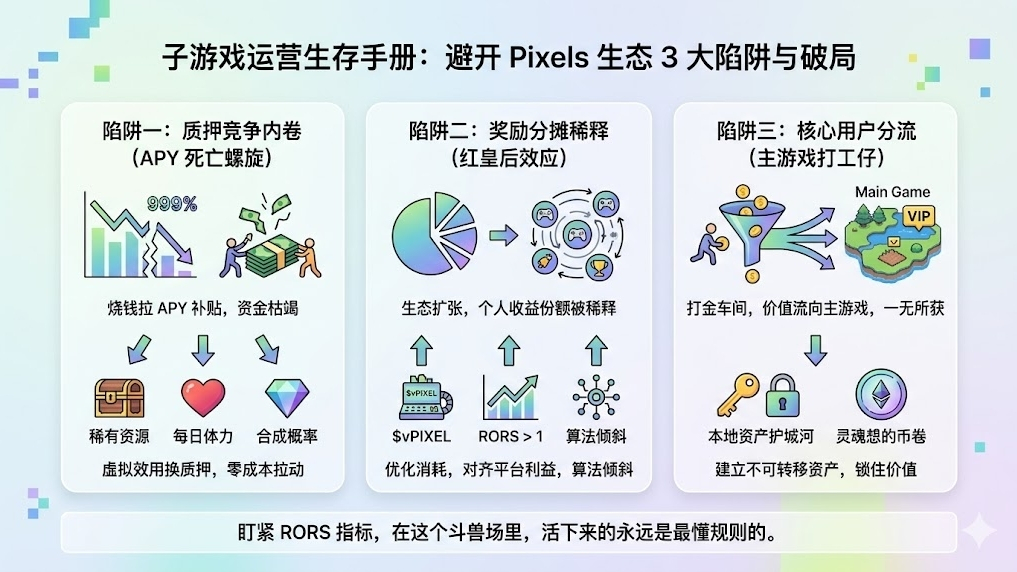
Survival Guide for Sub-game Operators: Avoiding 3 Hidden Loss Traps in the Pixels EcosystemRecently, a lot of friends in the chain game space have been asking me if they should dive into the @pixels ecosystem onboarding. To be honest, acquiring users for Web3 games is outrageously expensive; casually bringing in one user can cost hundreds of dollars, and many small teams can’t survive past three months. At this point, the "decentralized publishing platform" that Pixels has drawn up is indeed tempting—with ready-made millions of DAU and the so-called "publishing flywheel" that can help you acquire users at a low cost. No wonder the teams waiting to get onboard can circle around multiple times.
But let me throw some cold water on this: the bigger the pie the platform draws, the deeper the pit underneath. The white paper only says, "the game itself is the validator," which sounds cool, but what it doesn’t tell you is that you’re no longer just a developer quietly creating content; you’re thrown straight into an arena fighting for liquidity and token emission rights.
Survival Guide for Sub-game Operators: Avoiding 3 Hidden Loss Traps in the Pixels Ecosystem
Recently, a lot of friends in the chain game space have been asking me if they should dive into the @Pixels ecosystem onboarding. To be honest, acquiring users for Web3 games is outrageously expensive; casually bringing in one user can cost hundreds of dollars, and many small teams can’t survive past three months. At this point, the "decentralized publishing platform" that Pixels has drawn up is indeed tempting—with ready-made millions of DAU and the so-called "publishing flywheel" that can help you acquire users at a low cost. No wonder the teams waiting to get onboard can circle around multiple times.
But let me throw some cold water on this: the bigger the pie the platform draws, the deeper the pit underneath. The white paper only says, "the game itself is the validator," which sounds cool, but what it doesn’t tell you is that you’re no longer just a developer quietly creating content; you’re thrown straight into an arena fighting for liquidity and token emission rights.
But let me throw some cold water on this: the bigger the pie the platform draws, the deeper the pit underneath. The white paper only says, "the game itself is the validator," which sounds cool, but what it doesn’t tell you is that you’re no longer just a developer quietly creating content; you’re thrown straight into an arena fighting for liquidity and token emission rights.
1
1
411
·
--
The whitepaper only says, "attract better games," but doesn't clarify—what exactly qualifies as 'better'?
Breaking down that "launch flywheel," you'll uncover three layers of undisclosed vetting criteria.
First layer: Gameplay must "generate data." The whitepaper demands games produce "richer player data." To put it simply: if your gameplay is just a reskin of a farm game with no new user behavior dimensions (like new interactions or decision variables), the ecosystem won't accept it. If data doesn't grow, targeting won't be precise, and the flywheel won't spin.
Second layer: Anti-cheat capabilities must be solid. The whitepaper emphasizes "bot detection" and "on-chain reputation systems." Games must integrate with this framework and withstand bulk account manipulation. Otherwise, fake users flood in, RORS will skew, and ecosystem rewards will go to the wrong people—instant red card on the vetting process.
Third layer: The economy must be a closed loop. The whitepaper states that the sub-games ultimately serve as "validators" and must compete for player staking. The standards are straightforward: "high net in-game spending" plus "retention rates." This means games can't be designed for players to just cash out; they should encourage reinvestment. Withdrawal-type economic models will be rejected right off the bat.
After filtering through these three layers, you'll find: Pixels isn't just recruiting games; it's sourcing "data contributors" and "economic stabilizers." The unspoken rules of the whitepaper are the real access ticket. #pixel $PIXEL @pixels
{future}(PIXELUSDT)
The whitepaper only says, "attract better games," but doesn't clarify—what exactly qualifies as 'better'?
Breaking down that "launch flywheel," you'll uncover three layers of undisclosed vetting criteria.
First layer: Gameplay must "generate data." The whitepaper demands games produce "richer player data." To put it simply: if your gameplay is just a reskin of a farm game with no new user behavior dimensions (like new interactions or decision variables), the ecosystem won't accept it. If data doesn't grow, targeting won't be precise, and the flywheel won't spin.
Second layer: Anti-cheat capabilities must be solid. The whitepaper emphasizes "bot detection" and "on-chain reputation systems." Games must integrate with this framework and withstand bulk account manipulation. Otherwise, fake users flood in, RORS will skew, and ecosystem rewards will go to the wrong people—instant red card on the vetting process.
Third layer: The economy must be a closed loop. The whitepaper states that the sub-games ultimately serve as "validators" and must compete for player staking. The standards are straightforward: "high net in-game spending" plus "retention rates." This means games can't be designed for players to just cash out; they should encourage reinvestment. Withdrawal-type economic models will be rejected right off the bat.
After filtering through these three layers, you'll find: Pixels isn't just recruiting games; it's sourcing "data contributors" and "economic stabilizers." The unspoken rules of the whitepaper are the real access ticket. #pixel $PIXEL @Pixels
Breaking down that "launch flywheel," you'll uncover three layers of undisclosed vetting criteria.
First layer: Gameplay must "generate data." The whitepaper demands games produce "richer player data." To put it simply: if your gameplay is just a reskin of a farm game with no new user behavior dimensions (like new interactions or decision variables), the ecosystem won't accept it. If data doesn't grow, targeting won't be precise, and the flywheel won't spin.
Second layer: Anti-cheat capabilities must be solid. The whitepaper emphasizes "bot detection" and "on-chain reputation systems." Games must integrate with this framework and withstand bulk account manipulation. Otherwise, fake users flood in, RORS will skew, and ecosystem rewards will go to the wrong people—instant red card on the vetting process.
Third layer: The economy must be a closed loop. The whitepaper states that the sub-games ultimately serve as "validators" and must compete for player staking. The standards are straightforward: "high net in-game spending" plus "retention rates." This means games can't be designed for players to just cash out; they should encourage reinvestment. Withdrawal-type economic models will be rejected right off the bat.
After filtering through these three layers, you'll find: Pixels isn't just recruiting games; it's sourcing "data contributors" and "economic stabilizers." The unspoken rules of the whitepaper are the real access ticket. #pixel $PIXEL @Pixels

331
·
--
Benchmarking AppsFlyer: How can Pixels provide the growth remedy for Web2 games?The traditional gaming growth sector has long been trapped in two extreme systems.
AppsFlyer is the backbone of a centralized Web2 growth ecosystem: data is private, traffic is monopolized, and customer acquisition costs are dictated solely by the platform, leaving small to medium developers stuck in a never-ending cost spiral. Meanwhile, most Web3 projects are fixated on the narrative of absolute decentralization, where limitless freedom leads to governance chaos, economic instability, and inefficient operations, forever remaining in niche experimental stages and unable to break into the mainstream Web2 gaming market.
While the whole industry deliberately avoids a 'compromise solution' and stands firmly on extreme routes, Pixels presents a brilliantly insightful answer in its new white paper: rejecting the fanciful idea of extreme decentralization, they propose a hybrid architecture that combines semi-centralized governance with decentralized issuance, breaking down the barriers between Web2 and Web3.
Benchmarking AppsFlyer: How can Pixels provide the growth remedy for Web2 games?
The traditional gaming growth sector has long been trapped in two extreme systems.
AppsFlyer is the backbone of a centralized Web2 growth ecosystem: data is private, traffic is monopolized, and customer acquisition costs are dictated solely by the platform, leaving small to medium developers stuck in a never-ending cost spiral. Meanwhile, most Web3 projects are fixated on the narrative of absolute decentralization, where limitless freedom leads to governance chaos, economic instability, and inefficient operations, forever remaining in niche experimental stages and unable to break into the mainstream Web2 gaming market.
While the whole industry deliberately avoids a 'compromise solution' and stands firmly on extreme routes, Pixels presents a brilliantly insightful answer in its new white paper: rejecting the fanciful idea of extreme decentralization, they propose a hybrid architecture that combines semi-centralized governance with decentralized issuance, breaking down the barriers between Web2 and Web3.
AppsFlyer is the backbone of a centralized Web2 growth ecosystem: data is private, traffic is monopolized, and customer acquisition costs are dictated solely by the platform, leaving small to medium developers stuck in a never-ending cost spiral. Meanwhile, most Web3 projects are fixated on the narrative of absolute decentralization, where limitless freedom leads to governance chaos, economic instability, and inefficient operations, forever remaining in niche experimental stages and unable to break into the mainstream Web2 gaming market.
While the whole industry deliberately avoids a 'compromise solution' and stands firmly on extreme routes, Pixels presents a brilliantly insightful answer in its new white paper: rejecting the fanciful idea of extreme decentralization, they propose a hybrid architecture that combines semi-centralized governance with decentralized issuance, breaking down the barriers between Web2 and Web3.
197
·
--
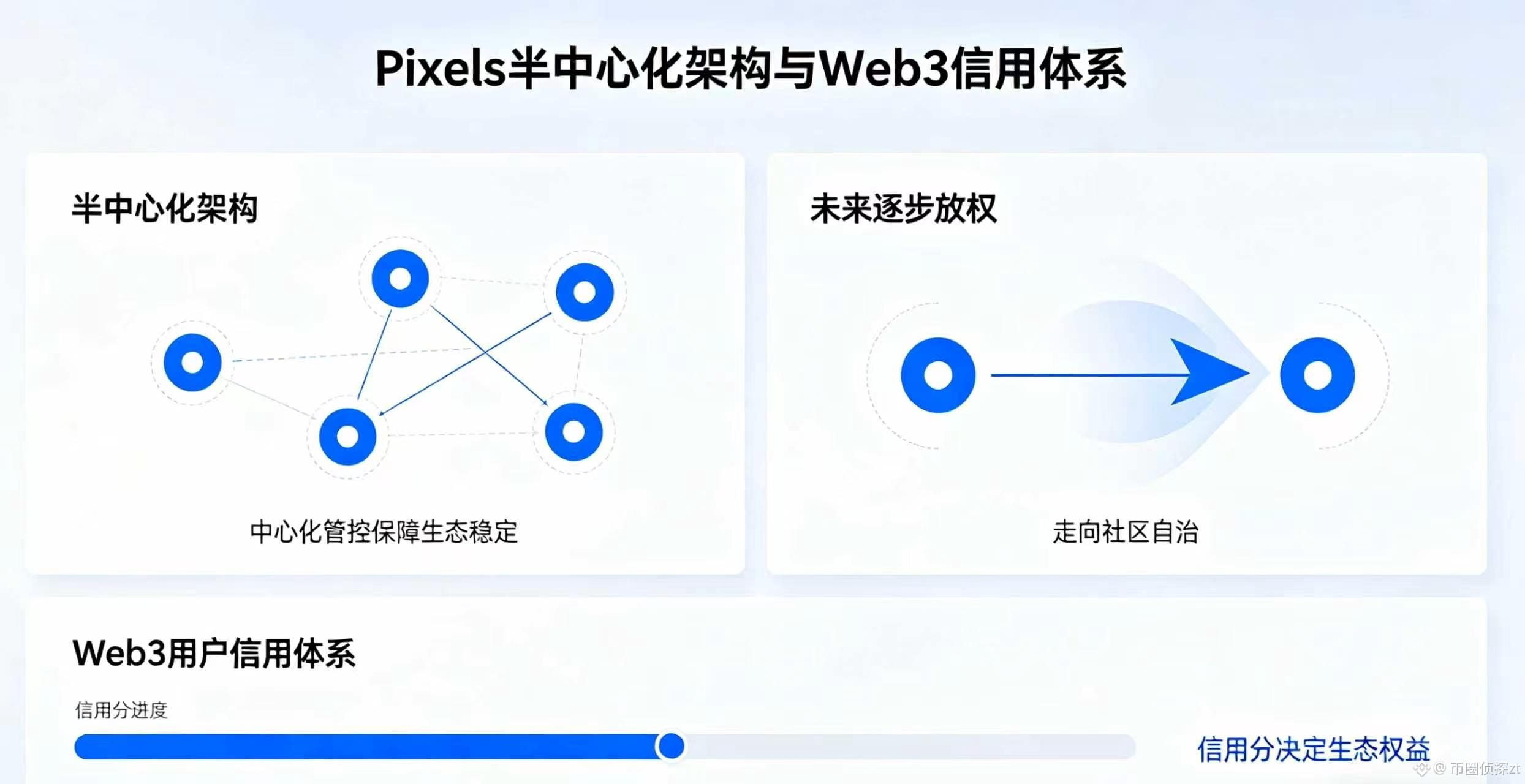
The market hails @pixels as the benchmark for decentralized gaming in Web3, but the white paper has already revealed the truth: it’s a semi-decentralized platform, with the core still under official control.
Pixels only decentralizes the traffic allocation phase; stakers can vote on the incentive quotas for sub-games, but the core powers like rule-making, economic model adjustments, and ecological risk control are always in the hands of the official team. RORS thresholds, withdrawal fees, token emissions, and sub-game review standards are all set uniformly by the officials, with stakers merely executing decisions.
This model avoids the inefficiency and chaos of pure decentralization, preventing community infighting and proposal mismanagement that could lead to ecological collapse. The officials guide the ecosystem through RORS and a smart reward system, directing resources towards quality players and games while weeding out speculators and low-quality projects.
The centralized control by the officials is a phased strategy; they will gradually decentralize powers, opening up voting on incentive rules and handing over parameter adjustment rights, ultimately moving towards community autonomy. The current model of "centralized steering, decentralized participation" is the core strength that allows Pixels to navigate cycles and solve the P2E dilemma.
Pixels isn’t just a gaming platform; it’s building the "user credit system" for Web3.
The strategy of Pixels has already transcended gaming; it is creating the first game-native user credit system in Web3.
The essence of the smart reward targeting system is to establish a unique credit score for each user, based on the user value model from the white paper. Actions like long-term retention, ecological consumption, long-term staking, and content creation will boost credit scores, while script operations, frequent withdrawals, and malicious dumping will lower scores.
Credit scores are the ecosystem’s invisible pass; high-scoring players can earn higher reward weights, lower withdrawal fees, priority access to new games, and whitelist unlocks; low-scoring users will face incentive restrictions and higher withdrawal costs, ultimately being filtered out by the ecosystem.
This system is built on real behavioral data rather than mere asset holdings, and it can expand across ecosystems in the future, becoming a universal credit certificate for chain games, DeFi, and NFTs. Pixels is no longer just an ordinary gaming platform; it is using gaming scenarios to solidify the rarest credit assets in Web3. #pixel $PIXEL
{future}(PIXELUSDT)
The market hails @Pixels as the benchmark for decentralized gaming in Web3, but the white paper has already revealed the truth: it’s a semi-decentralized platform, with the core still under official control.
Pixels only decentralizes the traffic allocation phase; stakers can vote on the incentive quotas for sub-games, but the core powers like rule-making, economic model adjustments, and ecological risk control are always in the hands of the official team. RORS thresholds, withdrawal fees, token emissions, and sub-game review standards are all set uniformly by the officials, with stakers merely executing decisions.
This model avoids the inefficiency and chaos of pure decentralization, preventing community infighting and proposal mismanagement that could lead to ecological collapse. The officials guide the ecosystem through RORS and a smart reward system, directing resources towards quality players and games while weeding out speculators and low-quality projects.
The centralized control by the officials is a phased strategy; they will gradually decentralize powers, opening up voting on incentive rules and handing over parameter adjustment rights, ultimately moving towards community autonomy. The current model of "centralized steering, decentralized participation" is the core strength that allows Pixels to navigate cycles and solve the P2E dilemma.
Pixels isn’t just a gaming platform; it’s building the "user credit system" for Web3.
The strategy of Pixels has already transcended gaming; it is creating the first game-native user credit system in Web3.
The essence of the smart reward targeting system is to establish a unique credit score for each user, based on the user value model from the white paper. Actions like long-term retention, ecological consumption, long-term staking, and content creation will boost credit scores, while script operations, frequent withdrawals, and malicious dumping will lower scores.
Credit scores are the ecosystem’s invisible pass; high-scoring players can earn higher reward weights, lower withdrawal fees, priority access to new games, and whitelist unlocks; low-scoring users will face incentive restrictions and higher withdrawal costs, ultimately being filtered out by the ecosystem.
This system is built on real behavioral data rather than mere asset holdings, and it can expand across ecosystems in the future, becoming a universal credit certificate for chain games, DeFi, and NFTs. Pixels is no longer just an ordinary gaming platform; it is using gaming scenarios to solidify the rarest credit assets in Web3. #pixel $PIXEL
Pixels only decentralizes the traffic allocation phase; stakers can vote on the incentive quotas for sub-games, but the core powers like rule-making, economic model adjustments, and ecological risk control are always in the hands of the official team. RORS thresholds, withdrawal fees, token emissions, and sub-game review standards are all set uniformly by the officials, with stakers merely executing decisions.
This model avoids the inefficiency and chaos of pure decentralization, preventing community infighting and proposal mismanagement that could lead to ecological collapse. The officials guide the ecosystem through RORS and a smart reward system, directing resources towards quality players and games while weeding out speculators and low-quality projects.
The centralized control by the officials is a phased strategy; they will gradually decentralize powers, opening up voting on incentive rules and handing over parameter adjustment rights, ultimately moving towards community autonomy. The current model of "centralized steering, decentralized participation" is the core strength that allows Pixels to navigate cycles and solve the P2E dilemma.
Pixels isn’t just a gaming platform; it’s building the "user credit system" for Web3.
The strategy of Pixels has already transcended gaming; it is creating the first game-native user credit system in Web3.
The essence of the smart reward targeting system is to establish a unique credit score for each user, based on the user value model from the white paper. Actions like long-term retention, ecological consumption, long-term staking, and content creation will boost credit scores, while script operations, frequent withdrawals, and malicious dumping will lower scores.
Credit scores are the ecosystem’s invisible pass; high-scoring players can earn higher reward weights, lower withdrawal fees, priority access to new games, and whitelist unlocks; low-scoring users will face incentive restrictions and higher withdrawal costs, ultimately being filtered out by the ecosystem.
This system is built on real behavioral data rather than mere asset holdings, and it can expand across ecosystems in the future, becoming a universal credit certificate for chain games, DeFi, and NFTs. Pixels is no longer just an ordinary gaming platform; it is using gaming scenarios to solidify the rarest credit assets in Web3. #pixel $PIXEL
1
298
·
--

Article
The 'Release Flywheel' Not Fully Covered in the White Paper: Three Fatal Flaws and Repair SolutionsWhile the whole industry is fawning over Pixels' "release flywheel," viewing it as the ultimate solution to break through in Web3 gaming, few have noticed: the white paper only depicts the flywheel's perfect forward cycle while deliberately omitting the three hidden prerequisites for its operation and the three fatal flaws currently being exposed.
This so-called "decentralized AppsFlyer" growth engine isn't born to self-operate in a perpetual cycle. Every part of it has a fragile balance point; once there's an issue in any segment, the whole flywheel could not only stop spinning but might even reverse, dragging the entire ecosystem into a death spiral.
The 'Release Flywheel' Not Fully Covered in the White Paper: Three Fatal Flaws and Repair Solutions
While the whole industry is fawning over Pixels' "release flywheel," viewing it as the ultimate solution to break through in Web3 gaming, few have noticed: the white paper only depicts the flywheel's perfect forward cycle while deliberately omitting the three hidden prerequisites for its operation and the three fatal flaws currently being exposed.
This so-called "decentralized AppsFlyer" growth engine isn't born to self-operate in a perpetual cycle. Every part of it has a fragile balance point; once there's an issue in any segment, the whole flywheel could not only stop spinning but might even reverse, dragging the entire ecosystem into a death spiral.
This so-called "decentralized AppsFlyer" growth engine isn't born to self-operate in a perpetual cycle. Every part of it has a fragile balance point; once there's an issue in any segment, the whole flywheel could not only stop spinning but might even reverse, dragging the entire ecosystem into a death spiral.
246
·
--

Article
From 'Play to Earn' to 'Contribute to Earn': The Final Act of P2E as Predicted in the Pixels WhitepaperAfter five years hustling in the P2E space, I’ve seen the wildest wealth creation myths and the harshest crash scenes. In 2021, Axie Infinity had Southeast Asian players raking in thousands of dollars a month through 'gold farming'. I had friends quitting their jobs to dive full-time, convinced the era of 'earning money through gaming' had arrived. By 2025, I watched as big-name projects like (embersword) and (nyanheroes), which had raised over a hundred million, shut down one after another, with industry funding plummeting 68% for the year. At least 17 well-known blockchain games announced they were halting development, and everywhere you looked, there were cries of 'P2E is dead'.
Everyone's asking: Has P2E really hit a dead end? It wasn't until I read the Pixels whitepaper four times that it suddenly clicked for me: what’s really dying isn’t the idea that 'players can earn from games', but rather the early-phase Ponzi dream of 'play and earn'. What Pixels lays out in its whitepaper isn’t just another skin-deep blockchain game story; it’s the final act of P2E’s second half — shifting from 'play to earn' to 'contribute to earn'. This isn’t the end of P2E; it’s its true coming-of-age.
From 'Play to Earn' to 'Contribute to Earn': The Final Act of P2E as Predicted in the Pixels Whitepaper
After five years hustling in the P2E space, I’ve seen the wildest wealth creation myths and the harshest crash scenes. In 2021, Axie Infinity had Southeast Asian players raking in thousands of dollars a month through 'gold farming'. I had friends quitting their jobs to dive full-time, convinced the era of 'earning money through gaming' had arrived. By 2025, I watched as big-name projects like (embersword) and (nyanheroes), which had raised over a hundred million, shut down one after another, with industry funding plummeting 68% for the year. At least 17 well-known blockchain games announced they were halting development, and everywhere you looked, there were cries of 'P2E is dead'.
Everyone's asking: Has P2E really hit a dead end? It wasn't until I read the Pixels whitepaper four times that it suddenly clicked for me: what’s really dying isn’t the idea that 'players can earn from games', but rather the early-phase Ponzi dream of 'play and earn'. What Pixels lays out in its whitepaper isn’t just another skin-deep blockchain game story; it’s the final act of P2E’s second half — shifting from 'play to earn' to 'contribute to earn'. This isn’t the end of P2E; it’s its true coming-of-age.
Everyone's asking: Has P2E really hit a dead end? It wasn't until I read the Pixels whitepaper four times that it suddenly clicked for me: what’s really dying isn’t the idea that 'players can earn from games', but rather the early-phase Ponzi dream of 'play and earn'. What Pixels lays out in its whitepaper isn’t just another skin-deep blockchain game story; it’s the final act of P2E’s second half — shifting from 'play to earn' to 'contribute to earn'. This isn’t the end of P2E; it’s its true coming-of-age.
2
1
417
·
--
For a long time, the marketing scene in Web3 has been flooded with a lot of ineffective noise: everywhere you look, there are airdrop announcements, bulk automated interaction scripts, fake social media retweets, and inflated activity metrics generated by bots. Many project teams have spent a ton of cash on marketing, only to attract not real players, but opportunistic 'wool farmers.'
@pixels 2.0 The release of the white paper is actually a proactive shift against this ineffective marketing. It proposes a solution that is a data-driven infrastructure built on the genuine behavior of a large player base.
In this adjustment of incentive mechanisms, Pixels has achieved a core transformation from 'blindly attracting attention' to 'precisely extracting value.' Traditional Web3 marketing is like throwing money into a black box without knowing if it's worth it; however, the decentralized distribution network created by Pixels acts more like a precise filtering tool. Leveraging extensive data analysis and machine learning, the platform can see through the superficial fake activity and accurately identify the truly valuable players—those who are willing to stick around in the game, use $vPIXEL for spending, and are inclined to pay for upgrades.
The key to really reducing this marketing noise lies in the core metric set in the white paper: RORS (Reward Outlay Return Score).
The reason fake marketing has proliferated is that the cost of violating regulations is lower than the blind subsidies from platforms. But in Pixels' new model, the power of traffic allocation is given to cautious stakers. If a particular game attracts only accounts that are just farming rewards without contributing, its RORS data will reflect poorly. The smart system will quickly identify such ineffective placements and automatically halt reward support for them. When fake operations can no longer yield rewards, those bot farms will naturally exit as their profits dry up.
Pixels' model sends a message to the entire industry: to resolve the chaotic state of Web3 marketing, it's not about more complex anti-farming verifications, but about changing the basis for reward distribution from 'activity data' to 'real value contribution data.' This also signifies that user growth in Web3 has finally transitioned from a reckless cash-splashing phase to a more rational stage that values return on investment. #pixel $PIXEL
{future}(PIXELUSDT)
For a long time, the marketing scene in Web3 has been flooded with a lot of ineffective noise: everywhere you look, there are airdrop announcements, bulk automated interaction scripts, fake social media retweets, and inflated activity metrics generated by bots. Many project teams have spent a ton of cash on marketing, only to attract not real players, but opportunistic 'wool farmers.'
@Pixels 2.0 The release of the white paper is actually a proactive shift against this ineffective marketing. It proposes a solution that is a data-driven infrastructure built on the genuine behavior of a large player base.
In this adjustment of incentive mechanisms, Pixels has achieved a core transformation from 'blindly attracting attention' to 'precisely extracting value.' Traditional Web3 marketing is like throwing money into a black box without knowing if it's worth it; however, the decentralized distribution network created by Pixels acts more like a precise filtering tool. Leveraging extensive data analysis and machine learning, the platform can see through the superficial fake activity and accurately identify the truly valuable players—those who are willing to stick around in the game, use $vPIXEL for spending, and are inclined to pay for upgrades.
The key to really reducing this marketing noise lies in the core metric set in the white paper: RORS (Reward Outlay Return Score).
The reason fake marketing has proliferated is that the cost of violating regulations is lower than the blind subsidies from platforms. But in Pixels' new model, the power of traffic allocation is given to cautious stakers. If a particular game attracts only accounts that are just farming rewards without contributing, its RORS data will reflect poorly. The smart system will quickly identify such ineffective placements and automatically halt reward support for them. When fake operations can no longer yield rewards, those bot farms will naturally exit as their profits dry up.
Pixels' model sends a message to the entire industry: to resolve the chaotic state of Web3 marketing, it's not about more complex anti-farming verifications, but about changing the basis for reward distribution from 'activity data' to 'real value contribution data.' This also signifies that user growth in Web3 has finally transitioned from a reckless cash-splashing phase to a more rational stage that values return on investment. #pixel $PIXEL
@Pixels 2.0 The release of the white paper is actually a proactive shift against this ineffective marketing. It proposes a solution that is a data-driven infrastructure built on the genuine behavior of a large player base.
In this adjustment of incentive mechanisms, Pixels has achieved a core transformation from 'blindly attracting attention' to 'precisely extracting value.' Traditional Web3 marketing is like throwing money into a black box without knowing if it's worth it; however, the decentralized distribution network created by Pixels acts more like a precise filtering tool. Leveraging extensive data analysis and machine learning, the platform can see through the superficial fake activity and accurately identify the truly valuable players—those who are willing to stick around in the game, use $vPIXEL for spending, and are inclined to pay for upgrades.
The key to really reducing this marketing noise lies in the core metric set in the white paper: RORS (Reward Outlay Return Score).
The reason fake marketing has proliferated is that the cost of violating regulations is lower than the blind subsidies from platforms. But in Pixels' new model, the power of traffic allocation is given to cautious stakers. If a particular game attracts only accounts that are just farming rewards without contributing, its RORS data will reflect poorly. The smart system will quickly identify such ineffective placements and automatically halt reward support for them. When fake operations can no longer yield rewards, those bot farms will naturally exit as their profits dry up.
Pixels' model sends a message to the entire industry: to resolve the chaotic state of Web3 marketing, it's not about more complex anti-farming verifications, but about changing the basis for reward distribution from 'activity data' to 'real value contribution data.' This also signifies that user growth in Web3 has finally transitioned from a reckless cash-splashing phase to a more rational stage that values return on investment. #pixel $PIXEL

2
1
223
·
--
Article
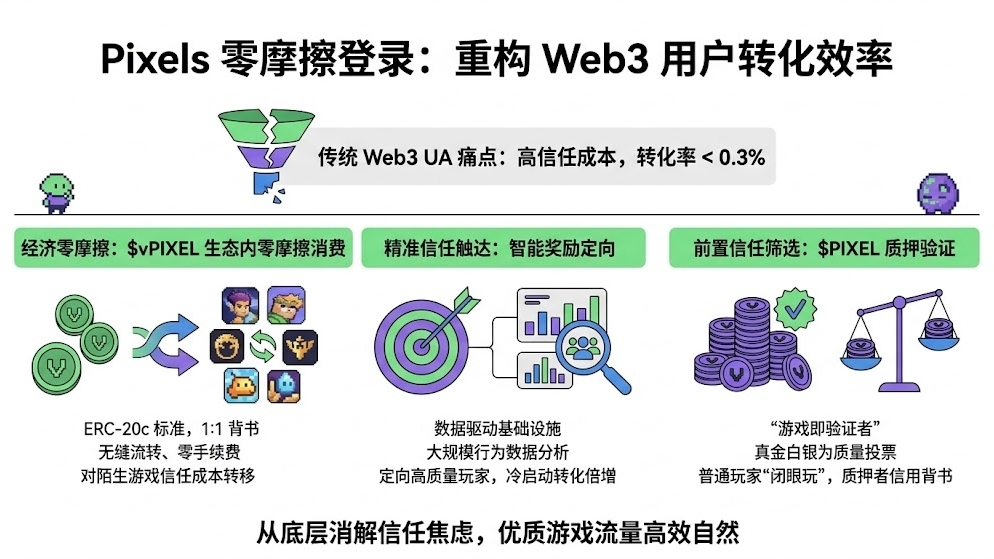
The 'Trust Cost' of Web3 Games: How Pixels' Zero-Friction Login Can Redefine User Conversion Efficiency?In the years I've spent making Web3 games, I've crunched some painful numbers: our team has spent hundreds of thousands of dollars on marketing, and from user clicks on ads to actually entering the game and making their first purchase, the full funnel conversion rate is less than 0.3%. The bottleneck in the conversion funnel has never been a lack of engaging gameplay; it's the inherent high trust costs of Web3.
In the traditional Web2 world, the trust barrier for players trying out a new game is almost zero—just click to download, and if they don't like it, they can uninstall anytime without any extra costs. But in the Web3 gaming space, this conversion funnel is ridiculously steep: the requirement to hold NFTs, complicated wallet signature authorizations, confusing cross-chain operations, and the ever-present Gas fees. Every interaction drains player trust a bit more, ultimately leading to sky-high user acquisition (UA) costs for the entire industry. This is a major headache for me and most of the folks in the field.
The 'Trust Cost' of Web3 Games: How Pixels' Zero-Friction Login Can Redefine User Conversion Efficiency?
In the years I've spent making Web3 games, I've crunched some painful numbers: our team has spent hundreds of thousands of dollars on marketing, and from user clicks on ads to actually entering the game and making their first purchase, the full funnel conversion rate is less than 0.3%. The bottleneck in the conversion funnel has never been a lack of engaging gameplay; it's the inherent high trust costs of Web3.
In the traditional Web2 world, the trust barrier for players trying out a new game is almost zero—just click to download, and if they don't like it, they can uninstall anytime without any extra costs. But in the Web3 gaming space, this conversion funnel is ridiculously steep: the requirement to hold NFTs, complicated wallet signature authorizations, confusing cross-chain operations, and the ever-present Gas fees. Every interaction drains player trust a bit more, ultimately leading to sky-high user acquisition (UA) costs for the entire industry. This is a major headache for me and most of the folks in the field.
In the traditional Web2 world, the trust barrier for players trying out a new game is almost zero—just click to download, and if they don't like it, they can uninstall anytime without any extra costs. But in the Web3 gaming space, this conversion funnel is ridiculously steep: the requirement to hold NFTs, complicated wallet signature authorizations, confusing cross-chain operations, and the ever-present Gas fees. Every interaction drains player trust a bit more, ultimately leading to sky-high user acquisition (UA) costs for the entire industry. This is a major headache for me and most of the folks in the field.
2
1
231
·
--
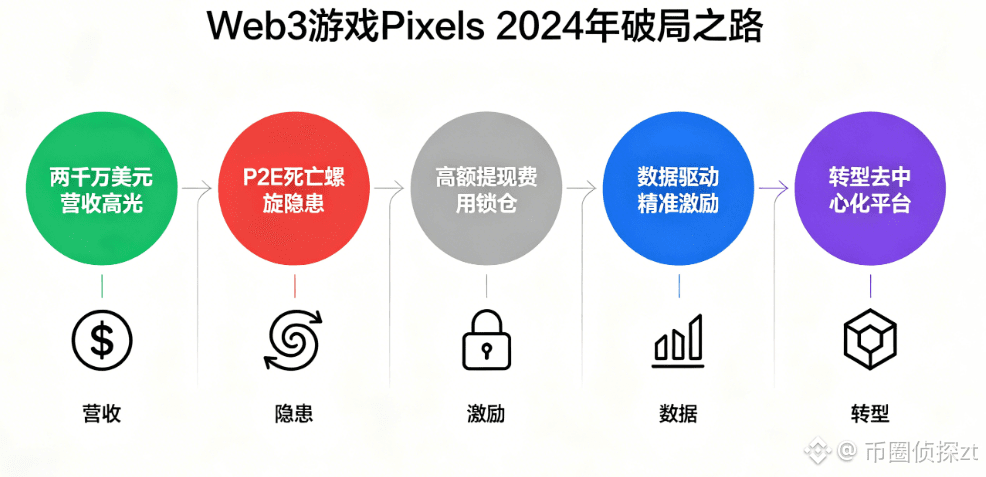
In 2024, I personally witnessed @pixels achieve twenty million dollars in revenue and reach the top of the entire Web3 gaming daily active user list. But beneath the surface of the internet's celebration, I noticed the team remained unusually calm—they had long seen through the death spiral ingrained in traditional P2E: unrestrained token issuance was brewing an unstoppable inflation tsunami.
I empathized with the pain points written in the white paper more than anyone else. At that time, the entire ecosystem was crazy; everyone treated the game as a free ATM, cashing out profits without leaving a penny to reinvest. The fundamentals of the ecosystem were being gradually hollowed out by this swarm of locust players; if this continued, Pixels would eventually follow the fate of all short-lived P2E games. To protect the entire ecosystem, the team launched a ruthless asset cleansing against speculators.
The first cut of this cleansing struck at the commonly accepted frictionless withdrawals. Pixels imposed high liquidity fees on $PIXEL withdrawals, directly shackling those opportunistic players who would jump around to cash out. The funds retained from this were all redistributed to stakers willing to lock in for the long term. This step effectively sealed off the most fatal bleeding point in the ecosystem.
At the same time, the underlying distribution logic of the entire ecosystem was completely overturned and rebuilt. Pixels ended the past era where those online the longest received the most, shifting to a data-driven precision incentive model. The team completely abandoned the vanity of daily active user numbers and focused all attention on the RORS (Reward Outlay Return on Spend) metric. From then on, every PIXEL token in the system flowed only to those core users willing to consume within the ecosystem and truly create commercial value.
Looking back now, the pain of 2024 was the boldest proactive breakthrough in the entire history of Web3 gaming. Through stringent withdrawal barriers and cold data audits, Pixels buried the false prosperity reliant on inflation for traffic and tore up the doomed Ponzi old covenant. Although there was much criticism at the time, it was precisely this most painful and resolute baptism that laid the strongest foundation for its later transformation into a decentralized game publishing platform. #pixel $PIXEL
{future}(PIXELUSDT)
In 2024, I personally witnessed @Pixels achieve twenty million dollars in revenue and reach the top of the entire Web3 gaming daily active user list. But beneath the surface of the internet's celebration, I noticed the team remained unusually calm—they had long seen through the death spiral ingrained in traditional P2E: unrestrained token issuance was brewing an unstoppable inflation tsunami.
I empathized with the pain points written in the white paper more than anyone else. At that time, the entire ecosystem was crazy; everyone treated the game as a free ATM, cashing out profits without leaving a penny to reinvest. The fundamentals of the ecosystem were being gradually hollowed out by this swarm of locust players; if this continued, Pixels would eventually follow the fate of all short-lived P2E games. To protect the entire ecosystem, the team launched a ruthless asset cleansing against speculators.
The first cut of this cleansing struck at the commonly accepted frictionless withdrawals. Pixels imposed high liquidity fees on $PIXEL withdrawals, directly shackling those opportunistic players who would jump around to cash out. The funds retained from this were all redistributed to stakers willing to lock in for the long term. This step effectively sealed off the most fatal bleeding point in the ecosystem.
At the same time, the underlying distribution logic of the entire ecosystem was completely overturned and rebuilt. Pixels ended the past era where those online the longest received the most, shifting to a data-driven precision incentive model. The team completely abandoned the vanity of daily active user numbers and focused all attention on the RORS (Reward Outlay Return on Spend) metric. From then on, every PIXEL token in the system flowed only to those core users willing to consume within the ecosystem and truly create commercial value.
Looking back now, the pain of 2024 was the boldest proactive breakthrough in the entire history of Web3 gaming. Through stringent withdrawal barriers and cold data audits, Pixels buried the false prosperity reliant on inflation for traffic and tore up the doomed Ponzi old covenant. Although there was much criticism at the time, it was precisely this most painful and resolute baptism that laid the strongest foundation for its later transformation into a decentralized game publishing platform. #pixel $PIXEL
I empathized with the pain points written in the white paper more than anyone else. At that time, the entire ecosystem was crazy; everyone treated the game as a free ATM, cashing out profits without leaving a penny to reinvest. The fundamentals of the ecosystem were being gradually hollowed out by this swarm of locust players; if this continued, Pixels would eventually follow the fate of all short-lived P2E games. To protect the entire ecosystem, the team launched a ruthless asset cleansing against speculators.
The first cut of this cleansing struck at the commonly accepted frictionless withdrawals. Pixels imposed high liquidity fees on $PIXEL withdrawals, directly shackling those opportunistic players who would jump around to cash out. The funds retained from this were all redistributed to stakers willing to lock in for the long term. This step effectively sealed off the most fatal bleeding point in the ecosystem.
At the same time, the underlying distribution logic of the entire ecosystem was completely overturned and rebuilt. Pixels ended the past era where those online the longest received the most, shifting to a data-driven precision incentive model. The team completely abandoned the vanity of daily active user numbers and focused all attention on the RORS (Reward Outlay Return on Spend) metric. From then on, every PIXEL token in the system flowed only to those core users willing to consume within the ecosystem and truly create commercial value.
Looking back now, the pain of 2024 was the boldest proactive breakthrough in the entire history of Web3 gaming. Through stringent withdrawal barriers and cold data audits, Pixels buried the false prosperity reliant on inflation for traffic and tore up the doomed Ponzi old covenant. Although there was much criticism at the time, it was precisely this most painful and resolute baptism that laid the strongest foundation for its later transformation into a decentralized game publishing platform. #pixel $PIXEL
247
·
--
Article
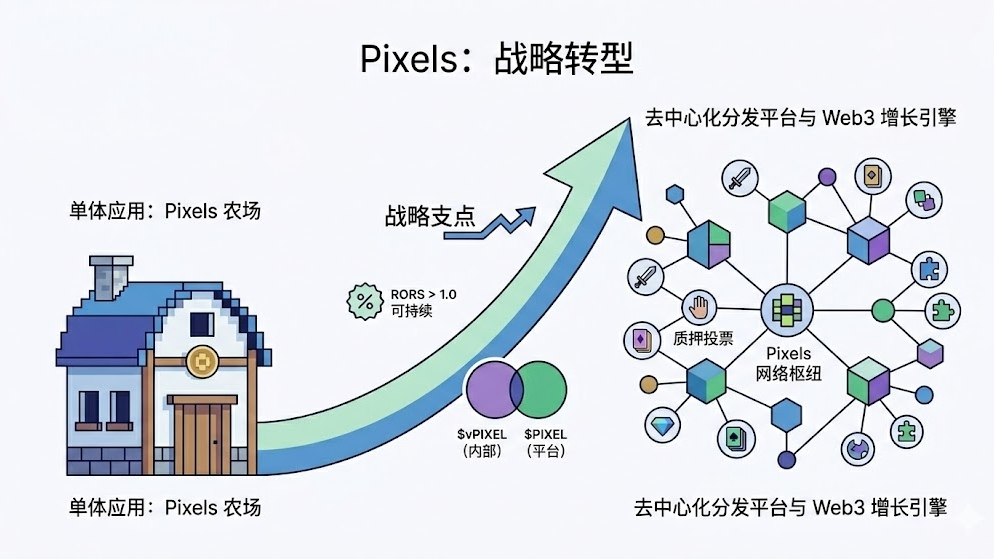
From Monolithic Application to Distribution Platform: The Strategic Shift of Pixels Founder Luke in My EyesI have always felt that in the Web3 gaming space, falling from 'the peak' often only requires an inflation cycle. Countless once-glorious Play-to-Earn (P2E) projects ultimately cannot escape the fate of token selling pressure and the death spiral. But when I saw the choice made by Pixels founder Luke, I was completely moved by his decisiveness—he did not continue to 'squeeze toothpaste' and muddle through with existing users, but instead formally announced Pixels' identity reconstruction to the outside world through the newly released white paper: it is no longer just a pixel-style farming game with millions of daily active users, but is transforming into a decentralized game distribution platform and Web3 growth engine.
From Monolithic Application to Distribution Platform: The Strategic Shift of Pixels Founder Luke in My Eyes
I have always felt that in the Web3 gaming space, falling from 'the peak' often only requires an inflation cycle. Countless once-glorious Play-to-Earn (P2E) projects ultimately cannot escape the fate of token selling pressure and the death spiral. But when I saw the choice made by Pixels founder Luke, I was completely moved by his decisiveness—he did not continue to 'squeeze toothpaste' and muddle through with existing users, but instead formally announced Pixels' identity reconstruction to the outside world through the newly released white paper: it is no longer just a pixel-style farming game with millions of daily active users, but is transforming into a decentralized game distribution platform and Web3 growth engine.
158
·
--
The sun is shining, brothers, remember to be prepared!
The sun is shining, brothers, remember to be prepared!

1
233
·
--
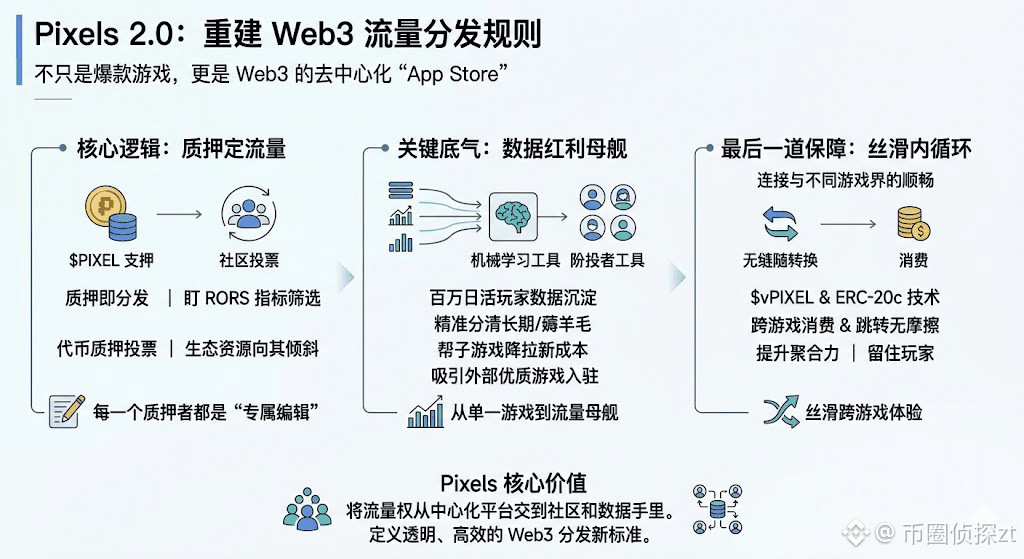
Traditional app stores, to put it bluntly, rely on algorithms to control the flow of traffic, with one dominant player; but as I watched @pixels 2.0 develop step by step, I found that it doesn't want to create a blockbuster game at all. Its ambition is quite grand — to use massive data with millions of DAU to rebuild the traffic distribution rules of Web3 and become a decentralized 'App Store' in the Web3 world.
Core logic: Staking determines traffic, not what the officials say.
Unlike the centralized recommendations of traditional app stores, Pixels has completely handed over the traffic decision-making power to us, the $PIXEL stakers.
This is not some complex mechanism; to put it simply, it's 'staking equals distribution': we don't have to follow the official commands; we just need to keep an eye on the RORS index, filter out those games that can consistently generate value and perform well, and stake tokens into them, which is equivalent to 'voting' for that game, and the ecological resources will naturally tilt towards it. Each of us stakers is not merely an investor; we are more like the 'exclusive editors' of this decentralized app store, endorsing game quality with real money.
Key confidence: Data dividends support the traffic mothership.
What impresses me the most is the traffic growth closed loop created by Pixels — the player data accumulated from millions of daily active users has been turned into a precise tool similar to Web2 advertising networks.
Through machine learning, it can accurately distinguish who the long-term players are and who the opportunists are, helping games significantly reduce the cost of acquiring new users. This tangible data advantage is the confidence that attracts high-quality external games to settle in and has transformed Pixels from a single game into a traffic mothership capable of carrying countless sub-games.
The final guarantee: Smooth internal circulation retains players.
Additionally, $vPIXEL and ERC-20c technology have completely solved the troubles of cross-game consumption. Players can jump between different sub-games and consume without complex operations and almost no friction. This smooth internal circulation experience is what truly gives Pixels the aggregative power of an app store.
I have always believed that the true entry point of Web3 is not the wallet, but the ecosystem with high stickiness and high-density players. Pixels has transferred the traffic rights from centralized platforms to our community and data, defining a new transparent and efficient distribution standard for Web3. This is its most core value. #pixel $PIXEL
{future}(PIXELUSDT)
Traditional app stores, to put it bluntly, rely on algorithms to control the flow of traffic, with one dominant player; but as I watched @Pixels 2.0 develop step by step, I found that it doesn't want to create a blockbuster game at all. Its ambition is quite grand — to use massive data with millions of DAU to rebuild the traffic distribution rules of Web3 and become a decentralized 'App Store' in the Web3 world.
Core logic: Staking determines traffic, not what the officials say.
Unlike the centralized recommendations of traditional app stores, Pixels has completely handed over the traffic decision-making power to us, the $PIXEL stakers.
This is not some complex mechanism; to put it simply, it's 'staking equals distribution': we don't have to follow the official commands; we just need to keep an eye on the RORS index, filter out those games that can consistently generate value and perform well, and stake tokens into them, which is equivalent to 'voting' for that game, and the ecological resources will naturally tilt towards it. Each of us stakers is not merely an investor; we are more like the 'exclusive editors' of this decentralized app store, endorsing game quality with real money.
Key confidence: Data dividends support the traffic mothership.
What impresses me the most is the traffic growth closed loop created by Pixels — the player data accumulated from millions of daily active users has been turned into a precise tool similar to Web2 advertising networks.
Through machine learning, it can accurately distinguish who the long-term players are and who the opportunists are, helping games significantly reduce the cost of acquiring new users. This tangible data advantage is the confidence that attracts high-quality external games to settle in and has transformed Pixels from a single game into a traffic mothership capable of carrying countless sub-games.
The final guarantee: Smooth internal circulation retains players.
Additionally, $vPIXEL and ERC-20c technology have completely solved the troubles of cross-game consumption. Players can jump between different sub-games and consume without complex operations and almost no friction. This smooth internal circulation experience is what truly gives Pixels the aggregative power of an app store.
I have always believed that the true entry point of Web3 is not the wallet, but the ecosystem with high stickiness and high-density players. Pixels has transferred the traffic rights from centralized platforms to our community and data, defining a new transparent and efficient distribution standard for Web3. This is its most core value. #pixel $PIXEL
Core logic: Staking determines traffic, not what the officials say.
Unlike the centralized recommendations of traditional app stores, Pixels has completely handed over the traffic decision-making power to us, the $PIXEL stakers.
This is not some complex mechanism; to put it simply, it's 'staking equals distribution': we don't have to follow the official commands; we just need to keep an eye on the RORS index, filter out those games that can consistently generate value and perform well, and stake tokens into them, which is equivalent to 'voting' for that game, and the ecological resources will naturally tilt towards it. Each of us stakers is not merely an investor; we are more like the 'exclusive editors' of this decentralized app store, endorsing game quality with real money.
Key confidence: Data dividends support the traffic mothership.
What impresses me the most is the traffic growth closed loop created by Pixels — the player data accumulated from millions of daily active users has been turned into a precise tool similar to Web2 advertising networks.
Through machine learning, it can accurately distinguish who the long-term players are and who the opportunists are, helping games significantly reduce the cost of acquiring new users. This tangible data advantage is the confidence that attracts high-quality external games to settle in and has transformed Pixels from a single game into a traffic mothership capable of carrying countless sub-games.
The final guarantee: Smooth internal circulation retains players.
Additionally, $vPIXEL and ERC-20c technology have completely solved the troubles of cross-game consumption. Players can jump between different sub-games and consume without complex operations and almost no friction. This smooth internal circulation experience is what truly gives Pixels the aggregative power of an app store.
I have always believed that the true entry point of Web3 is not the wallet, but the ecosystem with high stickiness and high-density players. Pixels has transferred the traffic rights from centralized platforms to our community and data, defining a new transparent and efficient distribution standard for Web3. This is its most core value. #pixel $PIXEL
1
222
·
--
Article
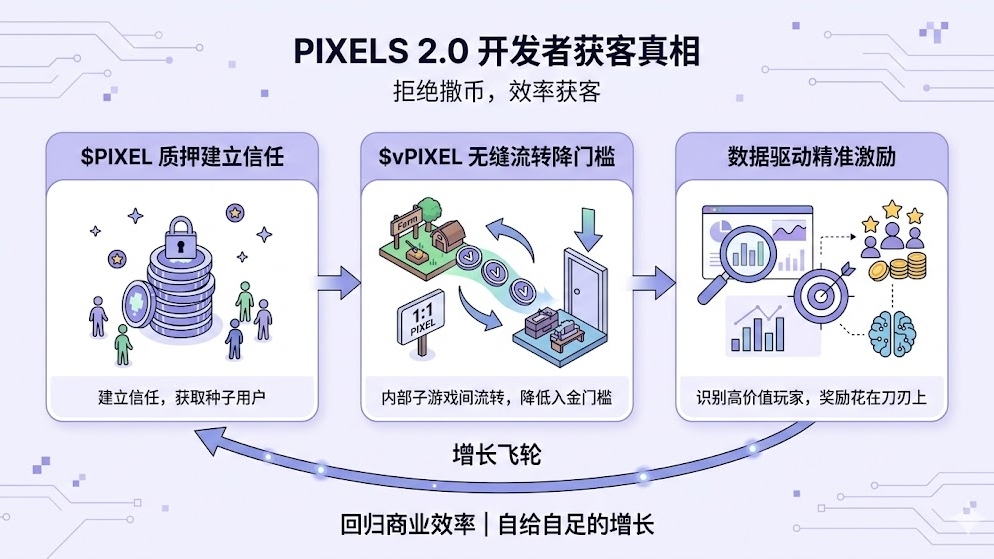
I See Through the Truth of Pixels 2.0 Cold Start: Refusing to Sprinkle Coins, Developers Use This Trick for Low-Cost Customer AcquisitionIn the old era of Web3 games, I have seen too many sub-game developers' dilemmas: to attract new users, either spend a lot of money to buy traffic or blindly throw tokens 'sprinkling coins', which seems to have users in the short term, but in reality, it is like draining the pond to catch the fish, and in the end, either the traffic is lost or the token inflation collapses. But the transformation of $PIXEL 2.0 has poured a bucket of cold water on all developers — the days of relying on inflation to exchange for traffic are completely over.
When the white paper designated RORS as the core ecological indicator, I realized that the way to cold start sub-games had completely changed. It is no longer 'the more coins you sprinkle, the more users you have,' but rather 'the higher the efficiency, the farther you go.' As a long-term participant rooted in Pixels, I have witnessed that those developers who refuse to blindly sprinkle coins have instead achieved low-cost, high-quality customer acquisition through a completely new logic.
I See Through the Truth of Pixels 2.0 Cold Start: Refusing to Sprinkle Coins, Developers Use This Trick for Low-Cost Customer Acquisition
In the old era of Web3 games, I have seen too many sub-game developers' dilemmas: to attract new users, either spend a lot of money to buy traffic or blindly throw tokens 'sprinkling coins', which seems to have users in the short term, but in reality, it is like draining the pond to catch the fish, and in the end, either the traffic is lost or the token inflation collapses. But the transformation of $PIXEL 2.0 has poured a bucket of cold water on all developers — the days of relying on inflation to exchange for traffic are completely over.
When the white paper designated RORS as the core ecological indicator, I realized that the way to cold start sub-games had completely changed. It is no longer 'the more coins you sprinkle, the more users you have,' but rather 'the higher the efficiency, the farther you go.' As a long-term participant rooted in Pixels, I have witnessed that those developers who refuse to blindly sprinkle coins have instead achieved low-cost, high-quality customer acquisition through a completely new logic.
When the white paper designated RORS as the core ecological indicator, I realized that the way to cold start sub-games had completely changed. It is no longer 'the more coins you sprinkle, the more users you have,' but rather 'the higher the efficiency, the farther you go.' As a long-term participant rooted in Pixels, I have witnessed that those developers who refuse to blindly sprinkle coins have instead achieved low-cost, high-quality customer acquisition through a completely new logic.
219
Log in to explore more content
Join global crypto users on Binance Square
⚡️ Get latest and useful information about crypto.
💬 Trusted by the world’s largest crypto exchange.
👍 Discover real insights from verified creators.
Email / Phone number