

BlockBreaker
8.3k Posts

BlockBreaker
 Square Verified+
Report
Block User
Crypto Analyst 🧠 | Binance charts📊 | Tracking Market Moves Daily | X @Block_Breaker55
Open Trade

BNB Holder
Frequent Trader
1.8 Years
171 Following
48.0K+ Followers
26.0K+ Liked
Posts
Portfolio
All
Live
·
--
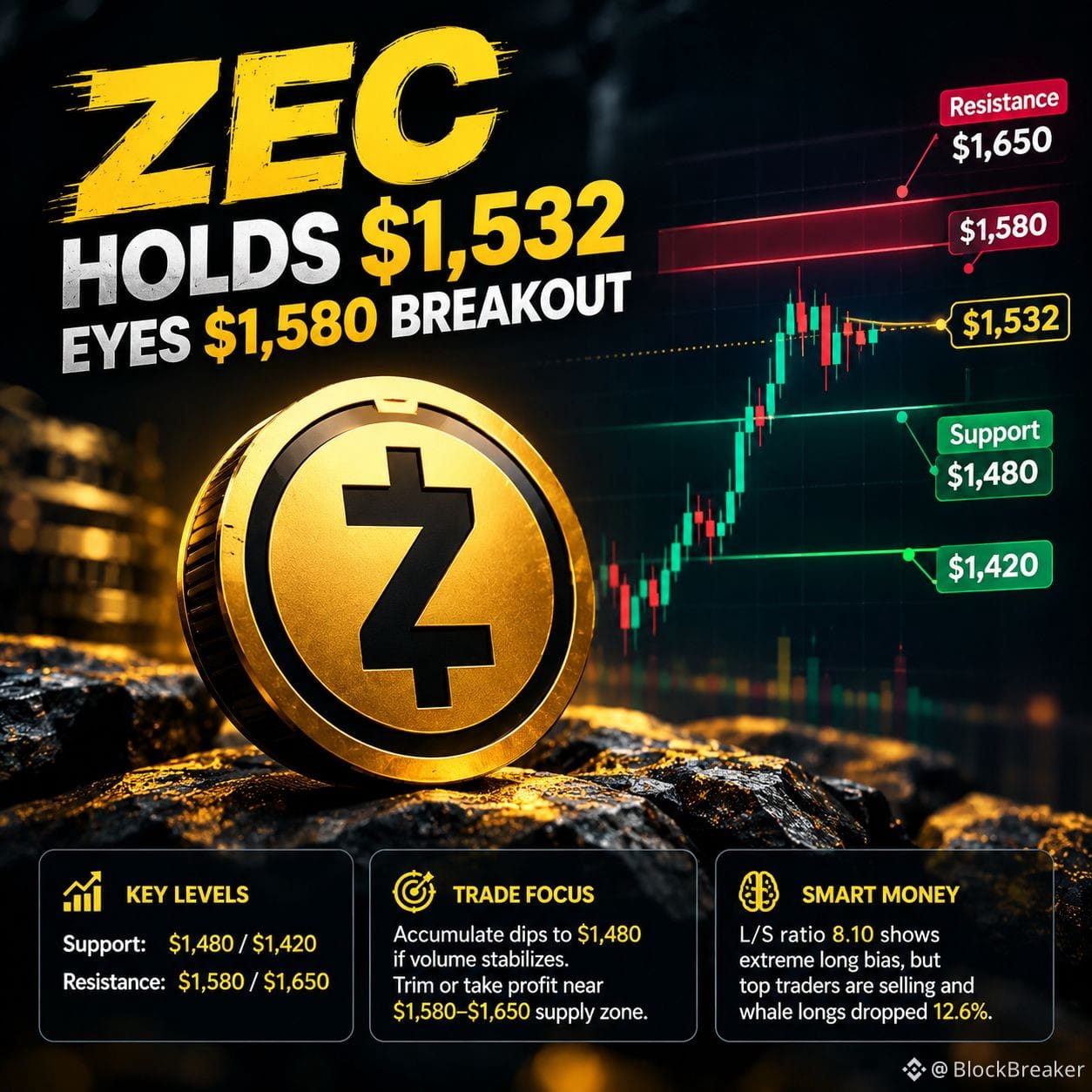
$ZEC is holding around $1,532 after a strong rally, with $1,580 as the key breakout level.
Support: $1,480 / $1,420
Resistance: $1,580 / $1,650
The interesting part: L/S ratio sits at 8.10, showing extreme long bias, while top traders are selling and whale longs have dropped 12.6%.
$1,580 is the level to watch.
{future}(ZECUSDT)
$ZEC is holding around $1,532 after a strong rally, with $1,580 as the key breakout level.
Support: $1,480 / $1,420
Resistance: $1,580 / $1,650
The interesting part: L/S ratio sits at 8.10, showing extreme long bias, while top traders are selling and whale longs have dropped 12.6%.
$1,580 is the level to watch.
Support: $1,480 / $1,420
Resistance: $1,580 / $1,650
The interesting part: L/S ratio sits at 8.10, showing extreme long bias, while top traders are selling and whale longs have dropped 12.6%.
$1,580 is the level to watch.
335
·
--
JUST IN: Elon Musk says he has been "sounding the alarm on AI for a long time."
$LSK $ARK $STEEM
JUST IN: Elon Musk says he has been "sounding the alarm on AI for a long time."
$LSK $ARK $STEEM
$LSK $ARK $STEEM

2
271
·
--
AI & Trading: How Is AI Changing the Game?
I think the most interesting thing about AI in trading isn’t the idea that a machine can “predict the market.”
It’s what happens before a trade is even considered.
A trader can throw a mountain of market data at an AI system and get patterns, summaries, comparisons, alerts, and strategy ideas in seconds. Things that once required hours of scrolling through charts and information can now be processed almost instantly.
That sounds like a huge advantage.
But there’s a catch.
Faster information does not automatically mean better decisions.
AI can spot a pattern without knowing whether that pattern actually matters. It can test a strategy against historical data, but history can behave very differently from the market in front of you. And automation can remove hesitation, but it can also execute a flawed idea without hesitation.
That’s why I see AI as a second set of eyes, not the person behind the wheel.
Research.
Analyse.
Monitor.
Test.
Automate.
Then comes the part AI still cannot outsource:
judgement.
Knowing what information deserves attention, questioning the assumptions behind a model, understanding risk, and recognizing when market conditions have changed.
Maybe the biggest shift isn’t AI replacing traders.
Maybe it’s traders using AI to spend less time collecting information and more time thinking about what that information actually means.
Would you trust AI to influence your trading decisions?
Educational only, not financial advice. DYOR.
AI & Trading: How Is AI Changing the Game?
I think the most interesting thing about AI in trading isn’t the idea that a machine can “predict the market.”
It’s what happens before a trade is even considered.
A trader can throw a mountain of market data at an AI system and get patterns, summaries, comparisons, alerts, and strategy ideas in seconds. Things that once required hours of scrolling through charts and information can now be processed almost instantly.
That sounds like a huge advantage.
But there’s a catch.
Faster information does not automatically mean better decisions.
AI can spot a pattern without knowing whether that pattern actually matters. It can test a strategy against historical data, but history can behave very differently from the market in front of you. And automation can remove hesitation, but it can also execute a flawed idea without hesitation.
That’s why I see AI as a second set of eyes, not the person behind the wheel.
Research.
Analyse.
Monitor.
Test.
Automate.
Then comes the part AI still cannot outsource:
judgement.
Knowing what information deserves attention, questioning the assumptions behind a model, understanding risk, and recognizing when market conditions have changed.
Maybe the biggest shift isn’t AI replacing traders.
Maybe it’s traders using AI to spend less time collecting information and more time thinking about what that information actually means.
Would you trust AI to influence your trading decisions?
Educational only, not financial advice. DYOR.
I think the most interesting thing about AI in trading isn’t the idea that a machine can “predict the market.”
It’s what happens before a trade is even considered.
A trader can throw a mountain of market data at an AI system and get patterns, summaries, comparisons, alerts, and strategy ideas in seconds. Things that once required hours of scrolling through charts and information can now be processed almost instantly.
That sounds like a huge advantage.
But there’s a catch.
Faster information does not automatically mean better decisions.
AI can spot a pattern without knowing whether that pattern actually matters. It can test a strategy against historical data, but history can behave very differently from the market in front of you. And automation can remove hesitation, but it can also execute a flawed idea without hesitation.
That’s why I see AI as a second set of eyes, not the person behind the wheel.
Research.
Analyse.
Monitor.
Test.
Automate.
Then comes the part AI still cannot outsource:
judgement.
Knowing what information deserves attention, questioning the assumptions behind a model, understanding risk, and recognizing when market conditions have changed.
Maybe the biggest shift isn’t AI replacing traders.
Maybe it’s traders using AI to spend less time collecting information and more time thinking about what that information actually means.
Would you trust AI to influence your trading decisions?
Educational only, not financial advice. DYOR.

1
172
·
--
#dusk $DUSK @Dusk_Foundation
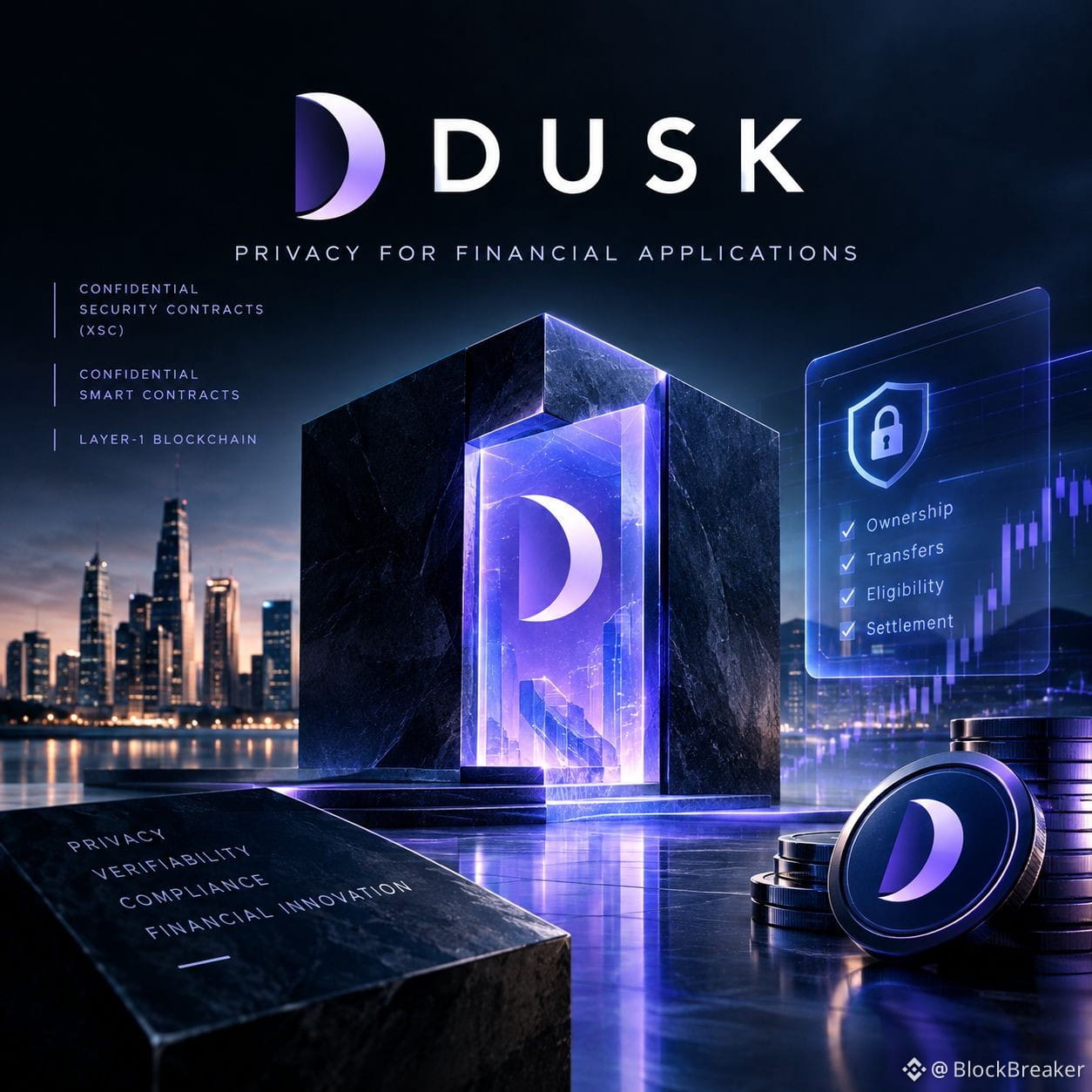
What interests me about Dusk is that its privacy thesis is becoming less about hiding transactions and more about hiding the parts of finance that never needed to be public in the first place.
That distinction matters.
Financial assets carry sensitive information around ownership, eligibility, pricing, transfers and settlement. Putting all of that into transparent smart contracts creates a strange tradeoff: you get composability, but you also expose data that regulated markets have spent decades controlling.
Dusk approaches the problem from the other side. Its privacy stack uses zero-knowledge proofs, PLONK, JubJub, Poseidon and Merkle-based structures to prove that rules were followed without publishing every underlying detail. The interesting part is not the cryptography itself. It is what that architecture can make possible for financial workflows.
And the recent engineering direction makes the thesis more credible. Aegis upgraded mainnet verification to PLONK V3 and added stronger consensus and refund protections, while August development work continued tightening proof and ciphertext validation.
Now DuskEVM is on testnet, giving Solidity developers a familiar execution path alongside Dusk’s native privacy stack.
My takeaway: Dusk is not really competing to be the “most private blockchain.” Its more interesting opportunity is becoming the layer where financial applications can remain verifiable without turning sensitive market information into public metadata.
That is a much harder problem, and a much more useful one to solve.
#dusk $DUSK @Dusk
What interests me about Dusk is that its privacy thesis is becoming less about hiding transactions and more about hiding the parts of finance that never needed to be public in the first place.
That distinction matters.
Financial assets carry sensitive information around ownership, eligibility, pricing, transfers and settlement. Putting all of that into transparent smart contracts creates a strange tradeoff: you get composability, but you also expose data that regulated markets have spent decades controlling.
Dusk approaches the problem from the other side. Its privacy stack uses zero-knowledge proofs, PLONK, JubJub, Poseidon and Merkle-based structures to prove that rules were followed without publishing every underlying detail. The interesting part is not the cryptography itself. It is what that architecture can make possible for financial workflows.
And the recent engineering direction makes the thesis more credible. Aegis upgraded mainnet verification to PLONK V3 and added stronger consensus and refund protections, while August development work continued tightening proof and ciphertext validation.
Now DuskEVM is on testnet, giving Solidity developers a familiar execution path alongside Dusk’s native privacy stack.
My takeaway: Dusk is not really competing to be the “most private blockchain.” Its more interesting opportunity is becoming the layer where financial applications can remain verifiable without turning sensitive market information into public metadata.
That is a much harder problem, and a much more useful one to solve.
What interests me about Dusk is that its privacy thesis is becoming less about hiding transactions and more about hiding the parts of finance that never needed to be public in the first place.
That distinction matters.
Financial assets carry sensitive information around ownership, eligibility, pricing, transfers and settlement. Putting all of that into transparent smart contracts creates a strange tradeoff: you get composability, but you also expose data that regulated markets have spent decades controlling.
Dusk approaches the problem from the other side. Its privacy stack uses zero-knowledge proofs, PLONK, JubJub, Poseidon and Merkle-based structures to prove that rules were followed without publishing every underlying detail. The interesting part is not the cryptography itself. It is what that architecture can make possible for financial workflows.
And the recent engineering direction makes the thesis more credible. Aegis upgraded mainnet verification to PLONK V3 and added stronger consensus and refund protections, while August development work continued tightening proof and ciphertext validation.
Now DuskEVM is on testnet, giving Solidity developers a familiar execution path alongside Dusk’s native privacy stack.
My takeaway: Dusk is not really competing to be the “most private blockchain.” Its more interesting opportunity is becoming the layer where financial applications can remain verifiable without turning sensitive market information into public metadata.
That is a much harder problem, and a much more useful one to solve.
3
2
254
·
--
#dusk $DUSK @Dusk_Foundation
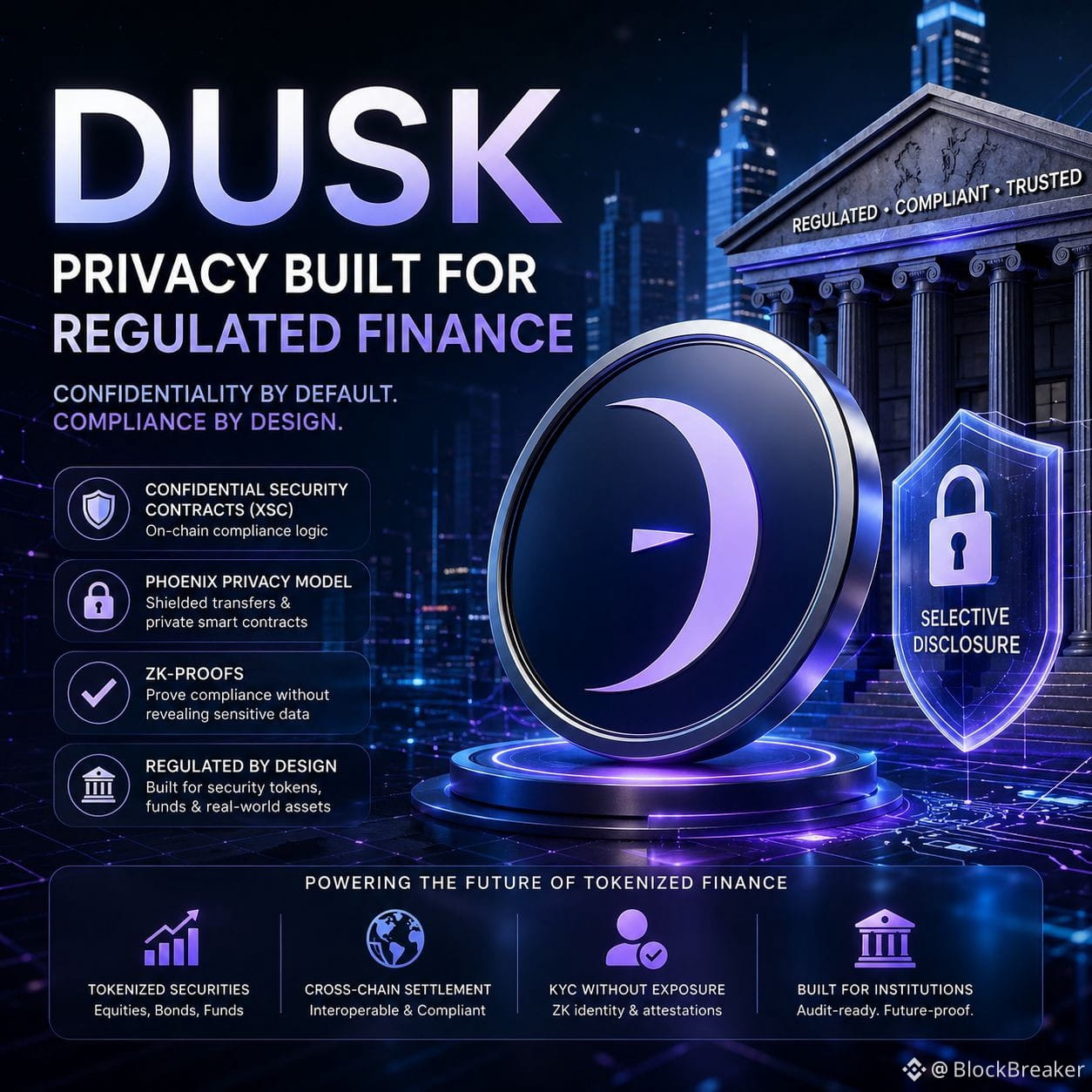
What stands out to me about Dusk is that it is not really trying to make blockchains “more private.” It is trying to make privacy a usable market primitive.
That distinction matters in finance. A securities ledger that exposes every balance, trade and investor relationship is transparent, but often unusable. Dusk takes the opposite route: keep sensitive state private, prove that the required rules were followed, and disclose only what a regulator, issuer or counterparty actually needs. That beats simply adding KYC to a transparent chain.
XSC is interesting for the same reason. Compliance is treated as programmable transaction logic, not paperwork around the edges. Access rules, transfer restrictions, ownership records and corporate actions can sit inside the asset workflow. Privacy then prevents those controls from becoming permanent public surveillance.
Recent development matters for what it signals, not headlines. Dusk has been tightening its protocol with PLONK V3 and consensus hardening, while its EVM path and developer tooling lower the barrier for builders. Its August 2026 zk-tooling work and focus on tokenized private markets point toward a bigger shift: from “privacy blockchain” to financial infrastructure.
Dusk’s edge is not secrecy alone. It is making regulated assets private without making them unverifiable. If tokenized finance demands confidentiality, auditability and deterministic settlement at the same time, that tradeoff becomes the product.
#dusk $DUSK @Dusk
What stands out to me about Dusk is that it is not really trying to make blockchains “more private.” It is trying to make privacy a usable market primitive.
That distinction matters in finance. A securities ledger that exposes every balance, trade and investor relationship is transparent, but often unusable. Dusk takes the opposite route: keep sensitive state private, prove that the required rules were followed, and disclose only what a regulator, issuer or counterparty actually needs. That beats simply adding KYC to a transparent chain.
XSC is interesting for the same reason. Compliance is treated as programmable transaction logic, not paperwork around the edges. Access rules, transfer restrictions, ownership records and corporate actions can sit inside the asset workflow. Privacy then prevents those controls from becoming permanent public surveillance.
Recent development matters for what it signals, not headlines. Dusk has been tightening its protocol with PLONK V3 and consensus hardening, while its EVM path and developer tooling lower the barrier for builders. Its August 2026 zk-tooling work and focus on tokenized private markets point toward a bigger shift: from “privacy blockchain” to financial infrastructure.
Dusk’s edge is not secrecy alone. It is making regulated assets private without making them unverifiable. If tokenized finance demands confidentiality, auditability and deterministic settlement at the same time, that tradeoff becomes the product.
What stands out to me about Dusk is that it is not really trying to make blockchains “more private.” It is trying to make privacy a usable market primitive.
That distinction matters in finance. A securities ledger that exposes every balance, trade and investor relationship is transparent, but often unusable. Dusk takes the opposite route: keep sensitive state private, prove that the required rules were followed, and disclose only what a regulator, issuer or counterparty actually needs. That beats simply adding KYC to a transparent chain.
XSC is interesting for the same reason. Compliance is treated as programmable transaction logic, not paperwork around the edges. Access rules, transfer restrictions, ownership records and corporate actions can sit inside the asset workflow. Privacy then prevents those controls from becoming permanent public surveillance.
Recent development matters for what it signals, not headlines. Dusk has been tightening its protocol with PLONK V3 and consensus hardening, while its EVM path and developer tooling lower the barrier for builders. Its August 2026 zk-tooling work and focus on tokenized private markets point toward a bigger shift: from “privacy blockchain” to financial infrastructure.
Dusk’s edge is not secrecy alone. It is making regulated assets private without making them unverifiable. If tokenized finance demands confidentiality, auditability and deterministic settlement at the same time, that tradeoff becomes the product.
2
5
432
·
--
#dusk $DUSK @Dusk_Foundation
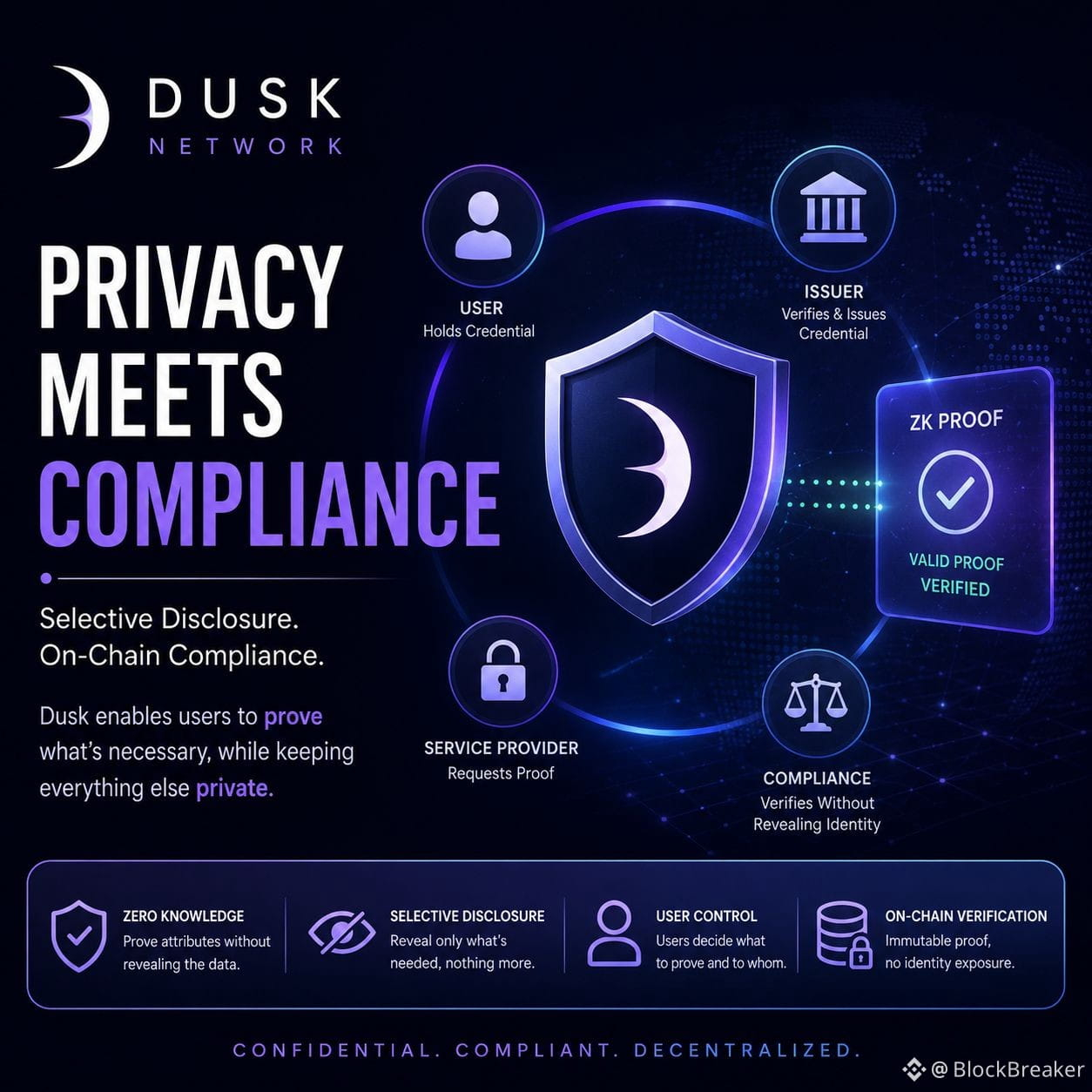
What I find interesting about Dusk’s compliance model is that it treats identity less like something you store and more like something you prove.
Citadel 2 separates the roles cleanly. A license provider verifies the user off-chain and signs the relevant attributes. The credential is registered without exposing its contents, then the user can generate a zero-knowledge proof showing they hold a valid credential without revealing which credential, their identity, or the underlying attributes. The service provider still decides what qualifies and whether access should be granted.
That is a subtle but important distinction from putting KYC data on-chain and calling it compliant. The chain should verify a statement such as “this participant is accredited” or “this holder satisfies the jurisdiction rule,” not permanently expose the passport, address, or birth date behind that statement.
The broader cryptographic direction supports this architecture. W3C’s 2026 Digital Credentials work treats selective disclosure and unlinkable presentations as core privacy properties, while its BBS cryptosuite formalizes derived proofs where holders can reveal chosen claims without making separate presentations trivially linkable.
My view is that Dusk’s difficult problem is no longer whether zero knowledge can hide KYC data. It is designing the policy layer around it: issuer trust, expiry, revocation, jurisdiction changes, wallet binding and anti-correlation.
That is where on-chain compliance becomes interesting: not identity disclosure, but programmable proof of eligibility.
#dusk $DUSK @Dusk
What I find interesting about Dusk’s compliance model is that it treats identity less like something you store and more like something you prove.
Citadel 2 separates the roles cleanly. A license provider verifies the user off-chain and signs the relevant attributes. The credential is registered without exposing its contents, then the user can generate a zero-knowledge proof showing they hold a valid credential without revealing which credential, their identity, or the underlying attributes. The service provider still decides what qualifies and whether access should be granted.
That is a subtle but important distinction from putting KYC data on-chain and calling it compliant. The chain should verify a statement such as “this participant is accredited” or “this holder satisfies the jurisdiction rule,” not permanently expose the passport, address, or birth date behind that statement.
The broader cryptographic direction supports this architecture. W3C’s 2026 Digital Credentials work treats selective disclosure and unlinkable presentations as core privacy properties, while its BBS cryptosuite formalizes derived proofs where holders can reveal chosen claims without making separate presentations trivially linkable.
My view is that Dusk’s difficult problem is no longer whether zero knowledge can hide KYC data. It is designing the policy layer around it: issuer trust, expiry, revocation, jurisdiction changes, wallet binding and anti-correlation.
That is where on-chain compliance becomes interesting: not identity disclosure, but programmable proof of eligibility.
What I find interesting about Dusk’s compliance model is that it treats identity less like something you store and more like something you prove.
Citadel 2 separates the roles cleanly. A license provider verifies the user off-chain and signs the relevant attributes. The credential is registered without exposing its contents, then the user can generate a zero-knowledge proof showing they hold a valid credential without revealing which credential, their identity, or the underlying attributes. The service provider still decides what qualifies and whether access should be granted.
That is a subtle but important distinction from putting KYC data on-chain and calling it compliant. The chain should verify a statement such as “this participant is accredited” or “this holder satisfies the jurisdiction rule,” not permanently expose the passport, address, or birth date behind that statement.
The broader cryptographic direction supports this architecture. W3C’s 2026 Digital Credentials work treats selective disclosure and unlinkable presentations as core privacy properties, while its BBS cryptosuite formalizes derived proofs where holders can reveal chosen claims without making separate presentations trivially linkable.
My view is that Dusk’s difficult problem is no longer whether zero knowledge can hide KYC data. It is designing the policy layer around it: issuer trust, expiry, revocation, jurisdiction changes, wallet binding and anti-correlation.
That is where on-chain compliance becomes interesting: not identity disclosure, but programmable proof of eligibility.
2
257
·
--
#termmax @termmax
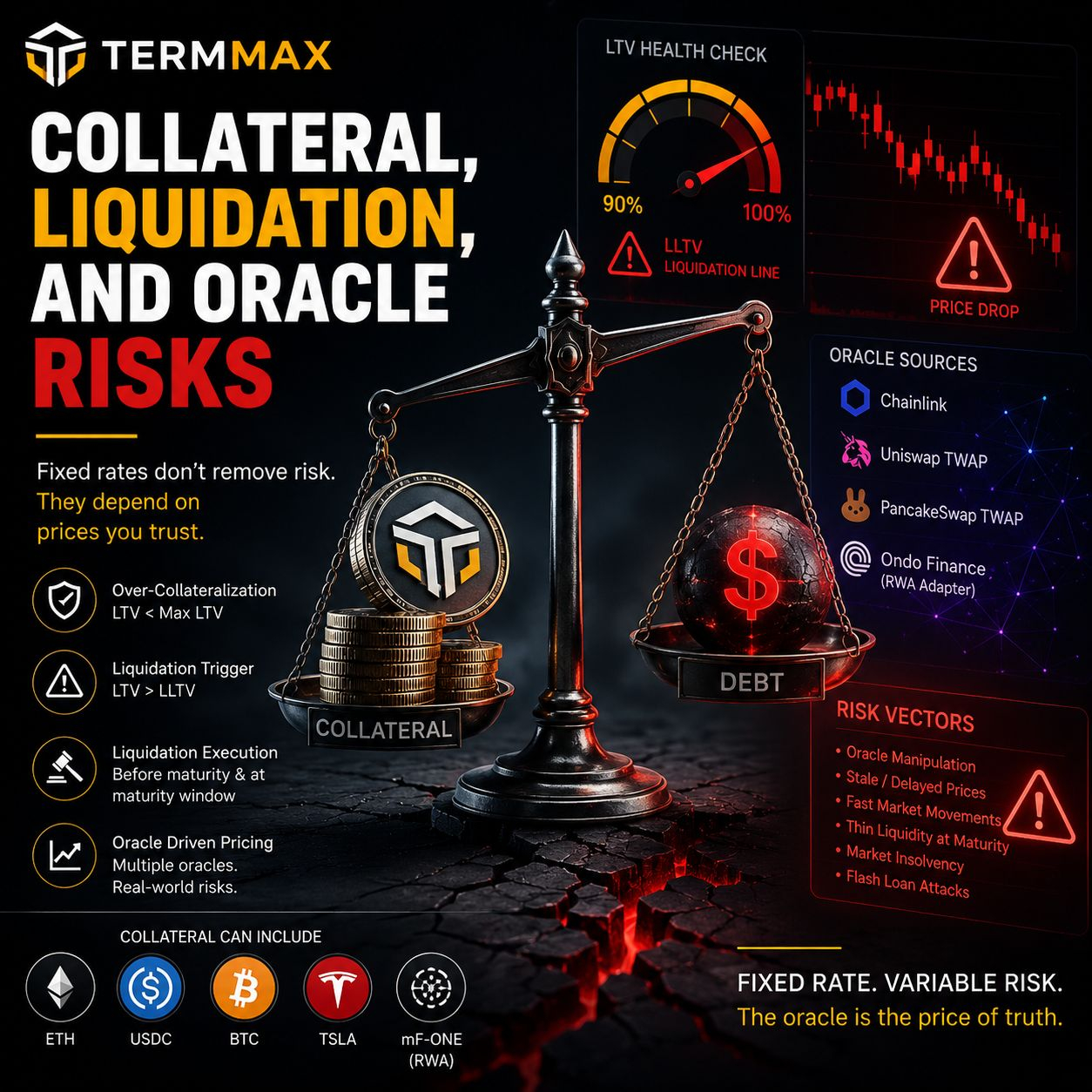
What I find most interesting in TermMax is that fixed-rate borrowing doesn’t make collateral risk disappear. It just moves the risk somewhere else.
I’ve been looking more closely at the Gearing Token logic, and the important part is that positions still live inside an LTV framework. Once collateral falls far enough, liquidation becomes the mechanism for containing bad debt. Near maturity, that risk gets even more interesting because the protocol has to reconcile a fixed-term position with a market that can move violently.
That makes the oracle layer the part I don’t fully trust by default.
TermMax’s architecture supports multiple pricing routes and adapters rather than relying on one universal feed. That matters when the collateral is something liquid like ETH, but the assumptions become much harder to judge for tokenized stocks or other RWA assets. A price can be technically “on-chain” and still be stale, thin, delayed, or disconnected from executable liquidity.
A simple stress case shows why. Suppose $100 of collateral backs $85 of debt. A 10% drop pushes the position close to a 94% LTV. A sharper move can leave the protocol racing liquidation against a market that is repricing faster than the oracle.
So I’m less interested in asking whether TermMax has liquidation.
The better question is: can liquidation happen at the right price, fast enough, when everyone else is trying to exit too?
That’s where I think the real risk model lives.
#termmax @TermMax
What I find most interesting in TermMax is that fixed-rate borrowing doesn’t make collateral risk disappear. It just moves the risk somewhere else.
I’ve been looking more closely at the Gearing Token logic, and the important part is that positions still live inside an LTV framework. Once collateral falls far enough, liquidation becomes the mechanism for containing bad debt. Near maturity, that risk gets even more interesting because the protocol has to reconcile a fixed-term position with a market that can move violently.
That makes the oracle layer the part I don’t fully trust by default.
TermMax’s architecture supports multiple pricing routes and adapters rather than relying on one universal feed. That matters when the collateral is something liquid like ETH, but the assumptions become much harder to judge for tokenized stocks or other RWA assets. A price can be technically “on-chain” and still be stale, thin, delayed, or disconnected from executable liquidity.
A simple stress case shows why. Suppose $100 of collateral backs $85 of debt. A 10% drop pushes the position close to a 94% LTV. A sharper move can leave the protocol racing liquidation against a market that is repricing faster than the oracle.
So I’m less interested in asking whether TermMax has liquidation.
The better question is: can liquidation happen at the right price, fast enough, when everyone else is trying to exit too?
That’s where I think the real risk model lives.
What I find most interesting in TermMax is that fixed-rate borrowing doesn’t make collateral risk disappear. It just moves the risk somewhere else.
I’ve been looking more closely at the Gearing Token logic, and the important part is that positions still live inside an LTV framework. Once collateral falls far enough, liquidation becomes the mechanism for containing bad debt. Near maturity, that risk gets even more interesting because the protocol has to reconcile a fixed-term position with a market that can move violently.
That makes the oracle layer the part I don’t fully trust by default.
TermMax’s architecture supports multiple pricing routes and adapters rather than relying on one universal feed. That matters when the collateral is something liquid like ETH, but the assumptions become much harder to judge for tokenized stocks or other RWA assets. A price can be technically “on-chain” and still be stale, thin, delayed, or disconnected from executable liquidity.
A simple stress case shows why. Suppose $100 of collateral backs $85 of debt. A 10% drop pushes the position close to a 94% LTV. A sharper move can leave the protocol racing liquidation against a market that is repricing faster than the oracle.
So I’m less interested in asking whether TermMax has liquidation.
The better question is: can liquidation happen at the right price, fast enough, when everyone else is trying to exit too?
That’s where I think the real risk model lives.
1
160
·
--
#dusk $DUSK @Dusk_Foundation
I’ve seen blockchain teams treat networking like plumbing. As long as blocks arrive, the architecture rarely gets much attention.
Kadcast makes me look at that layer differently.
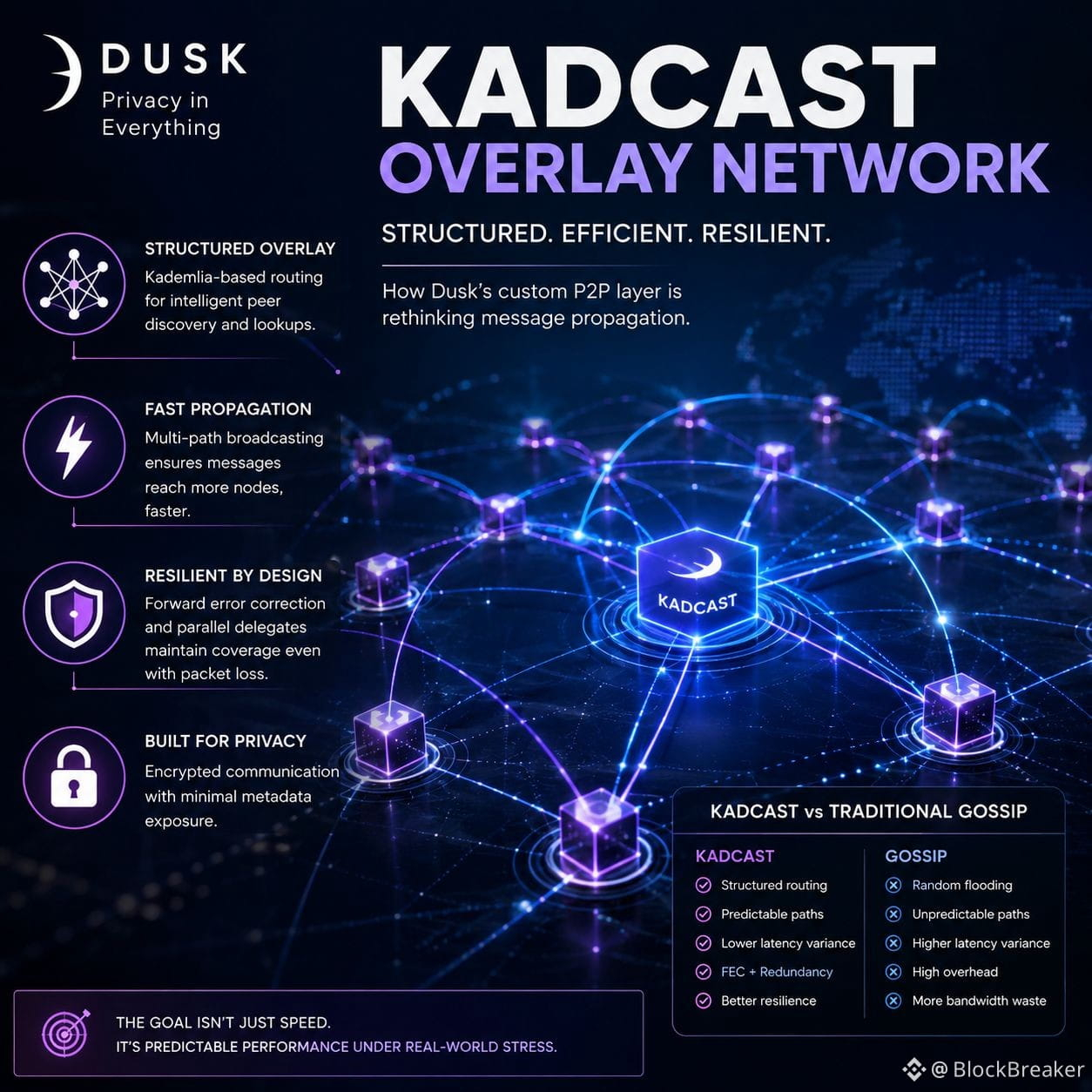
Dusk is not relying on the usual “receive, gossip, repeat” model alone. Kadcast organizes peers through a structured Kademlia-style overlay, so message propagation has some awareness of where nodes sit in the network. That sounds like a small implementation detail, but it changes the problem. Instead of hoping enough random peers spread a message quickly, the protocol is trying to make propagation more deliberate.
The part I find most interesting is how it handles imperfect networks. Kadcast uses UDP, which gives up some delivery guarantees, then adds redundancy and forward error correction to tolerate packet loss. In other words, it is not trying to make the network perfectly reliable. It is designing around the assumption that the network will be messy.
That is a much more useful framing for me.
Traditional gossip gets a lot of its resilience from redundancy. Kadcast appears to push more of that intelligence into peer selection and message routing. The tradeoff is complexity. A structured overlay now has to defend its routing tables, peer discovery and bootstrap process against bad actors and unfavorable topology.
So I’m less interested in raw propagation benchmarks.
The real test is whether Kadcast can keep latency predictable when nodes disappear, packets are dropped, peers behave badly, and the network gets larger.
Fast propagation is useful.
Predictable propagation under stress is what I’d actually want to measure.
#dusk $DUSK @Dusk
I’ve seen blockchain teams treat networking like plumbing. As long as blocks arrive, the architecture rarely gets much attention.
Kadcast makes me look at that layer differently.
Dusk is not relying on the usual “receive, gossip, repeat” model alone. Kadcast organizes peers through a structured Kademlia-style overlay, so message propagation has some awareness of where nodes sit in the network. That sounds like a small implementation detail, but it changes the problem. Instead of hoping enough random peers spread a message quickly, the protocol is trying to make propagation more deliberate.
The part I find most interesting is how it handles imperfect networks. Kadcast uses UDP, which gives up some delivery guarantees, then adds redundancy and forward error correction to tolerate packet loss. In other words, it is not trying to make the network perfectly reliable. It is designing around the assumption that the network will be messy.
That is a much more useful framing for me.
Traditional gossip gets a lot of its resilience from redundancy. Kadcast appears to push more of that intelligence into peer selection and message routing. The tradeoff is complexity. A structured overlay now has to defend its routing tables, peer discovery and bootstrap process against bad actors and unfavorable topology.
So I’m less interested in raw propagation benchmarks.
The real test is whether Kadcast can keep latency predictable when nodes disappear, packets are dropped, peers behave badly, and the network gets larger.
Fast propagation is useful.
Predictable propagation under stress is what I’d actually want to measure.
I’ve seen blockchain teams treat networking like plumbing. As long as blocks arrive, the architecture rarely gets much attention.
Kadcast makes me look at that layer differently.
Dusk is not relying on the usual “receive, gossip, repeat” model alone. Kadcast organizes peers through a structured Kademlia-style overlay, so message propagation has some awareness of where nodes sit in the network. That sounds like a small implementation detail, but it changes the problem. Instead of hoping enough random peers spread a message quickly, the protocol is trying to make propagation more deliberate.
The part I find most interesting is how it handles imperfect networks. Kadcast uses UDP, which gives up some delivery guarantees, then adds redundancy and forward error correction to tolerate packet loss. In other words, it is not trying to make the network perfectly reliable. It is designing around the assumption that the network will be messy.
That is a much more useful framing for me.
Traditional gossip gets a lot of its resilience from redundancy. Kadcast appears to push more of that intelligence into peer selection and message routing. The tradeoff is complexity. A structured overlay now has to defend its routing tables, peer discovery and bootstrap process against bad actors and unfavorable topology.
So I’m less interested in raw propagation benchmarks.
The real test is whether Kadcast can keep latency predictable when nodes disappear, packets are dropped, peers behave badly, and the network gets larger.
Fast propagation is useful.
Predictable propagation under stress is what I’d actually want to measure.
1
157
·
--
#termmax @termmax
What I’m watching in TermMax isn’t TVL. It’s where the liquidity actually gets used.
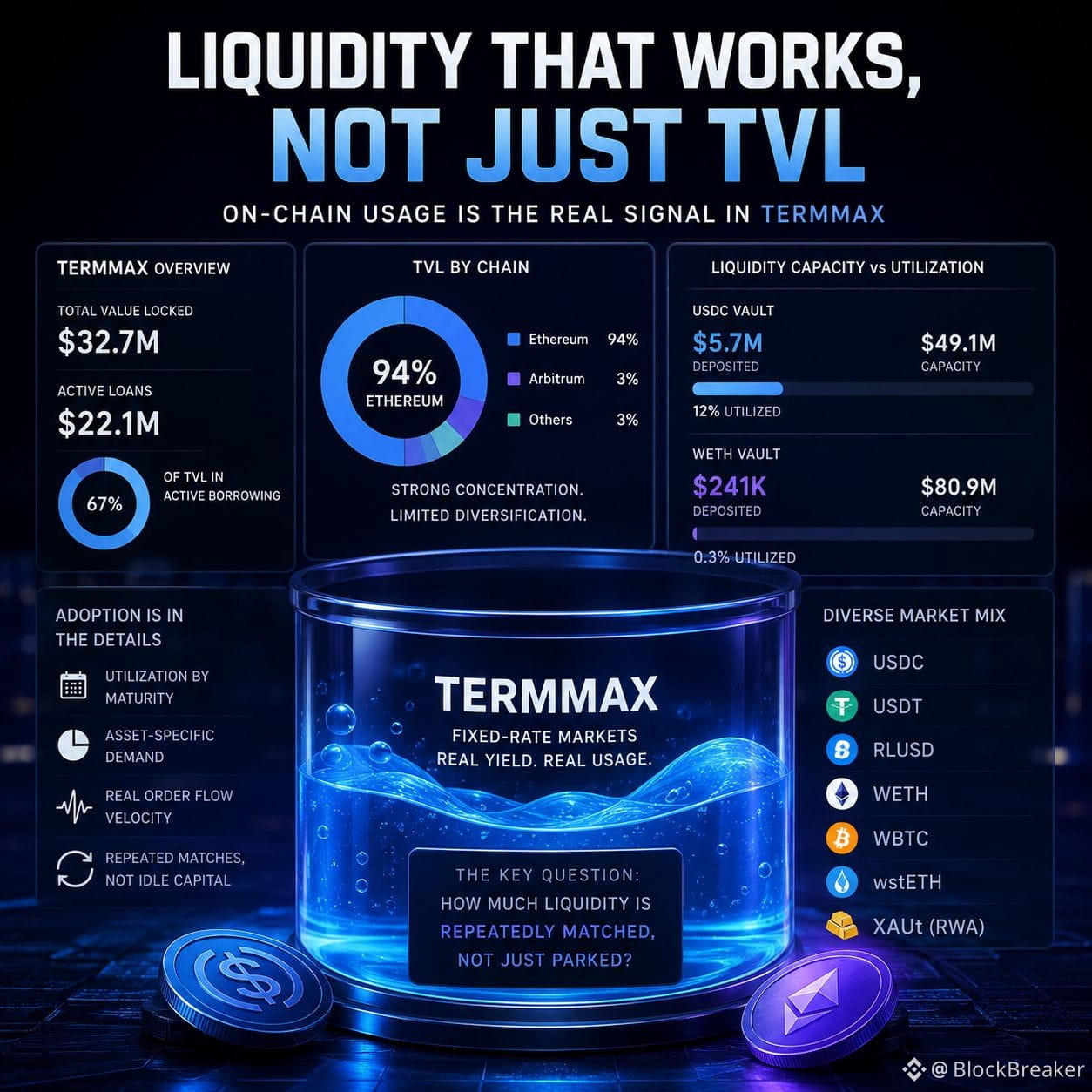
DefiLlama currently puts TermMax around $32.7M TVL, with roughly $22.1M in active loans. That implies about 67% of reported TVL is tied to active borrowing, which is more interesting to me than the headline number itself. Ethereum also represents about 94% of TVL, so the “multi-chain” story is still heavily concentrated in one venue.
But there is another layer I don’t fully trust: capacity. On TermMax’s own earn interface, the main USDC vault shows about $5.7M deposited against a $49.1M capacity, while a WETH vault has roughly $241K against $80.9M. That is a lot of theoretical liquidity that nobody is actually using.
This is where I keep noticing a subtle distinction between liquidity availability and liquidity demand. A market can advertise deep capacity while the active order flow remains thin. For fixed-rate products, that matters more because idle capacity at the wrong maturity or strike is not equivalent to usable liquidity.
I’ve seen this before in DeFi: TVL grows first, then people assume adoption followed. The better signal is utilization by market, maturity, and asset. Stablecoin borrowing, ETH collateral, and RWA-linked markets should not be lumped together.
TermMax’s current market mix already hints at that shift. The interface lists USDC, USDT, RLUSD, WETH, WBTC, wstETH and an expanding set of RWA collateral, including XAUt.
My real question is simple: how much of TermMax’s liquidity is repeatedly matched, not merely parked? That ratio will tell me far more about adoption than TVL alone.
#termmax @TermMax
What I’m watching in TermMax isn’t TVL. It’s where the liquidity actually gets used.
DefiLlama currently puts TermMax around $32.7M TVL, with roughly $22.1M in active loans. That implies about 67% of reported TVL is tied to active borrowing, which is more interesting to me than the headline number itself. Ethereum also represents about 94% of TVL, so the “multi-chain” story is still heavily concentrated in one venue.
But there is another layer I don’t fully trust: capacity. On TermMax’s own earn interface, the main USDC vault shows about $5.7M deposited against a $49.1M capacity, while a WETH vault has roughly $241K against $80.9M. That is a lot of theoretical liquidity that nobody is actually using.
This is where I keep noticing a subtle distinction between liquidity availability and liquidity demand. A market can advertise deep capacity while the active order flow remains thin. For fixed-rate products, that matters more because idle capacity at the wrong maturity or strike is not equivalent to usable liquidity.
I’ve seen this before in DeFi: TVL grows first, then people assume adoption followed. The better signal is utilization by market, maturity, and asset. Stablecoin borrowing, ETH collateral, and RWA-linked markets should not be lumped together.
TermMax’s current market mix already hints at that shift. The interface lists USDC, USDT, RLUSD, WETH, WBTC, wstETH and an expanding set of RWA collateral, including XAUt.
My real question is simple: how much of TermMax’s liquidity is repeatedly matched, not merely parked? That ratio will tell me far more about adoption than TVL alone.
What I’m watching in TermMax isn’t TVL. It’s where the liquidity actually gets used.
DefiLlama currently puts TermMax around $32.7M TVL, with roughly $22.1M in active loans. That implies about 67% of reported TVL is tied to active borrowing, which is more interesting to me than the headline number itself. Ethereum also represents about 94% of TVL, so the “multi-chain” story is still heavily concentrated in one venue.
But there is another layer I don’t fully trust: capacity. On TermMax’s own earn interface, the main USDC vault shows about $5.7M deposited against a $49.1M capacity, while a WETH vault has roughly $241K against $80.9M. That is a lot of theoretical liquidity that nobody is actually using.
This is where I keep noticing a subtle distinction between liquidity availability and liquidity demand. A market can advertise deep capacity while the active order flow remains thin. For fixed-rate products, that matters more because idle capacity at the wrong maturity or strike is not equivalent to usable liquidity.
I’ve seen this before in DeFi: TVL grows first, then people assume adoption followed. The better signal is utilization by market, maturity, and asset. Stablecoin borrowing, ETH collateral, and RWA-linked markets should not be lumped together.
TermMax’s current market mix already hints at that shift. The interface lists USDC, USDT, RLUSD, WETH, WBTC, wstETH and an expanding set of RWA collateral, including XAUt.
My real question is simple: how much of TermMax’s liquidity is repeatedly matched, not merely parked? That ratio will tell me far more about adoption than TVL alone.
22
13
795
·
--
#termmax @termmax
TermMax’s maker game is not about chasing the highest APR. It is about deciding where liquidity should become expensive.
OrderV2 lets makers shape orders with curves, while virtual reserves influence pricing as liquidity is consumed. The V2 repository was updated in July 2026, reinforcing that this order architecture is still being actively developed.
My view is that strong makers should think in zones. Start with competitive liquidity, then steepen the curve as utilization rises. The final segment can act as a reservation price, where capital is available only if compensation justifies the risk.
Two makers can commit the same capital and still produce different execution, utilization, and realized yield. The edge is curve design: knowing where to stay flexible, where to get defensive, and where to stop pricing cheaply. That is especially important when demand arrives unevenly across maturities and market conditions. On TermMax, the curve is the maker’s market view.
#termmax @TermMax
TermMax’s maker game is not about chasing the highest APR. It is about deciding where liquidity should become expensive.
OrderV2 lets makers shape orders with curves, while virtual reserves influence pricing as liquidity is consumed. The V2 repository was updated in July 2026, reinforcing that this order architecture is still being actively developed.
My view is that strong makers should think in zones. Start with competitive liquidity, then steepen the curve as utilization rises. The final segment can act as a reservation price, where capital is available only if compensation justifies the risk.
Two makers can commit the same capital and still produce different execution, utilization, and realized yield. The edge is curve design: knowing where to stay flexible, where to get defensive, and where to stop pricing cheaply. That is especially important when demand arrives unevenly across maturities and market conditions. On TermMax, the curve is the maker’s market view.
TermMax’s maker game is not about chasing the highest APR. It is about deciding where liquidity should become expensive.
OrderV2 lets makers shape orders with curves, while virtual reserves influence pricing as liquidity is consumed. The V2 repository was updated in July 2026, reinforcing that this order architecture is still being actively developed.
My view is that strong makers should think in zones. Start with competitive liquidity, then steepen the curve as utilization rises. The final segment can act as a reservation price, where capital is available only if compensation justifies the risk.
Two makers can commit the same capital and still produce different execution, utilization, and realized yield. The edge is curve design: knowing where to stay flexible, where to get defensive, and where to stop pricing cheaply. That is especially important when demand arrives unevenly across maturities and market conditions. On TermMax, the curve is the maker’s market view.
1
3
212
·
--
#dusk $DUSK @Dusk_Foundation
I’ve started looking at Dusk from a different angle: not as a “privacy blockchain,” but as a system where the execution environment decides how usable privacy actually becomes.
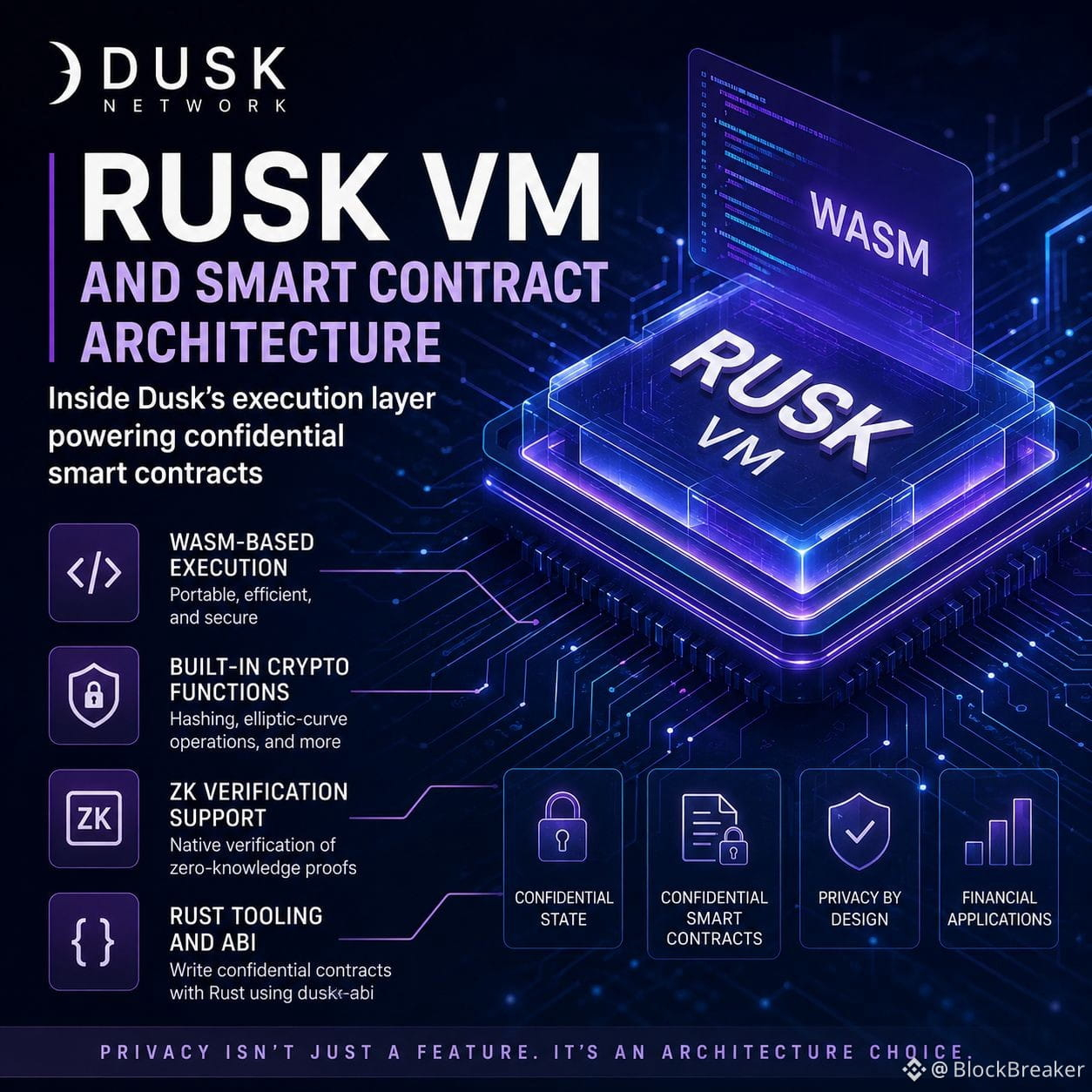
That is why Rusk VM caught my attention. It uses WASM for contract execution, but it doesn’t stop there. Dusk exposes cryptographic operations through the VM’s host layer, including hashing, elliptic-curve operations and zero-knowledge verification. In practice, the contract does not need to implement every expensive primitive itself.
I think that design choice is more important than it first appears. A confidential contract is only useful when developers can reason about its costs, inputs and failure paths. Rusk’s ABI and Rust tooling create a defined interface between contract code and those native capabilities.
I’ve seen this before with smart-contract systems: the interesting part is rarely the language. It is the boundary between application code and the low-level primitives underneath it.
What I’d be watching closely with Rusk is not another benchmark headline. I’d want to understand how predictable host calls remain, how gas pricing evolves, how ABI changes are handled, and how developers debug contracts when state itself is intentionally hidden.
That’s the part I find genuinely interesting. Privacy at the protocol level is one thing. Making privacy programmable without turning development into a cryptography research project is a much harder problem.
#dusk $DUSK @Dusk
I’ve started looking at Dusk from a different angle: not as a “privacy blockchain,” but as a system where the execution environment decides how usable privacy actually becomes.
That is why Rusk VM caught my attention. It uses WASM for contract execution, but it doesn’t stop there. Dusk exposes cryptographic operations through the VM’s host layer, including hashing, elliptic-curve operations and zero-knowledge verification. In practice, the contract does not need to implement every expensive primitive itself.
I think that design choice is more important than it first appears. A confidential contract is only useful when developers can reason about its costs, inputs and failure paths. Rusk’s ABI and Rust tooling create a defined interface between contract code and those native capabilities.
I’ve seen this before with smart-contract systems: the interesting part is rarely the language. It is the boundary between application code and the low-level primitives underneath it.
What I’d be watching closely with Rusk is not another benchmark headline. I’d want to understand how predictable host calls remain, how gas pricing evolves, how ABI changes are handled, and how developers debug contracts when state itself is intentionally hidden.
That’s the part I find genuinely interesting. Privacy at the protocol level is one thing. Making privacy programmable without turning development into a cryptography research project is a much harder problem.
I’ve started looking at Dusk from a different angle: not as a “privacy blockchain,” but as a system where the execution environment decides how usable privacy actually becomes.
That is why Rusk VM caught my attention. It uses WASM for contract execution, but it doesn’t stop there. Dusk exposes cryptographic operations through the VM’s host layer, including hashing, elliptic-curve operations and zero-knowledge verification. In practice, the contract does not need to implement every expensive primitive itself.
I think that design choice is more important than it first appears. A confidential contract is only useful when developers can reason about its costs, inputs and failure paths. Rusk’s ABI and Rust tooling create a defined interface between contract code and those native capabilities.
I’ve seen this before with smart-contract systems: the interesting part is rarely the language. It is the boundary between application code and the low-level primitives underneath it.
What I’d be watching closely with Rusk is not another benchmark headline. I’d want to understand how predictable host calls remain, how gas pricing evolves, how ABI changes are handled, and how developers debug contracts when state itself is intentionally hidden.
That’s the part I find genuinely interesting. Privacy at the protocol level is one thing. Making privacy programmable without turning development into a cryptography research project is a much harder problem.
2
4
163
·
--
#dusk $DUSK @Dusk_Foundation
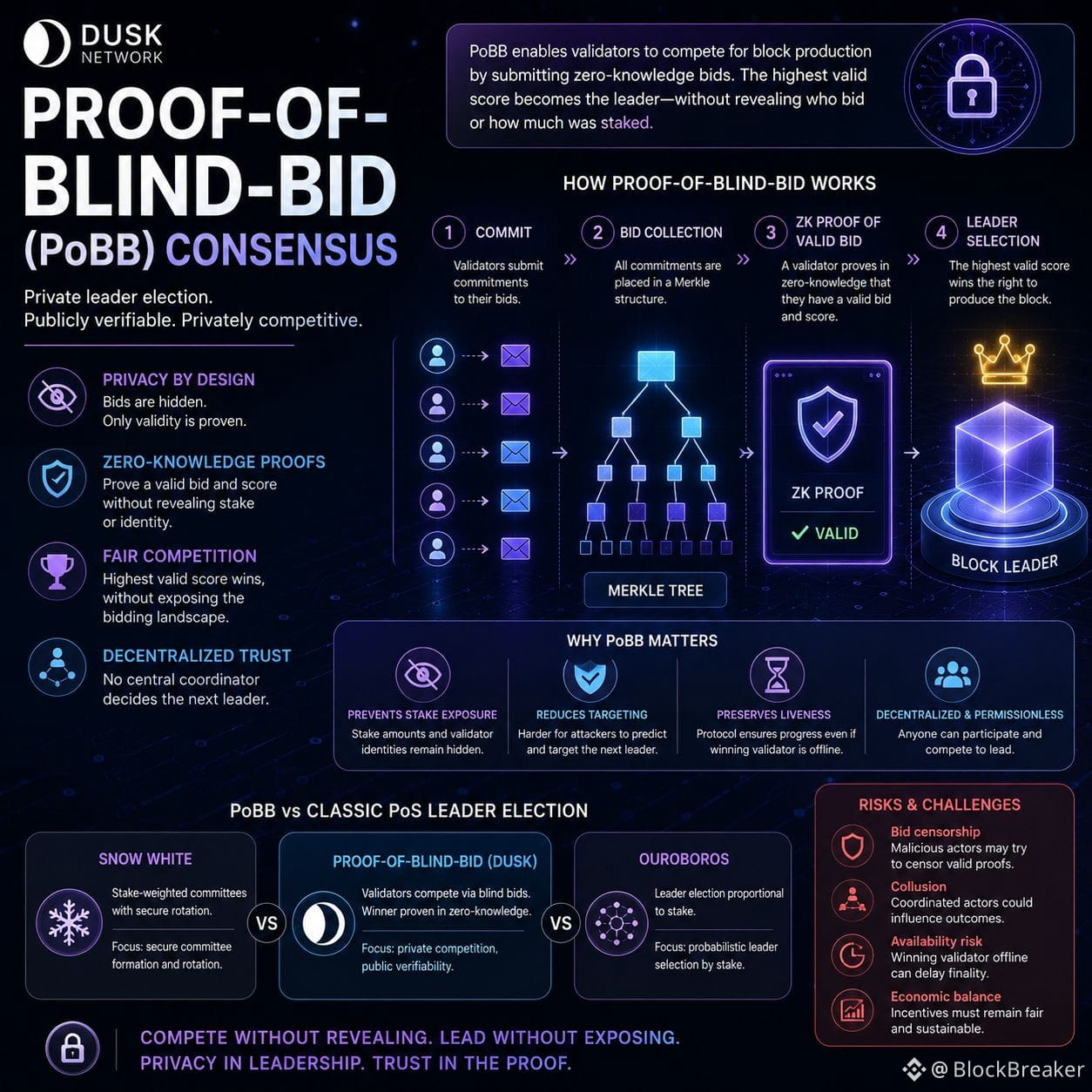
PoBB: The Hidden Game Behind Dusk’s Leader Election
I find PoBB interesting for a reason that gets missed when people call it “private leader selection.”
The deeper idea is that a validator can compete for block production without advertising the information that makes them an obvious target. In Dusk’s design, bids are committed and the eventual winner can prove the validity of the bid in zero knowledge, rather than simply exposing the whole bidding landscape.
That changes the game.
In a more transparent PoS system, knowing who is likely to produce the next block can become useful information. You can watch stake, track validators, and build strategies around predictable leadership. PoBB tries to remove some of that visibility.
But I’m not convinced privacy automatically makes the system safer.
The questions I care about are more practical: what happens when a winning bidder disappears? Can repeated censorship of bid proofs affect liveness? Do large operators gain an advantage through coordination? And can the scoring mechanism resist manipulation without making honest participation too expensive?
I’ve seen protocol designs solve one incentive problem only to move it somewhere less obvious.
That is what makes PoBB worth studying. Its real experiment is not whether Dusk can hide a validator’s bid. It is whether a blockchain can preserve fair competition when the competitors cannot easily see each other.
#dusk $DUSK @Dusk
PoBB: The Hidden Game Behind Dusk’s Leader Election
I find PoBB interesting for a reason that gets missed when people call it “private leader selection.”
The deeper idea is that a validator can compete for block production without advertising the information that makes them an obvious target. In Dusk’s design, bids are committed and the eventual winner can prove the validity of the bid in zero knowledge, rather than simply exposing the whole bidding landscape.
That changes the game.
In a more transparent PoS system, knowing who is likely to produce the next block can become useful information. You can watch stake, track validators, and build strategies around predictable leadership. PoBB tries to remove some of that visibility.
But I’m not convinced privacy automatically makes the system safer.
The questions I care about are more practical: what happens when a winning bidder disappears? Can repeated censorship of bid proofs affect liveness? Do large operators gain an advantage through coordination? And can the scoring mechanism resist manipulation without making honest participation too expensive?
I’ve seen protocol designs solve one incentive problem only to move it somewhere less obvious.
That is what makes PoBB worth studying. Its real experiment is not whether Dusk can hide a validator’s bid. It is whether a blockchain can preserve fair competition when the competitors cannot easily see each other.
PoBB: The Hidden Game Behind Dusk’s Leader Election
I find PoBB interesting for a reason that gets missed when people call it “private leader selection.”
The deeper idea is that a validator can compete for block production without advertising the information that makes them an obvious target. In Dusk’s design, bids are committed and the eventual winner can prove the validity of the bid in zero knowledge, rather than simply exposing the whole bidding landscape.
That changes the game.
In a more transparent PoS system, knowing who is likely to produce the next block can become useful information. You can watch stake, track validators, and build strategies around predictable leadership. PoBB tries to remove some of that visibility.
But I’m not convinced privacy automatically makes the system safer.
The questions I care about are more practical: what happens when a winning bidder disappears? Can repeated censorship of bid proofs affect liveness? Do large operators gain an advantage through coordination? And can the scoring mechanism resist manipulation without making honest participation too expensive?
I’ve seen protocol designs solve one incentive problem only to move it somewhere less obvious.
That is what makes PoBB worth studying. Its real experiment is not whether Dusk can hide a validator’s bid. It is whether a blockchain can preserve fair competition when the competitors cannot easily see each other.
2
123
·
--
#dusk $DUSK @Dusk_Foundation
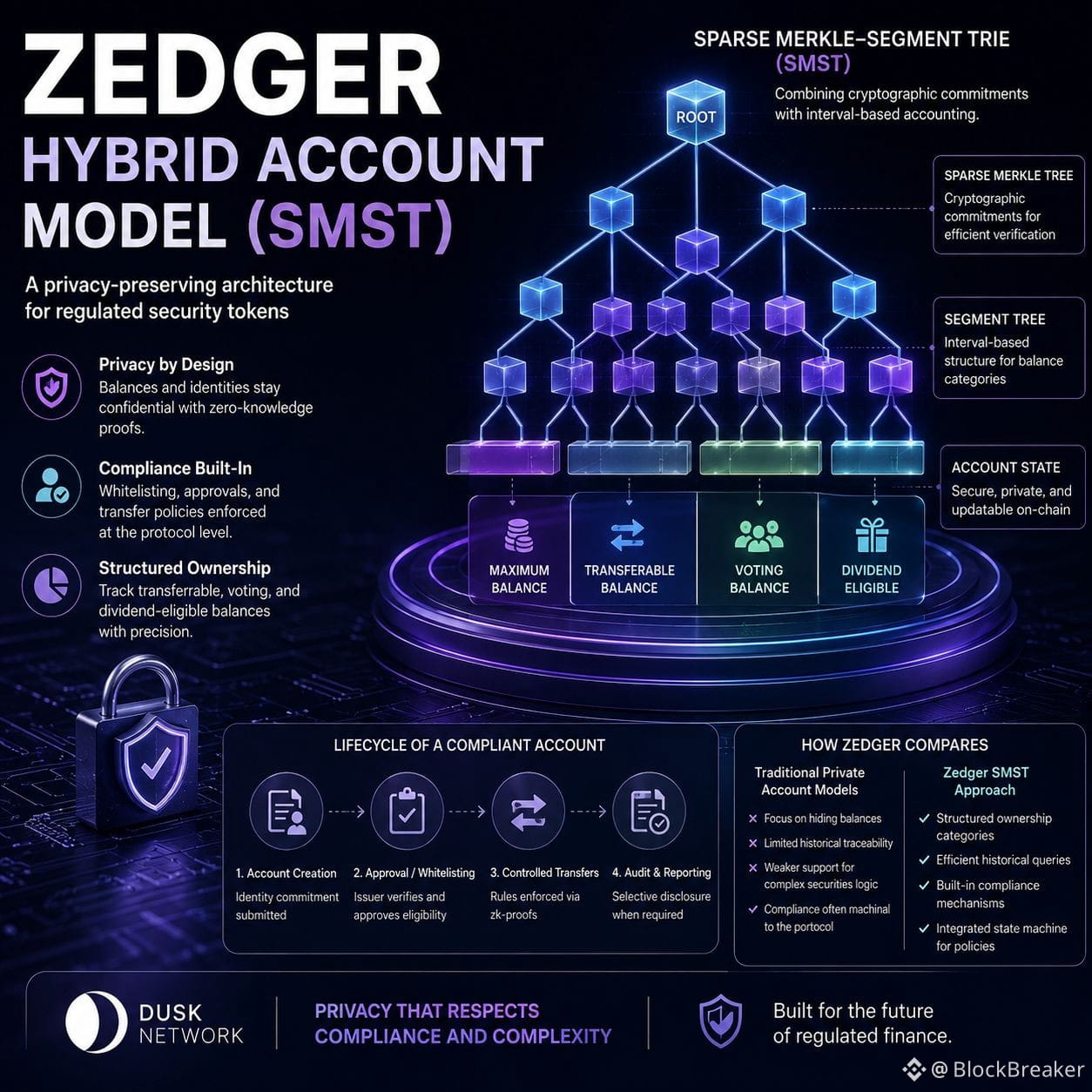
Zedger’s SMST: Maybe Privacy for Securities Needs an Accounting System First
I’ve been looking at Zedger from a slightly different angle. Most privacy models ask how to hide an account or transaction. Securities have another problem: ownership is not just a number. It changes by time, transfer rights, voting rights, dividends, and approval status.
That is why the Sparse Merkle-Segment Trie caught my attention. SMST combines a Sparse Merkle Tree with a Segment Tree, letting Zedger commit to account state while keeping different balance categories inside the structure. The design can track maximum, transferable, voting, and dividend-eligible balances without putting the entire account history on public display.
I’ve seen other privacy account models, such as BlockMaze, focus heavily on hiding balances and sender-recipient relationships with zk-SNARKs. That is useful for private payments, but corporate securities create a different data problem. You often need to prove that a transfer is allowed, not simply prove that value moved.
This is where Zedger feels more deliberate to me. Its whitelist tree and account memory structure are tied to the state machine, so compliance is not an external dashboard checking transactions after the fact.
I’m still cautious about the complexity. Every extra state field and proof rule adds engineering and verification overhead.
But the interesting question is not whether SMST hides balances. It is whether a cryptographic account model can preserve the messy realities of securities ownership without turning the ledger into a public shareholder database.
#dusk $DUSK @Dusk
Zedger’s SMST: Maybe Privacy for Securities Needs an Accounting System First
I’ve been looking at Zedger from a slightly different angle. Most privacy models ask how to hide an account or transaction. Securities have another problem: ownership is not just a number. It changes by time, transfer rights, voting rights, dividends, and approval status.
That is why the Sparse Merkle-Segment Trie caught my attention. SMST combines a Sparse Merkle Tree with a Segment Tree, letting Zedger commit to account state while keeping different balance categories inside the structure. The design can track maximum, transferable, voting, and dividend-eligible balances without putting the entire account history on public display.
I’ve seen other privacy account models, such as BlockMaze, focus heavily on hiding balances and sender-recipient relationships with zk-SNARKs. That is useful for private payments, but corporate securities create a different data problem. You often need to prove that a transfer is allowed, not simply prove that value moved.
This is where Zedger feels more deliberate to me. Its whitelist tree and account memory structure are tied to the state machine, so compliance is not an external dashboard checking transactions after the fact.
I’m still cautious about the complexity. Every extra state field and proof rule adds engineering and verification overhead.
But the interesting question is not whether SMST hides balances. It is whether a cryptographic account model can preserve the messy realities of securities ownership without turning the ledger into a public shareholder database.
Zedger’s SMST: Maybe Privacy for Securities Needs an Accounting System First
I’ve been looking at Zedger from a slightly different angle. Most privacy models ask how to hide an account or transaction. Securities have another problem: ownership is not just a number. It changes by time, transfer rights, voting rights, dividends, and approval status.
That is why the Sparse Merkle-Segment Trie caught my attention. SMST combines a Sparse Merkle Tree with a Segment Tree, letting Zedger commit to account state while keeping different balance categories inside the structure. The design can track maximum, transferable, voting, and dividend-eligible balances without putting the entire account history on public display.
I’ve seen other privacy account models, such as BlockMaze, focus heavily on hiding balances and sender-recipient relationships with zk-SNARKs. That is useful for private payments, but corporate securities create a different data problem. You often need to prove that a transfer is allowed, not simply prove that value moved.
This is where Zedger feels more deliberate to me. Its whitelist tree and account memory structure are tied to the state machine, so compliance is not an external dashboard checking transactions after the fact.
I’m still cautious about the complexity. Every extra state field and proof rule adds engineering and verification overhead.
But the interesting question is not whether SMST hides balances. It is whether a cryptographic account model can preserve the messy realities of securities ownership without turning the ledger into a public shareholder database.
5
2
119
·
--
#dusk $DUSK @Dusk_Foundation
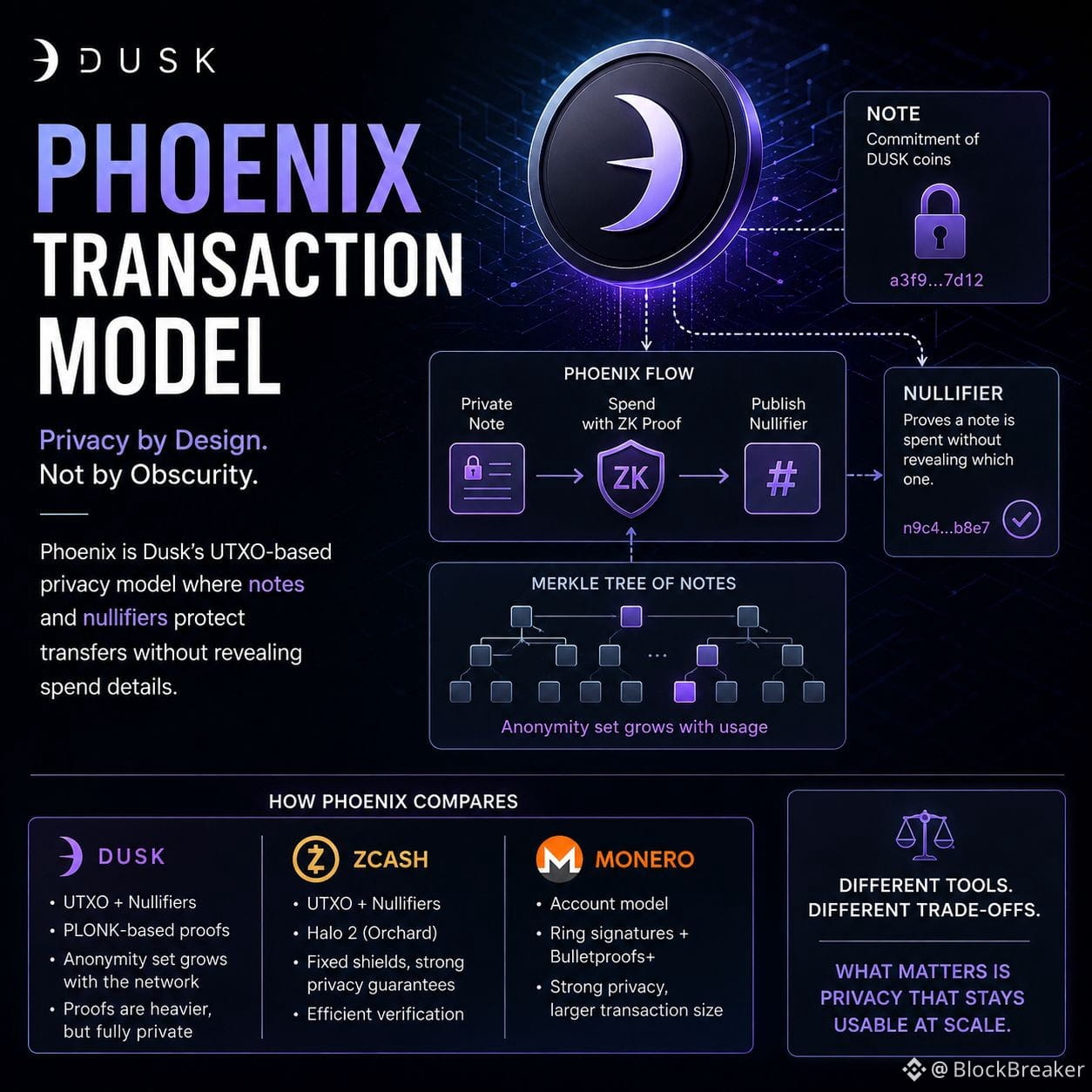
Phoenix made me look at Dusk differently.
I think privacy systems are often judged backwards. People ask whether a transaction can hide its sender, amount, and destination. I’d rather ask what the system is doing underneath that privacy layer, and what happens when real usage starts piling up.
Phoenix uses a UTXO-style model where DUSK exists as private notes. A spend publishes a nullifier to prove that the note has already been consumed without exposing which note it was. That separation is important because the privacy set can grow from the history of notes instead of depending on a handful of decoys selected at spend time.
This is where I find the design more interesting than the usual “Dusk is private” pitch.
The harder question is efficiency.
Phoenix uses zero-knowledge proofs to tie the whole thing together, and that creates a very different engineering profile from systems like Monero, which uses ring signatures plus Bulletproofs+, or Zcash, whose newer Orchard design uses Halo 2.
I’m not convinced the winner is whoever has the strongest cryptography on paper.
I want to know the cost of that privacy: proof size, proving time, verification time, and how those metrics behave as the note set gets larger.
Because privacy that works beautifully in a prototype is one thing. Privacy that stays usable when the chain is carrying years of transactions is a much more interesting test.
#dusk $DUSK @Dusk
Phoenix made me look at Dusk differently.
I think privacy systems are often judged backwards. People ask whether a transaction can hide its sender, amount, and destination. I’d rather ask what the system is doing underneath that privacy layer, and what happens when real usage starts piling up.
Phoenix uses a UTXO-style model where DUSK exists as private notes. A spend publishes a nullifier to prove that the note has already been consumed without exposing which note it was. That separation is important because the privacy set can grow from the history of notes instead of depending on a handful of decoys selected at spend time.
This is where I find the design more interesting than the usual “Dusk is private” pitch.
The harder question is efficiency.
Phoenix uses zero-knowledge proofs to tie the whole thing together, and that creates a very different engineering profile from systems like Monero, which uses ring signatures plus Bulletproofs+, or Zcash, whose newer Orchard design uses Halo 2.
I’m not convinced the winner is whoever has the strongest cryptography on paper.
I want to know the cost of that privacy: proof size, proving time, verification time, and how those metrics behave as the note set gets larger.
Because privacy that works beautifully in a prototype is one thing. Privacy that stays usable when the chain is carrying years of transactions is a much more interesting test.
Phoenix made me look at Dusk differently.
I think privacy systems are often judged backwards. People ask whether a transaction can hide its sender, amount, and destination. I’d rather ask what the system is doing underneath that privacy layer, and what happens when real usage starts piling up.
Phoenix uses a UTXO-style model where DUSK exists as private notes. A spend publishes a nullifier to prove that the note has already been consumed without exposing which note it was. That separation is important because the privacy set can grow from the history of notes instead of depending on a handful of decoys selected at spend time.
This is where I find the design more interesting than the usual “Dusk is private” pitch.
The harder question is efficiency.
Phoenix uses zero-knowledge proofs to tie the whole thing together, and that creates a very different engineering profile from systems like Monero, which uses ring signatures plus Bulletproofs+, or Zcash, whose newer Orchard design uses Halo 2.
I’m not convinced the winner is whoever has the strongest cryptography on paper.
I want to know the cost of that privacy: proof size, proving time, verification time, and how those metrics behave as the note set gets larger.
Because privacy that works beautifully in a prototype is one thing. Privacy that stays usable when the chain is carrying years of transactions is a much more interesting test.
1
2
286
·
--
#dusk $DUSK @Dusk_Foundation
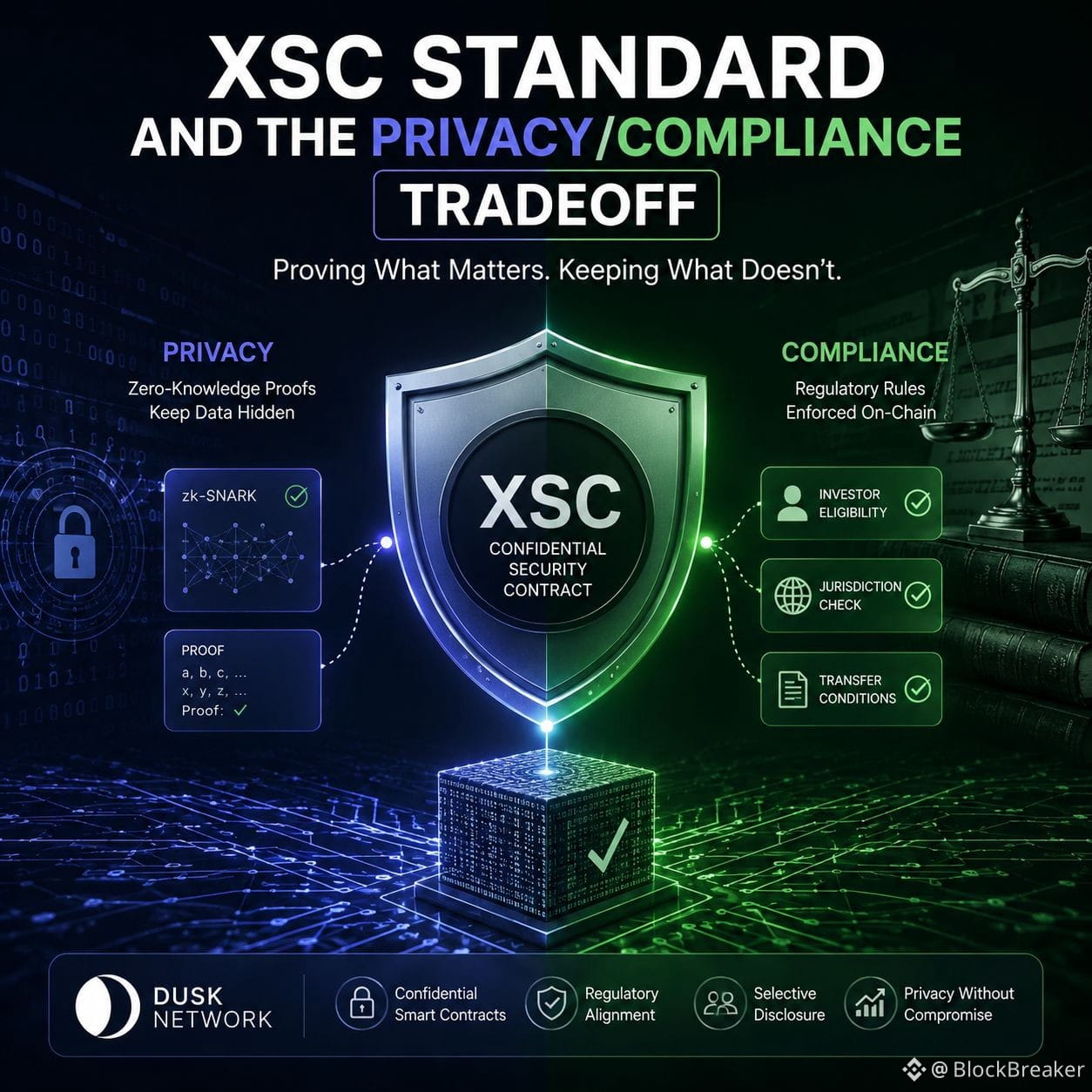
XSC Standard and the Privacy/Compliance Tradeoff
I keep coming back to one uncomfortable question around XSC: can you make a financial transaction private without making the underlying compliance logic too rigid?
The interesting part of Dusk’s design is not simply that zero-knowledge proofs can hide transaction details. XSC is built around proving that certain conditions are satisfied without exposing everything behind the proof. Its specification describes proof types for things such as set inclusion, knowledge, equality, range checks and authorization, while the contract itself defines the rules a wallet must enforce.
That sounds clean until you look at the legal side. Regulation is rarely a neat Boolean statement. “Is this investor eligible?” can become questions about jurisdiction, changing status, exemptions, reporting duties and who is allowed to verify what.
I’ve seen privacy systems treated as if cryptography solves the compliance problem by itself. It doesn’t. ZK can prove a statement; it cannot decide whether the statement captures the regulator’s intent. Research on blockchain compliance makes the same distinction: privacy-preserving proofs can reduce unnecessary disclosure, but governance, authorization and disclosure rules still matter.
That’s why I find XSC more interesting as a design problem than a product story. The real test is whether regulated finance can be expressed as precise, enforceable predicates without quietly turning privacy into another permission layer.
That tradeoff is where the serious work begins.
#dusk $DUSK @Dusk
XSC Standard and the Privacy/Compliance Tradeoff
I keep coming back to one uncomfortable question around XSC: can you make a financial transaction private without making the underlying compliance logic too rigid?
The interesting part of Dusk’s design is not simply that zero-knowledge proofs can hide transaction details. XSC is built around proving that certain conditions are satisfied without exposing everything behind the proof. Its specification describes proof types for things such as set inclusion, knowledge, equality, range checks and authorization, while the contract itself defines the rules a wallet must enforce.
That sounds clean until you look at the legal side. Regulation is rarely a neat Boolean statement. “Is this investor eligible?” can become questions about jurisdiction, changing status, exemptions, reporting duties and who is allowed to verify what.
I’ve seen privacy systems treated as if cryptography solves the compliance problem by itself. It doesn’t. ZK can prove a statement; it cannot decide whether the statement captures the regulator’s intent. Research on blockchain compliance makes the same distinction: privacy-preserving proofs can reduce unnecessary disclosure, but governance, authorization and disclosure rules still matter.
That’s why I find XSC more interesting as a design problem than a product story. The real test is whether regulated finance can be expressed as precise, enforceable predicates without quietly turning privacy into another permission layer.
That tradeoff is where the serious work begins.
XSC Standard and the Privacy/Compliance Tradeoff
I keep coming back to one uncomfortable question around XSC: can you make a financial transaction private without making the underlying compliance logic too rigid?
The interesting part of Dusk’s design is not simply that zero-knowledge proofs can hide transaction details. XSC is built around proving that certain conditions are satisfied without exposing everything behind the proof. Its specification describes proof types for things such as set inclusion, knowledge, equality, range checks and authorization, while the contract itself defines the rules a wallet must enforce.
That sounds clean until you look at the legal side. Regulation is rarely a neat Boolean statement. “Is this investor eligible?” can become questions about jurisdiction, changing status, exemptions, reporting duties and who is allowed to verify what.
I’ve seen privacy systems treated as if cryptography solves the compliance problem by itself. It doesn’t. ZK can prove a statement; it cannot decide whether the statement captures the regulator’s intent. Research on blockchain compliance makes the same distinction: privacy-preserving proofs can reduce unnecessary disclosure, but governance, authorization and disclosure rules still matter.
That’s why I find XSC more interesting as a design problem than a product story. The real test is whether regulated finance can be expressed as precise, enforceable predicates without quietly turning privacy into another permission layer.
That tradeoff is where the serious work begins.
3
224
·
--
Gold Climbs Above $4400 To Two-Month High
Gold pushed above $4,400 per ounce, reaching its highest level in more than two months, with spot prices briefly touching around $4,435.
The move comes as traders reassess the U.S. rate outlook following weaker jobs data, while attention now turns to key U.S. inflation figures for clues on the Fed’s next move.
For gold, the important question is whether buyers can sustain momentum above $4,400—or whether rising oil prices, yields and renewed rate-hike expectations trigger another pullback.
$RAD $BANANAS31 $MITO
Gold Climbs Above $4400 To Two-Month High
Gold pushed above $4,400 per ounce, reaching its highest level in more than two months, with spot prices briefly touching around $4,435.
The move comes as traders reassess the U.S. rate outlook following weaker jobs data, while attention now turns to key U.S. inflation figures for clues on the Fed’s next move.
For gold, the important question is whether buyers can sustain momentum above $4,400—or whether rising oil prices, yields and renewed rate-hike expectations trigger another pullback.
$RAD $BANANAS31 $MITO
Gold pushed above $4,400 per ounce, reaching its highest level in more than two months, with spot prices briefly touching around $4,435.
The move comes as traders reassess the U.S. rate outlook following weaker jobs data, while attention now turns to key U.S. inflation figures for clues on the Fed’s next move.
For gold, the important question is whether buyers can sustain momentum above $4,400—or whether rising oil prices, yields and renewed rate-hike expectations trigger another pullback.
$RAD $BANANAS31 $MITO

1
136
·
--
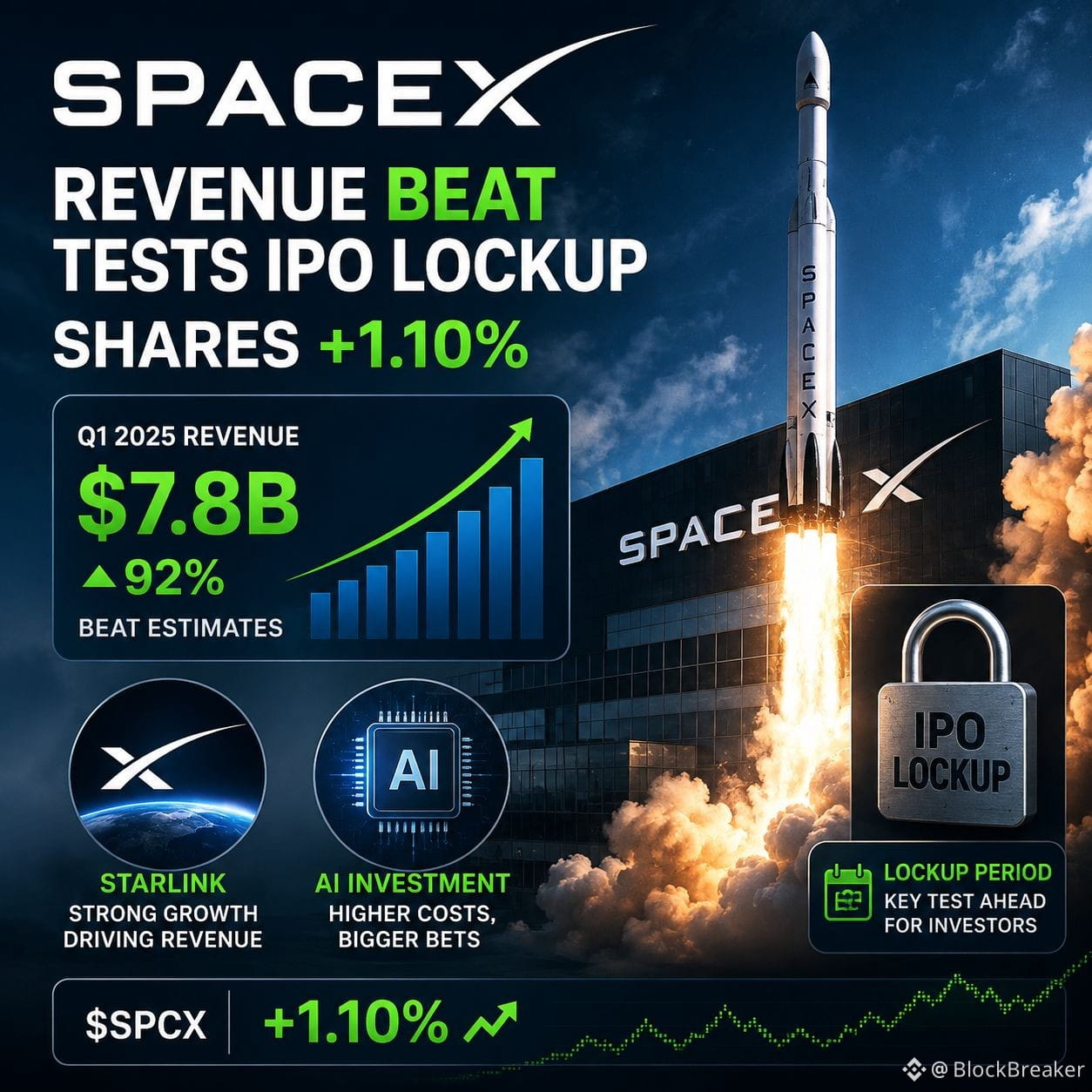
SpaceX just posted its first public earnings, and the numbers were strong: revenue jumped 92% to $7.8B and beat estimates. Now the market is watching two things closely — the share lockup and rising AI costs.
$HEI $BICO $BANK
SpaceX just posted its first public earnings, and the numbers were strong: revenue jumped 92% to $7.8B and beat estimates. Now the market is watching two things closely — the share lockup and rising AI costs.
$HEI $BICO $BANK
$HEI $BICO $BANK
3
107

·
--
#baby $BABY @babylonlabs_io
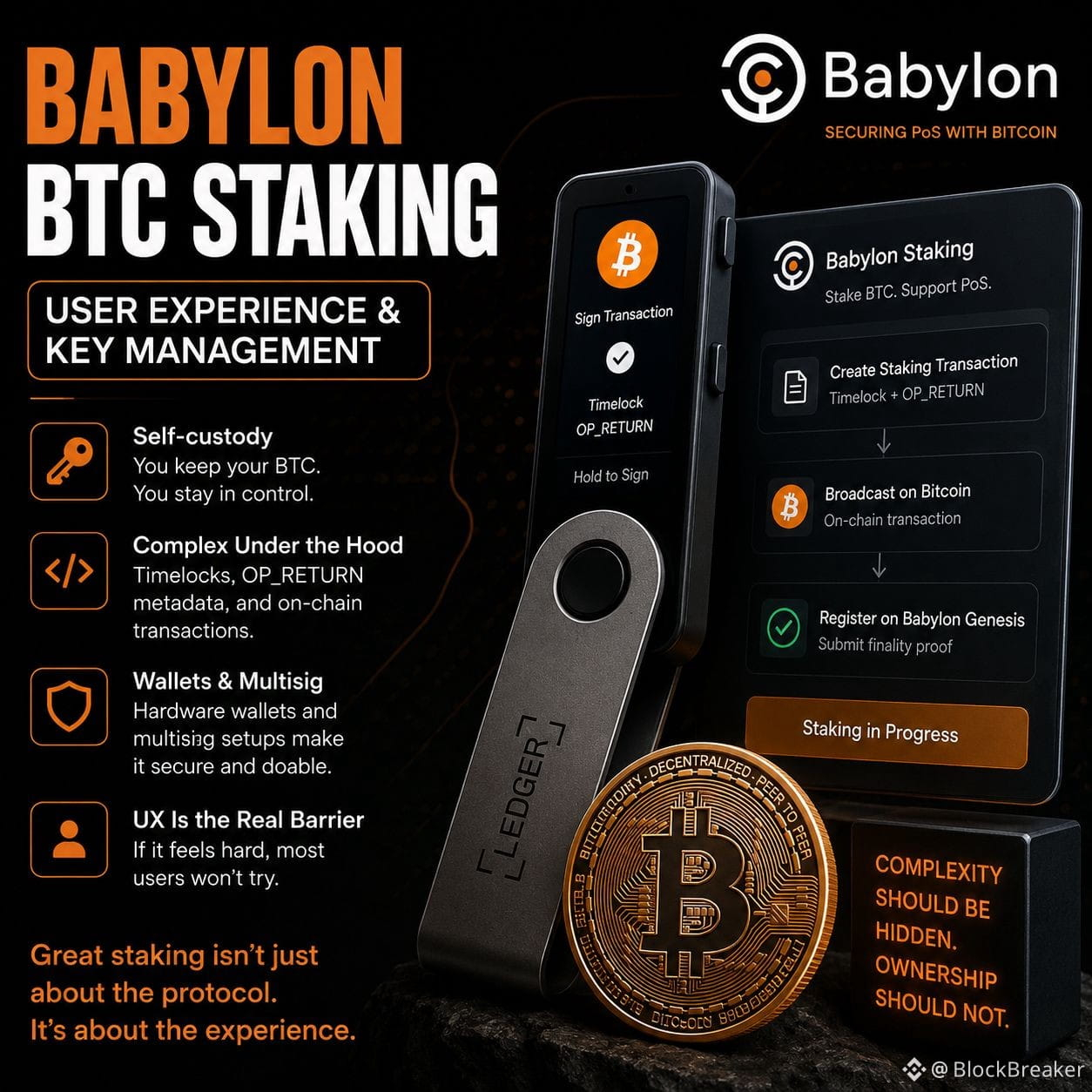
I've been thinking about Babylon from a user experience perspective, and I keep coming back to one idea: Bitcoin isn't difficult because of cryptography. It's difficult because every extra signing step makes people question whether they're about to make an irreversible mistake.
Babylon asks users to stay in control of their BTC while interacting with timelocks, staking transactions, registration steps, and wallet compatibility. None of these are flaws on their own, but together they raise the mental cost of participation.
What interests me most isn't the staking model. It's the interface between the protocol and the person holding the keys.
The projects that win won't necessarily be the ones with the smartest scripts. They'll be the ones that hide complexity without hiding ownership.
For me, that's the real benchmark. If I need to understand Bitcoin internals before I feel comfortable staking, the UX still has work to do. Self-custody should build confidence, not hesitation.
#baby $BABY @BabylonLabs_io
I've been thinking about Babylon from a user experience perspective, and I keep coming back to one idea: Bitcoin isn't difficult because of cryptography. It's difficult because every extra signing step makes people question whether they're about to make an irreversible mistake.
Babylon asks users to stay in control of their BTC while interacting with timelocks, staking transactions, registration steps, and wallet compatibility. None of these are flaws on their own, but together they raise the mental cost of participation.
What interests me most isn't the staking model. It's the interface between the protocol and the person holding the keys.
The projects that win won't necessarily be the ones with the smartest scripts. They'll be the ones that hide complexity without hiding ownership.
For me, that's the real benchmark. If I need to understand Bitcoin internals before I feel comfortable staking, the UX still has work to do. Self-custody should build confidence, not hesitation.
I've been thinking about Babylon from a user experience perspective, and I keep coming back to one idea: Bitcoin isn't difficult because of cryptography. It's difficult because every extra signing step makes people question whether they're about to make an irreversible mistake.
Babylon asks users to stay in control of their BTC while interacting with timelocks, staking transactions, registration steps, and wallet compatibility. None of these are flaws on their own, but together they raise the mental cost of participation.
What interests me most isn't the staking model. It's the interface between the protocol and the person holding the keys.
The projects that win won't necessarily be the ones with the smartest scripts. They'll be the ones that hide complexity without hiding ownership.
For me, that's the real benchmark. If I need to understand Bitcoin internals before I feel comfortable staking, the UX still has work to do. Self-custody should build confidence, not hesitation.
8
3
195
Log in to explore more content
Join global crypto users on Binance Square
⚡️ Get latest and useful information about crypto.
💬 Trusted by the world’s largest crypto exchange.
👍 Discover real insights from verified creators.
Email / Phone number
Trending Topics
EtherGains70.9%InQ3
94,796 views
923 Discussing
🧭🧭🧭 Analysis 🧭🧭🧭
💡 Altcoin Season Indicator 💡
🚨🚨🚨 The third quarter (Q3) has closed. ETH is up 71% and BTC is up 43%. 🚨🚨🚨
Was this the start of altcoin season?
Among the top 100:
🌐🌐🌐 57 outperformed BTC over the last 90 days
Altcoin season starts at 75, so it is still
It is also only advancing 10 points from its annual peak at 67 🌐🌐
💥💥💥 But wait, a month ago the indicator was only at 23!
Can October push it to 75? 👀💥💥💥
Please follow up
#EtherGains70.9%InQ3
$GRAM
Shamika Metting
·2 Likes
·886 views
TreasuryLetsStatesFileStablecoinCertificationsEarly
4,967 views
57 Discussing
US10YearYieldNears5.3%
121,088 views
985 Discussing