


Carefully! Lots of text.
Wrapped Ether (WETH) is a token pegged to the value of Ether (ETH). WETH is used on several platforms and DApps that support ERC-20 tokens. Although ETH is used to pay transaction fees on the network, it does not have the same functionality as ERC-20 tokens.
You can quickly convert ETH to WETH through a process known as "wrapping". It is also used to convert back to ETH. Both wrapping and deployment are done on a 1:1 ratio, meaning there are no additional costs other than the transaction fee.
You can manually wrap your ETH using the WETH smart contract, which will store your ETH and return the exact same amount of WETH to you.
The Ethereum-based DeFi ecosystem is huge, and using WETH provides more staking and investment opportunities. There are many versions of WETH, but some are more popular than others. You can even find wrapped ETH on other blockchains for use in their ecosystems. Typically, WETH is used for NFT trading, providing liquidity to pools, and crypto lending.
Introduction
If you use Ethereum, most of the tokens you trade and invest in will likely use the ERC-20 token standard. The use of this technical standard has become popular among decentralized applications, wallets, and projects as it provides advanced capabilities to most users. However, this raises another problem with the native token of the Ethereum network, ether.
Ether does not follow the same rules as ERC-20 tokens, but there is demand for its use in ERC-20 decentralized applications. Wrapped Ether aims to solve this problem and you may have come across this token before. Next, we will explain why it has become a useful tool for investors and owners in many projects and DApps.

What is wrapped Ether (WETH)?
WETH is an Ethereum-based ERC-20 token pegged to the price of Ether (ETH). The WETH token, unlike the native Ethereum token - ETH - cannot be used to pay for gas. However, WETH has a wider range of uses than ETH and is very popular in the decentralized finance (DeFi) ecosystem. WETH supports MetaMask, TrustWallet and almost any wallet on the Ethereum network. Let's look at some of the use cases.
Why wrap ETH
To begin with, it can be difficult to understand what the WETH token is for. Isn't there already an ETH token on the Ethereum blockchain? First you need to understand that not all Ethereum tokens are the same from a technical point of view. The network allows developers to create new rules and standards for cryptocurrencies.
One example would be the ERC-721 format, which allows access to non-fungible tokens (NFTs). They are significantly different from Ether or ERC-20 tokens. Developers have a lot of customization options when creating these digital assets. So, while ETH can be used as gas fees on Ethereum, it cannot be used in every DApp.
Most DApps in DeFi currently accept ERC-20 tokens for investment and staking. If we want to add ETH to a liquidity pool or use it as collateral, it is much easier to have it in the ERC-20 version. This ensures full compatibility with the blockchain and saves time on developing new smart contracts.
How to Wrap Ether (ETH)
The process of creating WETH is simple - you send your ETH to a smart contract, which then provides you with WETH. This means that all WETH created are fully backed by ETH reserves. Your ETH will be locked in a smart contract and can be exchanged back to WETH at any time. Once the ETH is returned, the contract burns the provided WETH.
To wrap Ether, you can interact directly with the WETH smart contract. It will take your ETH and credit WETH to your wallet at a 1:1 ratio (you will still have to pay for the transaction fee). The reverse conversion requires another interaction with the smart contract, but the process is almost the same.
However, it is much easier to exchange another token for WETH using a crypto exchange. Let's look at how you can exchange your ETH for WETH using the Uniswap DEX or directly through the Metamask wallet.
How to Wrap ETH on Uniswap
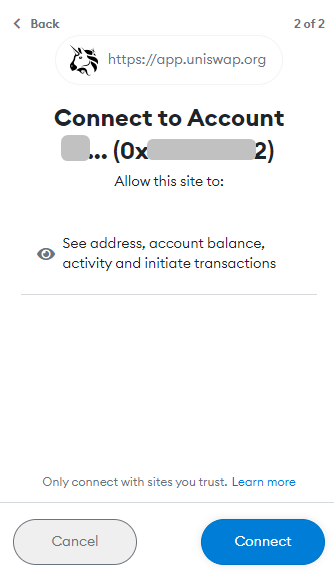
1. Open Uniswap and connect your wallet. Make sure you have the Ethereum network selected.

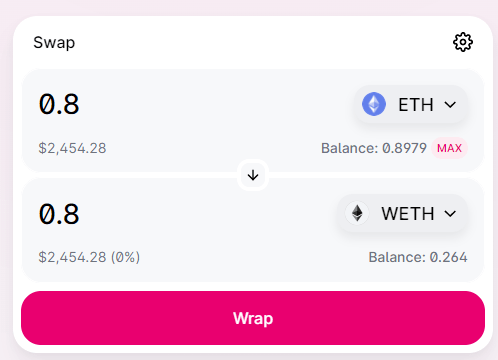
2. Select ETH in the top field and WETH in the bottom. If you click [Select a token], WETH will appear above the list.

3. Enter the amount of ETH you want to convert to WETH and click the [Swap] button.
4. Now you need to confirm the transaction in your crypto wallet. Don't forget that you will also need to pay for gas, so make sure you have extra ETH. Check the details and click [Confirm].

5. Now you need to wait for the transaction to be confirmed on the blockchain. The waiting time will depend on the network congestion. If you're in a hurry, you can speed up the process (for example, pay higher fees) to confirm the transaction faster.
How to wrap ETH on MetaMask
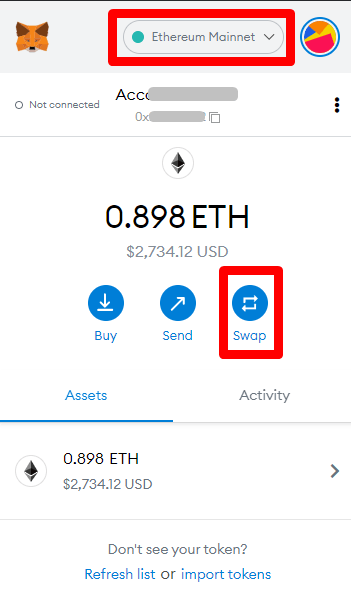
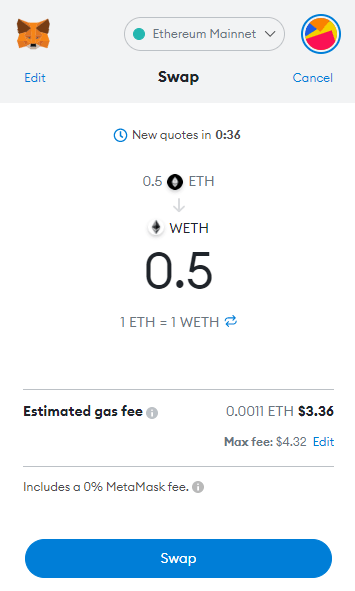
1. Open your MetaMask wallet and make sure [Ethereum Mainnet] is selected. Then click [Swap].
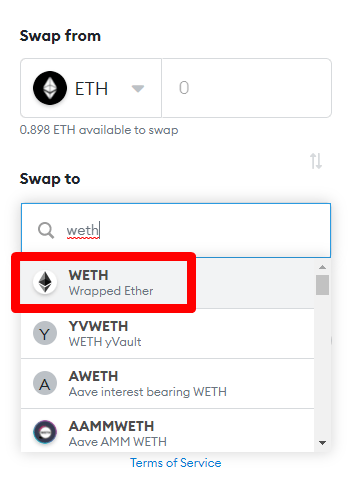
2. In the [Swap to] field, find WETH.
3. Enter the amount of ETH you want to exchange and click [Review Swap].

4. Now you will see a quote with the current rate (which should be 1 to 1). Click [Swap] to complete the transaction.
How to deploy ETH (WETH)
As we said earlier, you can deploy Ether manually by interacting with a smart contract. However, it is much easier and safer to exchange WETH for ETH. To do this, follow our previous instructions on Uniswap or MetaMask, but make sure to change WETH to ETH. You can also use Binance to convert WETH.
1. Go to the Conversion and OTC portal on the Binance exchange. Select WETH in the "C" field and ETH in the "On" field, and then click "Preview".

2. Here you can view the details of the transaction. Be sure to check them before confirming the exchange. Please note that Binance does not allow you to exchange ETH for WETH using this method.
Is it possible to wrap ETH on other blockchains?
Other packaged versions of ETH exist on many major blockchains, increasing ETH interoperability. For example, using wrapped ETH in BNB Smart Chain (BSC) allows WETH to be traded or used within the BSC DeFi ecosystem. To do this, you will need to withdraw ETH from Binance or another exchange to your BSC wallet. Before making a withdrawal, make sure your exchange supports ETH to WETH conversion.
Alternatively, you can use the services of a bridge. These are third-party DApps that take cryptocurrency and store it on the source blockchain, then create wrapped tokens at a 1:1 ratio on the destination blockchain.
Transferring tokens usually works fine, but keep in mind that moving tokens between blockchains can be risky. There have been cases where the smart contracts of some bridges have been compromised or hacked. If you want to transfer wrapped Bitcoin, Ethereum or another token, carefully review the platform you are using before using their services.
How does wrapped ETH preserve the value of ETH?
The key to keeping WETH pegged to ETH is its 1 to 1 convertibility. If WETH were cheaper, people would buy it and convert it into the more expensive ETH to make a profit. This possibility would increase WETH demand and therefore the price. If WETH were more expensive, users would buy ETH and convert it into WETH to sell, increasing the supply of WETH and reducing its price. This balance of supply and demand ensures that the peg remains relatively stable.
Which DeFi applications can use WETH?
Ethereum has many DApps in the DeFi segment that accept ERC-20 tokens. One option is to add WETH to the liquidity pool available on a decentralized exchange (DEX) such as Uniswap. By providing liquidity, you will receive commissions from users who exchange using the pool. However, non-permanent loss is always a possible risk, which may result in a decrease in the number of your deposited tokens. Using a pool with high liquidity reduces this risk.
You can also start lending out your WETH as a loan. For example, on the Aave platform. Other users can lend your tokens, but must first provide collateral covering their loan. In return, you will receive interest until you decide to remove the deposit.

Conclusion
The Ethereum blockchain has one of the oldest and most mature DApp ecosystems. This makes the use of WETH necessary as many ETH holders want to use their ETH in DeFi projects. If you decide to start experimenting with WETH, we recommend purchasing it with ETH or other tokens, as it is easier and more convenient than interacting with smart contracts for wrapping.