


Table of contents
Introduction
What is a golden cross?
What is a Death Cross?
What is the difference between a golden cross and a death cross?
How to trade the Golden Cross and Death Cross patterns
Summarize
Introduction
There are many chart patterns for technical analysis. We have discussed them before in "A Beginner's Guide to Classic Chart Patterns" and "12 Common K-line Chart Patterns in Technical Analysis". However, day traders, swing traders and long-term investors can refer to two more patterns, which are the "golden cross" and "death cross" introduced in this article.
Before we look at the two patterns, we first need to understand what a moving average (MA) is. In short, it is a line drawn on a price chart that measures the average price of an asset over a given period of time. For example, a 200-day moving average measures the average price of an asset over the past 200 days. For more information about moving averages, read Moving Average Explained.
So, what exactly are golden crosses and death crosses, and how can traders use them in their trading strategies?
What is a golden cross?
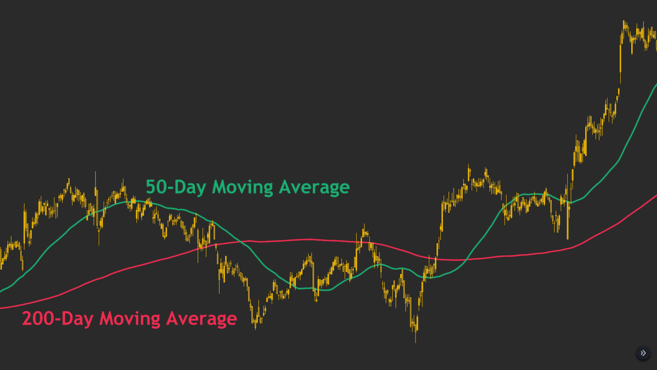
A golden cross (or golden cross) is a chart pattern that generally refers to a short-term moving average crossing upwards over a long-term moving average. We generally use the 50-day MA as the short-term average and the 200-day MA as the long-term average. However, this is not the only way a golden cross can appear. It can occur in any time period, and the basic situation is that the short-term average crosses upwards over the long-term average.
Golden cross generally appears in three stages:
During a downtrend, the short-term moving average is below the long-term moving average.
The trend reverses and the short-term average crosses the long-term average.
The short term average remains above the long term average and an uptrend starts.

The appearance of a golden cross indicates that Bitcoin is entering a new upward trend.
In many cases, a golden cross can be considered a bullish signal. Why? The reason is simple. As we know, a moving average measures the average price of an asset during the period of charting. From this perspective, a short-term average below a long-term average means that the short-term price trend is bearish compared to the long-term price trend.
Now, what happens when the short-term average crosses the long-term average? The answer is that the short-term average price will be higher than the long-term average price. This indicates a potential change in the market trend, and the golden cross is therefore a widely recognized bullish signal.
In the conventional concept, a golden cross is when the 50-day moving average crosses above the 200-day moving average. However, the general idea behind a golden cross is that a short-term moving average crosses a long-term moving average. Therefore, golden crosses may also occur on other timeframes (15 minutes, 1 hour, 4 hours, etc.). Nevertheless, signals in the long cycle tend to be more reliable than those in the short cycle.
So far, we have covered the golden cross of the simple moving average (SMA). However, there is another common moving average calculation method called the exponential moving average (EMA). It uses a completely different formula that emphasizes recent price action.
EMAs can also be used to find crossovers of bullish and bearish trends, including golden crosses. This tool is able to react more quickly to recent price action, but the crossover signals they produce can be less reliable and result in more false signals. Even so, EMA crossovers are a common tool for identifying trend reversals.
What is a Death Cross?
The death cross is basically the opposite of the golden cross. In this chart pattern, the short-term average is lower than the long-term average. For example, the 50-day average is lower than the 200-day average. Therefore, the death cross is a widely recognized bearish signal.
Death cross generally appears in three stages:
During an uptrend, the short-term moving average is above the long-term moving average.
The trend reverses and the short-term average falls below the long-term average.
When the short-term average is consistently below the long-term average, a downtrend is present.

Death cross confirming Bitcoin's downtrend.
After understanding the golden cross, it is easy to understand why the death cross is a bearish signal. The short-term average line falls below the long-term average line, indicating a bearish market outlook.
Throughout history, death crosses have issued bearish warnings before many financial crises, such as in 1929 or 2008. However, it can also send false signals, as was the case in 2016.
In 2016, a false death cross signal appeared on SPX.
As can be seen in the example, the market showed a death cross signal, but quickly resumed the upward trend and eventually formed a golden cross.
What is the difference between a golden cross and a death cross?
After discussing the concepts of golden cross and death cross, the difference between the two is not difficult to understand. They are essentially opposites of each other. A golden cross may be considered a bullish signal, while a death cross is considered a bearish signal.
Both can be confirmed by high volume. Some technical analysts also refer to other technical indicators when analyzing crossovers. Common examples include the moving average convergence divergence (MACD) and the relative strength index (RSI).
It is important to note that moving averages are lagging indicators and have no predictive capabilities. A crossover between the two usually indicates a trend reversal that has already occurred, but cannot be used to analyze a reversal that is still ongoing.
➟ Want to start your digital currency journey? Buy Bitcoin on Binance now!
How to trade the Golden Cross and Death Cross patterns
The basic idea behind these patterns is pretty simple. If you understand how traders use the MACD, it will be easy to understand how to trade based on these crossover signals.
When talking about golden and death crosses, we usually look at the daily trading chart. Therefore, the simplest strategy is to buy when the golden cross appears and sell in time after the death cross occurs. Although there have been many false signals in the past few years, this has been a relatively successful Bitcoin trading strategy. Therefore, blindly following one signal is usually not the best strategy. When it comes to market analysis techniques, traders need to take many factors into consideration.
To learn more about a simple strategy for recommending long-term positions, read Dollar Cost Averaging (DCA) Explained.
The crossover strategy mentioned above is based on the daily moving average crossover. What about other time periods? The golden cross and the death cross occur in the same situation, and traders can make full use of both indicators.
However, as with most chart analysis techniques, signals on longer timeframes are usually more accurate than shorter timeframes. When you see a dead cross on an hourly timeframe, you may see a golden cross if you extend the span to a week. Therefore, zooming in on the timeframe and looking at the chart trend (and considering multiple parameters) is the way to go.
When trading golden and death crosses, many traders also look at volume. As with other chart patterns, volume is an important tool for confirming trends. When a volume spike accompanies a crossover signal, many traders feel more certain that the signal is valid.
After a golden cross, the long-term moving average may be considered a potential support area. Conversely, after a death cross signal, it can be considered a potential resistance area.
Crossover signals can also be cross-checked with other technical indicators to find convergence points. Fusion traders combine multiple signals and indicators into a single trading strategy to make trading signals more reliable.
Summarize
In this article, we discussed the most commonly used crossover signals: golden cross and death cross.
A golden cross occurs when a short-term moving average crosses above a long-term moving average. A dead cross occurs when a long-term moving average falls below a short-term moving average. Whether it is the stock market, forex or cryptocurrency market, both indicators are reliable tools for confirming long-term trend reversals.
Do you have any other questions about trading crossover signals such as golden and death crosses? Please visit our Q&A platform Ask Academy, where members of the community will patiently answer your trading questions.