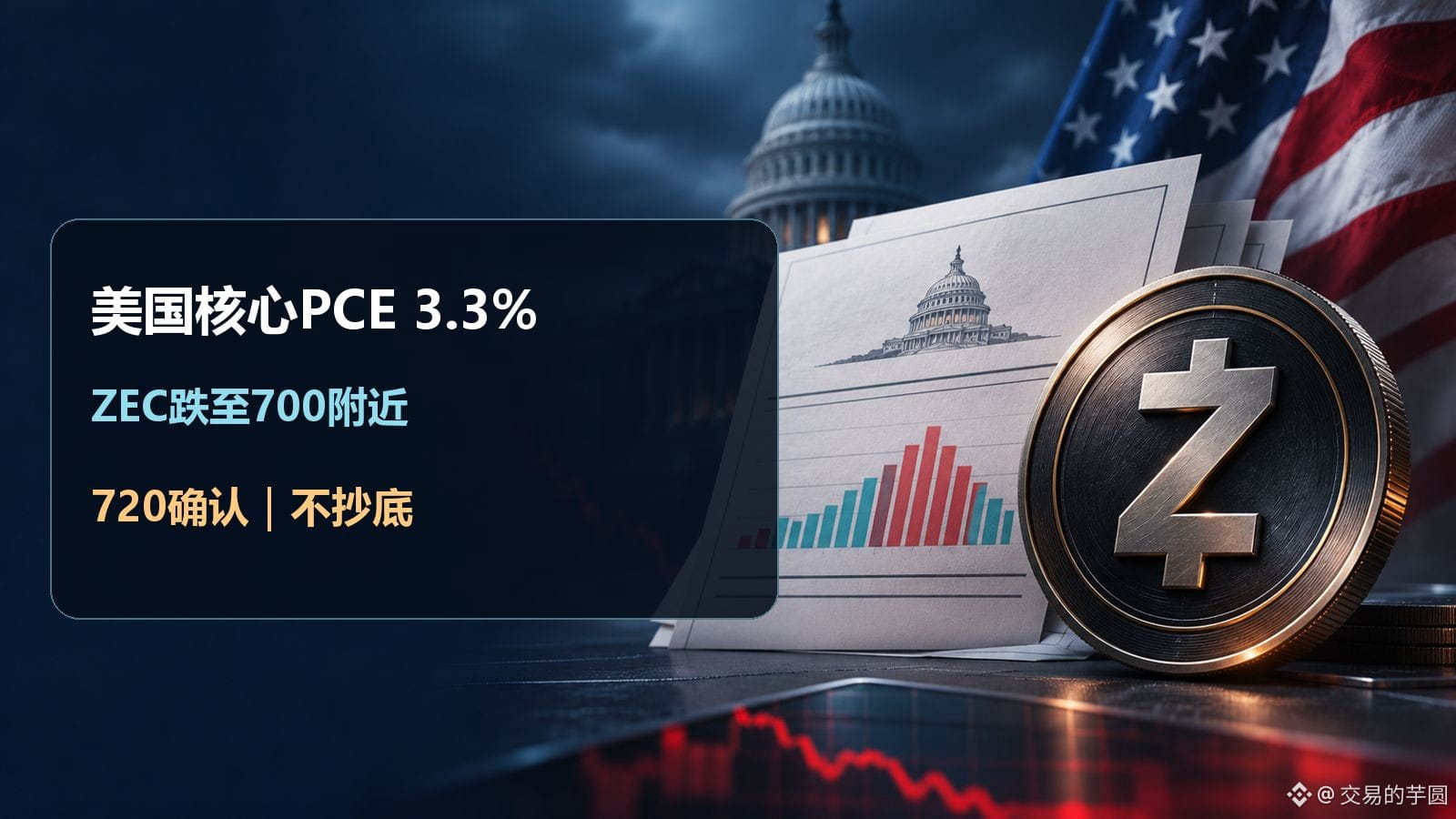
U.S. Core PCE up 3.3% year over year | ZEC falls toward 700 | Stay disciplined; don’t buy the dip
My short-term stance is cautious. The U.S. Bureau of Economic Analysis at the Department of Commerce has just released October personal income and spending data: the headline PCE price index rose 0.3% month over month and 3.8% year over year; core PCE, excluding food and energy, also rose 0.3% month over month and 3.3% year over year. Personal income increased 0.7% month over month, while nominal consumer spending rose 0.3%. These are reported figures, not market forecasts; but one report alone cannot prove that the Fed will definitely raise or cut rates next time. Employment, inflation trends, and officials’ comments also matter. There’s a hot discussion on Binance Square about whether October core PCE changes rate expectations. What I’m watching is how it changes the cost of capital for risk assets.
ZEC isn’t a direct instrument for trading U.S. interest rates, but it can be easily swayed by risk appetite across the broader crypto market. If core inflation stays elevated, real rates and expectations for the dollar could weigh on valuations for high-volatility coins. If the market instead judges that slowing consumption is the dominant factor, the direction could reverse quickly. The privacy narrative and Zcash’s governance process can affect ZEC’s relative strength, but they can’t make it rise independently of BTC and macro liquidity. Interpreting the PCE data directly as a specific project-level catalyst for ZEC would also skip necessary evidence of how the effect is transmitted.
As of 9:47 p.m. Beijing time, ZEC/USD on Kraken was around $703, with a 24-hour open near $739 and a range of approximately $694 to $744; BTC/USD was around $58,309, with its 24-hour low already at $57,919. Both are below their opening prices, suggesting risk appetite remained weak at this point after the data release. However, the intraday decline cannot be attributed entirely to PCE, because the sell-off had already begun before the data came out. A more reliable signal will be whether the next few hourly candles can reclaim key levels and whether BTC stops making new lows. Calling the trend confirmed just by looking at the first plunge makes it easy to get caught on the wrong side when liquidity rebounds.
My first line of defense is around $694 for ZEC. If the day’s low is breached and a rebound fails, short-term buying support could weaken further. The second level to watch is $720; only after reclaiming and holding it might a retest of the $739–$744 opening-price and upper-range area be possible. If revisions to core PCE or other data later change the rate outlook, the macro view needs to be updated. If ZEC moves above $720 while BTC continues to make new lows, claims of independent strength should also be discounted. Today’s priority is confirmation, not guessing the bottom.
If I were trading this myself, I wouldn’t buy the dip now; I’d stay on the sidelines for the time being. I’d only consider a leveraged-free spot long using at most 0.5% of my total capital if ZEC closes a four-hour candle back above $720, holds $715–$720 on a retest, and BTC stops making new intraday lows. The first target would be $739, where I’d sell half; I’d aim for $760 with the remainder and move the stop loss up to around breakeven. The initial stop would be below $693. If $694 is decisively broken first, the entire buy plan is invalidated. If, after entry, the price falls back below $715, or rate expectations rise further on macro developments while BTC weakens in tandem, I’d exit immediately. If the conditions aren’t met, I’ll keep my cash and won’t treat the plan as an executed trade.
#WillOctCorePCEShiftFedHikeExpectations? #ZEC
The above is solely my personal market observation and does not constitute investment advice.