
SignalX 💣
671 Posts

SignalX 💣
 Square Verified
Report
Block User
KITE-906830
Open Trade

BNB Holder
High-Frequency Trader
5.6 Years
160 Following
19.0K+ Followers
11.2K+ Liked
Posts
Portfolio
All
Videos
Live
PINNED
·
--
Verified

Article
KITE AI: The Day Machines Become Customers, Workers, and Economic CitizensThe next billion participants in the digital economy might not be human.
Imagine it's 2030.
A small business owner in Singapore is sleeping.
Meanwhile, her AI Agent notices that inventory is running low. It contacts another Agent representing a supplier in Germany, compares quotations, negotiates delivery terms, and initiates a payment within its authorized spending limit.
A third Agent arranges logistics.
A fourth verifies the transaction.
By sunrise, the supply chain has moved forward without a single email, phone call, or manual spreadsheet update.
This isn't simply automation.
It's the beginning of a fundamentally different economic architecture.
And it raises a question that projects like Kite AI are trying to answer:
Who builds the financial and trust infrastructure for an economy where machines transact with machines?
🧠 1. AI Has Intelligence. But Does It Have Economic Freedom?
We've spent years making AI smarter.
We taught machines to understand language, generate software, interpret images, and solve increasingly complex problems.
But intelligence alone doesn't create economic independence.
An AI Agent might know exactly which service to purchase, yet still lack the infrastructure to make that purchase securely.
It might identify a profitable business opportunity, yet have no verifiable identity or authorized way to execute a transaction.
This exposes a critical gap between AI that recommends actions and AI that can execute them.
Closing that gap requires more than better algorithms.
It requires infrastructure for identity, authorization, payments, and accountability.
This is where Kite AI enters the conversation.
🔗 2. Kite AI: Building the Economic Rails for Autonomous Agents
Kite AI is developing blockchain infrastructure designed for an emerging agent-driven economy.
Its broader vision addresses a problem that becomes increasingly important as autonomous systems grow more capable:
How can AI Agents interact economically without sacrificing trust, transparency, or human control?
Consider three foundational requirements.
Identity: An Agent needs a verifiable way to establish who or what it represents.
Authority: An Agent must operate within clearly defined permissions rather than receiving unlimited control over its owner's resources.
Payments: Agents need mechanisms to exchange value efficiently, potentially across platforms and borders.
These requirements are interconnected.
A payment system without identity creates accountability problems.
Identity without programmable authorization creates security risks.
And authorization without efficient payments limits economic usefulness.
The real opportunity lies in connecting these capabilities into infrastructure that developers can build upon.
That is what makes Kite AI's direction particularly interesting.
⚡ 3. The Most Overlooked Opportunity: An Economy of Micro-Decisions
Most discussions about AI Agents focus on replacing repetitive human tasks.
I believe the bigger opportunity is something less obvious.
AI could make previously uneconomical transactions economically viable.
Think about a $0.02 data request.
Today, involving a human to approve, negotiate, and settle such a transaction would be absurd.
The administrative cost would exceed the value being exchanged.
But what happens when autonomous Agents can evaluate and execute thousands of tiny transactions?
A research Agent could purchase specialized information from a data provider.
A logistics Agent could pay for a real-time traffic prediction.
A creative Agent could compensate another service for a specific computational task.
Each transaction might be insignificant individually.
Together, they could support entirely new digital marketplaces.
This is a powerful idea:
The Agent Economy may not simply automate existing markets. It could create markets that were previously impossible to operate efficiently.
Of course, making this practical requires low transaction costs, dependable infrastructure, and safeguards against abuse.
But the economic implications are enormous.
🛡️ 4. The Real Breakthrough Isn't Autonomy. It's Controlled Autonomy.
There's an uncomfortable truth about autonomous AI.
The more freedom we give an Agent, the more damage it could potentially cause if something goes wrong.
An Agent with unrestricted spending power isn't necessarily innovative.
It might simply be dangerous.
That's why I believe the defining feature of successful Agent infrastructure will be programmable trust.
Imagine giving your AI assistant permission to:
Spend up to $100 per day.Purchase only approved categories of services.Interact with verified counterparties.Request human approval for unusually large transactions.
Now autonomy becomes something measurable and controllable.
The goal shouldn't be to eliminate humans from economic decision-making.
It should be to move humans from approving every individual action toward defining the rules under which actions can occur.
That distinction could determine whether the Agent Economy becomes a useful global infrastructure or remains an interesting experiment.
💎 5. Where Does $KITE Fit Into the Bigger Picture?
For me, the most important question surrounding $KITE isn't whether AI is a popular market narrative.
It's whether the Kite ecosystem can translate its technological vision into sustained economic activity.
A useful framework is to examine three questions:
First: Are developers building applications that genuinely need agent-native infrastructure?
Second: Are those applications producing real transactions and measurable user value?
Third: Does network adoption translate into sustainable utility and demand within the Kite ecosystem?
These questions matter because technological innovation and token appreciation are not automatically the same thing.
A compelling narrative can attract attention.
But only practical utility, reliable execution, and sustainable adoption can support a durable ecosystem.
The strongest long-term thesis for Kite AI would therefore be based on actual agent activity rather than speculation alone.
🌍 6. My Prediction: The Internet Is Moving Toward an Agent-to-Agent Economy
The internet has already experienced several major transformations.
Web1: Humans consumed information.
Web2: Humans created content and interacted through platforms.
Web3: Blockchain introduced new ways to establish ownership and coordinate digital value.
The Agent Economy: Intelligent software may increasingly discover, negotiate, and transact on behalf of humans and organizations.
This next stage won't necessarily replace previous generations of the internet.
It could build on top of them.
Websites may increasingly serve not only human visitors but also software Agents acting as customers.
Digital businesses may optimize their services for both people and autonomous systems.
And payment infrastructure may need to accommodate transactions happening at machine speed.
If that future materializes, the winners won't necessarily be the projects with the loudest AI marketing.
They may be the ones solving the least glamorous but most essential problems:
Identity. Permissions. Settlement. Security. Interoperability.
These are the foundational challenges that make Kite AI worth studying.
🚀 Final Thought: The Next Economic Revolution May Be Invisible
The most important technological revolutions don't always announce themselves.
Sometimes they begin quietly.
A payment executed without friction.
A service purchased without human intervention.
A supply chain coordinated by software.
A thousand microtransactions that would never have made economic sense before.
Individually, these events may seem ordinary.
Collectively, they could signal a profound transformation in how economic value moves across the internet.
My thesis is simple:
The next phase of AI won't be defined only by machines becoming more intelligent.
It will be defined by whether intelligent machines can participate in economic activity safely, efficiently, and under meaningful human control.
Kite AI is positioning itself around that challenge.
Its success is not guaranteed, and the Agent Economy still faces significant technical and adoption hurdles.
But the problem it is addressing is real, and the opportunity is worth examining.
We spent decades building an internet where humans could connect with information.
Now we may be building an internet where intelligence can connect directly with economic value.
And that could change everything.
💬 One question for the community:
If AI Agents eventually conduct millions of transactions every day, what will become more valuable: the intelligence making decisions, or the infrastructure making those decisions trustworthy?
#KiteBBW #KiteAI #AgentEconomy #ArtificialIntelligence #Web3 #Blockchain $KITE
{future}(KITEUSDT)
KITE AI: The Day Machines Become Customers, Workers, and Economic Citizens
The next billion participants in the digital economy might not be human.
Imagine it's 2030.
A small business owner in Singapore is sleeping.
Meanwhile, her AI Agent notices that inventory is running low. It contacts another Agent representing a supplier in Germany, compares quotations, negotiates delivery terms, and initiates a payment within its authorized spending limit.
A third Agent arranges logistics.
A fourth verifies the transaction.
By sunrise, the supply chain has moved forward without a single email, phone call, or manual spreadsheet update.
This isn't simply automation.
It's the beginning of a fundamentally different economic architecture.
And it raises a question that projects like Kite AI are trying to answer:
Who builds the financial and trust infrastructure for an economy where machines transact with machines?
🧠 1. AI Has Intelligence. But Does It Have Economic Freedom?
We've spent years making AI smarter.
We taught machines to understand language, generate software, interpret images, and solve increasingly complex problems.
But intelligence alone doesn't create economic independence.
An AI Agent might know exactly which service to purchase, yet still lack the infrastructure to make that purchase securely.
It might identify a profitable business opportunity, yet have no verifiable identity or authorized way to execute a transaction.
This exposes a critical gap between AI that recommends actions and AI that can execute them.
Closing that gap requires more than better algorithms.
It requires infrastructure for identity, authorization, payments, and accountability.
This is where Kite AI enters the conversation.
🔗 2. Kite AI: Building the Economic Rails for Autonomous Agents
Kite AI is developing blockchain infrastructure designed for an emerging agent-driven economy.
Its broader vision addresses a problem that becomes increasingly important as autonomous systems grow more capable:
How can AI Agents interact economically without sacrificing trust, transparency, or human control?
Consider three foundational requirements.
Identity: An Agent needs a verifiable way to establish who or what it represents.
Authority: An Agent must operate within clearly defined permissions rather than receiving unlimited control over its owner's resources.
Payments: Agents need mechanisms to exchange value efficiently, potentially across platforms and borders.
These requirements are interconnected.
A payment system without identity creates accountability problems.
Identity without programmable authorization creates security risks.
And authorization without efficient payments limits economic usefulness.
The real opportunity lies in connecting these capabilities into infrastructure that developers can build upon.
That is what makes Kite AI's direction particularly interesting.
⚡ 3. The Most Overlooked Opportunity: An Economy of Micro-Decisions
Most discussions about AI Agents focus on replacing repetitive human tasks.
I believe the bigger opportunity is something less obvious.
AI could make previously uneconomical transactions economically viable.
Think about a $0.02 data request.
Today, involving a human to approve, negotiate, and settle such a transaction would be absurd.
The administrative cost would exceed the value being exchanged.
But what happens when autonomous Agents can evaluate and execute thousands of tiny transactions?
A research Agent could purchase specialized information from a data provider.
A logistics Agent could pay for a real-time traffic prediction.
A creative Agent could compensate another service for a specific computational task.
Each transaction might be insignificant individually.
Together, they could support entirely new digital marketplaces.
This is a powerful idea:
The Agent Economy may not simply automate existing markets. It could create markets that were previously impossible to operate efficiently.
Of course, making this practical requires low transaction costs, dependable infrastructure, and safeguards against abuse.
But the economic implications are enormous.
🛡️ 4. The Real Breakthrough Isn't Autonomy. It's Controlled Autonomy.
There's an uncomfortable truth about autonomous AI.
The more freedom we give an Agent, the more damage it could potentially cause if something goes wrong.
An Agent with unrestricted spending power isn't necessarily innovative.
It might simply be dangerous.
That's why I believe the defining feature of successful Agent infrastructure will be programmable trust.
Imagine giving your AI assistant permission to:
Spend up to $100 per day.Purchase only approved categories of services.Interact with verified counterparties.Request human approval for unusually large transactions.
Now autonomy becomes something measurable and controllable.
The goal shouldn't be to eliminate humans from economic decision-making.
It should be to move humans from approving every individual action toward defining the rules under which actions can occur.
That distinction could determine whether the Agent Economy becomes a useful global infrastructure or remains an interesting experiment.
💎 5. Where Does $KITE Fit Into the Bigger Picture?
For me, the most important question surrounding $KITE isn't whether AI is a popular market narrative.
It's whether the Kite ecosystem can translate its technological vision into sustained economic activity.
A useful framework is to examine three questions:
First: Are developers building applications that genuinely need agent-native infrastructure?
Second: Are those applications producing real transactions and measurable user value?
Third: Does network adoption translate into sustainable utility and demand within the Kite ecosystem?
These questions matter because technological innovation and token appreciation are not automatically the same thing.
A compelling narrative can attract attention.
But only practical utility, reliable execution, and sustainable adoption can support a durable ecosystem.
The strongest long-term thesis for Kite AI would therefore be based on actual agent activity rather than speculation alone.
🌍 6. My Prediction: The Internet Is Moving Toward an Agent-to-Agent Economy
The internet has already experienced several major transformations.
Web1: Humans consumed information.
Web2: Humans created content and interacted through platforms.
Web3: Blockchain introduced new ways to establish ownership and coordinate digital value.
The Agent Economy: Intelligent software may increasingly discover, negotiate, and transact on behalf of humans and organizations.
This next stage won't necessarily replace previous generations of the internet.
It could build on top of them.
Websites may increasingly serve not only human visitors but also software Agents acting as customers.
Digital businesses may optimize their services for both people and autonomous systems.
And payment infrastructure may need to accommodate transactions happening at machine speed.
If that future materializes, the winners won't necessarily be the projects with the loudest AI marketing.
They may be the ones solving the least glamorous but most essential problems:
Identity. Permissions. Settlement. Security. Interoperability.
These are the foundational challenges that make Kite AI worth studying.
🚀 Final Thought: The Next Economic Revolution May Be Invisible
The most important technological revolutions don't always announce themselves.
Sometimes they begin quietly.
A payment executed without friction.
A service purchased without human intervention.
A supply chain coordinated by software.
A thousand microtransactions that would never have made economic sense before.
Individually, these events may seem ordinary.
Collectively, they could signal a profound transformation in how economic value moves across the internet.
My thesis is simple:
The next phase of AI won't be defined only by machines becoming more intelligent.
It will be defined by whether intelligent machines can participate in economic activity safely, efficiently, and under meaningful human control.
Kite AI is positioning itself around that challenge.
Its success is not guaranteed, and the Agent Economy still faces significant technical and adoption hurdles.
But the problem it is addressing is real, and the opportunity is worth examining.
We spent decades building an internet where humans could connect with information.
Now we may be building an internet where intelligence can connect directly with economic value.
And that could change everything.
💬 One question for the community:
If AI Agents eventually conduct millions of transactions every day, what will become more valuable: the intelligence making decisions, or the infrastructure making those decisions trustworthy?
#KiteBBW #KiteAI #AgentEconomy #ArtificialIntelligence #Web3 #Blockchain $KITE
79
42
89
5.3k
·
--
Evolution isn’t just about technology. It’s about changing lives. 🔶
As a Vietnamese creator heading to Binance Blockchain Week 2026, I’m excited to explore how blockchain, AI and digital finance can transform everyday life.
I look forward to connecting with global builders, exchanging ideas and bringing fresh insights back to Vietnam.
The future of crypto isn’t just about prices. It’s about adoption, real-world utility and financial freedom.
See you in Bangkok! 🇻🇳🇹🇭
#EvolveAtBinanceBlockchainWeek
$BTC
{future}(BTCUSDT)
Evolution isn’t just about technology. It’s about changing lives. 🔶
As a Vietnamese creator heading to Binance Blockchain Week 2026, I’m excited to explore how blockchain, AI and digital finance can transform everyday life.
I look forward to connecting with global builders, exchanging ideas and bringing fresh insights back to Vietnam.
The future of crypto isn’t just about prices. It’s about adoption, real-world utility and financial freedom.
See you in Bangkok! 🇻🇳🇹🇭
#EvolveAtBinanceBlockchainWeek
$BTC
32
·
--
From discovering Bitcoin to co-founding Binance, @CZ journey is a remarkable story of curiosity, ambition, setbacks, and hard lessons. This animated short explores the people, persistence, and difficult choices behind that journey—and the responsibility that comes with building at scale.
#CZ #Binance @BinanceSquareCN @Binance_Vietnam
From discovering Bitcoin to co-founding Binance, @CZ journey is a remarkable story of curiosity, ambition, setbacks, and hard lessons. This animated short explores the people, persistence, and difficult choices behind that journey—and the responsibility that comes with building at scale.
#CZ #Binance @币安广场 @Binance Vietnam
37
·
--
As a child, a McLaren model car held all my dreams. Growing up, reality nearly made me give up—until a message from the future set me on a new path. On Binance Square, I’m finding my direction through learning and creating. This time, I’m taking the wheel of my life. 🏎️✨
@BinanceSquareCN
“Reborn: Driving a McLaren on Binance Square” | AI Original Short Film · Fictional Story
As a child, a McLaren model car held all my dreams. Growing up, reality nearly made me give up—until a message from the future set me on a new path. On Binance Square, I’m finding my direction through learning and creating. This time, I’m taking the wheel of my life. 🏎️✨
@币安广场
“Reborn: Driving a McLaren on Binance Square” | AI Original Short Film · Fictional Story
6
4
82
·
--
BTC is holding above the key $84K–$84.3K support zone. As long as this area holds, buyers could push price toward $85.5K–$86K.
A clean break below $84K would weaken the short-term structure and increase the risk of a deeper pullback.
Bias: Favor Long setups above $84K. Avoid chasing entries near resistance.
Personal market view, not financial advice.
$BTC #btc
167
·
--
Verified
Article
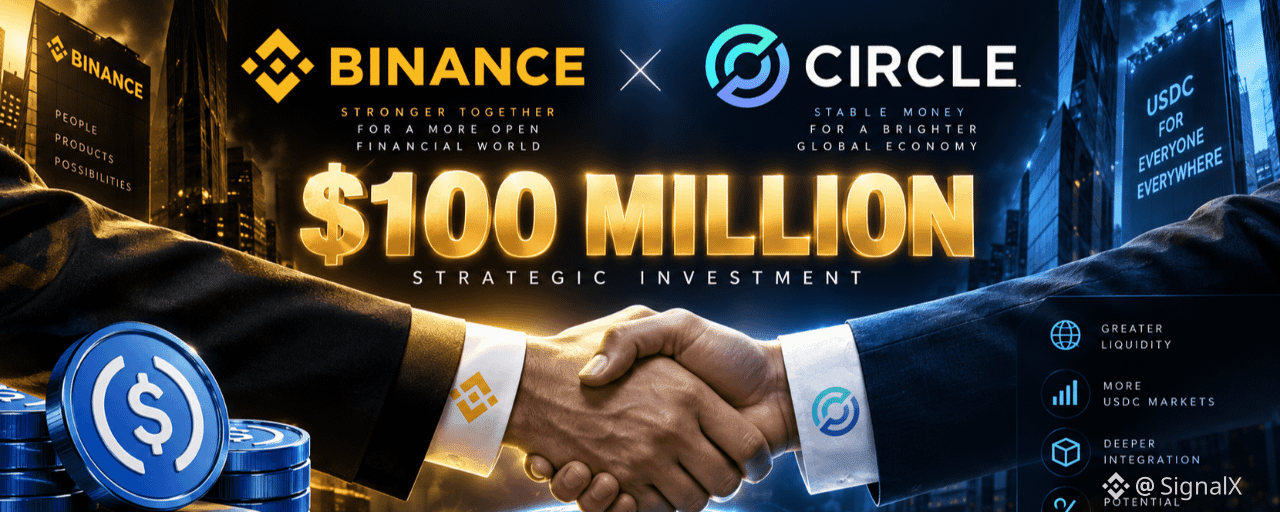
Binance’s $100 Million Circle Investment: What It Could Change for USDC UsersOn September 22, Binance announced a $100 million equity investment in Circle, alongside a renewed five-year partnership focused on expanding USDC globally, particularly in emerging markets. Binance purchased Circle Class A shares through a private placement at a 5% discount to the pre-closing market price.
For USDC users, the bigger story is not the $100 million itself it is distribution.
Under the expanded agreement, Binance will promote and integrate USDC more deeply across its platform, while Circle continues providing the underlying infrastructure. Circle will also pay Binance monthly incentives linked to USDC held through specified wallet infrastructure.
This could translate into greater USDC liquidity, more USDC-denominated markets, broader product integration and easier access for Binance users. Reporting also indicates plans for USDC integration into savings and investment products and incentives such as reduced fees on certain USDC trading pairs.
The strategic implication is bigger: Binance is no longer simply distributing USDC it now owns equity in its issuer. That aligns Binance more closely with Circle's long-term growth while giving Circle access to one of crypto's largest global distribution channels.
For users, the metric worth watching is simple: does the partnership make USDC cheaper, more liquid and more useful inside Binance? If it does, this $100 million investment could matter far more than its headline value.
#Binance #USDC #Circle #stablecoin #Crypto
Binance’s $100 Million Circle Investment: What It Could Change for USDC Users
On September 22, Binance announced a $100 million equity investment in Circle, alongside a renewed five-year partnership focused on expanding USDC globally, particularly in emerging markets. Binance purchased Circle Class A shares through a private placement at a 5% discount to the pre-closing market price.
For USDC users, the bigger story is not the $100 million itself it is distribution.
Under the expanded agreement, Binance will promote and integrate USDC more deeply across its platform, while Circle continues providing the underlying infrastructure. Circle will also pay Binance monthly incentives linked to USDC held through specified wallet infrastructure.
This could translate into greater USDC liquidity, more USDC-denominated markets, broader product integration and easier access for Binance users. Reporting also indicates plans for USDC integration into savings and investment products and incentives such as reduced fees on certain USDC trading pairs.
The strategic implication is bigger: Binance is no longer simply distributing USDC it now owns equity in its issuer. That aligns Binance more closely with Circle's long-term growth while giving Circle access to one of crypto's largest global distribution channels.
For users, the metric worth watching is simple: does the partnership make USDC cheaper, more liquid and more useful inside Binance? If it does, this $100 million investment could matter far more than its headline value.
#Binance #USDC #Circle #stablecoin #Crypto
3
1
1
110
·
--
I nailed the absolute bottom and pump for
$ETH
Never ever fade my analysis.
I nailed the absolute bottom and pump for
$ETH
Never ever fade my analysis.
135
·
--
$BTC
reclaimed $86.3k. May high is gone.
Wave 3 printed. This dip is a reload, not a breakdown.
Next: $88.6k... $92.2k... $97.6k ... $130k.
ETFs just took in $999M. Don’t get shaken out. Sidelines will chase later.
$BTC
reclaimed $86.3k. May high is gone.
Wave 3 printed. This dip is a reload, not a breakdown.
Next: $88.6k... $92.2k... $97.6k ... $130k.
ETFs just took in $999M. Don’t get shaken out. Sidelines will chase later.
1
113
·
--
Verified

Article
CPI Is Out - And I Think the Fed Is Now Closer to a Rate HikeThe August U.S. CPI report is finally here, and the numbers are important.
Headline CPI rose 0.4% MoM and 3.4% YoY, exactly in line with expectations. The more important signal came from Core CPI: +0.3% MoM, above the 0.2% forecast, while annual Core CPI eased slightly to 2.4% from 2.5%. Gasoline prices jumped 3.9%, accounting for more than one-third of the monthly CPI increase.
My view: this report is not hot enough to panic markets, but it is too sticky for the Fed to ignore.
The Fed funds rate is currently 3.50%–3.75%, and inflation remains clearly above the Fed’s 2% objective. After the CPI release, markets sharply increased their expectations for a rate hike at next week’s Fed meeting.
I currently lean toward a 25 bps hike.
For risk assets, the bigger question is not just whether the Fed hikes once. It is whether this CPI print, higher energy prices and persistent core inflation mark the beginning of another tightening cycle.
That would be a much bigger issue for stocks and crypto.
My bias: cautious short term.
What do you think : hike or hold?
#CPIWatch
CPI Is Out - And I Think the Fed Is Now Closer to a Rate Hike
The August U.S. CPI report is finally here, and the numbers are important.
Headline CPI rose 0.4% MoM and 3.4% YoY, exactly in line with expectations. The more important signal came from Core CPI: +0.3% MoM, above the 0.2% forecast, while annual Core CPI eased slightly to 2.4% from 2.5%. Gasoline prices jumped 3.9%, accounting for more than one-third of the monthly CPI increase.
My view: this report is not hot enough to panic markets, but it is too sticky for the Fed to ignore.
The Fed funds rate is currently 3.50%–3.75%, and inflation remains clearly above the Fed’s 2% objective. After the CPI release, markets sharply increased their expectations for a rate hike at next week’s Fed meeting.
I currently lean toward a 25 bps hike.
For risk assets, the bigger question is not just whether the Fed hikes once. It is whether this CPI print, higher energy prices and persistent core inflation mark the beginning of another tightening cycle.
That would be a much bigger issue for stocks and crypto.
My bias: cautious short term.
What do you think : hike or hold?
#CPIWatch
150
·
--
Macro View of Bitcoin $BTC
This chart shows Bitcoin moving within a long-term ascending logarithmic channel since 2012.
* 📈 Cycle Tops: 2013, 2017, 2021, and a projected top in 2025 near the upper channel.
* 📉 Cycle Bottoms: 2015, 2018, 2022, with a potential bottom projected for 2026 near the lower channel.
* 🎯 The idea is that Bitcoin continues following its historical four-year cycle, suggesting the current correction could extend before the next major accumulation phase.
It is only one possible outcome not confirmation of future price action.
#btc
61
Log in to explore more content
Join global crypto users on Binance Square
⚡️ Get latest and useful information about crypto.
💬 Trusted by the world’s largest crypto exchange.
👍 Discover real insights from verified creators.
Email / Phone number
Trending Topics
CanMarketsReboundAfterThanksgiving?
33,407 views
726 Discussing
Rate-Hike Bets Linger as US Markets Head Into Thanksgiving Closure
Binance News
·2 Likes
·2.1k views
CouldSpaceX’sOrbitalDataCentersBoostAIChipDemand?
20,794 views
447 Discussing
EvolveAtBinanceBlockchainWeek
682,646 views
7,713 Discussing