ZEC at $1,315—would you still chase it?
On its 10th anniversary, the founder voluntarily gave up his 8% share of block rewards. The NU7 upgrade countdown is on, and the price has surged from $1,100 to $1,315—but with the Fed decision due tonight, is this the start of the main rally or the last dance?
First, the surface picture: it’s already risen so much—but would you dare buy in?
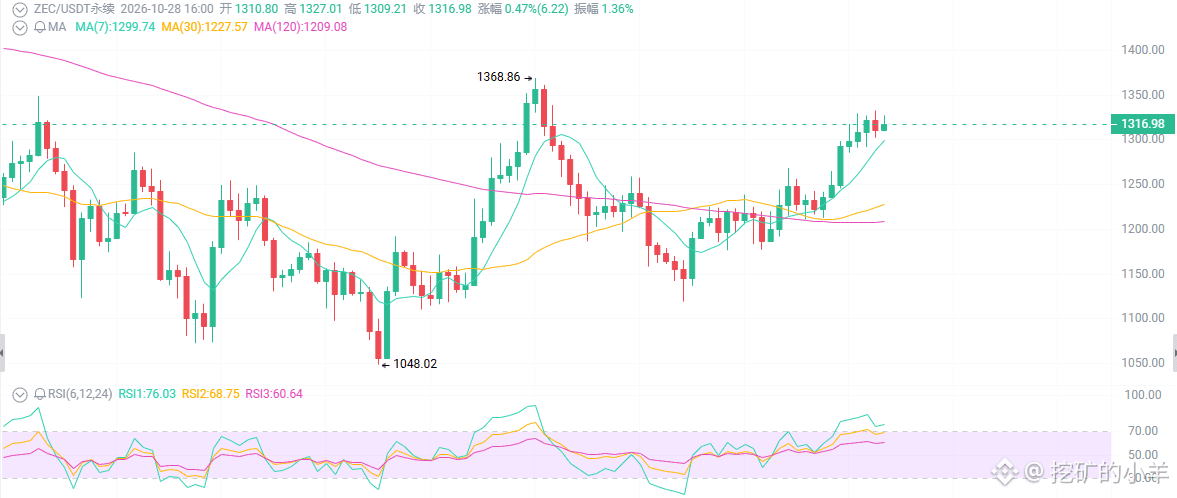
ZEC is now at $1,315, up 5%–8% in 24 hours, with a market cap of $21 billion and a spot in the top ten. It spent the past month building a base between $1,100 and $1,250, then broke above the psychological $1,300 level on rising volume. The moving averages are aligned bullishly, and momentum is leaning positive.
If you’re afraid to chase when it rises and afraid to buy when it falls, then when exactly will you buy?
First: on its 10th anniversary, the founder did something “against human nature”
Today marks exactly 10 years since the Zcash mainnet launched.
Co-founder Sean Bowe proposed ending the mechanism that automatically allocates 8% of block rewards to ZCG. The existing treasury holds about $125 million—enough to get by—so the network can transition to a Network Sustainability Mechanism.
How did the market react? Investors voted with their feet, sending the price from $1,250 to $1,315.
A blockchain willing to voluntarily give up its funding allocation is worth more than a hundred influencers hyping a coin.
Second: the NU7 upgrade countdown—this is the real catalyst
NU7 is expected to activate in early November. Key changes:
Block times cut from 75 seconds to 25 seconds—payment confirmations will be 3x faster
A fee reserve mechanism will be introduced
The testnet is already running, and the new Zillions wallet is gradually rolling out
ZEC is evolving from a “privacy coin” into a usable privacy payments network.
On top of that, the Grayscale ZCSH ETF continues to see net inflows, Cypherpunk is increasing its mining holdings, and the amount of ZEC bridged to Solana has hit a record—all signs that institutional access is opening up and the ecosystem is expanding.
Shielded supply accounts for about 29%, shielded transactions often exceed 60% of the total, and daily transaction activity has risen significantly year over year.
Third: the technical picture is at a “break through or pull back” inflection point
Structure: highs above $1,600 in September–October followed by a correction; a base formed between $1,100 and $1,250; then a high-volume breakout above $1,300, where price has held.
Support: $1,300 (psychological level + breakout point) → $1,250–$1,280 → $1,200–$1,220
Resistance: $1,330–$1,350 (intraday highs) → $1,400 → $1,500–$1,600 (previous high zone)
Volume: The rebound has come on rising volume; RSI is neutral to strong, and short-term bulls have the upper hand.
The Fed decision comes tonight. Rates are expected to remain unchanged, so the focus will be on the statement and the Chair’s guidance. Volatility tends to rise on event-driven days, and both false breakouts and sharp shakeouts are possible.