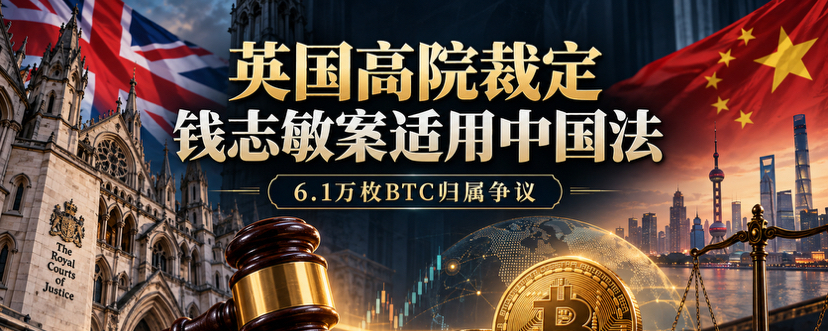

The Qian Zhimin case has reached a very significant turning point.
On October 12, 2026, the High Court of England and Wales ruled in Director of Public Prosecutions v Zhimin Qian & Anor [2026] EWHC 2509 (KB):
With regard to victims’ claims to more than 61,000 bitcoins in the Qian Zhimin case, the core substantive issues should be governed by Chinese law, not English law.
But there is one point here that is very easy to misunderstand.
This does not mean that the English court has ruled that the bitcoins belong to China, that the bitcoins have been awarded to Chinese victims, or that the UK government has acquired these assets.
What the UK High Court resolved this time was actually only a preliminary question:
Which country’s law should be used to determine whether the Chinese victims have “proprietary rights” in these bitcoins?
The court ultimately answered:
Chinese law. (Hassan Cohen Law Firm)
This seemingly procedural decision could directly affect how bitcoins worth billions of pounds are ultimately distributed.
1. What is really at stake in the 61,000 BTC dispute?
The core issue in the Zhimin Qian case is not simply whether Bitcoin constitutes criminal proceeds.
UK prosecutors have begun civil recovery proceedings under Part 5 of the Proceeds of Crime Act 2002 (POCA).
The truly complex question is:
Once criminal proceeds have been converted into Bitcoin, who do those bitcoins actually belong to?
The Chinese victims applied under section 281 of POCA.
This law allows a person to ask the court to determine that:
If property the UK government seeks to recover in fact belongs to someone else, that property should not be recovered by the UK state as criminal proceeds.
In other words, victims cannot merely prove that:
“Zhimin Qian defrauded me of my money.”
It must also be proven that:
“These bitcoins now seized in the UK still legally belong to me, or have been converted from property that originally belonged to me.”
There is a very big difference between the two. (Hassan Cohen Law Firm)
Because “victim” is a status,
“Owner of property,” by contrast, is a different legal status.
Section 281 of POCA does not address compensation for victims in the ordinary sense; it concerns the determination of property rights.
2. Why did the victims previously want English law to apply?
This is actually the most crucial point in the entire legal battle.
English law, particularly its system of equity, has a range of well-established doctrines, including:
Constructive Trust
And:
Tracing — tracing property.
Put simply:
If A’s money is obtained by B through fraud, and B then uses that money to buy other assets, then in certain circumstances A may have more than just a claim requiring B to repay the money. A may be able to claim:
The assets acquired later still contain a proprietary interest belonging to them.
This has enormous significance for the Zhimin Qian case.
Because investors put in RMB at the time, while what is being contested today is bitcoin worth billions of pounds.
If it is merely a personal claim, the focus is usually on “how much money was lost to fraud.”
But if proprietary rights can be established and successfully traced all the way to the BTC, the question becomes:
Who owns the BTC themselves?
The enormous appreciation in Bitcoin over the past decade or more is also what makes this issue so significant.
Accordingly, lawyers representing some of the victims sought to use rules under English law concerning rescission of contracts, constructive trusts, and tracing to trace the funds investors paid at the time all the way to the bitcoins now under seizure.
But Judge Turner did not accept this line of reasoning.
3. Why did the UK High Court ultimately choose Chinese law?
The court’s reasoning is actually very clear:
The fact that the bitcoins later arrived in the UK cannot turn all the legal relationships that arose earlier in China into relationships governed by English law.
The court placed particular emphasis on several connecting factors:
The investment activity took place in China;
The investors were primarily based in China;
The relevant promotional activities and fraud took place in China;
The funds were paid in China;
The initial purchase of bitcoin with the relevant funds also took place in China.
Therefore, whether analyzed through the contractual relationship, tort, restitution for unjust enrichment, or the traditional conflict-of-laws rules on property rights, the entire matter is much more closely connected to China than to the UK.
The court ultimately held that:
The fact that the bitcoins later entered the UK cannot be used retroactively to alter the legal relationships concerning property rights that had already arisen in China. (Hassan Cohen Law Firm)
This is the point in the judgment that deserves the most attention.
It effectively establishes a highly important framework for cross-border crypto assets:
Where digital assets are ultimately seized does not necessarily determine which jurisdiction’s law governs their prior ownership.
4. Does this mean the Chinese victims have lost?
No.
This point especially needs to be emphasized.
The UK High Court did not rule that:
“The Chinese victims do not own the bitcoins.”
The court even expressly stated that it has not yet formally considered the specific content of Chinese law.
This ruling only establishes that:
The next stage of determining whether the victims have proprietary rights must begin with an examination of Chinese law.
Judge Turner expressly noted at the end of the judgment:
Whether the victims have proprietary rights, and what those rights consist of, must be determined under Chinese law. The specific rules of Chinese law and how they are to be proven are questions for the next stage. (Hassan Cohen Law Firm)
So the real battle is only just beginning.
The next stage will likely see extensive expert evidence on Chinese law.
Including:
What type of legal relationship does the investment contract constitute under Chinese law?
In the context of fraud and illegal fundraising, does ownership of funds paid by investors transfer to someone else?
After investment funds are used to buy BTC, can the original investors still assert some form of proprietary interest in the BTC?
Are the relevant interests proprietary rights, personal claims, or some other legal rights?
And, most importantly:
Whether rights arising under Chinese law are sufficient to meet the “property belongs to him” standard required by section 281 of the UK POCA.
This is what will truly determine the ultimate fate of the 61,000 BTC.
5. The real difficulty: a claim in personam and a proprietary right are completely different things
Suppose an investor lost RMB 1 million at the time.
There are two completely different legal outcomes.
The first possibility:
Zhimin Qian owes the investor RMB 1 million.
This is a claim in personam.
The second possibility:
The investors retain a proprietary interest in some portion of the BTC converted from that RMB 1 million.
This is a proprietary relationship.
The economic outcomes of the two could be worlds apart.
Because if the claim is merely a personal one, the discussion may focus mainly on the amount of loss and the repayment rate.
But if proprietary rights in the BTC can be established, the enormous increase in value over the years may also become relevant to the question of who owns the assets.
That is also why this case is not simply about whether the money lost to fraud can be recovered.
In a sense, the real dispute is about:
After criminal proceeds are converted into an asset that increases in value many times over, who should be entitled to that appreciation?
This is also what makes the Zhimin Qian case so unusual.
6. Does this mean the UK government is now in a stronger position?
Based on the current state of the litigation:
Yes, the UK government’s position has been strengthened to some extent.
The reason is not that the UK already owns these BTC, but that the victims had hoped to use mechanisms under English equity, such as constructive trusts and tracing, to establish proprietary rights in the BTC directly.
This relatively favorable legal route is now significantly restricted.
The court even expressly stated:
If no corresponding proprietary right existed under Chinese law in the first place, English tracing procedures cannot “create” a proprietary right that did not previously exist simply because the assets later entered the UK. (Hassan Cohen Law Firm)
This statement is crucial.
In other words:
English law can help you trace an existing right, but it cannot create a right out of thin air.
The Financial Times also considered that this ruling increased the likelihood that the UK side would ultimately retain most of the recovered BTC.
But it is still important to emphasize:
Increased likelihood ≠ already owned by the UK. (Financial Times)
The victims are reportedly seeking to appeal, and the case will subsequently need to proceed to a hearing on the substantive issues of Chinese law.
7. The impact of this case goes far beyond 61,000 BTC
From the crypto industry’s perspective, the Zhimin Qian case could become a highly significant cross-border digital asset case.
People have often discussed:
Do bitcoins count as property?
Where is the exchange located?
Where is the wallet?
Where is the private key?
Where is the holder located?
Since the blockchain itself has no geographical location in the traditional sense, how should the “location” of BTC be determined?
The Zhimin Qian case raises an even more complex question:
If a crime is committed in Country A, the funds are obtained in Country A, then converted into BTC and transferred to Country B, where they are ultimately frozen by its judicial authorities, should the law of Country A or Country B apply?
The approach taken by the UK High Court this time was:
At least when determining how the original property rights arose, you cannot look only at where the assets ended up.
It must be traced back to:
When and where the rights arose, and through what transaction.
This has major implications for the future of:
Crypto fraud,
the bankruptcy of an exchange,
Crypto theft by hackers,
cross-border money laundering,
DeFi asset tracing,
It could even have implications for the recovery of digital assets between states.
8. My view
What truly matters about this ruling is not the simple statement:
“The UK court supports Chinese law.”
Rather, it brought the entire case back to the most fundamental question:
Where did the proprietary rights in these bitcoins come from?
Only those who first prove that they have a “right” are entitled to discuss how to trace the BTC.
For the victims, this clearly makes litigation more difficult.
But that does not mean there is no longer any chance.
For the UK government, this is clearly a temporary advantage.
But we are still a long way from being able to declare that the 61,000 BTC belong to the UK.
Therefore, what is truly worth watching next is not how much Bitcoin is worth today, but how the UK High Court interprets and considers expert evidence on Chinese law in the next stage.
Ultimately, the case may well have to answer a question worth billions of pounds:
RMB taken from someone in China through fraud is later converted by the perpetrators into bitcoin. Ten years later, the value of bitcoin has soared. Who should be entitled to that enormous increase in value: the victims, the pool of criminal assets, or the UK state through lawful recovery?
This is the real final dispute in the Zhimin Qian case.
And the October 12 ruling merely decided how this final dispute would be—
You have to start with Chinese law.
—
Case: Director of Public Prosecutions v Zhimin Qian & Anor
Citation: [2026] EWHC 2509 (KB)
Date of judgment: October 12, 2026
Key ruling: The underlying proprietary claims brought by victims under section 281 of POCA are, in principle, governed by Chinese law; English law continues to govern the POCA civil recovery proceedings.