



One sentence sent the market reeling
On the evening of October 7, after the release of the Fed’s September FOMC minutes, US and European stocks, gold, silver, and cryptocurrencies plunged in unison. Bitcoin fell from $85,318 to $83,551 in 20 minutes, a drop of about 2%; Ethereum fell nearly 5%, XRP dropped more than 6%, and Solana fell over 4%. Over the past 24 hours, 124,000 traders worldwide were liquidated, with the total exceeding $700 million; more than 90% of the liquidations were long positions. Dan Khus of LVRG Research put it aptly: this isn’t the start of a downtrend, but a “leverage flush”—overcrowded positions held by momentum-chasing traders were wiped out all at once.

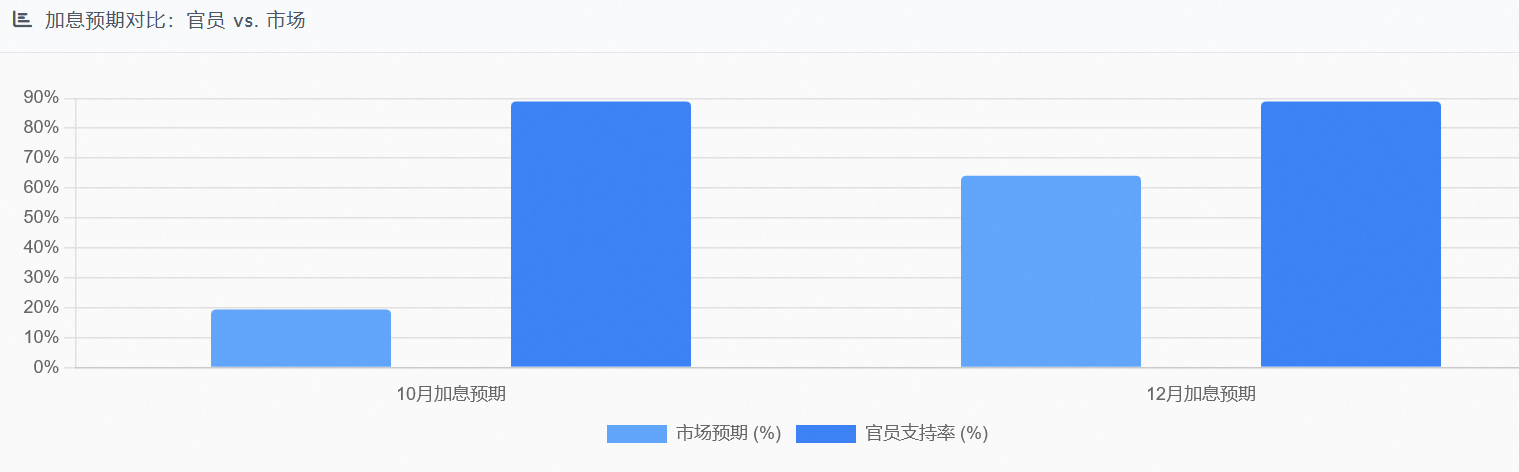
All 19 officials unanimously supported a 25-basis-point rate hike in September, to 3.75%–4.00%, and most thought another hike before year-end could be appropriate. CME data show that markets see just a 19.4% chance of a hike in October and a 64.1% chance in December; meanwhile, the dot plot shows that 16 of the 18 officials support one more hike this year.

$5.364%
The 10-year U.S. Treasury yield briefly broke above 5.364%, its highest level since 2002; the 30-year yield rose to 5.715%, while the U.K. 30-year yield topped 6%. The U.S. dollar index climbed back above 102, spot gold fell below $4,100 (down more than 1%), and silver dropped below $60 (down 2.5%).
When risk-free yields reach 5.36%, the opportunity cost of holding zero-yield assets rises accordingly. Goldman Sachs estimates that every 1-percentage-point increase in the 10-year yield raises corporate borrowing costs by an average of 0.8%.
AI infrastructure flagged as an inflation risk
This is the first time the Federal Reserve has directly linked AI investment to inflation risks. Officials outlined three transmission channels: first, a supply shock, as capital spending drives up demand for chips and data centers and intensifies supply-chain constraints; second, energy demand, with U.S. AI data centers projected to consume as much electricity by 2030 as the entire state of California uses today; and third, competition for labor, as the race for highly skilled workers pushes up wages and inflation expectations.
IDC estimates that AI infrastructure spending will reach $497 billion in 2026, up nearly 56% year over year. JPMorgan forecasts that AI-related debt issuance will reach $4.1 trillion by 2030. Financing costs are already rising: Oracle's off-balance-sheet project debt yields 7.534%, a 287.5-basis-point premium over Treasuries of a similar maturity; CoreWeave warns that every 1-percentage-point rise in interest rates will add $30 million to its interest expenses.
More importantly, they are competing for the same pool of money. A JPMorgan report shows that 65% of global family offices list AI as a current or future investment priority, while only 17% are focused on cryptocurrency. 89% of family offices have no cryptocurrency holdings, and the average allocation is just 0.4%.
The crypto market not only has to contend with the Federal Reserve; it also has to compete with the AI sector for capital. When the latter can offer clearer cash flows, institutional investors' choice is obvious.
Why crypto is bearing the brunt
CoinGlass data show that nearly all of the $712 million in liquidations came from long positions, indicating that leveraged longs were extremely crowded. When prices broke below key support levels, there was insufficient buying demand to absorb the selling, quickly amplifying the decline. On top of that, as surging AI demand for GPUs leads mining companies to redirect computing power toward inference services, Bitcoin's supply side is also being squeezed.
Some see rate hikes as “insurance” against inflation overshooting its target; others believe they are necessary to prevent inflation from spreading due to energy prices and AI demand; and a few think the neutral interest rate itself has risen. This means the policy path is highly uncertain, and markets are likely to remain volatile through December.
The good news is that expectations for an October rate hike have cooled considerably, with an 80.6% probability of rates holding steady. But the probability of no change in December is just 21.7%.
In summary
“Unanimous approval + another hike by year-end” raises the cost of holding all risk assets, while the designation of AI as an inflation risk exposes crypto's structural disadvantage in competing with AI for investment. The market is shifting from “chasing liquidity” to “earnings-driven” investing, and from zero-yield assets to interest-bearing ones. Bitcoin may stabilize in the short term, but its long-term momentum is being squeezed from both sides by policy and AI.#美联储纪要聚焦10月暂停加息 #美国抵押贷款利率升至7.49% #比特币跌破8.4万美元 $BTC
