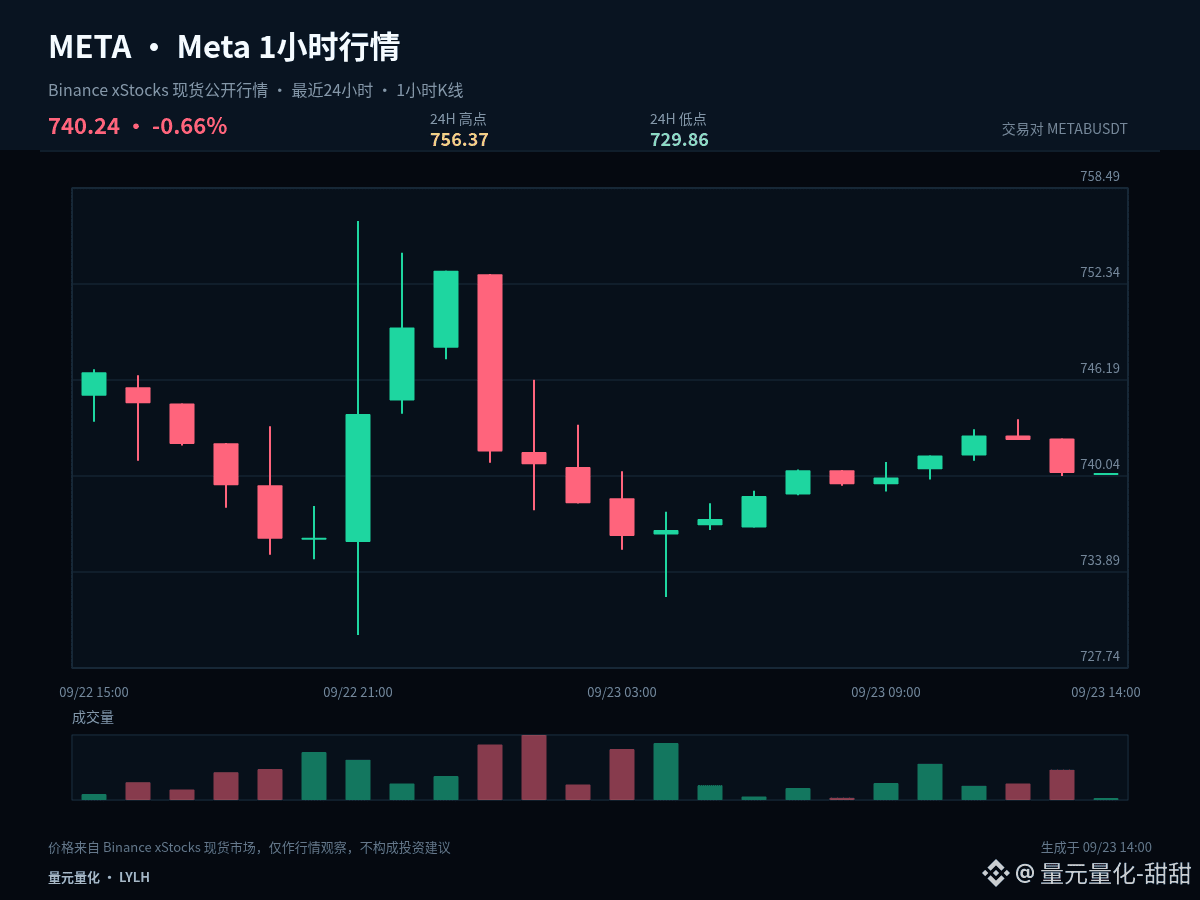
$METAB #META In a strong market, pullbacks often reveal the real order flow more clearly than accelerated rallies. Currently, the 1-hour change is 0.00%, and the 24-hour change is -0.68%. We need to determine whether this is normal cooling off or whether the structure has weakened.
Right now, the 1-hour 0.00% and the 24-hour -0.68% have not produced sufficiently clear alignment in the same direction across both periods. In a range-bound market, the tolerance for chasing and panic-selling is low. It’s more suitable to confirm direction with the upper boundary and confirm support with the lower boundary. The midline should only be used as the line that separates strength from weakness.
Short-term control has not yet been obviously broken. 743.115 is the primary standard for the quality of the pullback. If you hold it, then test 756.37 again—that is a relatively strong consolidation. If it breaks below the midline and stays there, then the focus of observation should be shifted down to 729.86.
When executing, set clear conditions: after breaking above 756.37, you need confirmation—not just seeing a momentary surge and then chasing. After probing down to 729.86, you need to see whether price can quickly reclaim the level—not catching every dip on sight. If the middle region doesn’t offer sufficient reward-to-risk, waiting is itself part of the strategy.
Existing positions can be handled in segments based on key levels to avoid making all decisions at once. Those without positions should wait for a breakout confirmation or for a pullback to stabilize. For U.S. stock assets, also be mindful of volatility caused by trading session transitions. Your plan should be based on price conditions—not on emotion replacing execution.
A trading plan must include invalidation conditions. If your judgment is correct, you can realize gains in stages. If your judgment is wrong, you must also be allowed to exit. Don’t use averaging down or adding to conceal the fact that the original logic has already changed. The market will update, and your viewpoint should adjust based on price evidence.
#AIStocksWhatNext
Right now, the 1-hour 0.00% and the 24-hour -0.68% have not produced sufficiently clear alignment in the same direction across both periods. In a range-bound market, the tolerance for chasing and panic-selling is low. It’s more suitable to confirm direction with the upper boundary and confirm support with the lower boundary. The midline should only be used as the line that separates strength from weakness.
Short-term control has not yet been obviously broken. 743.115 is the primary standard for the quality of the pullback. If you hold it, then test 756.37 again—that is a relatively strong consolidation. If it breaks below the midline and stays there, then the focus of observation should be shifted down to 729.86.
When executing, set clear conditions: after breaking above 756.37, you need confirmation—not just seeing a momentary surge and then chasing. After probing down to 729.86, you need to see whether price can quickly reclaim the level—not catching every dip on sight. If the middle region doesn’t offer sufficient reward-to-risk, waiting is itself part of the strategy.
Existing positions can be handled in segments based on key levels to avoid making all decisions at once. Those without positions should wait for a breakout confirmation or for a pullback to stabilize. For U.S. stock assets, also be mindful of volatility caused by trading session transitions. Your plan should be based on price conditions—not on emotion replacing execution.
A trading plan must include invalidation conditions. If your judgment is correct, you can realize gains in stages. If your judgment is wrong, you must also be allowed to exit. Don’t use averaging down or adding to conceal the fact that the original logic has already changed. The market will update, and your viewpoint should adjust based on price evidence.
#AIStocksWhatNext