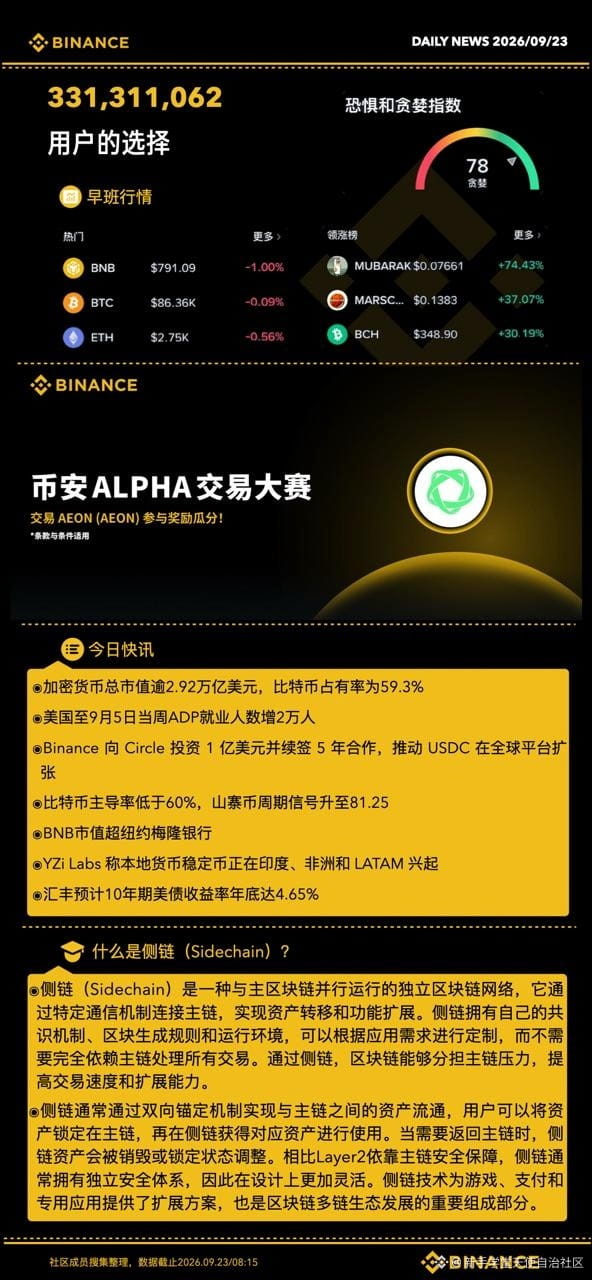

Gm,#学堂日报 9.23 market snapshot
1️⃣ Market Overview
▪ The total market capitalization of cryptocurrencies is about $2.92 trillion, with Bitcoin’s market share at 59.3%.
▪ The Fear & Greed Index is 78 (Greed), and market sentiment remains elevated.
2️⃣ Binance Updates
▪ Binance Alpha has launched the AEON (AEON) trading competition; users can earn rewards by participating.
▪ Binance announced a $100 million investment in Circle and a renewal of the 5-year partnership, further accelerating the expansion of USDC across global platforms and payment scenarios.
▪ Binance continues to advance its Alpha, stablecoin, and global payments ecosystem, further connecting trading with on-chain finance scenarios.
3️⃣ Industry Hot Topics
▪ In the week ending September 5, the U.S. saw ADP employment increase by about 20,000, and employment data continues to influence interest-rate expectations.
▪ Bitcoin’s dominance has fallen to below 60%, with expectations for an altcoin cycle heating up.
▪ BNB’s market value has surpassed that of Bank of New York Mellon, and the size of crypto assets continues to expand.
▪ YZi Labs believes local-currency stablecoins are accelerating in adoption in regions such as India, Africa, and LATAM.
▪ HSBC expects that U.S. 10-year Treasury yields may reach 4.65% by year-end.
4️⃣ Today’s Quick Learn: What is a Sidechain?
🔸 What is a sidechain?
▪ A sidechain is a blockchain that runs in parallel with the main blockchain, but has its own independent consensus mechanism and rules.
▪ It can connect to the main chain via bridge mechanisms, allowing assets to move between different networks.
🔸 Why do we need sidechains?
▪ The main chain may face issues such as transaction congestion and high fees.
▪ Sidechains can move some transactions and applications off the main chain, reducing pressure while enabling more flexible feature design.
🔸 How is it different from Layer 2?
▪ Layer 2 typically relies more on the main chain for security and final settlement.
▪ Sidechains have their own validators and consensus mechanisms, so security depends more on the sidechain itself.
🔸 Which scenarios are suitable?
▪ Games, payments, high-frequency trading, and applications that require independent rules may all use sidechains to improve performance and flexibility.
Follow @新手学堂天使自治社区 to learn more 🚀
1️⃣ Market Overview
▪ The total market capitalization of cryptocurrencies is about $2.92 trillion, with Bitcoin’s market share at 59.3%.
▪ The Fear & Greed Index is 78 (Greed), and market sentiment remains elevated.
2️⃣ Binance Updates
▪ Binance Alpha has launched the AEON (AEON) trading competition; users can earn rewards by participating.
▪ Binance announced a $100 million investment in Circle and a renewal of the 5-year partnership, further accelerating the expansion of USDC across global platforms and payment scenarios.
▪ Binance continues to advance its Alpha, stablecoin, and global payments ecosystem, further connecting trading with on-chain finance scenarios.
3️⃣ Industry Hot Topics
▪ In the week ending September 5, the U.S. saw ADP employment increase by about 20,000, and employment data continues to influence interest-rate expectations.
▪ Bitcoin’s dominance has fallen to below 60%, with expectations for an altcoin cycle heating up.
▪ BNB’s market value has surpassed that of Bank of New York Mellon, and the size of crypto assets continues to expand.
▪ YZi Labs believes local-currency stablecoins are accelerating in adoption in regions such as India, Africa, and LATAM.
▪ HSBC expects that U.S. 10-year Treasury yields may reach 4.65% by year-end.
4️⃣ Today’s Quick Learn: What is a Sidechain?
🔸 What is a sidechain?
▪ A sidechain is a blockchain that runs in parallel with the main blockchain, but has its own independent consensus mechanism and rules.
▪ It can connect to the main chain via bridge mechanisms, allowing assets to move between different networks.
🔸 Why do we need sidechains?
▪ The main chain may face issues such as transaction congestion and high fees.
▪ Sidechains can move some transactions and applications off the main chain, reducing pressure while enabling more flexible feature design.
🔸 How is it different from Layer 2?
▪ Layer 2 typically relies more on the main chain for security and final settlement.
▪ Sidechains have their own validators and consensus mechanisms, so security depends more on the sidechain itself.
🔸 Which scenarios are suitable?
▪ Games, payments, high-frequency trading, and applications that require independent rules may all use sidechains to improve performance and flexibility.
Follow @新手学堂天使自治社区 to learn more 🚀