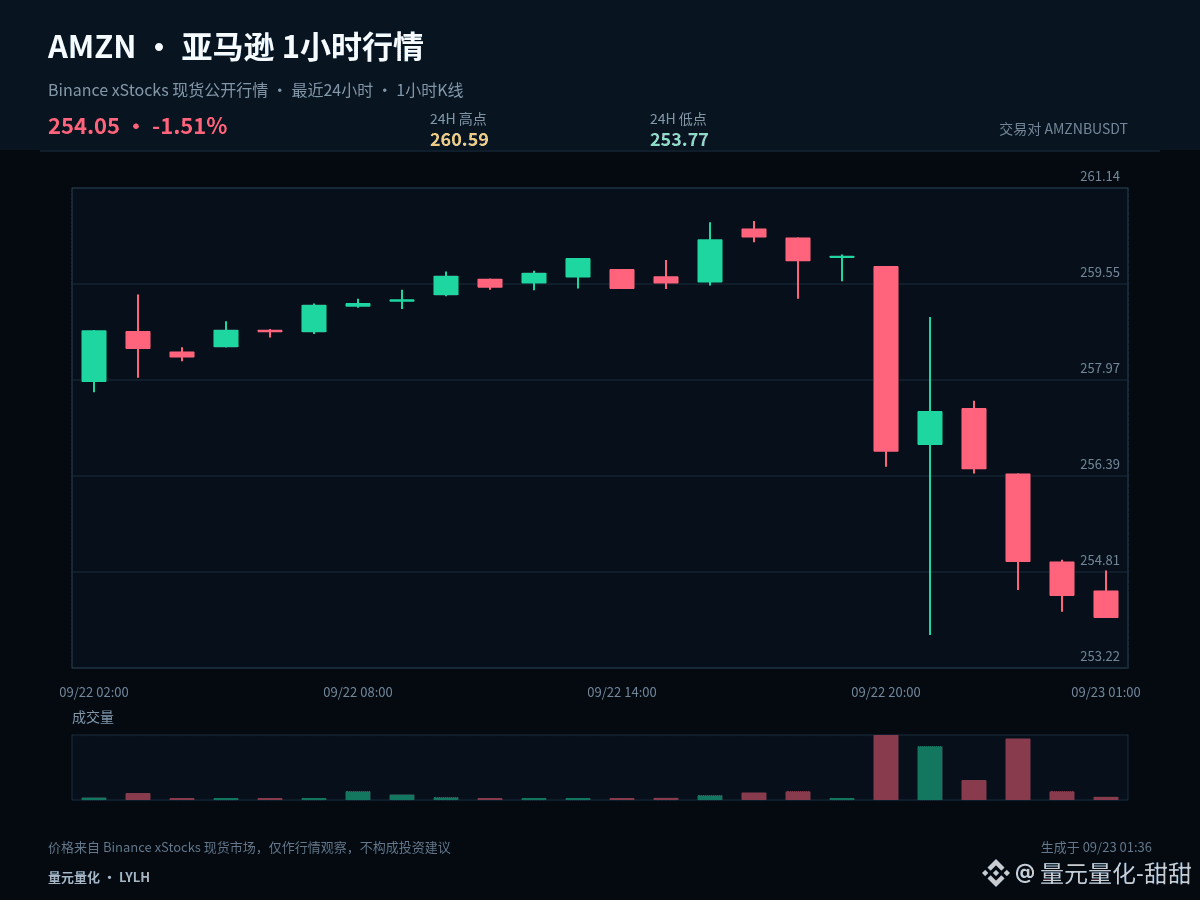
$AMZNB #AMZN Over the past 24 hours, the high-low swing amplitude is about 2.7%. The current price is 254.05. This is not a calm range suitable for opening a trade on a whim. When volatility expands, you should first adjust your position size, and only then discuss direction.
$AMZNB #AMZN is testing the lower bound of the past 24-hour range. It may look like the price is lower, but the real trading value depends on whether the buying support can keep holding—not just on the feeling that it’s “cheap.”
The current price is near the lower end of the past 24-hour volatility range: 1 hour -0.14%, 24 hours -1.46%. The core of analyzing lows is not to try to catch the bottom early, but to observe whether price can quickly reclaim after a breakdown. If it can reclaim, it suggests sell pressure is being absorbed. If it continues to linger below the lower bound, it indicates weakness has not ended.
For the short term, first watch whether 253.77 can form sustained buy support, and then whether 257.18 can be reclaimed. The former determines whether the downside can slow; the latter determines whether the rebound can strengthen. Without confirmation on both, you shouldn’t judge opportunities based solely on the magnitude of the drop.
In high-volatility phases, execution principles are: reduce single-trade exposure, avoid chasing prices back and forth in the middle of the range, and write the invalidation conditions before entering. If price doesn’t provide confirmation, it’s better to do fewer trades than to make up uncertainty with a larger position.
There are three ways to handle the next path: If price holds effectively above 260.59, wait for a pullback that does not break and then re-evaluate whether the move can continue. If it breaks down below 253.77, prioritize risk control and wait for new support. If it continues to oscillate around 257.18, treat it as range rotation and don’t repeatedly chase a direction in the middle.
The focus for short-term positioning is not to predict every individual candlestick, but to ensure there is a basis for entry, trimming, and exit. If there is no confirmation, do less. If a key level fails, redo the plan. Control single-trade risk first, then discuss potential further upside/downside space.
#AIStocksWhatNext
$AMZNB #AMZN is testing the lower bound of the past 24-hour range. It may look like the price is lower, but the real trading value depends on whether the buying support can keep holding—not just on the feeling that it’s “cheap.”
The current price is near the lower end of the past 24-hour volatility range: 1 hour -0.14%, 24 hours -1.46%. The core of analyzing lows is not to try to catch the bottom early, but to observe whether price can quickly reclaim after a breakdown. If it can reclaim, it suggests sell pressure is being absorbed. If it continues to linger below the lower bound, it indicates weakness has not ended.
For the short term, first watch whether 253.77 can form sustained buy support, and then whether 257.18 can be reclaimed. The former determines whether the downside can slow; the latter determines whether the rebound can strengthen. Without confirmation on both, you shouldn’t judge opportunities based solely on the magnitude of the drop.
In high-volatility phases, execution principles are: reduce single-trade exposure, avoid chasing prices back and forth in the middle of the range, and write the invalidation conditions before entering. If price doesn’t provide confirmation, it’s better to do fewer trades than to make up uncertainty with a larger position.
There are three ways to handle the next path: If price holds effectively above 260.59, wait for a pullback that does not break and then re-evaluate whether the move can continue. If it breaks down below 253.77, prioritize risk control and wait for new support. If it continues to oscillate around 257.18, treat it as range rotation and don’t repeatedly chase a direction in the middle.
The focus for short-term positioning is not to predict every individual candlestick, but to ensure there is a basis for entry, trimming, and exit. If there is no confirmation, do less. If a key level fails, redo the plan. Control single-trade risk first, then discuss potential further upside/downside space.
#AIStocksWhatNext