
Mira小白桃
591 Posts

Mira小白桃
Report
Block User
推特X:xiaobaitao05,越南胡志明,边学Web3边看市场,每下午准时开播陪你聊行情和热点, 分享学习心得, 陪新手一起成长

BNB Holder
High-Frequency Trader
4.3 Months
265 Following
17.5K+ Followers
2.4K+ Liked
Posts
All
Quotes
Videos
Live
PINNED
·
--
When you’re bored, feel free to come chat in the group and bullsh*t a bit 🍑
We can also discuss and exchange interesting news and market hotspots~
See you every afternoon in the live room—don’t be a stranger ❤️
When you’re bored, feel free to come chat in the group and bullsh*t a bit 🍑
We can also discuss and exchange interesting news and market hotspots~
See you every afternoon in the live room—don’t be a stranger ❤️
We can also discuss and exchange interesting news and market hotspots~
See you every afternoon in the live room—don’t be a stranger ❤️


16
6
78
135
·
--

乘风Sunshine
·
--
@针尖上的杀手 I don't know what you're doing, why are you treating my Peach Sister like this??? You silence people without warning, kick them out of the organization—you must be enjoying it. What about my Peach Sister? We also know each other; after just a few months, I didn't expect you to become so arrogant, overbearing, and unreasonable. It's really hard to understand. You don't need to reply to me; I don't want to hear anything either. That's it.



1


·
--

静心1688
·
--
🧧🧧🧧Follow and like to claim rewards🧧🧧🧧
#Circle推出机构比特币抵押借贷
#Circle推出机构比特币抵押借贷

·
--

露露rosy
·
--
Buy when no one pays attention. Sell where there is a crowd roaring.

11
·
--

virus世态炎凉
·
--
🧧🧧🧧 After you learn how to read on-chain data, you’ll realize the way the market tells stories is completely different from before.#virus


1
·
--

白鲨观点马来西亚
·
--
Don’t be afraid—the market is down this week. I’ve seen too many people fall in the night before a bull market
The market hasn’t been stable this week.
PPI came in above expectations, CPI is still up in the air, crude oil has surged, and the odds of rate hikes have skyrocketed…
Open your trading app—everything is red, and it’s just upsetting to look at.
I know what many people are feeling right now:
Those who are stuck in positions, constantly checking the charts, getting more and more anxious
Those who are in cash, thinking it will keep falling, but also afraid of missing out if they go all-in
Can’t sleep at night, can’t focus during the day
Honestly, I’m all too familiar with this feeling.
When I first entered the crypto world, during the 2018 bear market,
from $20,000 down to $3,000—I was there the whole time,
and that sense of despair was more painful than losing money.
But later I found a pattern:
Most people don’t lose money from the biggest drop—they lose it from all the back-and-forth.
Cut when it falls, chase when it rises,
trade up and down during sideways action—you end up paying plenty in fees.
After all that floundering, the principal keeps shrinking.
Here are three suggestions for everyone to calm down after the weekend:
First, don’t stare at the daily chart—stretch out the timeframe.
Look at the weekly and monthly charts: BTC is still in an upward channel.
From 57,000 in June this year to 77,000 now,
it’s up 35% in three months—actually, that’s pretty strong.
Second, check whether your position size feels comfortable.
What does “comfortable” mean?
It means if it drops 20%, you’re not panicked; if it rises 50%, you don’t regret.
If it doesn’t feel comfortable, adjust—adjust until it does.
Trading isn’t about who makes the most money—it’s about who stays alive the longest.
Third, don’t keep watching the market all weekend—rest well.
The market won’t collapse just because you don’t look,
and it won’t pump just because you keep staring.
Eat when it’s time to eat, sleep when it’s time to sleep.
Fight on again next week—having a full head and good energy matters more than anything.
If you lost money this week, or your mood isn’t great,
come to my chat room—there are a few hundred people in there, and everyone feels the same.
Over the weekend, we’ll talk about things beyond the charts—relax a bit.
Next week’s tough battle, we’ll take it on together.
#BinanceSquare #交易心得 #比特币 #Holding mindset
The market hasn’t been stable this week.
PPI came in above expectations, CPI is still up in the air, crude oil has surged, and the odds of rate hikes have skyrocketed…
Open your trading app—everything is red, and it’s just upsetting to look at.
I know what many people are feeling right now:
Those who are stuck in positions, constantly checking the charts, getting more and more anxious
Those who are in cash, thinking it will keep falling, but also afraid of missing out if they go all-in
Can’t sleep at night, can’t focus during the day
Honestly, I’m all too familiar with this feeling.
When I first entered the crypto world, during the 2018 bear market,
from $20,000 down to $3,000—I was there the whole time,
and that sense of despair was more painful than losing money.
But later I found a pattern:
Most people don’t lose money from the biggest drop—they lose it from all the back-and-forth.
Cut when it falls, chase when it rises,
trade up and down during sideways action—you end up paying plenty in fees.
After all that floundering, the principal keeps shrinking.
Here are three suggestions for everyone to calm down after the weekend:
First, don’t stare at the daily chart—stretch out the timeframe.
Look at the weekly and monthly charts: BTC is still in an upward channel.
From 57,000 in June this year to 77,000 now,
it’s up 35% in three months—actually, that’s pretty strong.
Second, check whether your position size feels comfortable.
What does “comfortable” mean?
It means if it drops 20%, you’re not panicked; if it rises 50%, you don’t regret.
If it doesn’t feel comfortable, adjust—adjust until it does.
Trading isn’t about who makes the most money—it’s about who stays alive the longest.
Third, don’t keep watching the market all weekend—rest well.
The market won’t collapse just because you don’t look,
and it won’t pump just because you keep staring.
Eat when it’s time to eat, sleep when it’s time to sleep.
Fight on again next week—having a full head and good energy matters more than anything.
If you lost money this week, or your mood isn’t great,
come to my chat room—there are a few hundred people in there, and everyone feels the same.
Over the weekend, we’ll talk about things beyond the charts—relax a bit.
Next week’s tough battle, we’ll take it on together.
#BinanceSquare #交易心得 #比特币 #Holding mindset

6
·
--

正乾商学--四条2
·
--
26.09.22 light rain
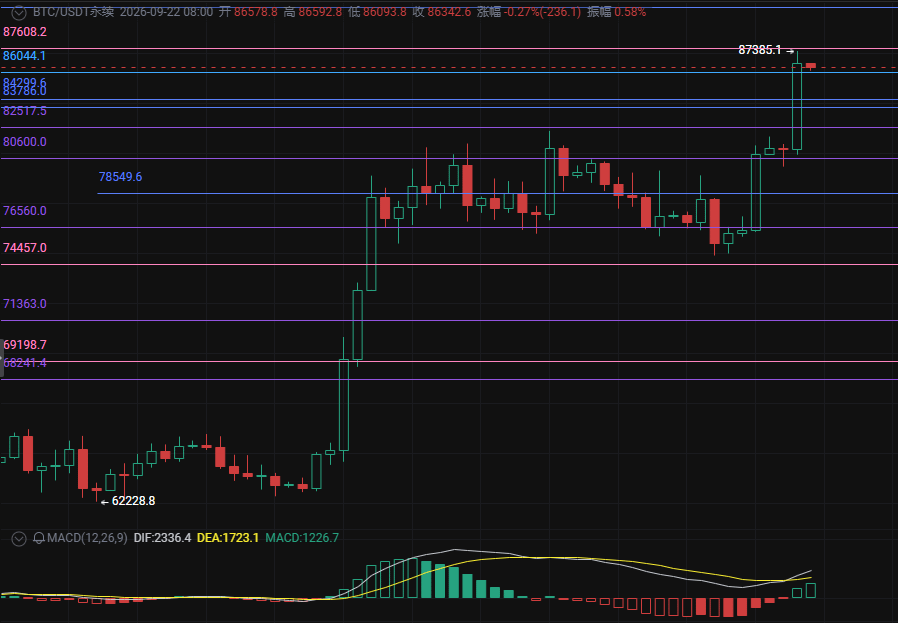
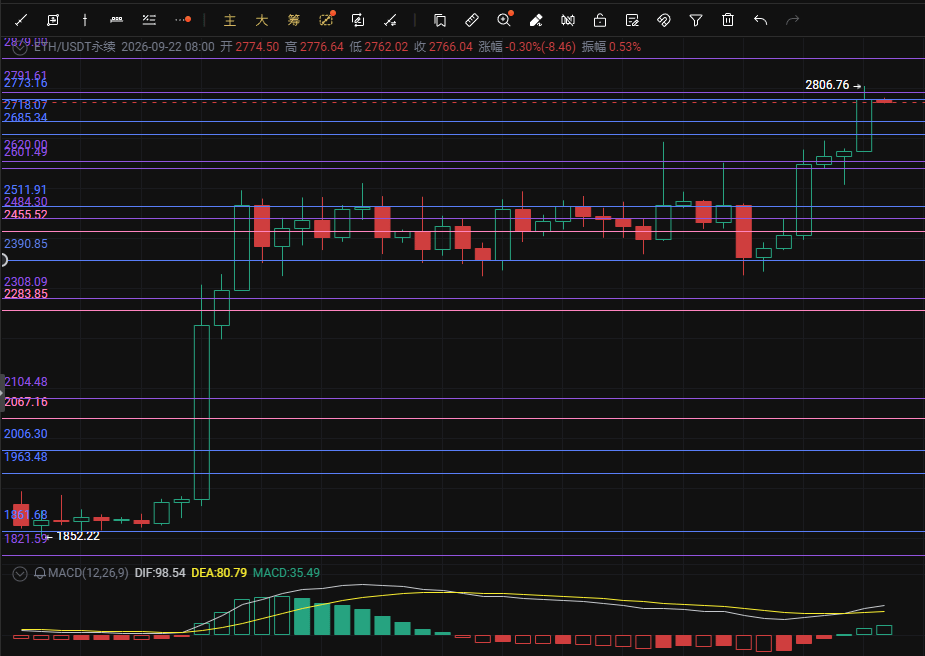
Yesterday BTC broke above 86,000 again, reached around 87,300 in the early hours, with a gain of over 7%. US spot BTC ETFs saw roughly $433M in net inflows with money staying put; Strategy also bought about 950 BTC.
This strong breakout—driven by liquidations on the short side, heightened short-term market enthusiasm, and the renewed return of ETF capital—means the next focus is whether ETF inflows will continue, and whether the price can hold above 86,000.
Recent strategy:
① Pressure zone above 86,800–87,600. Don’t chase longs; you can short temporarily, then look for a long after a pullback.
② 84,600–85,500 pullback zone. Pay close attention and wait for confirmation.
③ 83,600–84,200: relatively strong support. You can try a long position with a small size.
④ 80,600–81,300. If it breaks 82,500, and then pulls back to this zone, it’s a support level on a higher time frame and also a potential trend reversal point—be cautious, cautious, and even more cautious.
⑤ If 80,000 breaks, it suggests longs are weakening and the structure is weakening as well, with the possibility that shorts take control.
#比特币突破8.5万美元
Yesterday BTC broke above 86,000 again, reached around 87,300 in the early hours, with a gain of over 7%. US spot BTC ETFs saw roughly $433M in net inflows with money staying put; Strategy also bought about 950 BTC.
This strong breakout—driven by liquidations on the short side, heightened short-term market enthusiasm, and the renewed return of ETF capital—means the next focus is whether ETF inflows will continue, and whether the price can hold above 86,000.
Recent strategy:
① Pressure zone above 86,800–87,600. Don’t chase longs; you can short temporarily, then look for a long after a pullback.
② 84,600–85,500 pullback zone. Pay close attention and wait for confirmation.
③ 83,600–84,200: relatively strong support. You can try a long position with a small size.
④ 80,600–81,300. If it breaks 82,500, and then pulls back to this zone, it’s a support level on a higher time frame and also a potential trend reversal point—be cautious, cautious, and even more cautious.
⑤ If 80,000 breaks, it suggests longs are weakening and the structure is weakening as well, with the possibility that shorts take control.
#比特币突破8.5万美元
35
·
--

灼见
·
--
🚨 BTC breaks through $86K.
Highest in 8 months.
But the most important question now isn’t:
“How much more can BTC rise?”
Instead, it’s:
How real is this breakout?
Over the past few days, BTC has repeatedly cleared:
₿ $80K
₿ $82K
₿ $85K
₿ $86K
At the same time:
💰 The latest trading day net inflow into US spot BTC ETFs is about $433M
🏦 Strategy bought another 950 BTC last week
📈 BTC has reclaimed key long-term moving averages
🔥 Short squeeze pressure is accelerating the breakout
So the real question is now:
Is $80K–$82K NOW SUPPORT?
Because in a truly strong market,
it’s not about prices continuing to break resistance.
It’s about:
after the breakout, key levels are no longer given back to the shorts.
If $80K–$82K truly completes the resistance→support flip,
the next bigger battle in the market may be near $89K.
But if BTC quickly falls back below $82K,
then the leverage and short-squeeze components in this rally may be larger than we think.
Right now, I’m watching:
📍 $80K–$82K support
🎯 Resistance near $89K
💰 ETF flows for the next trading day
🔥 Whether leverage is quickly building back up
👇 What do you think?
Real breakout 🟢
or
a leverage-driven move 🔴?
#BTC #ETH #BNB
Highest in 8 months.
But the most important question now isn’t:
“How much more can BTC rise?”
Instead, it’s:
How real is this breakout?
Over the past few days, BTC has repeatedly cleared:
₿ $80K
₿ $82K
₿ $85K
₿ $86K
At the same time:
💰 The latest trading day net inflow into US spot BTC ETFs is about $433M
🏦 Strategy bought another 950 BTC last week
📈 BTC has reclaimed key long-term moving averages
🔥 Short squeeze pressure is accelerating the breakout
So the real question is now:
Is $80K–$82K NOW SUPPORT?
Because in a truly strong market,
it’s not about prices continuing to break resistance.
It’s about:
after the breakout, key levels are no longer given back to the shorts.
If $80K–$82K truly completes the resistance→support flip,
the next bigger battle in the market may be near $89K.
But if BTC quickly falls back below $82K,
then the leverage and short-squeeze components in this rally may be larger than we think.
Right now, I’m watching:
📍 $80K–$82K support
🎯 Resistance near $89K
💰 ETF flows for the next trading day
🔥 Whether leverage is quickly building back up
👇 What do you think?
Real breakout 🟢
or
a leverage-driven move 🔴?
#BTC #ETH #BNB

1
25
·
--
The Bank of Japan raises rates to a 31-year high—where does the market go next?
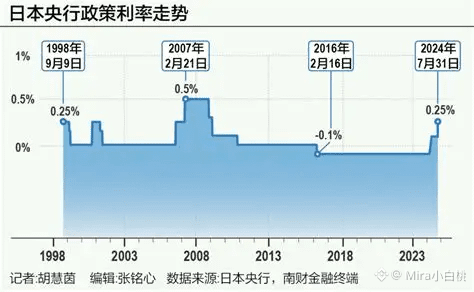
The Bank of Japan has just raised its policy rate to 1.25%, the highest level since 1995.
And just a couple of days ago, the Federal Reserve also completed a rate hike.
So this time, the market situation is somewhat special:
Fed rate hike + Bank of Japan rate hike
The global liquidity environment is changing.
Many people’s first reaction might be:
“Japan is hiking rates—won’t risk assets fall?”
But I think it’s not that simple.
Because this rate hike itself was already largely anticipated by the market, and after the news hit, the yen actually weakened, while BTC didn’t show a clear one-way selloff.
So what really matters now isn’t this rate hike itself.
Instead, it’s:
Will the Bank of Japan continue tightening further?
If it keeps sending hawkish signals going forward, the cost of yen funding could rise again, potentially affecting global capital flows and increasing volatility in risk assets like BTC and ETH.
But if the Bank of Japan maintains a more cautious pace afterward, concerns about further rate hikes may gradually get priced in.
So my thinking is quite simple:
In the short term, don’t automatically go bearish on BTC just because of the phrase “Japan rate hike.”
What matters more now is to look at:
Whether there’s a risk of capital withdrawing from risk assets, whether BTC’s key support can hold, and the Bank of Japan’s policy stance going forward.
After the news is released, how the price moves is always more important than the headline itself.
Trading news isn’t just about looking at two words like “bad news”—it’s about whether the market actually confirms it with a selloff.
$BTC $ETH $BNB
{future}(SOLUSDT)
{future}(ETHUSDT)
{future}(BTCUSDT)
#日本央行加息至31年高位
The Bank of Japan raises rates to a 31-year high—where does the market go next?
The Bank of Japan has just raised its policy rate to 1.25%, the highest level since 1995.
And just a couple of days ago, the Federal Reserve also completed a rate hike.
So this time, the market situation is somewhat special:
Fed rate hike + Bank of Japan rate hike
The global liquidity environment is changing.
Many people’s first reaction might be:
“Japan is hiking rates—won’t risk assets fall?”
But I think it’s not that simple.
Because this rate hike itself was already largely anticipated by the market, and after the news hit, the yen actually weakened, while BTC didn’t show a clear one-way selloff.
So what really matters now isn’t this rate hike itself.
Instead, it’s:
Will the Bank of Japan continue tightening further?
If it keeps sending hawkish signals going forward, the cost of yen funding could rise again, potentially affecting global capital flows and increasing volatility in risk assets like BTC and ETH.
But if the Bank of Japan maintains a more cautious pace afterward, concerns about further rate hikes may gradually get priced in.
So my thinking is quite simple:
In the short term, don’t automatically go bearish on BTC just because of the phrase “Japan rate hike.”
What matters more now is to look at:
Whether there’s a risk of capital withdrawing from risk assets, whether BTC’s key support can hold, and the Bank of Japan’s policy stance going forward.
After the news is released, how the price moves is always more important than the headline itself.
Trading news isn’t just about looking at two words like “bad news”—it’s about whether the market actually confirms it with a selloff.
$BTC $ETH $BNB
#日本央行加息至31年高位
The Bank of Japan has just raised its policy rate to 1.25%, the highest level since 1995.
And just a couple of days ago, the Federal Reserve also completed a rate hike.
So this time, the market situation is somewhat special:
Fed rate hike + Bank of Japan rate hike
The global liquidity environment is changing.
Many people’s first reaction might be:
“Japan is hiking rates—won’t risk assets fall?”
But I think it’s not that simple.
Because this rate hike itself was already largely anticipated by the market, and after the news hit, the yen actually weakened, while BTC didn’t show a clear one-way selloff.
So what really matters now isn’t this rate hike itself.
Instead, it’s:
Will the Bank of Japan continue tightening further?
If it keeps sending hawkish signals going forward, the cost of yen funding could rise again, potentially affecting global capital flows and increasing volatility in risk assets like BTC and ETH.
But if the Bank of Japan maintains a more cautious pace afterward, concerns about further rate hikes may gradually get priced in.
So my thinking is quite simple:
In the short term, don’t automatically go bearish on BTC just because of the phrase “Japan rate hike.”
What matters more now is to look at:
Whether there’s a risk of capital withdrawing from risk assets, whether BTC’s key support can hold, and the Bank of Japan’s policy stance going forward.
After the news is released, how the price moves is always more important than the headline itself.
Trading news isn’t just about looking at two words like “bad news”—it’s about whether the market actually confirms it with a selloff.
$BTC $ETH $BNB
#日本央行加息至31年高位
4
263
·
--
I don’t seem to have a concept of weekends 🥹
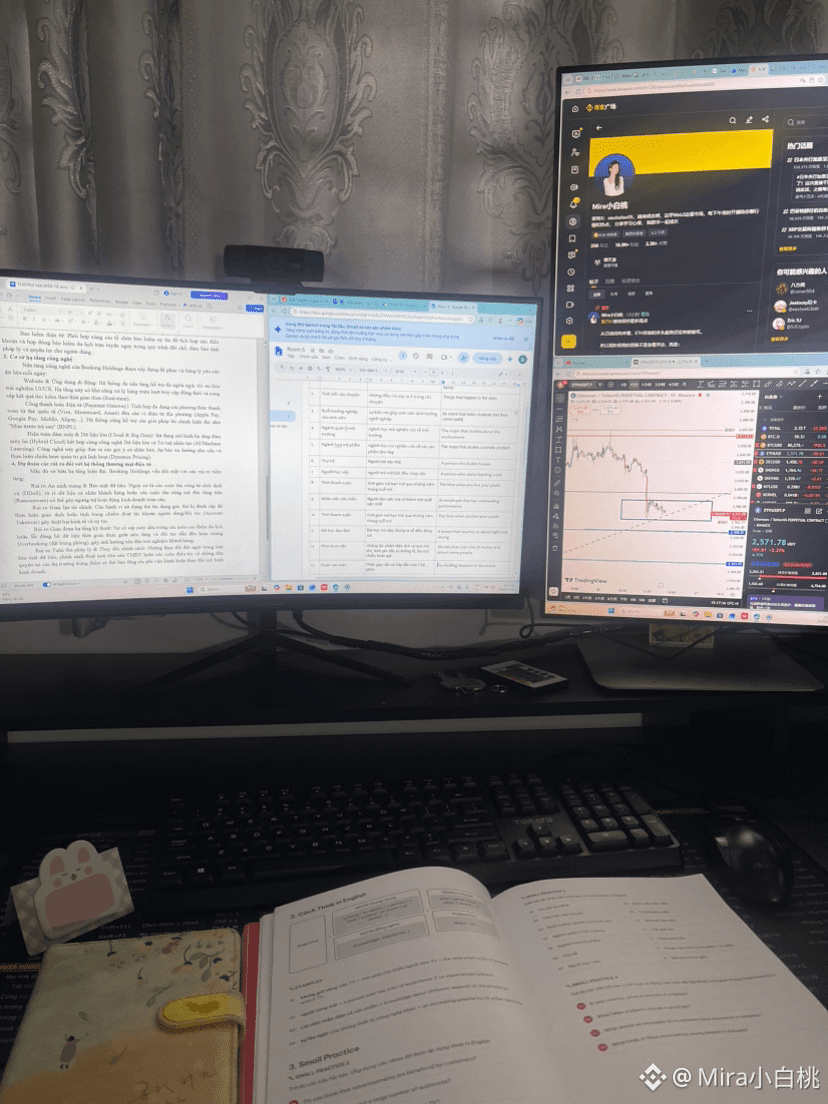
How’s the trading going, family members? Tune in at 6 o’clock this weekend—see you then!
I don’t seem to have a concept of weekends 🥹
How’s the trading going, family members? Tune in at 6 o’clock this weekend—see you then!
How’s the trading going, family members? Tune in at 6 o’clock this weekend—see you then!
2
4
583
·
--
Bitcoin has broken back above $80,000!
This rebound has a particular point that I think is especially worth noting:
After the market experienced rate hikes and regulatory news, BTC did not continue falling. Instead, it managed to regain a key area.
What does that indicate?
At least for now, the market has digested the earlier negative news to some extent.
Also, recently, US spot BTC ETFs have seen renewed capital inflows. On Thursday alone, net inflows were about $160 million, which has provided some funding support for this rebound.
But now, I won’t jump to the conclusion that because BTC broke through $80,000, the trend has completely reversed.
What really matters next is this: can $80,000 turn from resistance into support?
Right now, market analysts are paying close attention to the supply pressure zone overhead.
If BTC can stabilize above $80,000 and then gradually break through the upper supply zone, then this rebound would have a chance to extend further into higher price areas.
However, if after breaking through it falls back below $80,000 again:
Then you need to be careful about a false breakout.
In that case, I would actually focus more on whether the prior support zone below can hold.
So my thinking is very simple right now:
Hold above $80,000 → see whether the overhead resistance can continue to be broken.
Break the supply zone → watch for further trend extension.
Fall back below $80,000 again → prevent getting pulled back into another range-bound retracement.
This market move is no longer just about whether it’s “going up” or not—it’s about:
After the breakout, whether the market can truly turn key resistance into support.
So I’ll say it again:
I still lean bullish on direction, but don’t chase positions recklessly.
#比特币突破8万美元大关 #比特币市值超越特斯拉
Bitcoin has broken back above $80,000!
This rebound has a particular point that I think is especially worth noting:
After the market experienced rate hikes and regulatory news, BTC did not continue falling. Instead, it managed to regain a key area.
What does that indicate?
At least for now, the market has digested the earlier negative news to some extent.
Also, recently, US spot BTC ETFs have seen renewed capital inflows. On Thursday alone, net inflows were about $160 million, which has provided some funding support for this rebound.
But now, I won’t jump to the conclusion that because BTC broke through $80,000, the trend has completely reversed.
What really matters next is this: can $80,000 turn from resistance into support?
Right now, market analysts are paying close attention to the supply pressure zone overhead.
If BTC can stabilize above $80,000 and then gradually break through the upper supply zone, then this rebound would have a chance to extend further into higher price areas.
However, if after breaking through it falls back below $80,000 again:
Then you need to be careful about a false breakout.
In that case, I would actually focus more on whether the prior support zone below can hold.
So my thinking is very simple right now:
Hold above $80,000 → see whether the overhead resistance can continue to be broken.
Break the supply zone → watch for further trend extension.
Fall back below $80,000 again → prevent getting pulled back into another range-bound retracement.
This market move is no longer just about whether it’s “going up” or not—it’s about:
After the breakout, whether the market can truly turn key resistance into support.
So I’ll say it again:
I still lean bullish on direction, but don’t chase positions recklessly.
#比特币突破8万美元大关 #比特币市值超越特斯拉
This rebound has a particular point that I think is especially worth noting:
After the market experienced rate hikes and regulatory news, BTC did not continue falling. Instead, it managed to regain a key area.
What does that indicate?
At least for now, the market has digested the earlier negative news to some extent.
Also, recently, US spot BTC ETFs have seen renewed capital inflows. On Thursday alone, net inflows were about $160 million, which has provided some funding support for this rebound.
But now, I won’t jump to the conclusion that because BTC broke through $80,000, the trend has completely reversed.
What really matters next is this: can $80,000 turn from resistance into support?
Right now, market analysts are paying close attention to the supply pressure zone overhead.
If BTC can stabilize above $80,000 and then gradually break through the upper supply zone, then this rebound would have a chance to extend further into higher price areas.
However, if after breaking through it falls back below $80,000 again:
Then you need to be careful about a false breakout.
In that case, I would actually focus more on whether the prior support zone below can hold.
So my thinking is very simple right now:
Hold above $80,000 → see whether the overhead resistance can continue to be broken.
Break the supply zone → watch for further trend extension.
Fall back below $80,000 again → prevent getting pulled back into another range-bound retracement.
This market move is no longer just about whether it’s “going up” or not—it’s about:
After the breakout, whether the market can truly turn key resistance into support.
So I’ll say it again:
I still lean bullish on direction, but don’t chase positions recklessly.
#比特币突破8万美元大关 #比特币市值超越特斯拉
442
·
--
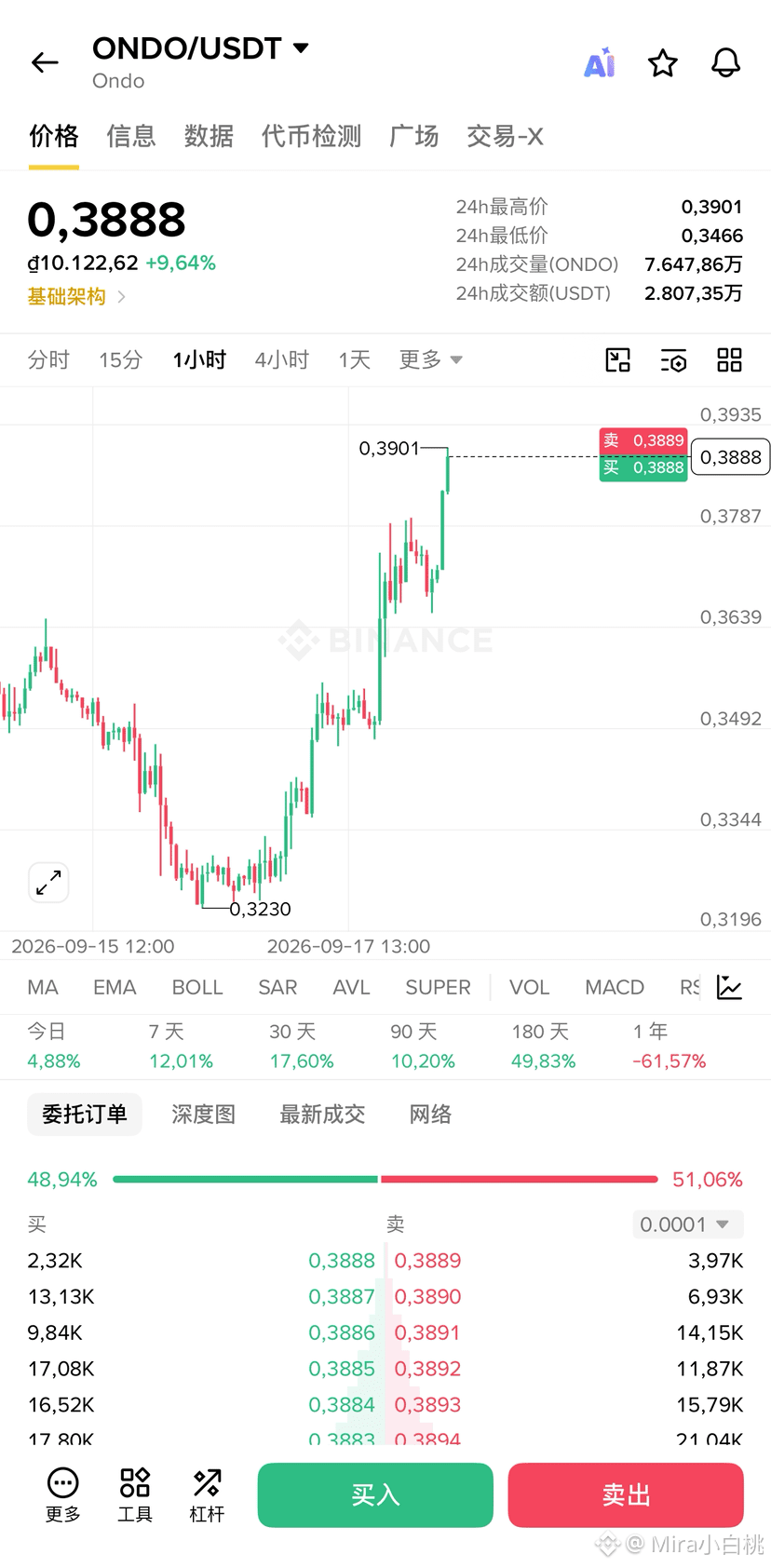
Thanks, boss, for the wealth code. I’m holding $ONDO with @Square-Creator-a7b6c2b8fe744
That day you said ONDO could be worth keeping an eye on. I thought, I’ll just buy a little first—turns out today it just took off directly
I originally only wanted to get a little taste, but I didn’t expect this wave to serve me a full-course meal
ONDO this time—yeah, it’s really smooth~
{future}(ONDOUSDT)
Thanks, boss, for the wealth code. I’m holding $ONDO with @稳健选手
That day you said ONDO could be worth keeping an eye on. I thought, I’ll just buy a little first—turns out today it just took off directly
I originally only wanted to get a little taste, but I didn’t expect this wave to serve me a full-course meal
ONDO this time—yeah, it’s really smooth~
That day you said ONDO could be worth keeping an eye on. I thought, I’ll just buy a little first—turns out today it just took off directly
I originally only wanted to get a little taste, but I didn’t expect this wave to serve me a full-course meal
ONDO this time—yeah, it’s really smooth~
3
2
477
·
--
🔥$ZEC has rushed to 1500—can it still move higher from here?
This round of ZEC’s strength has indeed gone beyond many people’s expectations.
From breaking through a key resistance level and continuously setting new highs, it has now entered a very critical position:
The uptrend hasn’t shown obvious signs of being broken, but the short-term market has already entered a high-level standoff.
Currently, the market has a few viewpoints that are quite interesting.
Some traders believe that ZEC now looks more like high-level consolidation within a strong trend. As long as the core breakout zone can be defended, there’s still a possibility for further upward expansion.
But some analysts are starting to warn:
Rising too fast is itself a risk.
Derivatives positioning continues to increase, and technical indicators have also moved into a clearly overheated area.
So going forward, I won’t simply chase the number “1500.”
I’m watching three areas instead:
First, the breakout zone overhead.
If ZEC can continue to break the prior high with expanding volume, and after breaking out it can turn this zone into a new support level, then the strong uptrend still has room to continue.
For the next phase above, keep an eye on higher integer psychological levels.
Second, the pressure around 1500.
This is a very important psychological level.
If it spikes up and then quickly falls back, it suggests that profit-taking from higher levels has started to cash in.
In that case, the short term is more likely to enter consolidation rather than immediately pushing higher.
Third, the core support zone below.
Right now, market analysis is focused on the earlier breakout zone.
As long as this zone holds, ZEC is still in a strong structure.
But if it breaks down and the subsequent retest can’t reclaim it, then be careful—this rally may be entering a deeper correction. Earlier analysis also pointed to the next lower layer of support as an observation area if the trend starts to weaken.
So my conclusion is simple:
ZEC still has upside potential, but the risk of chasing after a spike is getting higher.
Strong breakout and holding firm → continue to look for trend extension.
Push high and then pull back at high levels → wait for the dip to confirm.
If core support is lost → guard against the uptrend structure weakening.
When the market is strong, you can’t rely on emotion to chase.
I’d rather wait for a comfortable entry point than FOMO just because I see 1500.{future}(ZECUSDT)
🔥$ZEC has rushed to 1500—can it still move higher from here?
This round of ZEC’s strength has indeed gone beyond many people’s expectations.
From breaking through a key resistance level and continuously setting new highs, it has now entered a very critical position:
The uptrend hasn’t shown obvious signs of being broken, but the short-term market has already entered a high-level standoff.
Currently, the market has a few viewpoints that are quite interesting.
Some traders believe that ZEC now looks more like high-level consolidation within a strong trend. As long as the core breakout zone can be defended, there’s still a possibility for further upward expansion.
But some analysts are starting to warn:
Rising too fast is itself a risk.
Derivatives positioning continues to increase, and technical indicators have also moved into a clearly overheated area.
So going forward, I won’t simply chase the number “1500.”
I’m watching three areas instead:
First, the breakout zone overhead.
If ZEC can continue to break the prior high with expanding volume, and after breaking out it can turn this zone into a new support level, then the strong uptrend still has room to continue.
For the next phase above, keep an eye on higher integer psychological levels.
Second, the pressure around 1500.
This is a very important psychological level.
If it spikes up and then quickly falls back, it suggests that profit-taking from higher levels has started to cash in.
In that case, the short term is more likely to enter consolidation rather than immediately pushing higher.
Third, the core support zone below.
Right now, market analysis is focused on the earlier breakout zone.
As long as this zone holds, ZEC is still in a strong structure.
But if it breaks down and the subsequent retest can’t reclaim it, then be careful—this rally may be entering a deeper correction. Earlier analysis also pointed to the next lower layer of support as an observation area if the trend starts to weaken.
So my conclusion is simple:
ZEC still has upside potential, but the risk of chasing after a spike is getting higher.
Strong breakout and holding firm → continue to look for trend extension.
Push high and then pull back at high levels → wait for the dip to confirm.
If core support is lost → guard against the uptrend structure weakening.
When the market is strong, you can’t rely on emotion to chase.
I’d rather wait for a comfortable entry point than FOMO just because I see 1500.
This round of ZEC’s strength has indeed gone beyond many people’s expectations.
From breaking through a key resistance level and continuously setting new highs, it has now entered a very critical position:
The uptrend hasn’t shown obvious signs of being broken, but the short-term market has already entered a high-level standoff.
Currently, the market has a few viewpoints that are quite interesting.
Some traders believe that ZEC now looks more like high-level consolidation within a strong trend. As long as the core breakout zone can be defended, there’s still a possibility for further upward expansion.
But some analysts are starting to warn:
Rising too fast is itself a risk.
Derivatives positioning continues to increase, and technical indicators have also moved into a clearly overheated area.
So going forward, I won’t simply chase the number “1500.”
I’m watching three areas instead:
First, the breakout zone overhead.
If ZEC can continue to break the prior high with expanding volume, and after breaking out it can turn this zone into a new support level, then the strong uptrend still has room to continue.
For the next phase above, keep an eye on higher integer psychological levels.
Second, the pressure around 1500.
This is a very important psychological level.
If it spikes up and then quickly falls back, it suggests that profit-taking from higher levels has started to cash in.
In that case, the short term is more likely to enter consolidation rather than immediately pushing higher.
Third, the core support zone below.
Right now, market analysis is focused on the earlier breakout zone.
As long as this zone holds, ZEC is still in a strong structure.
But if it breaks down and the subsequent retest can’t reclaim it, then be careful—this rally may be entering a deeper correction. Earlier analysis also pointed to the next lower layer of support as an observation area if the trend starts to weaken.
So my conclusion is simple:
ZEC still has upside potential, but the risk of chasing after a spike is getting higher.
Strong breakout and holding firm → continue to look for trend extension.
Push high and then pull back at high levels → wait for the dip to confirm.
If core support is lost → guard against the uptrend structure weakening.
When the market is strong, you can’t rely on emotion to chase.
I’d rather wait for a comfortable entry point than FOMO just because I see 1500.
990
16
54
1.3k
·
--
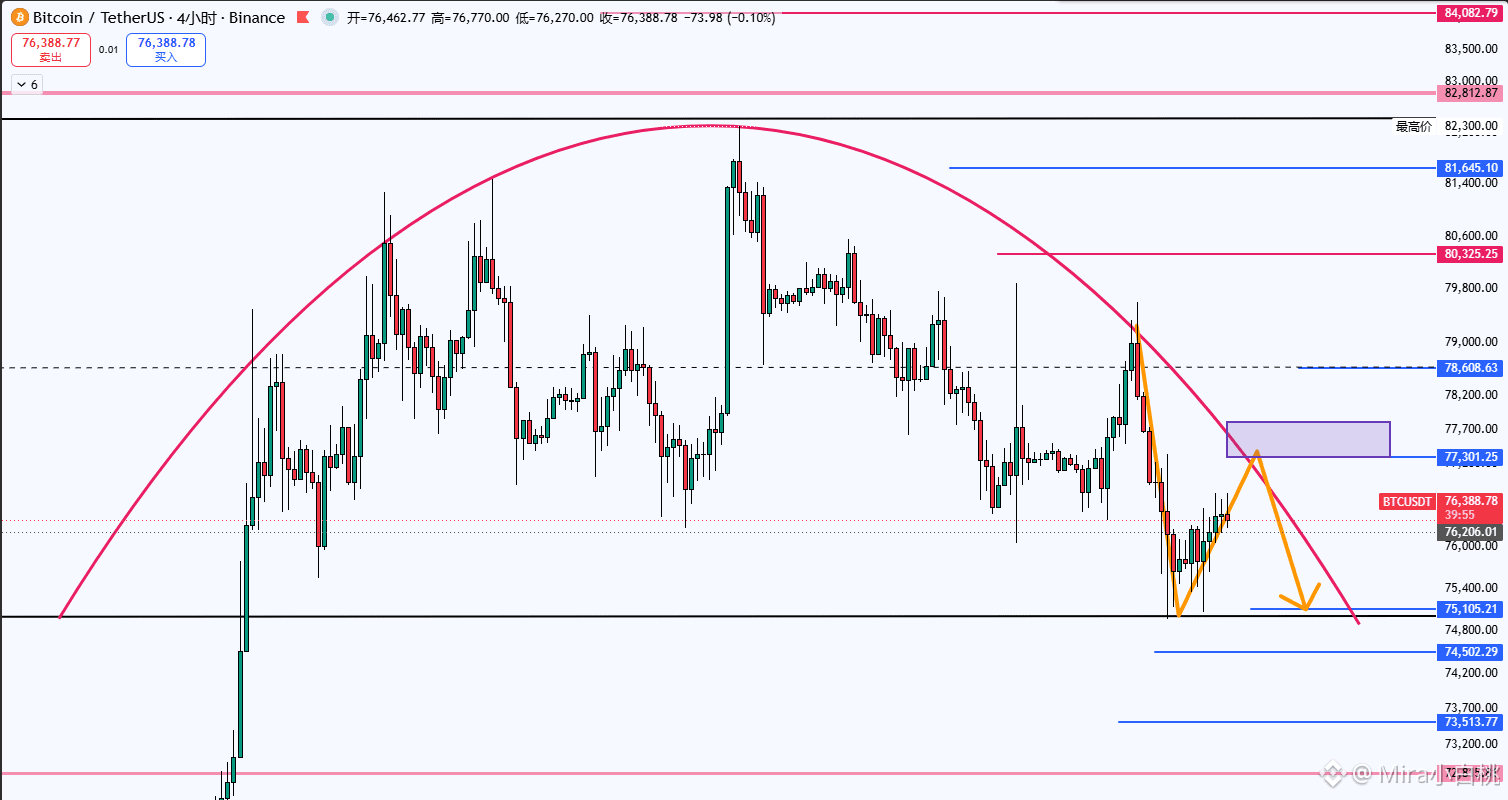
$BTC Now that this rebound is underway, I won’t rush to define it as a reversal.
From the 4H structure, there was a clear pullback earlier, and now price is starting to rebound.
However, combined with the key zones provided by several analysts in the current market, I believe what’s truly important next is not “how much it rises,” but whether it can reclaim the area above the resistance.
At the moment, I mainly look at three zones:
First, the overhead rebound resistance zone.
This is where longs and shorts truly first face off in the short term.
If price reaches this area and then gets rejected again, it suggests that sell pressure remains above, and the price is likely to return to consolidation—or even continue downward to find support.
Second, the stronger resistance zone further up.
This corresponds to the area near the previous highs, which is also the spot the market is paying the most attention to right now.
Only if price breaks through and holds that zone again can the prior pullback structure have a real chance of being decisively invalidated.
That’s also why I don’t immediately view the current short-term rebound as the start of a new uptrend.
Third, the key support zone below.
At present, most market analysis considers the area near the prior low as an important defense level.
As long as this area can still hold, BTC still has the possibility of consolidating and repairing.
But if support is effectively broken, the market structure will weaken further, and lower support zones will need to be watched again.
So my logic is simple:
Above, see whether resistance can be broken; below, see whether core support can hold.
Break resistance → watch for trend repair;
Resistance rejected → continue with weaker consolidation;
Core support fails → guard against a new round of downside.
At this point, I’d rather wait for structural confirmation than guess the direction early.
A trader doesn’t predict exactly how the market will move—rather, they think through different scenarios in advance.
$BTC
{future}(BTCUSDT)
$BTC Now that this rebound is underway, I won’t rush to define it as a reversal.
From the 4H structure, there was a clear pullback earlier, and now price is starting to rebound.
However, combined with the key zones provided by several analysts in the current market, I believe what’s truly important next is not “how much it rises,” but whether it can reclaim the area above the resistance.
At the moment, I mainly look at three zones:
First, the overhead rebound resistance zone.
This is where longs and shorts truly first face off in the short term.
If price reaches this area and then gets rejected again, it suggests that sell pressure remains above, and the price is likely to return to consolidation—or even continue downward to find support.
Second, the stronger resistance zone further up.
This corresponds to the area near the previous highs, which is also the spot the market is paying the most attention to right now.
Only if price breaks through and holds that zone again can the prior pullback structure have a real chance of being decisively invalidated.
That’s also why I don’t immediately view the current short-term rebound as the start of a new uptrend.
Third, the key support zone below.
At present, most market analysis considers the area near the prior low as an important defense level.
As long as this area can still hold, BTC still has the possibility of consolidating and repairing.
But if support is effectively broken, the market structure will weaken further, and lower support zones will need to be watched again.
So my logic is simple:
Above, see whether resistance can be broken; below, see whether core support can hold.
Break resistance → watch for trend repair;
Resistance rejected → continue with weaker consolidation;
Core support fails → guard against a new round of downside.
At this point, I’d rather wait for structural confirmation than guess the direction early.
A trader doesn’t predict exactly how the market will move—rather, they think through different scenarios in advance.
$BTC
From the 4H structure, there was a clear pullback earlier, and now price is starting to rebound.
However, combined with the key zones provided by several analysts in the current market, I believe what’s truly important next is not “how much it rises,” but whether it can reclaim the area above the resistance.
At the moment, I mainly look at three zones:
First, the overhead rebound resistance zone.
This is where longs and shorts truly first face off in the short term.
If price reaches this area and then gets rejected again, it suggests that sell pressure remains above, and the price is likely to return to consolidation—or even continue downward to find support.
Second, the stronger resistance zone further up.
This corresponds to the area near the previous highs, which is also the spot the market is paying the most attention to right now.
Only if price breaks through and holds that zone again can the prior pullback structure have a real chance of being decisively invalidated.
That’s also why I don’t immediately view the current short-term rebound as the start of a new uptrend.
Third, the key support zone below.
At present, most market analysis considers the area near the prior low as an important defense level.
As long as this area can still hold, BTC still has the possibility of consolidating and repairing.
But if support is effectively broken, the market structure will weaken further, and lower support zones will need to be watched again.
So my logic is simple:
Above, see whether resistance can be broken; below, see whether core support can hold.
Break resistance → watch for trend repair;
Resistance rejected → continue with weaker consolidation;
Core support fails → guard against a new round of downside.
At this point, I’d rather wait for structural confirmation than guess the direction early.
A trader doesn’t predict exactly how the market will move—rather, they think through different scenarios in advance.
$BTC
362
·
--
Verified
🔥The Federal Reserve raises rates for the first time in three years—how should $BTC look next?
The shoe has finally dropped.
The Federal Reserve has just announced a 25-basis-point hike, raising the benchmark rate to 3.75%—4.00%.
This is the Fed’s first rate increase since July 2023.
But what’s interesting is:
This hike was actually already priced in by the market.
So what’s really worth watching isn’t whether they raised rates—
it’s whether they’ll keep raising them next.
The Fed’s latest projections show that there could be one more rate hike before the end of this year, and they also raised their forecast for inflation this year.
That means the “easing environment” the market wants hasn’t truly returned—for now.
For BTC, the biggest short-term pressure still likely comes from interest rates and dollar liquidity.
And since the earlier CLARITY bill wasn’t able to move forward, BTC has already gone through a round of declines.
So right now, I actually wouldn’t recommend shorting just because you see the word “rate hike.”
After the news is released, the most important thing is to see how price moves.
If BTC can hold the key support levels ahead of it, and then regains an important position after the rate decision, that would suggest the market may be digesting this hike more strongly than expected.
On the other hand, if support continues to be broken and the Fed sends an even stronger tightening signal, you’ll need to watch out for the market continuing to look lower for support.
In short:
The rate hike itself isn’t the biggest variable for today.
What really matters is:
How many more times the Fed plans to hike next?
And whether the market will keep repricing interest rates.
For today’s BTC, don’t rush to guess the direction.
Watch the support, watch the reaction, and see what Powell says.
In times like this, patience matters even more.
#美联储加息是否已成定局 #美联储利率决议即将公布
{future}(BTCUSDT)
🔥The Federal Reserve raises rates for the first time in three years—how should $BTC look next?
The shoe has finally dropped.
The Federal Reserve has just announced a 25-basis-point hike, raising the benchmark rate to 3.75%—4.00%.
This is the Fed’s first rate increase since July 2023.
But what’s interesting is:
This hike was actually already priced in by the market.
So what’s really worth watching isn’t whether they raised rates—
it’s whether they’ll keep raising them next.
The Fed’s latest projections show that there could be one more rate hike before the end of this year, and they also raised their forecast for inflation this year.
That means the “easing environment” the market wants hasn’t truly returned—for now.
For BTC, the biggest short-term pressure still likely comes from interest rates and dollar liquidity.
And since the earlier CLARITY bill wasn’t able to move forward, BTC has already gone through a round of declines.
So right now, I actually wouldn’t recommend shorting just because you see the word “rate hike.”
After the news is released, the most important thing is to see how price moves.
If BTC can hold the key support levels ahead of it, and then regains an important position after the rate decision, that would suggest the market may be digesting this hike more strongly than expected.
On the other hand, if support continues to be broken and the Fed sends an even stronger tightening signal, you’ll need to watch out for the market continuing to look lower for support.
In short:
The rate hike itself isn’t the biggest variable for today.
What really matters is:
How many more times the Fed plans to hike next?
And whether the market will keep repricing interest rates.
For today’s BTC, don’t rush to guess the direction.
Watch the support, watch the reaction, and see what Powell says.
In times like this, patience matters even more.
#美联储加息是否已成定局 #美联储利率决议即将公布
The shoe has finally dropped.
The Federal Reserve has just announced a 25-basis-point hike, raising the benchmark rate to 3.75%—4.00%.
This is the Fed’s first rate increase since July 2023.
But what’s interesting is:
This hike was actually already priced in by the market.
So what’s really worth watching isn’t whether they raised rates—
it’s whether they’ll keep raising them next.
The Fed’s latest projections show that there could be one more rate hike before the end of this year, and they also raised their forecast for inflation this year.
That means the “easing environment” the market wants hasn’t truly returned—for now.
For BTC, the biggest short-term pressure still likely comes from interest rates and dollar liquidity.
And since the earlier CLARITY bill wasn’t able to move forward, BTC has already gone through a round of declines.
So right now, I actually wouldn’t recommend shorting just because you see the word “rate hike.”
After the news is released, the most important thing is to see how price moves.
If BTC can hold the key support levels ahead of it, and then regains an important position after the rate decision, that would suggest the market may be digesting this hike more strongly than expected.
On the other hand, if support continues to be broken and the Fed sends an even stronger tightening signal, you’ll need to watch out for the market continuing to look lower for support.
In short:
The rate hike itself isn’t the biggest variable for today.
What really matters is:
How many more times the Fed plans to hike next?
And whether the market will keep repricing interest rates.
For today’s BTC, don’t rush to guess the direction.
Watch the support, watch the reaction, and see what Powell says.
In times like this, patience matters even more.
#美联储加息是否已成定局 #美联储利率决议即将公布
3
399
·
--
$ZEC has broken to new highs again.
This trend is getting more and more outrageous.
When it broke above $1,000 earlier, many people already felt the rally was happening too fast.
So what happened?
After the pullback, instead of weakening for good, it actually pulled back up again—directly breaking through the previous high once more.
Now, ZEC isn’t just a simple rebound trade anymore.
From around $800, it has risen all the way to where it is now. In a short time, it has continuously broken through one key level after another, and market sentiment has clearly been fully ignited.
And after this breakout, I actually think there’s one position that’s especially important:
The previous high.
In the past, if a former resistance level could flip into support after breaking, then the significance of this new high would be completely different.
Next, I’ll focus on whether it can hold steady around 1,300.
If, after breaking through, it pulls back and there’s clear support around 1,300, it means the bulls are still there and the price may continue expanding higher.
But if it spikes up and then quickly drops back below the previous high, then be careful.
After all, it has already risen so much in a row—there must be a lot of profit-taking.
So the biggest taboo right now is:
When you see a new high and emotions run hot, don’t just chase immediately.
A strong trend doesn’t mean it won’t pull back.
A truly healthy move should be: after the breakout, it digests the profit-taking, and then continues higher—rather than yanking it up every day with one big bullish candle.
As for how far this ZEC rally can go, I’m not in a hurry to guess.
Watch the strength at the new high; watch the support on the pullback.
As long as key levels can still be defended, the trend is still intact.
But if we start seeing a surge followed by a selloff with heavy volume, be cautious—the market may shift from “wildly rising” into “high-level consolidation.”
This time, ZEC really has pulled the curtain on the privacy track’s visibility.
Next comes the most interesting part.
After setting a new high, can it keep creating new highs?
#Zcash持币者投票支持NU7升级 #Zcash上涨6%
{future}(ZECUSDT)
$ZEC has broken to new highs again.
This trend is getting more and more outrageous.
When it broke above $1,000 earlier, many people already felt the rally was happening too fast.
So what happened?
After the pullback, instead of weakening for good, it actually pulled back up again—directly breaking through the previous high once more.
Now, ZEC isn’t just a simple rebound trade anymore.
From around $800, it has risen all the way to where it is now. In a short time, it has continuously broken through one key level after another, and market sentiment has clearly been fully ignited.
And after this breakout, I actually think there’s one position that’s especially important:
The previous high.
In the past, if a former resistance level could flip into support after breaking, then the significance of this new high would be completely different.
Next, I’ll focus on whether it can hold steady around 1,300.
If, after breaking through, it pulls back and there’s clear support around 1,300, it means the bulls are still there and the price may continue expanding higher.
But if it spikes up and then quickly drops back below the previous high, then be careful.
After all, it has already risen so much in a row—there must be a lot of profit-taking.
So the biggest taboo right now is:
When you see a new high and emotions run hot, don’t just chase immediately.
A strong trend doesn’t mean it won’t pull back.
A truly healthy move should be: after the breakout, it digests the profit-taking, and then continues higher—rather than yanking it up every day with one big bullish candle.
As for how far this ZEC rally can go, I’m not in a hurry to guess.
Watch the strength at the new high; watch the support on the pullback.
As long as key levels can still be defended, the trend is still intact.
But if we start seeing a surge followed by a selloff with heavy volume, be cautious—the market may shift from “wildly rising” into “high-level consolidation.”
This time, ZEC really has pulled the curtain on the privacy track’s visibility.
Next comes the most interesting part.
After setting a new high, can it keep creating new highs?
#Zcash持币者投票支持NU7升级 #Zcash上涨6%
This trend is getting more and more outrageous.
When it broke above $1,000 earlier, many people already felt the rally was happening too fast.
So what happened?
After the pullback, instead of weakening for good, it actually pulled back up again—directly breaking through the previous high once more.
Now, ZEC isn’t just a simple rebound trade anymore.
From around $800, it has risen all the way to where it is now. In a short time, it has continuously broken through one key level after another, and market sentiment has clearly been fully ignited.
And after this breakout, I actually think there’s one position that’s especially important:
The previous high.
In the past, if a former resistance level could flip into support after breaking, then the significance of this new high would be completely different.
Next, I’ll focus on whether it can hold steady around 1,300.
If, after breaking through, it pulls back and there’s clear support around 1,300, it means the bulls are still there and the price may continue expanding higher.
But if it spikes up and then quickly drops back below the previous high, then be careful.
After all, it has already risen so much in a row—there must be a lot of profit-taking.
So the biggest taboo right now is:
When you see a new high and emotions run hot, don’t just chase immediately.
A strong trend doesn’t mean it won’t pull back.
A truly healthy move should be: after the breakout, it digests the profit-taking, and then continues higher—rather than yanking it up every day with one big bullish candle.
As for how far this ZEC rally can go, I’m not in a hurry to guess.
Watch the strength at the new high; watch the support on the pullback.
As long as key levels can still be defended, the trend is still intact.
But if we start seeing a surge followed by a selloff with heavy volume, be cautious—the market may shift from “wildly rising” into “high-level consolidation.”
This time, ZEC really has pulled the curtain on the privacy track’s visibility.
Next comes the most interesting part.
After setting a new high, can it keep creating new highs?
#Zcash持币者投票支持NU7升级 #Zcash上涨6%
1
888
·
--
Verified
#越南试点加密资产市场 Vietnam government bond auctions raise $564 million—should this news be taken seriously?
My understanding is:
By itself, $564 million is unlikely to have a major impact on global markets.
What matters more is the funding behind it and the interest-rate logic.
Vietnam has recently continued to finance itself through government bond issuance. This year, the size of government bond issuance has already been relatively large. At the same time, Vietnam’s 10-year government bond yield is currently above 4.5%, and compared with the beginning of the year it has risen noticeably.
So I’m paying attention to three points in this news:
First, funding needs.
When the government issues bonds, in essence it is raising funds from the market.
If the issuance size keeps increasing afterward, the market will need to absorb more bonds, which could put some pressure on liquidity.
Second, bond yields.
If bond supply increases while yields continue to rise, that suggests the market is demanding a higher cost of capital.
This would affect banks, corporate financing costs, and overall liquidity.
Third, consider it together with the global interest-rate environment.
Right now, US Treasury yields, oil prices, and inflation expectations are all highly sensitive.
So I won’t interpret this news on its own as purely “good” or “bad.”
What’s truly important is: the bond issuance size + bond yields + market liquidity—how these things change going forward.
For us in trading $BTC and assets like gold, Vietnam’s government bonds themselves are not a core driver.
But if global funding costs keep rising, risk assets overall will likely face some pressure.
When traders read the news, they can’t just look at the numbers—they must also look at the funding logic behind those numbers.
#越南试点加密资产市场 Vietnam government bond auctions raise $564 million—should this news be taken seriously?
My understanding is:
By itself, $564 million is unlikely to have a major impact on global markets.
What matters more is the funding behind it and the interest-rate logic.
Vietnam has recently continued to finance itself through government bond issuance. This year, the size of government bond issuance has already been relatively large. At the same time, Vietnam’s 10-year government bond yield is currently above 4.5%, and compared with the beginning of the year it has risen noticeably.
So I’m paying attention to three points in this news:
First, funding needs.
When the government issues bonds, in essence it is raising funds from the market.
If the issuance size keeps increasing afterward, the market will need to absorb more bonds, which could put some pressure on liquidity.
Second, bond yields.
If bond supply increases while yields continue to rise, that suggests the market is demanding a higher cost of capital.
This would affect banks, corporate financing costs, and overall liquidity.
Third, consider it together with the global interest-rate environment.
Right now, US Treasury yields, oil prices, and inflation expectations are all highly sensitive.
So I won’t interpret this news on its own as purely “good” or “bad.”
What’s truly important is: the bond issuance size + bond yields + market liquidity—how these things change going forward.
For us in trading $BTC and assets like gold, Vietnam’s government bonds themselves are not a core driver.
But if global funding costs keep rising, risk assets overall will likely face some pressure.
When traders read the news, they can’t just look at the numbers—they must also look at the funding logic behind those numbers.
My understanding is:
By itself, $564 million is unlikely to have a major impact on global markets.
What matters more is the funding behind it and the interest-rate logic.
Vietnam has recently continued to finance itself through government bond issuance. This year, the size of government bond issuance has already been relatively large. At the same time, Vietnam’s 10-year government bond yield is currently above 4.5%, and compared with the beginning of the year it has risen noticeably.
So I’m paying attention to three points in this news:
First, funding needs.
When the government issues bonds, in essence it is raising funds from the market.
If the issuance size keeps increasing afterward, the market will need to absorb more bonds, which could put some pressure on liquidity.
Second, bond yields.
If bond supply increases while yields continue to rise, that suggests the market is demanding a higher cost of capital.
This would affect banks, corporate financing costs, and overall liquidity.
Third, consider it together with the global interest-rate environment.
Right now, US Treasury yields, oil prices, and inflation expectations are all highly sensitive.
So I won’t interpret this news on its own as purely “good” or “bad.”
What’s truly important is: the bond issuance size + bond yields + market liquidity—how these things change going forward.
For us in trading $BTC and assets like gold, Vietnam’s government bonds themselves are not a core driver.
But if global funding costs keep rising, risk assets overall will likely face some pressure.
When traders read the news, they can’t just look at the numbers—they must also look at the funding logic behind those numbers.

332
·
--
#美联储加息是否已成定局 CLARITY Act stuck—does the crypto market have to wait again?
Last night, the U.S. Senate held a key vote on the “Digital Assets Market Clarity Act.”
The result was 49 votes in favor and 50 against, not reaching the 60 votes needed to move forward.
So this time, it’s not that the bill became law—it’s that even the step to continue reviewing it failed.
So what’s the big deal with this bill?
In simple terms, it aims to make the U.S. crypto market’s regulatory rules clearer.
The market has long had a major problem:
Which coins fall under securities regulation? Which are commodities? And who is responsible for overseeing them?
The CLARITY Act wants to write these boundaries into law, clearly define what the U.S. Securities and Exchange Commission (SEC) and the Commodity Futures Trading Commission (CFTC) handle, and establish more explicit rules for trading platforms, digital asset issuers, and others.
Because it couldn’t advance this time, market sentiment naturally took a hit.
After the news broke, Bitcoin briefly dipped to around $76,000, and crypto-related stocks like Coinbase and Circle also saw noticeable declines.
But one thing to pay attention to:
This doesn’t mean the CLARITY Act is completely over.
This time, the procedural vote failed. Also, after the vote, Senator Thom Tillis proposed a motion to reconsider—so there is still room for further negotiations and another push forward.
What’s really getting stuck isn’t only the question of whether crypto should be regulated.
There are currently many disagreements within the Senate, including issues about officials holding and participating in crypto assets, anti–money laundering requirements, and competition between stablecoins and traditional banks.
Even before this vote, the Senate Republicans had already released a revised version, adding a lot of new content—but they still couldn’t secure enough votes.
So I think in the short term, the market may continue to be affected by news flow.
But in a longer-term view, what’s truly worth watching is:
When will the U.S. finally set the regulatory boundaries for the crypto market for real?
That may matter more than the result of a single vote.
The CLARITY Act didn’t advance this time.
It doesn’t mean the regulatory story for crypto has ended.
It just means this road has another hurdle.
Do you think there will be renewed talks later?
#美联储加息是否已成定局 CLARITY Act stuck—does the crypto market have to wait again?
Last night, the U.S. Senate held a key vote on the “Digital Assets Market Clarity Act.”
The result was 49 votes in favor and 50 against, not reaching the 60 votes needed to move forward.
So this time, it’s not that the bill became law—it’s that even the step to continue reviewing it failed.
So what’s the big deal with this bill?
In simple terms, it aims to make the U.S. crypto market’s regulatory rules clearer.
The market has long had a major problem:
Which coins fall under securities regulation? Which are commodities? And who is responsible for overseeing them?
The CLARITY Act wants to write these boundaries into law, clearly define what the U.S. Securities and Exchange Commission (SEC) and the Commodity Futures Trading Commission (CFTC) handle, and establish more explicit rules for trading platforms, digital asset issuers, and others.
Because it couldn’t advance this time, market sentiment naturally took a hit.
After the news broke, Bitcoin briefly dipped to around $76,000, and crypto-related stocks like Coinbase and Circle also saw noticeable declines.
But one thing to pay attention to:
This doesn’t mean the CLARITY Act is completely over.
This time, the procedural vote failed. Also, after the vote, Senator Thom Tillis proposed a motion to reconsider—so there is still room for further negotiations and another push forward.
What’s really getting stuck isn’t only the question of whether crypto should be regulated.
There are currently many disagreements within the Senate, including issues about officials holding and participating in crypto assets, anti–money laundering requirements, and competition between stablecoins and traditional banks.
Even before this vote, the Senate Republicans had already released a revised version, adding a lot of new content—but they still couldn’t secure enough votes.
So I think in the short term, the market may continue to be affected by news flow.
But in a longer-term view, what’s truly worth watching is:
When will the U.S. finally set the regulatory boundaries for the crypto market for real?
That may matter more than the result of a single vote.
The CLARITY Act didn’t advance this time.
It doesn’t mean the regulatory story for crypto has ended.
It just means this road has another hurdle.
Do you think there will be renewed talks later?
Last night, the U.S. Senate held a key vote on the “Digital Assets Market Clarity Act.”
The result was 49 votes in favor and 50 against, not reaching the 60 votes needed to move forward.
So this time, it’s not that the bill became law—it’s that even the step to continue reviewing it failed.
So what’s the big deal with this bill?
In simple terms, it aims to make the U.S. crypto market’s regulatory rules clearer.
The market has long had a major problem:
Which coins fall under securities regulation? Which are commodities? And who is responsible for overseeing them?
The CLARITY Act wants to write these boundaries into law, clearly define what the U.S. Securities and Exchange Commission (SEC) and the Commodity Futures Trading Commission (CFTC) handle, and establish more explicit rules for trading platforms, digital asset issuers, and others.
Because it couldn’t advance this time, market sentiment naturally took a hit.
After the news broke, Bitcoin briefly dipped to around $76,000, and crypto-related stocks like Coinbase and Circle also saw noticeable declines.
But one thing to pay attention to:
This doesn’t mean the CLARITY Act is completely over.
This time, the procedural vote failed. Also, after the vote, Senator Thom Tillis proposed a motion to reconsider—so there is still room for further negotiations and another push forward.
What’s really getting stuck isn’t only the question of whether crypto should be regulated.
There are currently many disagreements within the Senate, including issues about officials holding and participating in crypto assets, anti–money laundering requirements, and competition between stablecoins and traditional banks.
Even before this vote, the Senate Republicans had already released a revised version, adding a lot of new content—but they still couldn’t secure enough votes.
So I think in the short term, the market may continue to be affected by news flow.
But in a longer-term view, what’s truly worth watching is:
When will the U.S. finally set the regulatory boundaries for the crypto market for real?
That may matter more than the result of a single vote.
The CLARITY Act didn’t advance this time.
It doesn’t mean the regulatory story for crypto has ended.
It just means this road has another hurdle.
Do you think there will be renewed talks later?
2
474
·
--
Verified
#比特币现货etf净流入1.6亿美元 Fed rate hike probability has already risen to 89%!
But I actually think the most interesting part right now is this:
The market has already priced in the outcome.
Currently, the market’s expectation for a 25bp hike at the September FOMC is around 89%; Wednesday will be the final answer.
So the question is:
If everyone knows the hike is coming, why hasn’t BTC just crashed outright?
Because trading has never been about “whether to hike,”
but about:
what the Fed will say after the hike.
📊 What I’m focusing on right now is three things:
① Can BTC hold above 77K?
As long as it can stay stable around 77K, I won’t immediately turn bearish just because rate-hike expectations have increased.
② Can 80K break through?
80K is the level that bulls must reclaim right now.
If 80K breaks with strong volume, market sentiment will improve noticeably.
Then to look further:
82K—83K.
③ Post-FOMC remarks
This is what I’m really watching.
If there’s a 25bp hike, but the subsequent guidance is not as hawkish as the market expects,
then “bad news” landing could turn into a catalyst for BTC to rise.
But if there’s a hike and hawkish statements at the same time,
then be careful—the market may continue compressing valuations.
🍑 So my logic is simple:
Hold 77K → continue observing the bulls.
Break 80K → target 82K—83K.
Hold 82K—83K → the upside space opens up again.
But if:
77K breaks down → defend first on the short term.
I’m not going to panic just because “an 89% chance of a hike” is four words,
and I’m also not going to start FOMO just because BTC rebounds.
When the market is truly dangerous,
it’s often not when the news is most frightening,
but when everyone thinks “it’s definitely fine.”
Over the next couple of days, I’d rather:
wait for the data, wait for the FOMC, wait for price confirmation.
Don’t guess the bottom, and don’t chase the top.
#比特币现货etf净流入1.6亿美元 Fed rate hike probability has already risen to 89%!
But I actually think the most interesting part right now is this:
The market has already priced in the outcome.
Currently, the market’s expectation for a 25bp hike at the September FOMC is around 89%; Wednesday will be the final answer.
So the question is:
If everyone knows the hike is coming, why hasn’t BTC just crashed outright?
Because trading has never been about “whether to hike,”
but about:
what the Fed will say after the hike.
📊 What I’m focusing on right now is three things:
① Can BTC hold above 77K?
As long as it can stay stable around 77K, I won’t immediately turn bearish just because rate-hike expectations have increased.
② Can 80K break through?
80K is the level that bulls must reclaim right now.
If 80K breaks with strong volume, market sentiment will improve noticeably.
Then to look further:
82K—83K.
③ Post-FOMC remarks
This is what I’m really watching.
If there’s a 25bp hike, but the subsequent guidance is not as hawkish as the market expects,
then “bad news” landing could turn into a catalyst for BTC to rise.
But if there’s a hike and hawkish statements at the same time,
then be careful—the market may continue compressing valuations.
🍑 So my logic is simple:
Hold 77K → continue observing the bulls.
Break 80K → target 82K—83K.
Hold 82K—83K → the upside space opens up again.
But if:
77K breaks down → defend first on the short term.
I’m not going to panic just because “an 89% chance of a hike” is four words,
and I’m also not going to start FOMO just because BTC rebounds.
When the market is truly dangerous,
it’s often not when the news is most frightening,
but when everyone thinks “it’s definitely fine.”
Over the next couple of days, I’d rather:
wait for the data, wait for the FOMC, wait for price confirmation.
Don’t guess the bottom, and don’t chase the top.
But I actually think the most interesting part right now is this:
The market has already priced in the outcome.
Currently, the market’s expectation for a 25bp hike at the September FOMC is around 89%; Wednesday will be the final answer.
So the question is:
If everyone knows the hike is coming, why hasn’t BTC just crashed outright?
Because trading has never been about “whether to hike,”
but about:
what the Fed will say after the hike.
📊 What I’m focusing on right now is three things:
① Can BTC hold above 77K?
As long as it can stay stable around 77K, I won’t immediately turn bearish just because rate-hike expectations have increased.
② Can 80K break through?
80K is the level that bulls must reclaim right now.
If 80K breaks with strong volume, market sentiment will improve noticeably.
Then to look further:
82K—83K.
③ Post-FOMC remarks
This is what I’m really watching.
If there’s a 25bp hike, but the subsequent guidance is not as hawkish as the market expects,
then “bad news” landing could turn into a catalyst for BTC to rise.
But if there’s a hike and hawkish statements at the same time,
then be careful—the market may continue compressing valuations.
🍑 So my logic is simple:
Hold 77K → continue observing the bulls.
Break 80K → target 82K—83K.
Hold 82K—83K → the upside space opens up again.
But if:
77K breaks down → defend first on the short term.
I’m not going to panic just because “an 89% chance of a hike” is four words,
and I’m also not going to start FOMO just because BTC rebounds.
When the market is truly dangerous,
it’s often not when the news is most frightening,
but when everyone thinks “it’s definitely fine.”
Over the next couple of days, I’d rather:
wait for the data, wait for the FOMC, wait for price confirmation.
Don’t guess the bottom, and don’t chase the top.
484
Log in to explore more content
Join global crypto users on Binance Square
⚡️ Get latest and useful information about crypto.
💬 Trusted by the world’s largest crypto exchange.
👍 Discover real insights from verified creators.
Email / Phone number
Trending Topics
XRPRises8%
356 views
82 Discussing
#XRPRises8% $XRP
/USDT Analysis💪
Current Price: $1.5140 (+6.81%)
24h High: 1.5743 | 24h Low: 1.4142
Key Levels: ready for next move 😜😊
Resistance 2: 1.5743
Resistance 1: 1.5400 - 1.5500
Working Level: 1.5000 - 1.5150
Support 1: 1.4600 - 1.4800
Support 2: 1.3700 - 1.3900
Support 3: 1.2400 - 1.2600
Bullish Scenario:
If price breaks and holds above 1.5150,
Next target: 1.5400 - 1.5500, then 1.5743
Bearish Scenario:
If price rejects 1.5150,
Downside: 1.4600 - 1.4800, then 1.3700 - 1.3900
Note: This is technical analysis only, not financial advice. Trade at your own risk.
#Xrp🔥🔥 #crypto #trading
Crypto junaid88
·0 Likes
·65 views
AppleGoogleSeekStablecoinTokenizedDepositTalent
447 views
67 Discussing
NvidiaToBuyAnother$1.5BSBEnergySharesPreIPO
43 views
11 Discussing