
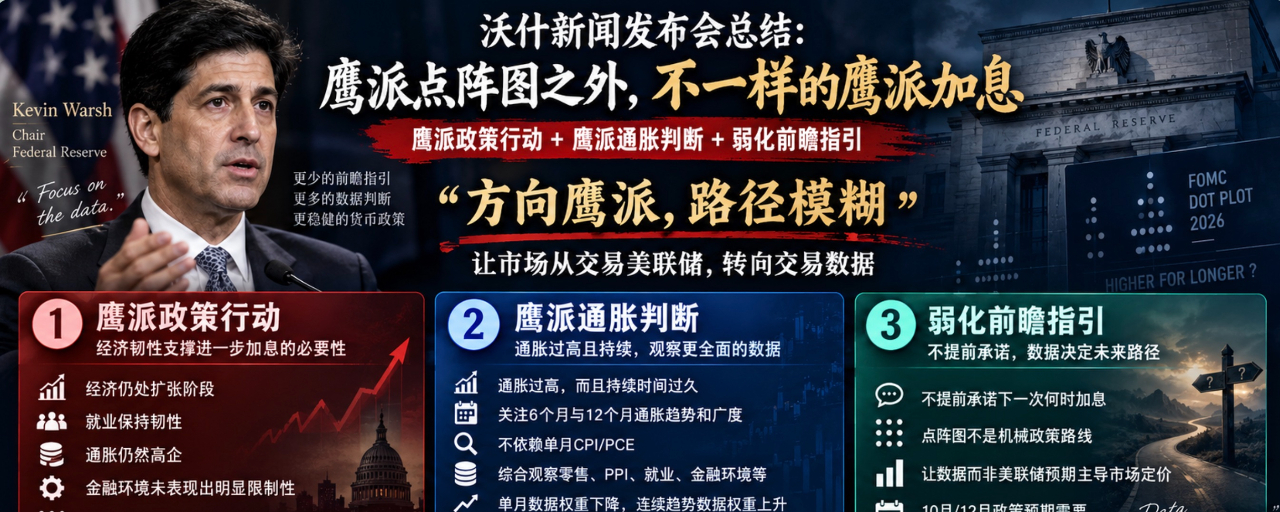

Waller’s news conference summary: a hawkish rate hike that’s different from the hawkish dot plot!
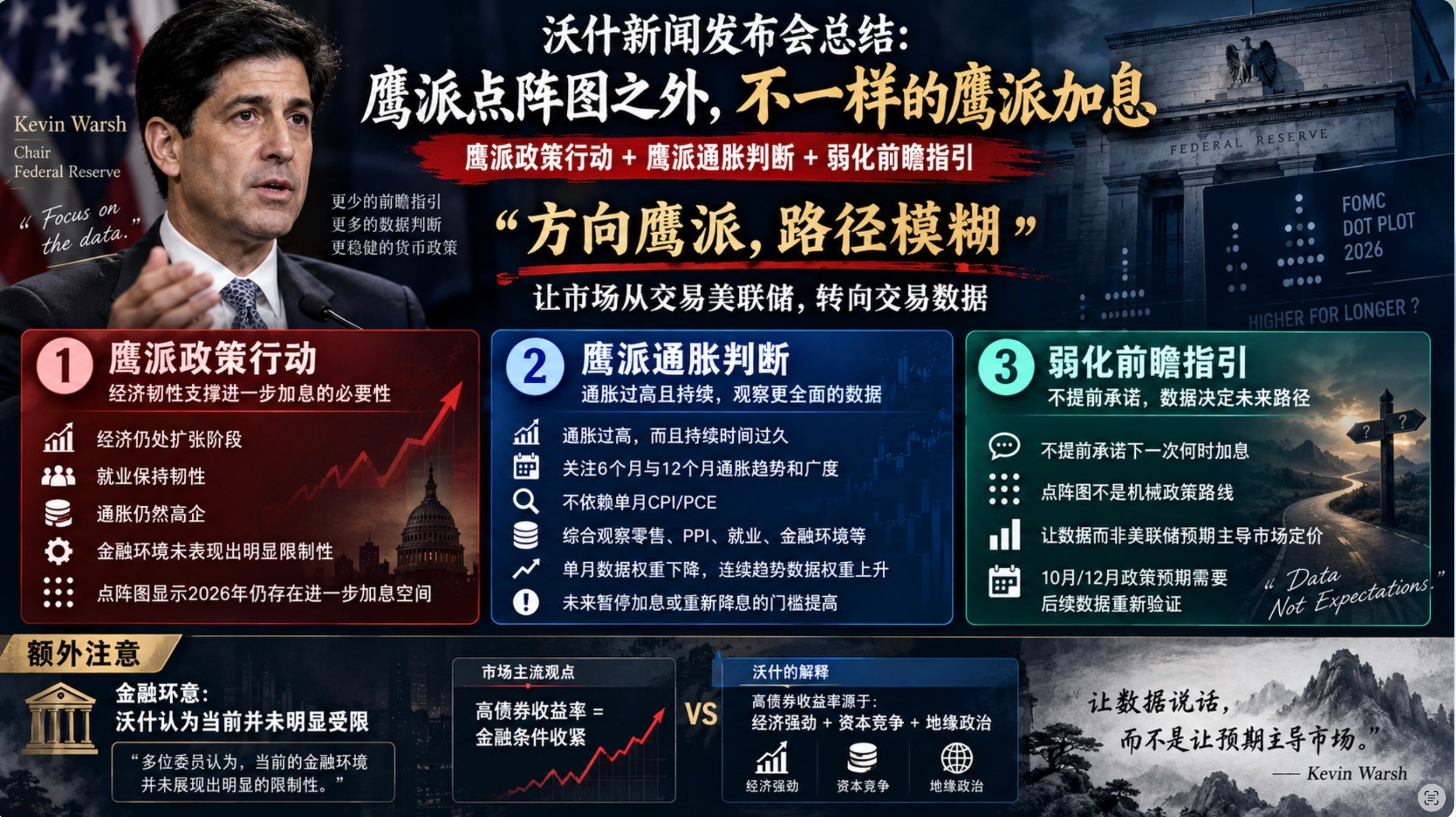
Tonight’s Waller speech can be summarized simply as a different kind of hawkish rate hike: hawkish policy action + hawkish inflation assessment + weakening forward guidance.
Hawkish policy action: #美联储加息是否已成定局
After the dot plot provides a hawkish view, Waller further reinforces it—especially with the view that the economy is currently in an expansion phase, employment remains resilient, inflation is still elevated, and most officials believe the current financial conditions are not restrictive enough, which undoubtedly deepens the hawkish stance of the dot plot.
Hawkish inflation assessment:
Waller believes the inflation rate is too high and has been kept at sufficiently high levels for a long time. He thinks that too many inflation indicators have remained above 3% over the past 6 to 12 months. Waller also believes that observing inflation is not just about looking at one-month CPI or PCE; instead, we should look at the 6-month inflation trend. At the same time, we should assess other data, such as retail, PPI, employment, and financial conditions. This clearly raises the threshold for pausing rate hikes in the future or returning to rate cuts.
Weaken forward guidance:
He continues to consolidate his policy of weakening forward guidance. Although the dot plot points to another rate hike in 2026, Waller did not clearly spell out this path. It is, in a sense, meant to ease market pressure in the short term. Of course, if the goal is to weaken expectations of a rate hike in October or December, in the future there must be better inflation data.
If we summarize Waller’s remarks tonight in one sentence, it would be: hawkish in direction, vague in path. Obviously, Waller wants the market to shift from trading the Federal Reserve to trading the data—this was also Waller’s policy stance at the outset.
Compared with the dot plot, Waller’s remarks are slightly softer. But for the future, using economic data to shape market expectations of Fed policy will undoubtedly raise the bar. Previously, if one-month inflation data weakened or strengthened, or employment data weakened or strengthened, it could change how the market adjusted its expectations for Fed policy. But under Waller’s influence, the effect of that single-month data on market expectations has been greatly weakened. The impact of one-month data is reduced, so we need more consecutive data with an underlying trend!
Additional points to note:
Another hidden emphasis is revealed in Waller’s remarks tonight. Waller said that several committee members believe that the current financial conditions have not shown any obvious tightening effect, which is at odds with the market’s current mainstream expectation.
The current market mainstream expectation is that a surge in bond yields has suppressed financial conditions, bringing financial conditions into a relatively restrictive phase. However, Waller does not seem to acknowledge this.
Also, Waller’s explanation for the high interest rates in the bond market is that the economy is strong + capital competition + geopolitics. This reasoning is quite weak, but it indicates that Waller does not want the market to think that the change in Federal Reserve policy is related to interest-rate management.