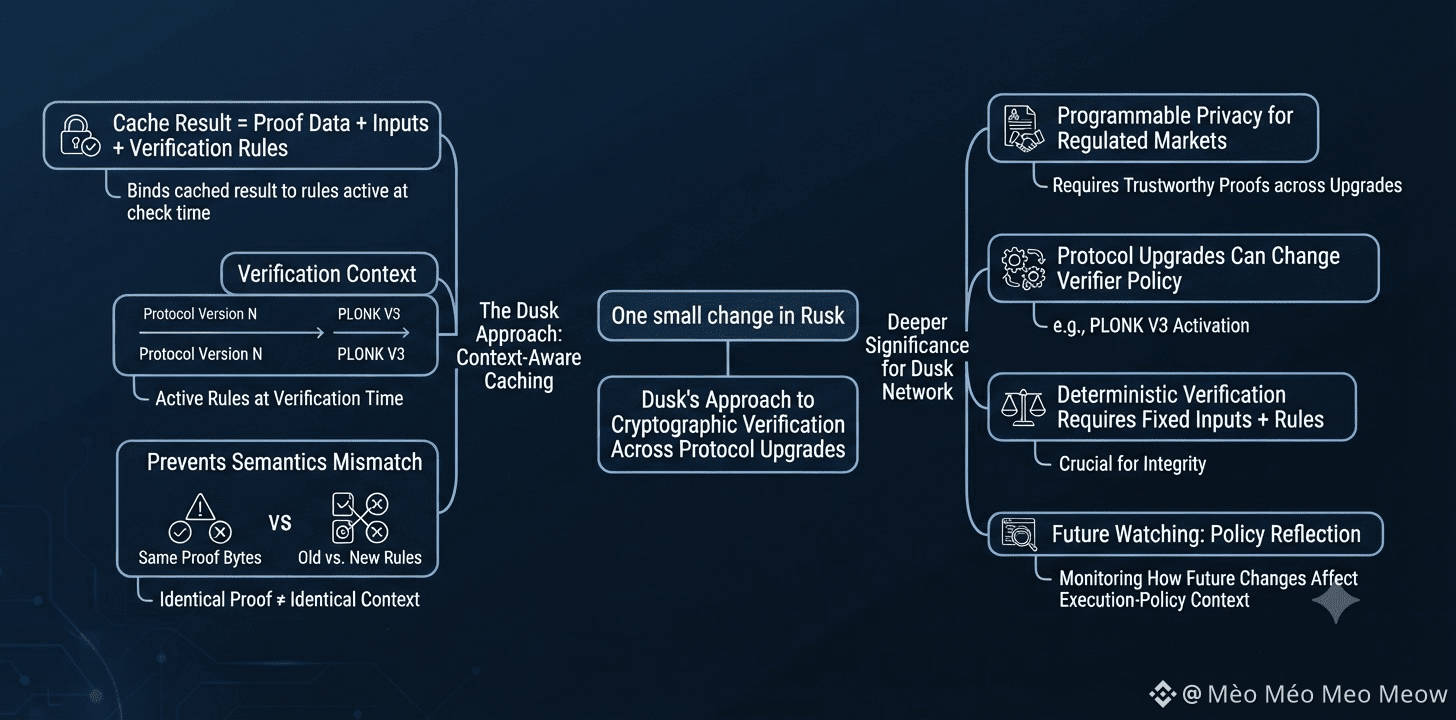
One small change in Rusk says a lot about how Dusk treats cryptographic verification across protocol upgrades.
A cached result is no longer tied only to the proof and its inputs. Dusk also binds that result to the verification rules that were active when the check was made.
That matters because identical proof data does not always mean an identical verification context. A protocol upgrade can change the verifier or execution policy without changing the proof bytes themselves.
For Dusk network, that becomes especially relevant as it builds programmable privacy for regulated markets, where cryptographic proofs need to stay trustworthy across protocol upgrades.
What I don't know yet is whether Dusk has isolated those version-specific rules tightly enough that a cached result can never outlive the semantics that made it valid.
The details worth watching are the execution-policy context included in cache keys, verifier changes such as the PLONK V3 activation, and what happens when future upgrades change verification behavior again.
Matching proof bytes are useful evidence that two checks look the same. They are weaker evidence that the same cached result is safe to reuse.
I'd care more about whether the active verifier context still matches than about how much verification work Dusk manages to cache.
The deeper point is that deterministic verification depends on more than fixing the input. The rules used to interpret that input have to be fixed too.
The question is whether Dusk can keep optimizing verification without letting old protocol semantics cross an upgrade boundary through the cache.
I am watching how future verifier changes are reflected in that execution-policy context.
#dusk $DUSK @Dusk
A cached result is no longer tied only to the proof and its inputs. Dusk also binds that result to the verification rules that were active when the check was made.
That matters because identical proof data does not always mean an identical verification context. A protocol upgrade can change the verifier or execution policy without changing the proof bytes themselves.
For Dusk network, that becomes especially relevant as it builds programmable privacy for regulated markets, where cryptographic proofs need to stay trustworthy across protocol upgrades.
What I don't know yet is whether Dusk has isolated those version-specific rules tightly enough that a cached result can never outlive the semantics that made it valid.
The details worth watching are the execution-policy context included in cache keys, verifier changes such as the PLONK V3 activation, and what happens when future upgrades change verification behavior again.
Matching proof bytes are useful evidence that two checks look the same. They are weaker evidence that the same cached result is safe to reuse.
I'd care more about whether the active verifier context still matches than about how much verification work Dusk manages to cache.
The deeper point is that deterministic verification depends on more than fixing the input. The rules used to interpret that input have to be fixed too.
The question is whether Dusk can keep optimizing verification without letting old protocol semantics cross an upgrade boundary through the cache.
I am watching how future verifier changes are reflected in that execution-policy context.
#dusk $DUSK @Dusk