


“Is this made by AI?”
“AI has truly restored the aura of the Nine Heavens Xuannü.”
“The dragon chase scenes are amazing—so many iconic moments.”
“Warm, kind, and truly original—like the real divining board flavor.”
“I saw it and then forgot it was AI.”
“When will Part 3 be released?”
After the recent launch of the AIGC online story film series “Floating Dreams” under (Soul Ferry), the focus of audience discussions quietly shifted—from the initial scrutiny of the “AI feel,” gradually returning to discussions about character arcs, narrative tension, and emotional resonance. Viewers no longer just identify which scenes are generated by AI; they start to talk about whether the story is compelling, whether the characters feel real, and whether the emotions are moving—while also eagerly anticipating the next installment.
For AI film and television, this kind of change may be more important than any single technical breakthrough.
From July this year, when the first certified AIGC online story film in China (Qi Tan: Paper Blade Crossing the Wasteland) launched on iQIYI, to August 22, when two works in the (Soul Bypass) “Floating Life Dream” series launched, three AI film feature-length works had entered the market in succession within one month. This not only means AI film and television is moving from trial runs with single works to continuous content supply. More importantly, with the emergence of strongly narrated, high-completion works, the public’s understanding of AI film and television is changing: it’s shifting from curiosity about whether “AI can make movies” to judging whether “this movie is actually good to watch.”
When audiences put their attention back on the story and characters, AI is also gradually moving from being the “star” of content to the role of a “creative tool” in content production.
From “is it AI?” to “is it good?”
Audience evaluation standards have changed.
In the early days when AI film and television emerged, audiences usually focused first on technology.
Will the characters suddenly change faces? Will the movements look natural? Can the shots stay coherent? Can a full-length film really keep people watching? These questions formed the public’s earliest understanding of AI film and television, and for a long time, “AI production” became the most prominent identity label and the focal point of controversy.
On April 21 this year, when iQIYI announced it would release the “Soul Bypass” AI films, it also encountered doubts like “can AI really work?” The topic #Soul Bypass All-AI Film Generation# once became a hot discussion focus on social platforms, reaching over 60 million reads. Four months later, on August 22, the (Soul Bypass) “Floating Life Dream” series officially launched on iQIYI, answering the audiences’ concerns.
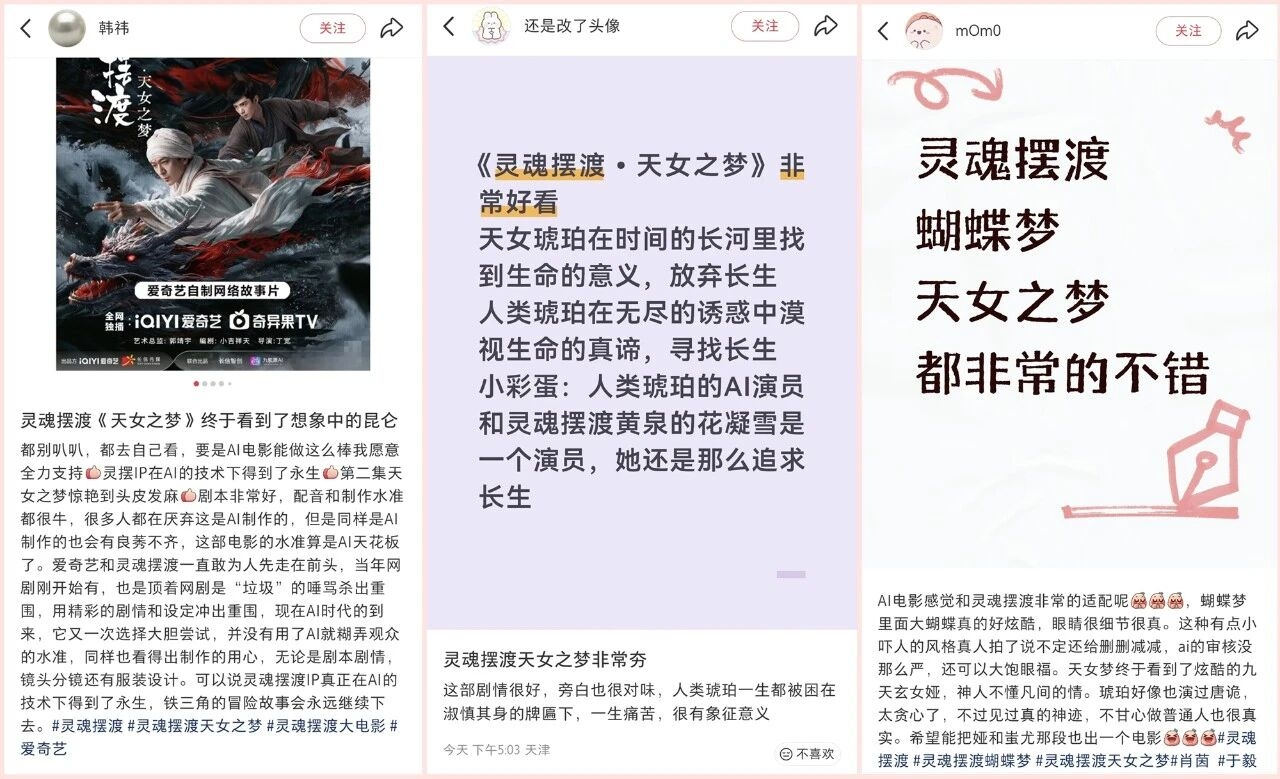
In the barrage comments and discussions on social platforms for (Soul Bypass·Butterfly Dream) (Soul Bypass·Heavenly Maiden’s Dream), some audiences still focus on the AI attributes of the works. But increasingly, evaluations are returning to the content itself: some people discuss the prequel backstory of the “iron triangle” and the characters’ destinies; some assess whether the work continues the familiar “Liangbai flavor”; and others are amazed by the refinement of the “special effects,” saying they were moved by the emotions between the characters—then they actively ask when Part 3 will be released, and whether in the AI era “Liangbai” can be developed faster and updated more densely. On August 23, #Soul Bypass Opening Feedback# topped Weibo’s hot search list, and the topic was filled with audiences’ positive reactions. On iQIYI, the content heat of these two AI films quickly surpassed 6,000, and they ranked among the top two on iQIYI’s film surge chart.


From “is this image generated by AI?” to “how will the story develop next?” From checking whether AI characters look like the actors to caring about the characters’ choices and fates; from coming into the work with technical curiosity to urging for more after finishing it—this shift in audience attention shows that AI is moving from the content’s “identity tag” back to the “creative tool” role in content production.
This change doesn’t mean audiences lowered their standards; on the contrary, it means audiences have started to assess AI film and television with more mature—and more rigorous—work standards.
AI won’t naturally earn recognition just because it’s new technology, nor will it be automatically denied just because it uses AI. Whether the story is精彩, whether the characters are believable, and whether the emotions hold up still determine whether audiences are willing to watch, whether they can keep watching, and after finishing whether they want to discuss and recommend it.
For AI film and television, what truly breaks the barriers of perception is never a one-time technical demonstration, but instead the steady production of good works that audiences are willing to watch, can empathize with, and want to keep following after finishing.
From “can it be done” to “can it be done well.”
AI film and television enters the stage of verifying content value.
From completing the full process of “filing—review—certification—launch” for (Qi Tan: Paper Blade Crossing the Wasteland) in July this year, to the consecutive launch of the (Soul Bypass) “Floating Life Dream” series, this further verified the replicability of this process. AIGC feature films are moving from one-off exploration toward continuous supply. As policy regulations become clearer step by step, and platform production capabilities keep accumulating, they also provide a foundation for AI film and television’s long-term development.
But an increase in supply quantity doesn’t mean that AI film and television naturally enters a mature stage.
It’s not just about how far this content format can go—whether it can generate images stably, how much it can reduce costs, or how much time it can shorten. The real question is whether it can build sustainable “boutique” creative capability. Only when AI film and television keeps producing works that audiences are willing to watch, discuss, and remember can the novelty of the technology truly transform into real content value.
The industrial signal brought by iQIYI’s “Soul Bypass” AI film series lies here: AI film and television doesn’t just need to prove that “AI can do it,” it also needs to prove that “AI can do it well.”
According to Guo Jingyu, Chief Creative Director of the AIGC network film arts for the (Soul Bypass) “Floating Life Dream” series, the film director Ding Kuan not only highly respects the original work, but is also a “detail-focused” person. In addition to deeply continuing the “Soul Bypass” world view in its creation, he and his team cross-checked details such as set dressing against the “Soul Bypass” works that had already been released, and conducted extensive technical research and breakthroughs on AI. When choosing actor images, these two works are not based solely on “face-value peak,” but instead match actors’ materials from corresponding periods according to the character design. For instance, the characters Dongqing and Aya mainly draw from the images of Liu Zhiyang and Xiao Yin in the first season of “Soul Bypass” shot in 2013, while the character Wuming is based on the image of Yi shot in 2017 for (Soul Bypass·Yellow Springs).

And the effort of these creative teams is clearly felt by audiences too. Comments like “Seeing my favorite actors looking young again on screen makes me really want to cry” and “Seeing so many fan-favorite scenes, old fans are really crying buckets” have been flooding social platforms under related “Soul Bypass” topics.
In (Soul Bypass·Heavenly Maiden’s Dream), many audiences commented that, “AI truly lets the Nine Heavens Goddess unleash full power,” and they analyzed how AI enabled the Nine Heavens Goddess to present a real aura and a sense of oppression. This shows that for high-quality works, AI offers not just a new visual package, but more likely a deep restoration of what audiences imagined in their minds—opening up new possibilities for creation.

From “how to shoot” to “what to shoot.”
AI is expanding the boundaries of content creation.
In discussions about AI film and television, the question of whether AI would replace traditional production has always been a high-frequency topic. But judging from the creative trends of the “Soul Bypass” IP in recent years, AI and live-action filming are not simply replacement relationships.
This year, “Soul Bypass” not only released a high-quality micro-drama made with live-action filming (Soul Bypass·Ten Years), but also produced the “Floating Life Dream” series online story films using AI. The two production methods coexist to serve different narrative needs, and they also demonstrate the same IP’s expressive possibilities under different creative conditions.
“Soul Bypass” proves that AI’s greatest value is not to replace existing production, but to give more content opportunities to be produced. Live-action filming offers unique qualities from real performances, on-site interaction, and physical spatial texture, and it remains an important way of creating film and television. AI, meanwhile, can provide new production conditions for stories that were previously limited by budgets, schedules, actor availability, and the difficulty of visual effects.
For example, the “Floating Life Dream” series needs to return to a younger period of the main characters, while also maintaining the audience’s familiar character recognition. If you rely completely on traditional filming, replacing actors with younger ones might affect character continuity, while bringing back the original actors faces challenges such as age setting and post-production. AI provides a new solution: while preserving the IP characters’ traits, it recreates the characters’ younger appearances, thereby opening up narrative space for their backstories.
Similarly, some large-scale fantasy settings, high-concept worlds, and unconventional audio-visual expressions often previously meant higher costs for set building, filming, and visual effects. Due to uncertainty in commercial returns, such creative ideas may have been abandoned already during project development. AI lowers some of the barriers to achieving these expressions, giving content that was previously “too expensive to shoot” or “hard to film” a chance to truly become a work.

The expansion of the IP universe is no longer entirely constrained by the production cycles and budgets of live-action filming. AIGC can also be developed as derivatives based on existing visual assets of the IP, forming a content matrix of “a live-action main series + an AI derivative series,” enabling multi-layered release of IP value.
From this perspective, AI is not a simple replacement outside traditional film and television, but an ever-expanding set of “options” for film and television creation. It doesn’t just change “how to shoot,” and it may also change “what can be shot.”
From (Qi Tan: Paper Blade Crossing the Wasteland) to the (Soul Bypass) “Floating Life Dream” series, three AIGC film feature-length titles launched consecutively within a month. This shows that AI film and television is getting more and more opportunities to enter the content market. But more than the increase in quantity, what deserves closer attention is that audiences are evaluating these works in new ways.
No matter how production tools change, what attracts audiences are valuable stories, creators’ judgments, and genuinely believable emotional connections between characters. AI won’t change the fundamental rule of film and television creation—but it can expand creators’ ability to realize these values.
When audiences stop asking “is it AI?” and instead sincerely say, “this work is really good,” that might be the mark that AI film and television has entered the “works era”—not that audiences remember a work was made with AI, but that they remember it’s a good movie worth watching.