
Aria Daisy 阿莉娅_黛西
563 Posts

Aria Daisy 阿莉娅_黛西
Aria Daisy 🌸 | Crypto Trader & Binance Expert Sharing market insights, trading ideas & Web3 opportunities Trade smart • Stay updated • Keep growing | DYOR
Open Trade
High-Frequency Trader
1.6 Years
359 Following
12.2K+ Followers
6.1K+ Liked
Posts
Portfolio
All
Quotes
PINNED
🎁 SOL COIN GIVEAWAY 🎁
🚀 Excited to share this 1000 SOL Giveaway with the Binance community!
💛 10 lucky winners will each receive 100 SOL.
How to participate:
✅ Follow me
🔁 Repost this post
💬 Comment “8"
Thank you for your amazing support and love! ❤️
Good luck to everyone! 🍀🔥
#BinanceSquareFamily #Follow_Like_Comment
$SOL $BTC
🚀 Excited to share this 1000 SOL Giveaway with the Binance community!
💛 10 lucky winners will each receive 100 SOL.
How to participate:
✅ Follow me
🔁 Repost this post
💬 Comment “8"
Thank you for your amazing support and love! ❤️
Good luck to everyone! 🍀🔥
#BinanceSquareFamily #Follow_Like_Comment
$SOL $BTC

go
生蚝哥Oyster
·
--
BearishBreaking News|LAPTOP Releases Airdrop Details! 20% of Total Tokens for Community Airdrops
On September 9, the Meme coin LAPTOP launched by Hunter Biden announced its full airdrop plan on social media. The project will allocate 20% of the total token supply for community airdrops. The distribution rules are as follows:
1. 2% of total: To compensate investors who incurred losses from the Trump Meme coin and related projects. Tokens will be distributed through partner exchanges, with eligibility review criteria determined by the partner platform.
2. 8% of total: For readers who subscribed to Hunter Biden’s Substack newsletter before September 6, 2026.
3. 10% of total: Reserved for a future community airdrop pool; the allocation method will be decided independently by the Phoenix Veritas Foundation.
⏰ Airdrop Claim Period:
The token listing will open the claim channel simultaneously. Claims must be completed within 30 days after listing. The timing is 8:00 AM Eastern Time on September 9 (8:00 PM Beijing time on September 9). Claims made after the deadline will be invalid.
Risk Warning: This is only a compilation of publicly available project information. Meme coins are highly volatile; an airdrop does not guarantee capital protection and does not constitute any investment advice.
On September 9, the Meme coin LAPTOP launched by Hunter Biden announced its full airdrop plan on social media. The project will allocate 20% of the total token supply for community airdrops. The distribution rules are as follows:
1. 2% of total: To compensate investors who incurred losses from the Trump Meme coin and related projects. Tokens will be distributed through partner exchanges, with eligibility review criteria determined by the partner platform.
2. 8% of total: For readers who subscribed to Hunter Biden’s Substack newsletter before September 6, 2026.
3. 10% of total: Reserved for a future community airdrop pool; the allocation method will be decided independently by the Phoenix Veritas Foundation.
⏰ Airdrop Claim Period:
The token listing will open the claim channel simultaneously. Claims must be completed within 30 days after listing. The timing is 8:00 AM Eastern Time on September 9 (8:00 PM Beijing time on September 9). Claims made after the deadline will be invalid.
Risk Warning: This is only a compilation of publicly available project information. Meme coins are highly volatile; an airdrop does not guarantee capital protection and does not constitute any investment advice.

go

慢就是快Mike
·
--
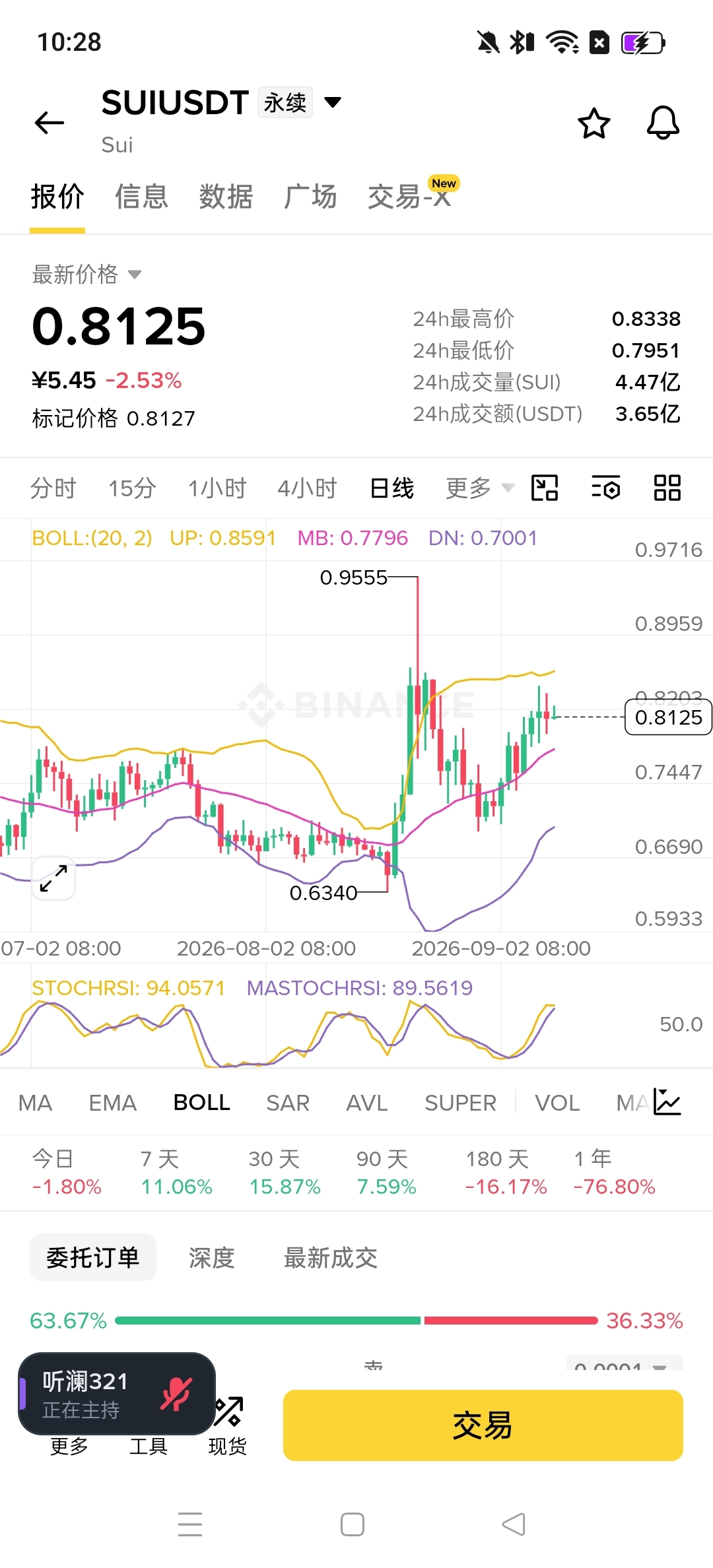
$SUI -Day Line is about to kick off; spot and futures are picking up!
Sui Network continues to expand through rising network activity and new financial products. Its BTCFi tools give Bitcoin holders more ways to use their assets. Users can earn returns through these applications, or borrow and lend using Bitcoin. Sui also supports DeFi platforms such as Swelland, Scallop, and BlueFin. These platforms add more use cases to the ever-expanding Sui ecosystem. Ledger has recently fully supported Sui tokens on its platform. Ledger has also launched a campaign offering 400,000 SUI to eligible users. Such initiatives may encourage more users to explore Sui. After a recent 7% drop, SUI’s trading price is nearing $2.35. Analysts believe the target could be around $6.50, and possibly even $10. As the ecosystem keeps growing, the token may gain another layer of catalysts.
Sui Network continues to expand through rising network activity and new financial products. Its BTCFi tools give Bitcoin holders more ways to use their assets. Users can earn returns through these applications, or borrow and lend using Bitcoin. Sui also supports DeFi platforms such as Swelland, Scallop, and BlueFin. These platforms add more use cases to the ever-expanding Sui ecosystem. Ledger has recently fully supported Sui tokens on its platform. Ledger has also launched a campaign offering 400,000 SUI to eligible users. Such initiatives may encourage more users to explore Sui. After a recent 7% drop, SUI’s trading price is nearing $2.35. Analysts believe the target could be around $6.50, and possibly even $10. As the ecosystem keeps growing, the token may gain another layer of catalysts.
go

Muzamil Abbas⁷⁵ 穆扎米尔_阿巴斯
·
--
Bullish$PEPE
🐸💚 $50 PEPE GIVEAWAY! 💚🐸
I’m giving away $50 worth of $PEPE to the community! 🚀
🎯 To Participate:
✅ Follow Muzamil Abbas
🔁 Repost this post
💬 Comment “1” to claim
Good luck everyone! 🍀🐸
Let’s grow together! 🚀🔥
#PEPE #Giveaway #Binance #Crypto
🐸💚 $50 PEPE GIVEAWAY! 💚🐸
I’m giving away $50 worth of $PEPE to the community! 🚀
🎯 To Participate:
✅ Follow Muzamil Abbas
🔁 Repost this post
💬 Comment “1” to claim
Good luck everyone! 🍀🐸
Let’s grow together! 🚀🔥
#PEPE #Giveaway #Binance #Crypto

go

JANNAT BM_
·
--
My New certificate from @Binance Academy 💛💛💛💛

go


NAJAF_加密 143
·
--
‼️$XRP 🐕 Reward is here ‼️
I’m sharing $XRP rewards with the community as a Bigger thank-you.
✨ Just claim your reward and enjoy! ✨
Claim it. Get rewarded
@XRP _ $XRP #xrp
I’m sharing $XRP rewards with the community as a Bigger thank-you.
✨ Just claim your reward and enjoy! ✨
Claim it. Get rewarded
@XRP _ $XRP #xrp

go

Sonu7856
·
--
‼️$BTTC Reward is here ‼️
I’m sharing $BTTC rewards with the community as a Bigger thank-you.
✨ Just claim your reward and enjoy! ✨
Claim it. Get rewarded
@BTTC_Pioneer _ $BTTC #BTTC
I’m sharing $BTTC rewards with the community as a Bigger thank-you.
✨ Just claim your reward and enjoy! ✨
Claim it. Get rewarded
@BTTC_Pioneer _ $BTTC #BTTC

go

Rania 拉妮娅
·
--
Claim and repost
$SOL
$SOL

go

I R F A N _ A L Y²
·
--
DON'T SCROLL❎️ FOCUS HERE👀
CLAIM YOUR SOLANA REWARD🎁🎁
1' LIKE
2' SHARE
3' REPOST
$SOL
$BTC
#BTC #sol
CLAIM YOUR SOLANA REWARD🎁🎁
1' LIKE
2' SHARE
3' REPOST
$SOL
$BTC
#BTC #sol

go

Suadagar Ali
·
--
#BNB ETH BTC$
follow like and
🌹☘️🥀🌹comments
repost
follow like and
🌹☘️🥀🌹comments
repost
go

Shaheen 69
·
--
Bullish🎁 A little red packet of Ethereum with a lot of RESPECT ❤️
This is my small gesture of love and gratitude to my amazing community, supporters, friends, and well-wishers. 🙏
May this ETH bring you happiness, prosperity, success, and good fortune. 🌟
Keep supporting, keep believing, and let’s grow together! 🚀
With love & respect — Shaheen69 ❤️
$ETH
This is my small gesture of love and gratitude to my amazing community, supporters, friends, and well-wishers. 🙏
May this ETH bring you happiness, prosperity, success, and good fortune. 🌟
Keep supporting, keep believing, and let’s grow together! 🚀
With love & respect — Shaheen69 ❤️
$ETH

😍

Arthur Mint
·
--
BullishCommunity sending you big gift 🎁🎁 so hurry up claim it thanks.

go

AbdullRauf
·
--
GIVEAWAY ALERT for our Square Family! 🧧
As a huge thank you, we're giving away gifts to our amazing community.
To Enter:
✅ Follow us
✅ Share this post
✅ Comment "666"
Winners chosen randomly. Good luck & thanks for being part of our journey!
As a huge thank you, we're giving away gifts to our amazing community.
To Enter:
✅ Follow us
✅ Share this post
✅ Comment "666"
Winners chosen randomly. Good luck & thanks for being part of our journey!

go

Bilawal Ashiq
·
--
🧧🧧Clam And Shere pls 🎉
$USELESS $IOST $VVV
$USELESS $IOST $VVV
🔥 JASMY COIN GIVEAWAY 🔥
I’m excited to share this giveaway with the Binance community! 🚀
🎁 1,000 JASMY for 10 lucky winners!
✅ Follow me
🔄 Repost this post
💬 Comment “JASMY”
Good luck everyone! 🍀❤️
Thank you for your amazing support and love! 🙏
#JASMAY #BinanceSquareFamily
$JASMY $BTC
I’m excited to share this giveaway with the Binance community! 🚀
🎁 1,000 JASMY for 10 lucky winners!
✅ Follow me
🔄 Repost this post
💬 Comment “JASMY”
Good luck everyone! 🍀❤️
Thank you for your amazing support and love! 🙏
#JASMAY #BinanceSquareFamily
$JASMY $BTC
🎁 $DOGE COIN GIVEAWAY 🎁
I’m giving away 1,000 DOGE to 3,000 lucky winners! 🐕💰
How to participate:
✅ Follow me
💬 Comment “2”
That’s it! Simple and easy. ✨
Thank you for all the love and support ❤️
Good luck everyone! 🔥
#BinanceSquareFamily #DOGE
$DOGE
I’m giving away 1,000 DOGE to 3,000 lucky winners! 🐕💰
How to participate:
✅ Follow me
💬 Comment “2”
That’s it! Simple and easy. ✨
Thank you for all the love and support ❤️
Good luck everyone! 🔥
#BinanceSquareFamily #DOGE
$DOGE

🎁 $XRP COIN GIVEAWAY 🎁
I’m giving away 1,000 XRP to 3000 lucky winners!
How to participate: ✅ Follow me ✅
💬 Comment 2
That’s it! Simple and easy.
Thank you for all the love and support ❤️
Good luck everyone 🔥
#Xrp🔥🔥 #ARBRises30%OnRobinhoodChainRevenue #Japan10YYieldHits3%FirstSince1996
I’m giving away 1,000 XRP to 3000 lucky winners!
How to participate: ✅ Follow me ✅
💬 Comment 2
That’s it! Simple and easy.
Thank you for all the love and support ❤️
Good luck everyone 🔥
#Xrp🔥🔥 #ARBRises30%OnRobinhoodChainRevenue #Japan10YYieldHits3%FirstSince1996


Peaceful moments, beautiful views and a little furry companion by my side. 🐱🤍 Sometimes, the simplest moments are the ones worth remembering. ✨
Stay calm stay focused, and keep building your journey in the crypto world. 🚀📈
#Binance #cryptouniverseofficial
$BTC $LAB
Stay calm stay focused, and keep building your journey in the crypto world. 🚀📈
#Binance #cryptouniverseofficial
$BTC $LAB

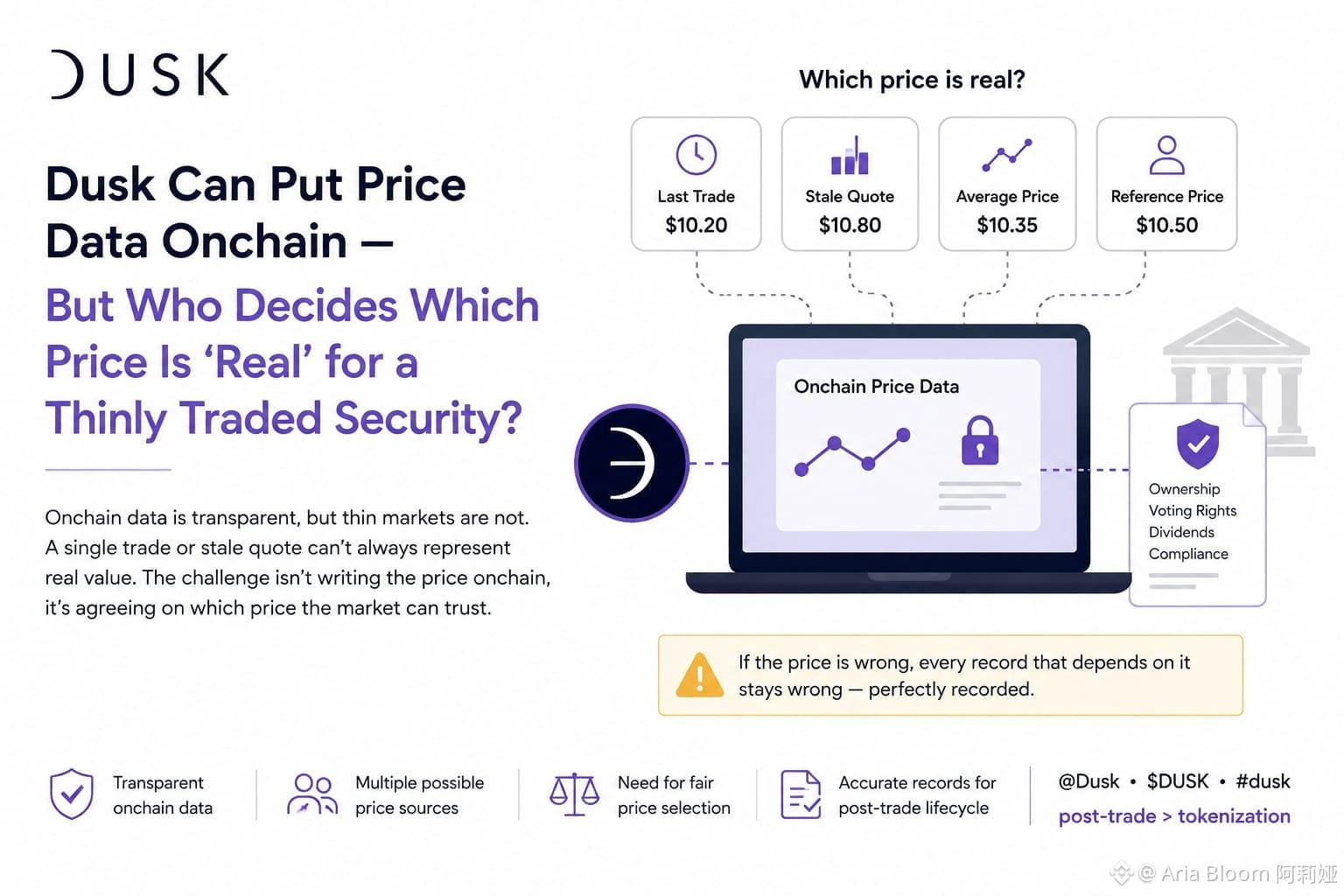
I’ve been thinking about Dusk’s onchain price data a bit differently lately. Putting a price onchain sounds straightforward until I imagine a security that barely trades. If it moves once every few days which price actually represents the market? The last trade? A stale quote? An average? Or some reference value agreed by the system?
That matters because tokenization doesn’t automatically make the underlying asset more measurable. The chain can preserve a number very accurately but it can’t decide by itself whether that number still reflects reality. For a thinly traded security a single small transaction could look meaningful even when it tells us very little about what another buyer would actually pay.
I think this is where Dusk’s post-trade focus gets more interesting to me. The source material makes the point that the hard part is keeping records correct after trading including rights payments and compliance. But there’s another dependency sitting underneath those records: the inputs have to be trustworthy in the first place. If eligibility or valuation eventually depends on price data.
bad inputs can stay perfectly recorded onchain.
I’d want to see how Dusk handles stale or disputed prices in practice. Who gets the final say when the market itself barely speaks?
#dusk $DUSK @Dusk
That matters because tokenization doesn’t automatically make the underlying asset more measurable. The chain can preserve a number very accurately but it can’t decide by itself whether that number still reflects reality. For a thinly traded security a single small transaction could look meaningful even when it tells us very little about what another buyer would actually pay.
I think this is where Dusk’s post-trade focus gets more interesting to me. The source material makes the point that the hard part is keeping records correct after trading including rights payments and compliance. But there’s another dependency sitting underneath those records: the inputs have to be trustworthy in the first place. If eligibility or valuation eventually depends on price data.
bad inputs can stay perfectly recorded onchain.
I’d want to see how Dusk handles stale or disputed prices in practice. Who gets the final say when the market itself barely speaks?
#dusk $DUSK @Dusk
Log in to explore more content