7.25Jack Afternoon Two-Biscuit Analysis
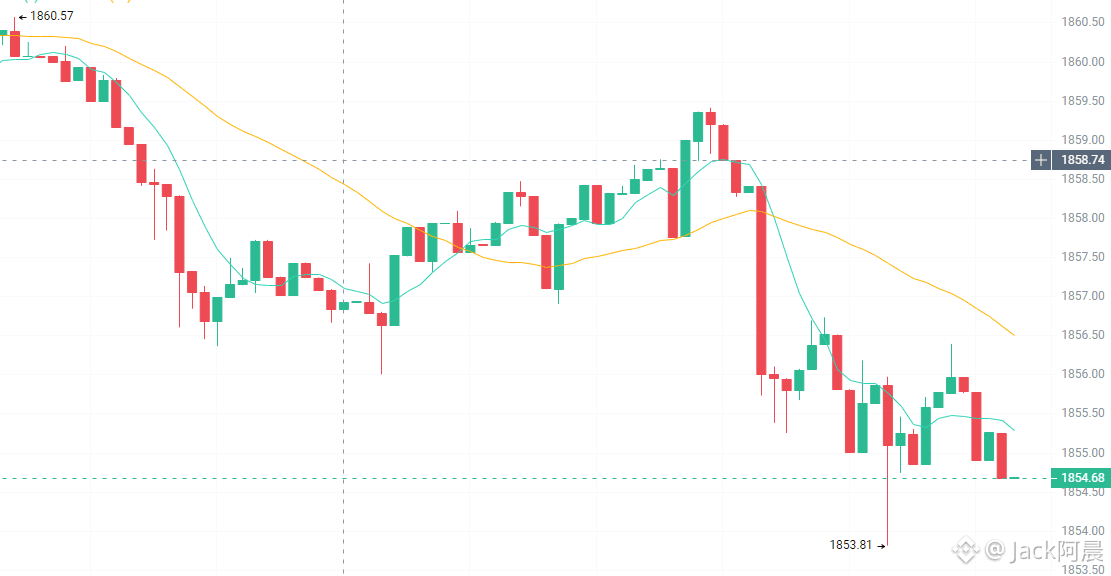
The market started at 1860.57 and continued to fall steadily. After bottoming out, it made a rebound to repair; when the price surged up to around 1858, it encountered clear sell pressure. A single large bearish candle immediately broke through short-term support, and the market turned weak again. The low reached 1853.81, and the current price is running at 1854.68.
Throughout the entire period, the moving averages kept pressing down on the price. Every rebound failed to hold above the moving averages. The bulls’ ability to counterattack is seriously insufficient, and the overall bearish trend is very clear. This segment’s ups-and-downs switching rhythm and the key resistance levels were already fully laid out and forecast by me earlier—the chart action fully matches the logic of the analysis done in advance.
Many people, when facing this kind of sideways-to-downward market, easily make frequent mistakes: they jump into the trade too quickly on small rebounds, ignore the layered resistance overhead, and keep getting left behind and then trapped. Only by being skilled at identifying support and resistance zones, understanding the trend signals provided by the moving averages, can you reduce ineffective trades and find the correct timing of the market rhythm.#二饼 #以太 $AAPL.US
The market started at 1860.57 and continued to fall steadily. After bottoming out, it made a rebound to repair; when the price surged up to around 1858, it encountered clear sell pressure. A single large bearish candle immediately broke through short-term support, and the market turned weak again. The low reached 1853.81, and the current price is running at 1854.68.
Throughout the entire period, the moving averages kept pressing down on the price. Every rebound failed to hold above the moving averages. The bulls’ ability to counterattack is seriously insufficient, and the overall bearish trend is very clear. This segment’s ups-and-downs switching rhythm and the key resistance levels were already fully laid out and forecast by me earlier—the chart action fully matches the logic of the analysis done in advance.
Many people, when facing this kind of sideways-to-downward market, easily make frequent mistakes: they jump into the trade too quickly on small rebounds, ignore the layered resistance overhead, and keep getting left behind and then trapped. Only by being skilled at identifying support and resistance zones, understanding the trend signals provided by the moving averages, can you reduce ineffective trades and find the correct timing of the market rhythm.#二饼 #以太 $AAPL.US