

Original title: Is the local dog on Solana more cost-effective? Using Kelly's formula to calculate the real situation of playing local dogs
Original author: Frank, PANews
Speculating on Bitcoin seems to be the eternal code for wealth in the crypto world. It is full of the most amazing stories of getting rich overnight in the cryptocurrency field, and it is also an exclusive track for many people who hope to make a small fortune. From Ethereum to BSC, and now to Solana. On the one hand, the story of skyrocketing prices has allowed some lucky people to embark on the road to freedom. On the other hand, it has also caused the vast majority of investors to lose all their money in repeated speculation on Bitcoin.
Currently, there is such an argument that although Chongtugou wins less and loses more, it can earn many times more if it wins once, so it is a high-quality gold-digging track. From a scientific investment perspective, is it a reasonable decision to invest in the Solana project? Next, PANews will use the Kelly formula to make a comprehensive analysis of this track from the perspectives of practical operation, winning rate, odds, etc.
Assuming you have a capital of $1,000, and every time you invest in Solana, you either lose all your money or earn 10 times the return. Should you invest, or what proportion should you invest?
Is Solana hype more cost-effective?
Solana has become the most dazzling public chain currency in this round of market. The highest increase in one year reached 15 times, behind which is the sharp increase in on-chain data. According to Defillama data, on December 22, 2023, Solana's highest daily transaction volume on the chain reached 2.6 billion US dollars, higher than Ethereum's highest daily transaction volume of 2.5 billion US dollars in 2023, and once became the most active public chain. Behind the active performance, it is inseparable from the enthusiasm of speculating on Solana to make money.
Compared with traditional Ethereum BTC, BTC transactions on Solana have the following characteristics: low gas fees, high transaction popularity, and fewer token contract backdoors.
Gas Fee: The average on-chain transaction fee on Ethereum ranges from a few dollars to tens of dollars. Solana’s on-chain fee can be so low that it is almost negligible.
Fewer backdoors in token contracts: Compared with the various contract vulnerabilities on Ethereum, such as Pixiu disk, high tax disk, siphon disk, etc. Solana has almost no other contract backdoors except for additional issuance and contract permissions due to its mechanism (these two items can also be easily seen on the on-chain data website).
Lower trial and error costs: The price of Solana’s mainnet token SOL is much lower than that of Ethereum, which also brings a more friendly entry threshold for players looking for golden dogs on Solana. Many players invest 0.1SOL at a time, which is about $10, and this amount is often not enough to pay a transaction fee on Ethereum.
These conditions make Solana's sled seem like a good opportunity to turn a bicycle into a motorcycle. But is this really the case?
The "Slaughterhouse" where players always lose
Players who are familiar with local dog trading know that the way to play local dog trading is almost a game of luck. This kind of game is more similar to gambling or lottery than investment. If local dog trading is regarded as a gambler's game, the Kelly formula is the most reasonable mathematical formula to measure whether this game should be participated in and how much proportion of funds should be participated each time.
The Kelly Criterion is a mathematical formula for optimizing money management in investment and gambling. Its core idea is: when faced with bets with positive expected values, how should funds be allocated to maximize long-term growth rates? The Kelly Criterion was proposed by John Kelly in 1956. It was originally used for information transmission problems on telephone lines, and later proved to be very effective in the fields of gambling and investment.
The basic form of the formula is:

F: The proportion of funds that should be invested
B: Odds (If you invest 1 yuan and earn 10 yuan, the odds are 9)
P: Winning rate (if you invest 100 times and win 3 times, your winning rate is 3%)
Q: Loss rate (q=1-p)
Through this formula, you can calculate the proportion of capital that should be used in each investment or bet in the hope of maximizing long-term capital growth. An important feature of the Kelly formula is that it takes into account the balance between risk and return, helping to avoid high-risk situations caused by overinvestment.
Based on the Kelly formula, we can calculate what proportion of funds should be invested in Bitcoin trading on the Ethereum and Solana chains.
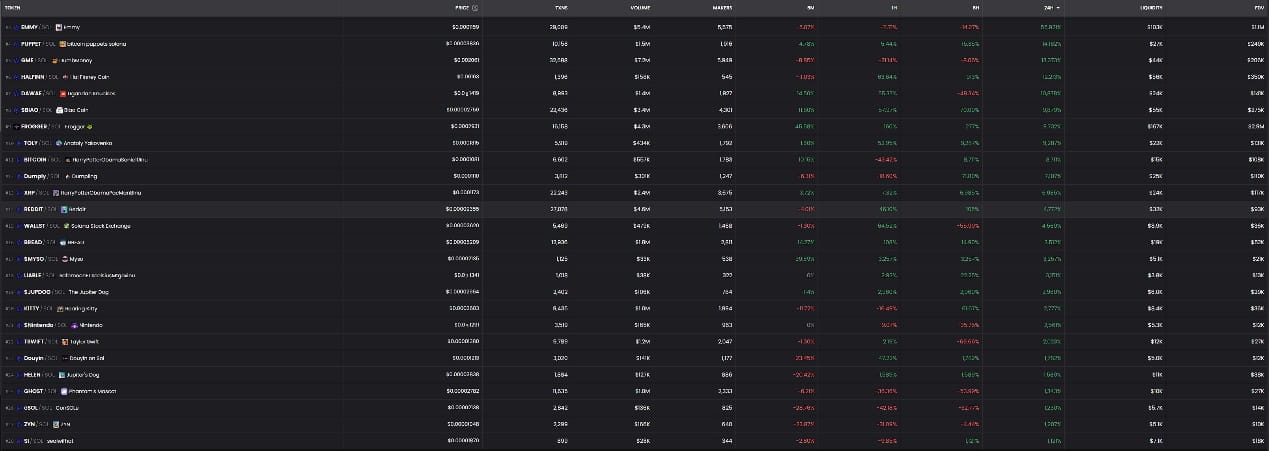
We extracted 24 hours of data for calculation. During the sample time, there were 1,743 newly issued Tokens on the Solana chain, while the average for Ethereum is currently around 213.
Here we set a potential golden dog condition: the number of coin holders is more than 100, and the increase in 24 hours is more than 10 times.
Under this condition, the potential number of Golden Dogs in 24 hours on Ethereum is 7, and the potential number of Golden Dogs on Solana is 28.

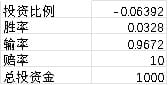
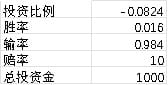
Assume we have a capital of $1,000, and our winning criterion is to buy a local dog and get a 10-fold increase each time. The odds are 10, and Ethereum's winning rate is: 7/213=3.28%. Solana's winning rate = 1.6%.
The values of the Kelly formula for both are:
Ethereum:
Solana:
Formula interpretation:
According to the data, we can see that the Kelly formula value for Ethereum is -0.06 and the value for Solana is -0.08. When the value calculated by the Kelly formula is negative, it means that the expected return of the investment or bet is negative based on the given odds and win rate. In other words, it is an investment or bet with an expected loss. In this case, the Kelly formula is actually telling us that we should not make this investment or bet.
As a professional dog trading player, you can watch the market 24 hours a day, buy in as soon as a project is launched, and sell it when the market rises 10 times. How much money should you invest in dog trading? According to the calculation of Kelly's formula, you should not participate in this game at all, because in the long run, you will only lose your principal.
Summarize
The reason is that the odds of the game seem to be very high (you often see people posting 10x, 100x or more returns), but the survivor effect is ignored. There are several difficulties for ordinary players to win in this game: first, it is impossible to buy every project that opens at the first time; second, few players can really tolerate the volatility and fully enjoy the 10x increase; third, it is difficult to increase the winning rate to more than 10%; therefore, from a mathematical point of view, even though Solana on Tugou has many advantages that are more friendly to the people than Ethereum, it is still a "slaughterhouse" where players always lose.
Of course, the Kelly formula is only a suggested investment ratio for rational investment. If you calculate it based on 10 times the odds, if you can maintain an investment winning rate of more than 10%, it is worth considering whether you should participate in this game.
Original link