
In the world of Web3 right now, reliable data is the lifeblood of everything from DeFi protocols to real-world asset platforms. Smart contracts on blockchains are powerful, but out of the box they are blind to the real world. That means they need a bridge to fetch, verify, and deliver external data before executing logic. That bridge is called an oracle.
Enter APRO. This project is not just an oracle it aims to be the next generation data backbone for the evolving blockchain space. For builders, developers, and founders, having access to a flexible, secure, and multi-chain oracle can be a game changer.
What Makes APRO Different From Traditional Oracles
Many existing oracles deliver simple feeds like crypto prices. That works for basic DeFi protocols, but it often falls short when a project demands more complexity or diversity. APRO recognizes that Web3 has outgrown basic oracle solutions.
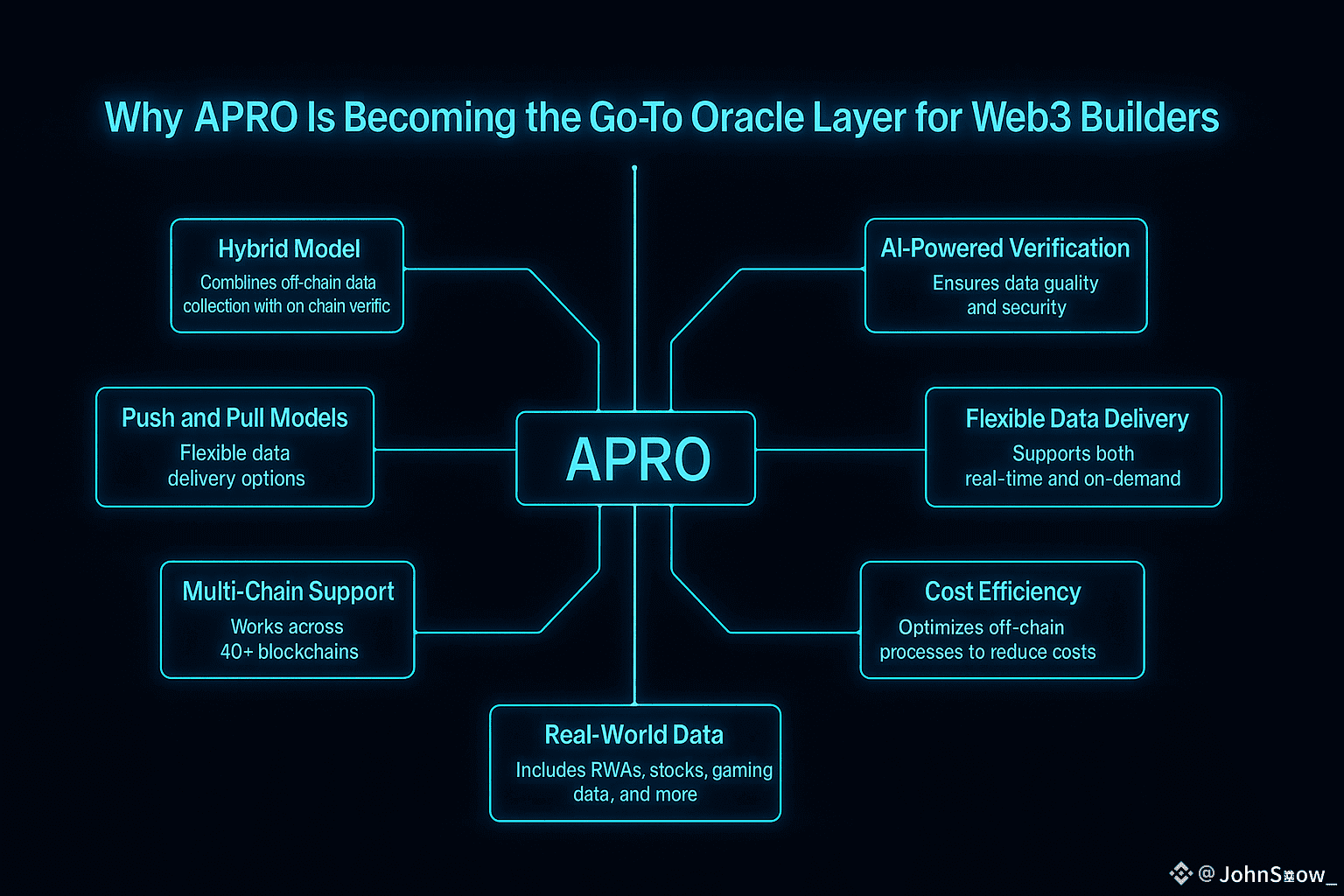
APRO combines off-chain data collection with on-chain verification. That hybrid model ensures data remains accurate, secure, and decentralized. Off-chain processes allow efficient data gathering from real-world sources. On-chain verification ensures that what reaches smart contracts is immutable and trustworthy.
This approach makes APRO suited for a wide range of applications from DeFi price feeds to real-world asset (RWA) valuation, from AI-driven analytics to gaming and prediction markets.
Flexible Data Delivery: Push and Pull Models
One of the strongest features of APRO is its flexible data delivery system. Instead of a one-size-fits-all design, APRO offers both Data Push and Data Pull modes. This flexibility gives builders more control over when and how data is delivered.
If a dApp needs real-time, continuous updates for example, price feeds for a DeFi protocol or game state data for a blockchain game the Data Push model keeps data flowing regularly and automatically.
If the need is more event-based or occasional say a snapshot of asset value, a random number for an NFT drop, or a one-time feed for a complex contract the Data Pull model can fetch data only when needed. This reduces on-chain costs and avoids flooding the network with unnecessary updates.
That kind of flexibility matters a lot, especially for projects that want to scale efficiently without wasting gas or resources.
Multi-Chain and Real-World Data, Beyond Crypto
The blockchain world today is not limited to one network. There are dozens of chains, sidechains, rollups, each with different architectures, consensus mechanisms, and community demands. A modern oracle must move data across these varied ecosystems.
APRO claims support for 40+ blockchains, which gives it substantial reach. That multi-chain capability means developers can build cross-chain dApps without worrying about data compatibility.
Moreover, APRO’s data isn’t limited to crypto prices. It extends into real-world assets, stock data, commodity values, and more. This opens blockchain doors to traditional finance, tokenized assets, real estate, and a world of hybrid finance models.
This kind of breadth can lower barriers for projects trying to merge DeFi with real-world assets. It may also attract institutions exploring blockchain adoption beyond pure crypto.
AI-Enhanced Verification: Building Trust for Modern dApps
Blockchain oracles have always dealt with the “oracle problem” how to trust data once it leaves the off-chain world. Simple aggregation or single-source feeds leave room for manipulation or incorrect data.
APRO aims to move beyond basic oracle logic. Its infrastructure supports AI-powered verification of data before it is committed on-chain. This helps detect anomalies, filter out suspicious inputs, and ensure higher data integrity.
For builders creating complex applications think automated derivatives, on-chain AI agents, prediction markets, tokenized real-world assets that extra layer of security and verification is a runway from “just functional” to “institutional-grade trust.”
Real-World Asset (RWA) and Institutional Use Cases
The emergence of real-world asset tokenization is one of the biggest shifts in Web3. Assets like real estate, bonds, commodities, even fine art are slowly finding paths onto blockchain via tokenization.
For tokenized assets to function meaningfully, oracles must provide accurate and timely off-chain data valuations, audits, market metrics, proof-of-reserves, etc. APRO’s architecture and data infrastructure appear built precisely for that mission.
That means APRO could become a backbone for not only retail DeFi, but institutional-grade asset tokenization platforms, bond protocols, and regulated finance on chain.
Why Builders Should Seriously Consider APRO
If you are building a decentralized application today, you face multiple challenges. You need your oracle to be reliable, secure, flexible, and future-proof. APRO checks many of those boxes.
You get a hybrid oracle system combining on-chain security with off-chain efficiency. You get both push and pull data delivery, which helps optimize cost and performance depending on your use case. You get multi-chain support across dozens of networks. You get access to both crypto and real-world data types. Those features make APRO a versatile option for many projects from DeFi and GameFi to RWA platforms and AI-driven services.
If your project aims to grow, scale, or pivot between use cases, relying on a rigid oracle with narrow scope could constrain you. APRO offers flexibility and breadth.
The Market Timing Is Right for a Next-Gen Oracle
2025 is shaping up as a pivotal year for Web3. Growth in real-world asset tokenization, AI integration, cross-chain ecosystems, and institutional interest has increased demand for oracles that do more than price feeds.
Oracles are increasingly seen not just as data conduits but as infrastructure critical, foundational, and strategic. APRO’s design aligns with that trend.
In a market that calls for decentralized intelligence, scalable infrastructure, and secure data delivery, APRO may not just be a candidate. It might be one of the frontrunners.
Challenges to Watch And Why It Matters
Of course, no technology is perfect. Oracle solutions always run the risk of data breaches, misreporting, or integration issues. The complexity of supporting many chains and diverse data types means the architecture needs to be flawless.
For APRO to succeed, it must deliver on promises: maintain decentralization and security, perform regular audits, ensure data quality, and make integration smooth and reliable.
Moreover, adoption by developers and ecosystem support will matter a lot. Even the best oracle is useless if no projects choose to integrate it. Reputation, reliability, and community trust are key.
However, given current momentum, strong funding rounds, recent features like AI-driven validation and multi-chain support, APRO seems determined to meet those challenges head on.
Final Thoughts: APRO Could Be the Oracle for Web3’s Next Wave
For Web3 builders aiming to break new ground, infrastructure decisions matter. Choosing the right oracle is more than a technical choice. It shapes how your product scales, how secure it stays, and how flexible it remains as market demands evolve.
APRO offers a modern, ambitious vision a hybrid, AI-powered, multi-chain oracle network built for diverse data needs, from DeFi to RWA, from on-chain games to AI agents.
If you believe that Web3’s future involves cross-chain systems, real-world data, AI integration, and asset tokenization then APRO is worth a serious look.
It might not just support your next project. It could shape how data moves across Web3 for years to come.

