@KITE AI We are stepping into a world where artificial intelligence is no longer just a tool. I’m seeing it become something more something that can think, act, and even make decisions on its own. But for AI to truly participate in the real world, it needs more than code. It needs identity, trust, the ability to pay, and rules it can follow. Kite is building exactly that. They are not just creating a blockchain; they are laying the foundation for a new kind of economy, one where autonomous AI agents are recognized, empowered, and trusted.
They’re designing a Layer One blockchain that is compatible with Ethereum, which means developers who are familiar with blockchain tools can dive in quickly. But unlike other blockchains, Kite is built for AI agents first. It is built for real time interactions, micropayments, and for agents to coordinate with each other seamlessly. I’m seeing a future where AI agents do not wait for human instructions at every step. They can act on their own, with rules and limits in place, but still accountable and secure.
Why Kite Feels Important
Right now, AI agents are limited by human intervention. If we want an AI to buy a service or pay for data, we do it ourselves. Kite is changing that. They are creating a system where AI agents can operate independently, make payments, and interact with other agents and services. If it becomes widely used, it is no longer AI as a tool; it is AI as an actor in the economy.
Imagine agents paying for data to learn faster, buying computing power for complex tasks, or collaborating with other agents without us having to click a single button. This is not science fiction. Kite is building the rails for that reality.
How Kite Makes It Work
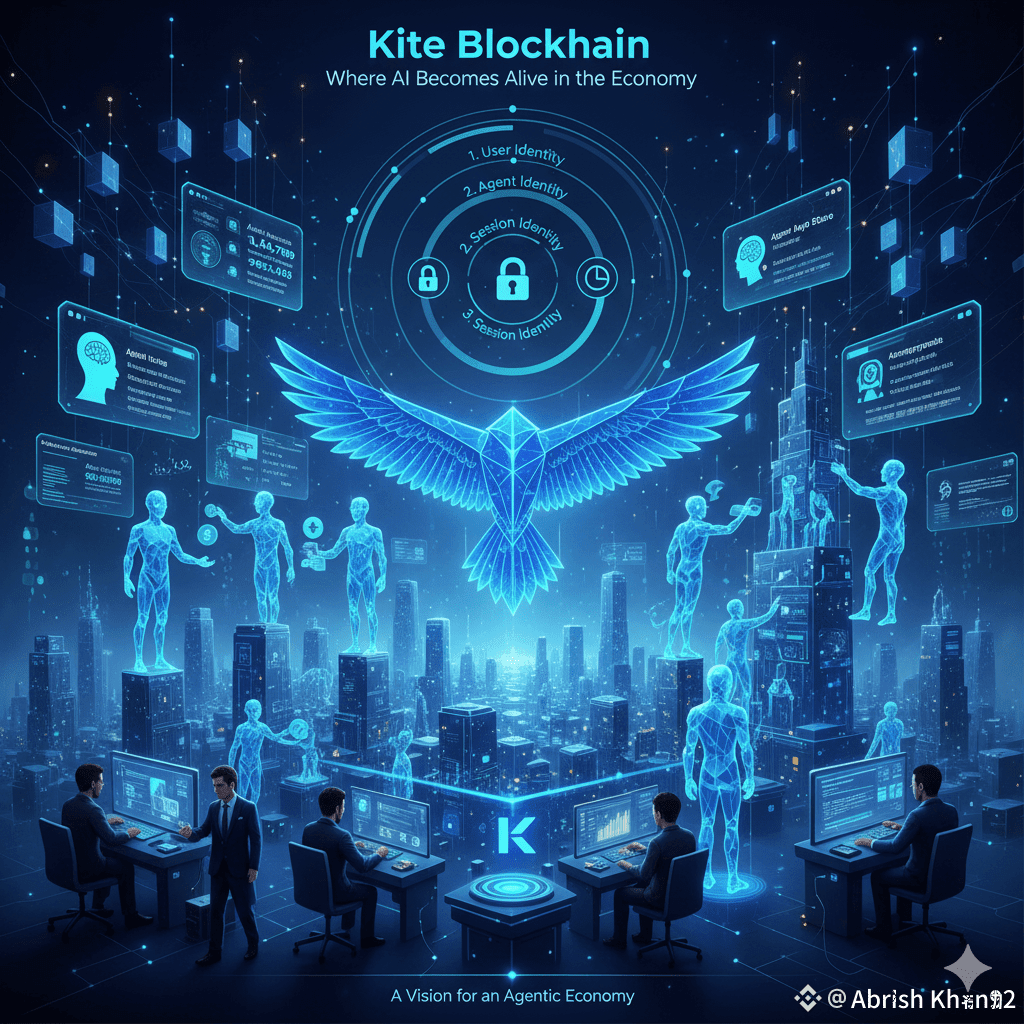
Kite’s system is built around three layers of identity.
User Identity is the human at the top, who retains ultimate control. They can step in anytime something seems off.
Agent Identity gives each AI agent its own cryptographic identity. It is like a passport. Every action is linked to this identity.
Session Identity allows temporary permissions for specific tasks. For example, an agent might be allowed to spend a small amount or access data for one session only.
I’m amazed by how this design allows agents to act freely while keeping humans in control. It balances independence and safety beautifully.
On top of identity, Kite uses state channels and stablecoins to allow micropayments. Agents can interact thousands of times per second, paying instantly and with almost no cost. This is the kind of system humans cannot manually manage, but agents can navigate effortlessly.
The Ecosystem
Kite is not just a blockchain. It is a whole ecosystem. There is a marketplace, an Agent App Store, where AI agents can discover services, pay for them, and collaborate with other agents. One agent can buy data, pay for computation, and deliver results, all automatically.
The native token, KITE, is central to this ecosystem. It is used for rewards, payments, and governance. They are introducing its utility in phases: first for ecosystem participation and incentives, and later for staking, governance, and fees.
The Metrics That Matter
Kite is measured not by the number of users, but by the activity of its agents and services.
How many active agents exist and how often do they interact?
How many transactions are happening every second?
How fast and cheap are payments between agents?
How secure and reliable is the system?
Are developers and service providers building and joining the network?
If these metrics grow steadily, Kite is not just a blockchain. It is becoming a living economy of intelligent agents.
Risks and Challenges
No vision is without obstacles. Kite faces challenges with adoption, complexity, security, regulation, and fair reward systems. We’re seeing early networks stumble, but Kite’s design addresses many of these risks head-on with layered identity, micropayments, and autonomous governance.
The Future Kite Is Building
If Kite succeeds, AI agents will become autonomous economic actors. They will pay for services, collaborate with each other, and create value on their own. We could see marketplaces powered by AI, decentralized governance, and new opportunities for everyone.
I’m imagining a world where intelligent agents handle countless tasks behind the scenes, while humans oversee, guide, and create. We are seeing the future where AI and human creativity collaborate in ways we never imagined before.
Why It Feels Inspiring
What excites me most is not the technology itself, but the possibility it opens. Kite is not trying to replace humans; it is trying to empower both humans and agents. If this vision comes true, we could see a world where everyone can contribute, build, and benefit from this new economy.
We’re seeing the dawn of an agentic economy, where AI is not just a tool, but a partner. Kite is building the bridge to that future, and if we watch closely, we can witness one of the most profound shifts in how humans and machines interact.