As one of the first domestic cryptocurrency traders and evangelists, there are still many people around me who truly own Bitcoin!

Having been in the cryptocurrency space for over 10 years and as a staunch believer in Bitcoin, the more resolute you are and the higher your understanding, the more the market will reward you!
I currently hold over 400 Bitcoins. In my lifetime, I aim to accumulate 1,000, patiently waiting for the flowers to bloom. In 10 years or 20 years, the market will provide you with the answer!
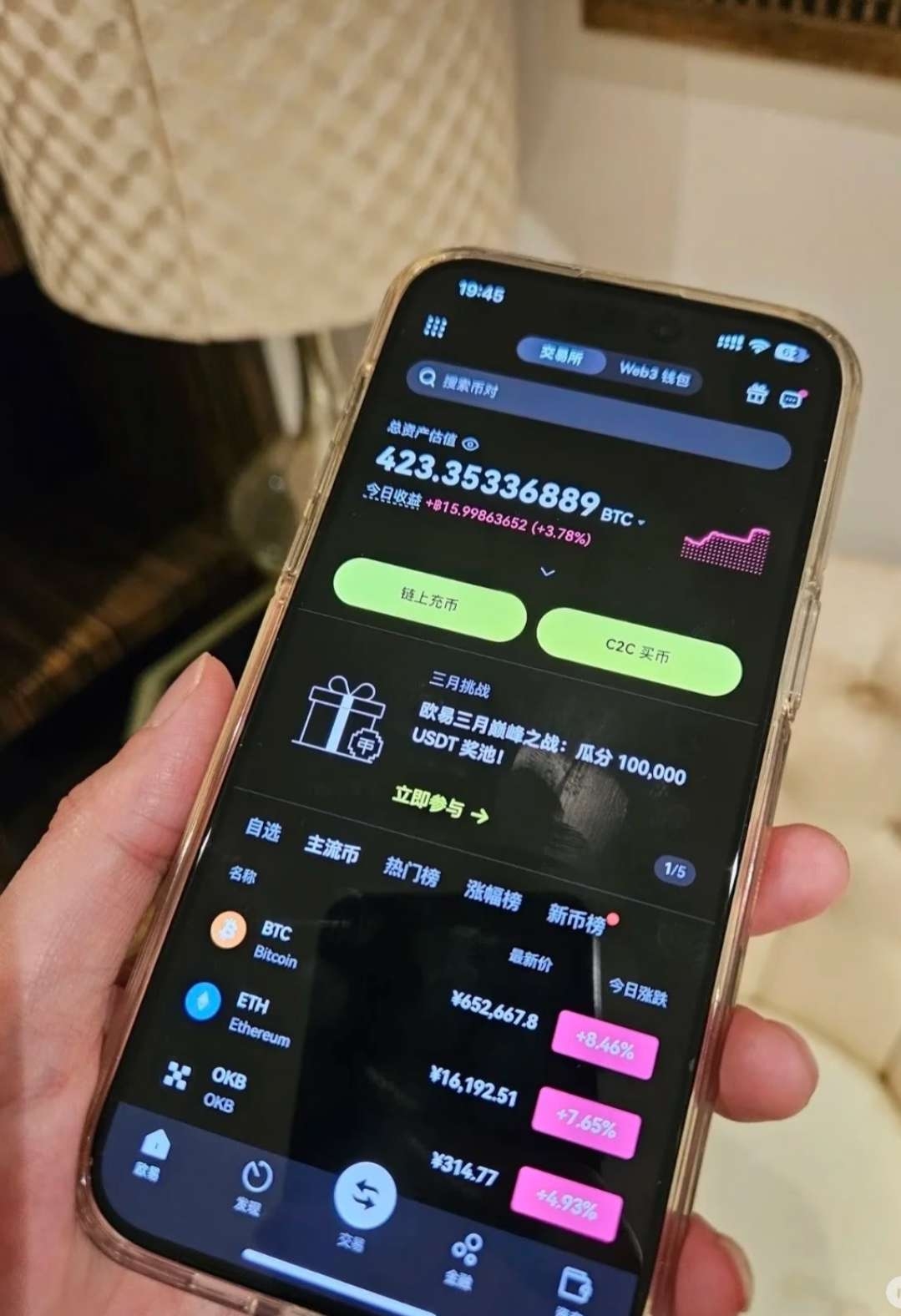
Based on the current price of Bitcoin, which is nearly $100,000 (equivalent to nearly 3 small suns in RMB)
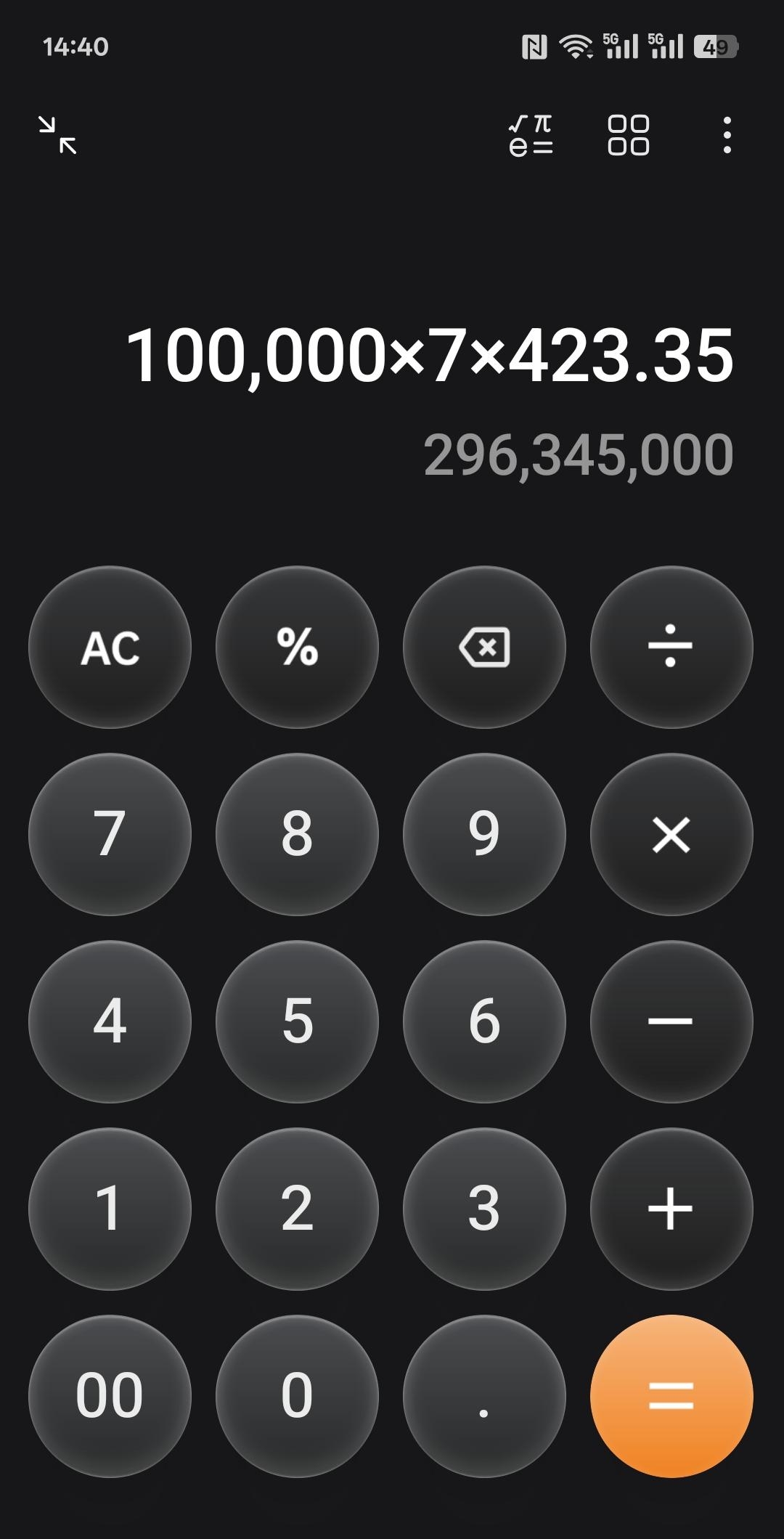
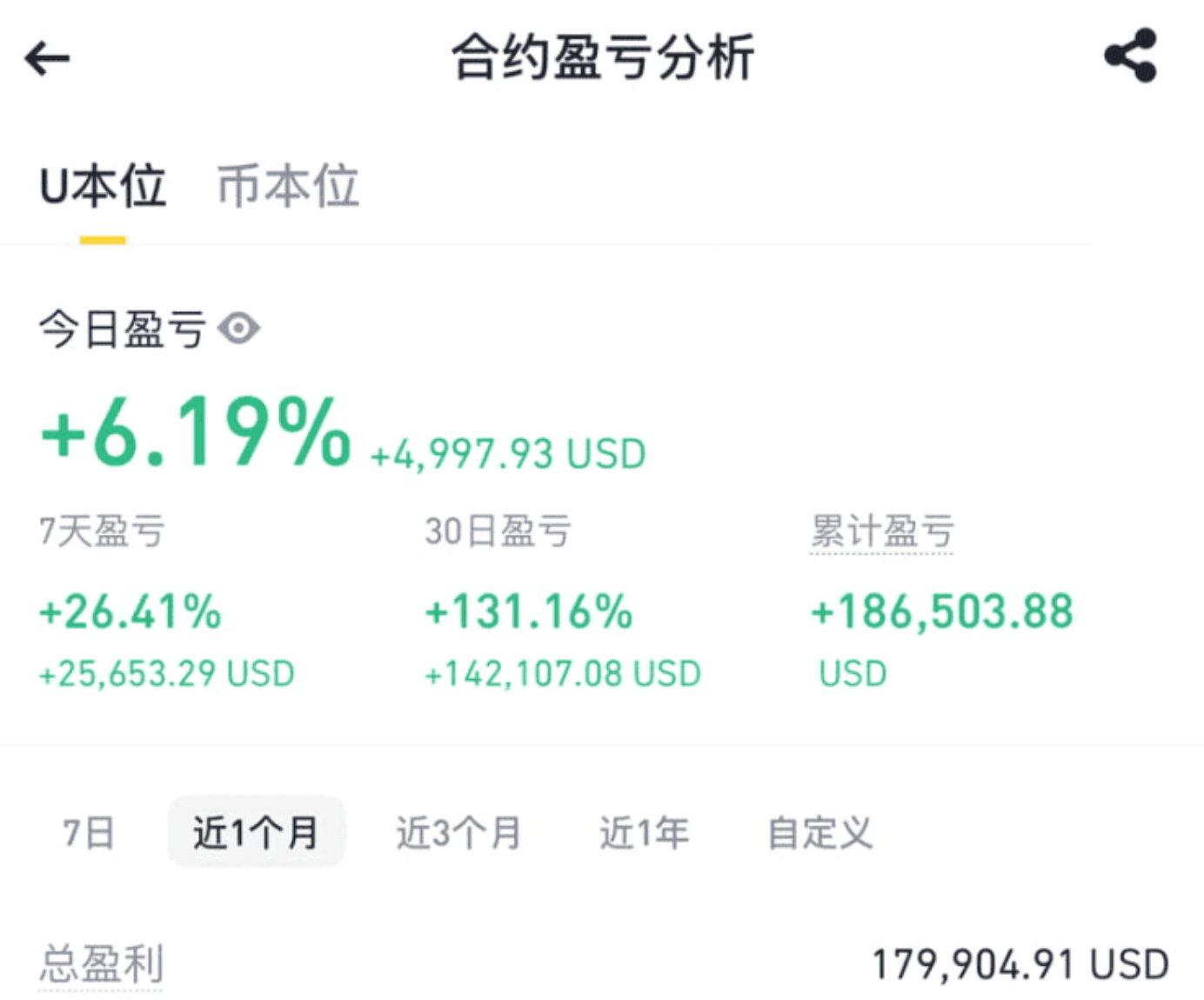
The first 10 million took the longest and was the most painful; the trading system was constantly reshaped and polished, taking a year and a half.
The second ten million took three months
The third ten million was achieved in just 40 days.
The fourth ten million was achieved in just 5 days.
75% of the funds were earned within six months.
Advice from cryptocurrency traders: Take a minute to read this! 8 things to note after achieving financial freedom in the cryptocurrency world.
On their path to financial freedom, many people have chosen the cryptocurrency world as their stepping stone.
However, the road to success is not smooth for everyone.
Here are 8 things to avoid after achieving financial freedom in the cryptocurrency world, to help you better enjoy life after success instead of being troubled by its side effects.
I. Protecting personal privacy
First and foremost, after achieving success, it is crucial to learn how to protect your privacy.
There's no need to flaunt your success or earnings to the outside world, and avoid excessive boasting on social media.
This way, you can avoid unnecessary attention and ensure your own safety.
II. Choosing a Circle
Not everyone can understand the risks and rewards of the cryptocurrency world.
Therefore, after achieving financial freedom, carefully choose the people you want to get to know better.
Sometimes, keeping a distance from those who don't understand your path is a way to protect your wealth and peace of mind.
III. Avoid high-risk choices
Gambling and drugs are devastating choices, both for wealth and for health.
After achieving success, you should be even more aware of this and resolutely stay away from anything that could destroy all your efforts.
IV. Maintain a peaceful state of mind
Be kind to others, stay calm, and avoid unnecessary arguments.
Remain calm amidst unnecessary conflict and invest your time and energy in more valuable things.
V. Helping Others and Self-Care
While one shouldn't be overly fixated on helping others, moderate acts of kindness and concern for others can enrich and make your path to success more meaningful.
At the same time, respect other people's choices and lives.
VI. Prudent Investment
Once you've succeeded, don't easily try investing in areas you don't understand.
Remember, knowledge is power, especially in investing.
VII. Be cautious when starting a business
If you want to get involved in entrepreneurship, make sure it's out of passion, not just to make money.
In the current complex economic environment, starting a business requires more enthusiasm and preparation.
8. Exercise
Health is the foundation of everything. After achieving success, it is even more important to pay attention to your health, otherwise your wealth will not be sustainable.
By following these 8 tips, you can not only protect the wealth you've earned in the cryptocurrency world, but also enjoy the true pleasure of financial freedom.
Remember, success is a journey, not just a destination.
Next, I will tell you my entire story of how I made money in the cryptocurrency market.
This isn't meant to show off, but simply to tell you how ordinary traders can truly turn small capital into big profits.
More importantly, you can also replicate the underlying methodology.
In the first two years of my cryptocurrency trading career, I made approximately 10 million yuan, with an initial investment of 10,000 yuan. I had never worked since graduating from university. I spent all my time browsing...
Watch the video and record the data.
1. With an initial investment of 10,000 yuan, I worked on projects during university, including Taobao affiliate marketing, fake orders, express delivery, app boosting, and various small tasks, and saved up 10,000 yuan.
2. Entering the crypto market: I felt BTC was too expensive, so I focused on ETH, which offered leverage, and then altcoin spot trading. Coin selection...
Manage your positions well. Stick to this simple approach: if the market is bad, take a small loss; if the market is good, make a killing.
Why enter the circle?
If you want to change your destiny, you must try the cryptocurrency world. If you can't get rich in this world, then ordinary people will never have a chance in their lifetime.
I'd like to share my cryptocurrency trading strategy with you:
Many people start trading contracts with only 10,000 USDT (approximately 1,400 USDT) in capital, thinking, "I have a small amount of capital, so I'll just go for it."
But the truth is: the smaller the amount of capital, the more important position management is.
Large funds can be sustained by time, while small funds rely entirely on discipline. Otherwise, a single margin call will force you to rebuild your "faith" from scratch.
The following method is suitable for contract traders with capital between 5,000 and 20,000 RMB. The goal is not to double your money in a day, but...
Low drawdown, steady growth.
Practical Guide to Rolling Over in Cryptocurrency: From 5000 USDT to 100,000 USDT – It's About Timing, Not Courage
Fans often ask, "Bro, how exactly does rolling over positions work? If I want to turn 5000 USDT into 100,000 USDT, do I have to go all in with leverage?"
Absolutely wrong! In the crypto world, rolling over positions isn't about guts, it's about timing. Follow these six steps, and your account will steadily grow like climbing stairs—100 times more reliable than blindly going all in.
Phase One: "Playing Dead" to Survive – Only by Staying Alive Can You Earn Money
Last year, I guided a friend to invest 4,000 USDT at a 20x leverage, only to have his entire account wiped out in three days. He lamented, "The crypto world is full of traps."
Later, a strict rule was set for him: with a principal of 5000U, the first order could use a maximum of 2000U; if he lost it all, he would accept the loss and would never add more funds.
He called me "too cowardly," and as a result, I lost 500U in the first week. In the second week, ETH experienced three small price movements, and I slowly recovered to 1200U by taking profits.
Remember: There's no shortage of opportunities to double your money in the crypto world, but the prerequisite is surviving until the opportunity arises. Survival first, then profits—this is the underlying logic of rolling over positions.
Second Phase: "Locking in" drawdowns, ensuring daily losses never exceed 20%.
No matter how high the account's unrealized profit is, the daily drawdown must be capped at 20%.
There was a newbie whose account reached 8000 USDT. He greedily held onto his positions, resulting in a 25% drawdown in a single day. His hands were shaking so badly he couldn't even hold the mouse.
I remotely locked his account for three days, forcing him to review the trades. After he returned, I changed the rules: use 5% of the account balance as the stop-loss line—if the account balance is 1000U, I will cut my losses if I lose a maximum of 50U; if the account balance is 10,000U, I will stop if I lose a maximum of 500U.
At first, it hurts to cut orders, but as you keep cutting, your account curve actually rises – small losses are manageable, but big losses are fatal; this is the ironclad rule of survival in the crypto world.
Third stage: Only trade "understandable candlestick patterns"; blindly chasing market trends is tantamount to suicide.
Before the market opens, you must draw two lines: a support level and a resistance level. Only take action if the line is broken; otherwise, remain an observer.
A student messaged me privately late at night: "A certain MEME coin has skyrocketed, should I chase it?" I looked at the candlestick chart and it looked like a tangled ball of yarn, so I replied directly: "If you dare to enter this trade, don't call me master." As a result, the price of the coin halved in three days, and he obediently wrote "only trade what you understand" into his trading rules.
Remember: If you don't understand the market, watching more and acting less is the way to make money. The crypto world has more traps than opportunities; don't gamble your capital on "luck."
Fourth Stage: Take profits in three parts, secure gains + let profits run
Don't fantasize about "selling at the highest point." Split your profit target into three parts for a steady and worry-free profit:
Short-term trades: Take profits of 30-50 points, then lock in half (preserve principal + some profit);
Trend-following strategy: Target a move of 150 points or more, hold onto core positions;
Leave a little profit: let it "run free," and you won't feel bad if it falls.
Everyone's ridden a roller coaster, but no one's averse to "taking profits and locking in gains." Earn a little, lock in a little, and your account will grow bigger and bigger.
Fifth Stage: Doubling Down Profits – Real Earnings Are Only True Gains
Forced profit withdrawal for each time the account reaches a round number:
6000U, withdraw 500U (buy a good meal, keep a calm mindset);
Withdraw 2000U from 10,000U (transfer to a cold wallet and freeze it, do not touch it);
Withdraw 5,000 USDT from 20,000 USDT (directly transferred to bank card, cash in hand).
Last year, a friend of mine had 10,000 USDT grow to 50,000 USDT but couldn't bring himself to withdraw it. Then, a black swan event wiped it all out overnight. He cried and said, "Brother, I should have listened to you and locked in my position!"
Remember: In the crypto world, digital currency doesn't count for real money; only what you actually have in your pocket is real profit.
VI. Stage Six: Leverage is the "stepmother," while position sizing is the "biological mother."
Once your account balance exceeds 8000 USDT, you can increase your position size to 1000-1500 USDT per trade, but there are conditions:
Stop-loss should be reduced to 3%-5% (allowing room for market movement, but never letting it get out of control);
Leverage should be at most 3-5 times (leverage of 10 times or more is gambling with your life, never touch it).
Previously, a student got greedy and wanted to increase his account by 10 times, so I changed his password and froze his account for three days. Now he's steadily climbing to 20,000 USDT, and he pats his chest, saying, "Thanks to my master for that lock!"
If you get the timing right, even 5000U can grow into 100,000.
Repeat these six steps three times, and you'll find that your account curve resembles a staircase:
5000→8000→12000→20000…… Stacking up step by step, with almost no major pullbacks.
Those who try to double their money through aggressive leverage usually fail halfway through. On the contrary, those who maintain a steady pace, control drawdowns, and secure profits are more likely to grow 5,000 USDT into 100,000 USDT.
Remember: In the crypto world, slow and steady wins the race; stability is key to wealth. If you can control your impulses and time your trades correctly, turning 5000 USDT into 100,000 USDT is just a matter of time.
Want to consistently profit in cryptocurrency futures trading and avoid being taken advantage of by market fluctuations?
Here's a strategy I've tested in practice to help you master buying low and selling high, and maintain control amidst market volatility!
Focus on mainstream cryptocurrencies: concentrate on BTC and ETH, and directly avoid altcoins. Mainstream cryptocurrencies have sufficient liquidity and low trading risk, making them the best targets for buying low and selling high, without being distracted by chaotic market conditions.
Short selling techniques: Keep a close eye on key moving average resistance levels on the 4-hour chart (such as MA60). If the moving average continues to suppress the price, place short orders in batches near these levels. Set the stop loss above the previous high after the price dipped to 2450. For example, if the resistance level is 2440 and the price dipped to 2450 before falling back, place the stop loss above 2450.
Long entry strategy: Enter long positions in batches at support levels of the same or higher level, with stop-loss orders placed below the previous low after a rebound. For example, if the support level is 2320, and the price rebounds after testing the bottom at 2310, the stop-loss order could be placed near 2300.
Ironclad rules of money management: The maximum daily loss should not exceed 20% of the total principal, and trading should be stopped immediately when this limit is reached; the loss on a single trade should be controlled within 10% to avoid wiping out previous profits in one trade; all open positions should be kept consistent, and blindly adding positions to amplify risks.
Never relax your trading discipline: When the market is favorable, you can pay a small amount of attention to hot coins, but never relax your risk control; lock in a profit-loss ratio of 3:1 to ensure that profits cover losses; suspend trading if the daily drawdown is 10%-15%, and resume operations after calming down.
Response to extreme market conditions: Remain completely out of the market during crashes or surges, and do not blindly buy the dip; observe without suitable signals, and it is better to miss an opportunity than to make a mistake, so as to avoid emotional losses.
Use stop-loss and take-profit orders flexibly: For break-even stop-loss, if the pattern is stable after opening a position, do not adjust it for the time being. If the pattern breaks down, immediately pull the stop-loss to the cost price (can be activated when ETH has a floating profit of 20 points and BTC has a floating profit of 350 points); use 3/5 minute K-lines to dynamically adjust the trailing stop-loss, activate it when ETH has a floating profit of 35 points and BTC has a floating profit of 500 points to lock in profits firmly.
Mindset is the key to victory: reject the all-in gambler's mentality, pursue stable profits rather than getting rich overnight; give up greed and wishful thinking, and stay calm and rational so as not to blow up your account due to greed.
How to manage risk in cryptocurrency trading (Part 1)
The 2% rule can help avoid shark-like attacks in the market.
The 6% rule can help you avoid the market's piranha-like attacks!
I. Why is the safety of principal so important?
Warren Buffett famously said, "There are three secrets to success: First, avoid risk and preserve your capital; second, avoid risk and preserve your capital; third, always remember the first two."
Why is the safety of principal so important? Because in the financial market, when anyone makes a profit, the base is smaller, and when they lose money, the base is larger. The base for losses is always greater than the base for profits.
What does this mean? Please see the image below:
Let's say you have $10,000 in your account.
When your account loses 20%, you need to earn 25% to break even, assuming your principal remains unchanged.
When your account loses 40%, you need to earn 67% to break even, assuming your initial investment remains unchanged.
When your account loses 50%, you need to earn 100% to break even, assuming your principal remains unchanged.
When your account loses 90%, you would need to earn 900% to break even, assuming your initial investment remains unchanged.
......
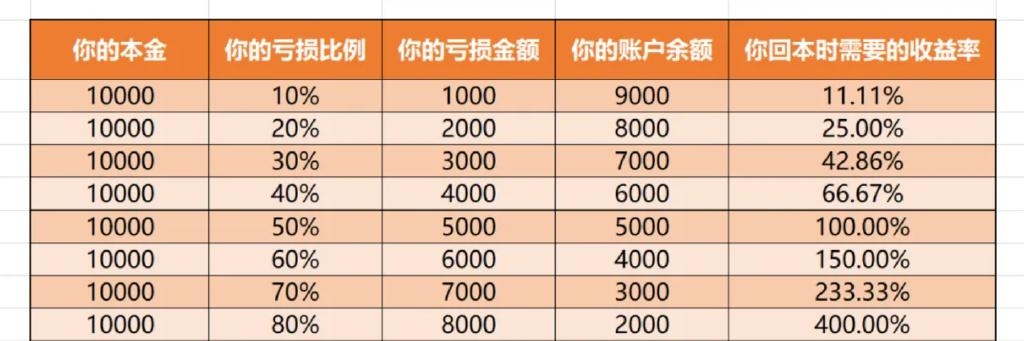
If trading is like walking a tightrope, then for safety, a safety net needs to be placed below the wire. If we slip off the wire, the safety net can save our lives—this is the importance of stop-loss orders. Even better than one safety net is two: if the first one fails to catch us, there's a second one—this is the importance of money management.
II. The Importance of Fund Management
The two pillars of money management are the 2% rule and the 6% rule. The 2% rule can help avoid shark-like attacks from the market, while the 6% rule can help avoid piranha-like attacks from the market.
Today we'll focus on the 2% rule.
definition:
The 2% rule is to prevent your account from incurring a loss of more than 2% of your principal in a single transaction.
For example:
If you have $100,000 in your account, the 2% rule requires you to limit the maximum risk you take on each trade to $2,000. This is not the size of the trade, but rather the amount of capital at risk in your account, calculated based on the distance between your entry point and stop-loss point.
a. Using spot goods as an example:
Suppose you decide to buy BTC at $35,000, with a stop-loss order at $34,000. This means you're taking on a $1,000 risk for every BTC you buy. Since your total risk tolerance is $2,000, dividing that by $1,000 per BTC, you can't afford to buy more than (2,000 ÷ 1,000) = 2 BTC in this position.
Of course, there is a second algorithm, which is what we often call "positioning based on loss":
Tolerable risk amount ÷ Loss ratio = Position size
Based on the example above: Tolerable risk amount = $2000, Loss percentage = Loss amount ÷ Entry price = (35000 - 34000) ÷ 35000 = 0.02857142857 ≈ 0.0286 = 2.86%. Therefore, the size of your position should not exceed $2000 ÷ 2.86% = 69930.06 ≈ 69930 ≈ 2 BTC.
Both algorithms are fine; once you've learned them, choose the one you prefer.
b. Using a U-standard contract as an example:
Let's say you decide to go long on BTC at $35,000, with a stop-loss at $34,000. This means you're risking $1,000 for every BTC you hold. Since your total risk tolerance is $2,000, dividing by $1,000 per BTC, we get the maximum you can afford to invest in this position: (2,000 ÷ 1,000) = 2 BTC = $70,000. Please note that the $2,000 and $70,000 here refer to your actual initial capital!
However, because you're using leverage, it amplifies not only your principal and profits but also your losses. Therefore, your actual opening margin = $70,000 ÷ leverage ratio.
70000 ÷ 10 = 7000
70000 ÷ 20 = 3500
70000 ÷ 50 = 1400
70000 ÷ 100 = 700
70000 ÷ 1500 = 46.67
......
Let me repeat myself:
If you use 10x leverage, you only need to invest $7,000 to buy 2 BTC worth $70,000. If the price of BTC drops to $34,000, triggering your stop-loss, then your actual loss will be...7000 (2.86% 10 = 28.6% = 2002 ≈ 2000 US dollarsIt's still your original, real, and risk-bearing capital.
If you use 20x leverage, you only need to invest $3,500 to buy 2 BTC worth $70,000. If the price of BTC drops to $34,000, triggering your stop-loss, then your actual loss will be...3500 (2.86% 20 = 57.2% = 2002 ≈ 2000 US dollarsIt's still your original, real, and risk-bearing capital.
If you use 50x leverage, you only need to invest $1400 to buy 2 BTC worth $70,000. If the price of BTC drops to $34,000, triggering your stop-loss, then your actual loss will be...1400 (2.86% 50 (143%) = 2002 ≈ 2000 USDIt's still your original, real, risk-bearing capital. (This also explains why you see many people trading contracts with "-200%" on their account but haven't been liquidated yet.)
III. Why 2%?
Why 2%, and not 0.5%, 1%, 5%, or 10%? This is mainly based on the number of consecutive stop-losses in our daily trading and the "loss base and rate of return" we discussed at the beginning. From the "comparison chart of loss base and rate of return" above, we can see that when your total account loss reaches 50%, assuming the principal remains unchanged, you need to earn 100% to break even, which is extremely difficult, almost impossible. Therefore, our acceptable maximum drawdown assumption is 20%, because starting from 20%, the difficulty of "breaking even" increases exponentially.
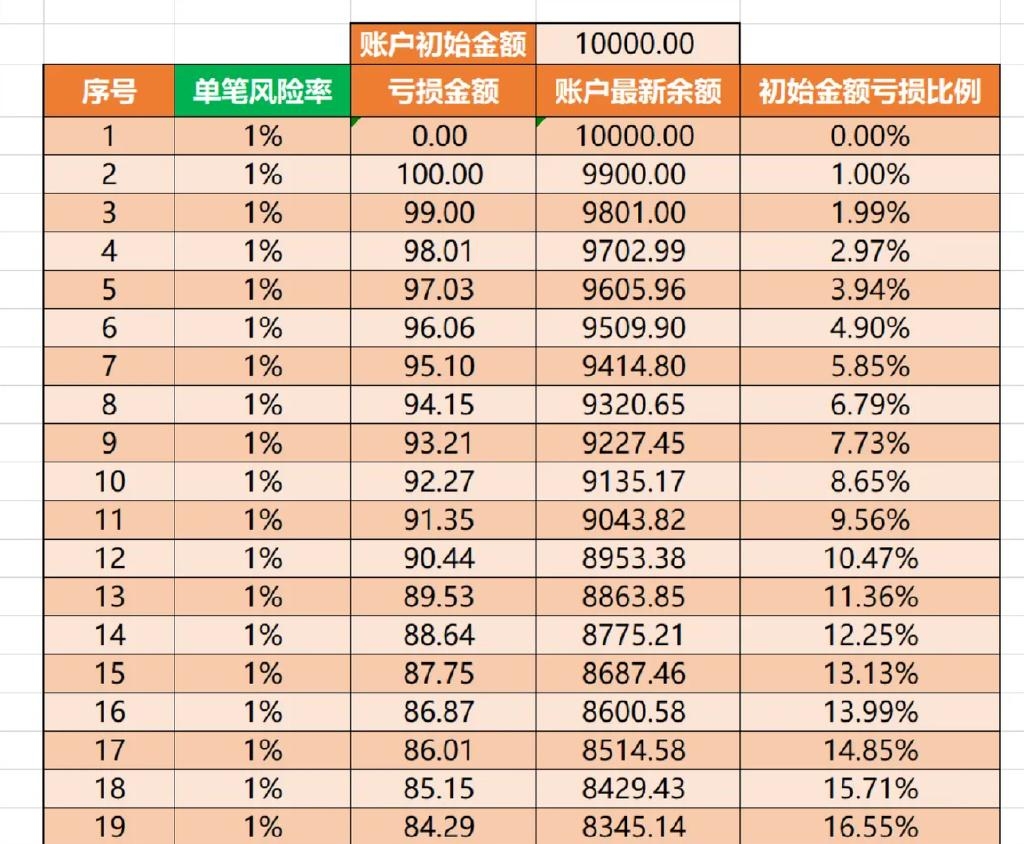
Therefore, we can use the table below (Figure 1) to simulate the calculation. When we set the single-trade risk rate to "1%", assuming we suffer 20 consecutive losses, the account loss for the initial amount of $10,000 would only be 17.38%, less than 20%. However, in real trading, it is rare to have more than 20 consecutive losses, so setting an amount as small as "0.5" is not conducive to the full utilization of funds. Of course, as your asset account size increases, I believe this number will become smaller and smaller, and may even fall below "0.5".
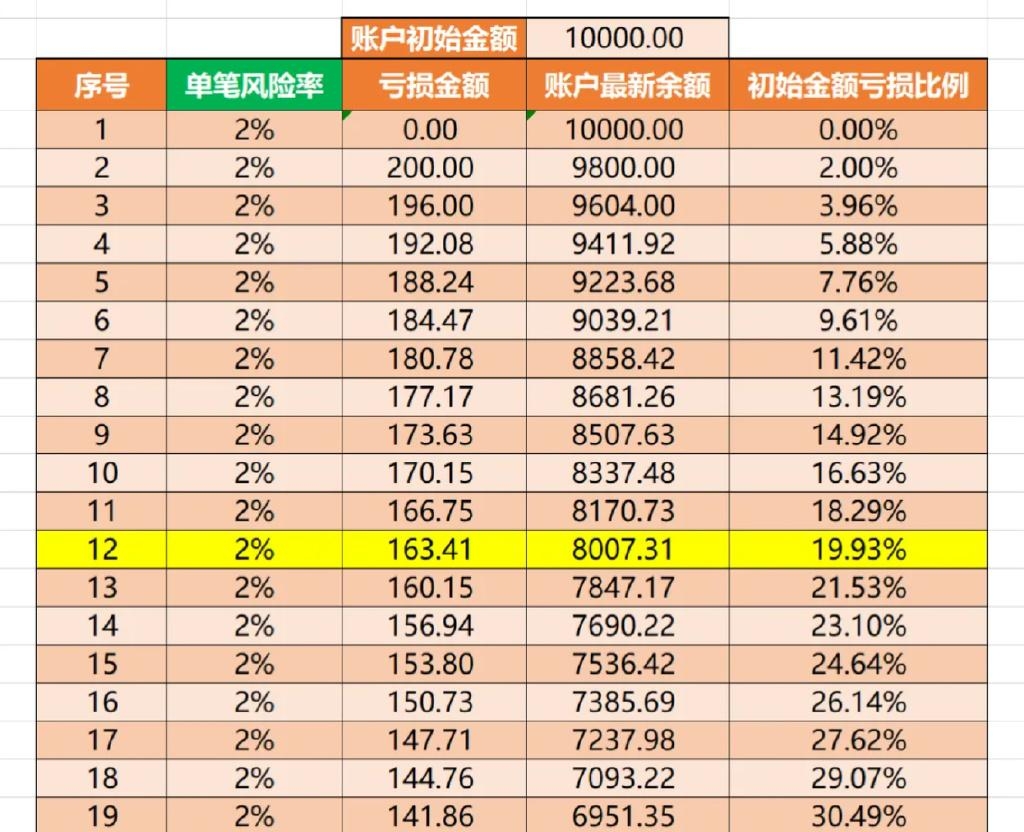
According to the simulation calculation in Figure 2, when we set the single-trade risk rate to "2%", assuming we suffer 12 consecutive losses, the account loss for an initial amount of $10,000 would be very close to 20%. While it's possible to experience 10 consecutive stop-losses in real trading, it's not common.
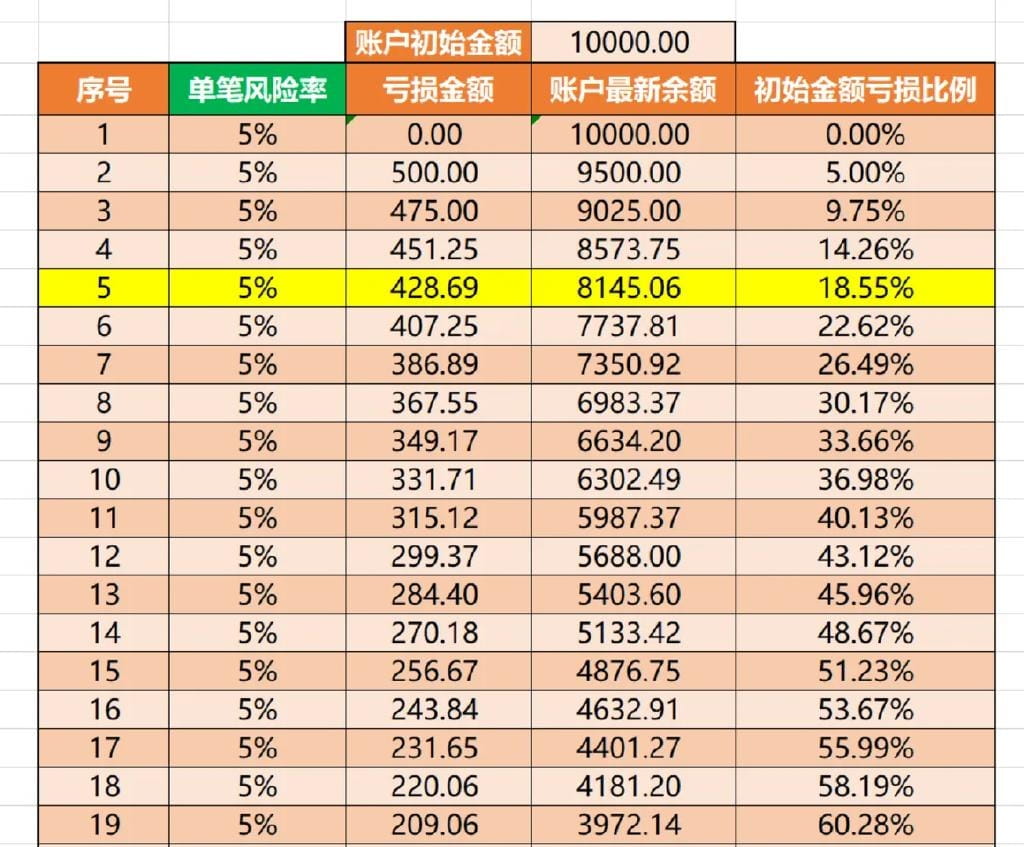
According to the simulation calculations in Figure 3, when we set the single-trade risk rate to "5%", after six consecutive losing trades, the account loss for an initial amount of $10,000 would already exceed 20% of the total account loss. If we also consider the fact that the trading discipline was not followed at the time, the subsequent account losses would be catastrophic. Therefore, the "5%" value is far too high for us!
Now here's the question: Regardless of whether your trading system has an average win rate of 50%, 60%, or 80%, have you ever encountered a situation where you suffer 5 or 10 consecutive stop-losses in actual trading? I think you definitely have, and this is a very normal phenomenon, unrelated to your trading system. It's like how we all know that the probability of flipping a coin is close to 50%, but when you actually toss the coin into the air, you're bound to get many consecutive heads or tails. Trading is the same!
When you've won 10 or 20 trades in a row, you might feel like you completely understand the game. However, a single catastrophic loss can wipe out all your past profits, even wiping out your initial capital. You need a money management strategy that can withstand a "shark strike." In the long run, a good trading system can give you a winning streak, but in the short term, the market is highly random. The outcome of any single trade is as uncertain as a coin toss. Professional traders expect to profit by the end of the month or quarter, but if you ask them if their next trade will be profitable, they'll honestly say they don't know. This is why stop-loss strategies are used: to prevent losing trades from destroying their accounts.
Technical analysis helps you determine stop-loss levels, which limits losses per share to a certain range. Money management rules protect your account overall. One of the most important principles is to keep the risk to your account below 2% in every trade.
The principal mentioned in this principle refers only to the money in your trading account, and does not include your savings, household assets, retirement accounts, or Lunar New Year savings. Trading assets are the assets you invest in trading; these are your true risk assets—assets belonging to your trading career.
How to manage risk in cryptocurrency trading (Part 2)
The 2% rule will protect you from shark attacks.
The 6% rule can save you from the jaws of a piranha.
I. Shark-like attack

Today we continue our discussion of the 6% rule, one of the two pillars of money management. As we discussed in the last episode, the 2% rule can help avoid shark-like attacks from the market, while the 6% rule can help avoid piranha-like attacks.
A "shark-like attack" simply means losing a large sum of money at once, causing you to lose confidence and develop fear for future actions. Therefore, the way to avoid a "shark-like attack" is to adhere to the 2% rule, which limits your losses to a manageable level.
What exactly is a "piranha-like attack"? Piranhas are fish found in tropical rivers. Although they are smaller than a human hand, they possess terrifying teeth. Their danger stems from their ability to attack in groups. Whether it's a dog, a donkey, or a human, if it falls into a tropical river, the entire school of piranhas will swarm and devour its prey. If a cow walks into the river and is attacked by piranhas, within minutes only its bones will remain.
The 2% rule can help us avoid losing more money at once, while the 6% rule can save you from a series of fatal attacks, forcing you to get out of the water before being attacked by piranhas and not get "hooked" in the trading market.
II. What is the 6% principle?
The 6% rule is defined as follows: When the sum of your total losses and the risk of your open positions reaches 6% of your total account balance this month, you will not be allowed to make any new trades for the remainder of the month.
Please note that there are two key points here:
Total loss.
Risk limits for open positions.
Total loss refers to the actual losses already incurred; the risk limit for open positions refers to the expected unrealized losses on current open positions. The sum of the two cannot exceed 6%.
If you still don't understand, that's okay. Here's an example:
a. At the end of the month, Zhang San had $50,000 in his account with no open positions. At the beginning of the month, he determined the maximum risk control target: 2% for each trade, or $1,000; and 6% for the total account, or $3,000 in risk.
b. A few days later, he found a very attractive stock A, set a stop-loss line, and bought the stock. The risk was 2% of the account principal, which is $1,000.
c. A few days later, he discovered stock B and made a similar purchase, adding another $1,000 of risk.
d. Near the end of the week, he discovered stock C and bought it, adding another $1,000 of risk.
e. In the second week, he found stock D to be more attractive than the previous three stocks. Should he buy it? — No, he shouldn't buy it because his overall account's unrealized loss has already reached 6%. He has three open positions, each with a 2% risk, meaning he could lose 6% if the market turns bad. The 6% rule doesn't allow him to add any more risk.
f. A few days later, stock A rose, and the trader raised his stop-loss order to the break-even point. Stock D, which was not a buyable option a few days ago, is still attractive. Can he buy it now? — Yes, he can buy it because his account now carries only 4% risk. The risk on stock B is 2%, and the risk on stock C is also 2%, but stock A carries no risk because its stop-loss point is above the break-even point. Zhang San's purchase of stock D uses an additional $1000, or 2% of his risk.
g. In the following days of this week, Zhang San discovered stock E, which has a very promising outlook. Can he buy E? — No, according to the 6% rule, his account is already showing a floating loss on three stocks (B, C, and D) with a combined risk of 6% (A is no longer risky). Therefore, Zhang San cannot buy stock E.
h. A few days later, stock B was stopped out, and stock E is still very attractive. Can Zhang San buy it? No, because he has already lost 2% on stock B, and stocks C and D have an additional 4% risk of unrealized loss. Buying a new position now would cause Zhang San's monthly unrealized loss to exceed 6%.
By now, do you fully understand the definition of the 6% rule? The 6% rule allows you to increase your trading size in a healthy, profitable trend. However, in a losing trend, it may cause you to close trades prematurely. When the market moves in your favor, you can adjust your stop-loss order to break-even, allowing more risk available for new trades. On the other hand, if the position trends against you and hits your stop-loss, you should immediately cut your losses to protect your account's core assets and ensure a fresh start next month.
3. Strictly adhere to your trading system.
Many traders experience emotional fluctuations, impulsively seeking revenge when facing consecutive stop-losses, or recklessly increasing positions when experiencing consecutive profit-taking, always hoping to quickly recover their principal. These emotional fluctuations are detrimental to your trading and will only have the opposite effect. Focusing your energy on risk control is a better choice. The 2% rule and the 6% rule can transform your efforts into safer trades.
Trading is like diving for treasure. There's gold on the seabed, but when you're digging, don't forget to check your barometer. Many divers' bodies lie on the ocean floor because they saw only the immense opportunity and exhausted their oxygen supplies. Professional divers always monitor their oxygen levels; if they don't find gold today, they can try again tomorrow. All they need is to survive and dive again. Beginners die from oxygen depletion because the temptation of free gold is too great. The only free thing in the world is the cheese in a mousetrap.
Successful traders survive and thrive because of their discipline. The 2% rule will protect you from shark attacks, and the 6% rule will save you from piranhas. If you adhere to these rules and have a sound trading system, you will leave your competitors far behind.

Ten years in the crypto world: eight survival tips from liquidation to rebirth
Over the past decade, I've seen countless passionate newcomers rush into the cryptocurrency world, only to be left bewildered and struggling with despair after losing so much money. In the past seven years, I've also experienced the agony of being liquidated. Today, I'll share eight survival rules with you—listen, then put them into practice!
1. The more precise your portfolio management, the greater your profits.
If you have less than 100,000 yuan, buy only one coin; if you have 200,000-300,000 yuan, buy at most two; and if you have less than 500,000 yuan, three to four are enough. Holding more than five coins? You might just be giving money away to the market. Concentrate your resources during a bull market, streamline your portfolio during a bear market, and be ready to exit at any time – that's the key.
2. Trends are the true masters of the market.
Technical analysis and news are not for making predictions, but for improving your win rate. Rebounds in a downtrend are mostly bull traps, and pullbacks in an uptrend are often shakeouts. Don't try to buy the dip, and don't try to guess the big players' intentions; just follow the trend.
3. Only hunt in active markets.
The cryptocurrency market isn't a 24/7 battlefield; much of the time is wasted in poor market conditions. Real opportunities only arise when market enthusiasm is high. At other times, patience is key.
4. Be decisive in stopping losses, and be prudent in taking profits.
When you're losing money, set a stop-loss order and stick to it; don't let wishful thinking ruin you. When you're making a profit, promptly raise your take-profit level to lock in the gains. The market won't be merciful just because you're reluctant to let go.
5. Buy quickly, sell even faster.
When opportunity knocks, hesitation means failure; when risk arises, delay means defeat. Decisive buying and resolute selling are the differences between experts and novices.
6. Ask yourself this question before adding to your position.
"If I didn't have a position right now, would I still buy?" The answer is definitely yes, then I'd add to my position. If you're hesitant, don't act. Adding to your position is about amplifying a correct move, not about fixing an emergency.
7. Don't waste your life on short-term trading.
Those who spend all their time staring at 15-minute candlestick charts to trade will only become employees of brokerage firms. Real wealth always comes from the patience to hold firmly after identifying a trend.
8. Buying at the bottom is costly.
"It's fallen so much, shouldn't it rebound by now?" Most people who think this have already left the market. Only 20% of people in the market make money, and their secret is—never try to buy at the bottom.
This path is not easy, but will you repeat the mistakes of others, or forge your own profitable path? The choice is always yours.
If you are still struggling in this cycle of margin calls, please force yourself to do these three things first:
1. Reduce transaction frequency:
2: Strictly implement stop-loss orders.
3: Don't let any small loss get out of control
If you're still feeling lost in the market and unsure of your next move, I'm here to share more specific strategies and mindset management methods. Opportunities are right in front of you; if you take the initiative, we can have a story together.
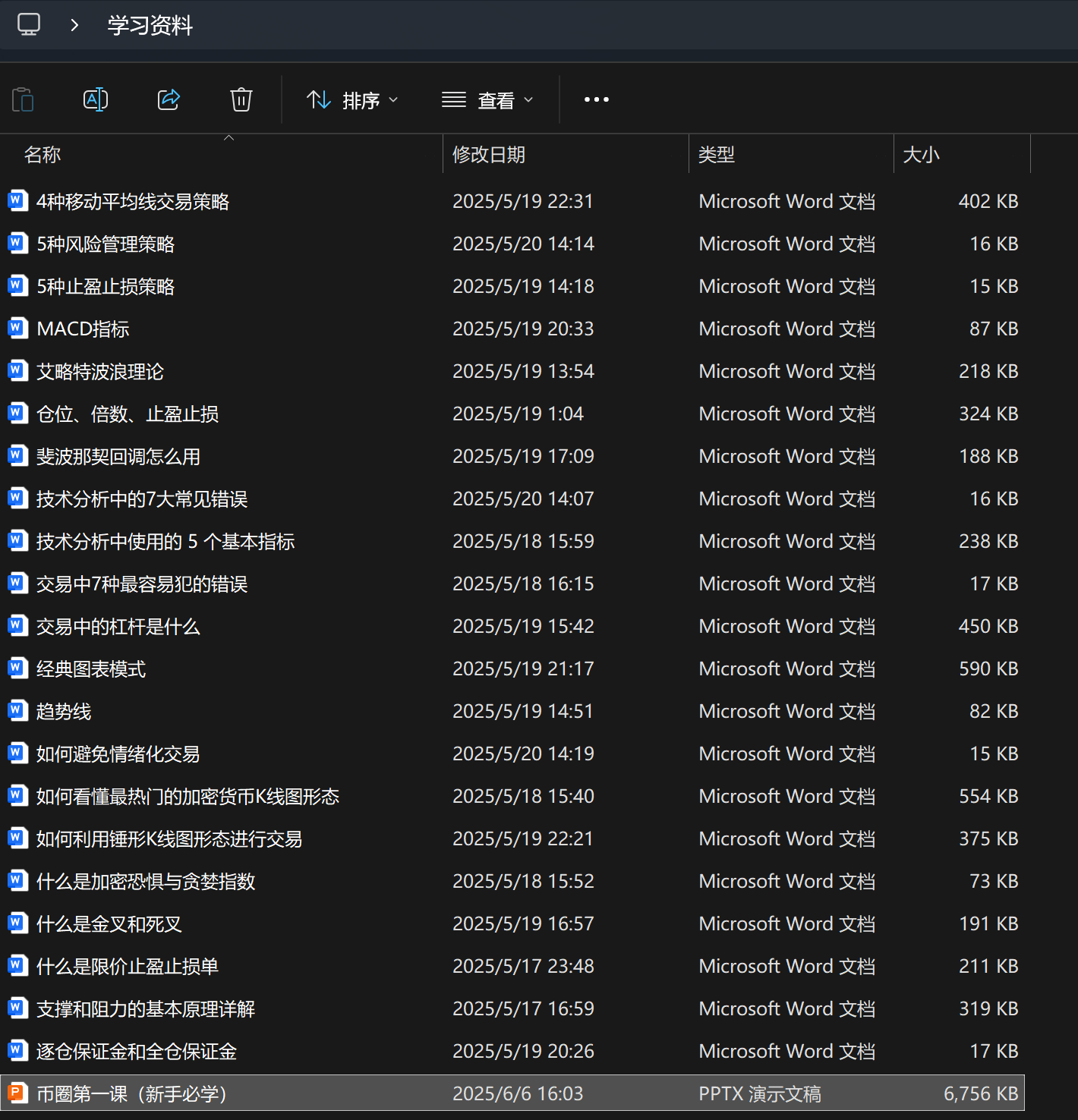
Investing is like a spiritual practice. Besides adhering to your investment philosophy in the face of drastic market fluctuations, you also need to develop a simple and easy-to-implement profit model. However, many novice investors don't know where to start. This resource, "Both Fish and Fishing," compiles solutions to frequently encountered problems in cryptocurrency spot and futures trading: (Essential Learning Materials for Cryptocurrency Traders). We hope our followers can find suitable methods for themselves and the learning methods they want to use, helping everyone build a clear and effective trading system.