


What is cryptoeconomics?
Simply put, cryptoeconomics combines cryptography with economics to coordinate the behavior of network participants.
Specifically, cryptoeconomics is a field of computer science that attempts to solve coordination problems among participants in digital ecosystems through cryptography and economic incentives.
Decentralized networks cannot be built without cryptoeconomics because the mechanism can be used to align participant incentives without the need for a trusted third party.
Cryptoeconomics is not a subset of traditional economics. It combines game theory, mechanism design, mathematics, and other methodologies in the field of economics. The main goal of cryptoeconomics is to understand how to fund, design, develop, and promote the operation of decentralized networks.
This article will dive into the origins of cryptoeconomics and its role in the design of Bitcoin and other decentralized networks.
What problems does cryptoeconomics solve?
Prior to the launch of Bitcoin, it was widely believed that it was impossible to create a peer-to-peer network that could achieve consensus without obvious vulnerabilities to attack and failure.
This problem is often referred to as the Byzantine Generals Problem. It is a logical dilemma that shows the importance of reaching agreement between different actors in a distributed system. The premise of this problem is that since some actors may be unreliable, agreement can never be reached and the network cannot function as expected.
With the creation of Bitcoin, Satoshi Nakamoto solved this problem by introducing economic incentives in a peer-to-peer network.
Since then, decentralized networks have continued to rely on cryptography to reach consensus about the state of the network and its history. In addition, most networks use economic incentives to encourage network participants to behave in certain ways.
This synergy of cryptographic protocols and economic incentives enables a new decentralized web ecosystem that is both resilient and secure.
The role of cryptoeconomics in Bitcoin mining
Bitcoin aims to create a value transfer network that is both immutable and censorship-resistant to accurately verify value transfers.
This is achieved through the mining process, in which miners who successfully verify a block of transactions are rewarded with Bitcoin. Such economic incentives encourage miners to act honestly, thereby improving the reliability and security of their network.
The mining process requires solving a mathematical puzzle based on a cryptographic hashing algorithm. In this case, the hash is used to link blocks together, essentially creating a time-stamped record of approved transactions known as a blockchain.
Hashes are also used in computational puzzles that miners compete to solve. In addition, transactions must also comply with a consensus that only valid digital signatures generated by private keys can be used to spend Bitcoin.
These technical rules related to mining comply with the security requirements of the Bitcoin network, including preventing malicious actors from taking control of the network.
How does cryptoeconomics improve Bitcoin's security?
Bitcoin’s security model is built around the majority rule, which means that a malicious actor could potentially take control of the blockchain by controlling a majority of the Bitcoin network’s computing power, an attack often referred to as a 51% attack.
In this case, the attacker will be able to prevent new transactions from being confirmed or even reverse transactions completely. However, controlling such a large amount of hashing power is extremely expensive and requires a lot of hardware and electricity.
Cryptoeconomics is one of the reasons why Bitcoin is successful. Satoshi Nakamoto implemented some assumptions and provided certain economic incentives to different categories of participants in the Bitcoin network based on these assumptions. These assumptions are about how network participants respond to certain economic incentives, and largely determine the security guarantees of the Bitcoin system.
If its cryptographic protocol is not strong enough, there will be no secure unit of account to reward miners. Without miners, there will be no way to guarantee the validity of transaction history in the distributed ledger unless the transactions are verified by a trusted third party, which would negate one of Bitcoin’s main advantages.
The symbiotic relationship between miners and the Bitcoin network, based on cryptoeconomic assumptions, provides this assurance. However, this does not guarantee that the system will continue to exist in the future.
Crypto Economy
The Cryptoeconomic Circle is a holistic model of cryptoeconomics. Published by Joel Monegro, it shows the abstract flow of value between different categories of participants in such a peer-to-peer economy.
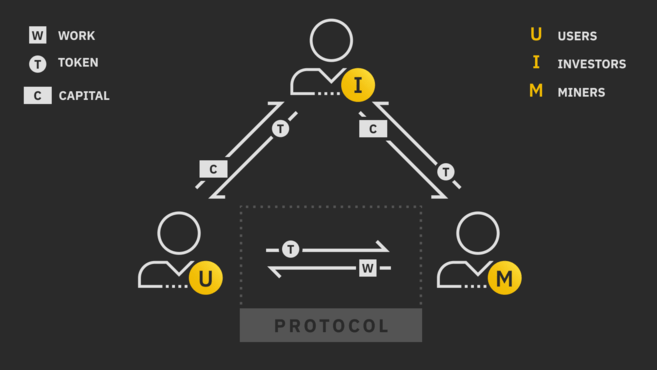
The model represents a three-party market between miners (supply side), users (demand side), and investors (capital side). Each party uses scarce cryptoeconomic resources (tokens) to exchange value with each other.
In the miner-user relationship within this community, miners are paid for their work in tokens used by users. The network’s consensus protocol standardizes this process, while the cryptoeconomic model governs when and how miners are paid.
As long as the benefits outweigh the disadvantages, it is desirable to create a network architecture maintained by a distributed supply side (miners), and its advantages generally include censorship resistance, unbounded transactions, and higher reliability. However, decentralized systems tend to have lower performance than centralized models.
In this model, investors play a dual role: they both provide liquidity for miners to sell tokens and they fund the network by supporting token prices above the cost of mining.
To illustrate this dual role, the model divides investors into two groups: traders (short-term investors) and holders (long-term investors).
Traders are responsible for creating token liquidity, allowing miners to sell their mined tokens and pay operating costs, while holders contribute to the growth of the network by supporting token prices to fund the network. The miner-trader relationship drives the direct flow of value, while the miner-holder relationship drives the indirect flow of value.
This simply means that all participants in the economy need to rely on each other to achieve their economic goals. This design results in a strong and secure network. It is more beneficial for individual participants to follow the incentive rules than to engage in malicious activities, which in turn increases the resilience of the network.
Summarize
Although cryptoeconomics is still a relatively new concept, having emerged with the launch of Bitcoin, it has become an important aspect that must be considered when designing decentralized networks.
Separating the different roles in a cryptoeconomic model helps analyze the costs, incentives, and value flows of each type of participant. In addition, it helps to think about relative power and identify potential directions of centralization, which is critical to designing more balanced governance and token distribution models.
In the future development of the network, the use of cryptoeconomics and cryptoeconomic models may be of great benefit. Researching cryptoeconomic models that have been tried and tested in real-world environments can help improve the efficiency and sustainability of future networks, thereby forming a more robust decentralized economic ecosystem.