


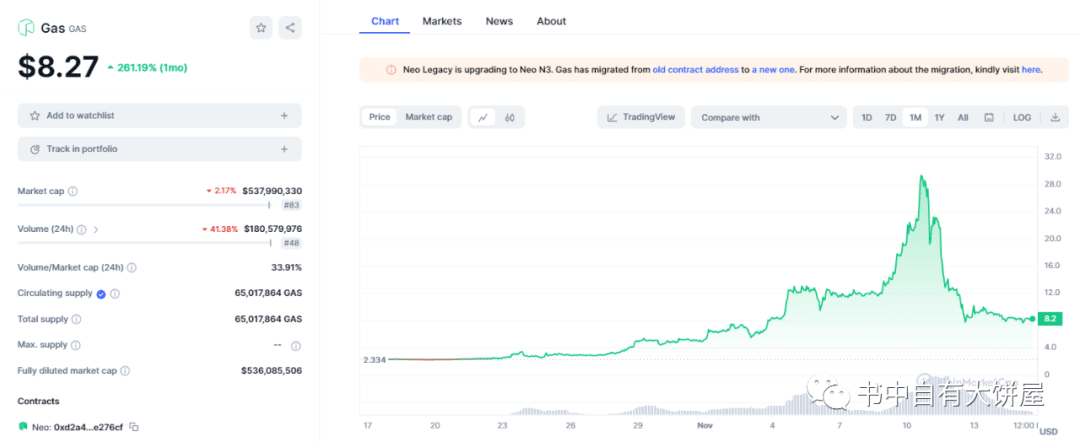
今天我们讲一个国产的公链,号称国产的以太坊,他就是小蚁链,是达鸿飞团队在2014年做的,起初叫小蚁,旨在建立一个类似于比特股的去中心化金融交易平台;2017年为了更加国际化,团队将其改名叫NEO,企图建立一个智能经济的分布式的平台。这个项目是一个双通证的项目,目前其代币涨的还是很猛,一个是NEO平台治理代币,还有一个叫GAS,是消耗的代币,可以看到GAS从2涨到了最高峰的30,差不多涨了15倍,然后NEO也是从7涨到了14,翻倍了。之前为什么不说这个项目,因为公链,而且它没啥特点,没有优势,所以就跳过去了,最近它发布了一个新版本然后哦我们就在回过头来在说下它。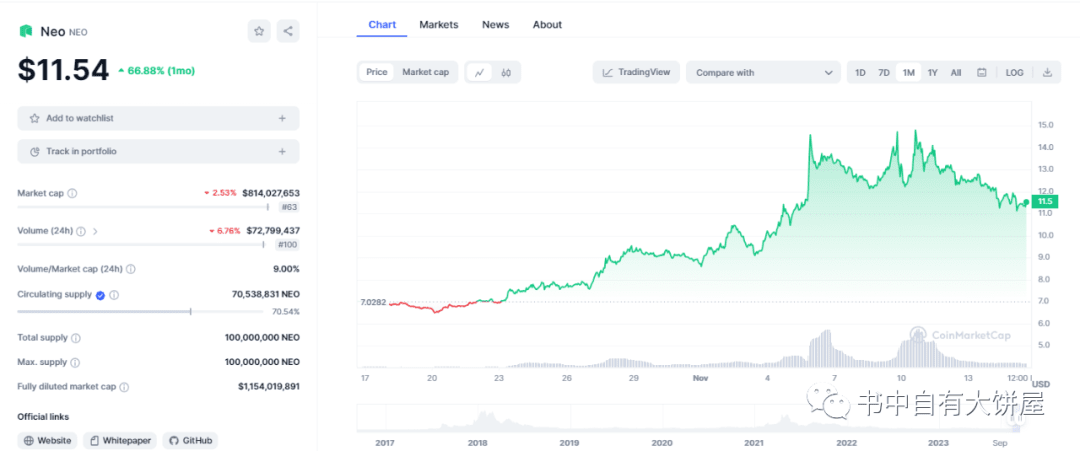
Introduction
The Neo blockchain was co-founded by Da Hongfei and Zhang Zhengwen in 2014. It was initially called Xiaoyi, and was later renamed Neo in 2017 and has been developed to this day. It was once hailed as “China’s Ethereum”.
The NEO blockchain allows you to manage your smart assets quickly, efficiently, safely and legally by combining a series of technologies such as peer-to-peer network, Byzantine fault tolerance, digital certificates, smart contracts, superconducting transactions, and cross-chain interoperability protocols.
In April 2016, dBFT, the first original consensus mechanism in China, was released. The dBFT mechanism actually uses an iterative consensus method to ensure that the system reaches a unanimous decision. dBFT, also known as the "authorized Byzantine Fault Tolerance" mechanism, is a fault-tolerant consensus algorithm implemented within the NEO blockchain. Its main purpose is to solve the Byzantine Generals Problem. The dBFT consensus mechanism is one of many solutions to solve this problem. In this mechanism, there are two participants, one is the "accounting node" that specializes in accounting, and the other is an ordinary user in the system. Ordinary users vote to determine the accounting nodes based on the proportion of their equity holdings. When a consensus needs to be passed, a spokesperson is randomly selected among these accounting nodes to formulate a plan, and then other accounting nodes use the Byzantine fault-tolerant algorithm to That is, the minority submits its position to the majority principle. If more than 66% of the nodes agree with the spokesperson plan, a consensus is reached; otherwise, the spokesperson is re-elected and the voting process is repeated.
Neo's mechanism
The dual-token economic mechanism of the Neo public chain: NEO tokens serve as governance tokens, with a total supply of 100 million, 50% allocated to early investors, and 50% used as development funds. NEO holders can participate in network management, such as consensus node voting and parameter modification. GAS tokens serve as public chain fuel, with no upper limit on the total amount and a destruction mechanism. There are currently approximately 101.2 million GAS tokens in circulation, with 5 being generated in each block.
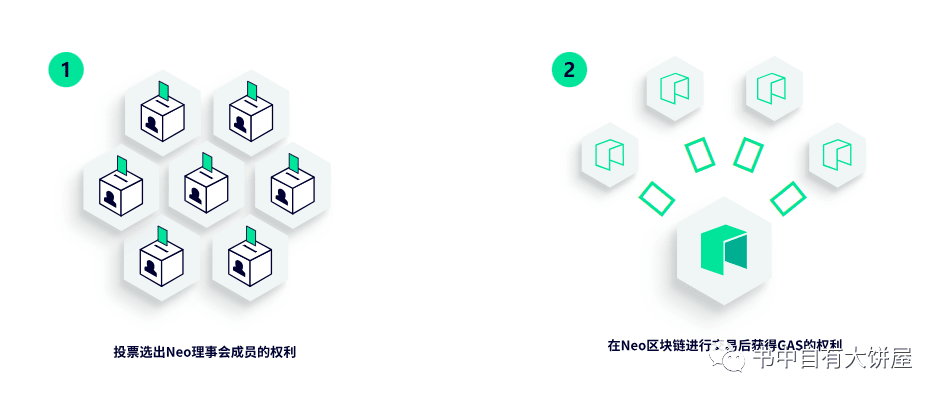
The early GAS token distribution method was relatively simple. NEO holders evenly distributed the GAS tokens generated by the block under specific conditions (specific conditions include NEO transfers and voting, etc.). This distribution method may cause NEO holders to be inattentive to governance because they can easily obtain GAS tokens and care less about the governance process. This means there are not enough incentives to participate in governance.
In order to solve this problem, the Neo team iterated in 2021 and migrated the public chain from the Neo Legacy stage to Neo N3.
In the Neo N3 governance model, candidates, committee members, and consensus nodes play important roles. The committee is responsible for main network parameter adjustment and on-chain environment maintenance, and the consensus nodes are responsible for packaging transactions and generating blocks. Committee members and consensus nodes are selected from a certain number of candidates with the highest votes. The new governance mechanism makes governance more decentralized and orderly, thereby improving the overall governance efficiency of the public chain.
New version of GAS
Operating and storing smart contracts in the Neo network requires GAS to prevent the abuse of node resources. System fees will be burned, and network fees will be redistributed to consensus nodes as an economic incentive for them to provide services.
Each block generates five GAS and assigns them to three types of roles:
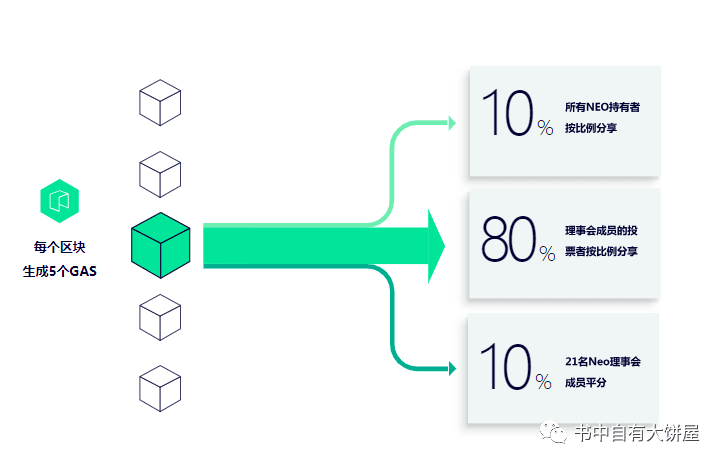
The smallest unit of GAS is 0.00000001. There is no need to pledge NEO to claim GAS. Most Neo wallets include a claim feature that allows you to claim GAS with the click of a button. Please note that some exchanges will distribute GAS to users holding NEO on their platform, while others will not.
Most of the GAS will be distributed to voters as a reward for their active role in network governance. If NEO holders want to participate in governance, they must ensure that the wallet used supports voting functionality.
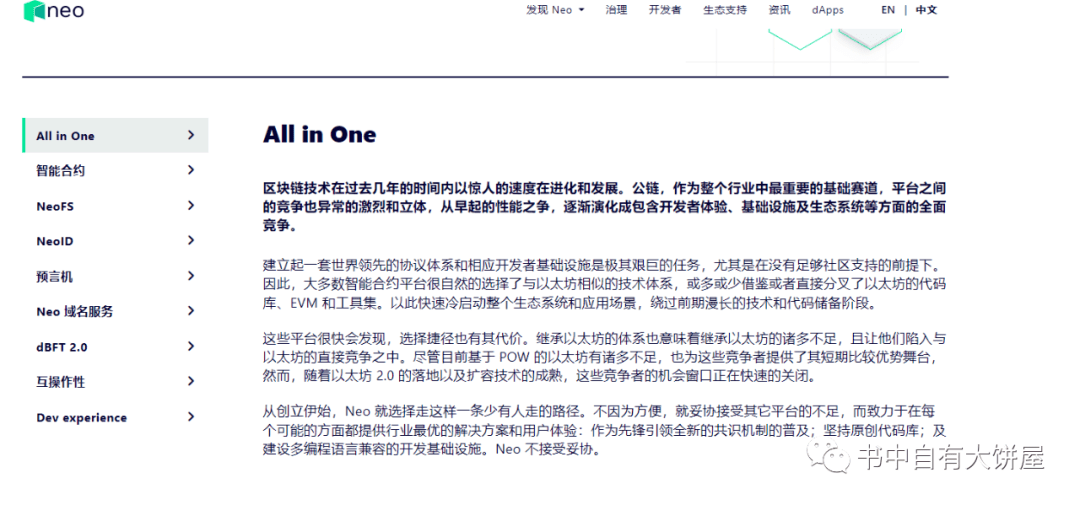
N3 Release Notes-All in One
Neo N3 is positioned as a "full-featured blockchain development platform" with a comprehensively upgraded underlying architecture and multiple optimization mechanisms, including:
Governance model: In order to achieve consensus while ensuring dynamic flexibility, N3’s governance model introduces a Neo Council voted by NEO holders, as well as other pivotal roles such as consensus nodes, Oracle nodes, and state root validators. .
Economic model: The readjusted GAS distribution mechanism will significantly increase the incentives for community members who participate in voting and reward members who are elected to the council.
Architectural changes: In order to provide better development and user experience, Neo N3 will replace Neo Legacy’s UTXO/Account hybrid model with a unified account model, so that developers and users can use digital assets on the platform more intuitively and easily.
dBFT 2.0: A new consensus mechanism that improves efficiency and security, ensuring single-block finality.
NeoVM: The updated NeoVM can be decoupled from the Neo node module and independently deployed for general use.
NeoFS: A decentralized distributed object storage network that gives users full control over their data and enhances security against malicious nodes through a combination of homomorphic cryptography and game theory models.
NeoID: A decentralized digital autonomous identity solution that adds a universal SSI function plug-in to the Neo blockchain, but does not conduct centralized management of identities, but instead authorizes users to store and manage their identities by themselves.
Oracle: N3 has a built-in oracle protocol that can help developers and users easily obtain external data required for smart contracts, thereby connecting the on-chain and off-chain worlds.
Integrate Poly Network: the leading heterogeneous cross-chain interoperability protocol that enables free flow of assets and logical atomicity between blockchains.
Token economy
I won’t talk about the token economy here. You can check the information. Its dual pass certificate should be obvious, because after all, it is almost a 10-year-old project. And when it comes to this big update, it has done a lot of work. , in fact, whether this update is useful or not can be seen from one data, which is TVL. The update at the end of August is already in November, which is almost more than 2 months ago, but the TVL on the chain has not increased at all. More than 30 million US dollars means that you said you have updated many functions to make it more convenient for developers, but no one uses it. This is the key problem.
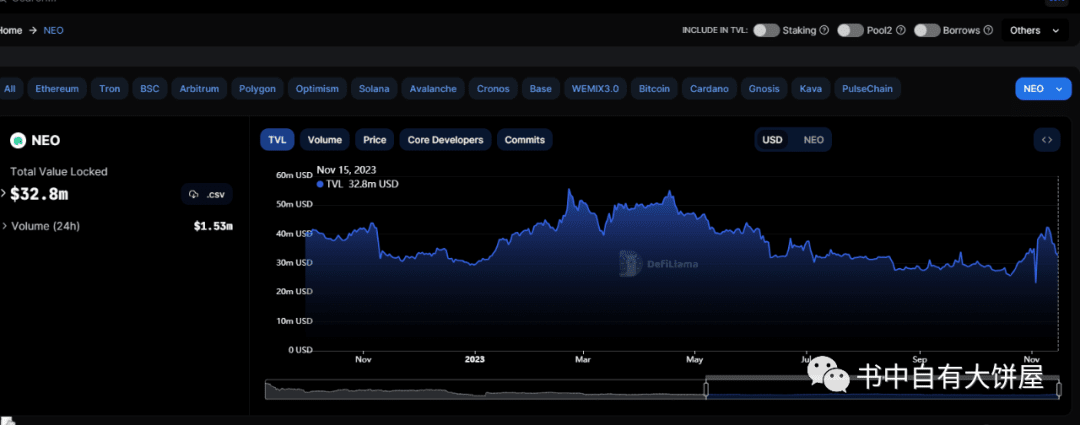
Finally, we summarized that this project is a very old project and there is no innovation in technology, so I skipped it before and did not talk about it. Regarding this surge, especially the surge in its gas token, which has probably increased by more than 10 times, I checked and it is probably due to the following reasons. One is that Neo founder Da Hongfei announced a major initiative: Neo A side chain that is resistant to Miner Extractable Value (MEV) attacks and compatible with the Ethereum Virtual Machine (EVM) is being created. The Neo side chain will be released at the end of 2023. There is also Upbit, a popular exchange in South Korea. Gas tokens have a large trading volume on it, so it may be brought about by Korean sticks. The third point is that when the new version is updated, the supply of gas is relatively low at the beginning, and it is easier to speculate later. There are probably three reasons for the surge in Gas, but if you look at it, it can't sustain it without fundamentals, so now it's starting to fall again. The current market value of NEO is US$800 million, the market value of gas is US$600 million, and the TVL of the entire Ant Chain is only US$30 million, so this explains everything. For public chains, TVL is just.