
1. Summary of Industry Dynamics
1. Industry dynamics
 Last week, the crypto market continued to fluctuate sideways with a slight recovery. On Friday, the U.S. stock market rose but the crypto market performed mediocrely. In terms of trading volume, the decline of centralized exchanges has stabilized but there is no recovery trend. Stablecoins are also in a trend of continuous outflow. As of writing, Bitcoin closed at 16937.48, up 1.96% on the week, with an amplitude of 2.95%; Ethereum performed relatively strongly, up 5.49% on the week, with an amplitude of 7.25%.
The current digital currency market faces two serious minefields. One is the thunderstorm problem of DCG and Genesis. Recently, whether it is Gemini's request for DCG to repay 900 million yuan of users' funds or Genesis's layoffs of 30% again, it indicates that this once behemoth is about to collapse. The other is the recent rumor hidden danger of Huobi. When major exchanges announced their asset status before, Huobi was criticized for holding more than 50% of platform coins as capital reserves. Recently, there have been even bigger layoff news. And Huobi has been facing a serious problem of net asset outflow. Since 2022, Huobi has continued to have a net asset outflow for more than a year, with a monthly net outflow of about 130 million to 590 million US dollars. Only in October 22, there was a positive inflow of 610 million US dollars. That was also the month when Sun Yuchen entered Huobi. Although Huobi's current size does not have much impact on the overall market, in a period of shrinking trading volume, any risk event may cover the market with a layer of haze.
 On the other hand, the US stock market surged on the last trading day of last week, with both the S&P and the Nasdaq rising by nearly 2% in a single day, which brought the price away from the bottom range in the graph. The non-farm data released on Friday exceeded expectations, but the month-on-month slowdown and wage growth slowed down. The number of non-farm payrolls in December increased by 223,000 per month, with a forecast of 200,000, and the unemployment rate of 3.5%, lower than 3.7% last month. The increase in employment and the decline in unemployment rate would have been a standard signal of market crash last year, but miraculously, the US stock market did not fall but rose on Friday. If we want to find a reason from the non-farm data, it may be that the wage growth was lower than expected. The hourly wage in December increased by 0.3%, which was expected to be 0.4%. The wage increase was lower than expected. Major media also gave positive judgments on the narrowing of wages. At the same time, the US Treasury yields also decreased, which also reflected that the market seemed to have a favorable judgment on the 2/1 rate hike. At present, the argument of a 25 basis point rate hike on 2/1 has become popular, and CME's forecast of 25 basis points has also reached 75%. With the expectation of stopping interest rate hikes in 2023, the overall market seems to be moving in a relatively optimistic direction. However, the U.S. manufacturing PMI in December fell to its lowest level since May 2020, and demand from large companies was lower than expected. The reality of the United States falling into recession is becoming increasingly obvious. Therefore, the future direction of the market still needs to be judged with caution.
 2. Industry data
1) Public Chain & TVL
As of January 8, the overall locked-in volume of various public chains denominated in US dollars rebounded slightly, rising from 38.9B last week to 40.1B, an increase of 1.2B.

 The TVL of various public chains fluctuated this week. Solana increased by 12%, ETH, BSC, Polygon and others increased slightly, and Tron and Cronos continued to decline slightly.
This week, Solana rebounded from an oversold price, with a weekly increase of more than 30%, mainly due to Vitalik Buterin's "call" on Twitter on December 30, saying: Solana is a serious and smart development community, those who take shortcuts have been washed out, and Solana has a bright future.

 As soon as this statement was made, the price of SOL rebounded immediately. As the short-selling funds accumulated during the previous decline began to close their positions or stop losses, the violent rebound of the price of SOL was further boosted.
Tron's TVL has continued to decline since January, and the deposit scale of JustLend, the mainstream lending protocol on the chain, has fallen by more than 12%, mainly due to the recent continued decoupling of the algorithmic stablecoin USDD (USDD accounts for 84% of the USDD-3pool on Curve). At the same time, this week, affected by the Huobi FUD (including bank runs, layoffs, and market maker withdrawals), the native token TRX once fell by more than 10%.

2) Stablecoins
As of January 7, 2023, the combined supply of the top four stablecoins (USDT, USDC, BUSD, and DAI) is approximately 132.2 billion, a decrease of approximately 900 million (-0.67%) from 133.1 billion a week ago. The supply of stablecoins has fallen for eight consecutive weeks, and funds have continued to flow out without improvement.
Compared with the end of October (the eve of FTX’s collapse), the supply of the top four stablecoins has decreased by about 8.12 billion (-5.8%); compared with the end of April (the eve of LUNA’s collapse), the supply of stablecoins has decreased by 26.8 billion (-16.86%).
 Among the three major fiat stablecoins this week, the supply of USDT did not change much, with a slight increase of about 19 million pieces. Since the past month, the supply of USDT has been rising steadily and relatively stable; USDC fell sharply again this week, with a supply reduction of 810 million pieces, which is similar to our forecast last week. BUSD was converted to USDC for withdrawal; and after a sharp drop, BUSD's downward trend improved slightly, with only about 100 million pieces reduced this week. Since the past month, affected by Binance FUD, BUSD supply has decreased by 5.6 billion (-25%). The stabilization of BUSD may indicate the end of FUD sentiment.
DAI, which is a leverage of ETH, did not change much this week, with the supply decreasing by about 6 million (-0.11%), indicating that the funds in the market lacked motivation to go long and were mainly on the sidelines.
Overall, the liquidity shortage in the market has not improved. Altcoins rebounded after the new year, while BTC and ETH did not fluctuate much, which also reflects the lack of funds in the currency market: in the case of insufficient liquidity, only oversold small currencies can be pulled up, and the liquidity required for the rise can be obtained through short squeeze. We maintain the view of oscillating bottoming out.
2. Macro and Technical Analysis
The market rebounded slightly following the macro situation. BTC is still mainly sideways, and most currencies led by ETH have rebounded significantly. In the short term, there is a news vacuum and the market is likely to move upward.
The trading volume has increased compared with last week, and the room for upward operation depends on whether it can break through the upper pressure level.

 Two-year Treasury bonds fell after the release of non-farm and wage inflation.
 Nasdaq is in a rebound pattern, but it may touch the previous low in the future
 1. Ahr999: 0.33, can be used for fixed investment
 2. MVRV: 0.846, cost performance is the same as Ahr999
 BTC address number: All coin holding addresses are rebounding
 Number of ETH holding addresses: The number of addresses holding more than 10k ETH is decreasing

 III. Summary of Investment and Financing
Investment and Financing Review
At the beginning of 2023, the crypto VC market was not active, with 7 disclosed investment and financing events and a cumulative financing amount of less than US$10 million;
The $5 million financing of Momentum Safe (MSafe), the first multi-signature wallet on the Aptos chain, is the largest financing project since 2023. It was led by Jump Crypto and co-invested by Circle Ventures, Coinbase Ventures and other institutions.
Organization News

 4. Crypto Ecosystem Tracking
1. NFTs & Metaverse
(1) This week’s NFT market
Market Overview: This week, the NFT blue chip index has risen significantly compared to last week. As of January 6, the overall market continues to recover steadily. Although the market is still at the freezing point of the bear market, judging from the blue chip index within 30 days, NFT has rebounded to a certain extent from the lowest point in November last year, and has shown a stable upward trend for two consecutive weeks.
 NFT total market value: This week, the total market value of the NFT market continued to rise, up 1.34%. The total transaction volume decreased this week (-4.86%) compared to the 19.47% increase last week, but remained relatively stable overall. The transaction volume also showed an upward trend in the past 30 days, with an increase of 97%.
 Market activity: There was little change in the holders of the NFT market this week. The activity of traders decreased compared with last week (-1.06%), the buyers decreased by -1.00% compared with last week, and the sellers increased by 0.44% year-on-year.
 The top three NFTs in terms of NFT market transaction volume this week are Azuki, BAYC, and MAYC. The floor price of BAYC has risen to 84ETH in the past week.
 Overview of Metaverse Projects This Week:
The total transaction volume of the 10 leading blue chip projects in the Metaverse sector this week decreased by 10.8% (mainly due to the otherside -16% and the sandbox - 38.5%). In terms of total market value, due to the addition of the new project nftworld, there is no reference value compared with last week, and the holders decreased by 21.29%. The top three Metaverse projects are Otherside, The Decentraland and the sandbox. It is worth mentioning that the transaction volume of the treeverse project has reached the fourth place. The transaction volume of several leading Metaverse real estate projects has increased this week. The floor price remains in the range of 0.9-1.4ETH.

 (2) This week’s NFT & Metaverse dynamics focus:
Yuga Labs Announce Details of The Otherside Metaverse Second Trip
BAYC Metaverse Project Otherside has announced that it will begin its second Metaverse journey in late March 2023. The first Otherside journey introduced all Monkey holders to their Metaverse, with over 5,000 people logged in at the same time. They also faced off against a giant Koda along with BAYC mascots Curtis and Blue. Yuga Labs has also announced that Voyagers will continue to enter the Otherside with more travel opportunities and persistent Metaverse experiences.
First BAYC trip:
 Second BAYC trip:
According to the official release of Yuga Labs, the second trip to Otherside will see new environments, new mechanics, and even more gameplay updates than users on the first trip. The team promises to provide more gamification options and high-energy entertainment mechanisms to project holders. In the second phase, users will be able to enter Otherside, connect their wallets, and then start using their NFTs immediately. Holders of BAYC, MAYC, or Meebits should have no trouble playing their own unique avatars in the near future. The next trip will most likely take place in a desert map of a Bonedeed. The adventure will follow Curtis, Blue, and the Voyager in search of "glowing, pulsating stones." In addition, new residents of the metaverse are also on their way to the other side.
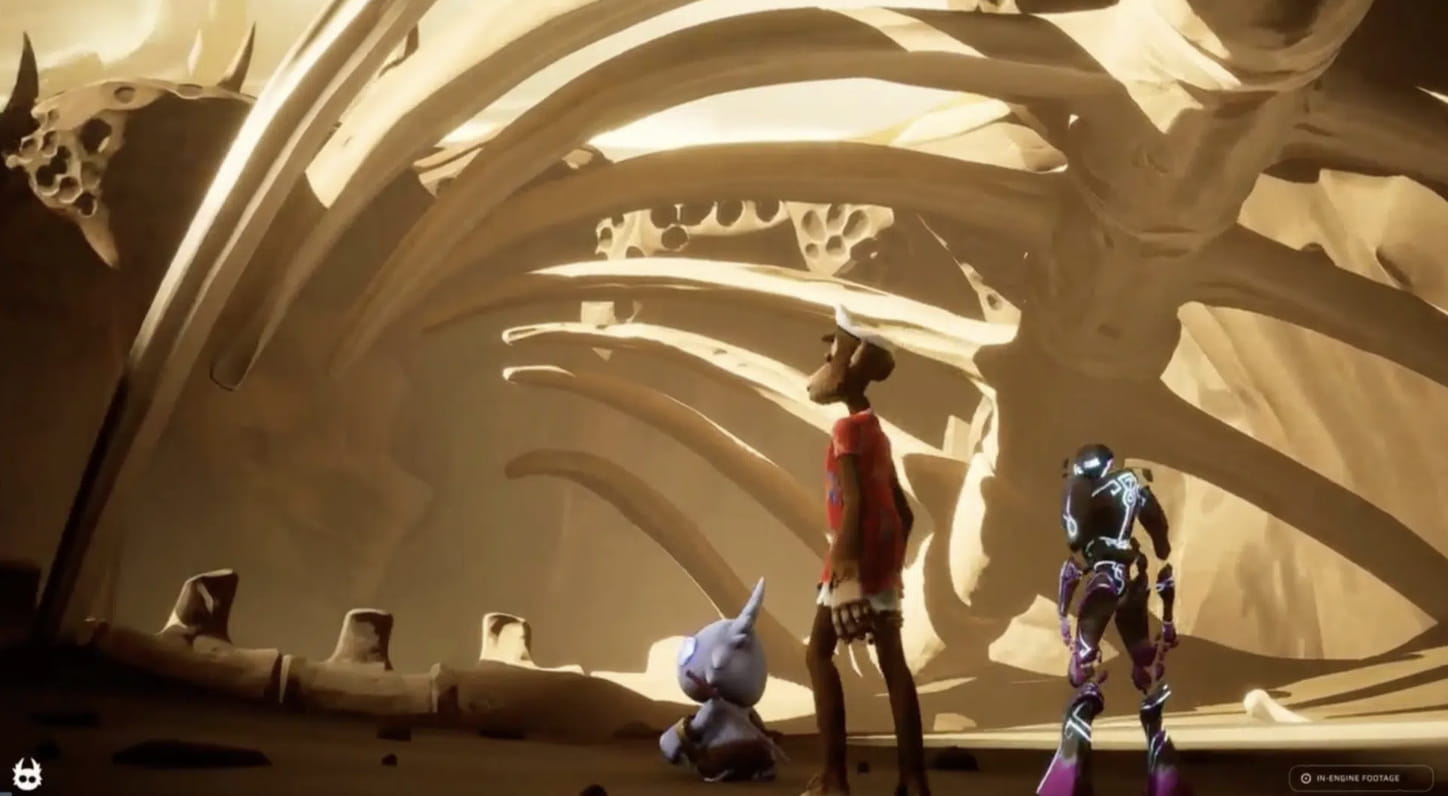 Additionally, Yuga Labs is working with Improbable to enhance their Avatar experience on their Otherside Development Kit (ODK). The new toolkit will not only allow creators to build and customize their avatars, it will also allow users to modify, create and interact with environments in innovative ways. The toolkit is also planned to be built on multiple different types of games. The introduction of these new mechanics and tools will allow Otherside to be used even more.
 Although more details about how to use custom NFTs to enter the Metaverse have not yet been announced, Yuga pointed out that the Metaverse exploration journey will come with the function of flying, which will also raise the expectations of holders very high.
(3) Introduction to key projects: Treeverse
Treeverse is an open-world social game developed for NFT collectors. Players can build their own houses by completing various tasks and display their NFT works here. They can also view other people's collections of NFTs and visit their houses, or explore new lands from their own third-person perspective.

It is worth noting that Treeverse has a category-free "Knowledge Tree" system that allows players to upgrade characters and attributes according to their preferences, thereby shaping their own metaverse adventure experience. This is to attract different types of players and help everyone find their own role in the growing Treeverse, and there are no preset restrictions in the metaverse of Treeverse. Players can mine, chop trees, fish, build and upgrade weapons and enjoy social features. Adventurous players can explore many side quests on the map. Each character and resource plays a role in the game and its economy.
According to founder Loopify, Treeverse is committed to becoming an NFT chat place that replaces social platforms such as Discord, Clubhouse and Twitter, while gamifying the online social experience and integrating social and gaming.
The Treeverse metaverse adopts a dual token model. Currently, the official has released three types of NFTs: Treeverse PLOT (land, floor price 0.8 ETH), NFTrees (tree, floor price 12 ETH), and Timeless Characters (avatar, floor price 0.5 ETH).

Nftrees is a "factory-type NFT". NFT trees can bloom and bear various fruits. The fruits are consumable fruits in the game. Once the player starts planting trees, the holder can set a $ROOT price for the fruits on the trees, and other players can buy them from your trees.
The roadmap of the project is that in the next few months, the team intends to introduce the economic system of the game's governance token and the distribution strategy of $ROOT tokens in more detail. Details about token governance will also be announced soon, and the project party also hopes to obtain feedback from the community. Loopify also expressed the hope that more management power will be left to game developers in the future, but also hopes that there should be a balance. He also said that he would work hard to find a way to motivate users in the long term.
The team will regularly update the progress and new features of the Metaverse project in the form of a monthly magazine.
 2. GameFi Chain Games
Overall review
Overall, there has been a recovery. According to the on-chain contract interaction volume, 80% of the top ten blockchain games have increased year-on-year, among which Benji Bananas has increased by 84% (at the end of the season, the number of addresses receiving P2E rewards increased);
 From the perspective of token price performance, 60% of the top ten blockchain games by market value have risen, and Gala Game has risen by 41.04% in the past week (Gala coin’s utility has been updated, a destruction mechanism has been added, and tokens have further deflated; positive news has been released, and a studio with 20M users has been acquired)
 Project of the Week
Matr1x:https://twitter.com/Matr1xOfficial
Matr1x is an FPS blockchain game. In the future, there will be three games on the Matr1x official website: Matr1x FIRE (FPS), Matr1xWAR (Shooting+MMORPG), and Matr1xEVOLUTION (SOC).
 The game is well-made, playable, and rare in category. It is expected to become the first sophisticated FPS game on the chain. Matr1x FIRE is a PVP multiplayer fair competition shooting game that provides PVE mode, 5V5, and battle royale gameplay. The game world view is built on the cyberpunk world and has a story background of more than 1 million words. More than 30 different weapons and props are provided in the game. Players will initially get ordinary characters for free and can play the game freely. If you need to make money, you need rare NFT characters and upgrade them to improve attributes.
 Token Economics:
FIRE coin: used for various use cases in games, such as avatar upgrades, box openings, and weapon casting
Stablecoin: USDC is a widely used stablecoin that is used as a transaction currency within the game.
NFT: Virtual characters are characters used by players for combat, and high-quality NFTs allow players to earn FIRE tokens and obtain weapon treasure chests in the game. Players can open boxes to obtain various NFT props, including combat weapons in the game, and various skins can be applied to weapons, but they do not change the properties of the weapons.
 Users: Matr1x Fire started pre-registration on September 15, 2022, and recorded nearly 28,000 users in less than 96 hours. It is currently in the closed beta stage, with nearly 60,000 pre-registrations.
Team: More than ten years of experience in the game industry, game producers from well-known companies such as Tencent, and have participated in the creation of well-known FPS products such as CF
Investors: Successfully raised $10 million and is about to complete a new round of financing. Past investors include Hana Financial Investments, a major Korean financial holding company; HashKey Capital; Amber Group; SevenX, etc.
3. Infrastructure
Project Introduction
https://twitter.com/eigenlayer
EigenLayer transfers the security of Ethereum to the upper-layer middleware by re-staking the ETH of the Ethereum validator network (for example, staking it to the upper-layer middleware), so that a wider range of infrastructure can share Ethereum-level security.
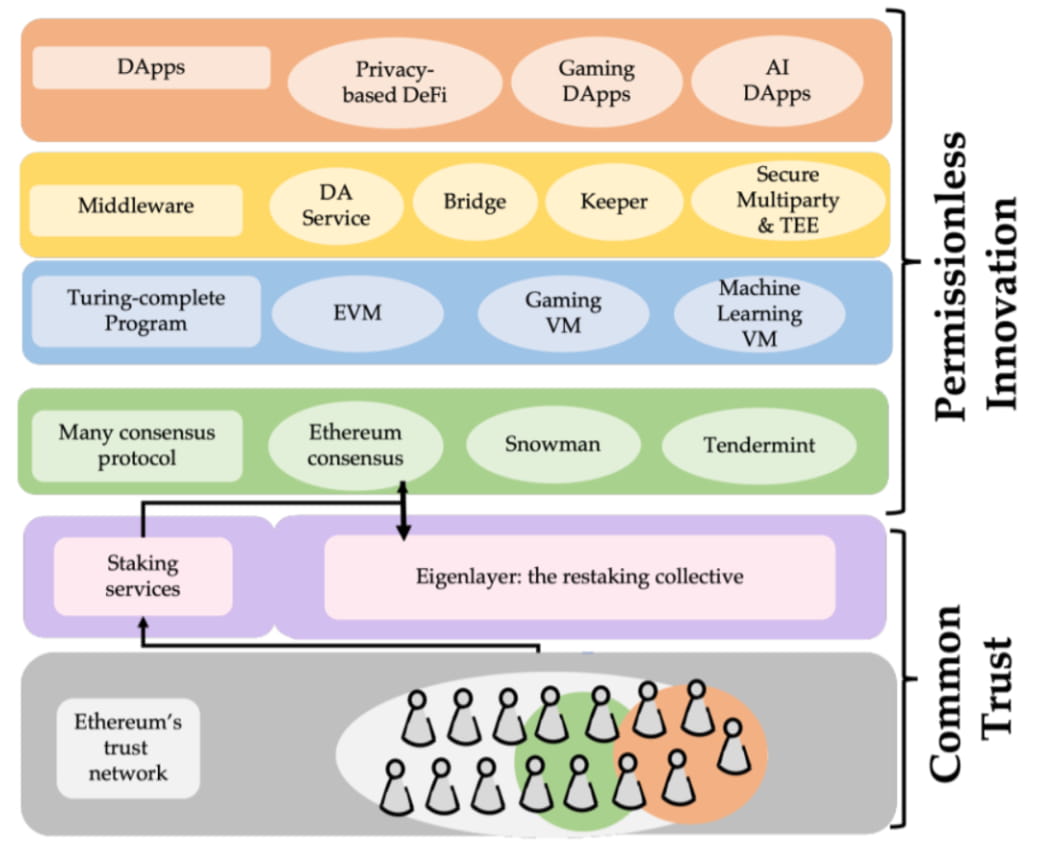 Originally, staking on Ethereum could only earn block rewards, and any malicious behavior would result in the slashing of the staked assets.
Now, through EigenLayer, they can re-stake the ETH that has been staked on the bottom layer on the upper-layer middleware to get more incentives (as shown below). In this way, the validator can pass the security of the bottom layer to the upper-layer middleware. If they do evil, their original ETH stake will be slashed.
The specific implementation method of Restake is: the pledger can set the withdrawal address in the Ethereum network to the EigenLayer smart contract, which gives it the power of Slashing.
In addition to directly restake $ETH, EigenLayer provides two other options to expand the Total Addressable Market, namely supporting LP Tokens for staking WETH/USDC and LP Tokens for stETH/USDC respectively.
For example, the following figure (left) shows the current middleware situation. Each middleware has only $1B in funding to ensure security, which means that hackers only need $1B to break into one of the middleware. However, after EigenLayer is enabled (right), all middleware and Ethereum share a $13B security.
 necessity:
The modularity will lead to a prominent short board effect. Some dApps (such as derivatives that require oracle price feeds) actually rely on the security of both Ethereum and middleware for their security. Assume that a highly composable DeFi application A involves billions of TVL, and the trust of oracle B only relies on hundreds of millions of pledged assets. Once a problem occurs, the risk transmission and nesting caused by the association between protocols may infinitely magnify the losses caused by the oracle. The security of the system depends on its shortcomings, and seemingly insignificant shortcomings may cause systemic risks.
Team Background
Eigenlayer founder Sreeram Kannan is the director of the Blockchain Lab at the University of Washington (UW). Chief Strategy Officer Calvin was previously the head of strategy at Compound. The rest of the team is mainly gigabrain Go developers and researchers from the University of Washington. Most of the other members are PhD students at the University of Washington.
It had previously received a total of US$15.6 million in three rounds of financing.

Token Economy
The white paper does not contain any information related to the token economy, but the founder’s interview clearly stated the expectation of issuing coins.
Summarize
From the perspective of the track, the Ethereum staking track to which EigenLayer belongs is a major narrative in the future. Whether it is the continuation of the Ethereum merger, the upcoming Ethereum Shanghai upgrade in March, or EigenLayer, their most direct impact is to promote the growth of Ethereum staking.
From the perspective of the interests of all parties, as the threshold for re-staking decreases, coupled with the staking boom that will continue for a long time in the future, the degree of retail investor participation will only increase. For project parties, EigenLayer's re-staking can save them the trouble of establishing a verification network and staking sufficient funds, and focus more on developing core functions and improving user experience. From the perspective of ecology, EigenLayer is conducive to the long-term development of the ecology. In addition to the security of the consensus layer brought to the middleware mentioned repeatedly above, more Ethereum-level middleware can be built based on EigenLayer.
In short, for the industry, if successful, secondary staking can create a more effective economic security system while promoting innovation; for users, it is also an additional value-added opportunity, combined with liquid staking derivatives, The capital efficiency of the network can be significantly improved.
5. Team News
JZL Garden Progress
The "Khmer Girl in the Dream - Willow Leaf" project was officially launched last week and is expected to be launched soon. We welcome your continued attention.
JZL Research Annual Summary
2022 is a turbulent year. We have witnessed geopolitical events, wars, epidemics, and the worst inflation in the United States in 40 years and the violent interest rate hikes by the Federal Reserve. The crypto market is also difficult to remain immune. The switching of bull and bear cycles and the depletion of liquidity have triggered a series of black swan events such as the LUNA death spiral, 3AC and FTX bankruptcy. The JZL team has compiled the weekly reports and research reports of the past year to review 2022 with everyone.
Download Link:
https://drive.google.com/drive/folders/1QObFpqK9yza6uX4qEY9CVCI6o87_XTC8?usp=sharing
The content of the document includes: 1) JZL team's weekly crypto market review since March 2022; 2) JZL team's research reports on stablecoins, leading quantitative institutions, NFT platforms and projects, infrastructure tracks, etc. Welcome everyone to discuss and exchange, thank you!
about Us
JZL Capital is a professional institution registered overseas, focusing on blockchain ecosystem research and investment. The founder has extensive work experience and has served as CEO and executive director of many overseas listed companies, and has led and participated in eToro's global investment. Team members come from top universities such as the University of Chicago, Columbia University, University of Washington, Carnegie Mellon University, University of Illinois at Urbana-Champaign, and Nanyang Technological University, and have served internationally renowned companies such as Morgan Stanley, Barclays Bank, Ernst & Young, KPMG, HNA Group, and Bank of America.

