


Yesterday, the Uniswap community voted to approve the temperature check proposal to "invest in Ekubo Protocol", after a vote of over 60% against the proposal, including market makers Wintermute and Keyrock, who expressed strong opposition. StableLab Lianchuang even said, "If this proposal is passed, I think the Uniswap governance organization should seriously think about the role of governance and accountability."
Proposal Details
Moody Salem, founder of Ekubo Protocol and former head of the Uniswap development team, initiated a proposal on the governance platform on October 13 and started the temperature check vote on Snapshot on October 23. The specific content of the proposal is as follows:
Investment needs: Ekubo proposed to cooperate with Uniswap DAO, and Uniswap provided 3 million UNI (worth about 12 million US dollars) in exchange for 20% of the future Ekubo protocol governance tokens. The main uses include engineering, auditing and legal support. Ekubo will also provide knowledge sharing authorization to Uniswap;
Token Plan: Within 1 month of passing this proposal, deploy a governance contract on Starknet that includes a token representing voting rights on the Ekubo protocol. Uniswap will receive 20% of this token, which it can redistribute at its discretion;
Background advantage: Moody Salem left Uniswap and devoted himself to developing AMM (Ekubo) on Starknet because he believed in Starkware's technical vision. The proposal stated that "Ekubo accounts for about 75% of Starknet's total transaction volume, while TVL accounts for only 5%", and also "reached a cooperation with Argent, the largest wallet on Starknet".
Opposition
Wintermute objection
“We would normally support experiments like this and are grateful for this opportunity being presented to the DAO. However, in its current state, we are unable to support this proposal due to the requested $12 million in funding and the implied $60 million valuation.”
Wintermute CEO Evgeny Gaevoy said, "In this case, I recommend that the voting delegates consider this proposal on its own merits, rather than the labels that may be applied to Ekubo Inc. (i.e., regardless of Ekubo's reputation, status, etc.)"
Considering the above:
For the Ekubo token, little or no information is provided beyond its intended use, plans for the remaining 80% of the token supply, etc.
The Uniswap DAO has not yet established a framework for financial diversification and investment decisions.
The above is further amplified by the size of the investment, which would put Ekubo above similar projects such as Paraswap, IDEX, and QuickSwap in the FDV ranking. These protocols exist on highly active chains and already have significant trading volume. (We do not think it is correct to compare Ekubo directly to these protocols, but it helps to determine the approximate market pricing).
Starknet’s TVL is $152.8 million, which is 2.5 times the implied FDV of Ekubo.
Ekubo appears to be an “amazing” DEX that has proven capable of capturing a large share of the DEX volume market share on Starknet. However, this decision requires the DAO to bet on both Ekubo and Starknet, which seems optimistic and overly forward-looking based on the implied FDV and insufficient information.
Market maker Keyrock opposes
Without a framework or committee to conduct more than 2-3 weeks of DD, we simply cannot justify any use of UNI for venture capital.
Finally, Ekubo should focus on building the DEX instead of holding an additional 2.5 million UNI delegated voting rights, and needs to consider becoming an active governance participant. If there is a need to create and promote proposals for future development, there is a group of delegates who can easily contact them with this ability.
In summary, the core arguments against this are:
3 million UNI is too high a valuation for the project;
The project has difficulty in being effectively governed using the voting rights granted by the tokens.
Project Details
Official documentation: The Ekubo protocol has centralized liquidity, singleton architecture, and scalability. It is designed to take full advantage of the Starknet architecture, with the goal of providing optimal Swap execution and liquidity provider returns.
Project Features
Save Gas: Ekubo adopts a model called "till", which means that all pools are managed in a single contract, and when trading with the Ekubo pool, the token transfer will be postponed until the end of the transaction. That is, users do not need to transfer tokens, and aggregators can save them in Ekubo for subsequent use, thus completely avoiding expensive token transfers. (Odaily Planet Daily Note: Same as the singleton model that Uniswap V4 will implement.)
As a result, users can perform many operations across multiple pools and only make the minimum number of token transfers required. The highly optimized and capital-efficient design combined with Starknet’s low fees enables the Ekubo Protocol to provide the best Gas execution network;
Centralized liquidity: users can provide LP within a specific range; (refer to Uniswap V3)
Scalability: Allows the creation of permissionless pools and implements features such as limit orders, TWAMM, etc. (See Uniswap V4)
Project Data
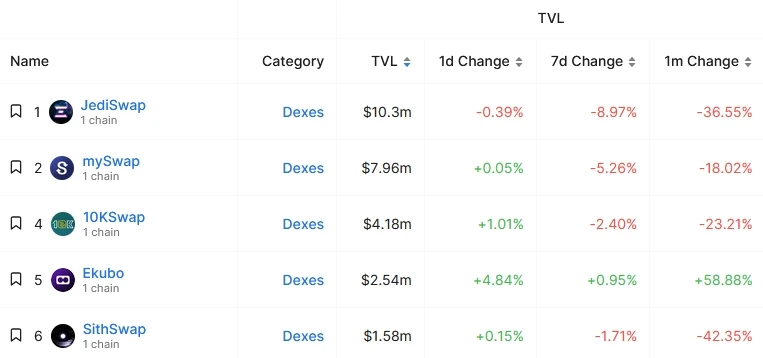
TVL is not dominant: According to DefiLlama data, Ekubo’s TVL is 2.54 million US dollars, ranking fourth among Starknet’s major DEXs.
Estimated revenue from the agreement:
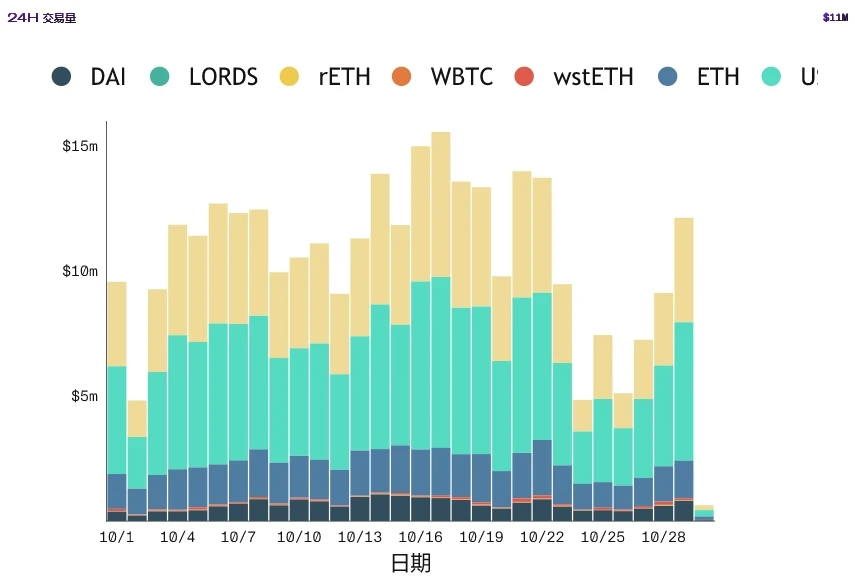
(1) Trading volume: The following is the official daily trading volume. The lowest daily trading volume in the past month is US$5 million and the highest is US$15 million. Here we assume that the daily trading volume is US$10 million.
(2) Transaction fee rate: The transaction fee rate of other DEXs on Starknet is 0.3%, including JediSwap, mySwap, 10KSwap, etc.
Ekubo offers 6 fee levels, including 0%, 0.01%, 0.05%, 0.3%, 1%, and 5%.
Judging from the official data, the fees are very low compared to other DEXs. The estimated fee for USDC-USDT trading pair is 0.0015%, and the fee for ETH-USDC trading pair is 0.0478%.
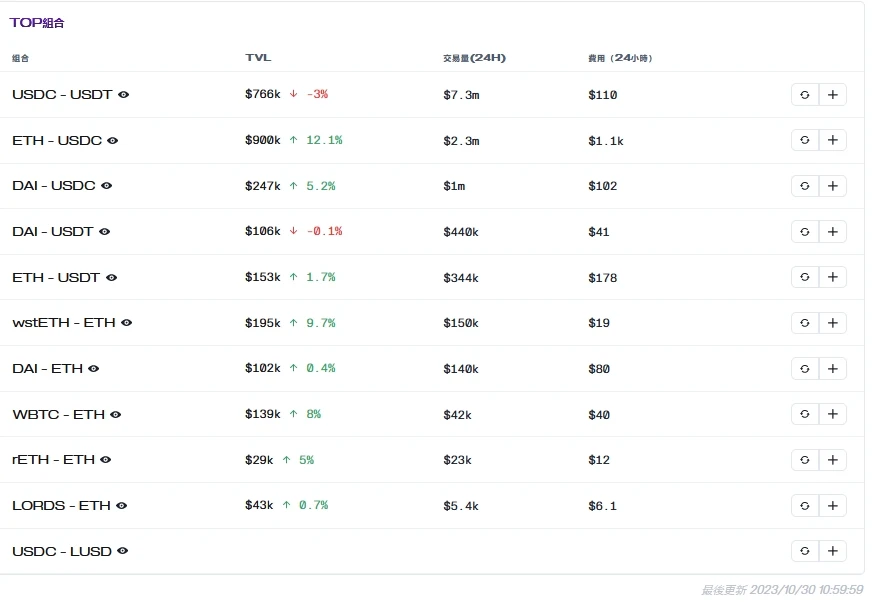
(3) Annualized transaction fees: Based on the official 24-hour trading volume of USD 11.739 million and daily transaction fee income of USD 1,688 as disclosed in the above figure, and calculated based on a daily trading volume of USD 10 million, the annual revenue of the DEX is 1000 ÷ 1,173.9 × 1,688 × 365 = USD 524,800.
(4) External comparison: According to DefiLlama data, the transaction fee income of the several DEXs mentioned by Wintermute above are:
Paraswap: 12 months from November 22 to now, $6.19 million;
QuickSwap: 12 months from November 22 to now, $5.74 million;
IDEX: Not disclosed.
in conclusion
In summary, although Ekubo’s trading volume is indeed significantly higher than other DEXs on Starknet, it only attracts users through its extremely low fees, rather than the characteristics and advantages of the protocol itself, and it is difficult to generate effective income. The estimated annual income of $524,800 is indeed significantly insufficient compared to the $12 million investment.
Although the opposition rate to the proposal once exceeded 60%, 8 million UNI votes from Jesse Walden directly reversed the situation (38% of the votes in favor and 24% of the total votes). It is reported that Jesse is the co-founder and general partner of Variant. Jesse led the company's investment in Uniswap, Phantom, Mirror, Flashbots, Foundation, etc. However, the opinions raised by Jesse in the governance forum cannot answer the above major questions:
“Directionally, if there was an arrangement that would allow Moody/Ebuku to make core developer contributions to the Uniswap protocol codebase (over a meaningful timeframe), I think that would be worth figuring out.
The details of how this would work in practice are not fully spelled out in this proposal, but could be fleshed out in more detail in subsequent governance proposals.
Also, the idea of Ebuku becoming the “official” Uniswap v4 deployment on Starknet is interesting given the effort/skill required to build on Cairo.”
Recently, Uniswap's application for US$46.2 million in working funds and the introduction of front-end fees have also caused a lot of controversy in the community, but they have been successfully implemented. The unity and effectiveness of public opinion and project governance may still require further consideration.