


This article briefly:
More than 1.4 billion people worldwide lack access to basic financial services, posing a major challenge.
PwC report highlights blockchain’s role in financial inclusion, with nearly 200 stablecoins proliferating.
The report also shows that 3.55 billion people in developing economies have never saved.

PricewaterhouseCoopers (PwC) has outlined the need for blockchain technology to address the ongoing financial inclusion problem, which is only set to grow worse over time.
“Financial inclusion remains a major global challenge, with more than 1.4 billion people lacking access to accounts or basic financial services,” the report states.
PwC advocates blockchain to expand financial access
A recent report from PwC highlighted the significant growth in innovative services within blockchain networks, which PwC noted plays a key role in promoting financial inclusion.
One effect it specifically points to is the proliferation of stablecoins:
“Today, there are nearly 200 different stablecoins to choose from, offering users the stability of multiple traditional fiat currencies while maintaining the benefits of digital assets, with the largest stablecoin being pegged to the U.S. dollar.”
It highlights the importance of providing alternatives, as many people in developing countries face limited access to traditional financial institutions.
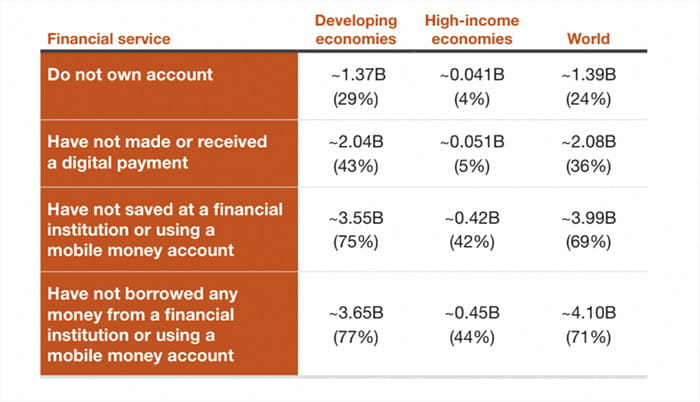 Number and proportion of people who have never used financial services. Source: PwC
In addition, PwC claims that approximately 3.55 billion people in emerging economies have never saved.
However, PwC highlighted the emergence of crypto platforms that are currently facilitating the creation of digital wallets on blockchain networks, allowing users to store stablecoins and generate yield.
This provides an alternative for individuals who do not have access to traditional financial institutions.
Developing countries favor CBDC
Furthermore, 43% of individuals in developing countries have never made an online payment.
Meanwhile, a recent survey by the Chartered Financial Analyst Institute (CFA Institute) shows that central bank digital currencies (CBDCs) are becoming increasingly popular in developing countries.
In developed countries, only 37% of respondents expressed a preference for CBDCs, while in emerging markets, that figure rises to 61%.
On the other hand, BeInCrypto recently reported that 130 countries, representing 98% of the global economy, are actively exploring the implementation of CBDCs. Furthermore, most G20 countries are actively moving forward with plans to introduce CBDCs in the coming years.
Meanwhile, India has thousands of customers and merchants signing up for the country’s CBDC pilot. The e-Rupee initiative is actively exploring the feasibility of digital cash alternatives.
It is understood that more than 20 countries are actively promoting CBDC pilots this year. #普华永道 #数字支付