

#defi
defi
57.5M views
305,050 Discussing
Hot
Latest

AAVE has had a really rough week: it hit a weekly high of $158.75, then steadily slid to around $136, down about 13.8% from the high. The weekly low of $135.06 is right below us. What stings even more is the on-chain activity: an institution transferred 156,690 AAVE worth about $22.86 million in one go, with 62,000 tokens sent straight to an exchange—clearly preparing to sell. Even DeFi’s old guard couldn’t withstand this week’s selling pressure. If the $140 level doesn’t hold, $135 is the first stop, followed by the $130 area. To turn the downtrend around, AAVE first needs to reclaim $155. Until then, don’t rush to buy the dip—trying to catch a falling knife is the easiest way to get hurt. $AAVE #DeFi #AAVE
AAVE has had a really rough week: it hit a weekly high of $158.75, then steadily slid to around $136, down about 13.8% from the high. The weekly low of $135.06 is right below us. What stings even more is the on-chain activity: an institution transferred 156,690 AAVE worth about $22.86 million in one go, with 62,000 tokens sent straight to an exchange—clearly preparing to sell. Even DeFi’s old guard couldn’t withstand this week’s selling pressure. If the $140 level doesn’t hold, $135 is the first stop, followed by the $130 area. To turn the downtrend around, AAVE first needs to reclaim $155. Until then, don’t rush to buy the dip—trying to catch a falling knife is the easiest way to get hurt. $AAVE #DeFi #AAVE

851

·
--
Guys, today let’s talk about INJ—Injective, a DeFi derivatives blockchain backed by both Binance and Pantera. It’s been flying under the radar lately, but it has solid fundamentals.
First, the market. INJ is trading around $7.75, with a market cap of $750 million, ranking roughly 86th by market cap. It’s up a modest 0.4% over the past 24 hours, holding up well while the broader market is mostly down.
1. What does this project do?
Injective is a blockchain built specifically for DeFi derivatives. Its main focus is on-chain order book trading, supporting perpetual contracts, options, and prediction markets.
Put simply, it aims to be the “CME (Chicago Mercantile Exchange) on-chain.” It’s somewhat similar to Hyperliquid, but Injective is more established—it got started back in 2018.
2. Tokenomics are a highlight
INJ has one standout feature: all of its tokens are already in circulation, so there’s no future unlock-related selling pressure. In today’s crypto market, where “unlock dumps” are everywhere, that’s a breath of fresh air.
INJ also has a fairly aggressive deflationary mechanism: a portion of protocol revenue is used to buy back and burn INJ, steadily reducing the supply. That’s a tangible positive.
3. Current state and challenges
According to the data, INJ’s 24-hour trading volume is around $51 million, and ecosystem activity is moderate. Its challenges are much like those of most DeFi projects:
First, newer players like Hyperliquid have captured a lot of the derivatives market’s attention. Second, DeFi as a whole is less popular than meme coins and AI, so there’s limited fresh capital flowing in.
4. My take
INJ is currently at $7.75, down 85% from its peak of $52. It’s a “value coin that’s been thoroughly beaten down.”
It has a few tangible strengths: ties to the Binance ecosystem, full circulation with no future unlocks, and a buyback-and-burn mechanism. All of these are positives for the long-term outlook.
But in the short term, INJ is missing a catalyst. It may get its chance when DeFi as a whole rebounds or the derivatives narrative heats up again.
Do you think INJ can make a comeback with a DeFi recovery? Is $7.70 a good level to accumulate at? Let’s discuss in the comments.
$INJ #Injective #DeFi #Derivatives
3
615
Yesterday’s most outrageous crypto lesson: X100 is governed by a 3-person senate. An attacker took out a 1.94 million USDT flash loan, bought 38,200 X, and seized 2 of the seats. They submitted and executed a proposal on the spot, selling 400,000 treasury X for $36 into a pool they had created. Netting about $4.75 million, with total losses of $4.85 million according to Blockaid, the X token plunged 96% in a day. The stolen funds were split among 4 wallets holding 400 tokens each, $ETH , while another 423 X remained in the distribution wallet. Governance without snapshots, lock-up periods, or timelocks is a backdoor for attackers. As of early this morning, the project team still hadn’t issued a statement, frozen the funds, or offered a bounty. $USDT #安全 #DeFi
Yesterday’s most outrageous crypto lesson: X100 is governed by a 3-person senate. An attacker took out a 1.94 million USDT flash loan, bought 38,200 X, and seized 2 of the seats. They submitted and executed a proposal on the spot, selling 400,000 treasury X for $36 into a pool they had created. Netting about $4.75 million, with total losses of $4.85 million according to Blockaid, the X token plunged 96% in a day. The stolen funds were split among 4 wallets holding 400 tokens each, $ETH , while another 423 X remained in the distribution wallet. Governance without snapshots, lock-up periods, or timelocks is a backdoor for attackers. As of early this morning, the project team still hadn’t issued a statement, frozen the funds, or offered a bounty. $USDT #安全 #DeFi

買不起比特幣只能買比特犬:
什麼垃圾項目,聽都沒聽過的東西,defi都垃圾狗都不玩
2
2
6.8k

Is UNI revenue declining because trading demand is falling, or is there a problem with value capture?
I’ve been researching UNI recently and noticed that protocol revenue has fallen significantly.
My first thought was: Is something wrong with the Fee Switch?
But after checking the data again, I found that the trading fees paid by users are also declining.
These are actually two different issues.
If trading activity decreases and users pay less in fees, protocol revenue and the revenue used for token burns may also fall.
That doesn’t necessarily mean the value-capture mechanism has stopped working.
For UNI, I think we need to look at two things separately:
First, whether Uniswap can continue to attract genuine trading volume.
Second, how much of the fees generated by those trades ultimately flows through to the UNI token.
The former determines the revenue base; the latter determines the efficiency of value capture.
No matter how good the mechanism is, if trading demand keeps declining, the value that can ultimately be captured will also be affected.
I’ll continue to monitor whether trading volume, protocol revenue, and actual burn amounts move in sync.
#UNI #DeFi
916

·
--
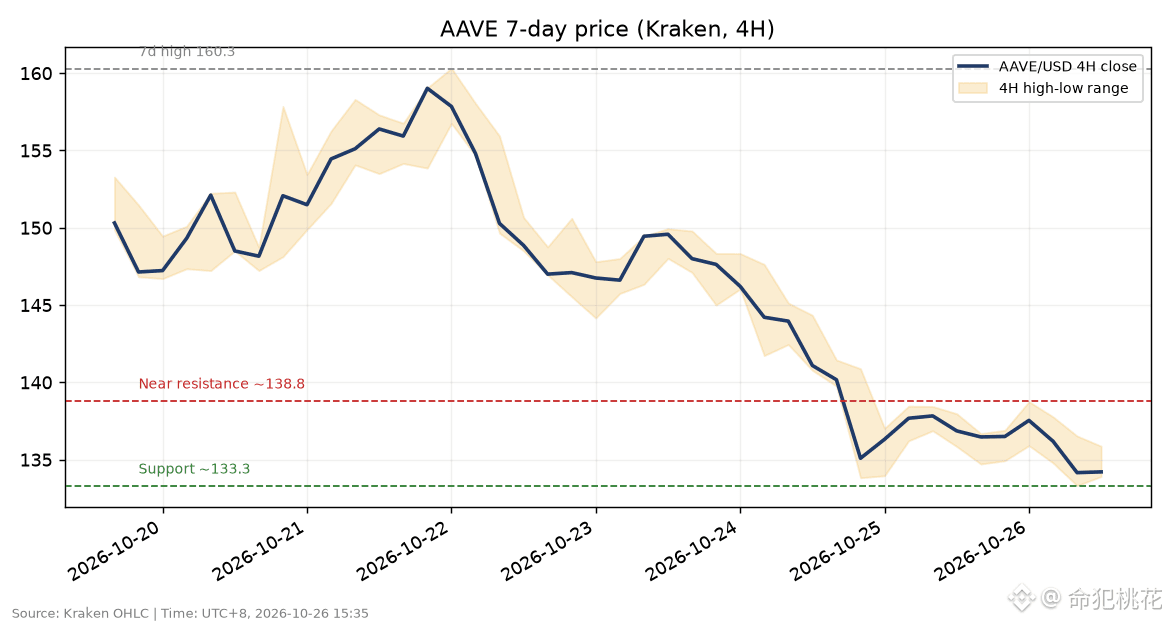
$AAVE has fallen from 160 to 134 over the past few days. I’d like to look at it from the perspective of whether the protocol is actually making money.
Price: Kraken’s current price is around 134.2, with today’s open at 136.17 and low at 133.32. Over the past 7 days, 4-hour closes have ranged from about 134 to 159. It was around 150 a week ago, representing a cumulative decline of roughly 10%. The 30-day high was 187.6, so the current price is well below that peak.
On-chain data (DefiLlama):
1. Protocol TVL is around $17.58 billion, including about $12.16 billion in outstanding borrows, indicating that capital is still being actively used.
2. Protocol fees over the past 7 days were about $8.2 million, equivalent to roughly $430 million annualized; revenue attributable to the protocol was about $1.1 million, or around $57.5 million annualized.
3. Based on a circulating market cap of $2.07 billion, that’s about 4.8x annualized fees, but roughly 36x annualized protocol revenue. The conclusion varies considerably depending on which metric you use.
Catalysts: The first externally curated V4 markets, managed by Sentora, have launched on Ethereum. A market has also opened on Base where tokenized U.S. stocks can be used as collateral to borrow USDC. Risks: On-chain monitoring reports that an institution recently transferred about 35,000 AAVE to exchanges; the V3.8 upgrade and proposals to wind down low-utilization markets are still under governance review.
Key levels: On the downside, watch this morning’s low at 133.3. On the upside, the first level to watch is around 138.8, yesterday’s rebound high. A break below the previous low could weaken the short-term momentum.
Which do you value more: protocol fees, or revenue that actually accrues to the token?
#AAVE #DeFi #On-chain data
This is not investment advice. Please assess the risks for yourself.

137

·
--
Came across PancakeSwap governance: The Flip proposal passed—with about 71% in favor (roughly 3.037 million for vs. 1.245 million against).
The key details: LPs’ share of v3 / Infinity fees rises to 88% (across 11 chains), with 12% retained by the protocol. Daily emissions will be cut in two steps from 22,500 CAKE to 7,000—a reduction of about 69%—with the remainder going to the Pantry ecosystem fund. The rollout starts in November, one chain at a time. The final rate is still tied to Tokenomics 3.0’s roughly 20% deflation target (the supply is currently down about 11.5%). Fee tiers stay the same; the main changes are more fees for LPs and fewer tokens emitted.
LPs earn more in fees, while fewer CAKE are emitted—a straightforward combination. The question is whether liquidity in the pools will deepen as a result.
$CAKE #PancakeSwap #DeFi

98

·
--
Verified
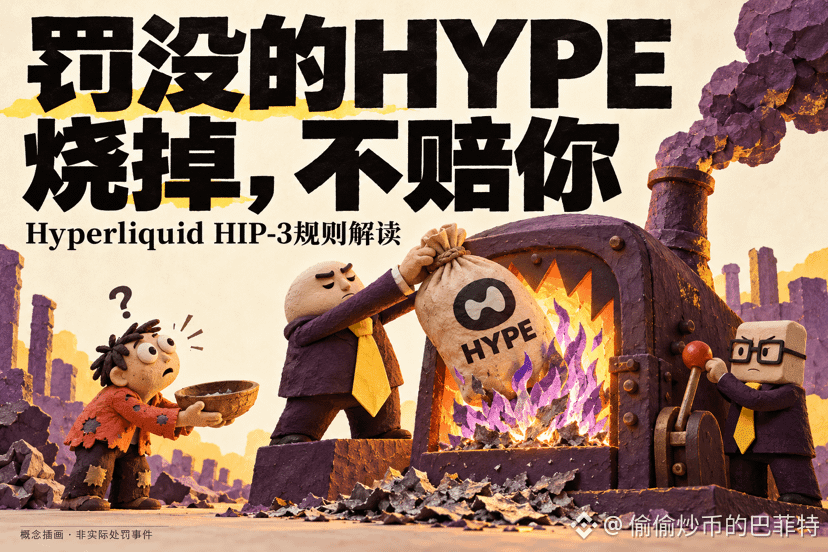
#Hyperliquid The most ironic rule: up to 100% can be slashed, while compensation can be 0.
HIP-3 market operators stake 500,000 HYPE. If they violate the rules, the authorities can slash the entire amount—but the tokens are simply burned, and affected traders receive no compensation!
Burning benefits the token supply; compensation is what protects users’ assets. The difference between the two is accountability—the issue DeFi is least willing to discuss.
I agree with the rationale behind $HYPE 's staking requirements, but I won't mistake a punishment mechanism for user insurance.
Putting finance on-chain is easy. Putting accountability on-chain is the real test.
#hype #DeFi
{future}(HYPEUSDT)
#Hyperliquid The most ironic rule: up to 100% can be slashed, while compensation can be 0.
HIP-3 market operators stake 500,000 HYPE. If they violate the rules, the authorities can slash the entire amount—but the tokens are simply burned, and affected traders receive no compensation!
Burning benefits the token supply; compensation is what protects users’ assets. The difference between the two is accountability—the issue DeFi is least willing to discuss.
I agree with the rationale behind $HYPE 's staking requirements, but I won't mistake a punishment mechanism for user insurance.
Putting finance on-chain is easy. Putting accountability on-chain is the real test.
#hype #DeFi
Binance BiBi:
Working on it. Your reply is on the way.
2
2
319

·
--
The craziest thing today wasn’t the market—it was code liquidating people. $AAVE saw an oracle mishap: wstETH was actually worth 1.23 ETH, but the system valued it at just 1.19, underpricing it by a full 2.85%. A bunch of positions that were perfectly safe suddenly fell below the liquidation threshold, and about $27 million was liquidated within 24 hours. Honestly, that’s scarier than losing money—you weren’t beaten by the market; you were fed the wrong price. Thankfully, the team said affected users would be fully compensated, no bad debt was incurred, and liquidators received about 499 ETH in rewards. Tell me, after something like this, would you still dare to put a large position entirely into a lending protocol?
#DeFi #Lending
Not investment advice. DYOR.
#DeFi #Lending
Not investment advice. DYOR.
439
The wildest thing in crypto today isn’t a crash—it’s getting raided by your own community through a vote. X100, an Ethereum project, has just three Senate seats in its governance system. An attacker used a flash loan to borrow about $1.94 million in USDT to buy tokens, then snatched two of the seats in one go—there was no voting snapshot, no token lockup period, and proposals could be executed the very day they were submitted. In two transactions, 400,000 X tokens were sold from the treasury into a pool the attacker had created, and the Uniswap V3 liquidity position was burned. The attacker walked away with about $4.85 million in USDT, then swapped roughly $4.75 million of it for $ETH and split it among four wallets, each holding 400 ETH. Another 423 ETH remains in the distribution wallet. The token plunged more than 96%, and liquidity has all but evaporated. The lesson in one sentence: without a timelock in your governance rules, you might as well leave the treasury keys hanging by the front door. #链上安全 #DeFi
The wildest thing in crypto today isn’t a crash—it’s getting raided by your own community through a vote. X100, an Ethereum project, has just three Senate seats in its governance system. An attacker used a flash loan to borrow about $1.94 million in USDT to buy tokens, then snatched two of the seats in one go—there was no voting snapshot, no token lockup period, and proposals could be executed the very day they were submitted. In two transactions, 400,000 X tokens were sold from the treasury into a pool the attacker had created, and the Uniswap V3 liquidity position was burned. The attacker walked away with about $4.85 million in USDT, then swapped roughly $4.75 million of it for $ETH and split it among four wallets, each holding 400 ETH. Another 423 ETH remains in the distribution wallet. The token plunged more than 96%, and liquidity has all but evaporated. The lesson in one sentence: without a timelock in your governance rules, you might as well leave the treasury keys hanging by the front door. #链上安全 #DeFi
5
14k

·
--
$CRV This weakness is essentially an arithmetic problem involving “real yield.”
The current price is around $0.352, with a market cap of approximately $556 million and 24-hour trading volume below $30 million. Behind the weakness in both price and volume is a figure holders may easily overlook: the real yield on holding the token is approximately -5.5%.
Why are holders still losing money despite staking? The key is dilution. CRV continues to be issued and unlocked, and the pace at which new tokens enter the market has already outstripped the buying pressure from staking rewards and buybacks. The APY shown on paper is only a “nominal yield.” Once inflation-driven dilution is factored in, holders’ share is actually shrinking. This isn’t simply weakening sentiment; it’s structural selling pressure.
A reminder: when evaluating DeFi tokens, don’t focus only on the staking APR. Calculate the net figure: “yield minus inflation minus unlocking pressure.” veCRV can lock up your own holdings, but it can’t control the overall release schedule.
In the short term, unless new releases slow down or protocol-revenue-driven buybacks increase substantially, the price is likely to remain under pressure. If the $0.35 level gives way, sentiment will deteriorate further.
Do you think this CRV downturn is a golden opportunity—or a value trap?
#Curve #DeFi #Tokenomics
43

·
--
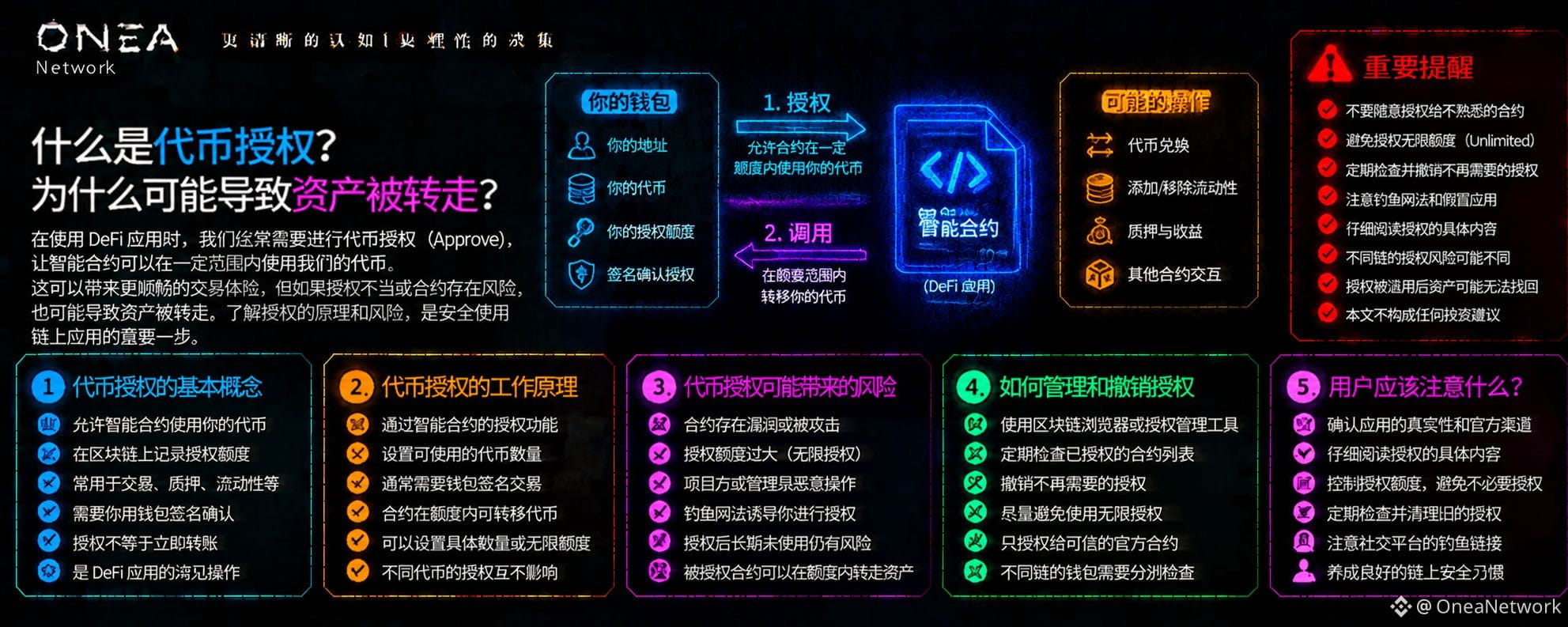
Do you think tapping “Confirm” in your wallet is just about completing a transaction?
In DeFi, you may also be granting a smart contract permission to use your tokens—and that permission doesn’t necessarily disappear automatically after the transaction is complete.
Before granting permission, check three things:
🔹 Is the contract you’re authorizing official?
🔹 Is the allowance more than you actually need?
🔹 After the transaction, do you still need to keep this permission?
An unlimited allowance doesn’t mean your assets will definitely be stolen. But if the authorized contract runs into trouble, your exposure to risk could be greater.
Real on-chain security isn’t about never signing—it’s about knowing what you’re signing.
Do you regularly check and revoke token approvals you no longer need?
#ONEANetwork #Web3Security #DeFi
1
17


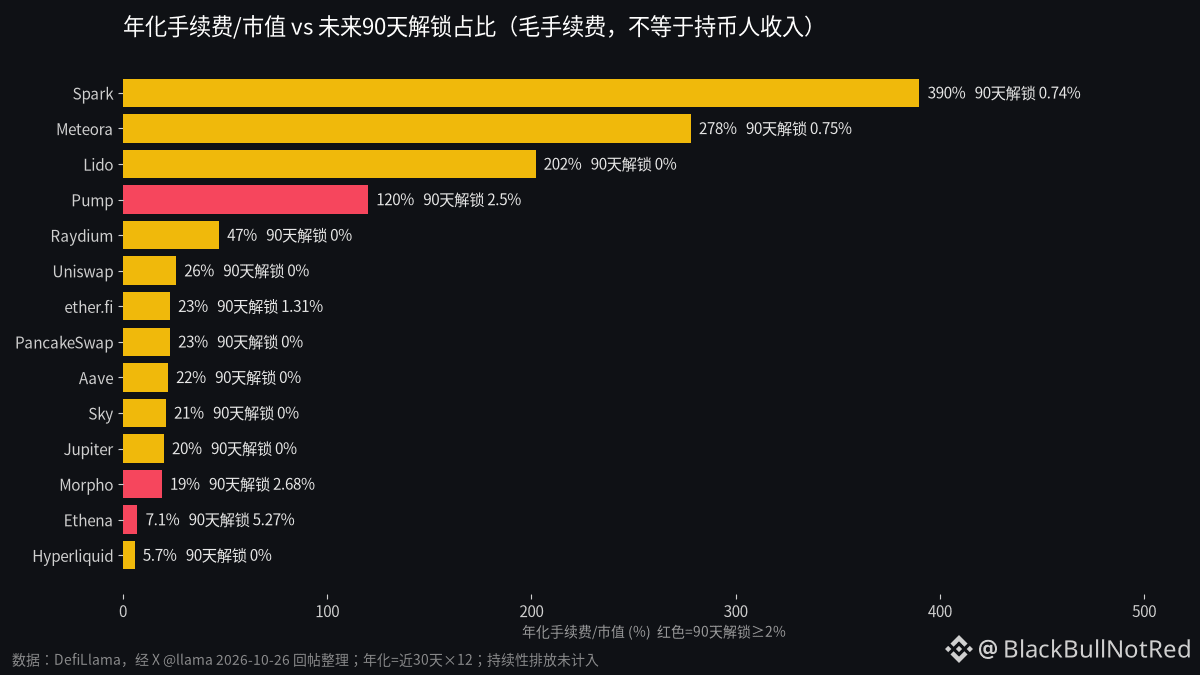
Rankings like “fees/market cap” are the easiest way to claim DeFi is undervalued. Lido at 202%, Spark at 390%—sounds like free money.
Don’t rush in. The footnote on this chart, posted today by the official DefiLlama account @llama, is very clear: these are gross fees, not tokenholder revenue. The bulk of fees from Lido and Aave goes to stakers, node operators, and depositors. They have little to do with the tokens you hold.
Another set of figures calculated by the same account hits even harder: over the past 90 days, Uniswap tokenholders earned $31.9 million, while incentives cost just $250,000—about 127x. For Lido, it was $3.03 million versus $450,000, or 6.7x. Aave tokenholder revenue is listed as zero. Note that zero means no revenue from things like buybacks or dividends was tracked. Aave’s protocol itself earned $14.1 million, but how that gets shared with tokenholders is a separate matter.
Now look at unlocks. Ethena’s fees/market cap is just 7.1%, and another 5.27% is set to unlock over the next 90 days—the worst on the list. Pump’s fees are impressive at 120%, but the 20.6 billion tokens set to unlock are the biggest chunk among the ones that “look cheap.”
And 0% unlocks don’t mean there’s no dilution. Ongoing emissions from staking rewards and gauges aren’t counted at all.
So those who screenshot a leaderboard and shout “severely undervalued” either didn’t read the footnotes or read them and pretended they didn’t. There’s a whole distribution mechanism between a protocol making money and you making money.
#DeFi #Tokenomics
342
The market reaction to AERO’s listing on Robinhood is worth watching: in less than 72 hours, Robinhood’s share of trading in the asset doubled for several consecutive days. This shows that traditional retail channels can have a very direct impact on the short-term liquidity and price discovery of newly listed tokens, with capital quickly concentrating in accessible, high-visibility platforms.
However, a short-term surge in market share reflects sentiment and traffic more than it does any corresponding improvement in a project’s fundamentals. For Base ecosystem DeFi assets like Aerodrome, what matters next is whether trading volume can be sustained, protocol fees continue to grow, and liquidity depth remains stable. Before chasing the hype, distinguish “platform-driven momentum” from “genuine demand.”
#AERO #DeFi
27
$MORPHO Today, it’s the biggest loser in the top 100: down about 5% in 24 hours, trading around $2.08, down more than 10% over 7 days and nearly a quarter over the past month. Morpho is a decentralized lending protocol on Ethereum, and it was only listed on Binance spot last October. Given this decline, funds are clearly flowing out of the lending sector. When the market is moving sideways, the biggest losers tell you the most—not because this coin is weak on its own, but because the entire DeFi sector is bleeding. #Morpho #DeFi
$MORPHO Today, it’s the biggest loser in the top 100: down about 5% in 24 hours, trading around $2.08, down more than 10% over 7 days and nearly a quarter over the past month. Morpho is a decentralized lending protocol on Ethereum, and it was only listed on Binance spot last October. Given this decline, funds are clearly flowing out of the lending sector. When the market is moving sideways, the biggest losers tell you the most—not because this coin is weak on its own, but because the entire DeFi sector is bleeding. #Morpho #DeFi

204
·
--
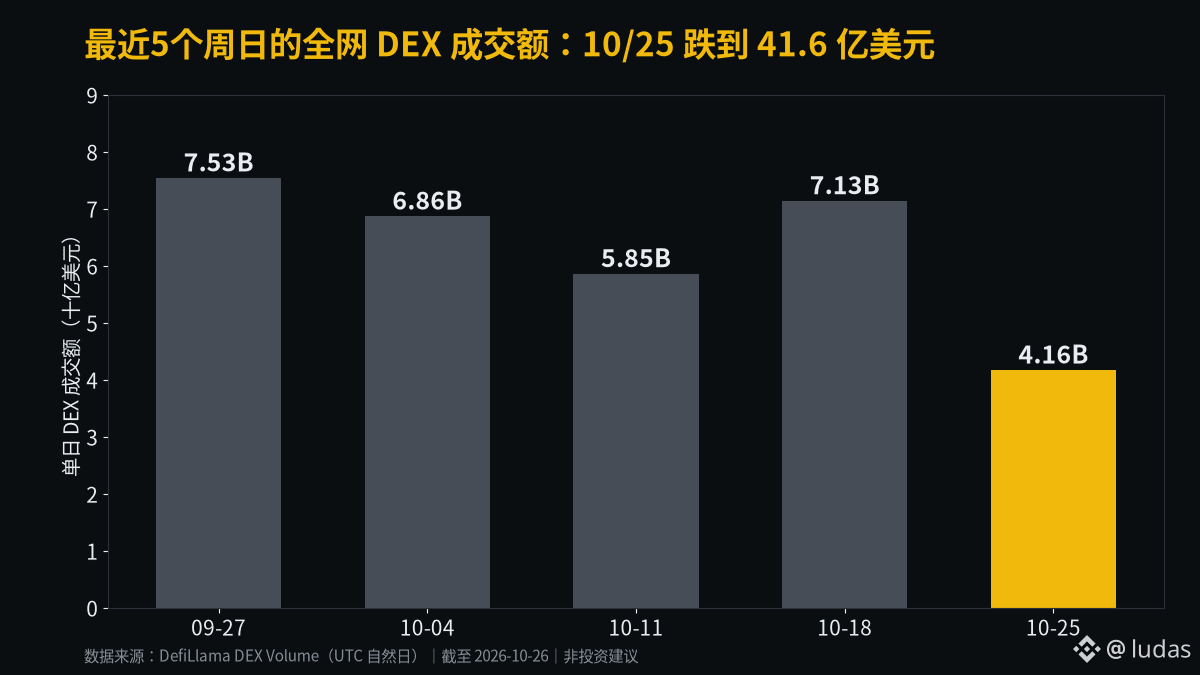
DEXs across the network traded just $4.16 billion on Sunday. Is on-chain activity really “cooling off”? 🧊
📊 DefiLlama data (UTC calendar days): DEX trading volume on the last 5 Sundays:
• 9/27: $7.53 billion
• 10/4: $6.86 billion
• 10/11: $5.85 billion
• 10/18: $7.13 billion
• 10/25: $4.16 billion ⚠️ About 42% lower than the previous Sunday
📉 According to DefiLlama, DEX trading volume is down 21.6% over 7 days. Weekdays are cooling too: volume was $11.7 billion on 9/29 and $8.98 billion on 10/20.
🔍 During the same period, BTC traded sideways around $80,000 (about $80,300 on Binance). Volatility was low, and on-chain trading appetite was weak too.
My take: Weekends are usually quiet, but this Sunday’s volume was clearly lower than on the previous few Sundays, so it’s not just the usual “weekend effect.” With a rate decision week ahead, investors are sitting on the sidelines. On-chain activity probably won’t pick up until the market chooses a direction. Not investment advice.
Has your on-chain trading activity been up or down lately? Share in the comments 👇
#链上数据 #DEX #DeFi
72
·
--
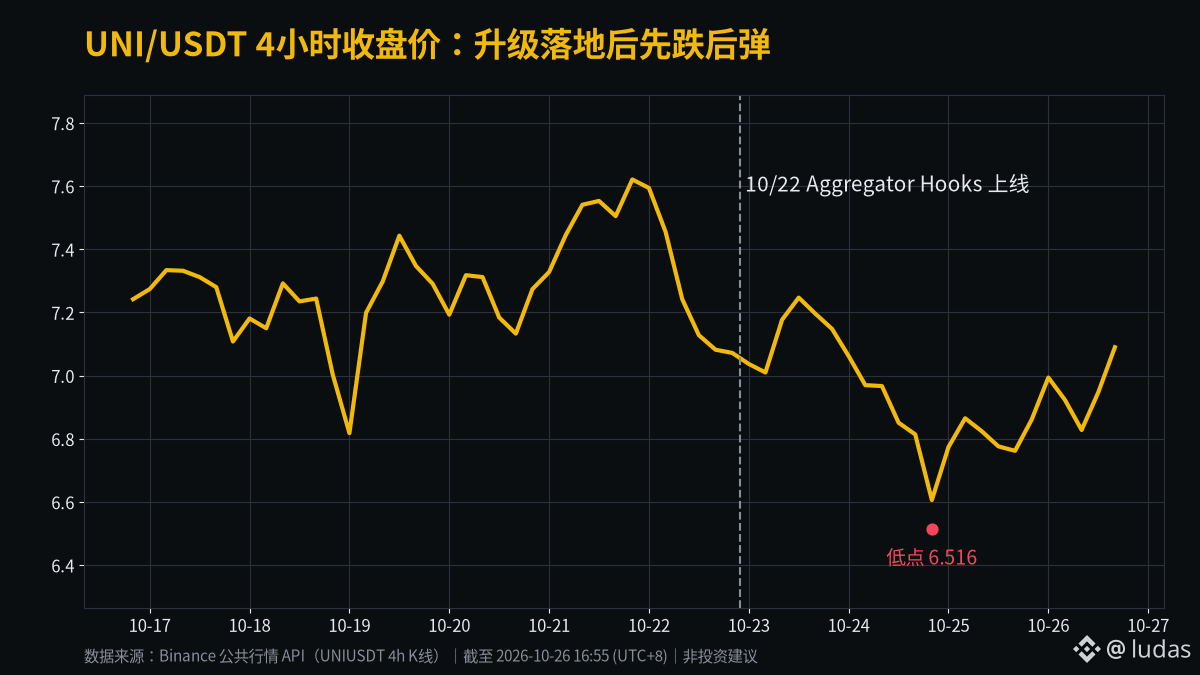
Uniswap turned its competitors’ liquidity into fuel for UNI, but the token price dropped 14% first? 🧐
📌 On October 22, Uniswap v4’s Aggregator Hooks launched on Ethereum, Base, and Robinhood Chain, connecting to 7 external liquidity sources, including Fluid, Curve, and PancakeSwap. Uniswap says they cover 90%+ of DEX trading across these three chains (Source: Uniswap official blog / The Block)
🔥 The key point: Trades routed through external pools also pay protocol fees, which go toward burning UNI
📊 Token price: Pre-launch high of 7.79 on 10/21, low of 6.516 on 10/24, now around 7.09, up 6.2% over 24 hours (Binance market data)
🗓 Next milestone: Unichain’s mainnet migration to OP Enterprise on October 29
My take: This is a recovery after “selling the news,” not a fundamental shift. What really matters is whether TokenJar’s fees and burn data over the next few weeks can turn the “aggregator” into quantifiable revenue. Not investment advice.
Do you think “DEXs becoming aggregators” can support the valuation of $UNI ? Let’s chat in the comments 👇 Like if you found this useful
#Uniswap #DeFi #Altcoins
46

·
--
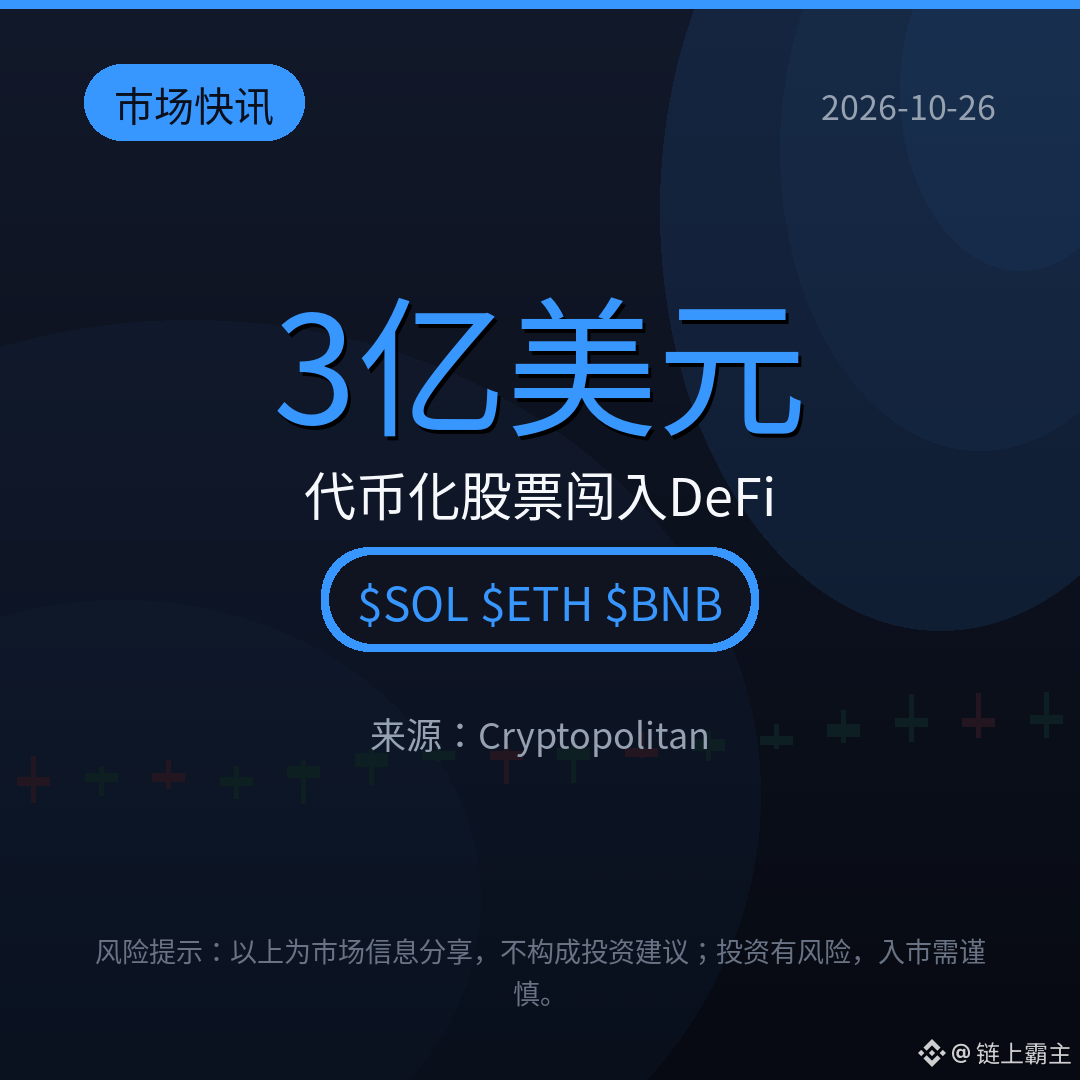
【Market Update】Tokenized stocks enter DeFi: up 25-fold in a year, surpassing $300 million. They were just $11.8 million a year ago and reached $262 million last month.
Solana leads with $102.6 million, or 34.2%; xStocks accounts for over 39%, and the top five chains make up around 96% combined. But DeFi accounts for just 6.8% of the $4.4 billion market.
U.S. stock positions earning yield in DeFi—are you in or sitting it out? Join the conversation in the comments.
$SOL $ETH $BNB
#代币化股票 #DeFi #Solana
(Source: Cryptopolitan)
⚠️Risk warning: The above is shared for market information purposes only and does not constitute investment advice. Investing involves risks; please exercise caution.
77

·
--
Have you noticed how most traders ignore DeFi setups until it's too late to get in?
The pain of missing a clean surge like this one on $CAP is real. You sit on the sidelines waiting for confirmation, then FOMO at the highs and have no idea when to exit before the token event dumps it.
$CAP just surged 39.33% on strong DeFi momentum heading into a key token event. The crowd still thinks DeFi is dead, but price action like this tells a different story. Utility tokens with upcoming catalysts don't wait for your permission to move.
Look at how $UNI and $AAVE reacted around similar events. The approach that works is to map the date, enter with a defined size, and set your take profit before the news cycle peaks. Waiting for the tweet is how accounts get rekt.
Where do you think this $CAP momentum heads after the token event?
#DeFi #Altcoins #CryptoTrading
4

·
--
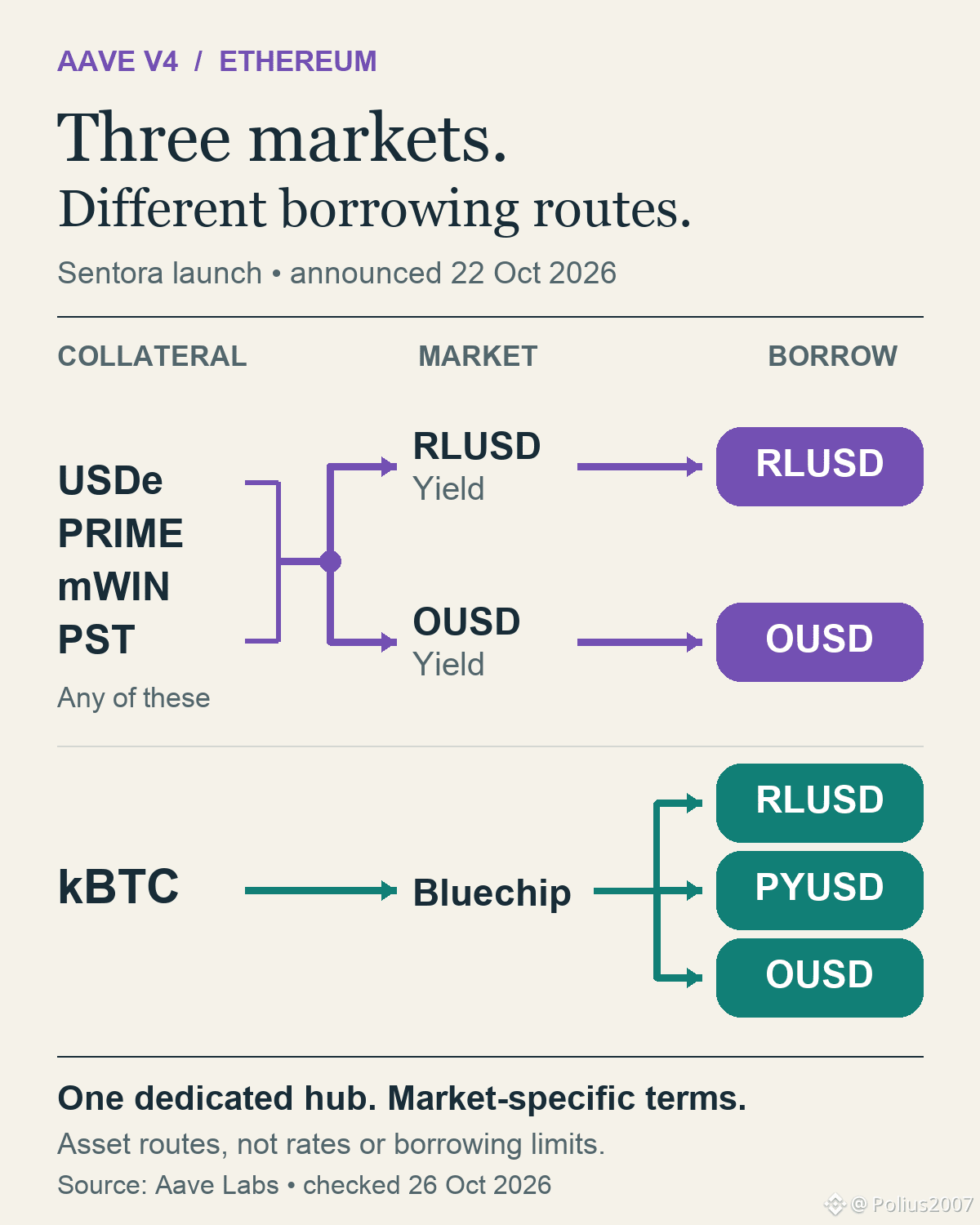
Aave's new Sentora markets give the same collateral two different borrowing routes: USDe, PRIME, mWIN or PST can back an RLUSD loan or an OUSD loan, depending on the market chosen.
Aave Labs' October 22 announcement describes three externally curated markets on Ethereum. The two Yield markets accept those four assets. The third, Bluechip, accepts kBTC as collateral and lets users borrow RLUSD, PYUSD or OUSD.
The distinction matters before depositing: the list of assets supported by the launch is not a menu of interchangeable collateral and loan combinations. The illustration maps which collateral opens which route.
Sentora runs a dedicated liquidity hub and chooses collateral and risk parameters for its markets. Aave supplies the V4 infrastructure and retains governance safeguards. According to the announcement, the Aave DAO owns the contracts, risk-increasing changes face a 48-hour timelock, and new assets need Aave governance review.
For borrowers, the useful change is more ways to borrow against these holdings without selling them. The next comparison is market-specific: the borrowing rate, how much the collateral lets you borrow, and when liquidation can begin. A shared codebase doesn't make those terms identical.
Source: Aave Labs, October 22, 2026; checked October 26. Availability is as announced, not a live transaction test.
https://aave.com/blog/sentora-aave-launch
#Aave #DeFi
36
Log in to explore more content
Join global crypto users on Binance Square
⚡️ Get latest and useful information about crypto.
💬 Trusted by the world’s largest crypto exchange.
👍 Discover real insights from verified creators.
Email / Phone number
Trending Topics
1
#BinancePick
2.6M views
139,849 Discussing
2
#EarningsSeason
5M views
24,144 Discussing
3
#FranklinTempletonFilesForTwoDividendToBitcoinETFs
0 views
0 Discussing
4
#StrategyMSTRSurpassesNasdaqInMarketCap
178 views
25 Discussing
5
#CanadaProposesStablecoinRedemptionWithin3BusinessDays
10 views
3 Discussing
6
#ElectrumWalletBugLetRogueServersStealFunds
5,961 views
190 Discussing
7
#ArgentineCourtDismissesLIBRACaseAgainstMilei
14,491 views
262 Discussing
8
#SKHynixReportedlyPlansSpecialDividendFromKioxiaStakeSale
2,786 views
42 Discussing
9
#KeystoneWebsiteBreachExposesBuyersShippingAddresses
1,532 views
35 Discussing
10
#USQ3GDPAndSeptemberPCEDueNextWeek
89,002 views
1,076 Discussing