
#binanceinflow
binanceinflow
5,202 views
6 Discussing
Hot
Latest

Article
$2.3B Back Into Binance: A Confidence Signal—But Not a Full Market “All Clear”When an exchange records $2.3 billion in net inflows, the headline is bigger than the number itself: it suggests that, during that period, more capital moved onto Binance than moved off it. In a market where exchange flows are watched closely for signs of fear, confidence, liquidity, and trading appetite, that reversal can matter.
But it should be read carefully. One strong daily inflow is a useful signal—not proof that every concern has disappeared.
What “net inflow” actually means
Net flow is simply:
Deposits − withdrawals = net inflow or outflow
So, a $2.3B net inflow means total deposits exceeded total withdrawals by about $2.3B during the measured window. It does not necessarily mean investors deployed $2.3B directly into Bitcoin or altcoins. Funds may arrive as stablecoins, collateral, assets transferred between wallets, or capital preparing to trade.
The immediate takeaway is that Binance attracted more value than it lost over that period.
Why the market pays attention
Large centralized exchanges are key liquidity hubs. When funds move onto them, market participants often interpret that in several possible ways:
Users may be regaining confidence in the platform after a period of withdrawals.Traders may be positioning for activity, such as spot buying, derivatives collateral, arbitrage, or market-making.Stablecoin liquidity may be returning, which can support higher trading volumes.The market may be shifting from defensive behavior to more active participation.
That said, inflows can also precede selling, especially when users deposit BTC, ETH, or other crypto assets to trade. The composition of the inflow matters: stablecoin deposits and crypto-asset deposits can imply different intentions.
Why this can be constructive for broader crypto liquidity
Binance remains an important venue for global crypto trading volume and order-book depth. More funds on the platform can improve available liquidity, tighten spreads, and support more efficient price discovery—particularly for large-cap assets and actively traded pairs.
If the inflows are sustained over several days rather than concentrated in a single session, the effects could include:
stronger spot and derivatives liquidity;more active market-making;greater capacity for large trades without moving price as sharply;renewed participation in altcoin markets;improved sentiment around centralized-exchange stability.
In a risk-on environment, returning exchange liquidity can also amplify momentum. That cuts both ways: it can help rallies extend, but it can also make liquidations and fast reversals more intense if leverage builds quickly.
The key caveat: inflows are not automatically bullish
A common mistake is treating exchange inflows as a simple “buy signal.” They are not.
For example:
Stablecoin inflows can indicate capital waiting to purchase assets, post collateral, or earn yield.BTC or ETH inflows can indicate potential selling, hedging, collateral use, or transfers by institutions and market makers.Large inflows after stress may reflect a recovery in operational confidence, but they can also be temporary repositioning.
The market reaction depends on what assets are flowing in, whether spot demand rises alongside the flows, and whether leverage is increasing faster than organic demand.
What to watch next
The most useful follow-through signals are:
Multi-day exchange-flow trend
A single 24-hour reading can be noisy. Persistent positive flows are more meaningful than one headline number.
Stablecoin balances and trading volume
Rising stablecoin liquidity paired with stronger spot volume can indicate more deployable buying power.
BTC and ETH exchange deposits
Large crypto deposits may increase potential sell-side supply, although they can also be used for derivatives collateral.
Funding rates and open interest
If derivatives leverage rises too quickly, a positive flow story can become fragile. Crowded positioning raises the risk of sharp liquidations.
Order-book depth and spreads
Better liquidity conditions support healthier price discovery; thin books make markets more vulnerable to abrupt moves.
Whether withdrawals remain orderly
Continued stable operations and transparent updates matter more than any one daily flow figure.
Bottom line
Binance’s $2.3B net inflow is best understood as a short-term confidence and liquidity signal: more capital entered the platform than exited during the reported period. That can support trading activity and improve market functioning, especially if it persists.
However, it is not a standalone verdict on market direction. The more important question is whether inflows continue, what assets are being deposited, how spot demand responds, and whether leverage stays controlled. Crypto markets can turn quickly, so exchange-flow data works best as one part of a broader picture—not as a guarantee of what prices will do next.
#crypto #BinanceInflow
$2.3B Back Into Binance: A Confidence Signal—But Not a Full Market “All Clear”
When an exchange records $2.3 billion in net inflows, the headline is bigger than the number itself: it suggests that, during that period, more capital moved onto Binance than moved off it. In a market where exchange flows are watched closely for signs of fear, confidence, liquidity, and trading appetite, that reversal can matter.
But it should be read carefully. One strong daily inflow is a useful signal—not proof that every concern has disappeared.
What “net inflow” actually means
Net flow is simply:
Deposits − withdrawals = net inflow or outflow
So, a $2.3B net inflow means total deposits exceeded total withdrawals by about $2.3B during the measured window. It does not necessarily mean investors deployed $2.3B directly into Bitcoin or altcoins. Funds may arrive as stablecoins, collateral, assets transferred between wallets, or capital preparing to trade.
The immediate takeaway is that Binance attracted more value than it lost over that period.
Why the market pays attention
Large centralized exchanges are key liquidity hubs. When funds move onto them, market participants often interpret that in several possible ways:
Users may be regaining confidence in the platform after a period of withdrawals.Traders may be positioning for activity, such as spot buying, derivatives collateral, arbitrage, or market-making.Stablecoin liquidity may be returning, which can support higher trading volumes.The market may be shifting from defensive behavior to more active participation.
That said, inflows can also precede selling, especially when users deposit BTC, ETH, or other crypto assets to trade. The composition of the inflow matters: stablecoin deposits and crypto-asset deposits can imply different intentions.
Why this can be constructive for broader crypto liquidity
Binance remains an important venue for global crypto trading volume and order-book depth. More funds on the platform can improve available liquidity, tighten spreads, and support more efficient price discovery—particularly for large-cap assets and actively traded pairs.
If the inflows are sustained over several days rather than concentrated in a single session, the effects could include:
stronger spot and derivatives liquidity;more active market-making;greater capacity for large trades without moving price as sharply;renewed participation in altcoin markets;improved sentiment around centralized-exchange stability.
In a risk-on environment, returning exchange liquidity can also amplify momentum. That cuts both ways: it can help rallies extend, but it can also make liquidations and fast reversals more intense if leverage builds quickly.
The key caveat: inflows are not automatically bullish
A common mistake is treating exchange inflows as a simple “buy signal.” They are not.
For example:
Stablecoin inflows can indicate capital waiting to purchase assets, post collateral, or earn yield.BTC or ETH inflows can indicate potential selling, hedging, collateral use, or transfers by institutions and market makers.Large inflows after stress may reflect a recovery in operational confidence, but they can also be temporary repositioning.
The market reaction depends on what assets are flowing in, whether spot demand rises alongside the flows, and whether leverage is increasing faster than organic demand.
What to watch next
The most useful follow-through signals are:
Multi-day exchange-flow trend
A single 24-hour reading can be noisy. Persistent positive flows are more meaningful than one headline number.
Stablecoin balances and trading volume
Rising stablecoin liquidity paired with stronger spot volume can indicate more deployable buying power.
BTC and ETH exchange deposits
Large crypto deposits may increase potential sell-side supply, although they can also be used for derivatives collateral.
Funding rates and open interest
If derivatives leverage rises too quickly, a positive flow story can become fragile. Crowded positioning raises the risk of sharp liquidations.
Order-book depth and spreads
Better liquidity conditions support healthier price discovery; thin books make markets more vulnerable to abrupt moves.
Whether withdrawals remain orderly
Continued stable operations and transparent updates matter more than any one daily flow figure.
Bottom line
Binance’s $2.3B net inflow is best understood as a short-term confidence and liquidity signal: more capital entered the platform than exited during the reported period. That can support trading activity and improve market functioning, especially if it persists.
However, it is not a standalone verdict on market direction. The more important question is whether inflows continue, what assets are being deposited, how spot demand responds, and whether leverage stays controlled. Crypto markets can turn quickly, so exchange-flow data works best as one part of a broader picture—not as a guarantee of what prices will do next.
#crypto #BinanceInflow
75

·
--
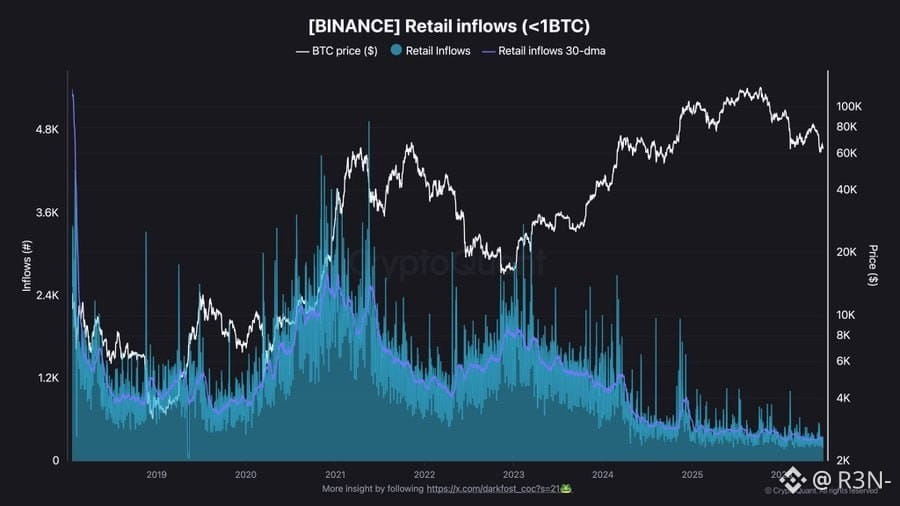
Bitcoin inflows to Binance reportedly dropping by 50% is one of those metrics that deserves a closer look.
At first glance, fewer coins being sent to an exchange could mean one thing: fewer investors are looking to sell.
Historically, large exchange inflows often increase selling pressure because users typically move Bitcoin to exchanges when they intend to trade or liquidate. A decline in those inflows may suggest holders are becoming more comfortable keeping their $BTC in self-custody or cold storage instead of preparing to exit.
That said, calling retail activity "officially dead" is probably too strong.
Exchange inflows are only one piece of the puzzle. Retail participation also shows up through ETF purchases, on-chain wallets, decentralized exchanges, and other centralized platforms.
The more interesting takeaway is the shift in behavior.
If fewer Bitcoin holders are sending coins to Binance while long-term holder balances continue rising, it could point to growing conviction rather than growing fear.
One metric rarely tells the whole story.
But when multiple on-chain signals start moving in the same direction, they become much harder to ignore.
#Binanceinflow #bitcoin
1
1
5k
Log in to explore more content
Join global crypto users on Binance Square
⚡️ Get latest and useful information about crypto.
💬 Trusted by the world’s largest crypto exchange.
👍 Discover real insights from verified creators.
Email / Phone number
Trending Topics
1
#USMidterms-WhatAreMarketsExpecting?
175,750 views
1,312 Discussing
2
#USOctoberNFP-AreRateCutsStillPossible
298,113 views
2,301 Discussing
3
#AMDBeatsExpectations-AINarrativeContinues
45,064 views
479 Discussing
4
#CircleQ3Revenue865M
5,490 views
187 Discussing
5
#BinanceIncidentReport
344,392 views
1,705 Discussing
6
#FrenchAssemblyPassesSelfCustodiedCryptoReportingAmendment
129 views
8 Discussing
7
#AnthropicIPOPricedDownasInvestorsEye$1.5T
25,566 views
121 Discussing
8
#HongKongPassesCryptoAssetReportingFrameworkAmendment
163 views
10 Discussing
9
#37thQuarterlyBNBBurnRemoves1.64MillionBNB
6,380 views
115 Discussing
10
#BinanceReopensWithdrawalsForMoreAssets
427,854 views
2,516 Discussing