
#xmr
xmr
41.5M views
156,337 Discussing
Hot
Latest

·
--
XMR Holds Above $610 | Node Sync Log Proposal Under Review | Watch $615
My stance is to wait and see. I wouldn’t treat a development proposal as a reason for a short-term buy. Binance Square’s current trending topics focus on employment, CPI, ETFs, and regulation, while XMR hasn’t appeared among the Most Searched topics over the past six hours. Without a relevant trending topic, I won’t chase a hashtag. On November 7, the official Monero code repository opened pull request 11692, proposing to add the current block timestamp and hard fork version to node synchronization logs. The developer’s before-and-after examples show that the original logs displayed only the sync height and progress, while the change would also show the date and version number corresponding to that height. The proposal is still open; it has not been merged or included in an official release. The latest official version listed on the website remains 0.18.5.4, released on October 16, so it would be inaccurate to say that all nodes already have this feature.
The practical value of this change is that it could help node operators troubleshoot historical synchronization. The “percentage complete” alone makes it difficult to tell which era of data and which set of protocol rules a machine is processing. Adding the date and hard fork version could make it quicker to identify where synchronization has stalled. The PR author also notes that each batch of blocks would require an additional database operation to read the timestamp of the top block, so this is not a cost-free optimization and still needs code review and runtime testing. It does not change XMR’s supply rules, transaction privacy proofs, or fees, nor will it automatically lead exchanges to expand support. Equating improved development logs with growing spot demand is an inference I would avoid.
The market’s current reaction also doesn’t support a strong narrative. At the time of writing, XMR/USD on Kraken is around $613.77, with a daily open of $611.30, a low of $603.03, and a high of $614.88. The price is slightly above the daily open and still near the intraday high, but there’s no evidence that this rise was driven by the sync-log PR. On the macro side, the Federal Reserve kept its target interest rate at 3.75%–4% at its last meeting. The growing focus on employment and CPI topics on Binance Square suggests traders are reassessing policy expectations. XMR has privacy use cases, but that doesn’t make it a safe-haven asset by default; it may still move with risk assets when liquidity tightens.
The key levels I’m watching are $615 and $603. A sustained hourly close above $615, followed by a successful retest, would suggest some short-term support. A break below $603 would invalidate the current stabilization thesis. The rolling 24-hour high is around $624; I wouldn’t assume further upside unless the price breaks above it. If the project proposal is closed or reviewers identify side effects, the development-related interpretation should be revised. If macro expectations suddenly turn more hawkish, I’d reduce risk exposure rather than look for reasons to stubbornly hold on.
If I were trading this myself, I wouldn’t enter now. The only direction I’d consider is a leveraged-free spot long, with a planned position of no more than 0.25% of total capital. The entry trigger would be two consecutive hourly candles closing above $615, followed by a retest near $612 that holds. Before that trigger, the position would be 0%. The first target is $620, where I’d take half off; the second target is $624, and I’d close the remaining position if an hourly candle closes back below $612. The initial stop-loss would be at $607. If the price breaks below $603 first, I’d cancel the long plan. All price levels are conditional; I won’t describe an untriggered plan as a completed or profitable trade.
Sources: Monero official repository pull request 11692, Monero official release history, Kraken XMR/USD, and the Federal Reserve statement. #XMR
The above is solely my personal market observation and does not constitute investment advice.



·
--
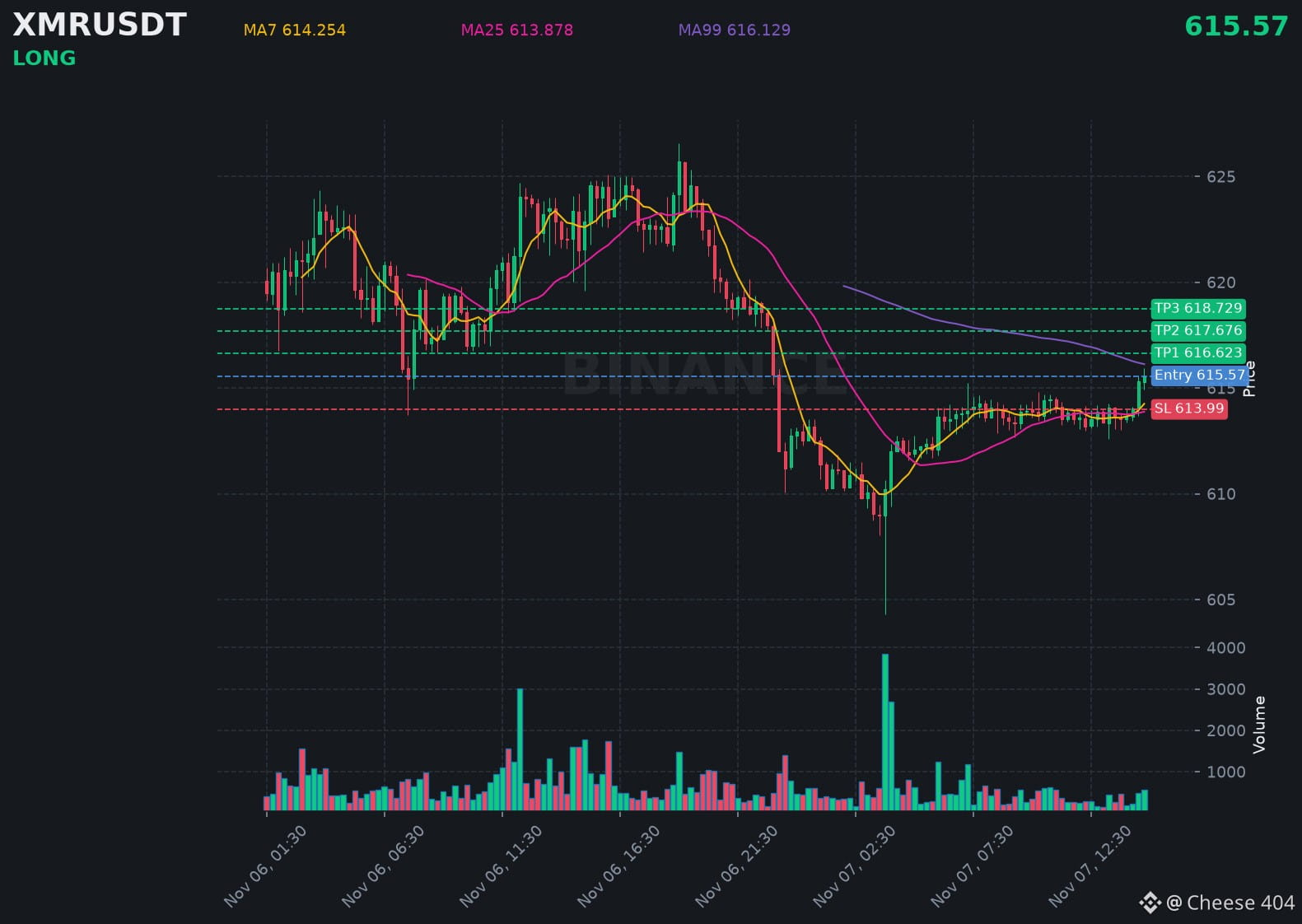
$XMR is gaining strong bullish momentum as volume rises and price breaks key resistance.
📍 @ 615.57 | Volume: 0.34M USD
RSI 66 | EMA20: 614.002 USD
📈 Trade Plan:
📈 Entry: 615.254 – 615.886
🛑 Stop Loss: 613.99
🎯 TP1: 616.623
🎯 TP2: 617.676
🎯 TP3: 618.729
Waiting for a retest, then riding the uptrend.
👉 $XMR 👈 Catch it
#XMR
📍 @ 615.57 | Volume: 0.34M USD
RSI 66 | EMA20: 614.002 USD
📈 Trade Plan:
📈 Entry: 615.254 – 615.886
🛑 Stop Loss: 613.99
🎯 TP1: 616.623
🎯 TP2: 617.676
🎯 TP3: 618.729
Waiting for a retest, then riding the uptrend.
👉 $XMR 👈 Catch it
#XMR
69
·
--
XMR Wallet Verification Proposal | Legacy Transaction Amount Validation Needs Fixing | Watch Around $612
My stance remains cautious: the value of a privacy coin comes from a verifiable payment experience, and whether the “amount received” shown by a wallet is trustworthy matters more than a price line. A PR opened on November 7 in Monero’s official code repository, #11693, proposes changes to the wallet’s check_tx_key verification process. The submission notes that when querying older v1 transactions, the wallet obtains pruned transaction data from a remote node, and the existing path’s transaction-hash check may be affected by the hash claimed by the node. If an untrusted node returns data that retains the real output keys but changes the plaintext amount, a user checking with a known transaction ID and transaction key could see an incorrect amount. The code diff shows a proposal to reuse the existing path for retrieving and hash-verifying complete v1 transactions, and then calculate the amount. I also checked the repository’s existing get_tx_for_proof implementation, which does indeed retrieve the complete transaction again when it encounters a pruned v1 transaction. This is a proposal that can be verified at the code level; it is not proof that anyone has exploited it, that funds have been stolen, or that the Monero mainnet has failed.
The limits of the mechanism need to be made clear: the PR is still Open; it has not been merged, and no official release has been issued. The most recent official software version on Monero’s website is still 0.18.5.4, from October 16, so it would be wrong to say “the vulnerability has been fixed.” The proposal primarily improves the verification of amounts when a wallet reads older transaction data from a node; it does not change the XMR privacy protocol itself, nor can it guarantee that all information from a user’s remote node is trustworthy. The PR explicitly notes that whether a transaction is in the mempool and its confirmation count still come from the node, so even if the code is merged, users of public remote nodes should remain mindful of the trust boundary. For the market, the accuracy of wallet displays can affect users’ and merchants’ confidence in receiving payments, which is beneficial to infrastructure quality over the long term. But an unmerged patch will not automatically bring in new XMR buying.
The price is not signaling that “good news has been priced in.” The latest Kraken XMR/USD trade at the time of writing was around $612.12, with today’s open at $611.30, an intraday low of $603.03 and high of $614.88, and a rolling 24-hour high of $624.29. The price is in the middle of the day’s range; this movement cannot be attributed to a newly opened PR. XMR is not on Binance Square’s current six-hour Most Searched ranking, and there is no trending topic directly tied to this wallet verification issue. Forcing in an unrelated macro or ETF narrative would mislead readers. I’d rather see whether code review, testing, and an official release actually come through, and then see whether the price can move out of the $603–$624 range.
If I were trading this myself: I would sit out for now, and only consider a directionally bullish, unleveraged spot position, with a planned position size of no more than 0.3% of total capital. The entry trigger would be XMR holding above $614.88 and successfully retesting that level, along with confirmation of a successful official PR review or progress toward an official release; if the code status remains unchanged, I would stay out. After a trigger, I’d first target $624.29 and take half off near that level; I’d target $632 with the remainder, closing early if price and volume weaken. I’d set a stop-loss about 2.5% below the entry price, or apply it strictly if the price falls below $603.03 and fails to recover. If the PR is closed, tests fail, or new official evidence overturns the issue description, I would withdraw my view and close the remaining position. A plan that hasn’t been triggered is not a trade, let alone a profit.
#XMR
The above is solely my personal market observation and does not constitute investment advice.

3

·
--
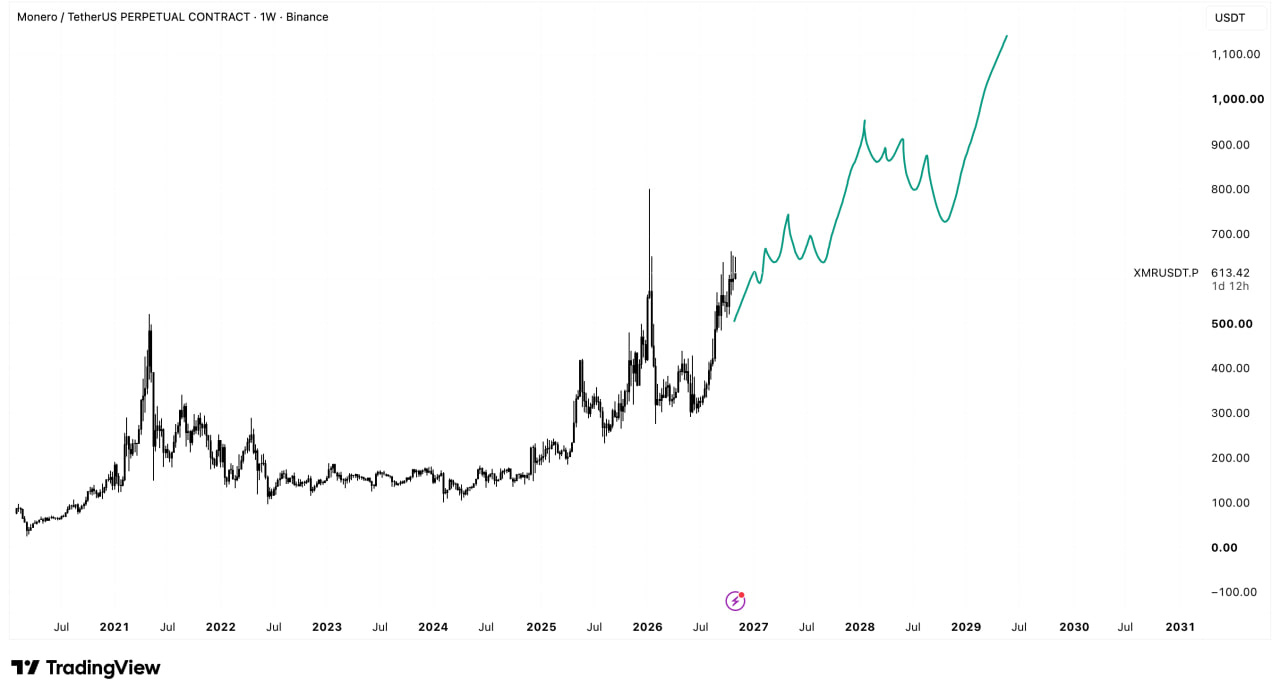
🔥 Technical Update #XMR / USDT (1W)
While the market is distracted by short-term fluctuations, Monero (XMR) has been quietly building one of the strongest macro bullish structures in crypto. 🤫📈
The current price is holding steady around $613, having completed a multi-year accumulation base and entered a phase of macro price discovery!
What lies ahead?
1️⃣ Phase 1 (Expansion): Push the price into the $700–$800 zone, followed by a structural retest.
2️⃣ Phase 2 (Parabolic Wave): Break decisively above the psychological $1,000 level and head into the macro cycle.
📍 Key levels to watch:
• Current price: ~$613.45
• Immediate resistance: $700 / $800
• Macro target: $1,000+
• Major support: $450–$500
Is Monero quietly preparing to become one of the best-performing coins of this cycle? 👁🚀
6
·
--
Monero wallet log patch still under review | Beware of local secret output | XMR below $624: wait and see
My stance is cautious: I’m watching and waiting, and won’t describe a security patch that hasn’t been merged as a fix already in place. On November 5, a pull request, #11686, appeared in Monero’s official code repository for simplewallet. It proposes continuing to display the output of certain commands containing secret information in the terminal, without writing it to wallet logs. The project page is currently marked Open, and the code diff shows a new toggle for controlling whether logs are written to disk, as well as changes to prevent multisig setup information and output related to transaction keys from being logged. The author describes tests using an offline temporary wallet, but those are the submitter’s test results; the patch still needs to be reviewed and merged by maintainers, officially released, and installed by users. I found no official evidence that this issue has caused actual financial losses or compromised the XMR network.
What matters to traders is not the headline “another major privacy coin incident.” On-chain privacy design and log management on personal devices are separate security boundaries. If someone uploads debug logs to a support ticket, syncs them to cloud storage, or leaves them on a shared computer, sensitive output originally intended only for themselves or multisig participants could be exposed more widely. Conversely, since the PR has not yet been merged, that alone is no basis for claiming that all wallet users have already been exposed. For command-line wallet users, I’d rather check the official release and log-retention practices than panic-sell because of a code review update. The latest official release I could verify on Monero’s website remains version 0.18.5.4, released on October 16; this PR should not be counted as a patch that has already shipped.
Market prices offer no clear one-way confirmation driven by the incident. When I checked Kraken, XMR/USD was around $612.29, with an opening price of about $611.30 and a 24-hour range of approximately $603.03 to $624.29. The current price is slightly above the open but still near the middle of the range, which neither proves that the market has absorbed the concern nor confirms the start of a new rally. The current Binance Square trending list has no topic directly related to this wallet PR, and XMR is absent from the six-hour trending searches; I’m discussing only project facts that can be verified. Broader risk appetite remains influenced by US interest-rate expectations: the Federal Reserve’s October decision set the target range at 3.75%–4%. XMR’s privacy features do not automatically make it a safe haven.
If I were trading this myself, I would stay out for now, with a 0% position, and only prepare a spot long plan with no leverage. I would consider committing at most 0.3% of my account funds only if XMR breaks above $624.29, retests and holds that level, volume improves at the same time, and the project has not disclosed a more serious security issue. The first target is $632, where I would take half off; the second is $640, and I would close the remaining position if the price falls back below $624.29. I would set a hard stop-loss below $610 after entry and exit immediately if it is hit. If the price first breaks below $603.03 and cannot quickly recover, the entire long plan is invalidated. If the PR review uncovers a wider scope of impact, I would also pause trading and reassess. A code review is not a fix that has already been implemented, and a price trigger is not an order that has already been filled.
Sources: Monero official repository PR #11686 and code diff; Monero 0.18.5.4 official release page; Kraken XMR/USD; Federal Reserve October statement.
#XMR
The above is solely my personal market observation and does not constitute investment advice.

5

·
--
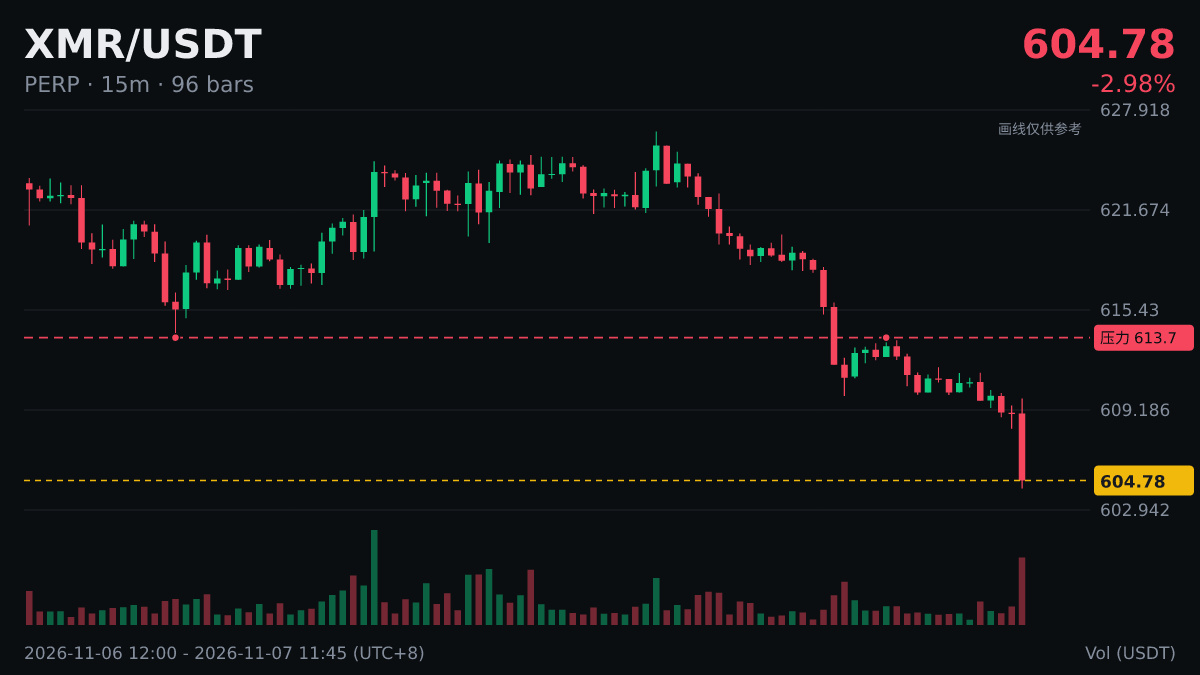
🧊 $XMR Set a new 24-hour low at 604.47, breaking below the previous low of 609.76.
After being quiet for half a day, it ultimately headed down. When prices are falling quickly, don’t rush to call the bottom. Did anyone get out early? Share your thoughts.
#XMR
🧊 $XMR Set a new 24-hour low at 604.47, breaking below the previous low of 609.76.
After being quiet for half a day, it ultimately headed down. When prices are falling quickly, don’t rush to call the bottom. Did anyone get out early? Share your thoughts.
#XMR
After being quiet for half a day, it ultimately headed down. When prices are falling quickly, don’t rush to call the bottom. Did anyone get out early? Share your thoughts.
#XMR
62
·
--
Monero Transaction-Pool Privacy Concern Under Review|Code-Path Report Still Being Reviewed|XMR First Needs to Hold $603
My stance is cautious and watchful. On November 6, a public issue numbered 11690 appeared in Monero’s official code repository. The reporter believes that when the transaction pool handles conflicts involving the same key image, differences in how nodes process connections could reveal whether a transaction that has not yet been publicly broadcast has entered a node’s transaction pool. The issue is still Open, and the text explicitly says this is a code-path analysis that has not been reproduced on the live network. I reviewed the cited code and another public review record. I can confirm that the discussion concerns the privacy boundary before a transaction is broadcast across the network, but this does not justify claiming that a large-scale identity leak has occurred on mainnet—much less that user assets have been stolen or the protocol has been breached.
XMR holders should pay attention because Monero’s value proposition relies heavily on expectations of privacy. Key images are intended to identify duplicate spends, while transaction propagation has its own stages. If node behavior during propagation reveals whether a transaction is in a node’s pool, that could undermine confidence in anonymity, even without directly disclosing addresses or amounts. On the other hand, the report has not yet been reproduced on the live network, and there is no official conclusion about a fix. The severity of the risk, the difficulty of exploiting it, and the scope of its impact all remain for maintainers to verify. The latest official software version shown on the website was still 0.18.5.4, released in October. This new issue is neither a software release nor proof that a fix has been completed. I’ll be watching for a maintainer response, reproducible experiments, a merged patch, and official release notes—not treating a single issue as a final outcome.
The news and the market should also be considered separately. XMR is not currently a directly rising topic on Binance Square’s Trending or Most Searched lists. The macro lists are still focused on employment and CPI expectations, so not every XMR price move should be attributed to this code discussion. I checked Kraken’s XMR/USD price at about $613.72, with a 24-hour low of $603.03 and a high of $624.29. The price remains within the range and has not clearly repriced the risk. To the downside, $603 is the first level to watch, followed by $590 if it breaks. To the upside, XMR would need to convincingly clear $624 before $635 comes into view. If maintainers confirm that the issue is difficult to reproduce, or if the price holds above $624 with strong volume, my assessment of short-term pressure should ease. If it is reproduced on the live network and $603 breaks, the risk assessment should be upgraded.
If I were trading this myself, I would stay out for now, with a neutral outlook and zero position. Only if the issue is clarified and spot holds above $624 without breaking back below it on a retest would I consider buying with the trend, using no more than 0.3% of total capital and no leverage. I would take half off at the first target of $635, set a target of $648 for the remainder, and place the initial stop below $603. If $603 breaks first, I would stay flat rather than short based on guesswork. If I bought and the price fell back below $624, or if the official assessment confirmed that the issue was more serious than expected, I would close the remaining position. These are conditional plans, not trades that have already been executed.
Sources: Monero’s official repository, issue #11690 and the cited code; Monero’s official release page; Kraken XMR/USD market data. #XMR
The above is solely my personal market observation and does not constitute investment advice.

3
·
--
Tech stocks remain volatile after sharp drop | XMR is not automatically a safe-haven asset | I’m waiting for confirmation of direction near $612
My stance is cautious observation. A November 6 review by the Nasdaq Economic Research Institute noted that the semiconductor index fell about 12% on Thursday and the Nasdaq 100 fell about 6%. The market then stabilized somewhat, but was still down about 5% for the week. On the same day, the U.S. Bureau of Labor Statistics reported 165,000 new nonfarm jobs in October and an unemployment rate of 4.1%; on October 28, the Federal Reserve kept the federal funds target rate at 3.75% to 4%. These are already published facts. Volatility in tech stocks, employment data, and central bank policy all influence the pricing of risk assets, but it would be an oversimplification to conclude that the next meeting will necessarily bring a rate hike, or to call XMR a safe-haven asset that has already been validated by capital flows.
Why use XMR to assess this shift in risk appetite? Privacy coins have different use cases from tech stocks, but XMR still trades within the crypto market’s liquidity system. If investors cut their overall risk exposure after a sharp stock-market decline, XMR could also face selling pressure; if liquidity on trading venues thins, volatility could increase instead. Monero’s official website explains the privacy design of on-chain transactions; it does not promise price resilience. Privacy is a technical feature, not a guarantee of stable returns in dollar terms, and it does not mean regulatory or exchange-channel risks disappear. I would treat it as a standalone crypto asset to monitor, not as a substitute for cash, Treasury securities, or traditional safe-haven allocations.
To see how the market has reacted, we can start with verifiable prices. When I checked Kraken’s XMR/USD quote, it was around $612.08, with a 24-hour low of $603.03 and a high of $624.29. It has clearly not broken above the upper end of the range. Compared with Thursday’s sharp drop in tech stocks, XMR is still moving within its own range. This neither proves it is a safe-haven winner nor means it is bound to catch up on the downside. In the short term, I’m watching to see whether it holds around $615, with the $624 upper boundary as the next level. On the downside, I’m watching $608 first, then $603. If it breaks below $603 and fails to recover promptly, that would invalidate my view that the range is leaning stable. If it breaks above $624 and holds on a retest, that would provide stronger evidence of buyer initiative.
If I were trading this myself, I would stay out for now and remain flat while waiting for direction. Only if the spot price moves above $624 and holds on a retest would I consider a small long position in the direction of the trend. The position would be no more than 0.3% of total capital, with no leverage. After entry, my first target would be $632, where I would reduce the position by half; the second target would be $640, where I would close the remaining position. I would set a hard stop-loss at $615 and exit the entire position if it is triggered first. Even if the stop is not hit, I would close manually if, after breaking out, the price falls back below $624 and continues weakening. If the entry conditions are not met, there is no trade—and no profit. Risk appetite can shift quickly, so protect capital first and consider trading opportunities second.
Sources: Nasdaq Economic Research Institute market review, November 6; U.S. Bureau of Labor Statistics October employment report; Federal Reserve October 28 FOMC statement; Monero official website FAQ; Kraken XMR/USD market data. #XMR
This is only my personal market observation and does not constitute investment advice.
9

·
--
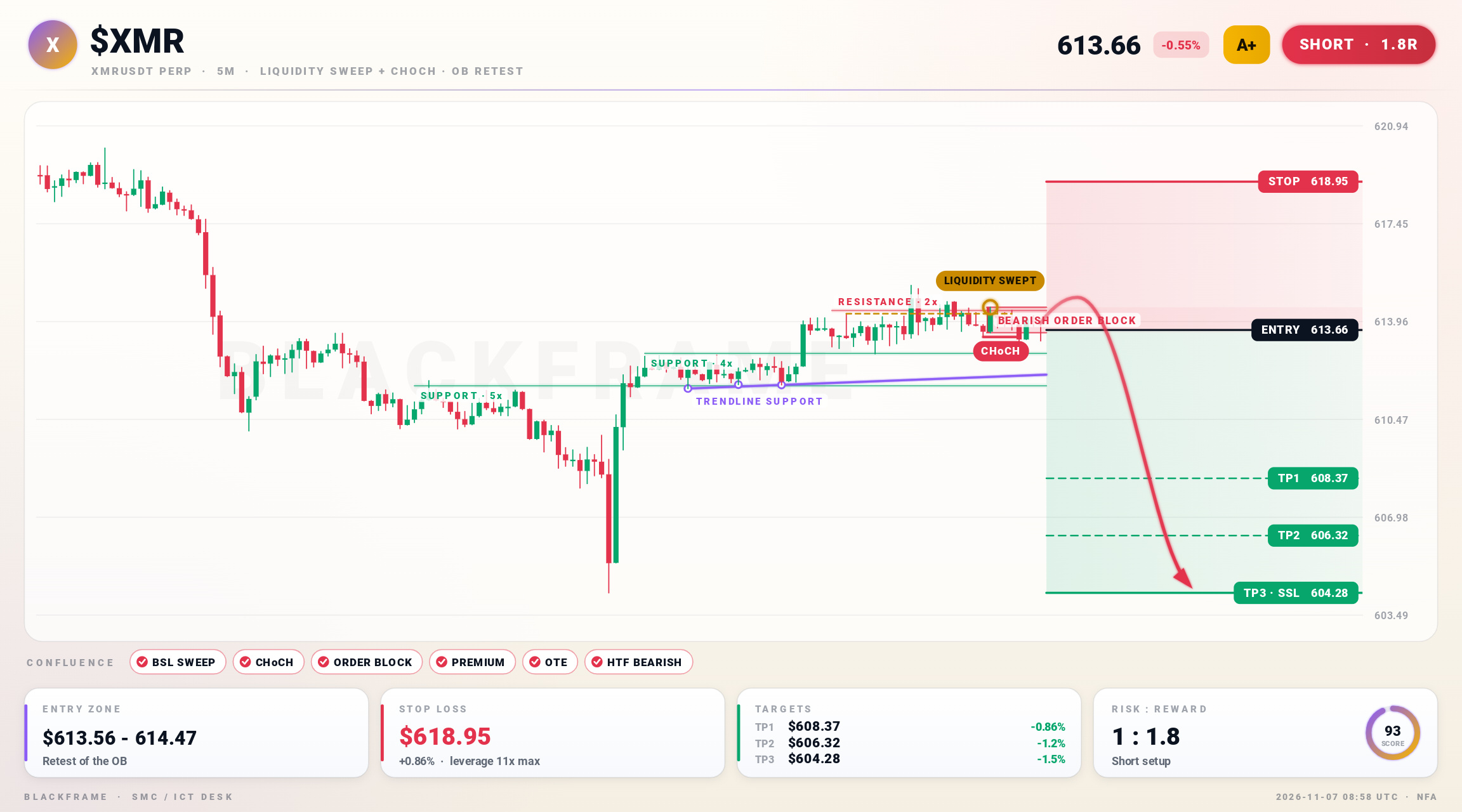
⚡️ $XMR bearish sweep clears path for shorts
SHORT · 5M
Entry: $613.56 - $613.66
TP1: $608.37
TP2: $606.32
TP3: $604.28
SL: $618.95
Buy-side liquidity was swept and CHoCH confirmed on the 5M. A fresh bearish order block retested, price in premium inside the OTE pocket. Target is $604.28 with stop at $618.95. Invalidated if price reclaims $614.24.
#XMR #SMC · NFA
39
·
--
U.S. CPI due next week | XMR is not immune to macro forces | I’ll hold the line at $603
My stance on XMR is cautious observation. Binance Square has added the topic #CPITestsDecemberRateOutlook, which discusses how inflation data could affect expectations for December interest rates. It does not mean CPI has already been released, much less that the Federal Reserve has decided to raise rates next time. XMR has no rising indicator among the Most Searched assets over the past six hours, so this discussion concerns a macro topic directly related to risk appetite across the crypto market. Any conclusion still needs to come down to XMR’s own liquidity and execution discipline.
The U.S. Bureau of Labor Statistics’ official schedule lists the October Consumer Price Index release for 8:30 a.m. Eastern Time on November 10. The latest published figures available to cite are that headline CPI rose 0.6% month over month and 3.7% year over year in September, while core CPI was up 2.6% year over year. The October reading and how it compares with expectations are not yet known. On October 28, the Federal Reserve kept the federal funds target range at 3.75% to 4%; that was not a commitment to take action in December either. Writing that a “possible rate hike” is a central bank decision would base a trading plan on something that has not happened.
Why does this affect XMR? If the new CPI reading is higher than the market expected, interest rates and the appeal of dollar assets could rise, putting pressure on risk-asset valuations and market-making liquidity. If it comes in below expectations, that pressure may ease. But XMR also has its own trading channels and compliance restrictions as a privacy coin, so BTC’s fund flows cannot simply be applied to it. Monero’s official materials explain that transaction privacy is a protocol feature, while centralized trading platforms may still require account identification. An improved macro backdrop will not automatically change exchange listing policies either. So I treat CPI only as a risk scenario, not as an announcement from the XMR project or evidence of increased adoption.
The market reaction is currently muted. At the time of checking, the last trade for Kraken XMR/USD was around $613.41, with a daily open of $611.30, an intraday low of $603.03 and high of $613.69, and a rolling 24-hour high of $624.29. The price is slightly above the daily open but has yet to break through the previous high. $613.69 is the nearby ceiling, $624.29 is the higher confirmation level, and $603.03 is the day’s risk line. Even if October CPI comes in relatively mild, a break below $603.03 would invalidate my cautiously bullish outlook. If XMR suddenly surges through $624.29 on heavy volume before the release, I’ll still wait for a retest rather than chase the price when a news headline appears.
If I were trading this myself, I would sit out for now. My directional bias is only conditionally bullish on spot, with a 0% position. Only if XMR closes an hourly candle above $624.30, then retests and holds $613.70, with no abnormal price gaps or spreads, would I use no more than 0.3% of my total capital for a test entry. No leverage. The first target is $636, where I would sell half; the second target is $648, where I would close the remaining position. After entry, if an hourly candle closes below $603, I would stop out of the entire position. If price falls below $603.03 before the data release, or trading access becomes clearly restricted, I would cancel any pending orders immediately. If none of these conditions are triggered, I will stay out of the market and won’t misrepresent waiting as a profit.
#CPITestsDecemberRateOutlook #XMR
This is solely my personal market observation and does not constitute investment advice.

9
·
--
Hong Kong Digital Asset Tax Hot Topic | Incentive Schemes and Reporting Obligations Go Hand in Hand | Check XMR’s Access Channels First
My stance on XMR is to wait and see, especially rather than interpreting the words “tax incentives” as a relaxation of restrictions on privacy-coin trading. Binance Square’s trending list featured #HongKongPlansTaxIncentivesCoveringDigitalAssets, but XMR did not appear in the six-hour Most Searched results. Popular topics are worth discussing, but any relevance must be grounded in the actual scope of the policy and the channels through which an asset can be traded. A single hashtag is not enough to infer that XMR will attract new capital.
Checking the original Hong Kong government sources, the Budget proposed including digital assets and other investments in the eligible investment scope for tax concessions available to funds and family offices, with the proposal to be advanced through legislative amendments. This concerns specific entities, eligibility requirements, and tax arrangements; it does not mean that all digital asset holders will receive a tax cut, much less that XMR has been approved for listing on local platforms. Separately, on November 4, the Hong Kong government announced that the Legislative Council had passed a bill establishing a crypto-asset reporting framework and adopting the revised Common Reporting Standard. The government says that relevant service providers will begin collecting the required information in 2027, and that the Inland Revenue Department plans to exchange crypto-asset transaction tax information with partner jurisdictions from 2028. The Inland Revenue Department’s website lists exchange, brokerage, and trading platform services among those that may be reporting service providers, and uses a functional definition covering crypto-assets that can be used for payment or investment. The precise application will still depend on the final rules and each service provider’s business. This page alone does not establish that every on-chain XMR transfer can be identified.
These two policy directions are not contradictory: one aims to attract eligible capital, while the other strengthens compliance reporting. Monero’s official website explains that its privacy design focuses on concealing on-chain transaction details; this is distinct from centralized service providers holding customer identity information. In my view, XMR’s key variables are more likely to be its on- and off-ramps, listings, and compliant access channels than direct buying pressure driven by Hong Kong’s tax-incentive narrative. This assessment would need to be revisited if subsequent official regulatory documents clearly change the scope of services permitted to support privacy coins, or if licensed platforms announce actual support. I have not seen any such new confirmation so far.
The market has not provided one-sided confirmation of this narrative either. At the time of checking, Kraken’s last XMR/USD trade was around $612.65, with a daily open of $611.30, an intraday low of $603.03, and an intraday high of $612.92; the 24-hour high was $624.29. The price is merely near the upper end of the intraday range and has yet to move back above $624. The modest recovery cannot be attributed to the Hong Kong topic. $613 is the immediate level to watch for a breakout, $603 is the intraday risk line, and $624 is the next major resistance. There is no verifiable direct flow of funds linking the policy news to the price, so there is insufficient evidence to chase it.
If I were trading this myself, I would stay out for now. My stance is conditionally bullish on spot, but only for observation, with a 0% position. I would only consider a trial position of no more than 0.3% of total capital, with no leverage, if XMR’s one-hour candle closes above $613, the price holds $610 on a retest, and no new access-channel restrictions emerge. The first target would be $620, where I would sell half; the second target would be $624, where I would close the rest. I would stop out if a one-hour candle closes below $603. If an official regulatory document introduces new restrictions that make it harder for service providers to support XMR, I would close the position regardless of price. If none of these conditions are met, I would remain out of the market and would not describe a trade plan as if it had already been executed.
#HongKongPlansTaxIncentivesCoveringDigitalAssets #XMR
The above is solely my personal market observation and does not constitute investment advice.

5

·
--
📉XMR bearish in the short term, with rebounds still facing pressure
Snapshot available on November 7: Binance XMRUSDT at 612.36, down 1.7% over 24 hours, with a trading volume of 43.5 million USDT, OI at approximately $58.3 million, and a funding rate of +0.052% per 8 hours. With prices weakening while longs are still paying, I expect continued pressure after any rebound. Market data source (https://loris.tools/markets/perps/xmr)
On the USD reference chart, RSI is around 31 and MACD is negative. Momentum is bearish but nearing oversold territory; changes in OI and aggressive buy/sell volume lack synchronized confirmation. Indicator source (https://www.investing.com/crypto/monero/technical)
Bearish outlook for the next 4–24 hours. Watch the 607–606 support zone; a break below it could send the price toward the 600 round-number level. Resistance is at 617–622. If volume expands and the price breaks above and holds 622, the bearish outlook is invalidated, with 625 as the next target.
#XMR #XMRUSDT #门罗币 #MarketAnalysis
77

·
--
🚨 $XMR WHALES FLUSH HEAVY SUPPLY OFF 466 AS BEARISH MOMENTUM ACCELERATES! 🔻
Entry: 425.74 ⚡
Target: 318.28 📉
Stop Loss: 466.44 ⚠️
📌 Smart money left an unmistakable footprint with that brutal upper wick rejection at 466, signaling aggressive whale distribution. 🔍 MACD is locking into a high-conviction dead cross while momentum indicators turn sharply downward, leaving overleveraged buyers trapped at the highs.
🌊 Sellers are driving price discovery straight toward lower liquidity pools as order flow shifts decisively bearish. 💬 Are you riding this distribution wave down or waiting for a relief bounce before joining the short? 👇
⚠️ Not financial advice. Always manage your risk. 🛡️
🏷️ #XMR #ShortSetup #Crypto #Monero #Bearish
🐻 🩸
14

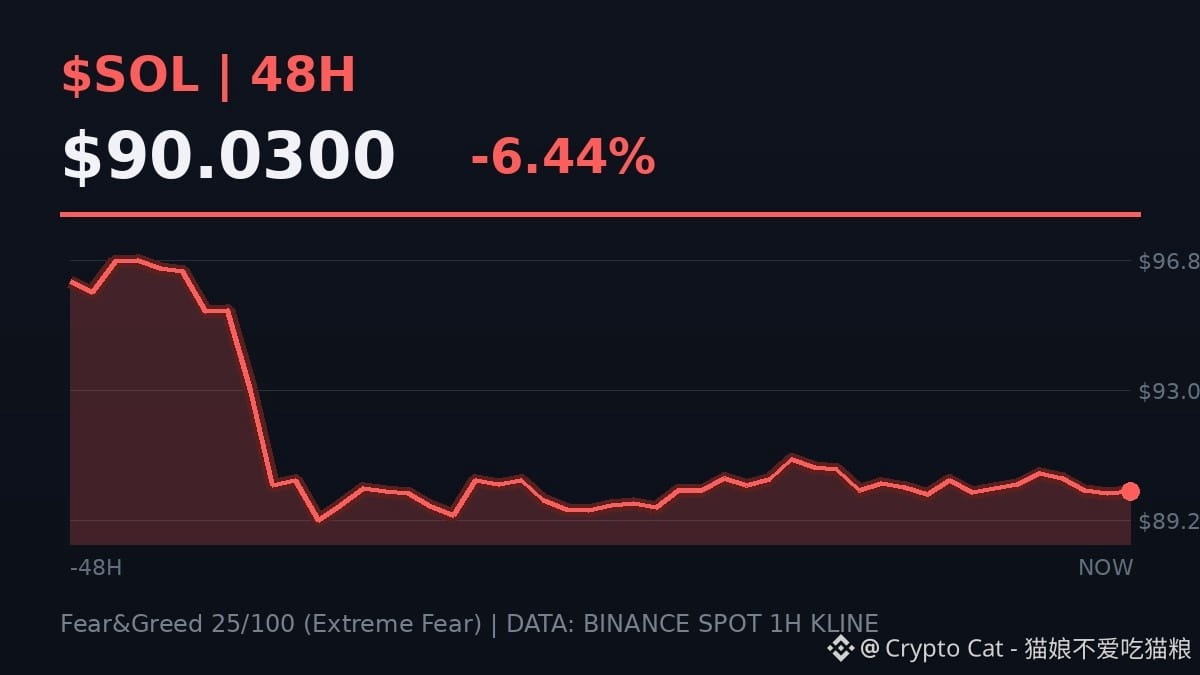
XMR on THORChain is only waiting for node rotation, $SOL is stuck at 89.98, up just 0.67%.
Development is complete, but it still can’t go live; node rotation is also held up by Solana issues.
Is development completion really a reason to celebrate? A fear index of 25 won’t play along.
Bullish signals: node rotation completes, the $SOL issue is resolved, and XMR can truly deposit and withdraw across chains.
Bearish scenario: rotation keeps dragging on, and there are no buyers for spot. The spot Taker plan ends on November 9—if you want in, make the most of it.
If you’re holding XMR or $SOL right now, type 1; if you’re sitting on the sidelines, type 2.
#Write2Earn #BinanceSquare #XMR #TradingTournament
11

·
--
In short: THORChain has completed development of its Monero integration; launch is still pending node rotation.
This should give everyone a bit of a boost, but how far it goes depends on the volume that follows. I’ll add this to my watchlist and check the price again in a few days.
$XMR latest: 612.28, worth keeping an eye on.
#XMR
This should give everyone a bit of a boost, but how far it goes depends on the volume that follows. I’ll add this to my watchlist and check the price again in a few days.
$XMR latest: 612.28, worth keeping an eye on.
#XMR
35

·
--
⬆️ Just now: THORChain has completed Monero integration development; launch is still pending node rotation
Don't scroll past this—this could affect your position! Despite the good news, I'm more interested in how strong buying pressure will be during a pullback.
$XMR
#XMR
This is not investment advice of any kind. You are responsible for your own gains and losses.
Don't scroll past this—this could affect your position! Despite the good news, I'm more interested in how strong buying pressure will be during a pullback.
$XMR
#XMR
This is not investment advice of any kind. You are responsible for your own gains and losses.
34

·
--
Take a quick look—this news could set the tone for a while!
THORChain has completed development of its Monero integration; launch is still awaiting node rotation
Don't rush just because the good news is out—watch to see whether the market has already priced it in.
$XMR , momentum is building, but don't chase too hard!
#XMR
THORChain has completed development of its Monero integration; launch is still awaiting node rotation
Don't rush just because the good news is out—watch to see whether the market has already priced it in.
$XMR , momentum is building, but don't chase too hard!
#XMR
2

·
--
Place your stop-loss outside the structure, and there’s no need to panic no matter how much buzz the news creates.
Take this as an example: THORChain has completed development of its Monero integration; launch is still pending node rotation.
Next, watch two things: whether volume can keep up, and whether buyers step in on a pullback.
$XMR is currently trading at 612.32.
#XMR
Take this as an example: THORChain has completed development of its Monero integration; launch is still pending node rotation.
Next, watch two things: whether volume can keep up, and whether buyers step in on a pullback.
$XMR is currently trading at 612.32.
#XMR
30

·
--
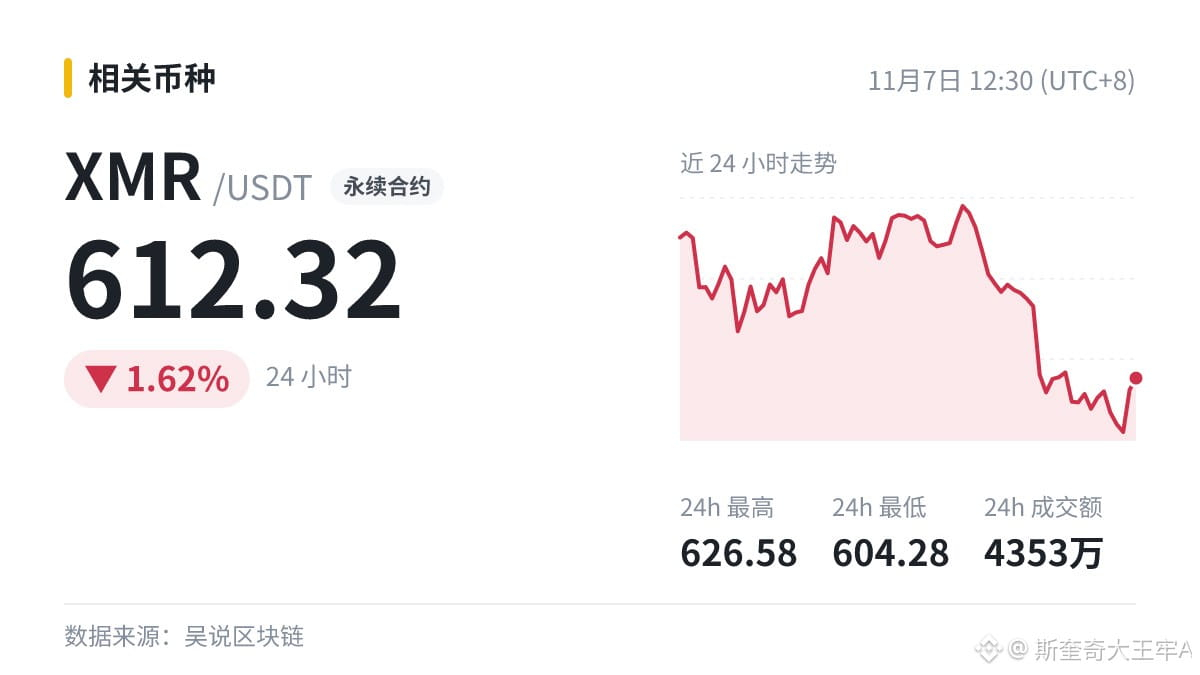
THORChain has completed development of its Monero integration; launch is still pending node rotation | $XMR 612.32 (-1.62%), 24h trading volume: 43.53 million.
Bullish news—let’s see whether the data can confirm it.
#XMR
THORChain has completed development of its Monero integration; launch is still pending node rotation | $XMR 612.32 (-1.62%), 24h trading volume: 43.53 million.
Bullish news—let’s see whether the data can confirm it.
#XMR
Bullish news—let’s see whether the data can confirm it.
#XMR
4

·
--
A post I saw at 12:31: THORChain has completed development of its Monero integration; launch is still pending node rotation.
It’s fine to be optimistic, but there’s no need to get carried away: a pullback is still possible after good news. The main thing to watch for next is whether more details are officially announced.
$XMR (24h -1.68%). The original post has more details; I’ve only included the most important parts here.
#XMR
Just my personal opinion, not investment advice.
61
Log in to explore more content
Join global crypto users on Binance Square
⚡️ Get latest and useful information about crypto.
💬 Trusted by the world’s largest crypto exchange.
👍 Discover real insights from verified creators.
Email / Phone number
Trending Topics
1
#JobsReportRaisesHikeOdds
328,599 views
2,505 Discussing
2
#CPITestsDecemberRateOutlook
54,590 views
619 Discussing
3
#BitcoinRebounds$75KAsChipsLead
27,106 views
255 Discussing
4
#US Data Center Rules May Constrain AI Expansion
49,331 views
185 Discussing
5
#ARKPlans14ThematicETFsCoveringAIAndTokenizedMarkets
758 views
31 Discussing
6
#WillAnthropicListOnTime
86,982 views
995 Discussing
7
#WillUS-IranTensionsBoostSafe-HavenDemand?
25,863 views
262 Discussing
8
#BitcoinETFsSee$412MNetOutflows
6,693 views
48 Discussing
9
#HKSFCPlansToRestrictCryptoAndExchangeTerms
23,552 views
350 Discussing
10
#TradFiForBeginners
53,265 views
777 Discussing