

#signdigitalsovereigninfra
signdigitalsovereigninfra
12.2M views
97,300 Discussing
Hot
Latest

·
--
#openledger $OPEN Focus on Sovereign Infrastructure
Empowering regions with robust decentralized architecture is the next massive frontier for Web3. By building foundational digital sovereign infrastructure, @SignOfficial is positioning itself perfectly to drive real-world economic growth and scale utility. Looking forward to seeing the long-term impact of $SIGN across emerging markets. #SignDigitalSovereignInfra
#openledger $OPEN Focus on Sovereign Infrastructure
Empowering regions with robust decentralized architecture is the next massive frontier for Web3. By building foundational digital sovereign infrastructure, @SignOfficial is positioning itself perfectly to drive real-world economic growth and scale utility. Looking forward to seeing the long-term impact of $SIGN across emerging markets. #SignDigitalSovereignInfra
Empowering regions with robust decentralized architecture is the next massive frontier for Web3. By building foundational digital sovereign infrastructure, @SignOfficial is positioning itself perfectly to drive real-world economic growth and scale utility. Looking forward to seeing the long-term impact of $SIGN across emerging markets. #SignDigitalSovereignInfra
270




·
--
Bullish
$SIGN — The quiet infrastructure play most people overlook
I took a deeper look at $SIGN again, and the more I think about it, the clearer its role becomes:
It’s not trying to be where apps live —
it’s trying to become what--apps rely on to trust users.
🧠 The core idea: Attestations as infrastructure
At its simplest, SIGN lets you answer one question on-chain:
“Can this claim about a user be trusted?”
Instead of rebuilding logic every time, projects can use SIGN to verify:
Eligibility (airdrops, mints)
Contributions (tasks, roles)
Identity signals (real vs sybil)
Reputation history
This turns SIGN into a shared trust layer across apps.
⚙️ Why this is a big deal
Right now, most crypto apps are blind:
They don’t know who the user really is
They can’t easily filter bots
They struggle to reward real contributors
So every project keeps reinventing the same systems.
SIGN changes that by making trust:
👉 Reusable
👉 Composable
👉 On-chain verifiable
🔗 Where it fits in the stack
Think of it like this:
L1/L2 → execution
Apps → user interaction
SIGN → truth verification layer
It’s closer to an identity + reputation protocol than a chain.
📊 The underrated angle
Most people look for:
New chains
Faster TPS
Bigger narratives
But SIGN plays a different game:
👉 It grows as more apps depend on it
👉 Not as users directly interact with it
That’s a very Web2-style moat —
like APIs that power everything but stay invisible.
🧩 My perspective
This is one of those projects where:
Adoption > hype
Integrations > price action
Usage > narrative
If SIGN succeeds, you won’t notice it directly —
you’ll just see better airdrops, cleaner DAOs, and fewer bots everywhere.
#SignDigitalSovereignInfra @SignOfficial
$SIGN — The quiet infrastructure play most people overlook
I took a deeper look at $SIGN again, and the more I think about it, the clearer its role becomes:
It’s not trying to be where apps live —
it’s trying to become what--apps rely on to trust users.
🧠 The core idea: Attestations as infrastructure
At its simplest, SIGN lets you answer one question on-chain:
“Can this claim about a user be trusted?”
Instead of rebuilding logic every time, projects can use SIGN to verify:
Eligibility (airdrops, mints)
Contributions (tasks, roles)
Identity signals (real vs sybil)
Reputation history
This turns SIGN into a shared trust layer across apps.
⚙️ Why this is a big deal
Right now, most crypto apps are blind:
They don’t know who the user really is
They can’t easily filter bots
They struggle to reward real contributors
So every project keeps reinventing the same systems.
SIGN changes that by making trust:
👉 Reusable
👉 Composable
👉 On-chain verifiable
🔗 Where it fits in the stack
Think of it like this:
L1/L2 → execution
Apps → user interaction
SIGN → truth verification layer
It’s closer to an identity + reputation protocol than a chain.
📊 The underrated angle
Most people look for:
New chains
Faster TPS
Bigger narratives
But SIGN plays a different game:
👉 It grows as more apps depend on it
👉 Not as users directly interact with it
That’s a very Web2-style moat —
like APIs that power everything but stay invisible.
🧩 My perspective
This is one of those projects where:
Adoption > hype
Integrations > price action
Usage > narrative
If SIGN succeeds, you won’t notice it directly —
you’ll just see better airdrops, cleaner DAOs, and fewer bots everywhere.
#SignDigitalSovereignInfra @SignOfficial
I took a deeper look at $SIGN again, and the more I think about it, the clearer its role becomes:
It’s not trying to be where apps live —
it’s trying to become what--apps rely on to trust users.
🧠 The core idea: Attestations as infrastructure
At its simplest, SIGN lets you answer one question on-chain:
“Can this claim about a user be trusted?”
Instead of rebuilding logic every time, projects can use SIGN to verify:
Eligibility (airdrops, mints)
Contributions (tasks, roles)
Identity signals (real vs sybil)
Reputation history
This turns SIGN into a shared trust layer across apps.
⚙️ Why this is a big deal
Right now, most crypto apps are blind:
They don’t know who the user really is
They can’t easily filter bots
They struggle to reward real contributors
So every project keeps reinventing the same systems.
SIGN changes that by making trust:
👉 Reusable
👉 Composable
👉 On-chain verifiable
🔗 Where it fits in the stack
Think of it like this:
L1/L2 → execution
Apps → user interaction
SIGN → truth verification layer
It’s closer to an identity + reputation protocol than a chain.
📊 The underrated angle
Most people look for:
New chains
Faster TPS
Bigger narratives
But SIGN plays a different game:
👉 It grows as more apps depend on it
👉 Not as users directly interact with it
That’s a very Web2-style moat —
like APIs that power everything but stay invisible.
🧩 My perspective
This is one of those projects where:
Adoption > hype
Integrations > price action
Usage > narrative
If SIGN succeeds, you won’t notice it directly —
you’ll just see better airdrops, cleaner DAOs, and fewer bots everywhere.
#SignDigitalSovereignInfra @SignOfficial
2
4
773

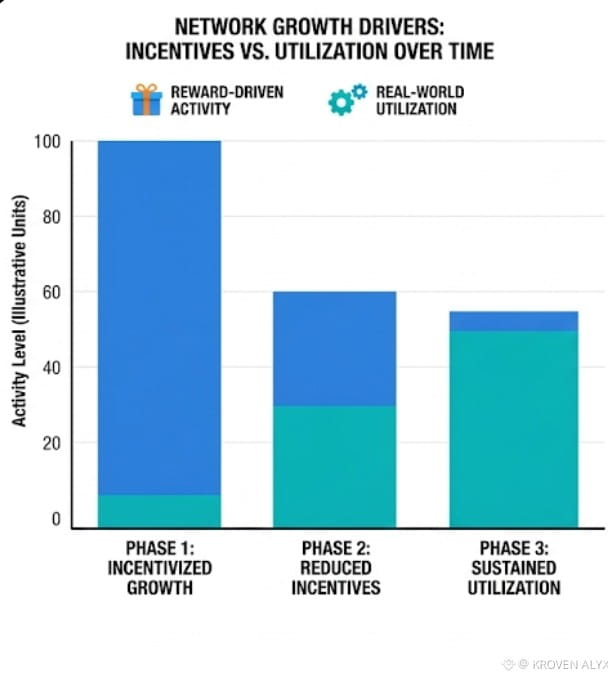
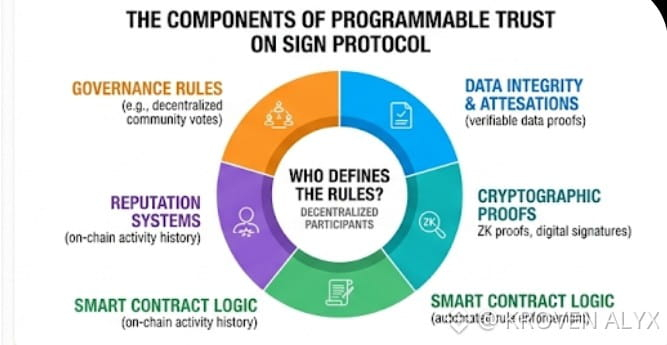
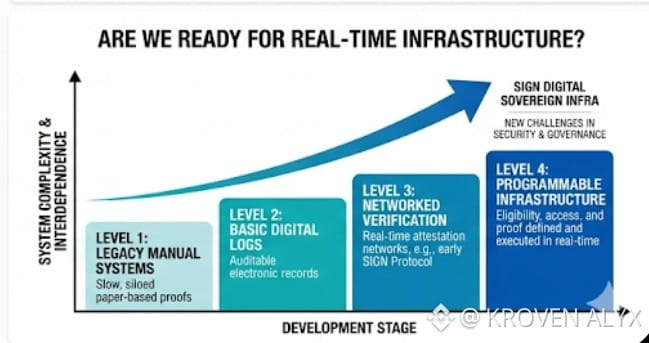
The more I think about SIGN Protocol, the more basic questions come to mind. Is this just reward-driven activity, or are we watching real usage take shape? If incentives slow down, does the behavior stay? If trust becomes programmable, who defines the rules? And if digital systems start deciding eligibility, access, and proof in real time, are we ready for that level of infrastructure? That is why @SignOfficial feels interesting to me. $SIGN is not only about distribution or credentials. It raises a bigger question: are we building systems people use for rewards, or systems they actually need?
#SignDigitalSovereignInfra
The more I think about SIGN Protocol, the more basic questions come to mind. Is this just reward-driven activity, or are we watching real usage take shape? If incentives slow down, does the behavior stay? If trust becomes programmable, who defines the rules? And if digital systems start deciding eligibility, access, and proof in real time, are we ready for that level of infrastructure? That is why @SignOfficial feels interesting to me. $SIGN is not only about distribution or credentials. It raises a bigger question: are we building systems people use for rewards, or systems they actually need?
#SignDigitalSovereignInfra
#SignDigitalSovereignInfra
13
18
542

#signdigitalsovereigninfra $SIGN
Building digital sovereignty is no longer an option but a necessity for modern economic growth. Together with @SignOfficial, we see how digital sovereignty infrastructure becomes key to economic transformation in the Middle East. With the adoption of the $SIGN token, data transparency and security become stronger, creating a self-sufficient and efficient ecosystem for industry players. Let's support the future of stronger infrastructure! 🚀
#SignDigitalSovereignInfras $BTC
#signdigitalsovereigninfra $SIGN
Building digital sovereignty is no longer an option but a necessity for modern economic growth. Together with @SignOfficial, we see how digital sovereignty infrastructure becomes key to economic transformation in the Middle East. With the adoption of the $SIGN token, data transparency and security become stronger, creating a self-sufficient and efficient ecosystem for industry players. Let's support the future of stronger infrastructure! 🚀
#SignDigitalSovereignInfras $BTC
Building digital sovereignty is no longer an option but a necessity for modern economic growth. Together with @SignOfficial, we see how digital sovereignty infrastructure becomes key to economic transformation in the Middle East. With the adoption of the $SIGN token, data transparency and security become stronger, creating a self-sufficient and efficient ecosystem for industry players. Let's support the future of stronger infrastructure! 🚀
#SignDigitalSovereignInfras $BTC
3
17

·
--
#signdigitalsovereigninfra $SIGN @SignOfficial On Sign, once a field slips position and one surface starts reading amount like time, or deadline like business value, this is no longer formatting. It is operational truth drift. The record is live. The meaning is not.
That matters more than people like to pretend.
A failed transaction is almost easier to respect. At least failure tells the truth. What bothered me here was how polite the error was. The attestation still looked healthy. One surface could still show a clean record. Another was already one bad decode away from moving money, opening permission, or approving the next action off the wrong meaning. That is worse than a crash. A crash stops you. A clean looking lie keeps moving.
On Sign, schema discipline is not presentation discipline. It is meaning discipline. Field order is part of the fact. Decoder assumptions are part of the fact. Rendering logic is part of the fact. If the schema, the hook, the explorer, and the app stop reading the same thing from the same bytes, then the attestation does not just get messy.
#signdigitalsovereigninfra $SIGN @SignOfficial On Sign, once a field slips position and one surface starts reading amount like time, or deadline like business value, this is no longer formatting. It is operational truth drift. The record is live. The meaning is not.
That matters more than people like to pretend.
A failed transaction is almost easier to respect. At least failure tells the truth. What bothered me here was how polite the error was. The attestation still looked healthy. One surface could still show a clean record. Another was already one bad decode away from moving money, opening permission, or approving the next action off the wrong meaning. That is worse than a crash. A crash stops you. A clean looking lie keeps moving.
On Sign, schema discipline is not presentation discipline. It is meaning discipline. Field order is part of the fact. Decoder assumptions are part of the fact. Rendering logic is part of the fact. If the schema, the hook, the explorer, and the app stop reading the same thing from the same bytes, then the attestation does not just get messy.
That matters more than people like to pretend.
A failed transaction is almost easier to respect. At least failure tells the truth. What bothered me here was how polite the error was. The attestation still looked healthy. One surface could still show a clean record. Another was already one bad decode away from moving money, opening permission, or approving the next action off the wrong meaning. That is worse than a crash. A crash stops you. A clean looking lie keeps moving.
On Sign, schema discipline is not presentation discipline. It is meaning discipline. Field order is part of the fact. Decoder assumptions are part of the fact. Rendering logic is part of the fact. If the schema, the hook, the explorer, and the app stop reading the same thing from the same bytes, then the attestation does not just get messy.
9
12
359

·
--
#signdigitalsovereigninfra $SIGN
Project @SignOfficial @ draws attention as one of the most important initiatives that builds a real infrastructure for digital sovereignty in the future. As the economy of the Middle East evolves, the need for solutions like $SIGN S becomes essential to empower individuals to securely and decentralize control over their identities and data.
What distinguishes Sign is its focus on creating an integrated system that supports the digital economy and gives users real power in managing their assets and identities. I see that $SIGN NS has great growth potential, especially with the digital expansion in the region.
Could Sign be one of the pillars of digital transformation in the Middle East? 👀
#SignDigitalSovereignInfrap
#signdigitalsovereigninfra $SIGN
Project @SignOfficial @ draws attention as one of the most important initiatives that builds a real infrastructure for digital sovereignty in the future. As the economy of the Middle East evolves, the need for solutions like $SIGN S becomes essential to empower individuals to securely and decentralize control over their identities and data.
What distinguishes Sign is its focus on creating an integrated system that supports the digital economy and gives users real power in managing their assets and identities. I see that $SIGN NS has great growth potential, especially with the digital expansion in the region.
Could Sign be one of the pillars of digital transformation in the Middle East? 👀
#SignDigitalSovereignInfrap
Project @SignOfficial @ draws attention as one of the most important initiatives that builds a real infrastructure for digital sovereignty in the future. As the economy of the Middle East evolves, the need for solutions like $SIGN S becomes essential to empower individuals to securely and decentralize control over their identities and data.
What distinguishes Sign is its focus on creating an integrated system that supports the digital economy and gives users real power in managing their assets and identities. I see that $SIGN NS has great growth potential, especially with the digital expansion in the region.
Could Sign be one of the pillars of digital transformation in the Middle East? 👀
#SignDigitalSovereignInfrap
2
34

·
--
Bullish
I just built a feature to verify contributor reputation for a DAO tool last week.
Then I sat down and looked back at the codebase and felt a bit discouraged: seven custom integrations, four off-chain listeners, two centralized backends, and way too many points of failure.
All just to verify a very basic thing: whether someone has actually done something on Web3.
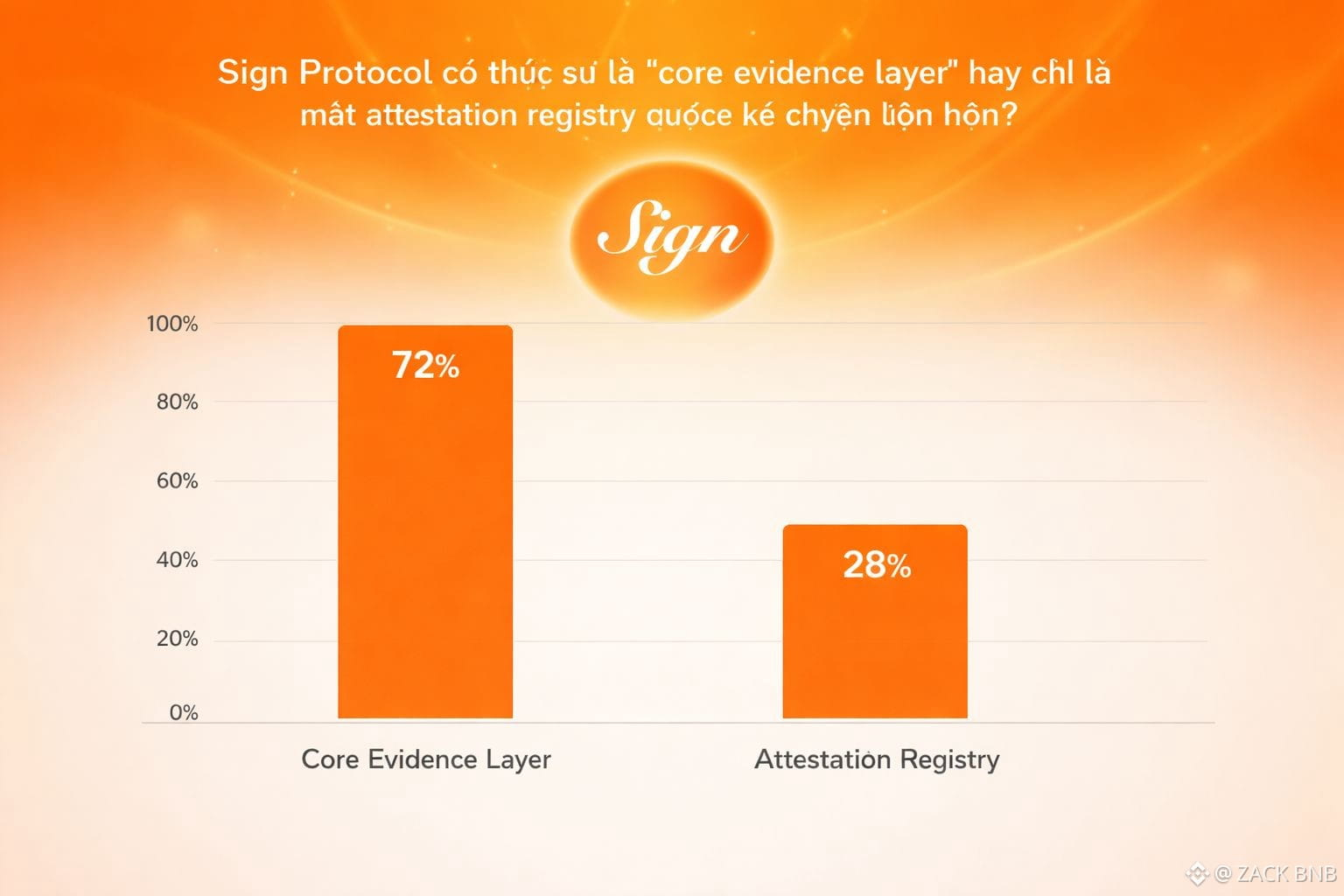
In my view, this is exactly where Sign deserves discussion if they truly become the core evidence layer.
Because a simple attestation registry does not solve this problem. I still have to connect each source myself, handle format mismatches, and maintain my own infrastructure. But if there were shared specifications, persistent identifiers, and logic attestation running more consistently, then that workload could shrink significantly.
For me, the most compelling thesis of Sign is not the trust story, but the ability to eliminate a whole layer of redundant code.
@SignOfficial #SignDigitalSovereignInfra $SIGN
I just built a feature to verify contributor reputation for a DAO tool last week.
Then I sat down and looked back at the codebase and felt a bit discouraged: seven custom integrations, four off-chain listeners, two centralized backends, and way too many points of failure.
All just to verify a very basic thing: whether someone has actually done something on Web3.
In my view, this is exactly where Sign deserves discussion if they truly become the core evidence layer.
Because a simple attestation registry does not solve this problem. I still have to connect each source myself, handle format mismatches, and maintain my own infrastructure. But if there were shared specifications, persistent identifiers, and logic attestation running more consistently, then that workload could shrink significantly.
For me, the most compelling thesis of Sign is not the trust story, but the ability to eliminate a whole layer of redundant code.
@SignOfficial #SignDigitalSovereignInfra $SIGN
Then I sat down and looked back at the codebase and felt a bit discouraged: seven custom integrations, four off-chain listeners, two centralized backends, and way too many points of failure.
All just to verify a very basic thing: whether someone has actually done something on Web3.
In my view, this is exactly where Sign deserves discussion if they truly become the core evidence layer.
Because a simple attestation registry does not solve this problem. I still have to connect each source myself, handle format mismatches, and maintain my own infrastructure. But if there were shared specifications, persistent identifiers, and logic attestation running more consistently, then that workload could shrink significantly.
For me, the most compelling thesis of Sign is not the trust story, but the ability to eliminate a whole layer of redundant code.
@SignOfficial #SignDigitalSovereignInfra $SIGN
136

·
--
Bearish
#signdigitalsovereigninfra $SIGN SIGN Protocol: The Workshop of Digital Truth
In Web3, trust is not given, it is built. With SIGN Protocol, we move from abstraction to the "workshop" where verification is tangible. By connecting hardware and real data with the blockchain, we create a layer of irrefutable evidence.
Each attestation functions as a decentralized seal of approval: transparent, sovereign, and free from intermediaries. No more blind faith; now the user has control over their own certainty. Remember: in a market that punishes emotions, the discipline of verification is your greatest asset.@SignOfficial
#signdigitalsovereigninfra $SIGN SIGN Protocol: The Workshop of Digital Truth
In Web3, trust is not given, it is built. With SIGN Protocol, we move from abstraction to the "workshop" where verification is tangible. By connecting hardware and real data with the blockchain, we create a layer of irrefutable evidence.
Each attestation functions as a decentralized seal of approval: transparent, sovereign, and free from intermediaries. No more blind faith; now the user has control over their own certainty. Remember: in a market that punishes emotions, the discipline of verification is your greatest asset.@SignOfficial
In Web3, trust is not given, it is built. With SIGN Protocol, we move from abstraction to the "workshop" where verification is tangible. By connecting hardware and real data with the blockchain, we create a layer of irrefutable evidence.
Each attestation functions as a decentralized seal of approval: transparent, sovereign, and free from intermediaries. No more blind faith; now the user has control over their own certainty. Remember: in a market that punishes emotions, the discipline of verification is your greatest asset.@SignOfficial
1
9
81

·
--
Bullish
I am very happy to gain profit this coin is a ama my portfolio is double .if you want to gain profit trade this coin#signdigitalsovereigninfra $SIGN
I am very happy to gain profit this coin is a ama my portfolio is double .if you want to gain profit trade this coin#signdigitalsovereigninfra $SIGN
1
1

·
--
Bullish
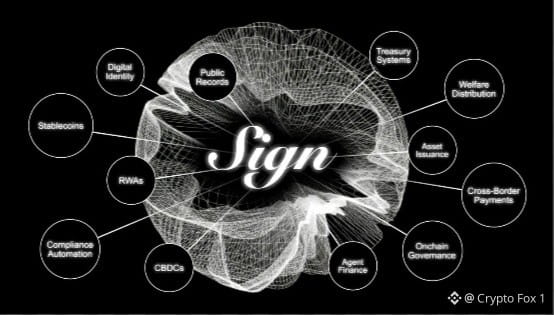
I keep noticing a strange tension every time I move through crypto platforms, like I’m walking through systems that move fast but think slowly. I watch transactions finalize in seconds while I still repeat the same verifications again and again. I connect wallets, confirm eligibility, prove identity, and then do it all over somewhere else.
I feel that small irritation building, not because anything is broken loudly, but because nothing remembers me for long.
When I look at SIGN, I don’t approach it with excitement. I approach it with suspicion shaped by too many cycles.
I’ve seen projects promise smoother experiences before, yet complexity usually grows instead of shrinking. But here I notice something different I see an attempt to reduce repetition rather than add another layer. I see credential verification and token distribution being treated like parts of the same memory instead of separate processes.
I keep thinking about how much effort goes into proving things I already proved yesterday.
I realize the real friction isn’t speed; it’s restarting trust every time I move.
SIGN makes me wonder what happens if systems stop forgetting. If credentials travel with me, participation feels continuous instead of temporary.
@SignOfficial #signdigitalsovereigninfra $SIGN
{spot}(SIGNUSDT)
I keep noticing a strange tension every time I move through crypto platforms, like I’m walking through systems that move fast but think slowly. I watch transactions finalize in seconds while I still repeat the same verifications again and again. I connect wallets, confirm eligibility, prove identity, and then do it all over somewhere else.
I feel that small irritation building, not because anything is broken loudly, but because nothing remembers me for long.
When I look at SIGN, I don’t approach it with excitement. I approach it with suspicion shaped by too many cycles.
I’ve seen projects promise smoother experiences before, yet complexity usually grows instead of shrinking. But here I notice something different I see an attempt to reduce repetition rather than add another layer. I see credential verification and token distribution being treated like parts of the same memory instead of separate processes.
I keep thinking about how much effort goes into proving things I already proved yesterday.
I realize the real friction isn’t speed; it’s restarting trust every time I move.
SIGN makes me wonder what happens if systems stop forgetting. If credentials travel with me, participation feels continuous instead of temporary.
@SignOfficial #signdigitalsovereigninfra $SIGN
I feel that small irritation building, not because anything is broken loudly, but because nothing remembers me for long.
When I look at SIGN, I don’t approach it with excitement. I approach it with suspicion shaped by too many cycles.
I’ve seen projects promise smoother experiences before, yet complexity usually grows instead of shrinking. But here I notice something different I see an attempt to reduce repetition rather than add another layer. I see credential verification and token distribution being treated like parts of the same memory instead of separate processes.
I keep thinking about how much effort goes into proving things I already proved yesterday.
I realize the real friction isn’t speed; it’s restarting trust every time I move.
SIGN makes me wonder what happens if systems stop forgetting. If credentials travel with me, participation feels continuous instead of temporary.
@SignOfficial #signdigitalsovereigninfra $SIGN
19
37
10.3k

·
--
#signdigitalsovereigninfra $SIGN the entire community must invest in it, thank you all for the beautiful investment in it, it is very beautiful and profitable.
#signdigitalsovereigninfra $SIGN the entire community must invest in it, thank you all for the beautiful investment in it, it is very beautiful and profitable.
1
1

·
--
Article
When SIGN and the Illusion of Portable Trust in Digital SystemsI didn’t come to something like SIGN because I was searching for a solution. If anything, I’ve developed a habit of distrusting anything that presents itself too neatly in a space that has historically been messy, chaotic, and deeply human. Over time, I’ve watched narratives form around “fixing trust,” and almost all of them felt incomplete not because they lacked intelligence, but because they underestimated how strange trust actually is once you try to formalize it.
When I think about SIGN, I don’t immediately think about credentials or tokens. I think about memory. Not in the technical sense, but in the behavioral one. I’ve seen how the internet forgets people. Not literally data is always stored somewhere but functionally. You can spend years building credibility in one corner of the digital world, and the moment you step into another, it’s like starting from zero. That reset isn’t accidental. It’s built into the structure of platforms that benefit from owning your history rather than letting you carry it.
So the idea that credibility could move with me, that it could exist independently of any single platform, feels intuitively powerful. But I’ve been around long enough to know that intuitive power and practical reality rarely align cleanly.
At the surface, SIGN feels like a straightforward attempt to solve this fragmentation. A system where credentials can be issued, verified, and transported across contexts, with a token layer acting as both incentive and connective tissue. It sounds almost obvious when you phrase it like that. But I’ve learned that when something sounds obvious in hindsight, it usually means the hard parts are hidden beneath the surface.
Because the real issue isn’t whether I can prove something. It’s whether that proof means anything outside the environment where it was created.
I keep coming back to the question of who gets to define credibility. In any system, someone is always making that decision, even if it’s abstracted away. If SIGN allows anyone to issue credentials, then the system becomes a marketplace of claims. And in a marketplace, not all signals carry equal weight. Some will be trusted, others ignored, and many gamed.
I’ve seen this pattern repeat across different cycles. The moment a system introduces measurable signals, behavior begins to adapt around those signals. People don’t necessarily chase truth they chase what is recognized. Over time, the system starts reflecting optimized behavior rather than genuine value. It doesn’t collapse immediately. It just slowly drifts.
That drift is what I think most people underestimate.
So when I look at SIGN, I’m less interested in the mechanics of verification and more interested in how it resists that drift. How does it maintain the integrity of what a credential represents over time? How does it prevent the system from becoming another layer of performative activity, where the goal shifts from doing meaningful work to collecting recognizable proofs?
Because if that shift happens, the infrastructure still functions but the meaning erodes.
There’s also something deeper that keeps bothering me, and it’s not purely technical. It’s about compression. Every credential is, in a way, a compressed story. It takes something complex effort, context, intention and reduces it to a form that can be stored and verified. That compression is necessary for scalability, but it comes at a cost.
The more I compress, the more nuance I lose.
And yet, without compression, nothing becomes interoperable.
This is the tension I can’t ignore. If SIGN succeeds in creating a universal layer for credentials, it will inevitably standardize how value is expressed. But value is rarely standard. It’s contextual, subjective, and often ambiguous. Turning it into something structured enough to move across systems means making decisions about what gets preserved and what gets discarded.
Those decisions aren’t neutral. They shape behavior.
I also find myself thinking about time in a way that most discussions seem to skip. A credential is usually treated as a static proof—something that happened, verified and recorded. But in reality, credibility isn’t static. It evolves. It compounds. Sometimes it decays. Something I did years ago might not carry the same weight today, or it might carry more depending on how it connects to everything that followed.
If SIGN becomes infrastructure, it has to deal with that fluidity. Not just recording events, but reflecting trajectories. Otherwise, it risks becoming a ledger of moments rather than a representation of ongoing credibility.
Then there’s the token layer, which I approach with a mix of curiosity and caution. I understand why it exists. Systems need incentives, especially in their early stages. Tokens can accelerate participation, align interests, and create a sense of shared ownership. But I’ve also seen how quickly that alignment can become distortion.
The presence of a token changes how people interact with a system. It introduces a secondary motive that can either reinforce or overshadow the primary purpose. If the underlying credential system is strong, the token amplifies it. If it’s ambiguous, the token amplifies the ambiguity.
I’ve watched too many systems where the conversation quietly shifts from “does this work?” to “can this be monetized?” And once that shift happens, it’s hard to reverse. The system starts optimizing for attention, for activity, for anything that can sustain perceived value even if it drifts away from the original intent.
So I keep asking myself whether SIGN can hold that balance. Whether it can use the token as a tool without letting it redefine the system’s priorities.
I don’t have a clear answer, and I’m not sure anyone does yet.
What I do feel, though, is that SIGN sits inside a much larger movement that’s been unfolding slowly. The separation of identity, reputation, and ownership from centralized platforms isn’t just a technical trend it’s a response to accumulated friction. People are tired of rebuilding themselves from scratch in every new environment. They want continuity, even if they don’t always articulate it that way.
But wanting something and adopting it are very different things.
I’ve learned that most people don’t engage with infrastructure because it’s principled. They engage because it makes their lives easier, or because it gives them an advantage, or because everyone around them is doing it. If SIGN requires people to think too differently, to manage too much, or to care about things they currently ignore, adoption becomes an uphill battle.
Convenience often wins over control.
That’s the quiet paradox of systems that aim for digital sovereignty. They offer something meaningful, but they also introduce responsibility. And responsibility, in most cases, is something people avoid unless the trade-off is clearly worth it.
So if SIGN is going to matter, it won’t be because it’s right. It will be because it fits—into workflows, into incentives, into habits that already exist.
There’s also a more subtle layer that I can’t shake off. A system that records and verifies credentials at scale inevitably shapes how people behave. When actions can be turned into portable proof, those actions start to carry an additional dimension. They’re no longer just experiences they’re potential assets.
That shift is easy to overlook, but it changes things.
I’ve seen what happens when visibility becomes measurable. People adapt. Not always consciously, but consistently. If credibility becomes something that can be accumulated, transferred, and potentially monetized, behavior will bend in that direction. Some of that might be productive. Some of it might become performative.
And I don’t think there’s a clean way to separate the two.
So I find myself sitting in a space that isn’t quite belief and isn’t quite skepticism. I can see why something like SIGN feels necessary. The current system is fragmented in a way that discourages long-term value from carrying forward. There’s a kind of inefficiency in constantly starting over that feels almost absurd once you notice it.
But I can also see how difficult it is to translate something as complex as trust into infrastructure without losing parts of it along the way.
Maybe that’s the real point of tension. Not whether SIGN works, but what it has to simplify in order to work.
And whether those simplifications are acceptable.
I don’t think this is something that will be resolved quickly. Systems like this don’t fail or succeed overnight. They evolve, they get tested, they get distorted, and sometimes they stabilize into something useful in ways that weren’t fully intended.
@SignOfficial #SignDigitalSovereignInfra $SIGN
{spot}(SIGNUSDT)
When SIGN and the Illusion of Portable Trust in Digital Systems
I didn’t come to something like SIGN because I was searching for a solution. If anything, I’ve developed a habit of distrusting anything that presents itself too neatly in a space that has historically been messy, chaotic, and deeply human. Over time, I’ve watched narratives form around “fixing trust,” and almost all of them felt incomplete not because they lacked intelligence, but because they underestimated how strange trust actually is once you try to formalize it.
When I think about SIGN, I don’t immediately think about credentials or tokens. I think about memory. Not in the technical sense, but in the behavioral one. I’ve seen how the internet forgets people. Not literally data is always stored somewhere but functionally. You can spend years building credibility in one corner of the digital world, and the moment you step into another, it’s like starting from zero. That reset isn’t accidental. It’s built into the structure of platforms that benefit from owning your history rather than letting you carry it.
So the idea that credibility could move with me, that it could exist independently of any single platform, feels intuitively powerful. But I’ve been around long enough to know that intuitive power and practical reality rarely align cleanly.
At the surface, SIGN feels like a straightforward attempt to solve this fragmentation. A system where credentials can be issued, verified, and transported across contexts, with a token layer acting as both incentive and connective tissue. It sounds almost obvious when you phrase it like that. But I’ve learned that when something sounds obvious in hindsight, it usually means the hard parts are hidden beneath the surface.
Because the real issue isn’t whether I can prove something. It’s whether that proof means anything outside the environment where it was created.
I keep coming back to the question of who gets to define credibility. In any system, someone is always making that decision, even if it’s abstracted away. If SIGN allows anyone to issue credentials, then the system becomes a marketplace of claims. And in a marketplace, not all signals carry equal weight. Some will be trusted, others ignored, and many gamed.
I’ve seen this pattern repeat across different cycles. The moment a system introduces measurable signals, behavior begins to adapt around those signals. People don’t necessarily chase truth they chase what is recognized. Over time, the system starts reflecting optimized behavior rather than genuine value. It doesn’t collapse immediately. It just slowly drifts.
That drift is what I think most people underestimate.
So when I look at SIGN, I’m less interested in the mechanics of verification and more interested in how it resists that drift. How does it maintain the integrity of what a credential represents over time? How does it prevent the system from becoming another layer of performative activity, where the goal shifts from doing meaningful work to collecting recognizable proofs?
Because if that shift happens, the infrastructure still functions but the meaning erodes.
There’s also something deeper that keeps bothering me, and it’s not purely technical. It’s about compression. Every credential is, in a way, a compressed story. It takes something complex effort, context, intention and reduces it to a form that can be stored and verified. That compression is necessary for scalability, but it comes at a cost.
The more I compress, the more nuance I lose.
And yet, without compression, nothing becomes interoperable.
This is the tension I can’t ignore. If SIGN succeeds in creating a universal layer for credentials, it will inevitably standardize how value is expressed. But value is rarely standard. It’s contextual, subjective, and often ambiguous. Turning it into something structured enough to move across systems means making decisions about what gets preserved and what gets discarded.
Those decisions aren’t neutral. They shape behavior.
I also find myself thinking about time in a way that most discussions seem to skip. A credential is usually treated as a static proof—something that happened, verified and recorded. But in reality, credibility isn’t static. It evolves. It compounds. Sometimes it decays. Something I did years ago might not carry the same weight today, or it might carry more depending on how it connects to everything that followed.
If SIGN becomes infrastructure, it has to deal with that fluidity. Not just recording events, but reflecting trajectories. Otherwise, it risks becoming a ledger of moments rather than a representation of ongoing credibility.
Then there’s the token layer, which I approach with a mix of curiosity and caution. I understand why it exists. Systems need incentives, especially in their early stages. Tokens can accelerate participation, align interests, and create a sense of shared ownership. But I’ve also seen how quickly that alignment can become distortion.
The presence of a token changes how people interact with a system. It introduces a secondary motive that can either reinforce or overshadow the primary purpose. If the underlying credential system is strong, the token amplifies it. If it’s ambiguous, the token amplifies the ambiguity.
I’ve watched too many systems where the conversation quietly shifts from “does this work?” to “can this be monetized?” And once that shift happens, it’s hard to reverse. The system starts optimizing for attention, for activity, for anything that can sustain perceived value even if it drifts away from the original intent.
So I keep asking myself whether SIGN can hold that balance. Whether it can use the token as a tool without letting it redefine the system’s priorities.
I don’t have a clear answer, and I’m not sure anyone does yet.
What I do feel, though, is that SIGN sits inside a much larger movement that’s been unfolding slowly. The separation of identity, reputation, and ownership from centralized platforms isn’t just a technical trend it’s a response to accumulated friction. People are tired of rebuilding themselves from scratch in every new environment. They want continuity, even if they don’t always articulate it that way.
But wanting something and adopting it are very different things.
I’ve learned that most people don’t engage with infrastructure because it’s principled. They engage because it makes their lives easier, or because it gives them an advantage, or because everyone around them is doing it. If SIGN requires people to think too differently, to manage too much, or to care about things they currently ignore, adoption becomes an uphill battle.
Convenience often wins over control.
That’s the quiet paradox of systems that aim for digital sovereignty. They offer something meaningful, but they also introduce responsibility. And responsibility, in most cases, is something people avoid unless the trade-off is clearly worth it.
So if SIGN is going to matter, it won’t be because it’s right. It will be because it fits—into workflows, into incentives, into habits that already exist.
There’s also a more subtle layer that I can’t shake off. A system that records and verifies credentials at scale inevitably shapes how people behave. When actions can be turned into portable proof, those actions start to carry an additional dimension. They’re no longer just experiences they’re potential assets.
That shift is easy to overlook, but it changes things.
I’ve seen what happens when visibility becomes measurable. People adapt. Not always consciously, but consistently. If credibility becomes something that can be accumulated, transferred, and potentially monetized, behavior will bend in that direction. Some of that might be productive. Some of it might become performative.
And I don’t think there’s a clean way to separate the two.
So I find myself sitting in a space that isn’t quite belief and isn’t quite skepticism. I can see why something like SIGN feels necessary. The current system is fragmented in a way that discourages long-term value from carrying forward. There’s a kind of inefficiency in constantly starting over that feels almost absurd once you notice it.
But I can also see how difficult it is to translate something as complex as trust into infrastructure without losing parts of it along the way.
Maybe that’s the real point of tension. Not whether SIGN works, but what it has to simplify in order to work.
And whether those simplifications are acceptable.
I don’t think this is something that will be resolved quickly. Systems like this don’t fail or succeed overnight. They evolve, they get tested, they get distorted, and sometimes they stabilize into something useful in ways that weren’t fully intended.
@SignOfficial #SignDigitalSovereignInfra $SIGN
When I think about SIGN, I don’t immediately think about credentials or tokens. I think about memory. Not in the technical sense, but in the behavioral one. I’ve seen how the internet forgets people. Not literally data is always stored somewhere but functionally. You can spend years building credibility in one corner of the digital world, and the moment you step into another, it’s like starting from zero. That reset isn’t accidental. It’s built into the structure of platforms that benefit from owning your history rather than letting you carry it.
So the idea that credibility could move with me, that it could exist independently of any single platform, feels intuitively powerful. But I’ve been around long enough to know that intuitive power and practical reality rarely align cleanly.
At the surface, SIGN feels like a straightforward attempt to solve this fragmentation. A system where credentials can be issued, verified, and transported across contexts, with a token layer acting as both incentive and connective tissue. It sounds almost obvious when you phrase it like that. But I’ve learned that when something sounds obvious in hindsight, it usually means the hard parts are hidden beneath the surface.
Because the real issue isn’t whether I can prove something. It’s whether that proof means anything outside the environment where it was created.
I keep coming back to the question of who gets to define credibility. In any system, someone is always making that decision, even if it’s abstracted away. If SIGN allows anyone to issue credentials, then the system becomes a marketplace of claims. And in a marketplace, not all signals carry equal weight. Some will be trusted, others ignored, and many gamed.
I’ve seen this pattern repeat across different cycles. The moment a system introduces measurable signals, behavior begins to adapt around those signals. People don’t necessarily chase truth they chase what is recognized. Over time, the system starts reflecting optimized behavior rather than genuine value. It doesn’t collapse immediately. It just slowly drifts.
That drift is what I think most people underestimate.
So when I look at SIGN, I’m less interested in the mechanics of verification and more interested in how it resists that drift. How does it maintain the integrity of what a credential represents over time? How does it prevent the system from becoming another layer of performative activity, where the goal shifts from doing meaningful work to collecting recognizable proofs?
Because if that shift happens, the infrastructure still functions but the meaning erodes.
There’s also something deeper that keeps bothering me, and it’s not purely technical. It’s about compression. Every credential is, in a way, a compressed story. It takes something complex effort, context, intention and reduces it to a form that can be stored and verified. That compression is necessary for scalability, but it comes at a cost.
The more I compress, the more nuance I lose.
And yet, without compression, nothing becomes interoperable.
This is the tension I can’t ignore. If SIGN succeeds in creating a universal layer for credentials, it will inevitably standardize how value is expressed. But value is rarely standard. It’s contextual, subjective, and often ambiguous. Turning it into something structured enough to move across systems means making decisions about what gets preserved and what gets discarded.
Those decisions aren’t neutral. They shape behavior.
I also find myself thinking about time in a way that most discussions seem to skip. A credential is usually treated as a static proof—something that happened, verified and recorded. But in reality, credibility isn’t static. It evolves. It compounds. Sometimes it decays. Something I did years ago might not carry the same weight today, or it might carry more depending on how it connects to everything that followed.
If SIGN becomes infrastructure, it has to deal with that fluidity. Not just recording events, but reflecting trajectories. Otherwise, it risks becoming a ledger of moments rather than a representation of ongoing credibility.
Then there’s the token layer, which I approach with a mix of curiosity and caution. I understand why it exists. Systems need incentives, especially in their early stages. Tokens can accelerate participation, align interests, and create a sense of shared ownership. But I’ve also seen how quickly that alignment can become distortion.
The presence of a token changes how people interact with a system. It introduces a secondary motive that can either reinforce or overshadow the primary purpose. If the underlying credential system is strong, the token amplifies it. If it’s ambiguous, the token amplifies the ambiguity.
I’ve watched too many systems where the conversation quietly shifts from “does this work?” to “can this be monetized?” And once that shift happens, it’s hard to reverse. The system starts optimizing for attention, for activity, for anything that can sustain perceived value even if it drifts away from the original intent.
So I keep asking myself whether SIGN can hold that balance. Whether it can use the token as a tool without letting it redefine the system’s priorities.
I don’t have a clear answer, and I’m not sure anyone does yet.
What I do feel, though, is that SIGN sits inside a much larger movement that’s been unfolding slowly. The separation of identity, reputation, and ownership from centralized platforms isn’t just a technical trend it’s a response to accumulated friction. People are tired of rebuilding themselves from scratch in every new environment. They want continuity, even if they don’t always articulate it that way.
But wanting something and adopting it are very different things.
I’ve learned that most people don’t engage with infrastructure because it’s principled. They engage because it makes their lives easier, or because it gives them an advantage, or because everyone around them is doing it. If SIGN requires people to think too differently, to manage too much, or to care about things they currently ignore, adoption becomes an uphill battle.
Convenience often wins over control.
That’s the quiet paradox of systems that aim for digital sovereignty. They offer something meaningful, but they also introduce responsibility. And responsibility, in most cases, is something people avoid unless the trade-off is clearly worth it.
So if SIGN is going to matter, it won’t be because it’s right. It will be because it fits—into workflows, into incentives, into habits that already exist.
There’s also a more subtle layer that I can’t shake off. A system that records and verifies credentials at scale inevitably shapes how people behave. When actions can be turned into portable proof, those actions start to carry an additional dimension. They’re no longer just experiences they’re potential assets.
That shift is easy to overlook, but it changes things.
I’ve seen what happens when visibility becomes measurable. People adapt. Not always consciously, but consistently. If credibility becomes something that can be accumulated, transferred, and potentially monetized, behavior will bend in that direction. Some of that might be productive. Some of it might become performative.
And I don’t think there’s a clean way to separate the two.
So I find myself sitting in a space that isn’t quite belief and isn’t quite skepticism. I can see why something like SIGN feels necessary. The current system is fragmented in a way that discourages long-term value from carrying forward. There’s a kind of inefficiency in constantly starting over that feels almost absurd once you notice it.
But I can also see how difficult it is to translate something as complex as trust into infrastructure without losing parts of it along the way.
Maybe that’s the real point of tension. Not whether SIGN works, but what it has to simplify in order to work.
And whether those simplifications are acceptable.
I don’t think this is something that will be resolved quickly. Systems like this don’t fail or succeed overnight. They evolve, they get tested, they get distorted, and sometimes they stabilize into something useful in ways that weren’t fully intended.
@SignOfficial #SignDigitalSovereignInfra $SIGN
46
1
91
18.3k

·
--
Article
Trust That Travels: What Sign Protocol Really ChangesI’ve been thinking about Sign Protocol a lot lately, and honestly, calling it an “attestation registry” feels way too small. It makes everything sound like a clean digital filing cabinet—proofs go in, sit quietly, and get pulled out when someone needs them. That’s technically true, but it misses the heart of what’s happening.
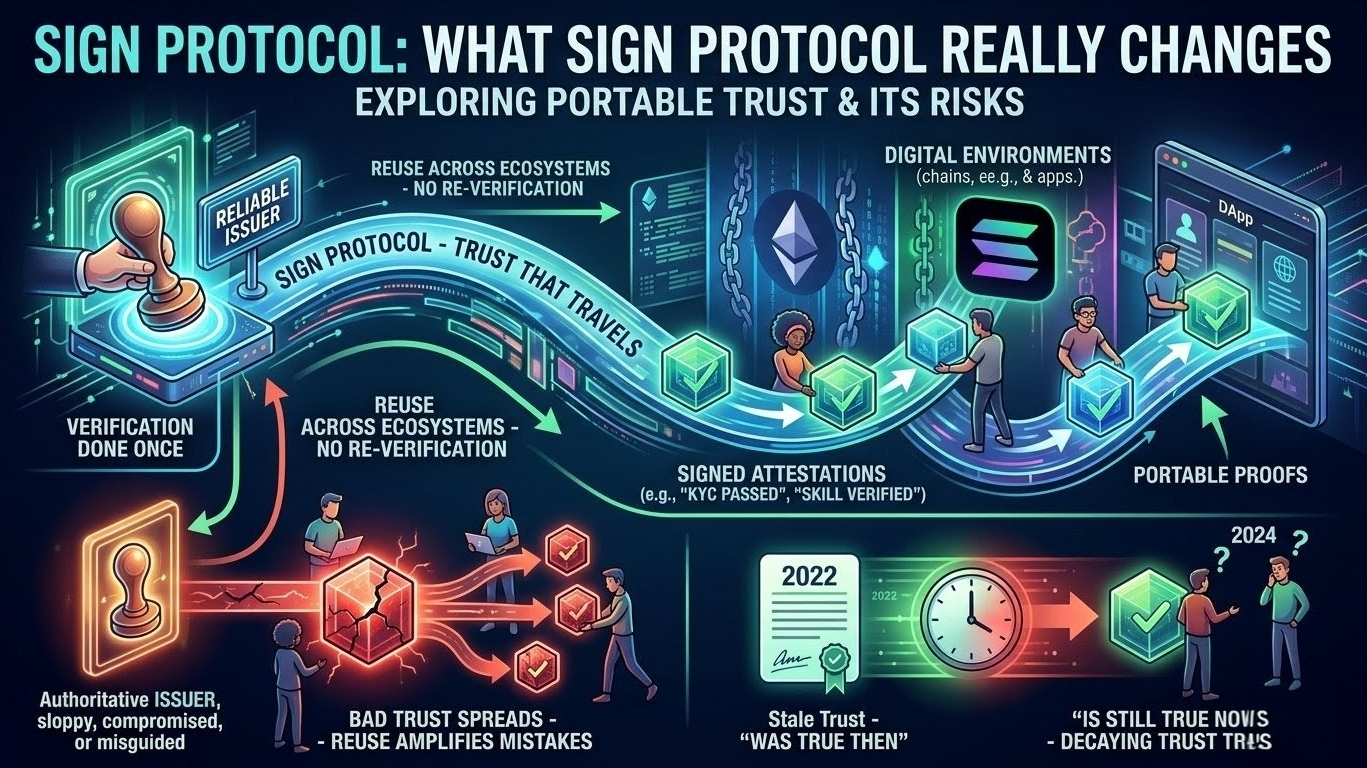
What actually excites me is how Sign lets trust travel.
You know how most digital systems feel right now? Every new app, every new chain, every fresh context acts like it has to start from scratch. Re-verify the user. Re-check the credential. Run the whole trust routine again, pretending nothing that came before matters. It’s tiring, wasteful, and a little silly—like we’re confusing repetition with real security.
Sign flips that. It lets signed proofs move cleanly across boundaries—between chains, apps, and ecosystems—without losing their meaning. One place does the hard or careful verification once, signs it properly, and that proof can follow the user and get reused elsewhere. No more forcing every new system to pretend history began five minutes ago. Verification becomes portable. Context stops vanishing at every edge.
To me, that’s not just storage. That’s real infrastructure. The kind that could make cross-chain life feel much less brittle, less repetitive, and way less forgetful about what’s already been figured out.
The Hidden Weight of Portable Trust
But here’s where it gets uncomfortable.
If trust is going to travel farther and get reused more often, then the issuer suddenly matters a lot more than people admit. A thoughtful, reliable issuer can make the whole system feel smooth and trustworthy. A sloppy, compromised, or misguided one? That bad proof doesn’t stay local anymore—it spreads. Downstream apps might trust the signature more than they ever understood the original source. The same efficiency that removes friction can quietly turn into a fast way to amplify mistakes.
When Time Makes Trust Dangerous
And then there’s the time problem that keeps nagging at me.
A proof can be perfectly valid the day it’s signed and quietly misleading months later. The signature still checks out. The format still looks clean. But life has moved on—the user’s status changed, the condition expired, the world shifted underneath it. Yet the old attestation keeps traveling forward, looking as official as ever. Stale trust is sneaky like that. It doesn’t announce itself; it just lingers, because signed things carry this quiet air of permanence even when the reality behind them has faded.
So when I look at Sign, I don’t see a simple database of attestations. I see a protocol trying to stitch these fractured digital worlds back together so we can stop rebuilding the same basic checks over and over. That reusability feels genuinely powerful. It could make identity, credentials, compliance—pretty much everything—feel more continuous and less amnesiac across chains and apps.
At the same time, it quietly raises the stakes. Issuer quality matters more now. Freshness and revocation matter more. The difference between “was true then” and “is still true now” becomes a really big deal.
Portable trust is a beautiful idea. It just doesn’t erase risk—it moves it around. The very thing that lets good trust flow farther is the same thing that can let flawed or outdated trust travel faster and wider than before.
The upside is exciting, and I suspect many of us are still underestimating it. But the responsibility that comes along with it deserves a much closer look. That tension is exactly why Sign feels worth paying real attention to.
@SignOfficial #SignDigitalSovereignInfra
$SIGN
{spot}(SIGNUSDT)
Trust That Travels: What Sign Protocol Really Changes
I’ve been thinking about Sign Protocol a lot lately, and honestly, calling it an “attestation registry” feels way too small. It makes everything sound like a clean digital filing cabinet—proofs go in, sit quietly, and get pulled out when someone needs them. That’s technically true, but it misses the heart of what’s happening.
What actually excites me is how Sign lets trust travel.
You know how most digital systems feel right now? Every new app, every new chain, every fresh context acts like it has to start from scratch. Re-verify the user. Re-check the credential. Run the whole trust routine again, pretending nothing that came before matters. It’s tiring, wasteful, and a little silly—like we’re confusing repetition with real security.
Sign flips that. It lets signed proofs move cleanly across boundaries—between chains, apps, and ecosystems—without losing their meaning. One place does the hard or careful verification once, signs it properly, and that proof can follow the user and get reused elsewhere. No more forcing every new system to pretend history began five minutes ago. Verification becomes portable. Context stops vanishing at every edge.
To me, that’s not just storage. That’s real infrastructure. The kind that could make cross-chain life feel much less brittle, less repetitive, and way less forgetful about what’s already been figured out.
The Hidden Weight of Portable Trust
But here’s where it gets uncomfortable.
If trust is going to travel farther and get reused more often, then the issuer suddenly matters a lot more than people admit. A thoughtful, reliable issuer can make the whole system feel smooth and trustworthy. A sloppy, compromised, or misguided one? That bad proof doesn’t stay local anymore—it spreads. Downstream apps might trust the signature more than they ever understood the original source. The same efficiency that removes friction can quietly turn into a fast way to amplify mistakes.
When Time Makes Trust Dangerous
And then there’s the time problem that keeps nagging at me.
A proof can be perfectly valid the day it’s signed and quietly misleading months later. The signature still checks out. The format still looks clean. But life has moved on—the user’s status changed, the condition expired, the world shifted underneath it. Yet the old attestation keeps traveling forward, looking as official as ever. Stale trust is sneaky like that. It doesn’t announce itself; it just lingers, because signed things carry this quiet air of permanence even when the reality behind them has faded.
So when I look at Sign, I don’t see a simple database of attestations. I see a protocol trying to stitch these fractured digital worlds back together so we can stop rebuilding the same basic checks over and over. That reusability feels genuinely powerful. It could make identity, credentials, compliance—pretty much everything—feel more continuous and less amnesiac across chains and apps.
At the same time, it quietly raises the stakes. Issuer quality matters more now. Freshness and revocation matter more. The difference between “was true then” and “is still true now” becomes a really big deal.
Portable trust is a beautiful idea. It just doesn’t erase risk—it moves it around. The very thing that lets good trust flow farther is the same thing that can let flawed or outdated trust travel faster and wider than before.
The upside is exciting, and I suspect many of us are still underestimating it. But the responsibility that comes along with it deserves a much closer look. That tension is exactly why Sign feels worth paying real attention to.
@SignOfficial #SignDigitalSovereignInfra
$SIGN
What actually excites me is how Sign lets trust travel.
You know how most digital systems feel right now? Every new app, every new chain, every fresh context acts like it has to start from scratch. Re-verify the user. Re-check the credential. Run the whole trust routine again, pretending nothing that came before matters. It’s tiring, wasteful, and a little silly—like we’re confusing repetition with real security.
Sign flips that. It lets signed proofs move cleanly across boundaries—between chains, apps, and ecosystems—without losing their meaning. One place does the hard or careful verification once, signs it properly, and that proof can follow the user and get reused elsewhere. No more forcing every new system to pretend history began five minutes ago. Verification becomes portable. Context stops vanishing at every edge.
To me, that’s not just storage. That’s real infrastructure. The kind that could make cross-chain life feel much less brittle, less repetitive, and way less forgetful about what’s already been figured out.
The Hidden Weight of Portable Trust
But here’s where it gets uncomfortable.
If trust is going to travel farther and get reused more often, then the issuer suddenly matters a lot more than people admit. A thoughtful, reliable issuer can make the whole system feel smooth and trustworthy. A sloppy, compromised, or misguided one? That bad proof doesn’t stay local anymore—it spreads. Downstream apps might trust the signature more than they ever understood the original source. The same efficiency that removes friction can quietly turn into a fast way to amplify mistakes.
When Time Makes Trust Dangerous
And then there’s the time problem that keeps nagging at me.
A proof can be perfectly valid the day it’s signed and quietly misleading months later. The signature still checks out. The format still looks clean. But life has moved on—the user’s status changed, the condition expired, the world shifted underneath it. Yet the old attestation keeps traveling forward, looking as official as ever. Stale trust is sneaky like that. It doesn’t announce itself; it just lingers, because signed things carry this quiet air of permanence even when the reality behind them has faded.
So when I look at Sign, I don’t see a simple database of attestations. I see a protocol trying to stitch these fractured digital worlds back together so we can stop rebuilding the same basic checks over and over. That reusability feels genuinely powerful. It could make identity, credentials, compliance—pretty much everything—feel more continuous and less amnesiac across chains and apps.
At the same time, it quietly raises the stakes. Issuer quality matters more now. Freshness and revocation matter more. The difference between “was true then” and “is still true now” becomes a really big deal.
Portable trust is a beautiful idea. It just doesn’t erase risk—it moves it around. The very thing that lets good trust flow farther is the same thing that can let flawed or outdated trust travel faster and wider than before.
The upside is exciting, and I suspect many of us are still underestimating it. But the responsibility that comes along with it deserves a much closer look. That tension is exactly why Sign feels worth paying real attention to.
@SignOfficial #SignDigitalSovereignInfra
$SIGN
107
83
18.9k

Article
SIGN Isn’t About Trust It’s About Whether Meaning Survives the MessLook, I’ll be honest. The market is exhausted.
Every other project talks about “trust,” “identity,” “coordination.” I’ve seen this movie before. Same script, different logo. And yeah, it sounds smart at first… until you actually try to use these systems and everything starts breaking in weird, quiet ways.
Data doesn’t move cleanly. Credentials don’t mean the same thing everywhere. And suddenly all that “composable infrastructure” talk? It falls apart.
So when something like SIGN shows up positioning itself as infrastructure for credential verification and token distribution I don’t get excited. I get suspicious. That’s just how this space trains you.
Because the idea itself isn’t new. Not even close.
But here’s where it gets interesting… and also messy.
The first thing people don’t talk about enough is this: a credential and a token distribution are not the same thing. Not even remotely.
A credential is basically someone saying, “yeah, this person qualifies.”
A distribution is actually giving them something of value.
Simple, right? You’d think.
But most systems just mash these together like it’s one clean pipeline prove something → get tokens. Done.
That’s lazy thinking. Honestly.
Because in real life, eligibility changes. Issuers aren’t always reliable. And sometimes… even if someone qualifies, they still don’t get anything. Policies, timing, funding there’s always something.
If SIGN treats these two layers like they’re identical, that’s a crack in the foundation. A big one.
Now let’s talk about the real problem. Not storage. Not speed.
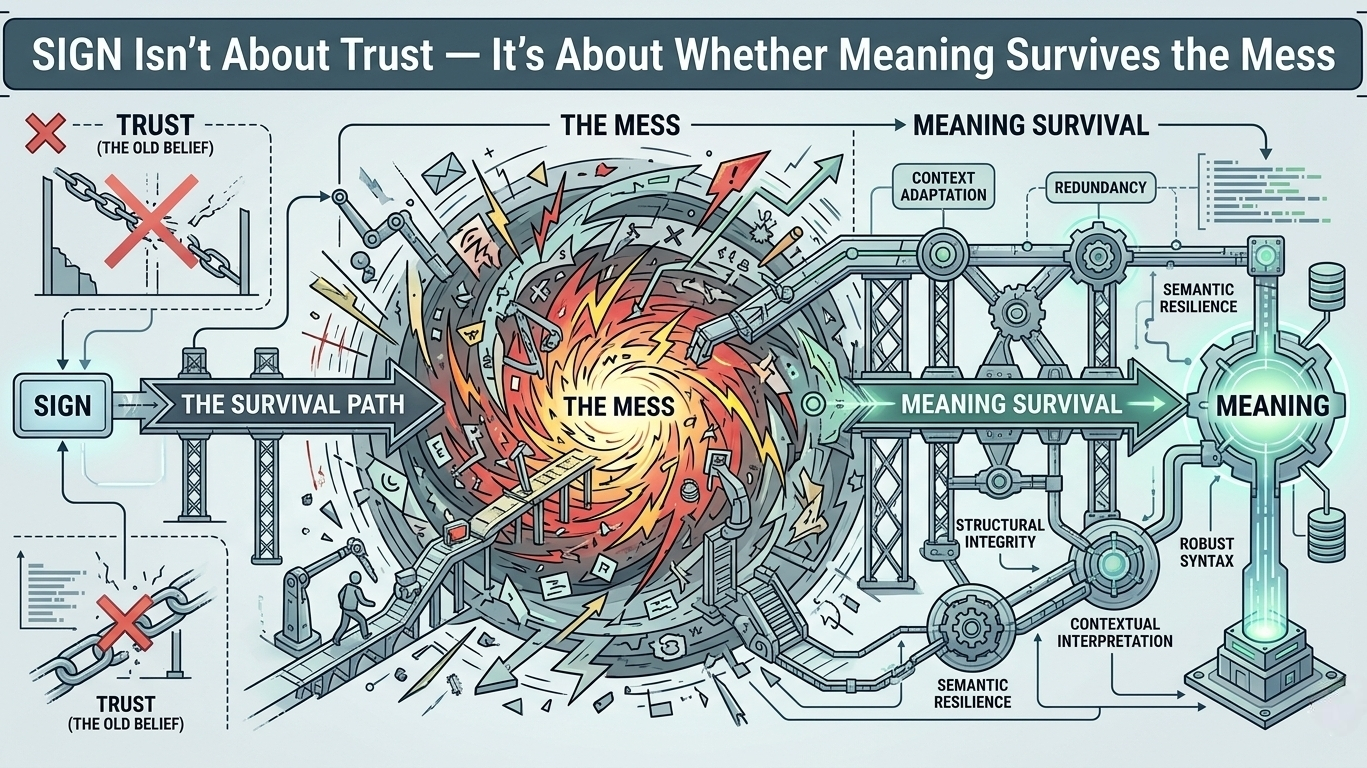
Meaning.
Yeah, meaning. The thing nobody builds for.
A credential isn’t just data sitting somewhere. It’s a claim. And that claim comes with baggage:
Who issued it?
Under what rules?
At what time?
And who actually trusts that issuer?
Move that credential somewhere else and boom, half that context disappears.
I’ve seen this happen over and over. A proof that made total sense in one system suddenly looks useless somewhere else. Not because it’s wrong… but because nobody knows how to interpret it anymore.
That’s what I call proof decay. And it’s everywhere.
So the real question for SIGN isn’t “can you verify something?”
That part’s easy.
The real question is: can that meaning survive travel?
Because if it can’t, then what’s the point?
And then there’s the real world. Which, let’s be real, is a mess.
People lose wallets.
They reuse identities.
They forget things.
Institutions? Even worse. Inconsistent, slow, sometimes just wrong.
Records aren’t clean. They’re incomplete. Sometimes duplicated. Sometimes outdated.
This is the environment SIGN has to live in.
Not a perfect, trustless fantasy. Chaos.
So yeah, I start asking uncomfortable questions:
What happens when a credential needs to be revoked… but it’s already everywhere?
What if two issuers say opposite things about the same person?
What if someone only has half the credentials they need?
What stops someone from reusing a valid claim in a totally different context?
These aren’t edge cases. This is normal behavior.
If SIGN doesn’t handle this stuff, it won’t fail loudly. It’ll fail quietly. And that’s worse.
Another thing that bugs me and it happens a lot in Web3 is how people flatten everything into “proofs.”
Not all data is the same. Not even close.
A signed agreement? That’s a commitment between parties. Context-heavy. Legal implications.
A credential? That’s just a claim about someone. Might expire. Might get revoked.
A token distribution record? That’s history. It happened. Done.
Three completely different things.
But systems love to treat them like identical Lego blocks. Plug and play.
Bad idea.
You end up with weird situations like treating a temporary credential as permanent truth, or assuming a financial transaction somehow proves legitimacy.
It doesn’t.
If SIGN can’t keep these categories separate, things will get confusing fast. And confusion in financial systems? Yeah… that’s where problems start.
Now let’s get into token distribution, because this is where things usually break.
Most people think distribution is just logistics. Who gets what.
It’s not.
It’s a verification problem. And honestly, it’s kind of adversarial.
Airdrops, grants, incentives they fail all the time. Not because the system can’t send tokens, but because it can’t define who actually deserves them.
SIGN tries to flip this by focusing on claims instead of addresses.
That’s smart. I’ll give it that.
Instead of “this wallet gets tokens,” it’s more like “this person qualifies based on these proofs.”
But here’s the catch.
The more precise you make those rules, the harder they are to understand. And if people can’t understand why they qualify or don’t they stop trusting the system.
And then you get gaming.
People don’t contribute real value. They just optimize for the criteria. Farm the credentials. Hit the checklist.
You’ve seen it. I’ve seen it.
So yeah, better verification helps… but it doesn’t magically fix behavior.
There’s also the time problem. Nobody wants to deal with this, but it matters.
Every credential expires. Or at least, it should.
Something that was true last year might not be true today. But systems love to treat proofs like they’re eternal.
They’re not.
If SIGN doesn’t build in time like actual expiration, renewal, context awareness it’s just going to collect stale claims. And over time, those claims start misleading people.
That’s how trust quietly erodes.
So where does that leave us?
Honestly… somewhere in the middle.
I’m not dismissing SIGN. There’s something here. The focus on claims, on portability, on tying verification to distribution it’s directionally right.
But direction isn’t enough.
If this turns into just another attestation layer, it’ll fade into the background. We’ve got plenty of those already.
If it tries to force rigid standards, institutions won’t play along. They never do.
And if it ignores how messy the real world is, it’ll break the moment it scales.
But if and it’s a big if it manages to carry meaning across systems… not just data, but actual meaning, with context, constraints, and time baked in?
That’s different.
That’s not exciting. It’s not flashy. Nobody’s going to hype it on a bull run.
But it’s useful. Quietly useful.
And when the noise dies down and it always does systems that preserve order tend to stick around.
Everything else?
It just adds to the pile of things that almost worked.
#SignDigitalSovereignInfra @SignOfficial $SIGN
{future}(SIGNUSDT)
SIGN Isn’t About Trust It’s About Whether Meaning Survives the Mess
Look, I’ll be honest. The market is exhausted.
Every other project talks about “trust,” “identity,” “coordination.” I’ve seen this movie before. Same script, different logo. And yeah, it sounds smart at first… until you actually try to use these systems and everything starts breaking in weird, quiet ways.
Data doesn’t move cleanly. Credentials don’t mean the same thing everywhere. And suddenly all that “composable infrastructure” talk? It falls apart.
So when something like SIGN shows up positioning itself as infrastructure for credential verification and token distribution I don’t get excited. I get suspicious. That’s just how this space trains you.
Because the idea itself isn’t new. Not even close.
But here’s where it gets interesting… and also messy.
The first thing people don’t talk about enough is this: a credential and a token distribution are not the same thing. Not even remotely.
A credential is basically someone saying, “yeah, this person qualifies.”
A distribution is actually giving them something of value.
Simple, right? You’d think.
But most systems just mash these together like it’s one clean pipeline prove something → get tokens. Done.
That’s lazy thinking. Honestly.
Because in real life, eligibility changes. Issuers aren’t always reliable. And sometimes… even if someone qualifies, they still don’t get anything. Policies, timing, funding there’s always something.
If SIGN treats these two layers like they’re identical, that’s a crack in the foundation. A big one.
Now let’s talk about the real problem. Not storage. Not speed.
Meaning.
Yeah, meaning. The thing nobody builds for.
A credential isn’t just data sitting somewhere. It’s a claim. And that claim comes with baggage:
Who issued it?
Under what rules?
At what time?
And who actually trusts that issuer?
Move that credential somewhere else and boom, half that context disappears.
I’ve seen this happen over and over. A proof that made total sense in one system suddenly looks useless somewhere else. Not because it’s wrong… but because nobody knows how to interpret it anymore.
That’s what I call proof decay. And it’s everywhere.
So the real question for SIGN isn’t “can you verify something?”
That part’s easy.
The real question is: can that meaning survive travel?
Because if it can’t, then what’s the point?
And then there’s the real world. Which, let’s be real, is a mess.
People lose wallets.
They reuse identities.
They forget things.
Institutions? Even worse. Inconsistent, slow, sometimes just wrong.
Records aren’t clean. They’re incomplete. Sometimes duplicated. Sometimes outdated.
This is the environment SIGN has to live in.
Not a perfect, trustless fantasy. Chaos.
So yeah, I start asking uncomfortable questions:
What happens when a credential needs to be revoked… but it’s already everywhere?
What if two issuers say opposite things about the same person?
What if someone only has half the credentials they need?
What stops someone from reusing a valid claim in a totally different context?
These aren’t edge cases. This is normal behavior.
If SIGN doesn’t handle this stuff, it won’t fail loudly. It’ll fail quietly. And that’s worse.
Another thing that bugs me and it happens a lot in Web3 is how people flatten everything into “proofs.”
Not all data is the same. Not even close.
A signed agreement? That’s a commitment between parties. Context-heavy. Legal implications.
A credential? That’s just a claim about someone. Might expire. Might get revoked.
A token distribution record? That’s history. It happened. Done.
Three completely different things.
But systems love to treat them like identical Lego blocks. Plug and play.
Bad idea.
You end up with weird situations like treating a temporary credential as permanent truth, or assuming a financial transaction somehow proves legitimacy.
It doesn’t.
If SIGN can’t keep these categories separate, things will get confusing fast. And confusion in financial systems? Yeah… that’s where problems start.
Now let’s get into token distribution, because this is where things usually break.
Most people think distribution is just logistics. Who gets what.
It’s not.
It’s a verification problem. And honestly, it’s kind of adversarial.
Airdrops, grants, incentives they fail all the time. Not because the system can’t send tokens, but because it can’t define who actually deserves them.
SIGN tries to flip this by focusing on claims instead of addresses.
That’s smart. I’ll give it that.
Instead of “this wallet gets tokens,” it’s more like “this person qualifies based on these proofs.”
But here’s the catch.
The more precise you make those rules, the harder they are to understand. And if people can’t understand why they qualify or don’t they stop trusting the system.
And then you get gaming.
People don’t contribute real value. They just optimize for the criteria. Farm the credentials. Hit the checklist.
You’ve seen it. I’ve seen it.
So yeah, better verification helps… but it doesn’t magically fix behavior.
There’s also the time problem. Nobody wants to deal with this, but it matters.
Every credential expires. Or at least, it should.
Something that was true last year might not be true today. But systems love to treat proofs like they’re eternal.
They’re not.
If SIGN doesn’t build in time like actual expiration, renewal, context awareness it’s just going to collect stale claims. And over time, those claims start misleading people.
That’s how trust quietly erodes.
So where does that leave us?
Honestly… somewhere in the middle.
I’m not dismissing SIGN. There’s something here. The focus on claims, on portability, on tying verification to distribution it’s directionally right.
But direction isn’t enough.
If this turns into just another attestation layer, it’ll fade into the background. We’ve got plenty of those already.
If it tries to force rigid standards, institutions won’t play along. They never do.
And if it ignores how messy the real world is, it’ll break the moment it scales.
But if and it’s a big if it manages to carry meaning across systems… not just data, but actual meaning, with context, constraints, and time baked in?
That’s different.
That’s not exciting. It’s not flashy. Nobody’s going to hype it on a bull run.
But it’s useful. Quietly useful.
And when the noise dies down and it always does systems that preserve order tend to stick around.
Everything else?
It just adds to the pile of things that almost worked.
#SignDigitalSovereignInfra @SignOfficial $SIGN
Every other project talks about “trust,” “identity,” “coordination.” I’ve seen this movie before. Same script, different logo. And yeah, it sounds smart at first… until you actually try to use these systems and everything starts breaking in weird, quiet ways.
Data doesn’t move cleanly. Credentials don’t mean the same thing everywhere. And suddenly all that “composable infrastructure” talk? It falls apart.
So when something like SIGN shows up positioning itself as infrastructure for credential verification and token distribution I don’t get excited. I get suspicious. That’s just how this space trains you.
Because the idea itself isn’t new. Not even close.
But here’s where it gets interesting… and also messy.
The first thing people don’t talk about enough is this: a credential and a token distribution are not the same thing. Not even remotely.
A credential is basically someone saying, “yeah, this person qualifies.”
A distribution is actually giving them something of value.
Simple, right? You’d think.
But most systems just mash these together like it’s one clean pipeline prove something → get tokens. Done.
That’s lazy thinking. Honestly.
Because in real life, eligibility changes. Issuers aren’t always reliable. And sometimes… even if someone qualifies, they still don’t get anything. Policies, timing, funding there’s always something.
If SIGN treats these two layers like they’re identical, that’s a crack in the foundation. A big one.
Now let’s talk about the real problem. Not storage. Not speed.
Meaning.
Yeah, meaning. The thing nobody builds for.
A credential isn’t just data sitting somewhere. It’s a claim. And that claim comes with baggage:
Who issued it?
Under what rules?
At what time?
And who actually trusts that issuer?
Move that credential somewhere else and boom, half that context disappears.
I’ve seen this happen over and over. A proof that made total sense in one system suddenly looks useless somewhere else. Not because it’s wrong… but because nobody knows how to interpret it anymore.
That’s what I call proof decay. And it’s everywhere.
So the real question for SIGN isn’t “can you verify something?”
That part’s easy.
The real question is: can that meaning survive travel?
Because if it can’t, then what’s the point?
And then there’s the real world. Which, let’s be real, is a mess.
People lose wallets.
They reuse identities.
They forget things.
Institutions? Even worse. Inconsistent, slow, sometimes just wrong.
Records aren’t clean. They’re incomplete. Sometimes duplicated. Sometimes outdated.
This is the environment SIGN has to live in.
Not a perfect, trustless fantasy. Chaos.
So yeah, I start asking uncomfortable questions:
What happens when a credential needs to be revoked… but it’s already everywhere?
What if two issuers say opposite things about the same person?
What if someone only has half the credentials they need?
What stops someone from reusing a valid claim in a totally different context?
These aren’t edge cases. This is normal behavior.
If SIGN doesn’t handle this stuff, it won’t fail loudly. It’ll fail quietly. And that’s worse.
Another thing that bugs me and it happens a lot in Web3 is how people flatten everything into “proofs.”
Not all data is the same. Not even close.
A signed agreement? That’s a commitment between parties. Context-heavy. Legal implications.
A credential? That’s just a claim about someone. Might expire. Might get revoked.
A token distribution record? That’s history. It happened. Done.
Three completely different things.
But systems love to treat them like identical Lego blocks. Plug and play.
Bad idea.
You end up with weird situations like treating a temporary credential as permanent truth, or assuming a financial transaction somehow proves legitimacy.
It doesn’t.
If SIGN can’t keep these categories separate, things will get confusing fast. And confusion in financial systems? Yeah… that’s where problems start.
Now let’s get into token distribution, because this is where things usually break.
Most people think distribution is just logistics. Who gets what.
It’s not.
It’s a verification problem. And honestly, it’s kind of adversarial.
Airdrops, grants, incentives they fail all the time. Not because the system can’t send tokens, but because it can’t define who actually deserves them.
SIGN tries to flip this by focusing on claims instead of addresses.
That’s smart. I’ll give it that.
Instead of “this wallet gets tokens,” it’s more like “this person qualifies based on these proofs.”
But here’s the catch.
The more precise you make those rules, the harder they are to understand. And if people can’t understand why they qualify or don’t they stop trusting the system.
And then you get gaming.
People don’t contribute real value. They just optimize for the criteria. Farm the credentials. Hit the checklist.
You’ve seen it. I’ve seen it.
So yeah, better verification helps… but it doesn’t magically fix behavior.
There’s also the time problem. Nobody wants to deal with this, but it matters.
Every credential expires. Or at least, it should.
Something that was true last year might not be true today. But systems love to treat proofs like they’re eternal.
They’re not.
If SIGN doesn’t build in time like actual expiration, renewal, context awareness it’s just going to collect stale claims. And over time, those claims start misleading people.
That’s how trust quietly erodes.
So where does that leave us?
Honestly… somewhere in the middle.
I’m not dismissing SIGN. There’s something here. The focus on claims, on portability, on tying verification to distribution it’s directionally right.
But direction isn’t enough.
If this turns into just another attestation layer, it’ll fade into the background. We’ve got plenty of those already.
If it tries to force rigid standards, institutions won’t play along. They never do.
And if it ignores how messy the real world is, it’ll break the moment it scales.
But if and it’s a big if it manages to carry meaning across systems… not just data, but actual meaning, with context, constraints, and time baked in?
That’s different.
That’s not exciting. It’s not flashy. Nobody’s going to hype it on a bull run.
But it’s useful. Quietly useful.
And when the noise dies down and it always does systems that preserve order tend to stick around.
Everything else?
It just adds to the pile of things that almost worked.
#SignDigitalSovereignInfra @SignOfficial $SIGN
56
32
536

From Airdrop to Staking: A Whole New Wealth Game Rule
In the world of digital assets
From Airdrop to Staking: A Whole New Wealth Game Rule
In the world of digital assets, the SIGN token is redefining community governance and incentives for long-term holders in an unprecedented way. It’s no longer just a trading chip; it’s a creative and interactive experiment where every holder can become a participant in the ecosystem’s development.
Initially, SIGN attracted users through airdrops, which is not only a quick user acquisition strategy but also a creative way to stimulate community engagement. Airdrops give ordinary folks a chance to get involved with the project, breaking the traditional finance monopoly on resources and allowing more people to ride the digital economy wave. However, the airdrop is just the beginning; the real value lies in how to continuously engage users and encourage them to hold long-term.
Thus, SIGN introduced a staking mechanism, which is not only a technical innovation but also a deep incentive for user behavior. Through staking, users can earn stable yields while participating in community decision-making, truly embodying the idea of "holding tokens equals power." This design makes holders not just investors but core drivers of the project’s development.
Throughout this process, SIGN has shown unique creative thinking by cleverly combining economic incentives with community governance, creating a sustainable ecosystem. For shoppers, this is not just an investment opportunity but a new consumption experience—they can earn additional yields by holding tokens and even influence the project’s future direction.
Such a design undoubtedly brings new vitality to the market and allows SIGN to stand out among many projects. It proves that when technology, creativity, and user demand perfectly blend, surprising results can be achieved. Whether for long-term holders or ordinary users, SIGN offers a whole new value proposition worth diving into and paying attention to.
From Airdrop to Staking: A Whole New Wealth Game Rule
In the world of digital assets, the SIGN token is redefining community governance and incentives for long-term holders in an unprecedented way. It’s no longer just a trading chip; it’s a creative and interactive experiment where every holder can become a participant in the ecosystem’s development.
Initially, SIGN attracted users through airdrops, which is not only a quick user acquisition strategy but also a creative way to stimulate community engagement. Airdrops give ordinary folks a chance to get involved with the project, breaking the traditional finance monopoly on resources and allowing more people to ride the digital economy wave. However, the airdrop is just the beginning; the real value lies in how to continuously engage users and encourage them to hold long-term.
Thus, SIGN introduced a staking mechanism, which is not only a technical innovation but also a deep incentive for user behavior. Through staking, users can earn stable yields while participating in community decision-making, truly embodying the idea of "holding tokens equals power." This design makes holders not just investors but core drivers of the project’s development.
Throughout this process, SIGN has shown unique creative thinking by cleverly combining economic incentives with community governance, creating a sustainable ecosystem. For shoppers, this is not just an investment opportunity but a new consumption experience—they can earn additional yields by holding tokens and even influence the project’s future direction.
Such a design undoubtedly brings new vitality to the market and allows SIGN to stand out among many projects. It proves that when technology, creativity, and user demand perfectly blend, surprising results can be achieved. Whether for long-term holders or ordinary users, SIGN offers a whole new value proposition worth diving into and paying attention to.
From Airdrop to Staking: A Whole New Wealth Game Rule In the world of digital assets
From Airdrop to Staking: A Whole New Wealth Game Rule
In the world of digital assets, the SIGN token is redefining community governance and incentives for long-term holders in an unprecedented way. It’s no longer just a trading chip; it’s a creative and interactive experiment where every holder can become a participant in the ecosystem’s development.
Initially, SIGN attracted users through airdrops, which is not only a quick user acquisition strategy but also a creative way to stimulate community engagement. Airdrops give ordinary folks a chance to get involved with the project, breaking the traditional finance monopoly on resources and allowing more people to ride the digital economy wave. However, the airdrop is just the beginning; the real value lies in how to continuously engage users and encourage them to hold long-term.
Thus, SIGN introduced a staking mechanism, which is not only a technical innovation but also a deep incentive for user behavior. Through staking, users can earn stable yields while participating in community decision-making, truly embodying the idea of "holding tokens equals power." This design makes holders not just investors but core drivers of the project’s development.
Throughout this process, SIGN has shown unique creative thinking by cleverly combining economic incentives with community governance, creating a sustainable ecosystem. For shoppers, this is not just an investment opportunity but a new consumption experience—they can earn additional yields by holding tokens and even influence the project’s future direction.
Such a design undoubtedly brings new vitality to the market and allows SIGN to stand out among many projects. It proves that when technology, creativity, and user demand perfectly blend, surprising results can be achieved. Whether for long-term holders or ordinary users, SIGN offers a whole new value proposition worth diving into and paying attention to.
216

·
--

Article
🚨 Breaking: Shooting at the Correspondents' Dinner. How is the market reacting?The world is shaken by the weekend events in Washington. The attack on the Washington Hilton hotel during the annual White House Correspondents' Association dinner has become the major geopolitical trigger of these days.
What's known at this moment? 🛡️
Incident:
Shots were fired during the event. President Donald Trump and the First Lady were urgently evacuated by the Secret Service.
🚨 Breaking: Shooting at the Correspondents' Dinner. How is the market reacting?
The world is shaken by the weekend events in Washington. The attack on the Washington Hilton hotel during the annual White House Correspondents' Association dinner has become the major geopolitical trigger of these days.
What's known at this moment? 🛡️
Incident:
Shots were fired during the event. President Donald Trump and the First Lady were urgently evacuated by the Secret Service.
What's known at this moment? 🛡️
Incident:
Shots were fired during the event. President Donald Trump and the First Lady were urgently evacuated by the Secret Service.
1
183

·
--
Article
Shock‑Resistant by Design Infrastructure That Holds When Everything BreaksI have heard enough big crypto claims to know the pattern everything Sounds airtight until markets peak then it vanishes. So fail‑safe infrastructure doesn’t make me excited; it makes me cautious. I dug in because SIGN Protocol looked different for a straightforward reason: it isn’t stuck in theory, it’s already in use.
The idea’s simple enough to respect build systems that don’t crumble under pressure, not just for me trading at night but for entire countries. That’s a heavy claim. Governments don’t want experiments; they need things that keep working when everything else breaks. What grabs me is the focus on shock resistance. It’s real: markets crash, banks freeze, systems fail. I’ve watched it happen too many times. If infra can’t take stress it’s useless when it matters.
@SignOfficial SIGN seems aimed right at that gap. Instead of launching another token or chasing the same hype loop, it works on the base layer how trust and data are handled. Quiet work but important. From what I can tell it’s already deployed in real situations, and that outweighs any roadmap slide.
Still I’m not blindly recommending it or throwing myself wholly in. Sovereign‑grade infrastructure is serious governments move slowly for good reason. Security, control, accountability can’t be half‑baked. One weak point and the whole system gets questioned; tech ends up trash. I respect the direction, though. If blockchain has long‑term value, this is where it needs to go: not memes, not speculation, but ecosystems that stay standing when things go sideways.
I’m doubtful, but I’m watching closely. If something like this actually works at scale, it changes how countries think about digital infrastructure. I don’t get carried away by big claims, but I don’t ignore quiet progress either. Watch what gets used, learn, teach others that’s how real adoption moves forward. It’s not as far off as people think.#SignDigitalSovereignInfra $SIGN
Shock‑Resistant by Design Infrastructure That Holds When Everything Breaks
I have heard enough big crypto claims to know the pattern everything Sounds airtight until markets peak then it vanishes. So fail‑safe infrastructure doesn’t make me excited; it makes me cautious. I dug in because SIGN Protocol looked different for a straightforward reason: it isn’t stuck in theory, it’s already in use.
The idea’s simple enough to respect build systems that don’t crumble under pressure, not just for me trading at night but for entire countries. That’s a heavy claim. Governments don’t want experiments; they need things that keep working when everything else breaks. What grabs me is the focus on shock resistance. It’s real: markets crash, banks freeze, systems fail. I’ve watched it happen too many times. If infra can’t take stress it’s useless when it matters.
@SignOfficial SIGN seems aimed right at that gap. Instead of launching another token or chasing the same hype loop, it works on the base layer how trust and data are handled. Quiet work but important. From what I can tell it’s already deployed in real situations, and that outweighs any roadmap slide.
Still I’m not blindly recommending it or throwing myself wholly in. Sovereign‑grade infrastructure is serious governments move slowly for good reason. Security, control, accountability can’t be half‑baked. One weak point and the whole system gets questioned; tech ends up trash. I respect the direction, though. If blockchain has long‑term value, this is where it needs to go: not memes, not speculation, but ecosystems that stay standing when things go sideways.
I’m doubtful, but I’m watching closely. If something like this actually works at scale, it changes how countries think about digital infrastructure. I don’t get carried away by big claims, but I don’t ignore quiet progress either. Watch what gets used, learn, teach others that’s how real adoption moves forward. It’s not as far off as people think.#SignDigitalSovereignInfra $SIGN
The idea’s simple enough to respect build systems that don’t crumble under pressure, not just for me trading at night but for entire countries. That’s a heavy claim. Governments don’t want experiments; they need things that keep working when everything else breaks. What grabs me is the focus on shock resistance. It’s real: markets crash, banks freeze, systems fail. I’ve watched it happen too many times. If infra can’t take stress it’s useless when it matters.
@SignOfficial SIGN seems aimed right at that gap. Instead of launching another token or chasing the same hype loop, it works on the base layer how trust and data are handled. Quiet work but important. From what I can tell it’s already deployed in real situations, and that outweighs any roadmap slide.
Still I’m not blindly recommending it or throwing myself wholly in. Sovereign‑grade infrastructure is serious governments move slowly for good reason. Security, control, accountability can’t be half‑baked. One weak point and the whole system gets questioned; tech ends up trash. I respect the direction, though. If blockchain has long‑term value, this is where it needs to go: not memes, not speculation, but ecosystems that stay standing when things go sideways.
I’m doubtful, but I’m watching closely. If something like this actually works at scale, it changes how countries think about digital infrastructure. I don’t get carried away by big claims, but I don’t ignore quiet progress either. Watch what gets used, learn, teach others that’s how real adoption moves forward. It’s not as far off as people think.#SignDigitalSovereignInfra $SIGN
22
20
476

Article
WHEN TRUST FAILS TO TRAVEL, SYSTEMS START BREAKING WHY SIGN MATTERS MORE UNDER PRESSUREI don’t get pulled in by polished narratives as easily as I used to.
Too many projects have already trained me out of that habit. I’ve seen serious problems described with sharp language and elegant structure, only for the actual system underneath to weaken the moment real conditions arrive. At this point, I pay less attention to how clean the explanation sounds and more attention to whether the design can survive repetition, pressure, and imperfect usage. That filter changes what stands out, and it is one of the main reasons Sign keeps holding my attention.
Not because it makes identity look exciting. It doesn’t. And honestly, that is part of why it feels more serious. Identity, verification, credentials, permissions, attestations — these are not the glamorous parts of a digital system. They are the structural parts. They are the parts that decide whether coordination becomes smoother over time or more fragile. When a project treats that layer as infrastructure instead of presentation, it starts to feel less like a performance and more like something built for reality.
What keeps standing out to me is where Sign is positioned inside the stack. It is not trying to live at the surface where attention is easiest. It is sitting deeper, closer to the place where friction quietly accumulates. Most systems today still keep rebuilding trust from the beginning. The same person, the same credentials, the same claims, the same approvals often need to be checked again and again across different environments. Each platform recreates its own version of certainty. That repetition has become so normal that many people stop noticing it, but normal does not mean efficient. It creates drag, and the more systems grow, the more that drag compounds.
What makes this especially important is that this kind of weakness rarely announces itself in dramatic ways. Systems do not always collapse when trust stops scaling. Sometimes they simply become slower, heavier, and harder to coordinate. They lose efficiency before they lose function. They start creating more friction than they remove. That kind of failure is easy to ignore because it doesn’t always look like a breakdown from the outside. But over time it limits growth, reduces flexibility, and weakens the system long before people are willing to admit something is wrong.
That is the layer where Sign feels most relevant to me.
The real promise is not just verification by itself. It is the possibility that trust can move between systems without having to be rebuilt from scratch each time. That matters because once trust becomes portable in a meaningful way, behavior changes. Systems stop duplicating the same work. Users stop carrying the same burden everywhere they go. Coordination becomes lighter because proof is no longer reset at every step. The idea sounds simple when explained in a sentence, but the effect of it is much bigger than the sentence suggests.
That is why I see attestations as more important than they first appear. On the surface, they can sound technical and easy to overlook. But if a verified claim can exist in a format that other systems can understand, check, and use without restarting the full process, then the structure underneath digital interaction becomes stronger. It means trust is no longer trapped inside isolated environments. It can begin to function as reusable infrastructure instead of repeated overhead.
That is where Sign starts to feel less like a feature and more like a necessary layer.
Still, this is exactly where the real test begins. Markets do not validate ideas because the ideas sound intelligent. They validate them through repeated exposure to messy conditions. A system can appear convincing in theory for a very long time. The hard part begins when it has to work across different users, institutions, incentives, and edge cases. That is when assumptions start colliding with reality. That is when coordination becomes harder than design. That is when the quality of infrastructure matters more than the quality of storytelling.
And real usage is never clean.
It brings inconsistency, incomplete information, conflicting incentives, institutional boundaries, privacy tension, and behavior that no diagram fully captures. This is where many systems reveal that they were designed to explain a problem better than they were designed to handle it. That is also why Sign stands out to me more than most projects I watch. Not because I assume it has solved everything, and not because I think the path is easy, but because it is aimed at the layer where the real problems actually live.
It is not built around avoiding complexity. It is built around moving into it.
There is also something important about how quiet this kind of work usually looks from the outside. In crypto, visibility is often mistaken for strength. A project becomes loud, gains attention, becomes widely repeated, and people start treating that attention as evidence of durability. I have become much less impressed by that cycle. The systems that end up mattering most are often not the ones demanding constant visibility while they are being built. They become important later, when enough activity depends on them and people suddenly realize the layer beneath the surface was doing more work than they understood.
That is the standard I keep coming back to now. I am less interested in what sounds advanced and more interested in what becomes necessary. Less interested in what explains itself well and more interested in what reduces friction when usage expands. Less interested in what captures attention quickly and more interested in what continues to hold function when pressure increases.
That does not remove the risks. In fact, the risks here are real and impossible to ignore. Infrastructure work is slower, adoption takes longer, and coordination across multiple systems is difficult by default. Even when the direction is right, the outcome is not guaranteed. A project can identify a genuine weakness in digital systems and still take a long time to become embedded in actual behavior. Need alone does not guarantee adoption. Good design does not automatically create smooth integration. And the deeper the problem, the longer the path usually is.
But dismissing a project because it is solving a hard problem misses the point completely.
For me, Sign stands out because it is trying to strengthen one of the weakest and least glamorous layers of digital coordination without turning that effort into empty theater. That matters. It matters because trust is still one of the most expensive things to keep rebuilding. It matters because repeated verification creates invisible drag that most systems quietly absorb until they become harder to scale. And it matters because any system that can make trust more reusable without stripping away meaning is not just improving efficiency. It is improving resilience.
That is why Sign feels worth taking seriously.
Not as a loud narrative, not as a polished surface story, and not as something that needs constant performance to justify attention. It feels important because it is pointed at a real structural weakness, one that becomes more valuable to solve as digital systems grow more connected, more complex, and more dependent on coordination across boundaries.
A lot of systems still look strong from the outside while carrying friction underneath. That gap will matter more over time, not less. And when that hidden friction becomes too costly to ignore, the projects that matter most will not be the ones that sounded best early. They will be the ones that were quietly making systems more durable before everyone else realized durability was the real problem.
That is the moment I think about when I look at Sign.
And Sign feels like it is being built for exactly that moment.
#SignDigitalSovereignInfra $SIGN @SignOfficial
WHEN TRUST FAILS TO TRAVEL, SYSTEMS START BREAKING WHY SIGN MATTERS MORE UNDER PRESSURE
I don’t get pulled in by polished narratives as easily as I used to.
Too many projects have already trained me out of that habit. I’ve seen serious problems described with sharp language and elegant structure, only for the actual system underneath to weaken the moment real conditions arrive. At this point, I pay less attention to how clean the explanation sounds and more attention to whether the design can survive repetition, pressure, and imperfect usage. That filter changes what stands out, and it is one of the main reasons Sign keeps holding my attention.
Not because it makes identity look exciting. It doesn’t. And honestly, that is part of why it feels more serious. Identity, verification, credentials, permissions, attestations — these are not the glamorous parts of a digital system. They are the structural parts. They are the parts that decide whether coordination becomes smoother over time or more fragile. When a project treats that layer as infrastructure instead of presentation, it starts to feel less like a performance and more like something built for reality.
What keeps standing out to me is where Sign is positioned inside the stack. It is not trying to live at the surface where attention is easiest. It is sitting deeper, closer to the place where friction quietly accumulates. Most systems today still keep rebuilding trust from the beginning. The same person, the same credentials, the same claims, the same approvals often need to be checked again and again across different environments. Each platform recreates its own version of certainty. That repetition has become so normal that many people stop noticing it, but normal does not mean efficient. It creates drag, and the more systems grow, the more that drag compounds.
What makes this especially important is that this kind of weakness rarely announces itself in dramatic ways. Systems do not always collapse when trust stops scaling. Sometimes they simply become slower, heavier, and harder to coordinate. They lose efficiency before they lose function. They start creating more friction than they remove. That kind of failure is easy to ignore because it doesn’t always look like a breakdown from the outside. But over time it limits growth, reduces flexibility, and weakens the system long before people are willing to admit something is wrong.
That is the layer where Sign feels most relevant to me.
The real promise is not just verification by itself. It is the possibility that trust can move between systems without having to be rebuilt from scratch each time. That matters because once trust becomes portable in a meaningful way, behavior changes. Systems stop duplicating the same work. Users stop carrying the same burden everywhere they go. Coordination becomes lighter because proof is no longer reset at every step. The idea sounds simple when explained in a sentence, but the effect of it is much bigger than the sentence suggests.
That is why I see attestations as more important than they first appear. On the surface, they can sound technical and easy to overlook. But if a verified claim can exist in a format that other systems can understand, check, and use without restarting the full process, then the structure underneath digital interaction becomes stronger. It means trust is no longer trapped inside isolated environments. It can begin to function as reusable infrastructure instead of repeated overhead.
That is where Sign starts to feel less like a feature and more like a necessary layer.
Still, this is exactly where the real test begins. Markets do not validate ideas because the ideas sound intelligent. They validate them through repeated exposure to messy conditions. A system can appear convincing in theory for a very long time. The hard part begins when it has to work across different users, institutions, incentives, and edge cases. That is when assumptions start colliding with reality. That is when coordination becomes harder than design. That is when the quality of infrastructure matters more than the quality of storytelling.
And real usage is never clean.
It brings inconsistency, incomplete information, conflicting incentives, institutional boundaries, privacy tension, and behavior that no diagram fully captures. This is where many systems reveal that they were designed to explain a problem better than they were designed to handle it. That is also why Sign stands out to me more than most projects I watch. Not because I assume it has solved everything, and not because I think the path is easy, but because it is aimed at the layer where the real problems actually live.
It is not built around avoiding complexity. It is built around moving into it.
There is also something important about how quiet this kind of work usually looks from the outside. In crypto, visibility is often mistaken for strength. A project becomes loud, gains attention, becomes widely repeated, and people start treating that attention as evidence of durability. I have become much less impressed by that cycle. The systems that end up mattering most are often not the ones demanding constant visibility while they are being built. They become important later, when enough activity depends on them and people suddenly realize the layer beneath the surface was doing more work than they understood.
That is the standard I keep coming back to now. I am less interested in what sounds advanced and more interested in what becomes necessary. Less interested in what explains itself well and more interested in what reduces friction when usage expands. Less interested in what captures attention quickly and more interested in what continues to hold function when pressure increases.
That does not remove the risks. In fact, the risks here are real and impossible to ignore. Infrastructure work is slower, adoption takes longer, and coordination across multiple systems is difficult by default. Even when the direction is right, the outcome is not guaranteed. A project can identify a genuine weakness in digital systems and still take a long time to become embedded in actual behavior. Need alone does not guarantee adoption. Good design does not automatically create smooth integration. And the deeper the problem, the longer the path usually is.
But dismissing a project because it is solving a hard problem misses the point completely.
For me, Sign stands out because it is trying to strengthen one of the weakest and least glamorous layers of digital coordination without turning that effort into empty theater. That matters. It matters because trust is still one of the most expensive things to keep rebuilding. It matters because repeated verification creates invisible drag that most systems quietly absorb until they become harder to scale. And it matters because any system that can make trust more reusable without stripping away meaning is not just improving efficiency. It is improving resilience.
That is why Sign feels worth taking seriously.
Not as a loud narrative, not as a polished surface story, and not as something that needs constant performance to justify attention. It feels important because it is pointed at a real structural weakness, one that becomes more valuable to solve as digital systems grow more connected, more complex, and more dependent on coordination across boundaries.
A lot of systems still look strong from the outside while carrying friction underneath. That gap will matter more over time, not less. And when that hidden friction becomes too costly to ignore, the projects that matter most will not be the ones that sounded best early. They will be the ones that were quietly making systems more durable before everyone else realized durability was the real problem.
That is the moment I think about when I look at Sign.
And Sign feels like it is being built for exactly that moment.
#SignDigitalSovereignInfra $SIGN @SignOfficial
Too many projects have already trained me out of that habit. I’ve seen serious problems described with sharp language and elegant structure, only for the actual system underneath to weaken the moment real conditions arrive. At this point, I pay less attention to how clean the explanation sounds and more attention to whether the design can survive repetition, pressure, and imperfect usage. That filter changes what stands out, and it is one of the main reasons Sign keeps holding my attention.
Not because it makes identity look exciting. It doesn’t. And honestly, that is part of why it feels more serious. Identity, verification, credentials, permissions, attestations — these are not the glamorous parts of a digital system. They are the structural parts. They are the parts that decide whether coordination becomes smoother over time or more fragile. When a project treats that layer as infrastructure instead of presentation, it starts to feel less like a performance and more like something built for reality.
What keeps standing out to me is where Sign is positioned inside the stack. It is not trying to live at the surface where attention is easiest. It is sitting deeper, closer to the place where friction quietly accumulates. Most systems today still keep rebuilding trust from the beginning. The same person, the same credentials, the same claims, the same approvals often need to be checked again and again across different environments. Each platform recreates its own version of certainty. That repetition has become so normal that many people stop noticing it, but normal does not mean efficient. It creates drag, and the more systems grow, the more that drag compounds.
What makes this especially important is that this kind of weakness rarely announces itself in dramatic ways. Systems do not always collapse when trust stops scaling. Sometimes they simply become slower, heavier, and harder to coordinate. They lose efficiency before they lose function. They start creating more friction than they remove. That kind of failure is easy to ignore because it doesn’t always look like a breakdown from the outside. But over time it limits growth, reduces flexibility, and weakens the system long before people are willing to admit something is wrong.
That is the layer where Sign feels most relevant to me.
The real promise is not just verification by itself. It is the possibility that trust can move between systems without having to be rebuilt from scratch each time. That matters because once trust becomes portable in a meaningful way, behavior changes. Systems stop duplicating the same work. Users stop carrying the same burden everywhere they go. Coordination becomes lighter because proof is no longer reset at every step. The idea sounds simple when explained in a sentence, but the effect of it is much bigger than the sentence suggests.
That is why I see attestations as more important than they first appear. On the surface, they can sound technical and easy to overlook. But if a verified claim can exist in a format that other systems can understand, check, and use without restarting the full process, then the structure underneath digital interaction becomes stronger. It means trust is no longer trapped inside isolated environments. It can begin to function as reusable infrastructure instead of repeated overhead.
That is where Sign starts to feel less like a feature and more like a necessary layer.
Still, this is exactly where the real test begins. Markets do not validate ideas because the ideas sound intelligent. They validate them through repeated exposure to messy conditions. A system can appear convincing in theory for a very long time. The hard part begins when it has to work across different users, institutions, incentives, and edge cases. That is when assumptions start colliding with reality. That is when coordination becomes harder than design. That is when the quality of infrastructure matters more than the quality of storytelling.
And real usage is never clean.
It brings inconsistency, incomplete information, conflicting incentives, institutional boundaries, privacy tension, and behavior that no diagram fully captures. This is where many systems reveal that they were designed to explain a problem better than they were designed to handle it. That is also why Sign stands out to me more than most projects I watch. Not because I assume it has solved everything, and not because I think the path is easy, but because it is aimed at the layer where the real problems actually live.
It is not built around avoiding complexity. It is built around moving into it.
There is also something important about how quiet this kind of work usually looks from the outside. In crypto, visibility is often mistaken for strength. A project becomes loud, gains attention, becomes widely repeated, and people start treating that attention as evidence of durability. I have become much less impressed by that cycle. The systems that end up mattering most are often not the ones demanding constant visibility while they are being built. They become important later, when enough activity depends on them and people suddenly realize the layer beneath the surface was doing more work than they understood.
That is the standard I keep coming back to now. I am less interested in what sounds advanced and more interested in what becomes necessary. Less interested in what explains itself well and more interested in what reduces friction when usage expands. Less interested in what captures attention quickly and more interested in what continues to hold function when pressure increases.
That does not remove the risks. In fact, the risks here are real and impossible to ignore. Infrastructure work is slower, adoption takes longer, and coordination across multiple systems is difficult by default. Even when the direction is right, the outcome is not guaranteed. A project can identify a genuine weakness in digital systems and still take a long time to become embedded in actual behavior. Need alone does not guarantee adoption. Good design does not automatically create smooth integration. And the deeper the problem, the longer the path usually is.
But dismissing a project because it is solving a hard problem misses the point completely.
For me, Sign stands out because it is trying to strengthen one of the weakest and least glamorous layers of digital coordination without turning that effort into empty theater. That matters. It matters because trust is still one of the most expensive things to keep rebuilding. It matters because repeated verification creates invisible drag that most systems quietly absorb until they become harder to scale. And it matters because any system that can make trust more reusable without stripping away meaning is not just improving efficiency. It is improving resilience.
That is why Sign feels worth taking seriously.
Not as a loud narrative, not as a polished surface story, and not as something that needs constant performance to justify attention. It feels important because it is pointed at a real structural weakness, one that becomes more valuable to solve as digital systems grow more connected, more complex, and more dependent on coordination across boundaries.
A lot of systems still look strong from the outside while carrying friction underneath. That gap will matter more over time, not less. And when that hidden friction becomes too costly to ignore, the projects that matter most will not be the ones that sounded best early. They will be the ones that were quietly making systems more durable before everyone else realized durability was the real problem.
That is the moment I think about when I look at Sign.
And Sign feels like it is being built for exactly that moment.
#SignDigitalSovereignInfra $SIGN @SignOfficial
81
56
1.5k
Log in to explore more content
Join global crypto users on Binance Square
⚡️ Get latest and useful information about crypto.
💬 Trusted by the world’s largest crypto exchange.
👍 Discover real insights from verified creators.
Email / Phone number
Related Coins
Trending Topics
1
#UKFCAWinsCourtOrderToRecover851400Pounds
17,502 views
633 Discussing
2
#ChainlinkLaunchesCCIP2WithEnterpriseVerification
31,253 views
827 Discussing
3
#GoldFallsTo$4144
11,420 views
140 Discussing
4
#QNTFallsOver40%FromMorningHigh
72,675 views
1,254 Discussing
5
#USDTAdds845900HoldersInPast7Days
11,434 views
362 Discussing
6
#KospiFalls2.7%SamsungSKHynixDropOver5%
21,432 views
535 Discussing
7
#BitgetCEOConfirms$388MStolenInHack
4,809 views
41 Discussing
8
#BTCFallsBelow$83000
28,082 views
161 Discussing
9
#BitgetDetailsSecurityIncidentTimeline
39,080 views
685 Discussing
10
#BitcoinSpotETFs$2.39BWeeklyNetInflow
13,064 views
48 Discussing