



In fact, forward and futures contracts are agreements that allow traders, investors and commodity producers to make money on the future price of an asset. They function as a two-way commitment that allows an asset to be traded in the future (until a specified expiration date) at a price agreed upon at the time the contract is created.
The financial instrument of a forward or futures contract can be any asset - a stock, commodity, currency, interest rate, and even a bond.
Unlike forward contracts, futures contracts are standardized (like legal agreements) and traded on specific markets (futures exchanges). They are subject to a set of rules that determine, for example, the contract size and daily interest rates. In many cases, futures contracts are guaranteed to be executed by a clearing house, reducing third party risk during trading.
The first primitive forms of futures markets appeared in the 17th century in Europe, but the Japanese Dōjima Rice Exchange is considered the first futures exchange. In early 18th century Japan, most payments were made in rice, so futures contracts were used to hedge risks associated with unstable rice prices.
With the advent of electronic trading systems, futures contracts have become more widely used throughout the financial industry.
Functions of futures contracts
In the financial industry, futures contracts typically perform the following functions:
Hedging and Risk Management: Futures contracts can be used to mitigate specific risks. For example, a farmer may sell futures contracts on his produce to obtain a certain price in the future regardless of market fluctuations. Or a Japanese investor holding US bonds could buy JPYUSD futures contracts worth the quarterly coupon payment (at the interest rate) and thus lock in the coupon value in Japanese yen at a predetermined rate, i.e., hedge his USD.
Leverage: Futures contracts allow investors to take leveraged positions. Since contracts settle on the expiration date, investors can take a leveraged position. For example, a leverage of 3:1 allows you to enter a position three times higher than the trader's initial balance.
Short-term exposure: Futures contracts are an opportunity to gain short-term exposure to an asset. Selling a futures contract without owning the underlying asset is called a “net position.”
Asset diversity: Investors can gain exposure to assets that are difficult to sell quickly. Providing goods such as oil entails large transportation and storage costs. However, through the use of futures contracts, investors and traders can speculate on a wide range of assets without having to physically exchange them.
Pricing: Sellers and buyers fully realize their needs in futures markets (i.e., supply meets demand) for several asset types, which include commodities. For example, the price of oil can be determined by demand in real-time futures markets rather than through trading at the gas station.
Calculation mechanism
The expiration date of a futures contract is the last day of trading for a specific contract, after which trading stops and settlement takes place. There are two main mechanisms for regulating futures contracts:
Physical settlement: The underlying asset is exchanged between two parties at a predetermined price. The party in the short position (the seller) agrees to transfer the asset to the party in the long position (the buyer).
Cash settlement: The underlying asset is not exchanged directly. Instead, one party pays the other an amount that reflects the current value of the asset. One typical example of a cash-settled futures contract is an oil futures contract, where money is exchanged rather than barrels of oil, since physically trading thousands of barrels of oil would be difficult.
Cash-settled futures contracts are much more convenient and popular than physically-settled contracts - even for liquid financial securities or fixed income instruments, where ownership can be transferred quite quickly (at least compared to physical assets such as barrels). oil).
However, cash-settled contracts may result in manipulation of the price of the underlying assets. This type of market manipulation involves abnormal trading activity to deliberately disrupt the order book as a futures contract approaches its expiration date.
Exit Strategies for Futures Contracts
After opening a position on a futures contract, a trader has three options:
Compensation: Closing out a futures contract position by creating an opposite transaction of the same value. If a trader has a short position of 50 futures contracts, he can open a long position of the same size, neutralizing his original position. This allows gains and losses to be realized before the settlement date.
Rollover: Opening a new position in a futures contract after offsetting the original position—essentially extending the life of that position. Let's say a trader has a long position in 30 futures contracts expiring through the first week of January, but wants to extend his position for another six months. In this case, you can offset the original position and open a new one of the same size with an expiration date in the first week of July.
Settlement: If the futures trader does not offset or roll over his position, the contract will settle on the expiration date. At this point, the parties involved are legally obligated to exchange their assets (or cash) according to their position.

Price models of futures contracts: contango and ordinary backwardation
From the time futures contracts are created until they are executed, the market price of the contracts will continually change in response to fluctuations in buying and selling.
The relationship between the maturity and changing prices of futures contracts gives rise to various price patterns called contango (1) and conventional backwardation (3). These price models are directly related to the expected spot price (2) of the asset at expiration date (4), as shown below.
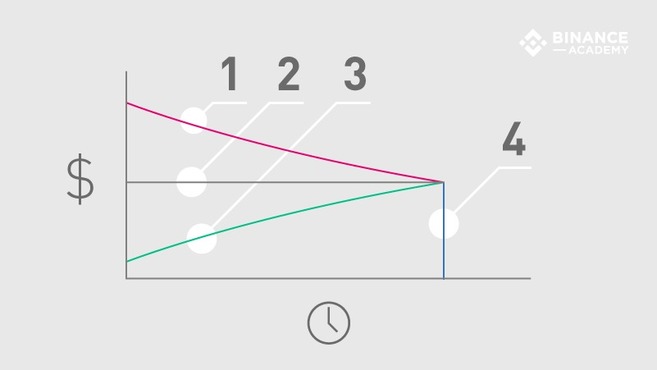
Contango (1): A market condition in which the price of a futures contract is higher than the expected futures spot price.
Expected Spot Price (2): The expected price of the asset at the time of settlement (expiration date). Please note that the expected spot price is not always constant and may change depending on market supply and demand.
Regular backwardation (3): A market condition in which the price of a futures contract is lower than the expected futures spot price.
Expiration Date (4): The last day of trading activity for a particular futures contract before settlement.
While contango market conditions tend to be more favorable to sellers (short positions) than to buyers (long positions), conventional backwardation markets, in contrast, are more favorable to buyers.
As the expiration date approaches, the price of the futures contract is expected to gradually move closer to the spot price until they eventually become equal. If the futures contract and the spot price do not match on the expiration date, traders profit from arbitrage.
Contango is the trading of futures contracts above the expected spot price of the underlying asset, usually for reasons of convenience. For example, a futures trader can pay more to deliver physical goods in the future, thereby saving themselves the additional costs of storing and insuring the cargo (gold is a popular example). Additionally, companies can use futures contracts to lock in future costs at a predictable cost when purchasing commodities for their production (for example, a bread manufacturer buying futures contracts for wheat).
Normal backwardation, in turn, occurs when futures contracts trade below the expected spot price. Speculators buy futures contracts with the goal of making a profit if prices rise. For example, a trader might buy a barrel of oil futures contract at $30 when the expected spot price for next year is $45.
Summary
Futures contracts are a standardized version of forward contracts and are one of the most popular instruments in the financial industry, with many uses. Despite their benefits, it is important to understand the mechanisms and markets of futures contracts before depositing any funds.
“Fixing” the future price of an asset is useful in certain circumstances, but is not always safe, especially when trading on margin. Therefore, risk management strategies are often used to reduce the risks associated with trading futures contracts. Some speculators also use technical analysis indicators along with fundamental analysis techniques to better understand price movements in the futures markets.