

The web has been evolving for over three decades, slowly taking us from the early days of Web1, with static text and images, to the rise of Web2, ushering in the internet we know today — an internet dominated by centralized platforms.
Right now, we are at the beginning of Web3, which envisions value and data moving seamlessly across decentralized platforms, with ownership and control also decentralized.
However, there are still some obstacles to overcome to realize the vision of this new network.
A brief history of the Internet
Despite its foundational nature, Web1 was an era defined by decentralized, open protocols.
The earliest platforms running on the Internet were powered by open source code, shared through forums, bulletin board systems, and mailing lists, much of which was non-proprietary and free.
Then, after the dot-com crash (circa 2000), a new type of online service emerged.
With the rise of faster internet speeds, streaming sites like YouTube and Netflix have started to gain more prominence.
At the same time, social media emerged, and soon the ability to connect experiences to media by sharing videos or live broadcasts became commonplace.
This era also saw the rise of mobile internet, which gave people greater access to these platforms thanks to their phones and tablets.
However, as these new platforms came from businesses and corporations, the open source code and platforms that once defined Web1 became proprietary, and no one could copy and modify these models without anticipating serious legal consequences.
Furthermore, the emergence of such platforms aggregates users into centralized hubs, ultimately controlled by large tech companies such as Facebook and Google.
Before long, collecting user data became standard practice — often hidden behind ostensibly “free” services.
Unfortunately, this is the foundation of Web2.
The Potential of Web3
Regardless of its trajectory so far, the internet continues to evolve, and blockchain-powered decentralized applications (dapps) promise to once again wrest control away from a handful of centralized gatekeepers.
The “Internet of Money” is emerging with the emergence of distributed data hosting and user-controlled platforms.
Decentralized Finance (DeFi) has provided millions of people around the world with the means to exchange assets, earn passive income, take out loans, and more, all without the involvement of intermediaries, which is turning the idea of cryptocurrency into a reality for the unbanked.
It’s not just about personal money management either, this new world opens up possibilities for things like SocialFi – a synthesis of social media and finance that aims to provide everything you’d expect.
Without blockchain, the option of sending money through social apps would be more cumbersome, less secure, and require an independent third party to instill trust rather than an automated and immutable payment layer.
However, with this layer in place, users can conduct trustless transactions — eliminating costly middlemen and providing more efficient payments.
There’s also the thriving world of GameFi, which ties into the vision of the upcoming Metaverse.
The in-game economy will be powered by cryptocurrency assets and non-fungible tokens (NFTs), following a “play and earn” model where gamers will be rewarded by earning real valuable assets that they own.
Furthermore, in addition to providing trustless transactions and decentralized central entities, decentralized technology also provides a completely new business model to replace the popular prototypes of the Internet.
This comes in the form of decentralized autonomous organizations (DAOs), which distribute control to a group of users, giving them a say in the direction of the platform and incentivizing usage through tangible ownership and governance rewards.
This means startups can now compete with incumbent services on a level playing field, expanding coverage through incentives to attract user bases and drive network effects.
The potential for this new internet to revolutionize the way users, developers, and brands interact is huge, but there is still a lot of work to be done.
Current platform shortcomings hold Web3 back
Despite the vast number of possible use cases, there are still some major issues that hinder this vision of Web3.
For one thing, many self-described decentralized applications are far from truly decentralized, and it is not uncommon for the front end of these services to run on cloud servers, meaning that access to them still relies on legacy infrastructure and the blockchain is only occasionally used to send or receive data.
Even blockchain networks themselves, which are designed to be decentralized, lose that distinction if most of them run on Amazon Web Services or similar centralized enterprise clouds.
This is increasingly the case, even in the case of Ethereum.
Single points of failure like this are exactly what blockchains are designed to deal with, so the current situation is neither ideal nor sustainable.
Another common problem hindering progress is that many Web3 services currently run on Ethereum, which is notoriously prone to high transaction fees, low throughput, and an inability to scale without external infrastructure.
These inherent obstacles from the touted Web 3 backbone will hinder its potential, and in order for the Metaverse to truly work for everyone, entry barriers such as these need to be resolved as soon as possible.
How we will get there
All things considered, it’s too early to say we’re already in Web3, but that doesn’t mean the foundations aren’t being laid.
For example, new platforms are emerging that want to break free from the constraints of Web2 standards entirely. This includes the Internet Computer, a blockchain that runs at web speeds, serves the web, and provides an infinitely scalable platform for smart contracts.
The Internet Computer has overcome issues of scaling, speed, and cost, laying the foundation for a DeFi experience that is neither slow nor expensive — allowing dapps to harness the full potential of decentralized architecture.
To realize the vision of Web3, every part of the online service, from the front end to the back end, needs to be hosted on-chain.
No legacy infrastructure is required, which means no gatekeepers and minimal downtime, resulting in a 100% authentic Web3 experience while delivering significantly better performance.
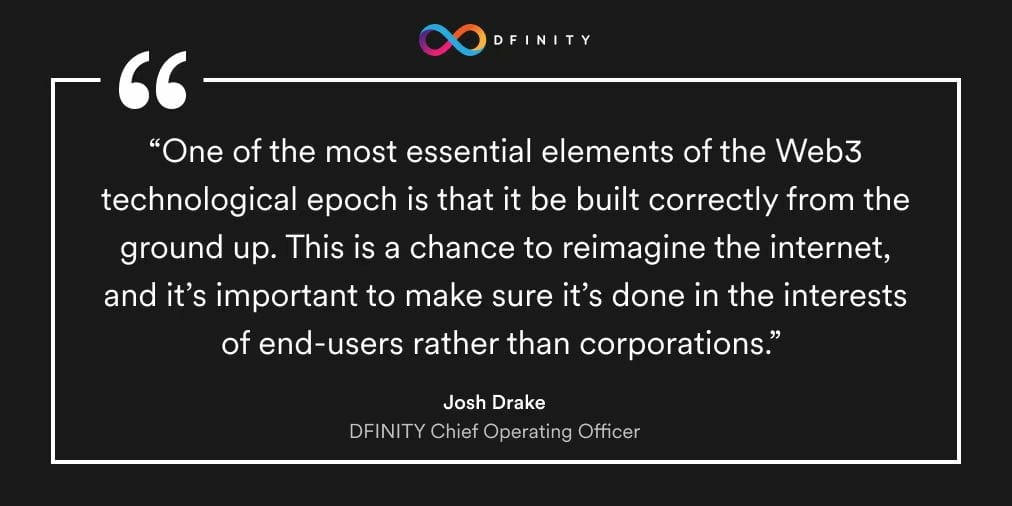
However, one of the most important elements of this new technology era is that it is built correctly from the ground up. It is an opportunity to reimagine the internet, and it is important to ensure that it is done for the benefit of the end user rather than corporations.
By Josh Drake (DFINITY COO)
Translation: Catherine
IC content you care about
Technology Progress | Project Information | Global Activities
 Collect and follow IC Binance Channel
Answer your questions at any time